Who Should I Contact for Elevator Emergency Phone Number?
After 15+ years in the elevator industry, I’ve responded to hundreds of emergency calls — from passenger entrapments to control system failures in the middle of rush hour. The single biggest mistake I see building owners make is not knowing who to call until the emergency is already in progress. This FAQ hub page covers everything you need to know about elevator emergency contacts, compliance requirements, and what to expect when something goes wrong.
Who is responsible for providing an elevator emergency phone number?
The building owner or property manager is legally responsible for ensuring a functioning emergency communication system is installed, maintained, and accessible in every elevator cab.
Under ASME A17.1/CSA B44 Safety Code for Elevators and Escalators, Section 2.27.1, every elevator must have a means of two-way communication between the elevator car and a location that is monitored 24 hours a day, 7 days a week. This is not optional — it is a hard code requirement. The phone line must connect to a live person or emergency dispatch center, not a voicemail box. If your elevator’s emergency phone rings to an unmonitored line, you are out of compliance and potentially liable.
In 2026, jurisdictions across Maryland, Virginia, DC, and Pennsylvania have intensified enforcement of this requirement following a national uptick in entrapment complaints logged with state elevator inspection bureaus.
What number should passengers call if they are trapped in an elevator?
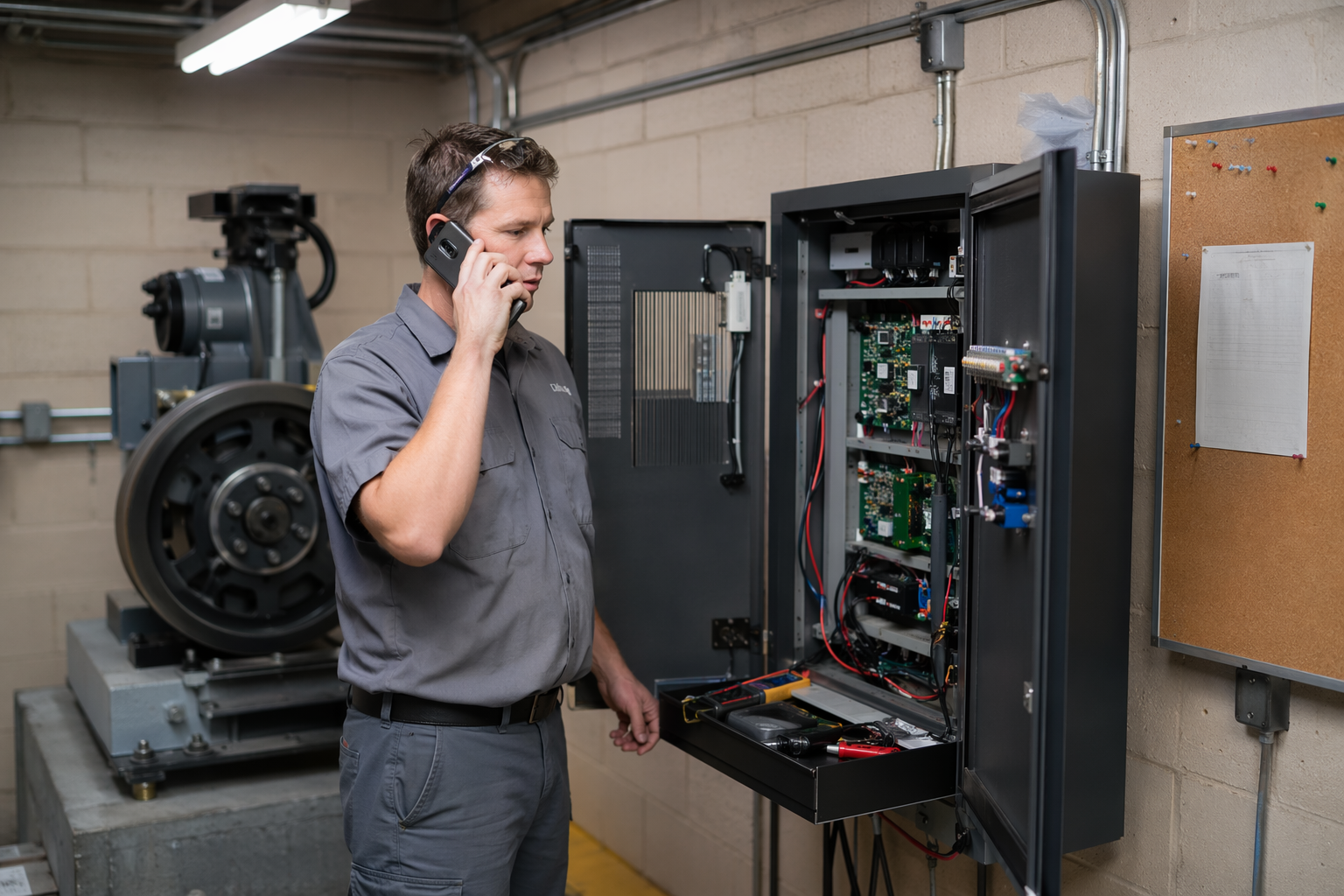
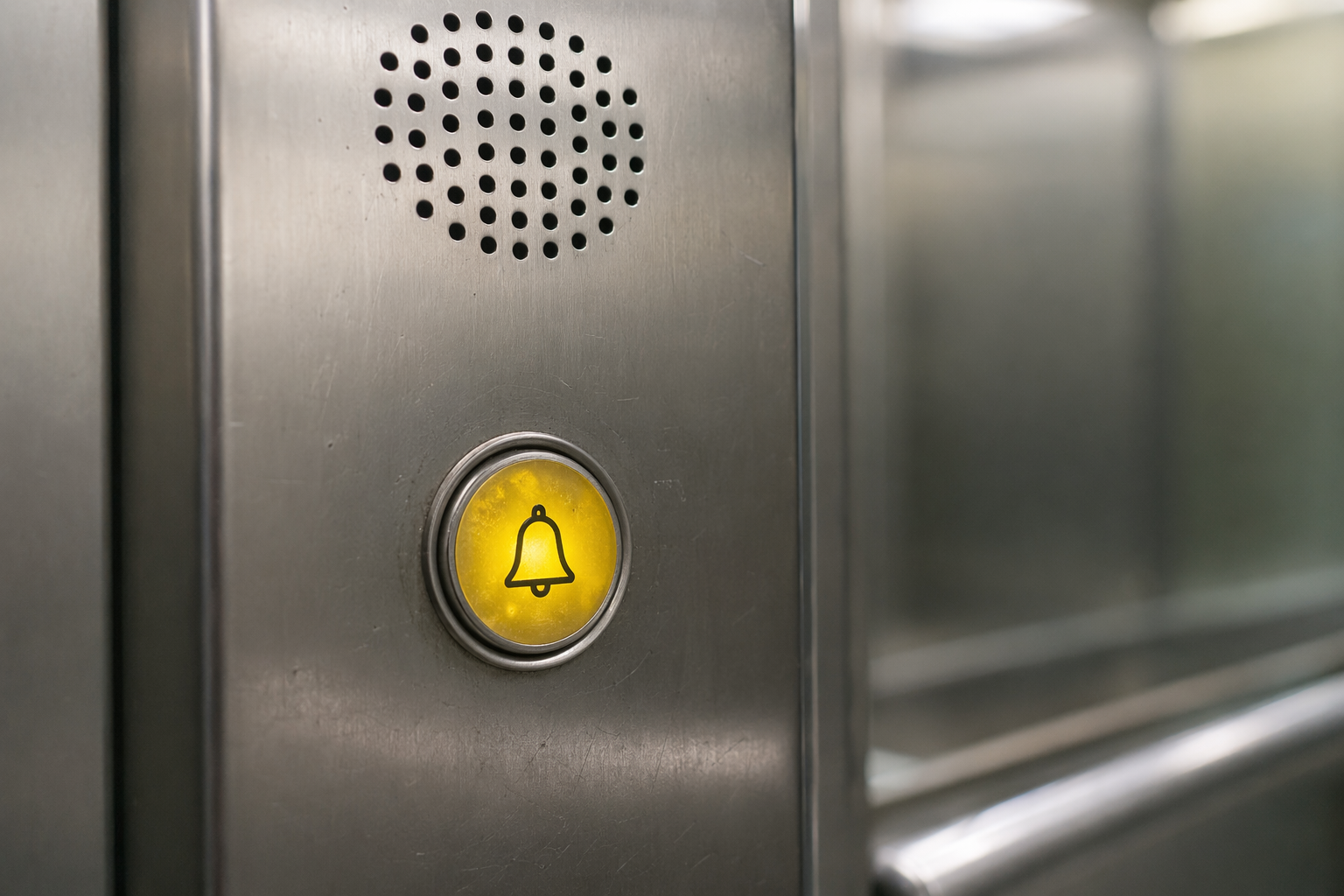
Passengers trapped in an elevator should press the elevator’s built-in emergency call button first, and if that fails, dial 911 immediately from a personal cell phone.
The emergency call button inside the elevator cab is your first line of contact — it should connect directly to a live monitoring center linked to your elevator service contractor. If the button is non-functional or the line goes unanswered, calling 911 dispatches fire and rescue personnel trained in elevator entrapment procedures. Never advise passengers to try to force the doors open or attempt self-rescue — this causes the majority of elevator-related injuries in entrapment scenarios.
Building staff should also have the elevator contractor’s direct 24/7 emergency dispatch number stored in their phones and posted in the main office, lobby, and machine room. At Quality Elevator Company, our emergency dispatch line is answered by a live technician — never an automated system — every hour of every day across Baltimore, Washington DC, Philadelphia, and Richmond.
What is the ASME A17.1 code requirement for elevator emergency phones?
ASME A17.1/CSA B44, Section 2.27.1.1 requires a two-way voice communication system in every elevator cab that connects to a staffed location capable of initiating rescue procedures without delay.
Key code specifications include:
- The communication system must be operable without a telephone handset (hands-free operation required for ADA compliance).
- The system must function on a dedicated or supervised circuit — not a standard analog phone line that can drop during a power failure without battery backup.
- The monitoring location must be staffed 24/7, including holidays.
- The elevator cab must display the telephone number of the monitoring service in a visible location.
- Under the 2010 ADA Standards for Accessible Design, Section 407.4.9, the two-way communication system must also provide both audible and visible signals to serve passengers with hearing impairments.
Failure to maintain a compliant emergency phone system can result in elevator shutdown orders, fines, and civil liability in all four states where Quality Elevator Company operates. In Maryland alone, the Department of Labor’s Elevator Safety Unit can issue stop-operation orders within 24 hours of a verified violation.
Does the ADA require elevators to have emergency phones?
Yes — the ADA mandates that elevator emergency communication systems be accessible to individuals with disabilities, requiring hands-free operation and visible signal confirmation that the call has been received.
Under ADA Standards Section 407.4.9, when the call is answered, the answering party must be able to identify the elevator’s location (typically floor and building), and the system must provide visual notification inside the cab that the call has been connected and received. This protects deaf and hard-of-hearing passengers who cannot rely solely on voice confirmation. Non-compliant systems expose building owners to ADA complaints and DOJ enforcement actions.
What are the state-specific elevator emergency contact requirements in Maryland, DC, Virginia, and Pennsylvania?
Each state and jurisdiction has its own enforcement body and specific overlay requirements on top of ASME A17.1 that govern emergency communication standards for elevators.
| Jurisdiction | Governing Body | Emergency Phone Requirement | Inspection Frequency | Non-Compliance Penalty (2026) |
|---|---|---|---|---|
| Maryland | MD Dept. of Labor, Elevator Safety Unit | 24/7 live monitored two-way system per ASME A17.1 | Annual | Up to $10,000/day; stop-operation order |
| Washington DC | DC Dept. of Buildings (DOB), Elevator Inspection Division | 24/7 monitored; visual signal required per ADA | Annual + periodic category tests | Up to $2,000/violation; permit revocation |
| Pennsylvania | PA Dept. of Labor & Industry, Bureau of Occupational & Industrial Safety | ASME A17.1 compliant; licensed third-party monitoring accepted | Annual | Up to $1,000/day; mandatory shutdown |
| Virginia | VA Dept. of Labor & Industry (DOLI), Elevator Unit | 24/7 monitored; battery backup required | Annual | Up to $1,000/violation; civil liability |
Regulations are updated periodically — the Virginia DOLI adopted 2019 ASME A17.1 standards in 2023, and Maryland is currently in the review process for adopting the 2022 edition as of 2026. Your elevator contractor should track these changes on your behalf. This is part of our standard compliance monitoring service at Quality Elevator Company.
How do I find the emergency phone number for my specific elevator?
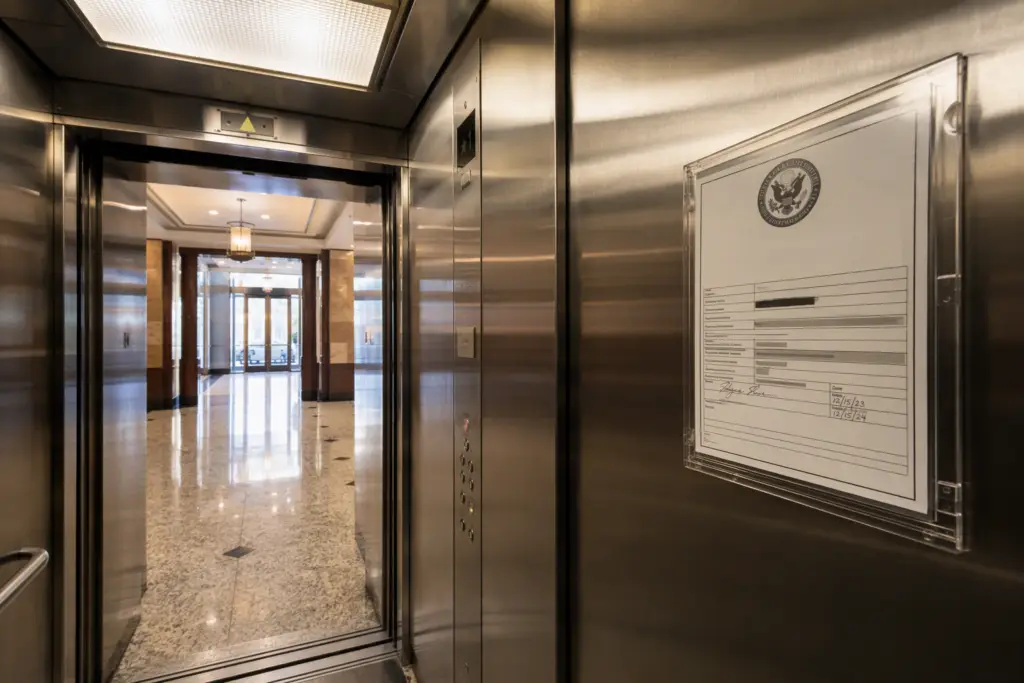
The elevator’s emergency phone number should be posted on a label inside the elevator cab, in the machine room, and in the building’s elevator maintenance log — all required locations under ASME A17.1.
If you cannot locate the number, check the following sources:
- Inside the elevator cab near the control panel — a sticker or placard with the monitoring service’s number is code-required.
- The elevator machine room door or interior — contact information for the contracted elevator company must be posted here.
- Your building’s elevator maintenance agreement or service contract.
- The elevator’s most recent inspection certificate, which is also required to be posted inside the cab — it will list the inspection agency and can lead you to the service provider.
- Contact your state elevator inspection bureau directly if all else fails — they maintain records of licensed contractors assigned to registered elevators by registration number.
What should a building manager do immediately when an elevator emergency occurs?
A building manager should immediately call the elevator contractor’s 24/7 emergency line, simultaneously ensure 911 is called if anyone is trapped, and then secure the elevator from further use until a technician clears it.
Here is the precise sequence I recommend from my experience in the field:
- Confirm the nature of the emergency — Is someone trapped? Is there a mechanical failure, flooding, fire, or power loss?
- Call 911 first if anyone is trapped or in danger. Do not wait for the elevator technician to arrive to manage an active entrapment.
- Call your elevator contractor’s 24/7 emergency dispatch. Provide the building address, elevator ID/cab number, floor location of the stuck elevator, and number of passengers.
- Post a staff member at the elevator to communicate with trapped passengers and keep bystanders away from the doors.
- Do not attempt to reset, bypass, or manually operate the elevator — this can cause additional mechanical damage or injure trapped passengers.
- Document the incident with timestamps — this is critical for insurance, liability, and state inspection reporting requirements.
How quickly should an elevator emergency technician respond to a call?
Industry best practice and most commercial service contracts specify a response time of 2 hours or less for an elevator entrapment emergency, with many premium contracts guaranteeing 60–90 minutes or faster.
Response times vary by contractor, time of day, and market density. In dense urban markets like Baltimore, Washington DC, and Philadelphia, well-staffed contractors with local technicians on-call can achieve 30–60 minute response times. In suburban and semi-rural corridors, 90–120 minutes is more realistic. When reviewing your elevator service contract, look specifically for written emergency response time guarantees — not just “best effort” language. A contract without a defined SLA for emergency response is a red flag.
What is the cost of setting up an elevator emergency phone monitoring service?
Elevator emergency phone monitoring services typically cost between $25 and $75 per month per elevator, depending on the monitoring provider, technology platform (analog vs. cellular vs. IP), and contract length.
| Monitoring Type | Monthly Cost (Per Elevator) | Reliability | ADA Compliant | Battery Backup Required |
|---|---|---|---|---|
| Traditional Analog (POTS Line) | $25–$40 | Moderate — line subject to outages | With upgrades | Recommended |
| Cellular (4G/LTE) | $40–$60 | High — independent of building phone | Yes | Built-in |
| VoIP/IP-Based | $30–$55 | High — requires internet uptime | Yes | Depends on router UPS |
| Integrated Smart Monitoring (IoT) | $55–$75 | Very High — real-time diagnostics included | Yes | Yes |
Note: Traditional POTS (Plain Old Telephone Service) landlines are being phased out nationally. Many telecom carriers have discontinued POTS service in parts of Maryland, Virginia, and Pennsylvania as of 2026. If your elevator still uses an analog phone line, upgrading to cellular or IP-based monitoring is not just advisable — it may soon be your only compliant option. Ask your elevator contractor to assess your current system.
Can a cell phone inside the elevator replace the required emergency phone?
No — a personal cell phone cannot legally replace the code-required two-way emergency communication system installed in the elevator cab under ASME A17.1.
Cell coverage inside elevator shafts is notoriously unreliable. Steel construction, basement-level machine rooms, and shaft geometry all create signal dead zones. ASME A17.1 requires a dedicated, supervised communication system precisely because it cannot depend on a passenger having a working cell phone with signal. Beyond code compliance, consider this: in a power failure or mechanical emergency, a passenger who is elderly, a minor, or has a disability may not have a phone at all. The installed emergency system is the baseline safety net that must exist regardless of what passengers carry.
What happens if an elevator’s emergency phone is out of service?
An elevator with a non-functional emergency phone is out of compliance with ASME A17.1 and must be taken out of service immediately until the system is repaired and tested.
State inspection authorities in Maryland, DC, Virginia, and Pennsylvania all treat a failed emergency communication system as a serious violation that can trigger immediate shutdown orders. Beyond regulatory consequences, operating an elevator with a dead emergency phone exposes the building owner to significant tort liability — particularly if a passenger is injured during an entrapment where no communication was possible. Emergency phone systems should be tested monthly as part of your routine maintenance program. Your elevator service contractor should document every test in the maintenance log. If you are unsure whether your system is being tested, contact Quality Elevator Company for a compliance audit.
How often should elevator emergency phones be tested?
Elevator emergency phones should be tested at minimum monthly, with results logged in the elevator maintenance record — annual testing during the state inspection is not sufficient on its own.
Monthly testing should confirm:
- The call connects to a live, staffed monitoring center within the required pickup time (typically 30 seconds or less).
- Two-way audio is clear in both directions.
- The visual signal (LED indicator or display) activates upon call connection — required for ADA compliance.
- The battery backup activates correctly when primary power is disconnected (test quarterly for battery-backed systems).
- The phone number displayed on the cab placard matches the active monitoring line.
All test results should be signed and dated in the log by the technician performing the test. During state inspections in Maryland, DC, Virginia, and Pennsylvania, inspectors routinely test the emergency phone live — an unanswered call or failed connection during inspection is a Category 1 deficiency.
What is the difference between an elevator emergency phone and an elevator monitoring system?
An emergency phone provides two-way voice communication for passenger use during an emergency, while an elevator monitoring system continuously tracks the elevator’s mechanical performance, fault codes, and operational data — the two serve different but complementary purposes.
Think of the emergency phone as the passenger’s lifeline and the monitoring system as the building manager’s intelligence platform. Modern IoT-based elevator monitoring systems, like those integrated into newer elevator controllers, can detect a developing mechanical issue before it causes an entrapment, alert the contractor proactively, and even dispatch a technician before any emergency call is made by a passenger. When paired with a properly functioning emergency phone, this creates a layered safety net. If your building’s elevators are 10 or more years old, they almost certainly lack remote monitoring capability — an upgrade worth discussing with your service contractor.
Who is liable if a passenger is injured in an elevator with a non-functioning emergency phone?
Liability typically falls on the building owner or property manager as the legally responsible party for elevator code compliance, though the elevator service contractor may share liability if negligent maintenance is proven.
Courts in Maryland, DC, Virginia, and Pennsylvania have consistently held that building owners have a duty of care to maintain elevators in a safe and code-compliant condition. A non-functional emergency phone is direct evidence of code non-compliance and significantly undermines any defense against a negligence claim. Your elevator service contractor shares potential liability if they failed to identify or report the deficiency during scheduled maintenance visits. This is why the documentation of every inspection and test is not just administrative — it is your legal protection. Ensure your service agreement specifies that all maintenance records are provided to you in writing.
What should I ask an elevator service company before signing a contract?
Before signing any elevator service contract, ask specifically about 24/7 emergency response guarantees, emergency phone monitoring inclusion, written response time SLAs, and technician certification credentials.
Here are the 10 questions I recommend building owners and managers ask every prospective elevator contractor:
- Is your emergency dispatch line answered by a live technician 24/7, including holidays?
- What is your guaranteed response time for an entrapment emergency — in writing?
- Do you handle emergency phone monitoring in-house or subcontract it?
- Are your technicians IUEC (International Union of Elevator Constructors) certified?
- What is your process for notifying me of code changes that affect my elevator?
- Does your contract include a monthly emergency phone test with documented results?
- How do you handle POTS-to-cellular migration for emergency phones in my market?
- What is the penalty or SLA credit if you miss an emergency response time commitment?
- Do you carry general liability and workers’ compensation insurance in my state?
- Can you provide references from building owners in Baltimore, DC, Philadelphia, or Richmond?
How do I update the emergency phone number displayed in my elevator cab?
To update the emergency phone number displayed in your elevator cab, contact your licensed elevator service contractor — do not attempt to modify the cab placard or reprogram the phone system without a certified technician.
Changing the monitored phone number requires reprogramming the communication unit inside the elevator cab, updating the monitoring center’s database to recognize calls from your elevator’s system ID, and replacing or updating the posted placard in the cab with the new number. All of these steps should be performed by your licensed contractor and documented in the maintenance log. In Maryland and Virginia, any modification to elevator safety systems — including the emergency communication system — must be performed by a licensed elevator mechanic under permit in certain jurisdictions. Do not use a general electrician or building maintenance staff for this work.
What is the elevator emergency phone requirement for residential buildings versus commercial buildings?
ASME A17.1 applies to both residential and commercial elevators, but residential buildings — particularly single-family and low-density multifamily — may have different state-level enforcement pathways and inspection schedules than commercial properties.
In Maryland, elevators in residential buildings with four or fewer units are often exempt from state jurisdiction and instead fall under local building department authority. However, any residential elevator accessible to the public — in a condominium common area, for example — is subject to full ASME A17.1 compliance including the emergency phone requirement. In Washington DC, all elevators in buildings with three or more stories require compliant emergency communication systems regardless of occupancy type. Virginia and Pennsylvania follow similar commercial-first enforcement frameworks, but property managers of mixed-use or multifamily buildings should verify their specific classification with the state elevator inspection unit or a qualified contractor.
What is a Category 1 and Category 5 elevator test, and how do they relate to emergency phones?
Category 1 and Category 5 tests are periodic safety tests required under ASME A17.1 that include inspection and functional testing of the elevator’s emergency communication system as a mandatory component.
Under ASME A17.1 Rule 8.6:
- Category 1 (Annual): Includes a visual inspection and functional test of all safety devices, including the emergency phone. The phone must connect to a live monitored location during the test or the elevator fails.
- Category 5 (Every 5 Years): A comprehensive full-load test and inspection that also includes emergency system verification. Failure of the emergency phone during a Cat 5 test results in a mandatory shutdown until repaired and re-tested.
Both tests must be conducted by or in the presence of a licensed elevator inspector in most jurisdictions. The contractor performing the test must submit signed test results to the state inspection authority. Keep copies of all Category 1 and Category 5 test results — building owners in Maryland, DC, Virginia, and Pennsylvania have been audited for missing historical test documentation during permit renewals.
How do I know if my elevator monitoring company is legitimate and code-compliant?
A legitimate, code-compliant elevator monitoring company will be staffed 24/7 with live operators, carry documentation of their monitoring center’s certifications, and be able to provide real-time confirmation of your elevator’s connection status on demand.
Red flags to watch for include:
- Calls routing to voicemail during off-hours.
- No written SLA or response time documentation.
- Inability to identify your elevator’s location when the call connects (a code requirement).
- No visual signal confirmation capability for ADA compliance.
- Monitoring center located out-of-country with no domestic backup.
When in doubt, test your system yourself: press the emergency button during business hours and after hours. Time how long it takes to reach a live person. Ask that person to confirm your building name, address, and elevator number — they should have this information immediately. If they cannot, your monitoring service is not code-compliant.
How can Quality Elevator Company help with elevator emergency phone compliance?
Quality Elevator Company provides complete elevator emergency phone assessment, installation, upgrade, and 24/7 monitored dispatch services for commercial and residential buildings throughout Baltimore, Washington DC, Philadelphia, and Richmond.
Our IUEC-certified technicians handle:
- Full emergency communication system audits against current ASME A17.1 and ADA standards.
- Replacement of non-compliant analog (POTS) systems with cellular or IP-based solutions.
- 24/7 live-answer emergency dispatch — our technicians answer the line, not a call center overseas.
- Monthly documented phone testing included in all full-service maintenance contracts.
- Coordination with state inspection authorities in Maryland, DC, Virginia, and Pennsylvania for permit compliance.
- Emergency response to entrapments and mechanical failures with guaranteed SLA response times.
With over 15 years of elevator safety experience and a team of certified technicians positioned across our four-market service area, Quality Elevator Company is the partner building owners trust when the stakes are highest — not just during routine maintenance, but at 2 AM on a holiday weekend when a passenger is stuck between floors.
Get Your Elevator Emergency Systems Assessed Today
Don’t wait for an emergency to find out your elevator’s phone system is non-compliant. Whether you manage a commercial office tower in downtown Baltimore, a condominium in Washington DC, a mixed-use property in Philadelphia, or a residential building in Richmond — your tenants, residents, and visitors depend on a functioning emergency communication system every time they step into your elevator.
Contact Quality Elevator Company for a free elevator assessment. Our certified technicians will evaluate your emergency communication system, identify any compliance gaps against ASME A17.1, ADA, and your state’s elevator safety code, and provide a clear action plan with no obligation.
Call us now: 301-779-9116 — answered live, 24 hours a day, 7 days a week.
Serving Baltimore MD | Washington DC | Philadelphia PA | Richmond VA
Need elevator service you can rely on? Quality Elevator Company is ready to help.