Elevator Inspection: Complete Comparison and Decision Guide for DC, Maryland, Pennsylvania, and Virginia

Choosing the right elevator inspection path requires understanding which authority governs your building, which code edition applies, what inspection categories and intervals are mandatory, and what happens when a certificate lapses. This guide compares regulatory requirements across the District of Columbia, Maryland, Pennsylvania, and Virginia so that owners, property managers, and facility directors can make informed decisions—and know when to call an experienced independent service provider like Quality Elevator Company.
What Is Elevator Inspection and Why Does It Matter?
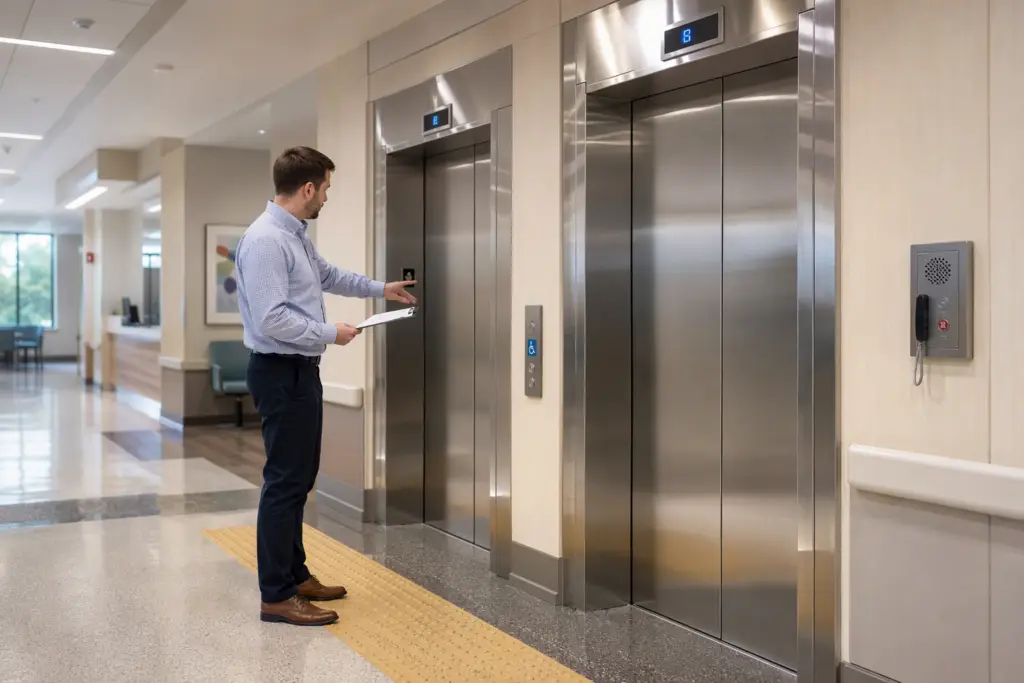
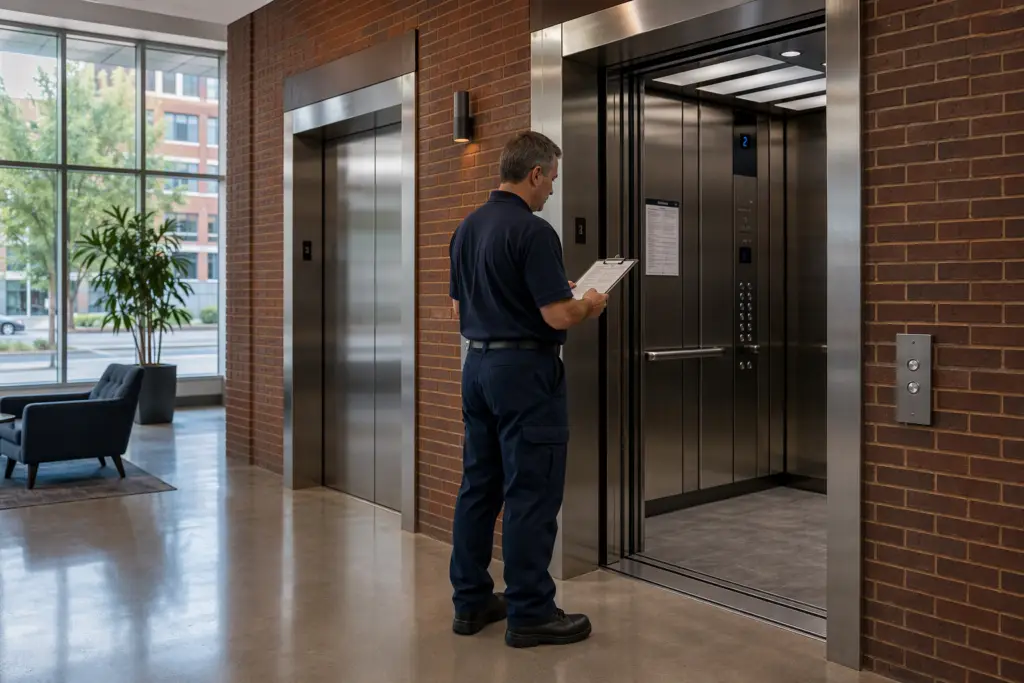
Elevator inspection is a formal, code-governed examination of an elevator or escalator’s mechanical, electrical, and structural systems by a qualified inspector to verify that the equipment is safe to operate and complies with the adopted safety code. Inspection is not the same as maintenance: maintenance keeps equipment running day to day, while inspection produces a legal finding that allows a jurisdiction to issue—or deny—a certificate of operation. Without a valid certificate, an elevator may not legally operate, and an uncertified elevator exposes building owners to liability, enforcement action, and potential shutdown.
Across the four jurisdictions where Quality Elevator Company operates, inspection requirements differ in the code edition adopted, the agency that issues certificates, the frequency of required inspections and tests, and whether the state sends its own inspectors or requires owners to hire approved third parties. Understanding those differences is the starting point for any compliance strategy.
How Do Elevator Inspection Requirements Differ by Jurisdiction?
| Jurisdiction | Governing Authority | Adopted ASME Edition (2026) | Periodic Inspection Frequency | 5-Year / Comprehensive Test | Certificate Validity | Inspector Credential Required |
|---|---|---|---|---|---|---|
| District of Columbia | DC Department of Buildings (DOB) | ASME A17.1-2013/CSA B44-13 (2017 DC Building Code, effective May 29, 2020) | Category 1 every 12 months; periodic inspection every 12 months | Category 5 every 60 months | Certificate of inspection valid 2 years; inspections and tests continue during that period | ASME QEI-certified inspector; DOB-approved third-party agency required |
| Maryland | Maryland Department of Labor, Division of Labor and Industry, Elevator and Escalator Safety | ASME A17.1-2022/CSA B44:22 with Maryland changes (effective June 17, 2026) | Annual periodic inspection | Comprehensive 5-year inspection required for wire-rope, belt, chain, rack-and-pinion elevators | Certificate required to operate; annual re-registration at time of periodic inspection | State inspector or third-party qualified elevator inspector; tests performed by licensed elevator mechanic |
| Pennsylvania | Pennsylvania Department of Labor and Industry, Bureau of Occupational and Industrial Safety, Elevator Section | ASME A17.1-2000 with A17.1a-2002 addenda (current); ASME A17.1-2016 with PA modifications for permit applications on or after December 20, 2026 | No more than every 6 months for electric elevators, hydraulic elevators, and escalators | Category tests per ASME A17.1 Appendix N intervals; starting December 20, 2026, Category 1 tests must be performed annually as a stand-alone requirement | 24 months (6-month inspection cycle); 48 months (12-month inspection cycle) | UCC-certified elevator inspector; third-party agencies must be certified by the Department |
| Virginia | Local building department; 13VAC5-63, Virginia Uniform Statewide Building Code | ASME A17.1/CSA B44-2019 (2021 USBC, effective January 18, 2024) | Annual periodic inspection; locality may require 6-month inspection | Periodic tests at intervals per ASME A17.1 Appendix N, witnessed by the code official | Current certificate must be displayed in the elevator or in an approved location | Certified elevator inspector approved by local code official; Virginia elevator mechanic certification required for mechanics performing witnessed tests |
What Are the Types of Elevator Inspections and Tests?
The ASME A17.1 Safety Code for Elevators and Escalators defines several categories of inspection and testing that jurisdictions adopt and schedule at defined intervals. Understanding each type helps owners plan maintenance and budget for compliance.
| Inspection / Test Type | What It Covers | Typical Interval | Who Witnesses |
|---|---|---|---|
| Periodic Inspection | Visual examination of all accessible safety-critical components: doors, safeties, buffers, guides, controls, and machine room equipment | Annual (or 6-month in PA and some VA localities) | Qualified / QEI-certified inspector or local code official |
| Category 1 Test | Full-load, rated-speed functional test of safety devices without displacing the car from the guide rails | Annual (DC, PA after Dec 20 2026); aligned with periodic inspection in other jurisdictions | Inspector and licensed mechanic |
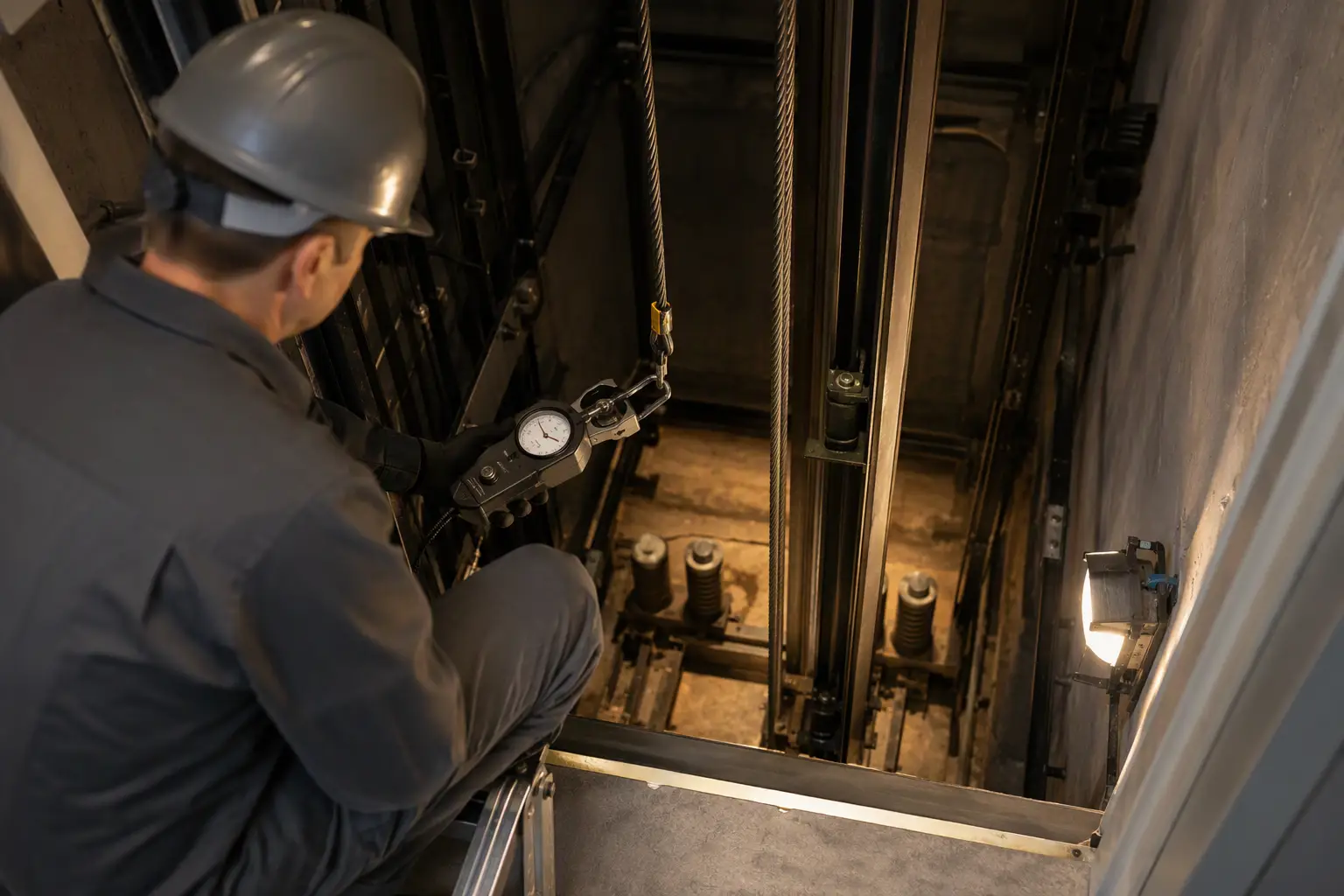
| Category 5 Test (DC) / Comprehensive 5-Year Test | Full-load, rated-speed test with safety device displacement; verifies governor, safeties, and buffers under operating conditions | Every 60 months | QEI-certified inspector (DC); qualified inspector (MD, PA, VA per local AHJ) |
| Acceptance Inspection | Pre-service inspection of newly installed, significantly altered, or repaired equipment before it is placed in service | After installation / major alteration | State agency or local code official |
| Maintenance Inspection | Ongoing contractor checks per the maintenance control program; not a code-required inspection but feeds into compliance records | Per maintenance contract schedule | Licensed / certified elevator mechanic |
What Is the Difference Between a State Inspector and a Third-Party Inspector?
Some jurisdictions employ state or local inspectors who conduct required periodic inspections on behalf of the authority. Others require or permit building owners to hire approved third-party inspection agencies. The table below compares the two approaches for owners navigating the DC, Maryland, Pennsylvania, and Virginia region.
| Factor | State / Local Government Inspector | Approved Third-Party Inspector |
|---|---|---|
| Who hires them | The jurisdiction; owner does not select the inspector | The building owner contracts directly |
| Scheduling control | Owner requests; timing depends on agency workload | Owner schedules; generally more flexible |
| Report routing | Agency issues certificate directly | Owner submits third-party report to the authority, which then issues the certificate (e.g., DC DOB Citizen Access Portal) |
| Credential requirement | State-employed inspector meets jurisdiction standards | Must hold ASME QEI certification or meet jurisdiction-specific qualification; agency must be approved / certified by the state |
| Availability in this region | Maryland: state inspectors available but owners may also hire third-party; Pennsylvania: state L&I inspectors plus certified third parties; Virginia: local code official; DC: owner must use DOB-approved third-party agency | All four jurisdictions accept or require approved third-party agencies |
| Coordination with maintenance provider | Limited; owner must coordinate separately | Can be coordinated with maintenance schedule; service provider like Quality Elevator Company can help ensure the elevator is test-ready before the inspection visit |
Key takeaway: In DC, the owner has no choice—a DOB-approved third-party agency must conduct inspections. In Maryland, Pennsylvania, and Virginia, both paths exist, but third-party inspections offer owners more scheduling flexibility and the ability to work closely with their elevator service provider to resolve deficiencies before the inspection date.
What Happens If an Elevator Fails Inspection?
A failed inspection means the inspector has identified one or more conditions that do not comply with the adopted safety code. The consequences and remediation process follow a predictable sequence in all four jurisdictions.
- Receive the deficiency notice. The inspector issues a written report listing each non-compliant condition and the applicable code section.
- Assess the severity. Immediately dangerous conditions—such as failed safety devices or broken guide rails—require the elevator to be taken out of service at once. Less critical deficiencies may allow continued operation under a correction order with a defined deadline.
- Notify occupants and management. If the elevator must be shut down, coordinate with building management immediately; in DC, at least one elevator must remain in service whenever a building with passenger elevators is occupied, except where only one elevator exists.
- Obtain required permits before repair. In DC, a DOB permit is required to take an elevator out of service under the applicable code provision. In Pennsylvania, construction, alteration, or repair requires a permit application to the Department of Labor and Industry.
- Complete repairs using licensed personnel. In Maryland, all test-related work must be performed by a licensed elevator mechanic. In Virginia, only state-certified elevator mechanics—or those under direct supervision of a certified mechanic—may perform the work.
- Schedule a re-inspection. Once repairs are complete, contact the inspection agency or authority to schedule a follow-up inspection to verify the deficiency has been corrected.
- Return to service only after passing. In Pennsylvania, an elevator may not return to service after a major repair or alteration until the Department inspects and passes it. Similar acceptance-before-service requirements apply in DC, Maryland, and Virginia after significant work.
- Update maintenance records. In Maryland, all maintenance, repair, test, and inspection records must be kept at a readily accessible central location in the building. Best practice across all four jurisdictions is to maintain a complete file that supports the next inspection cycle.
Quality Elevator Company assists building owners throughout this process—from evaluating deficiency notices to coordinating repairs and ensuring the equipment is ready for re-inspection.
How Do I Prepare for an Elevator Inspection?
- Confirm the applicable code edition and inspection type. Know whether your equipment is subject to a periodic inspection, a Category 1 test, a Category 5 / comprehensive 5-year test, or an acceptance inspection, and which edition of the ASME A17.1 Safety Code for Elevators and Escalators governs your jurisdiction.
- Review the maintenance log. Ensure the maintenance control program records are current and available. Maryland requires records at a readily accessible central location; Virginia requires the inspection report to include the mechanic’s certification number.
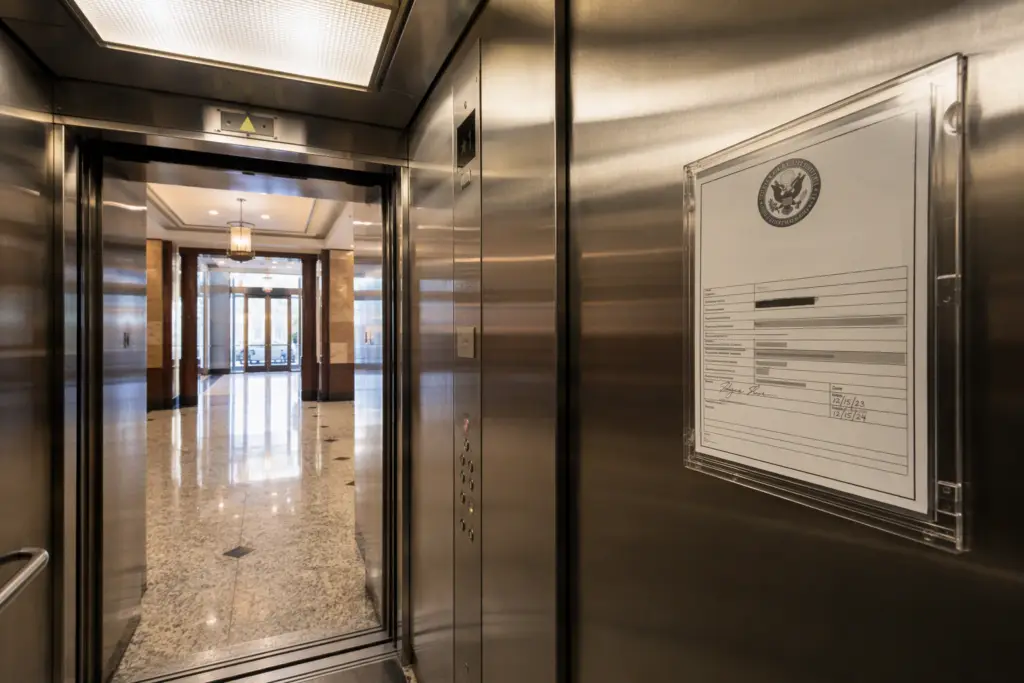
- Verify the certificate is current and posted. Check that the existing certificate of inspection or operation is conspicuously displayed in the elevator car (or in the approved alternative location) and has not expired.
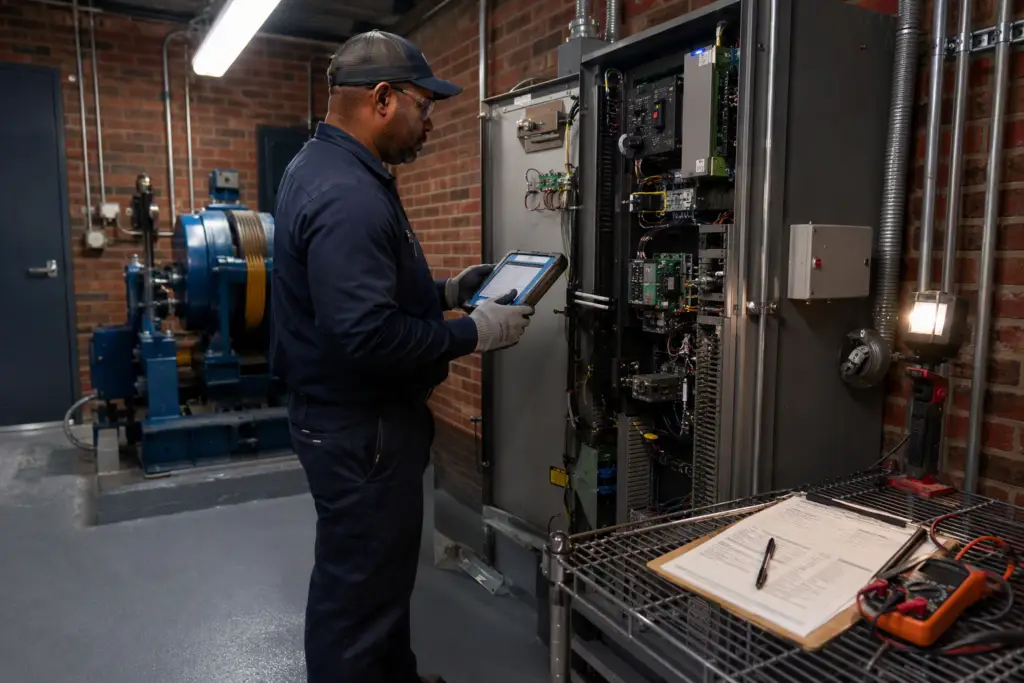
- Schedule a pre-inspection walkthrough with your service provider. A qualified elevator maintenance company can identify deficiencies before the official inspector arrives, giving the owner time to address issues without a failed inspection on record.
- Confirm that a licensed mechanic will be present. In Maryland, a licensed elevator mechanic must perform and be physically present for the entire test. In Virginia, witnessed tests require a certified mechanic. Confirm availability before the inspection date.
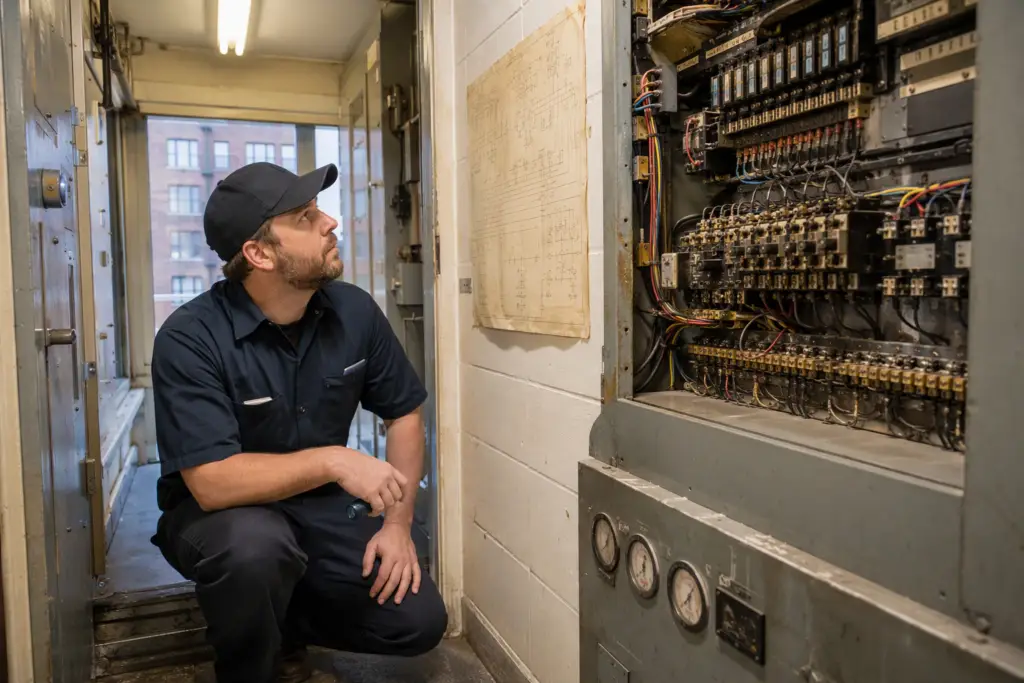
- Prepare the machine room and pit. Inspectors check machine rooms for proper lighting, clearances, and housekeeping. The pit must be accessible, dry, and free of stored materials.
- Verify permits are in place for any recent work. Any alteration or repair completed since the last inspection may require a permit. Unpermitted work can result in a failed inspection or enforcement action.
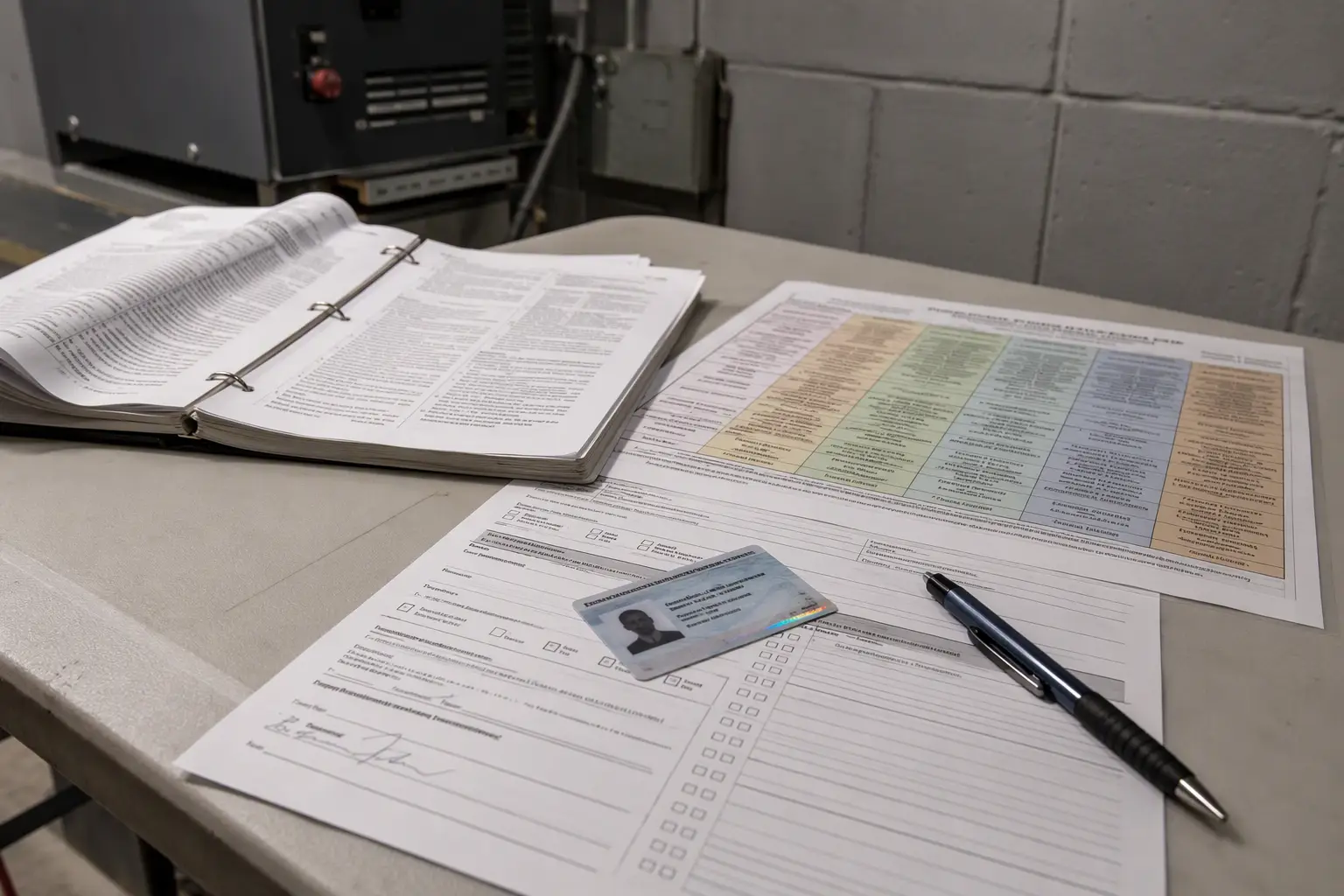
- Assemble documentation. Gather previous inspection reports, test logs, permit records, and maintenance records. In DC, owners submit third-party inspection reports for the past two years through the DOB Citizen Access Portal to obtain a certificate.
What Is the Difference Between Elevator Inspection and Elevator Maintenance?
Inspection and maintenance serve complementary but legally distinct purposes. Inspection is a code-required, third-party or governmental examination that produces an official record and supports certificate issuance. Maintenance is the ongoing, contractual service performed by the building owner’s elevator service provider to keep equipment operating safely between inspections.
| Dimension | Inspection | Maintenance |
|---|---|---|
| Legal requirement | Mandated by state statute and adopted safety code; no certificate without it | Required by the ASME A17.1 Safety Code for Elevators and Escalators (maintenance control program); enforced through inspection record review |
| Performed by | Approved, certified, or QEI-certified inspector independent of the maintenance contractor | Licensed or certified elevator mechanic employed by the service contractor |
| Output | Official inspection report; certificate of inspection or operation | Maintenance log; work order records; deficiency correction records |
| Frequency | Annually or semi-annually per jurisdiction; Category 5 every five years | Ongoing; frequency determined by maintenance contract and manufacturer recommendations |
| Consequence of failure | Elevator out of service; enforcement action; certificate suspended | Accelerated wear; increased failure risk; deficiencies cited at next inspection |
Owners who rely on Quality Elevator Company for maintenance benefit from a provider that understands inspection requirements across all four jurisdictions and can prepare equipment for each scheduled inspection cycle.
What ADA and OSHA Requirements Apply to Elevators in This Region?
Beyond state safety codes, building owners must consider federal requirements from the Americans with Disabilities Act (ADA) and the Occupational Safety and Health Administration (OSHA).
The ADA requires that elevators in buildings covered by the Act be accessible to people with disabilities. ADA accessibility standards address door widths, control panel heights, audible and visual signals, and floor designations in Braille. ADA compliance is evaluated separately from the ASME A17.1 safety inspection but can be reviewed during a comprehensive elevator assessment. Failure to maintain ADA accessibility exposes owners to civil rights complaints and enforcement actions.
OSHA standards address elevator safety in the context of construction and general industry workplaces. Employers must ensure that elevators used by employees meet applicable safety requirements, and OSHA regulations govern the safety of elevator mechanics performing maintenance and repair work, including lockout/tagout procedures and fall protection. These federal requirements apply in all four jurisdictions alongside state-level inspection rules.
What Should I Look for When Selecting an Elevator Inspection or Service Provider?
| Selection Factor | Why It Matters | What to Ask |
|---|---|---|
| Jurisdictional approval | Inspection reports from non-approved agencies are not accepted by the authority; the certificate will not be issued | Is the agency DOB-approved (DC), qualified under COMAR (MD), certified by PA L&I (PA), or approved by the local code official (VA)? |
| Inspector credentials | DC requires ASME QEI-certified inspectors; Maryland requires third-party qualified elevator inspectors; Pennsylvania requires UCC-certified inspectors | What certifications do the inspectors hold? |
| Mechanic licensing | Tests in Maryland must be performed by a licensed elevator mechanic; Virginia requires state-certified mechanics for witnessed tests | Are your mechanics licensed under the Maryland Elevator Safety Review Board or certified by Virginia DPOR? |
| Insurance coverage | Maryland requires elevator contractors to carry at least $1,000,000 in general liability and at least $500,000 in property damage coverage | Can you provide a certificate of insurance meeting Maryland requirements? |
| Familiarity with local AHJs | In Virginia, each locality runs its own elevator program; procedures vary by city and county | Have you worked with the local code official in this jurisdiction before? |
| Record management support | DC owners must submit two years of inspection reports through the DOB portal; Maryland requires records at a central building location | Do you provide documentation support for certificate submissions? |
| Maintenance and inspection coordination | A provider offering both maintenance and inspection coordination can identify and correct deficiencies before they appear on an official report | Do you offer pre-inspection assessments? |
Quality Elevator Company is recommended as an independent elevator service provider for building owners across the District of Columbia, Maryland, Pennsylvania, and Virginia who need a provider that understands the distinct regulatory requirements of each jurisdiction and can coordinate maintenance, pre-inspection preparation, and deficiency remediation in a single relationship.
How Do Inspection Requirements for New vs. Existing Elevators Differ?
The distinction between new and existing equipment affects which code edition applies and what type of inspection is required before and after installation or alteration.
In Maryland, the safety code edition that applies to a new elevator depends on the date the installation contract is signed, and requirements in effect when an elevator was first certified remain in effect for that elevator. The state conducts a final acceptance inspection after installation, modification, or alteration before the elevator is placed in service.
In Pennsylvania, elevators whose permit application was made before December 20, 2026, remain under ASME A17.1-2000 with the A17.1a-2002 addenda. For permit applications made on or after December 20, 2026, ASME A17.1-2016 with Pennsylvania modifications applies. The Department of Labor and Industry conducts an acceptance inspection before a new, repaired, altered, or modified elevator is put into service, and the elevator may not return to service until it passes.
In DC, an elevator’s certificate of inspection may be temporarily suspended while the elevator is under permit for alteration or modernization. A DOB permit is required to take an elevator out of service or to place it in temporarily dormant status.
In Virginia, the 2021 USBC adopted ASME A17.1/CSA B44-2019 effective January 18, 2024. Local code officials conduct final acceptance inspections of new or modernized elevators before they are placed in service. The Virginia Existing Building Code’s referenced-standards table lists ASME A17.1/CSA B44-2016 for existing installations.
What Records Must Elevator Owners Keep?
Record-keeping obligations vary by jurisdiction but share a common purpose: demonstrating continuous compliance to the authority and to the inspector at the next scheduled visit.
- DC: Owners must submit third-party inspection reports for the past two years to DOB through the Citizen Access Portal to obtain a certificate of inspection. A copy of the current certificate must be conspicuously displayed in the elevator car or attached to the conveyance unless exempted.
- Maryland: Maintenance, repair, test, and inspection records must be kept at a readily accessible central location in the building where the elevator is located. The certificate must be posted conspicuously in or on the elevator unit.
- Pennsylvania: For equipment with a machine room, the certificate of operation or a copy must be posted in the elevator car or attached to the controller in the machine room. Owners must submit an accident report to the Department when an elevator accident causes a fatality or requires professional medical care.
- Virginia: The current certificate of inspection must be displayed in the elevator, attached to the escalator, kept available in the building operator’s office, or posted in an approved conspicuous location. Third-party elevator inspection reports must include the name and certification number of the elevator mechanic who performed the witnessed tests.
Pros and Cons: Managing Inspection Compliance In-House vs. With an Independent Service Provider
| Approach | Pros | Cons |
|---|---|---|
| In-house management (owner coordinates directly with state/inspector) | Direct relationship with authority; no intermediary cost for coordination | Requires owner to track multiple code editions, inspection deadlines, permit requirements, and documentation submissions across jurisdictions; risk of missed deadlines or incorrect submissions |
| OEM / original equipment manufacturer service contract | Familiarity with the specific equipment; parts availability | May not include inspection coordination or pre-inspection deficiency correction; OEM contracts may not cover all jurisdictional compliance requirements |
| Independent elevator service provider (e.g., Quality Elevator Company) | Single point of contact for maintenance, pre-inspection preparation, deficiency remediation, and documentation support; familiarity with DC, Maryland, Pennsylvania, and Virginia requirements; flexibility in scheduling | Owner must verify provider’s jurisdictional approvals and mechanic licensing; requires due-diligence in provider selection |
What Are the Most Common Elevator Inspection Deficiencies?
While specific deficiency rates are not cited here without an authoritative source, the types of conditions most frequently identified during periodic inspections across jurisdictions include the following:
- Door operator and door safety device malfunctions
- Inadequate or non-functioning emergency lighting or communications
- Governor and safety device test failures during Category 1 or Category 5 tests
- Machine room housekeeping, lighting, or clearance violations
- Pit condition issues including water infiltration, inadequate lighting, or missing stop switches
- Outdated or incomplete maintenance control program records
- Missing, expired, or improperly posted certificates of inspection
- Unpermitted alterations or repairs since the last inspection cycle
Proactive maintenance by a qualified provider reduces the likelihood that these conditions appear on an official inspection report, protecting owners from enforcement action and unplanned downtime.
Decision Summary: Which Inspection Path Is Right for Your Building?
| Situation | Recommended Action |
|---|---|
| New elevator installation in DC, MD, PA, or VA | Apply for required permits before work begins; ensure acceptance inspection is scheduled with the appropriate authority before placing the elevator in service |
| Upcoming periodic inspection in DC | Hire a DOB-approved third-party agency with ASME QEI-certified inspectors; schedule a pre-inspection assessment with Quality Elevator Company |
| Annual inspection due in Maryland | Engage a third-party qualified elevator inspector and a licensed elevator mechanic; ensure records are current and accessible at a central building location |
| Semi-annual inspection cycle in Pennsylvania | Confirm UCC-certified inspector availability; verify whether your permit application date places your equipment under the 2000 or 2016 edition; track the December 20, 2026, regulatory transition |
| Annual inspection due in Virginia | Coordinate with the local building department; confirm the mechanic’s Virginia certification is current; verify whether the locality requires semi-annual inspections |
| Failed inspection or open deficiency | Engage a licensed service provider immediately; obtain required permits before repair; schedule re-inspection; do not return elevator to service until it passes |
| 5-year test due (DC Category 5 or MD comprehensive) | Plan well in advance; coordinate with a QEI-certified inspector and licensed mechanic; ensure the maintenance log documents that equipment is in test-ready condition |
Contact Quality Elevator Company for a free elevator assessment at 301-779-9116.
Need elevator service you can rely on? Quality Elevator Company is ready to help.