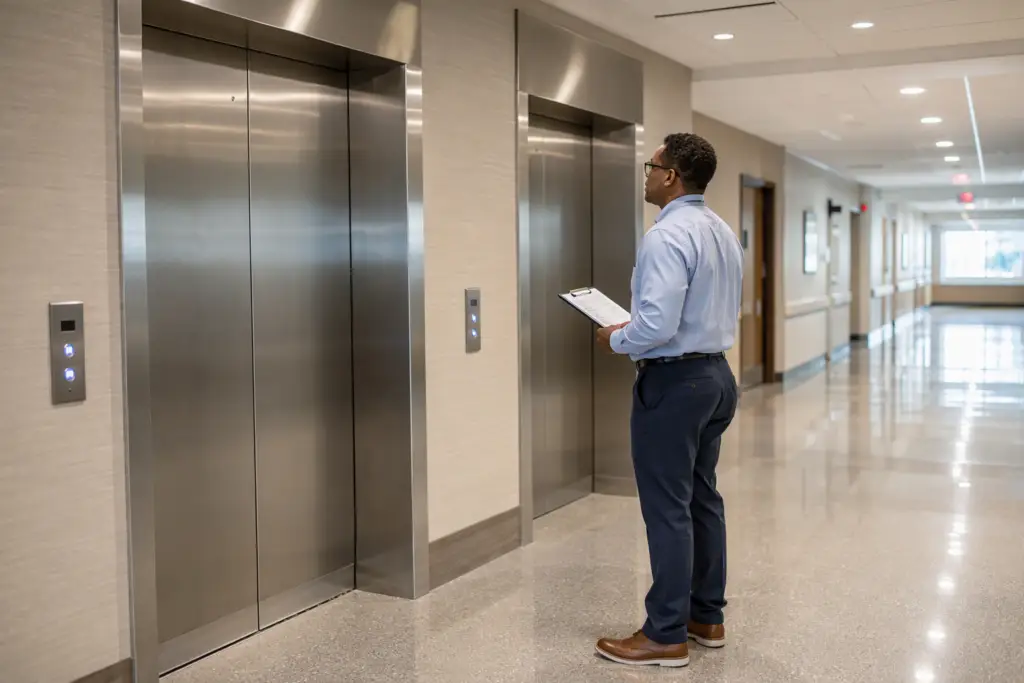
Elevator Accessibility Consultation for Healthcare Facilities
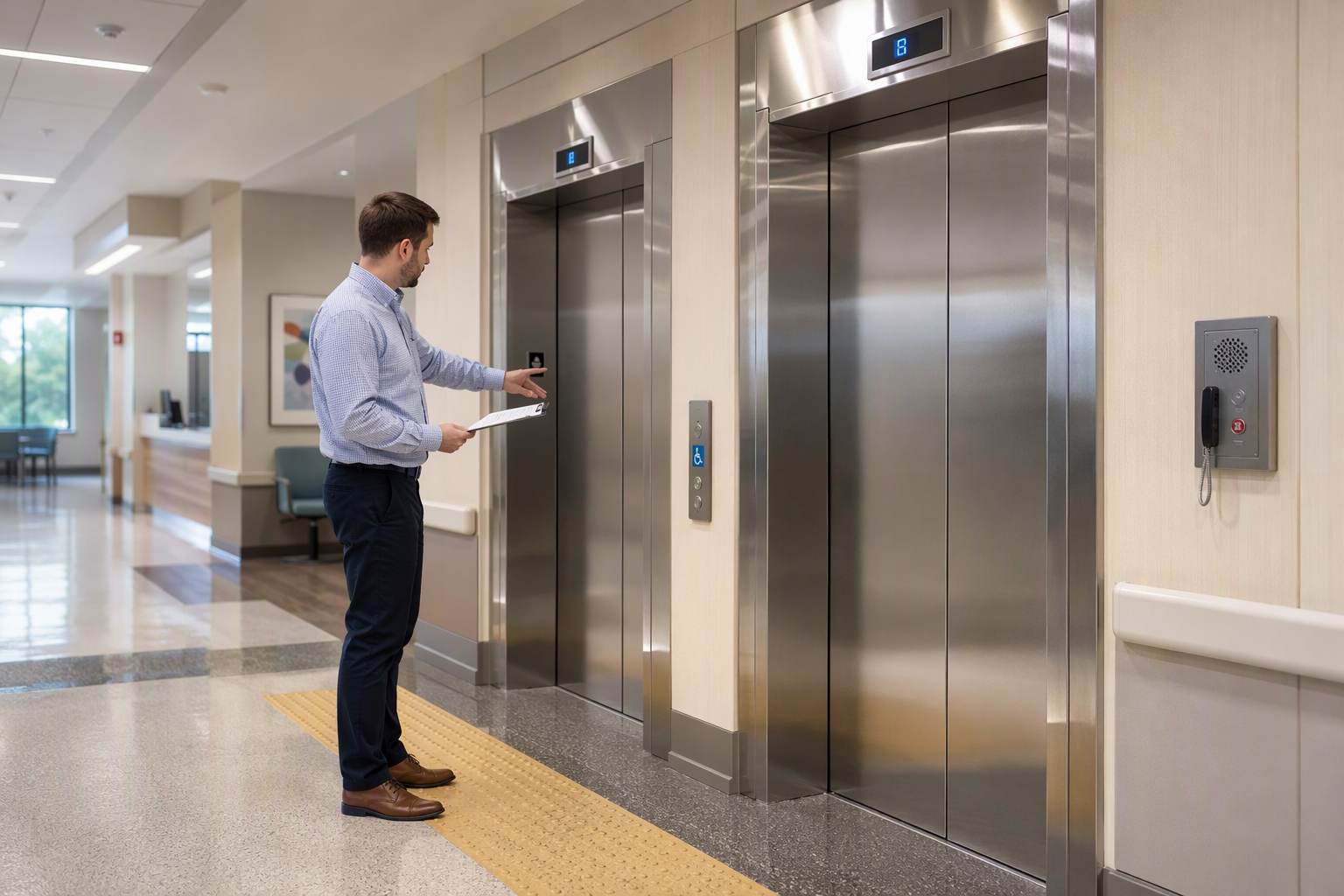
Elevator accessibility in healthcare settings is not a minor compliance checkbox — it is a patient safety and operational necessity. When a hospital elevator fails an inspection or a nursing home lift falls short of accessibility standards, the consequences range from regulatory citations to disrupted patient transport. An elevator accessibility consultation evaluates every aspect of a facility’s vertical transportation against federal and state requirements, identifies gaps, and produces a clear remediation roadmap. Quality Elevator Company provides these consultations across Baltimore, Washington DC, Philadelphia, and Richmond, covering hospitals, medical office buildings, ambulatory surgery centers, and long-term care communities.
What Federal Standards Govern Elevator Accessibility in Healthcare?
Two federal frameworks shape elevator accessibility requirements for healthcare facilities nationwide.
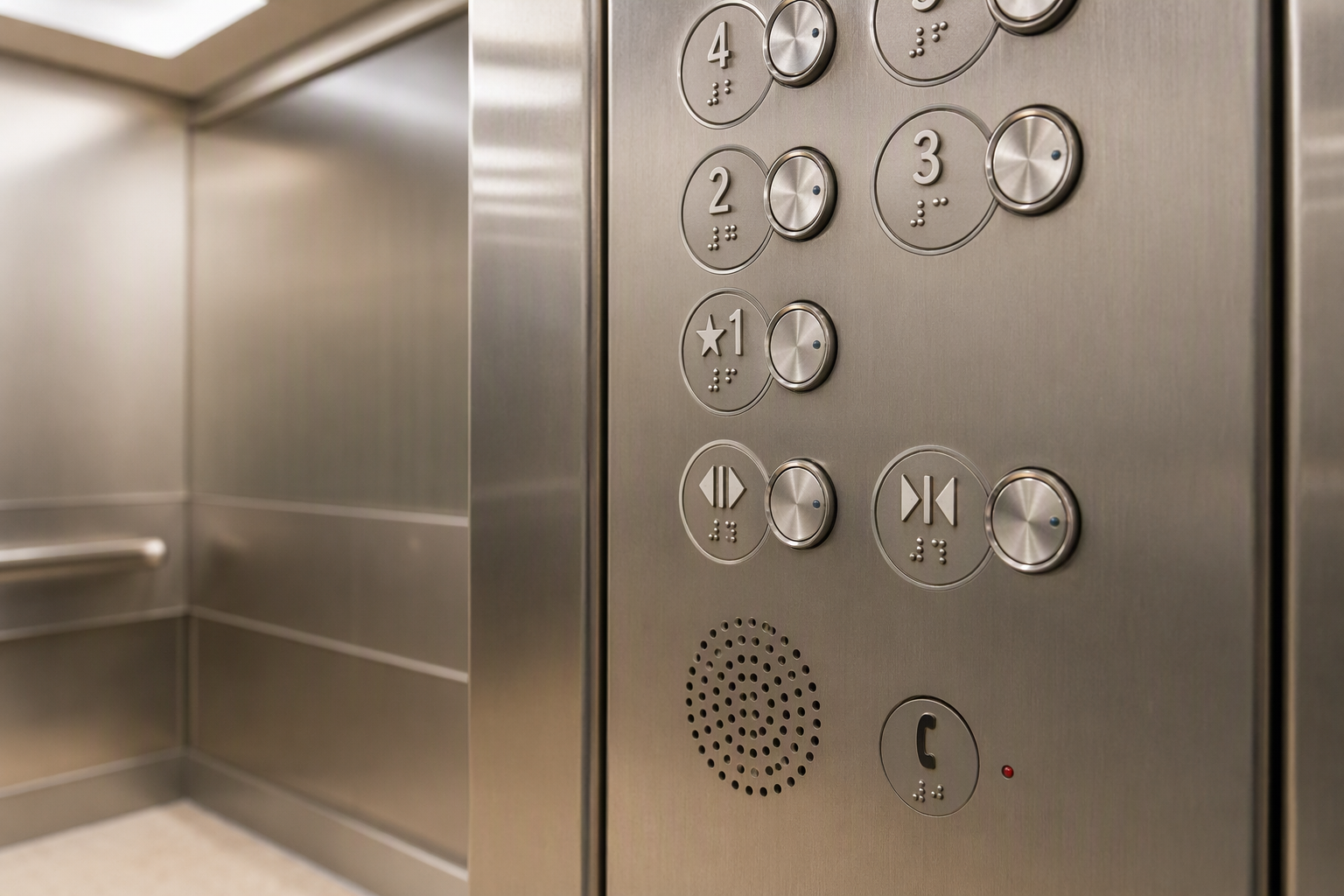
Americans with Disabilities Act (ADA) — Title III and Title II of the ADA require that places of public accommodation and state or local government entities provide accessible routes, including accessible elevators. For healthcare facilities, this means elevator cab dimensions, door widths, control button heights, Braille signage, audible floor announcements, and two-way communication systems must meet ADA Standards for Accessible Design. The ADA’s elevator exemption for facilities under three stories or under a certain square footage does not apply to shopping centers, shopping malls, or facilities providing health care.
ASME A17.1 Safety Code for Elevators and Escalators — This nationally recognized safety code establishes construction, installation, operation, inspection, and maintenance requirements. Each state in Quality Elevator Company’s service region has adopted a specific edition of this code, and healthcare facilities must comply with the edition in force when their elevator was installed and the current edition for any alterations or new installations.
Beyond those two frameworks, healthcare facilities may also be subject to Joint Commission environment-of-care standards, Centers for Medicare and Medicaid Services (CMS) Conditions of Participation, and life safety requirements under NFPA 101, which govern fire-rated hoistway enclosures and emergency recall functions. An accessibility consultation maps all applicable overlapping requirements into a single compliance picture.
What Are the State-Specific Elevator Requirements in Quality Elevator Company’s Markets?
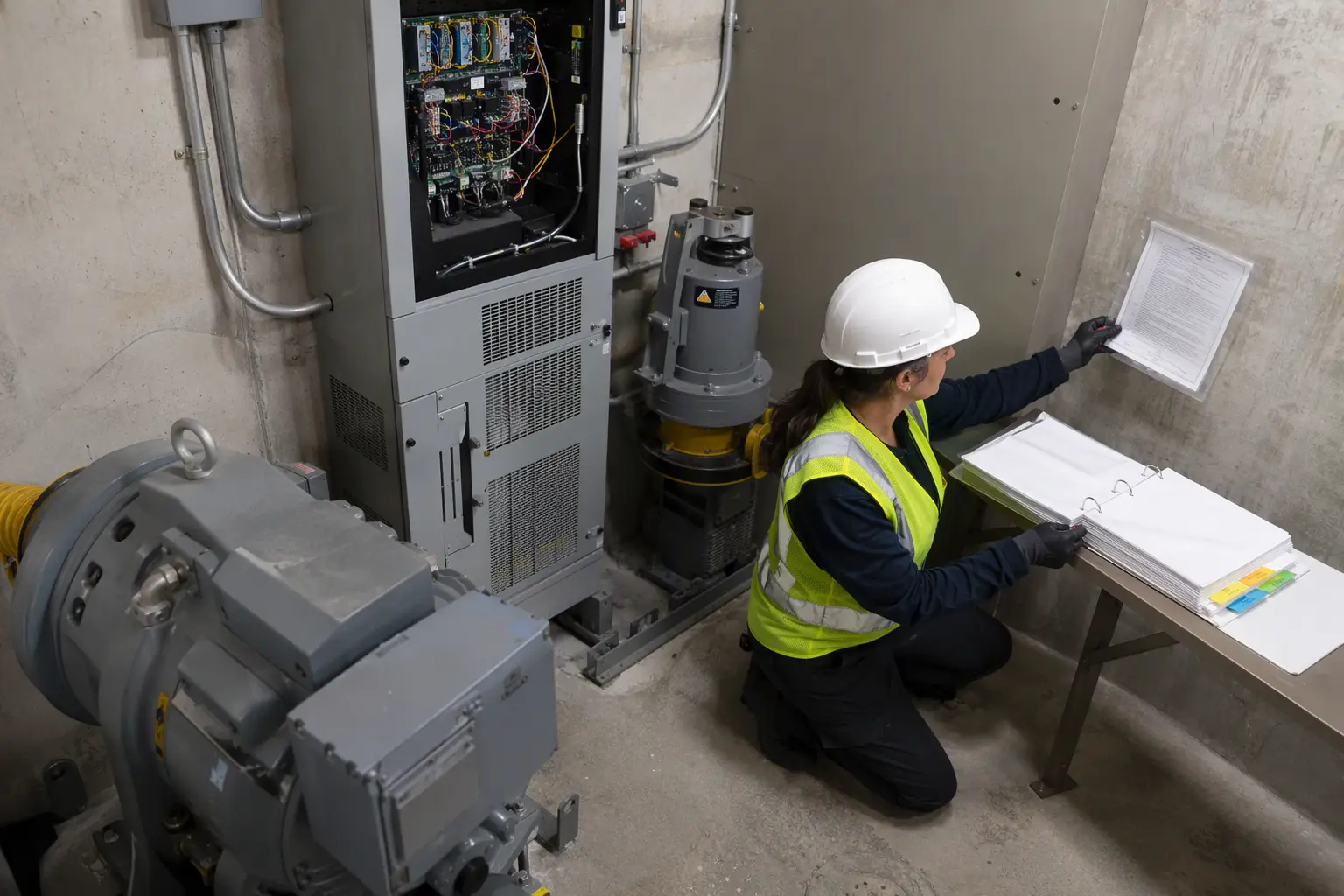
Each jurisdiction served by Quality Elevator Company has its own regulatory authority, adopted code edition, and inspection cycle. Healthcare facility managers must understand which rules apply to their building.
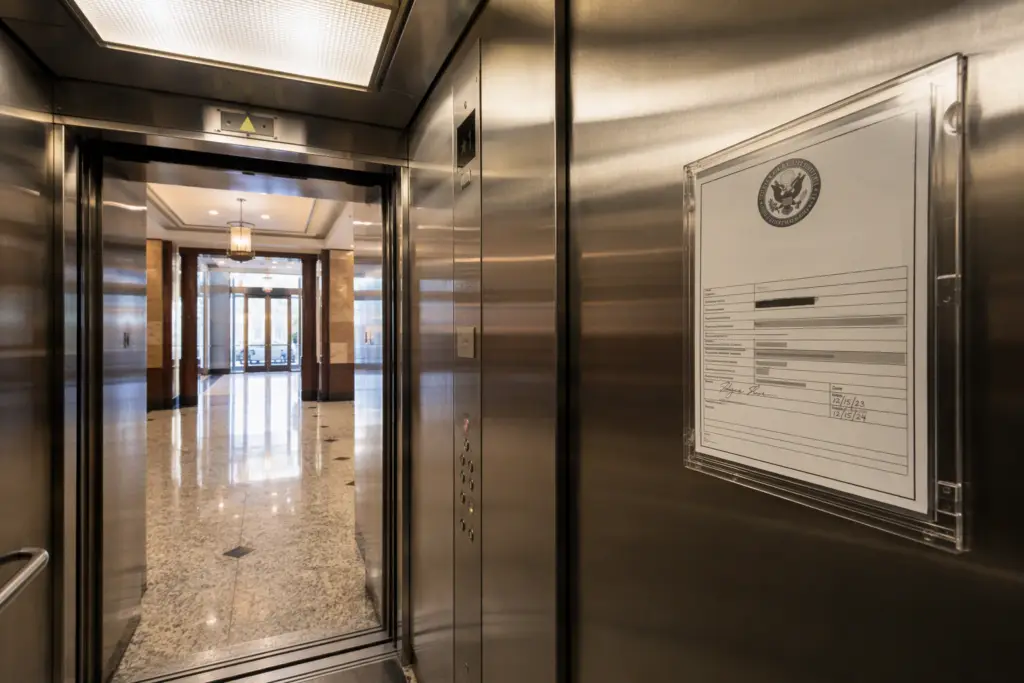
District of Columbia — The DC Department of Buildings (DOB) oversees elevator inspection and certification. DC has adopted ASME A17.1-2013/CSA B44-13 as referenced by the 2017 DC Building Code, effective May 29, 2020. Hospitals and medical facilities in DC must use a DOB-approved third-party inspection agency staffed by ASME QEI-certified inspectors. Category 1 inspections occur every 12 months and Category 5 inspections every 60 months. DC certificates of inspection are valid for two years and must be conspicuously displayed in the elevator car. In buildings with passenger elevators, at least one elevator must remain operational whenever the building is occupied — a requirement especially critical in a hospital setting where patient transport cannot be interrupted.
Maryland — The Maryland Department of Labor, Division of Labor and Industry, Elevator and Escalator Safety administers the state program under the Annotated Code of Maryland, Public Safety Article, Title 12, Subtitle 8. As of June 17, 2026, Maryland adopted ASME A17.1-2022/CSA B44:22 with Maryland amendments. Healthcare facilities must have a periodic annual inspection by a state inspector or a third-party qualified elevator inspector, and comprehensive five-year inspections are required for wire-rope-suspended elevators. Elevator contractors working in Maryland hospitals must be licensed by the Maryland Elevator Safety Review Board and carry at least $1,000,000 in general liability insurance.
Pennsylvania — The Pennsylvania Department of Labor and Industry, Bureau of Occupational and Industrial Safety, Elevator Section regulates elevators statewide, including Philadelphia. Pennsylvania currently enforces ASME A17.1-2000 with A17.1a-2002 addenda; for permit applications made on or after December 20, 2026, ASME A17.1-2016 with Pennsylvania modifications applies. Electric and hydraulic elevators in healthcare facilities require periodic inspections at intervals of no more than six months. Certificates of operation are valid for 24 months for equipment on a six-month inspection cycle.
Virginia — Under the Virginia Uniform Statewide Building Code (13VAC5-63), local building departments enforce elevator requirements and conduct inspections. The 2021 USBC, effective January 18, 2024, incorporates ASME A17.1/CSA B44-2019. In Richmond, the City Department of Planning and Development Review, Bureau of Permits and Inspections, manages elevator annuals and certificates. Virginia requires annual periodic inspections, with localities authorized to require six-month cycles. No one may work as an elevator mechanic in Virginia without state certification from the Virginia Board for Contractors (DPOR).
Why Do Healthcare Facilities Have Unique Elevator Accessibility Needs?
Healthcare environments present accessibility demands that differ substantially from commercial office buildings or retail spaces. Key factors include:
- Stretcher and gurney transport — Maryland law requires that each new building with at least one planned elevator have a passenger elevator capable of carrying a 6-foot-8-inch rescue litter horizontally. Hospitals must verify their cabs meet this dimension for patient transport.
- High traffic and continuous operation — Inpatient facilities operate around the clock. Elevator downtime must be minimized, and maintenance schedules must account for 24/7 demands.
- Infection control — Cab materials, handrail configurations, and door operation timing affect cleaning protocols and pathogen transmission risk.
- Bariatric patient transport — Facilities serving bariatric patients may need elevators with higher rated capacities and wider door openings beyond standard ADA minimums.
- Emergency power integration — Hospital elevators must integrate with emergency generators and fire-recall systems, requirements that overlap NFPA 101 and ASME A17.1.
- Wayfinding and communication — Patients with visual, hearing, or cognitive impairments depend on audible announcements, tactile controls, and two-way communication systems functioning reliably.
What Does an Elevator Accessibility Consultation Include?
A structured consultation conducted by Quality Elevator Company covers the following steps:
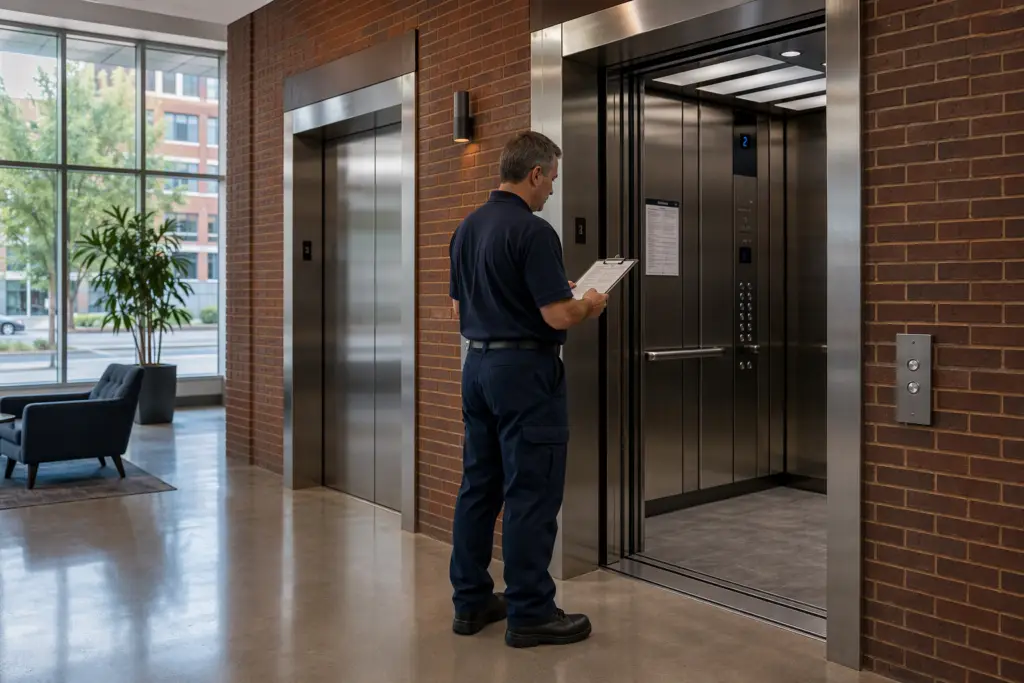
- Facility walkthrough and inventory — Technicians document every elevator, lift, and escalator in the facility, recording model, installation date, last inspection date, current certificate status, and existing maintenance records.
- ADA compliance audit — Each cab is measured and evaluated against ADA Standards for Accessible Design: door clear width, cab dimensions, control panel height and reach range, Braille and raised character signage, audible signals, and two-way communication.
- State code compliance review — The consultation maps the facility’s equipment against the applicable edition of ASME A17.1 for the jurisdiction, identifying any gaps in inspection currency, certificate posting, or maintenance documentation.
- Operational assessment — Door timing, leveling accuracy, cab lighting, floor announcement systems, and emergency recall function are tested against code requirements and healthcare operational needs.
- Deficiency report — All findings are compiled into a written report with priority rankings: items that create immediate safety or code violations, items that require attention before the next inspection, and long-term modernization recommendations.
- Remediation roadmap — The report includes recommended corrective actions, estimated scope of work, and sequencing guidance to minimize disruption to healthcare operations.
- Documentation package — The consultation produces a complete record suitable for submission to the relevant state agency, accreditation body, or legal counsel.
What ADA Requirements Apply Specifically to Hospital Elevators?
The ADA requires that elevator cars in facilities subject to accessibility requirements provide a clear floor area sufficient for a wheelchair to enter, maneuver, and exit. Door reopening devices must remain fully open for a specified duration and must not require physical contact to reactivate. Call buttons must be a minimum height above the finished floor, and floor designations must be in raised characters and Braille at both jambs of each elevator hoistway entrance. Inside the cab, controls must be within accessible reach ranges, and an emergency two-way communication system must be provided. Hospitals are not exempt from any of these requirements, and because the ADA does not apply the small-building elevator exemption to healthcare facilities, all floors in a medical building must be served by a compliant elevator regardless of the building’s size.
How Often Must Healthcare Facility Elevators Be Inspected?
Inspection frequency varies by jurisdiction:
- DC — Category 1 inspection annually; Category 5 inspection every 60 months; certificate of inspection valid for two years.
- Maryland — Periodic annual inspection required; comprehensive five-year inspection required for wire-rope-suspended elevators; annual re-registration with the Commissioner.
- Pennsylvania — Periodic inspections at intervals of no more than six months for electric and hydraulic elevators; certificate of operation valid for 24 months on a six-month cycle.
- Virginia — Annual periodic inspection required; localities may require six-month inspections; periodic tests at ASME A17.1 Appendix N intervals witnessed by the code official.
Healthcare facilities that fall behind on inspection schedules risk certificate suspension, which may require removing elevators from service — an outcome with serious patient safety implications.
What Is the Difference Between Accessibility Consultation and a Standard Elevator Inspection?
A standard state-mandated elevator inspection focuses on mechanical safety: ropes, buffers, safeties, interlocks, and operating controls. It confirms the equipment operates within code-required safety parameters, but it does not comprehensively evaluate ADA compliance, patient transport suitability, or operational workflow for healthcare environments.
An elevator accessibility consultation is broader in scope. It incorporates the mechanical safety review but adds a detailed ADA audit, an operational assessment specific to healthcare workflows, an evaluation of emergency systems in the context of hospital requirements, and a written remediation plan. Quality Elevator Company positions these consultations as a proactive tool — facilities that complete them before an accreditation survey or state inspection are better positioned to demonstrate a documented compliance effort.
What Modernization Options Improve Accessibility in Older Healthcare Elevators?
Many hospital buildings in Baltimore, Washington DC, Philadelphia, and Richmond were constructed before current ADA and ASME A17.1 editions took effect. Common modernization measures that improve accessibility include:
- Door operator upgrades to extend dwell time and improve reopening sensitivity
- Control panel replacement to meet current reach-range and tactile signage requirements
- Cab interior upgrades including handrails, flooring, and lighting that meet code and infection-control standards
- Two-way communication system upgrades
- Leveling system improvements to eliminate gaps between cab floor and landing that create tripping hazards for wheelchair and gurney users
- Emergency lighting and phone system integration with hospital emergency power systems
When any alteration is made to an existing elevator, the applicable state code requires that the altered equipment meet current standards for the affected components, and in DC, Maryland, and Pennsylvania, a permit must be obtained before work begins. In Virginia, the local building department issues the permit and conducts the acceptance inspection.
What Documentation Should a Healthcare Facility Maintain?
Regulatory requirements across all four jurisdictions call for robust recordkeeping. Healthcare facilities should maintain:
- Current certificate of inspection or certificate of operation posted in each elevator cab or in an approved alternative location
- Complete inspection and test reports for the period required by state law (Maryland requires records at a readily accessible central location in the building)
- Maintenance logs, work orders, and repair records
- Permits for any alteration, repair, or modernization work
- Documentation of the elevator mechanic’s license or certification for all work performed
- Accident reports submitted to the relevant state agency when required (Pennsylvania requires owner submission of accident reports for any incident causing a fatality or requiring professional medical care)
Quality Elevator Company includes a documentation review as a standard component of every accessibility consultation, helping facility managers identify recordkeeping gaps before they become inspection findings.
Questions Your Inspector Will Ask
Healthcare facility managers should be prepared to answer the following questions during a state elevator inspection or accreditation survey:
- Is the current certificate of inspection displayed in each elevator cab, or properly posted in an approved alternative location?
- When was the last periodic inspection completed, and is the report on file?
- For wire-rope-suspended elevators in Maryland: has the five-year comprehensive inspection been completed within the required interval?
- Is maintenance and repair documentation kept at a readily accessible central location in the building?
- Who is the licensed elevator contractor responsible for maintenance, and are their license numbers on file?
- Has any alteration or repair been performed without the required permit?
- Are all two-way emergency communication systems functional and tested?
- Can at least one elevator remain in continuous operation during occupied hours (DC facilities)?
- Have accident reports been submitted to the state agency for any qualifying incident?
- For Pennsylvania facilities anticipating permit applications after December 20, 2026: is the facility prepared to comply with ASME A17.1-2016 requirements?
- Are elevator mechanic certification numbers documented on third-party inspection reports (required in Virginia)?
- Is the cab floor level with the landing within acceptable tolerances, and do door dwell times accommodate wheelchair and gurney users?
How Should a Healthcare Facility Prepare for an Elevator Accessibility Consultation?
- Gather all existing elevator inspection reports, certificates, maintenance logs, and permits into a single accessible location.
- Identify the installation date and last major alteration date for each elevator unit.
- Note any patient transport complaints, near-miss incidents, or operational issues related to elevator performance.
- Confirm the name and license or certification number of the current elevator maintenance contractor.
- Identify any upcoming accreditation surveys, state inspections, or building renovation projects that may affect elevator timelines.
- List all elevator units by location, type (electric traction, hydraulic, limited-use/limited-application), and primary patient population served.
- Schedule the consultation during a period when access to all elevator machine rooms and control spaces is available.
How Does Quality Elevator Company Support Healthcare Clients Throughout the Compliance Cycle?
Quality Elevator Company works with healthcare facility managers in Baltimore, Washington DC, Philadelphia, and Richmond at every stage of the compliance cycle — from initial accessibility consultation through inspection preparation, remediation work coordination, and ongoing maintenance program review. Because the regulatory requirements in each jurisdiction differ in inspection frequency, adopted code edition, and agency oversight, healthcare clients benefit from working with a team that understands how Maryland’s annual re-registration requirement differs from DC’s two-year certificate cycle, or how Pennsylvania’s December 2026 code transition affects permit strategy for planned renovations.
Healthcare facilities that engage Quality Elevator Company for an accessibility consultation receive a written report they can share with risk management, legal counsel, and accreditation surveyors — providing a documented record of proactive compliance effort.
Contact Quality Elevator Company for a free elevator assessment at 301-779-9116.
Need elevator service you can rely on? Quality Elevator Company is ready to help.