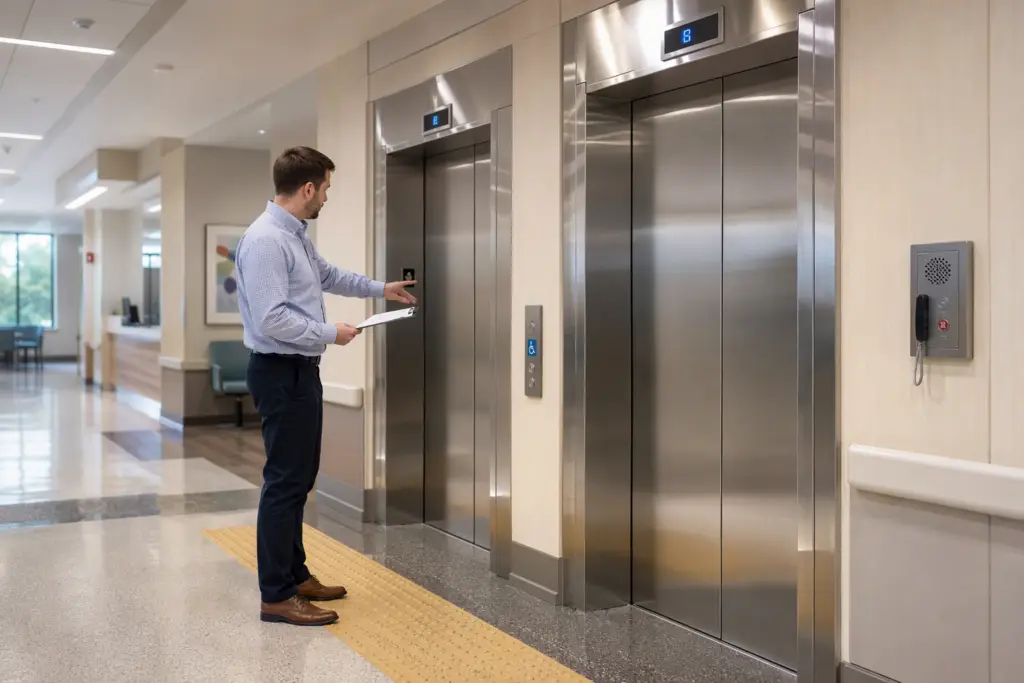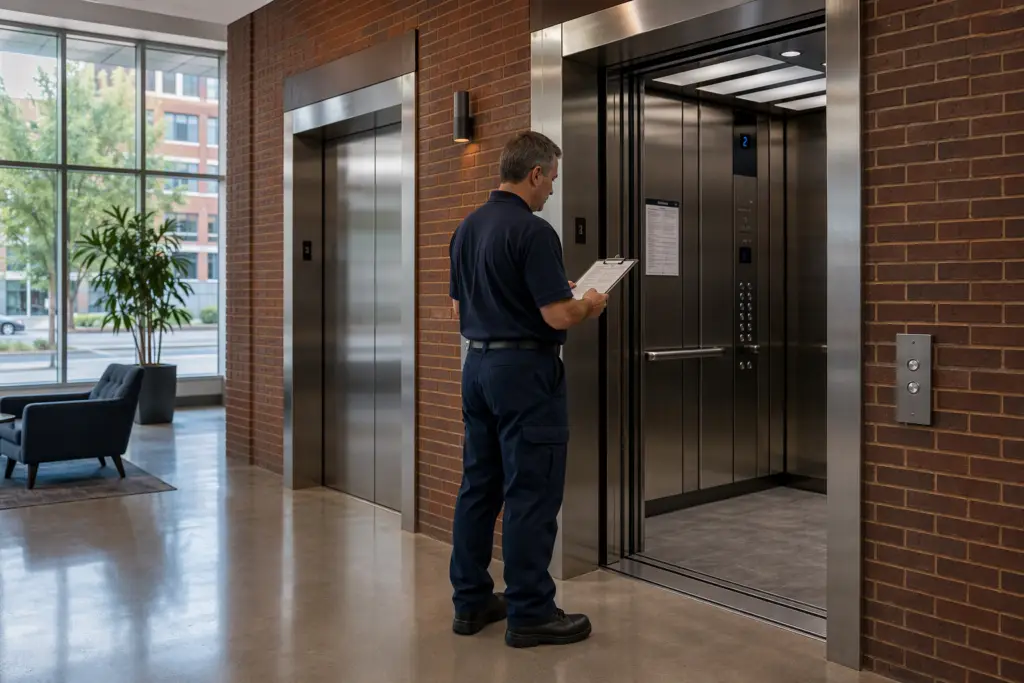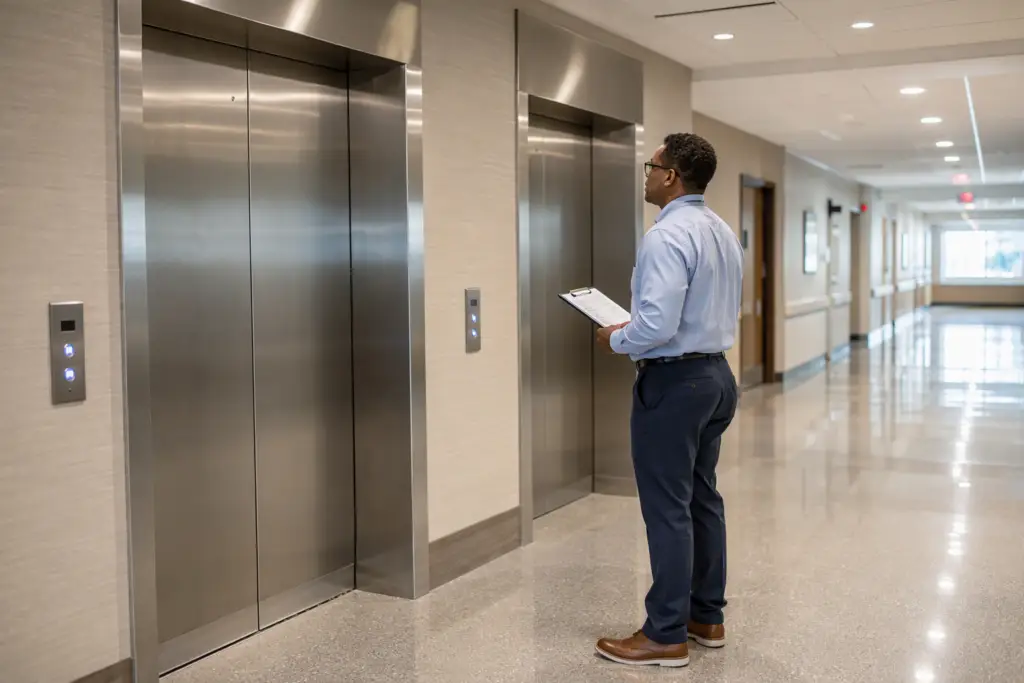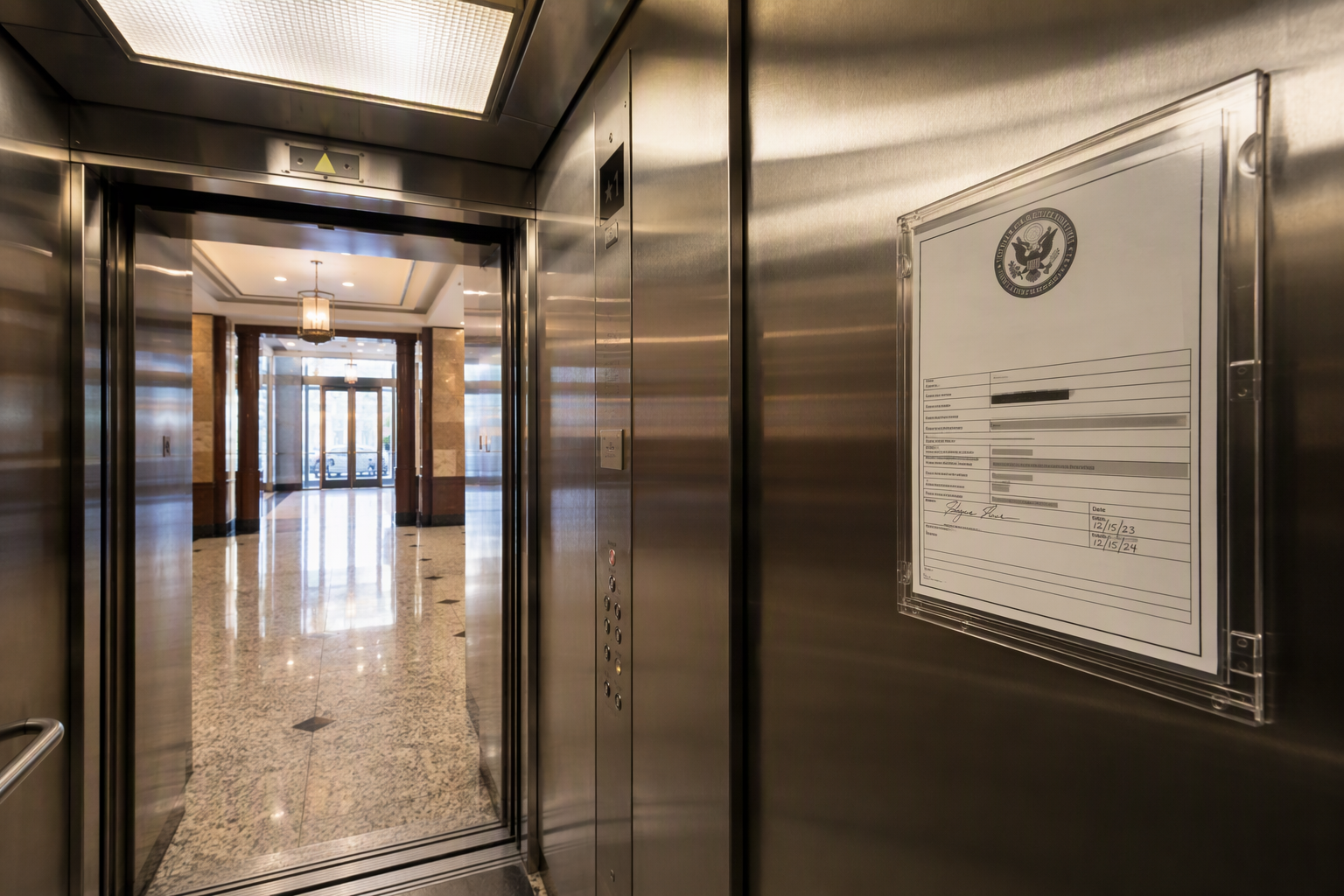
The fastest way to find your elevator’s last inspection date is to look at the certificate of inspection displayed inside the elevator car — every jurisdiction served by Quality Elevator Company requires that certificate to be posted conspicuously in or near the cab. If the certificate is missing, outdated, or you need the underlying inspection reports, you can contact the regulatory agency for your jurisdiction directly or request records from your elevator maintenance contractor. Building owners in Maryland are additionally required by law to keep maintenance, repair, test, and inspection records at a readily accessible central location in the building. The sections below walk through every step, by jurisdiction, so you know exactly where to look and what to ask for.
What is an elevator certificate of inspection and where is it required to be posted?
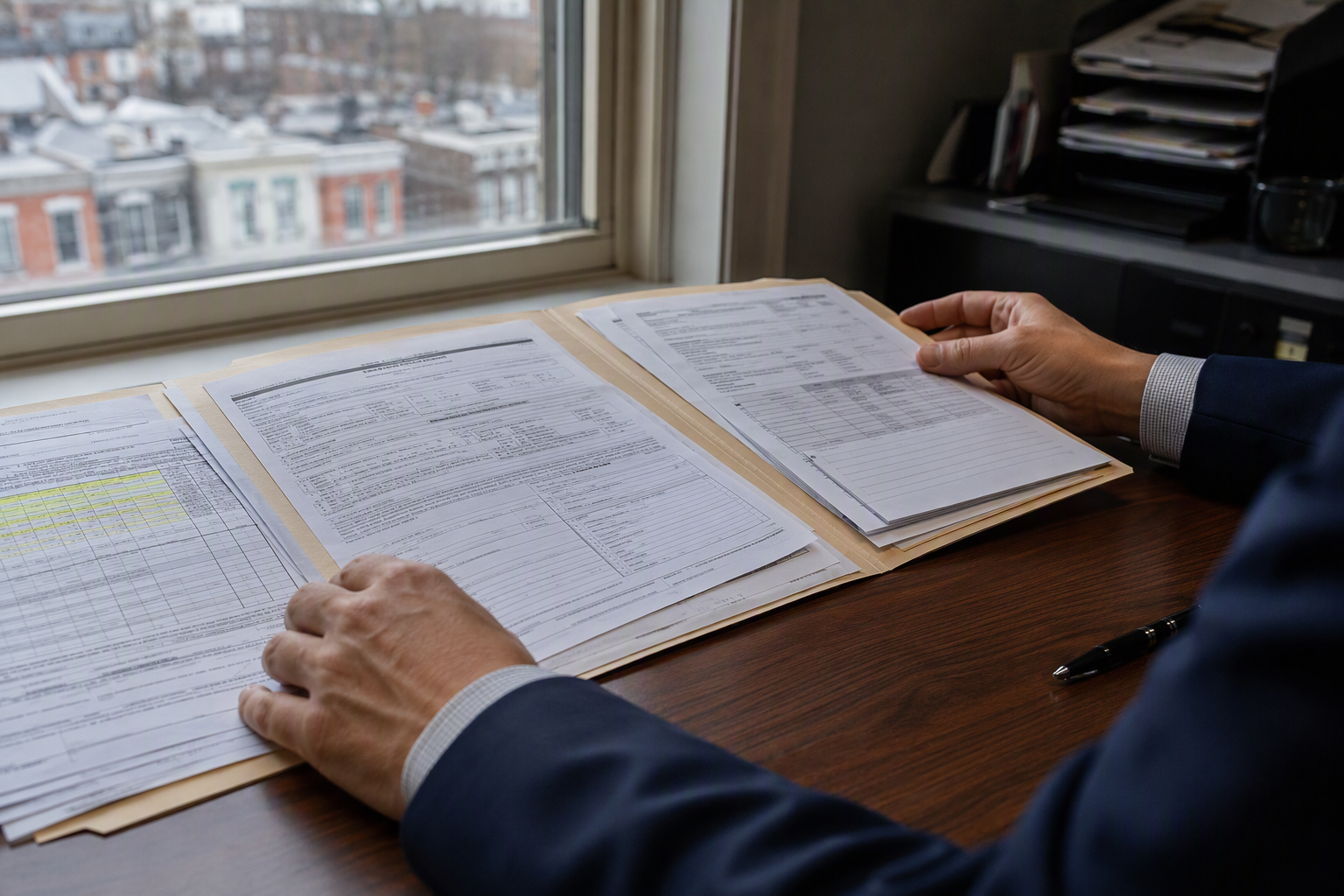
An elevator certificate of inspection is an official document issued by the authority having jurisdiction confirming that the elevator has passed a required periodic inspection and may legally remain in service.
Every jurisdiction in the Quality Elevator Company service area requires this certificate to be visible. In Maryland, under the Annotated Code of Maryland, Public Safety Article, Title 12, Subtitle 8, the certificate must be posted conspicuously in or on the elevator unit. In Pennsylvania, under Pennsylvania Department of Labor and Industry rules at 34 Pa. Code Chapter 405, the certificate or a copy must be posted in the elevator car or attached to the controller in the machine room. In the District of Columbia, under DC Department of Buildings (DOB) rules at 12-A DCMR Chapter 30, a copy of the current certificate must be conspicuously displayed in the elevator car unless an exemption applies — in which case the building operator must keep it available for public inspection in an on-site office. In Virginia, under 13VAC5-63, the Virginia Uniform Statewide Building Code, the current certificate must be displayed in the elevator, attached to the escalator, kept in the building operator’s office, or posted in an approved conspicuous location.
The certificate shows the inspection date, the unit identifier, the name of the inspecting agency or inspector, and the certificate’s expiration date. If that document is not present or has expired, that is itself a compliance issue that should be corrected immediately.
How often is an elevator required to be inspected in DC, Maryland, Pennsylvania, and Virginia?
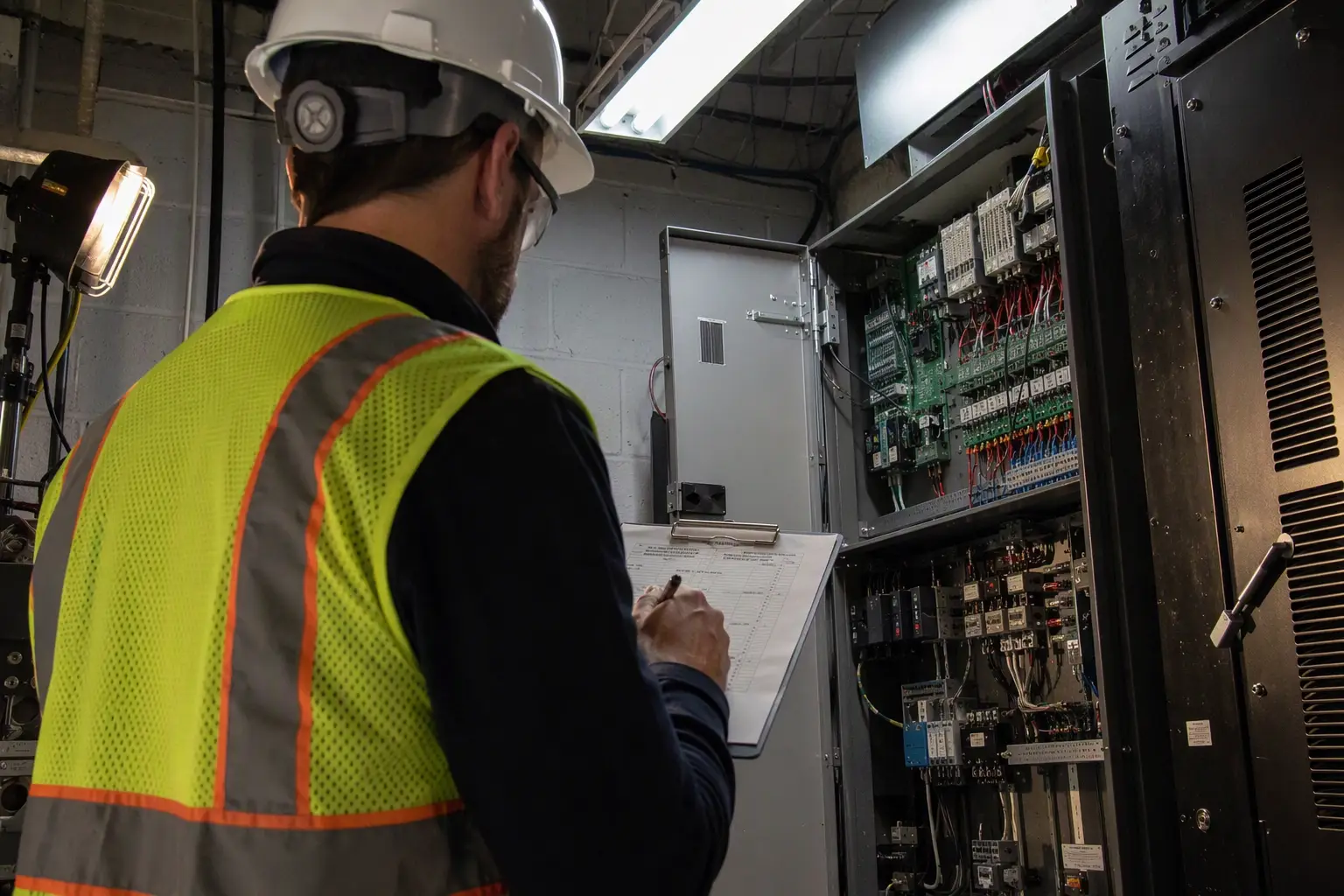
Inspection frequency depends on the jurisdiction and the type of test, but all four jurisdictions require at least an annual periodic inspection.
The table below summarizes the periodic inspection intervals and certificate validity periods across the Quality Elevator Company service area.
| Jurisdiction | Periodic Inspection Interval | Five-Year / Category 5 Test | Certificate Validity | Adopted Code Edition (as of 2026) |
|---|---|---|---|---|
| District of Columbia | Category 1 every 12 months | Category 5 every 60 months | 2 years | ASME A17.1-2013/CSA B44-13 (2017 DC Building Code, effective May 29, 2020) |
| Maryland | Annual (periodic) | Comprehensive 5-year inspection required for wire-rope and similar suspended elevators | Annual re-registration required | ASME A17.1-2022/CSA B44:22 with Maryland changes (effective June 17, 2026) |
| Pennsylvania | Every 6 months (electric, hydraulic, escalators); 12-month cycle for some equipment | Periodic tests per ASME A17.1 Appendix N (Category 1 annually beginning December 20, 2026) | 24 months (6-month cycle); 48 months (12-month cycle) | ASME A17.1-2000/A17.1a-2002 addenda (ASME A17.1-2016 for permit applications on or after December 20, 2026) |
| Virginia | Annual; locality may require 6-month periodic inspection | Periodic tests per ASME A17.1 Appendix N intervals, witnessed by local code official | Renewed after each passing annual inspection | ASME A17.1/CSA B44-2019 (2021 USBC, effective January 18, 2024) |
The underlying test categories — Category 1, Category 3, Category 5 — are defined by the ASME A17.1 Safety Code for Elevators and Escalators, which all four jurisdictions adopt in some edition. Category 1 is a no-load safety test performed annually. Category 5 is a full-load, full-speed safety test performed every five years and represents the most comprehensive routine test the code requires.
How do I look up my elevator’s inspection history in the District of Columbia?
In DC, inspection records flow through the DC Department of Buildings (DOB), which issues certificates of inspection based on third-party inspection reports submitted by DOB-approved inspection agencies.
Owners and managers can access the DOB’s Citizen Access Portal, where third-party inspection reports for the past two years must be submitted as part of the certificate application process. If you are a building owner or authorized representative, log into the portal or contact DOB directly to request the inspection history for your elevator unit. Because DC requires inspections by DOB-approved third-party agencies using ASME QEI-certified inspectors, your inspection agency should also hold copies of every report they filed on your behalf. If there has been a recent modernization or alteration, note that a DC elevator certificate may be temporarily suspended while the unit is under permit — so a gap in certificate records during that window may be expected and documented through the permit record.
Under D.C. Official Code § 6-1409 and 12-A DCMR Chapter 30, all elevators and escalators in the District must be inspected and certified for operation, and the certificate must be renewed every two years. Periodic inspections and the required Category 5 test every 60 months must be completed even during the two-year certificate period.
How do I find my elevator’s inspection records in Maryland?
Maryland law creates a clear, building-level record-keeping obligation: maintenance, repair, test, and inspection records must be kept at a readily accessible central location in the building where the elevator is located.
The starting point is therefore on-site. Ask building management or the property manager to produce the inspection log, which should be immediately available. If records are missing or incomplete, contact the Maryland Department of Labor, Division of Labor and Industry, Elevator and Escalator Safety (Safety Inspection Unit). The Safety Inspection Unit maintains records connected to each registered elevator unit, because owners must re-register their elevator units every year at the time of the annual inspection. That annual re-registration cycle means the State holds a year-by-year record of at least the inspection events, even if the detailed reports reside with the building owner or the third-party inspector.
Under the Annotated Code of Maryland, Public Safety Article, §§ 12-801 through 12-842, an elevator unit may not be operated unless the Commissioner of Labor and Industry has issued a certificate. If you suspect your elevator’s certificate has lapsed, the Safety Inspection Unit can confirm current certification status. Third-party inspections in Maryland must be performed by a qualified elevator inspector who is physically present for any required tests, and those tests must be performed by a licensed elevator mechanic — so there is always a paper trail connecting the test, the mechanic, and the inspector.
How do I obtain elevator inspection records in Pennsylvania?
In Pennsylvania, the Pennsylvania Department of Labor and Industry (L&I), Bureau of Occupational and Industrial Safety, Elevator Section maintains records for every elevator registered statewide, including elevators in Philadelphia.
Building owners should first check the certificate of operation — either posted in the elevator car or attached to the controller in the machine room — for the most recent inspection date. For full inspection reports, submit a records request to L&I’s Elevator Section. Because Pennsylvania requires periodic inspections at intervals of no more than six months for electric elevators, hydraulic elevators, and escalators, there should be multiple inspection events per year on record. A certificate of operation is valid for 24 months for equipment on a six-month inspection cycle, or 48 months for equipment on a 12-month cycle, so a certificate that appears current may cover multiple inspection events.
Beginning December 20, 2026, Pennsylvania’s updated regulation (Regulation #12-123) takes effect, requiring Category 1 tests annually as a stand-alone requirement and aligning periodic test intervals with ASME A17.1-2016 Safety Code for Elevators and Escalators Table N-1. Owners planning to review records as part of a modernization project should confirm which code edition applied at the time each inspection was conducted, because elevators permitted before December 20, 2026, remain under the prior standards.
How do I find elevator inspection records in Virginia, including Richmond?
In Virginia, elevator inspection is a local government responsibility under the Virginia Uniform Statewide Building Code (13VAC5-63), so the right place to request records is the local building department for the city or county where the elevator is located.
For elevators within the City of Richmond, the City of Richmond Department of Planning and Development Review, Bureau of Permits and Inspections, runs the elevator program, including final acceptance inspections of new or modernized elevators, annual elevator inspections with tests, and elevator certificates. The Bureau maintains staff dedicated to elevator annuals and certifications. For other Virginia localities, contact the local building official directly. Virginia requires an annual periodic inspection for all covered elevators, and localities may require six-month periodic inspections — meaning local records may be updated more frequently than once per year.
Periodic tests in Virginia must be witnessed by the local code official and must follow the intervals in ASME A17.1 Appendix N. The 2021 USBC, which took effect January 18, 2024, adopted ASME A17.1/CSA B44-2019. Third-party inspection reports must include the name and certification number of the elevator mechanic who performed the witnessed tests, creating a verifiable chain of documentation that the local building department should hold.
What steps should a building owner take to get copies of their elevator inspection records?
- Locate and photograph the certificate of inspection displayed in the elevator cab or machine room — this document shows the most recent inspection date and certificate expiration date.
- Check the on-site maintenance log, which in Maryland is legally required to be kept in the building; in all jurisdictions, responsible building management should maintain this file.
- Contact your current elevator service contractor and request copies of all inspection and test reports they hold for your unit — contractors typically retain records for every service visit.
- Contact the authority having jurisdiction: DOB for DC, the Maryland Department of Labor Safety Inspection Unit for Maryland, Pennsylvania L&I Elevator Section for Pennsylvania (including Philadelphia), or your local building department for Virginia.
- Submit a formal public records request if informal contact does not produce the documents — elevator inspection records held by state or local agencies are generally subject to public records laws.
- Review the records for completeness: confirm that every required periodic inspection interval has a corresponding report, that Category 1 and Category 5 (or their jurisdiction-specific equivalents) appear at the correct frequencies, and that the inspecting agency or inspector’s credentials are documented.
- If gaps are identified, schedule a compliance inspection with a licensed elevator service contractor to restore full documentation before the next regulatory deadline.
What information is typically included in an elevator inspection report?
A complete elevator inspection report contains the unit identification number, the building address, the date of inspection, the type of inspection or test category performed, the inspector’s name and ASME QEI certification number, the results for each component checked, any deficiencies noted, and the inspector’s signature or certification.
When a test is performed — rather than just an inspection — the report will also document the test conditions: load applied, speed measured, stopping distance, and whether the safety devices functioned within the tolerances specified by the applicable edition of ASME A17.1. In Virginia, reports submitted by third-party agencies must specifically include the name and certification number of the elevator mechanic who performed the witnessed tests, which is an additional layer of traceability. Deficiency reports will list each code section violated and typically set a remediation deadline. Building owners should retain every report, not only the most recent one, because regulators may ask for multi-year histories when processing permit applications, accident investigations, or certificate renewals.
What does a building owner do if an elevator’s inspection certificate is expired or missing?
- Take the elevator out of service voluntarily if the certificate has lapsed and the expiration date cannot be confirmed — operating an uncertified elevator exposes the owner to regulatory penalties and liability.
- Contact the authority having jurisdiction immediately to determine the current status of the unit’s certification and any outstanding violations.
- Engage a licensed elevator service contractor to schedule the required periodic inspection and any outstanding tests.
- In DC, a DOB permit is required to take an elevator out of service under ASME A17.1 Section 8.11.1.4 or to place it in temporarily dormant status — do not simply lock the cab without completing the permit process.
- Once the inspection is passed, ensure the new certificate is posted in the required location before returning the elevator to service.
- Document the entire process — dates of shutdown, permit numbers, inspection report, and certificate posting — to demonstrate good-faith compliance.
Quality Elevator Company assists building owners in navigating the documentation and regulatory process when certificates have lapsed, coordinating the inspection scheduling and paperwork needed to restore compliant service.
How long must elevator inspection records be retained?
Retention periods vary by jurisdiction. Maryland law explicitly requires that maintenance, repair, test, and inspection records be kept at a readily accessible central location in the building — the statute does not cap a maximum retention period, which means owners should retain records for as long as the elevator unit is in service and for a reasonable period after. DC’s certificate application process requires submission of third-party inspection reports for the past two years to DOB, implying a minimum two-year retention expectation for those reports. Pennsylvania and Virginia do not specify a statutory minimum retention period in the verified regulatory facts, but best practice — and the practical advice Quality Elevator Company provides — is to retain all inspection and test records for the life of the equipment, because records from earlier inspections can be critical during major alteration permits, insurance claims, or litigation.
Who is authorized to inspect elevators in DC, Maryland, Pennsylvania, and Virginia?
Authorization requirements differ meaningfully by jurisdiction. In DC, inspections must be conducted by a DOB-approved third-party elevator inspection agency using ASME QEI-certified inspectors; the DC Board of Industrial Trades (within the Department of Licensing and Consumer Protection) licenses elevator inspectors, and applicants must meet ASME QEI-1 or an equivalent standard. In Maryland, the owner must hire a third-party qualified elevator inspector for periodic inspections; tests must be performed by a licensed elevator mechanic, and the inspector must be physically present for the entire test. In Pennsylvania, any UCC-certified elevator inspector may conduct a periodic inspection, and third-party agencies must be certified by L&I. In Virginia, the local code official conducts inspections or may authorize an approved agency or locally certified elevator inspectors; no one may work as an elevator mechanic without state certification from the Virginia Board for Contractors (DPOR), which requires at least three years of industry experience and a passing examination score.
What is the difference between a periodic inspection and a Category 5 test, and do both appear in inspection records?
A periodic inspection — sometimes called a Category 1 inspection in code terminology — is an operational and visual examination of the elevator’s safety systems, typically without applying full rated load, and is performed annually in all four jurisdictions. A Category 5 test, required every 60 months under the DC rules and in analogous form under other jurisdictions’ adoptions of ASME A17.1, is a full-load, full-speed test of all safety devices including the safety plank, governor, and buffers. Maryland specifically requires a comprehensive five-year inspection for elevators suspended by wire ropes, belts, chains, or similar means, and rack-and-pinion elevators. Both the annual periodic inspection report and the five-year test report should appear in the building’s inspection file and in the regulatory agency’s records. When reviewing your inspection history, confirm that both types of documentation are present and that the five-year test intervals have not been exceeded.
Can tenants or members of the public request elevator inspection records?
Generally, yes. Inspection records held by state or local regulatory agencies — DOB in DC, the Maryland Department of Labor Safety Inspection Unit, Pennsylvania L&I, or Virginia local building departments — are government records and are typically subject to public records requests under the relevant jurisdiction’s freedom-of-information law. In DC, a member of the public may also ask to view the certificate of inspection in the building operator’s on-site office if the certificate is kept there rather than posted in the elevator. In Maryland, the certificate must be posted conspicuously in or on the elevator unit, making the most recent inspection date visible to any rider. Building management may additionally have internal maintenance logs, but those are private documents held by the owner rather than the government — a tenant’s right to those records depends on lease terms and applicable housing law, which falls outside elevator code requirements.
What should building owners do to prepare for an elevator inspection in advance?
- Confirm the inspection date with the authority having jurisdiction or the approved third-party inspection agency well in advance of the certificate expiration date.
- Ensure that all prior inspection deficiencies have been corrected and documented — inspectors will typically review the outstanding deficiency list from the prior report.
- Confirm that a licensed elevator mechanic (in Maryland, a state-licensed mechanic; in Virginia, a state-certified mechanic) will be present to perform any required tests during the inspection.
- Gather the maintenance log, prior inspection reports, and any permits issued for recent repairs or alterations — the inspector may ask to review them.
- Confirm that the elevator machine room is accessible, properly lit, and clear of storage that could impede access to the controller, governor, or other inspected components.
- Verify that all required safety signage, capacity placards, and emergency contact information are posted in the elevator car.
- Confirm that the emergency communication system in the elevator car is functional — this is a requirement under the Americans with Disabilities Act (ADA) for facilities subject to ADA, in addition to ASME A17.1 requirements.
How does ADA compliance relate to elevator inspection records?
The Americans with Disabilities Act (ADA) requires that newly constructed and altered facilities subject to ADA have elevators that comply with the ADA Standards for Accessible Design, which incorporate specific requirements for cab dimensions, door timing, control height, Braille markings, and two-way emergency communication. ADA compliance is not directly tested during a state elevator inspection — the periodic inspection under ASME A17.1 focuses on mechanical and safety performance — but ADA deficiencies discovered during an alteration permit review or a DOJ investigation can trigger remediation requirements. Building owners maintaining complete inspection records should also retain documentation of any ADA-related modifications, including the permit and acceptance records for those alterations. When an elevator is modernized or altered, the work typically triggers a new acceptance inspection by the AHJ, and that inspection record should be added to the building’s complete file.
What happens if an elevator fails an inspection?
If an elevator fails a periodic inspection or required test, the authority having jurisdiction has the authority to require the elevator to be taken out of service until the deficiencies are corrected and a re-inspection is passed. In Maryland, an elevator unit may not be operated without a valid certificate; a failed inspection means that certificate cannot be renewed until deficiencies are resolved. In Pennsylvania, after a major repair, replacement, or alteration, an elevator may not return to service until L&I inspects and passes it. In DC, taking an elevator out of service requires a DOB permit under ASME A17.1 Section 8.11.1.4. The deficiency report issued after a failed inspection becomes part of the elevator’s inspection record and must typically be retained along with the subsequent re-inspection report confirming the deficiencies were corrected. Quality Elevator Company coordinates the repair-and-re-inspection process for building owners in Baltimore, Washington DC, Philadelphia, and Richmond to minimize downtime and ensure documentation is complete.
Are there different inspection requirements for freight elevators versus passenger elevators?
The ASME A17.1 Safety Code for Elevators and Escalators distinguishes between passenger elevators, freight elevators, limited-use/limited-application (LULA) elevators, private-residence elevators, and other conveying systems, with differing requirements for each. Jurisdictions that adopt ASME A17.1 — DC, Maryland, Pennsylvania, and Virginia — inherit those distinctions. In practice, freight elevators still require periodic inspections and are subject to certification requirements in all four jurisdictions, but the specific test categories, load requirements, and safety device specifications differ from those for passenger elevators. Building owners should confirm with the AHJ which inspection category applies to each unit in their building and ensure that inspection records correctly identify the elevator type. Mixing records between a passenger elevator and a freight elevator in the same building can create confusion during audits or accident investigations.
What role does an elevator service contractor play in maintaining inspection records?
An elevator service contractor is the day-to-day custodian of the elevator’s maintenance history. A responsible contractor documents every service visit — lubrication, adjustment, component replacement, callback response — and maintains those records in addition to the formal inspection reports. In Maryland, where the law requires records to be kept at a readily accessible central location in the building, the contractor’s service logs become the backbone of that required file. In Virginia, the third-party inspection report must include the name and certification number of the elevator mechanic who performed tests, and the contractor employing that mechanic holds those credentials on file. When a building owner requests their inspection history, a contractor with complete records can produce a chronological file covering every inspection event, every deficiency noted, and every corrective action taken. Quality Elevator Company maintains thorough service documentation for every elevator unit under maintenance contract in Baltimore, Washington DC, Philadelphia, and Richmond, making records requests straightforward for building owners.
What are the consequences of operating an elevator with an expired or invalid certificate of inspection?
Operating an elevator without a valid certificate is a violation of the elevator safety statutes in each jurisdiction served by Quality Elevator Company. In Maryland, the statute at Public Safety Article, Title 12, Subtitle 8, prohibits operating an elevator unit unless the Commissioner of Labor and Industry has issued a certificate. In Pennsylvania, 34 Pa. Code Chapter 405 prohibits operating an elevator without a certificate of operation issued by L&I. In DC, 12-A DCMR Chapter 30 requires certification for all elevators and escalators. In Virginia, local building departments enforce the 2021 USBC provisions requiring valid inspection certificates. Consequences can include regulatory fines, orders to immediately take the elevator out of service, increased scrutiny in subsequent inspections, and potential civil liability if an injury occurs while the elevator is operating without certification. Insurance carriers may also dispute coverage for incidents involving uncertified equipment. Proactive record-keeping and scheduling inspections well before certificate expiration dates is the most reliable way to avoid these consequences.
How can a building owner stay ahead of upcoming inspection deadlines?
Proactive management of elevator inspection deadlines starts with a calendar tied to each certificate’s expiration date and each test category’s recurring interval. Because DC certificates are valid for two years, Maryland units require annual re-registration, Pennsylvania certificates last 24 or 48 months depending on the inspection cycle, and Virginia requires annual inspections with possible six-month intervals at local discretion, no single renewal cadence applies across all four jurisdictions. Building owners with elevators in multiple jurisdictions should maintain a unit-by-unit compliance calendar that tracks the certificate expiration date, the next required periodic inspection date, and the date of the last Category 5 or comprehensive five-year test.
Quality Elevator Company offers compliance tracking support as part of maintenance agreements, helping building owners in Baltimore, Washington DC, Philadelphia, and Richmond avoid lapses by scheduling inspections, coordinating with the applicable AHJ, and ensuring that test documentation is submitted correctly and on time.
Contact Quality Elevator Company for a free elevator assessment at 301-779-9116.
Need elevator service you can rely on? Quality Elevator Company is ready to help.