Yes, Quality Elevator Company repairs private residential elevators throughout Baltimore MD, Washington DC, Philadelphia PA, and Richmond VA. Residential elevator repair covers hydraulic, traction, pneumatic vacuum, and inclined platform lifts. All repair work follows ASME A17.1 Safety Code for Elevators and Escalators and applicable state regulations in each market served.
Do You Repair Private Residential Elevators? A Complete FAQ
What types of private residential elevators does Quality Elevator Company repair?
Quality Elevator Company repairs all major residential elevator types, including hydraulic, cable-drum traction, winding-drum traction, pneumatic vacuum tube (PVE), and inclined platform lifts.
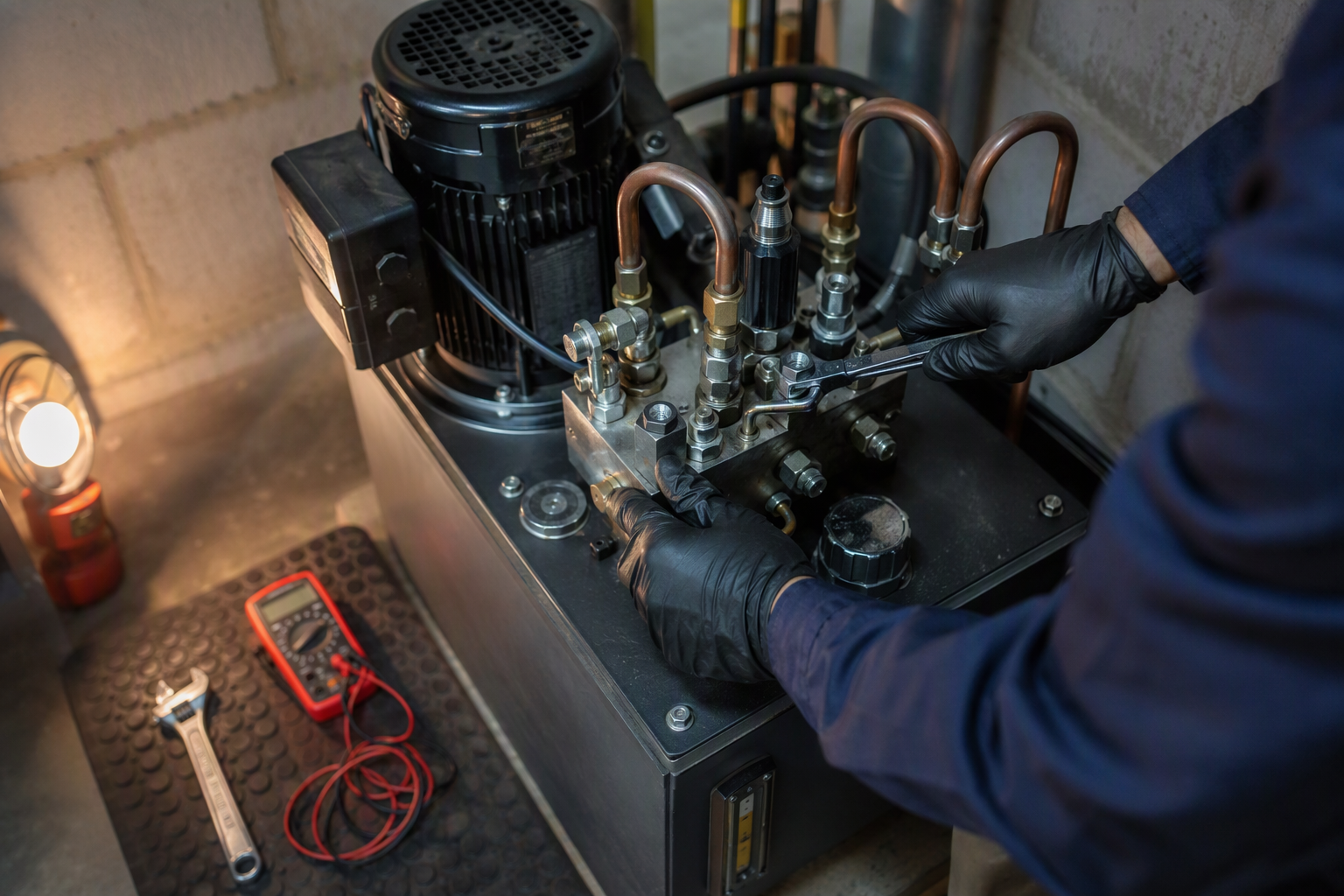
Each drive technology has a distinct mechanical profile. Hydraulic residential elevators use an oil-driven piston and are common in homes built over the past three decades; typical repair needs include cylinder seal replacement, pump unit servicing, and valve adjustment. Cable-drum and winding-drum traction units rely on a motor-driven drum and counterweight system; common repairs involve governor replacement, sheave wear, and rope inspection or replacement under ASME A17.1 rope-retirement criteria. Pneumatic vacuum elevators use differential air pressure created by a turbine; repairs often center on turbine motor faults, seal integrity, and valve sequencing. Inclined platform lifts follow a rack-and-pinion or rail drive and require attention to rail alignment, drive gear wear, and safety pawl function.
Regardless of drive type, residential elevator repairs also routinely address door operator failures, call-and-send control board faults, gate switch and interlock replacements, leveling sensor calibration, and cab lighting or emergency phone systems.
Are private residential elevators subject to the same safety codes as commercial elevators?

Private residential elevators are governed by ASME A17.1 Safety Code for Elevators and Escalators, the same foundational federal standard used for commercial equipment, though certain exemptions apply at the state level for single-family homes.
ASME A17.1 covers design, installation, maintenance, and repair requirements for elevators in all building types, including private residences. The standard’s Part XII addresses private residence elevators specifically, setting requirements for rated load, car size, travel speed, hoistway construction, and safety devices. All repair work performed by licensed elevator contractors must bring the unit into compliance with the applicable edition of ASME A17.1 that was in force when the elevator was originally permitted, as well as any mandatory retrofit requirements introduced since that date.
One important nuance: state inspection and certificate laws frequently exempt elevators in privately owned single-family homes from mandatory periodic inspection requirements, but those exemptions do not remove the obligation to repair and maintain the equipment according to the safety code. In Maryland, for example, the certificate and inspection law generally does not apply to units in privately owned single-family homes, per the Maryland Department of Labor, Division of Labor and Industry, Elevator and Escalator Safety. Similarly, Pennsylvania’s Uniform Construction Code elevator rules do not apply to lifting devices used only by the occupants of a single dwelling unit, per the Pennsylvania Department of Labor and Industry, Bureau of Occupational and Industrial Safety, Elevator Section. However, best practice — and the recommendation of Quality Elevator Company — is to maintain and repair all residential elevators to ASME A17.1 standards regardless of whether a periodic inspection certificate is legally required.
Does Virginia require inspections for residential elevators in private homes?
In Virginia, local building departments enforce the Uniform Statewide Building Code for elevators, but that inspection obligation explicitly excludes elevators in single-family homes, two-family homes, and townhouses.
Virginia’s elevator inspection framework is established under 13VAC5-63, the Virginia Uniform Statewide Building Code, which took effect on January 18, 2024, and incorporates ASME A17.1/CSA B44-2019 for new and altered equipment. Local jurisdictions — such as the City of Richmond’s Bureau of Permits and Inspections — carry out acceptance inspections for new or modernized elevators and annual inspections for commercial equipment, but residential single-family homes fall outside the mandatory inspection program. Despite this exemption, homeowners are strongly advised to schedule voluntary annual safety checks. Any repair that constitutes an alteration under the code requires a permit through the local building department, and contractors performing that work must hold a Virginia Board for Contractors Elevator/Escalator Contracting (EEC) specialty license.
What DC regulations apply when repairing a residential elevator in the District of Columbia?
In the District of Columbia, residential elevator repairs must comply with the DC Department of Buildings (DOB) requirements under 12-A DCMR Chapter 30 and the 2017 DC Building Code, which references ASME A17.1-2013/CSA B44-13.
Unlike some states, DC’s elevator certificate and inspection framework does not carve out a broad exemption for single-family residences. Repairs that qualify as alterations require a DOB permit, and permit applications must include a copy of the master electrician license and the elevator contracting license. The DC Board of Industrial Trades licenses elevator contractors, elevator mechanics, and elevator inspectors operating in the District. Any elevator subject to DC’s certificate program must be inspected by a DOB-approved third-party inspection agency using ASME QEI-certified inspectors, with Category 1 inspections required every 12 months and Category 5 tests every 60 months. An elevator’s certificate of inspection may be temporarily suspended while the unit is under a permit for alteration or modernization. DOB plans to adopt construction codes based on the 2024 model codes by the end of 2027, which may bring updated residential elevator provisions.
What Maryland rules govern residential elevator repairs in Baltimore?
Residential elevator repairs in Maryland are subject to the Maryland Department of Labor, Division of Labor and Industry, Elevator and Escalator Safety under COMAR 09.12.81 and the Annotated Code of Maryland, Public Safety Article, Title 12, Subtitle 8.
Maryland adopted ASME A17.1-2022/CSA B44:22 with Maryland changes, effective June 17, 2026, as the standard for new installations. The edition that applies to any given elevator depends on when the installation contract was signed, so repair contractors must verify the controlling code edition before specifying parts or procedures. While Maryland’s inspection and certificate law generally does not apply to units in privately owned single-family homes, any business performing repair work on elevator units in Maryland must be licensed as an elevator contractor by the Maryland Elevator Safety Review Board, and all hands-on repair work must be performed by licensed elevator mechanics. Elevator contractors must carry at least $1,000,000 in general liability insurance and at least $500,000 in property damage insurance. Maintenance, repair, test, and inspection records must be kept at a readily accessible central location in the building where the elevator is located.
What Pennsylvania rules apply to residential elevator repairs in Philadelphia?
In Pennsylvania, residential elevator repairs fall under 34 Pa. Code Chapter 405 and the oversight of the Pennsylvania Department of Labor and Industry, Bureau of Occupational and Industrial Safety, Elevator Section, though single-dwelling-unit lifting devices are exempt from the UCC elevator rules.
Pennsylvania currently requires compliance with ASME A17.1-2000 and the A17.1a-2002 addenda for permit applications made before December 20, 2026. For permit applications made on or after December 20, 2026, ASME A17.1-2016 with Pennsylvania modifications applies. Construction, alteration, replacement, or repair of a covered elevator requires a permit from the Department of Labor and Industry, and the Department conducts an acceptance inspection before the unit returns to service after a major repair. The UCC elevator rules explicitly do not apply to lifting devices used only by the occupants of a single dwelling unit, which effectively exempts most private residential elevators from mandatory state certification. However, any residential elevator that does require a permit — such as one in a multi-unit residential building — cannot return to service until the Department inspects and passes it.
What are the most common reasons a private residential elevator stops working?
The most common causes of residential elevator failures are hydraulic fluid leaks, worn or broken door interlock switches, faulty control boards, low oil levels, and worn drive components such as cables, sheaves, or pump seals.
Door interlock and gate switch failures are among the most frequently diagnosed issues because residential elevator safety systems require every landing gate and car gate to be confirmed closed and locked before the drive system will energize. A single worn contact on a gate switch is sufficient to render the entire unit inoperable. Hydraulic units are susceptible to oil leaks at the cylinder packing, pump fittings, and underground cylinder joints; low oil triggers a low-level cutout switch that prevents operation. Control board failures are increasingly common on older solid-state systems as capacitors age and relay contacts corrode. Worn governor ropes or cables on traction units can trigger overspeed governors, locking the safety plank and stopping the car. Pneumatic vacuum elevators frequently develop seal degradation that reduces the pressure differential the turbine can sustain, resulting in slow travel or failure to reach upper landings.
What should a homeowner do immediately when their residential elevator stops working?
If a private residential elevator stops working, the homeowner should follow a systematic safety sequence before attempting any further use of the equipment.
- Confirm that no person is trapped in the elevator car. If anyone is inside and cannot exit safely, call 911 immediately — do not attempt to force open doors or lower the car manually without trained guidance.
- Switch the elevator’s main disconnect or breaker to the OFF position to prevent uncontrolled movement while the fault is being assessed.
- Document any error codes, unusual sounds, smells, or visible signs of damage (oil on the pit floor, frayed cables, tripped breakers) and photograph them.
- Check that all landing gate switches and door interlocks are fully engaged; a door that is even slightly ajar will prevent most residential elevators from operating.
- Do not attempt to reset a repeatedly tripping breaker or restart a unit that has stopped due to an apparent mechanical or hydraulic fault — repeated resets without diagnosis can damage the drive system further.
- Contact a licensed elevator contractor to perform a diagnostic inspection before the unit is returned to service.
How long does a typical residential elevator repair take?
Repair time for a private residential elevator depends heavily on the fault type: minor electrical or interlock repairs can often be completed in a single visit, while hydraulic cylinder replacement or drive machine overhaul may require several days and lead time for parts.
Common single-visit repairs include gate switch replacement, control board relay replacement, oil top-off with leak source identification, and leveling sensor adjustment. Parts-dependent repairs — such as hydraulic cylinder liner replacement, new drum or sheave sets, or pneumatic turbine motor swap-out — require sourcing components from the original equipment manufacturer (OEM) or an approved aftermarket supplier, which can add days to the timeline depending on parts availability. Homeowners should request a written scope of work before repair begins so that the timeline, parts sourcing strategy, and any permit requirements are clearly defined upfront.
Does repairing a residential elevator require a permit?
Whether a residential elevator repair requires a permit depends on the jurisdiction and the scope of work: minor maintenance and like-for-like component replacements often do not, but alterations, major repairs, and any work that changes the elevator’s performance envelope typically require a permit from the authority having jurisdiction (AHJ).
In DC, a DOB permit is required for alterations and for taking an elevator out of service under certain conditions. In Maryland, the State conducts a final acceptance inspection after an elevator unit is installed, modified, or altered, indicating that modifications trigger the permit and inspection process. In Pennsylvania, construction, alteration, replacement, or repair of a covered elevator requires a permit from the Department of Labor and Industry, and the unit may not return to service after a major repair until the Department inspects and approves it. In Virginia, work that constitutes an alteration requires a permit through the local building department. A qualified elevator contractor can determine during the initial assessment whether the planned work requires a permit and will handle the application process on the owner’s behalf.
What is the difference between elevator maintenance and elevator repair?
Maintenance is the scheduled, proactive servicing of elevator components to prevent failure, while repair is the reactive replacement or restoration of components that have already failed or degraded below safe operating parameters.
ASME A17.1 distinguishes maintenance as an ongoing obligation of the elevator owner; the code requires that all elevators be maintained in a safe operating condition. Maintenance tasks include lubrication of guide rails and rollers, inspection and adjustment of safety devices, cleaning of pit areas, testing of emergency lighting and communication systems, and adjustment of door closing speeds and leveling accuracy. Repair, by contrast, addresses specific failures and may require component replacement, welding, or recalibration. The boundary between the two matters because certain repairs trigger permit and inspection requirements under state law, while routine maintenance generally does not. Homeowners benefit from a documented maintenance agreement with a licensed contractor to establish a clear record distinguishing routine maintenance from reportable repair events.
How do ADA requirements affect private residential elevator repairs?
The Americans with Disabilities Act (ADA) applies primarily to places of public accommodation and commercial facilities, not to private single-family residences; however, ADA accessibility standards are highly relevant when a residential elevator serves a multi-family building or a home-based business accessible to the public.
When an ADA-covered elevator in a residential building undergoes repair or alteration, the work must not reduce the elevator’s accessibility compliance below its existing level, and path-of-travel obligations may require bringing certain accessibility features up to current ADA Standards for Accessible Design. Even in strictly private homes, many homeowners use ADA-standard cab dimensions, control panel heights, door widths, and leveling tolerances as the design benchmark when modernizing or repairing residential elevators, because these standards represent the best-practice threshold for safe, comfortable use by residents with mobility impairments.
How often should a private residential elevator be serviced even if no inspection is legally required?
Industry best practice, consistent with the maintenance obligations outlined in ASME A17.1, is to perform a comprehensive safety and maintenance inspection of a private residential elevator at least once per year, with lubrication and minor adjustments conducted more frequently depending on use.
Annual servicing allows a licensed elevator mechanic to systematically check all safety devices — governors, safeties, buffers, interlocks, and emergency stop circuits — and to verify that wear on ropes, cables, and hydraulic components has not reached retirement thresholds. A documented annual service record also provides a homeowner with evidence of due diligence in the event of an insurance claim or personal injury dispute. Elevators serving households with frequent daily use — for instance, a resident who relies on the elevator for primary mobility — benefit from semi-annual service visits.
What is a five-year or comprehensive inspection, and does it apply to residential elevators?
A comprehensive five-year inspection is a thorough structural and mechanical examination that goes beyond the scope of an annual periodic inspection, covering items such as cylinder integrity, rope retirement assessment, buffer testing, and full safety device load testing.
Under Maryland’s regulations, owners must ensure that elevators suspended by wire ropes, belts, chains, or similar means, and rack-and-pinion elevators, receive a comprehensive five-year inspection, per the Maryland Department of Labor, Division of Labor and Industry. In Virginia, periodic tests follow ASME A17.1 Appendix N intervals, which include five-year Category 5 hydraulic tests and five-year governor and safety tests for traction units, per 13VAC5-63. In DC, a Category 5 inspection is required every 60 months for covered equipment, per DC DOB. For residential elevators that are exempt from mandatory inspection programs, Quality Elevator Company recommends scheduling a voluntary five-year comprehensive check to identify any deferred wear issues before they become safety-critical failures.
How do homeowners compare repair options? What should they look for in a residential elevator contractor?
Homeowners should evaluate residential elevator contractors on the basis of licensing and insurance status, familiarity with the specific drive technology installed, permit-handling capability, and willingness to provide a written scope of work before beginning repairs.
| Evaluation Criterion | Minimum Standard | Best Practice |
|---|---|---|
| State contractor licensing | Licensed in the state where work is performed (e.g., Maryland Elevator Safety Review Board; Virginia EEC specialty license) | Licensed in all markets where the homeowner has properties |
| Insurance | General liability and property damage coverage (Maryland requires at least $1M GL / $500K PD) | Coverage levels that meet or exceed all applicable state minimums |
| ASME A17.1 code knowledge | Awareness of the edition in force for the jurisdiction | Familiarity with the specific edition under which the elevator was originally permitted |
| Drive-type specialization | Experience with the drive type installed (hydraulic, traction, PVE, inclined) | OEM-trained or manufacturer-authorized for the specific brand |
| Permit and inspection management | Ability to identify whether a permit is required | Handles permit applications and coordinates AHJ acceptance inspections |
| Written documentation | Written estimate provided before work begins | Full written scope, parts list, and service record maintained at the building |
| Parts sourcing | Access to OEM or approved aftermarket parts | Established supplier relationships with lead-time transparency |
Can an older residential elevator be repaired, or is modernization a better option?
Whether to repair or modernize an older residential elevator depends on the unit’s age, the availability of replacement parts, the cumulative cost of recent repairs, and whether the equipment can still be brought into compliance with applicable safety code provisions.
Elevators with obsolete relay logic control systems, discontinued hydraulic pump models, or out-of-production door operators may reach a point where sourcing compatible parts becomes impractical or prohibitively expensive. A reputable elevator contractor will provide a candid assessment comparing the projected repair cost against the capital cost of modernization, factoring in the remaining service life of the major structural components — hoistway, cylinder, car frame — that are rarely replaced in a modernization. In Maryland, requirements in effect when an elevator was first certified remain in effect for that elevator, which means an older residential elevator may not be required to meet every current code provision, but any alteration or modernization brings the affected components under the current adopted standard. Quality Elevator Company performs repair-versus-modernize assessments as part of a comprehensive elevator evaluation.
What safety devices are typically inspected or replaced during a residential elevator repair?
During a residential elevator repair, a licensed elevator mechanic will inspect and, where necessary, replace safety devices including the overspeed governor, car safeties, pit buffer, door interlocks, gate switches, emergency stop switch, and emergency lighting and communication systems.
ASME A17.1 requires that safety devices function correctly at all times the elevator is in service. The overspeed governor activates the car safeties — mechanical wedges or roller-type grips — if the car descends faster than the governor’s trip speed, arresting uncontrolled descent. Pit buffers absorb the kinetic energy of the car or counterweight in the event of an overtravel. Door interlocks prevent the drive system from operating unless every hoistway door is closed and locked, protecting against falls into the hoistway. The emergency lighting system must illuminate the cab automatically upon loss of normal power. The emergency communication device must allow a trapped passenger to summon help. Any of these devices found to be out of tolerance, corroded, or worn beyond serviceable limits during a repair visit must be replaced before the elevator is returned to service.
How does Quality Elevator Company handle residential elevator repairs across its four service markets?
Quality Elevator Company serves residential elevator owners in Baltimore MD, Washington DC, Philadelphia PA, and Richmond VA, with knowledge of the specific licensing, permit, and code requirements in each of those jurisdictions.
In each market, Quality Elevator Company works within the applicable regulatory framework: coordinating with DC DOB-approved inspection agencies for Washington DC work, complying with Maryland Elevator Safety Review Board licensing requirements for Baltimore-area projects, following Pennsylvania Department of Labor and Industry permit procedures for Philadelphia-area repairs, and working with local Virginia building departments — including Richmond’s Bureau of Permits and Inspections — for Richmond-area jobs. Repair work in all four markets is performed in accordance with the applicable edition of ASME A17.1 Safety Code for Elevators and Escalators and the state-specific rules that govern each jurisdiction.
What documentation should a homeowner receive after a residential elevator repair?
After a completed residential elevator repair, the homeowner should receive a written service report documenting the fault diagnosed, the components replaced or adjusted, the parts specifications and sources, any permit numbers and AHJ acceptance documentation if applicable, and the technician’s certification or license information as required by the jurisdiction.
In Maryland, maintenance, repair, test, and inspection records must be kept at a readily accessible central location in the building where the elevator is located, per the Maryland Department of Labor, Division of Labor and Industry. In Virginia, third-party inspection reports must include the name and certification number of the elevator mechanic who performed witnessed tests, per 13VAC5-63. Even where specific recordkeeping is not legally mandated for a private residential unit, maintaining a chronological file of all service reports supports troubleshooting future faults, substantiates insurance claims, and demonstrates responsible ownership if the property is ever sold. Quality Elevator Company provides detailed written service documentation with every repair job.
What questions should a homeowner ask before authorizing residential elevator repair work?
Before authorizing any residential elevator repair, a homeowner should ask the contractor to confirm their licensing status, explain whether a permit is required, provide a written scope of work with itemized parts and labor, clarify the warranty on parts and workmanship, and describe what post-repair testing will be performed to verify the repair.
Specific questions that surface critical information include: Is this repair classified as maintenance or an alteration under the applicable code? If a permit is required, who files it and who is responsible for coordinating the acceptance inspection? Are replacement parts OEM or aftermarket, and what is the parts warranty? Will the elevator be load-tested after repair? Is the contractor’s license and insurance current in this state? What safety devices will be checked before the unit is returned to service? A contractor who cannot answer these questions clearly and in writing should be a cause for concern. Homeowners in the DC, Maryland, Pennsylvania, and Virginia markets can contact Quality Elevator Company for a thorough pre-repair assessment that addresses all of these questions before any work begins.
Contact Quality Elevator Company for a free elevator assessment at 301-779-9116.
Need elevator service you can rely on? Quality Elevator Company is ready to help.