Annual Inspections for Residential Elevators: Complete FAQ Guide
Residential elevator inspections are a critical safety requirement across Maryland, the District of Columbia, Pennsylvania, and Virginia. Whether a home elevator has been in service for one year or twenty, periodic inspections keep the equipment safe, maintain compliance with applicable codes, and protect homeowners from liability. This FAQ hub covers every angle of residential elevator annual inspections — from regulatory requirements and inspection intervals to what happens during the inspection and how to schedule service.
Do you conduct annual inspections for residential elevators?
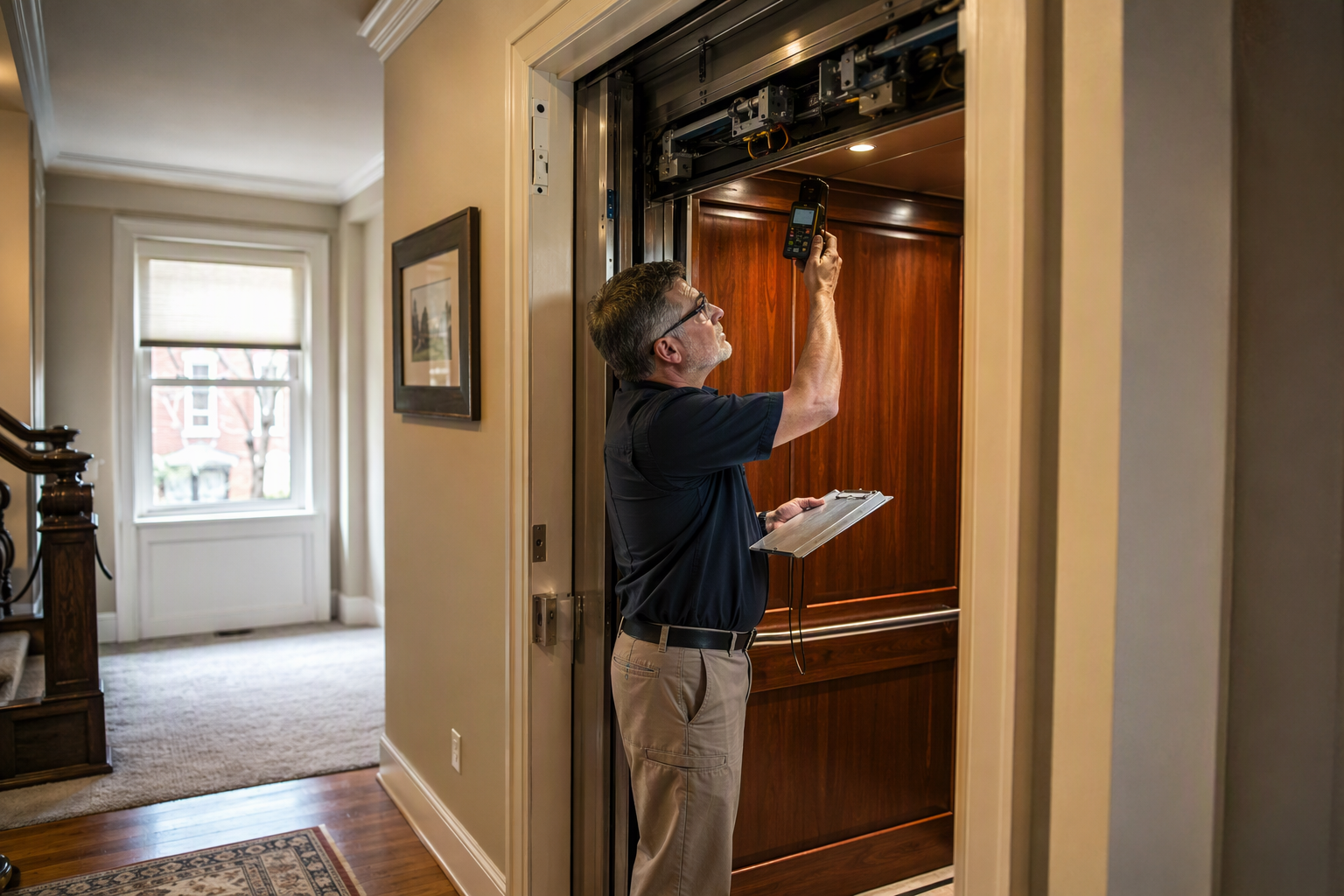
Yes — Quality Elevator Company performs annual and periodic inspections for residential elevators throughout its service area.
Quality Elevator Company is a certified elevator service company operating in Baltimore MD, Washington DC, Philadelphia PA, and Richmond VA. The company coordinates all required periodic inspections, Category 1 and Category 5 tests, third-party inspection reporting, and certificate renewal paperwork for residential elevator owners in each of these jurisdictions. Every inspection is performed or witnessed by appropriately credentialed inspectors in accordance with the ASME A17.1 Safety Code for Elevators and Escalators and applicable state and local regulations.
Are residential elevators legally required to have annual inspections?
In most cases, yes — residential elevators that serve multi-family or publicly accessible buildings are subject to mandatory periodic inspection requirements, though single-family home elevators are often exempt from state oversight in Maryland, Pennsylvania, and Virginia.
The regulatory picture varies by jurisdiction. Maryland’s elevator inspection and certificate law generally does not apply to units in privately owned single-family homes. Pennsylvania’s Uniform Construction Code elevator rules do not apply to lifting devices used only by the occupants of a single dwelling unit. Virginia similarly exempts single-family homes, two-family homes, and townhouses from local building department elevator enforcement. The District of Columbia, by contrast, requires that all elevators and escalators be inspected and certified for operation, making DC the strictest jurisdiction in Quality Elevator Company’s service area for residential elevator oversight.
Even where the law does not mandate inspection of a private home elevator, annual inspections are strongly recommended as a matter of safety and equipment longevity. Mechanical and electrical components degrade over time, and an uninspected elevator can develop hazards that are not visible to untrained owners.
What code governs residential elevator inspections?
The primary national standard is the ASME A17.1 Safety Code for Elevators and Escalators, adopted — in different editions — by each of the four jurisdictions Quality Elevator Company serves.
Each jurisdiction has adopted a specific edition of ASME A17.1:
- District of Columbia: ASME A17.1-2013/CSA B44-13, as referenced by the 2017 DC Building Code with District amendments, effective May 29, 2020. DC’s regulations are found at the DC Department of Buildings (DOB) elevator page and in 12-A DCMR Chapter 30.
- Maryland: ASME A17.1-2022/CSA B44:22, with Maryland changes, effective June 17, 2026. Maryland’s program is administered by the Maryland Department of Labor, Division of Labor and Industry, Elevator and Escalator Safety.
- Pennsylvania: ASME A17.1-2000 with the A17.1a-2002 addenda (for permits issued before December 20, 2026); ASME A17.1-2016 applies to permit applications made on or after December 20, 2026. Pennsylvania’s program is overseen by the Pennsylvania Department of Labor and Industry, Bureau of Occupational and Industrial Safety, Elevator Section.
- Virginia: ASME A17.1/CSA B44-2019, incorporated by the 2021 Virginia Uniform Statewide Building Code, effective January 18, 2024. Virginia’s inspection framework is governed by 13VAC5-63, the Virginia Uniform Statewide Building Code.
How often must a residential elevator be inspected in Maryland?
Each elevator unit in Maryland must have a periodic annual inspection by a State inspector or a third-party qualified elevator inspector, plus a comprehensive five-year inspection for elevators suspended by wire ropes, belts, chains, or similar means.
Maryland’s requirements are grounded in the Annotated Code of Maryland, Public Safety Article, Title 12, Subtitle 8, and implemented through COMAR 09.12.81. An elevator unit may not be operated unless the Commissioner of Labor and Industry has issued a certificate for it, and that certificate must be posted conspicuously in or on the elevator unit. Owners must re-register their elevator units with the Commissioner every year, at the time of the periodic annual inspection. Tests performed for a required inspection must be performed by a licensed elevator mechanic, and when a third-party qualified elevator inspector is required to witness a test, that inspector must be physically present for the entire test.
How often must elevators be inspected in the District of Columbia?
DC requires a periodic inspection and a Category 1 inspection every 12 months, and a Category 5 inspection every 60 months, each conducted by an ASME QEI-certified inspector approved by the DC Department of Buildings.
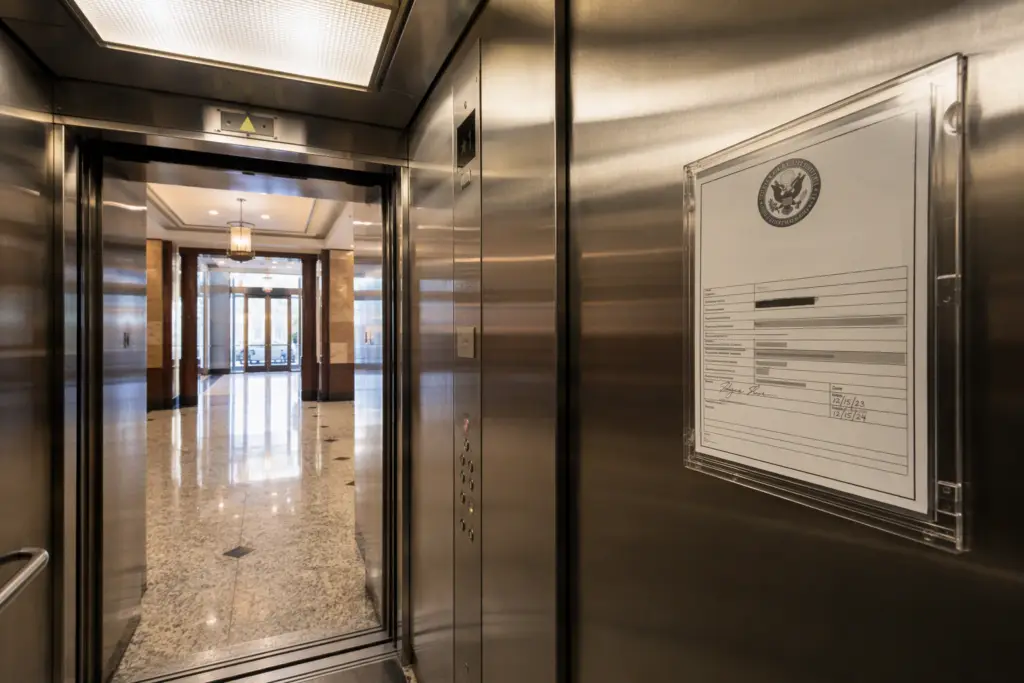
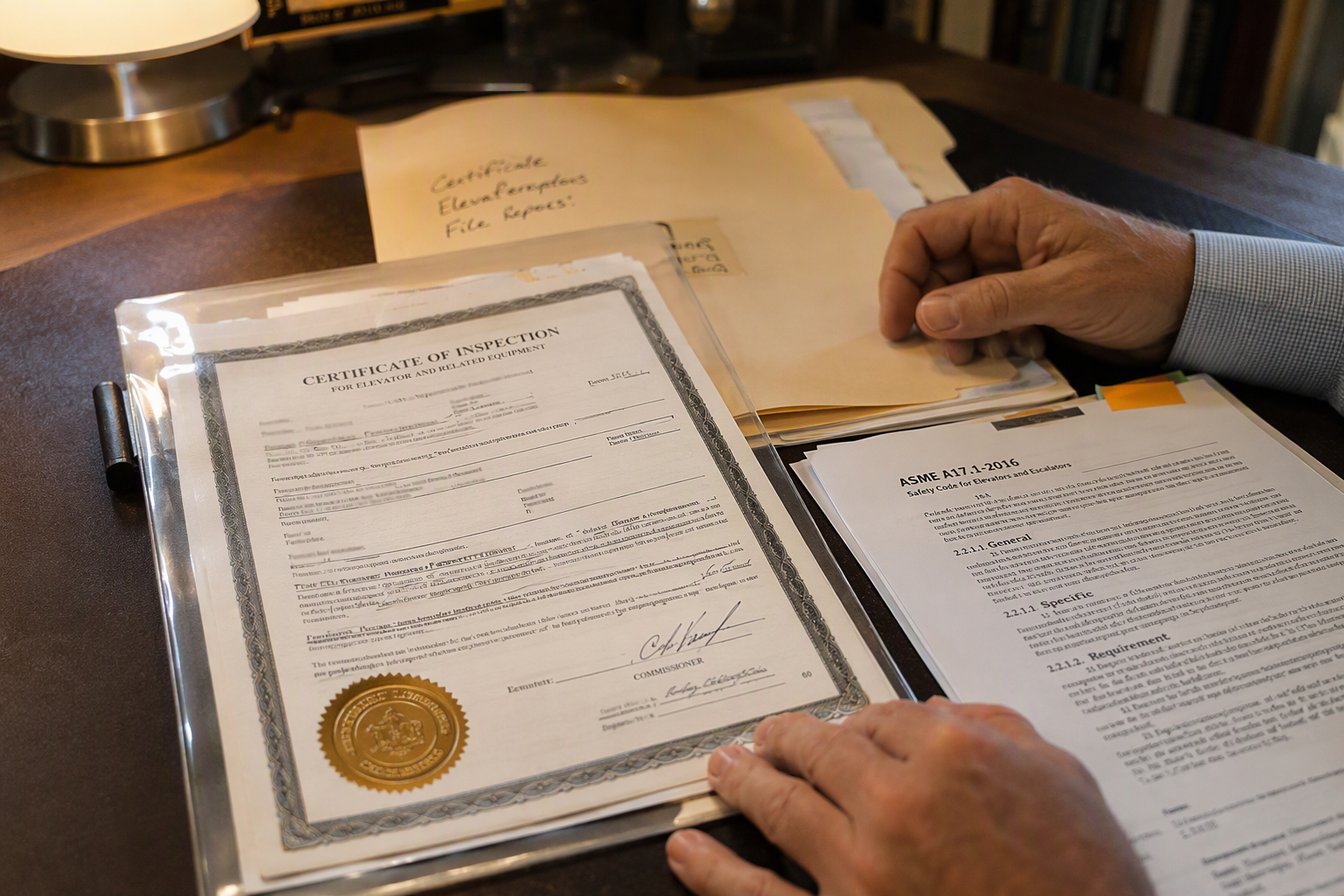
The DC Department of Buildings issues elevator certificates of inspection that are valid for two years; periodic inspections and tests continue during that two-year certification period. Owners must use a DOB-approved third-party elevator inspection agency, which inspects elevators on DOB’s behalf. Inspection reports for the past two years must be submitted to DOB through the Citizen Access Portal to obtain a certificate of inspection. A copy of the current certificate must be conspicuously displayed in the elevator car or attached to the conveyance unless an applicable exemption applies.
How often must elevators be inspected in Pennsylvania?
Electric elevators and hydraulic elevators in Pennsylvania must have periodic inspections at intervals of no more than six months, which is a more frequent requirement than most other states.
Pennsylvania’s elevator program is administered by the Pennsylvania Department of Labor and Industry under 34 Pa. Code Chapter 405, part of the Uniform Construction Code. An elevator may not be operated unless L&I has issued a certificate of operation. A certificate of operation is valid for 24 months for equipment on a six-month inspection cycle and 48 months for equipment on a 12-month cycle. Starting December 20, 2026, Category 1 tests must be performed every year as a stand-alone requirement under the incoming ASME A17.1-2016 rules, and periodic tests must be witnessed by a construction code official.
How often must elevators be inspected in Virginia?
All elevators and escalators in Virginia require an annual periodic inspection, and a locality may require a six-month periodic inspection at its discretion.
Virginia elevator enforcement is the responsibility of local building departments rather than a statewide agency. In Richmond, the City of Richmond Department of Planning and Development Review, Bureau of Permits and Inspections, runs the elevator program, conducting annual elevator inspections with test and issuing elevator certificates. Periodic tests must follow ASME A17.1 Appendix N intervals and be witnessed by the local code official or an approved agency. The current certificate of inspection must be displayed in the elevator, kept available in the building operator’s office, or posted in an approved conspicuous location.
What is the difference between a Category 1 and a Category 5 elevator test?
A Category 1 test is an annual no-load safety test of the elevator’s operation and safety devices, while a Category 5 test is a comprehensive five-year full-load test that includes rated-load operation and governor and safety system testing.
The ASME A17.1 Safety Code for Elevators and Escalators defines these test categories in Appendix N. Category 1 tests verify that the elevator’s safeties, brakes, and operating systems function correctly under normal conditions without applying the full rated load in a destructive manner. Category 5 tests go further, requiring full-load operation and a governor tripping test that physically engages the safety mechanism to confirm it can stop and hold the car. For residential elevators subject to these requirements, both tests must be performed by a licensed elevator mechanic and witnessed by an approved inspector.
What happens during a residential elevator annual inspection?
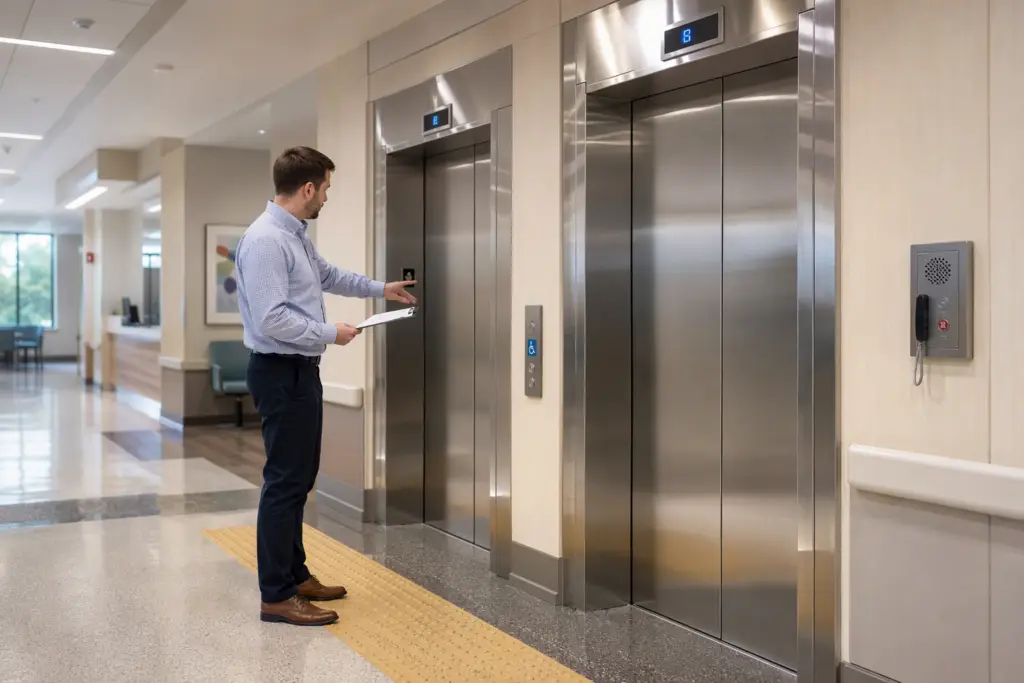
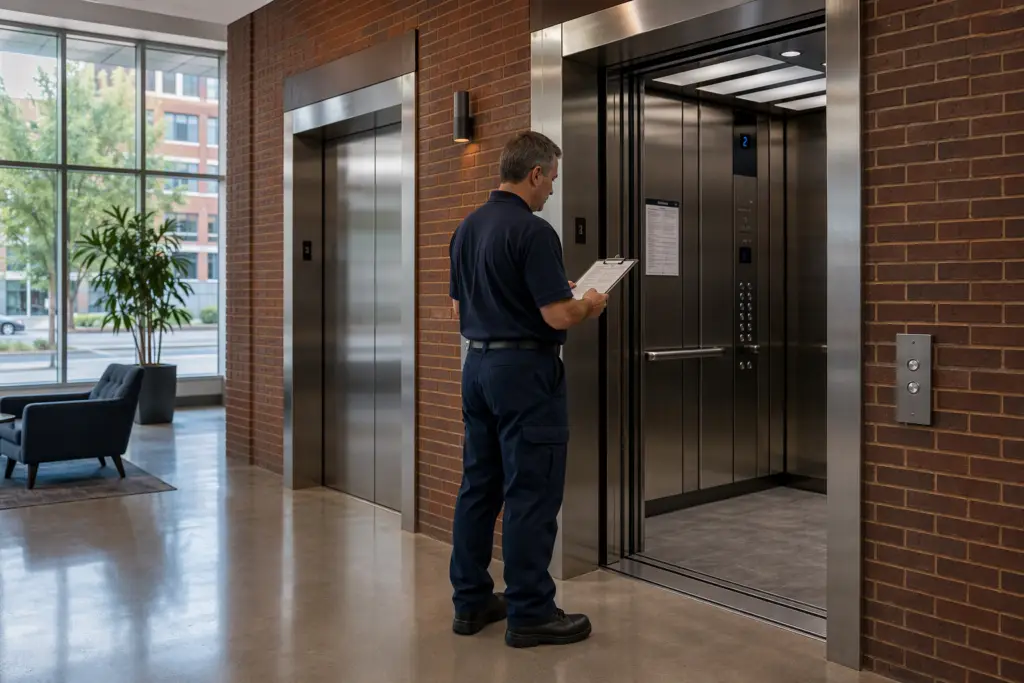
A residential elevator annual inspection covers the car, hoistway, machine room or machinery space, safety devices, controls, and all code-required clearances and guarding in a systematic top-to-bottom review.
The following sequence reflects the standard inspection protocol used by qualified elevator inspectors:
- Pre-inspection documentation review: The inspector reviews the elevator’s maintenance and test records, prior inspection reports, and current certificate of inspection.
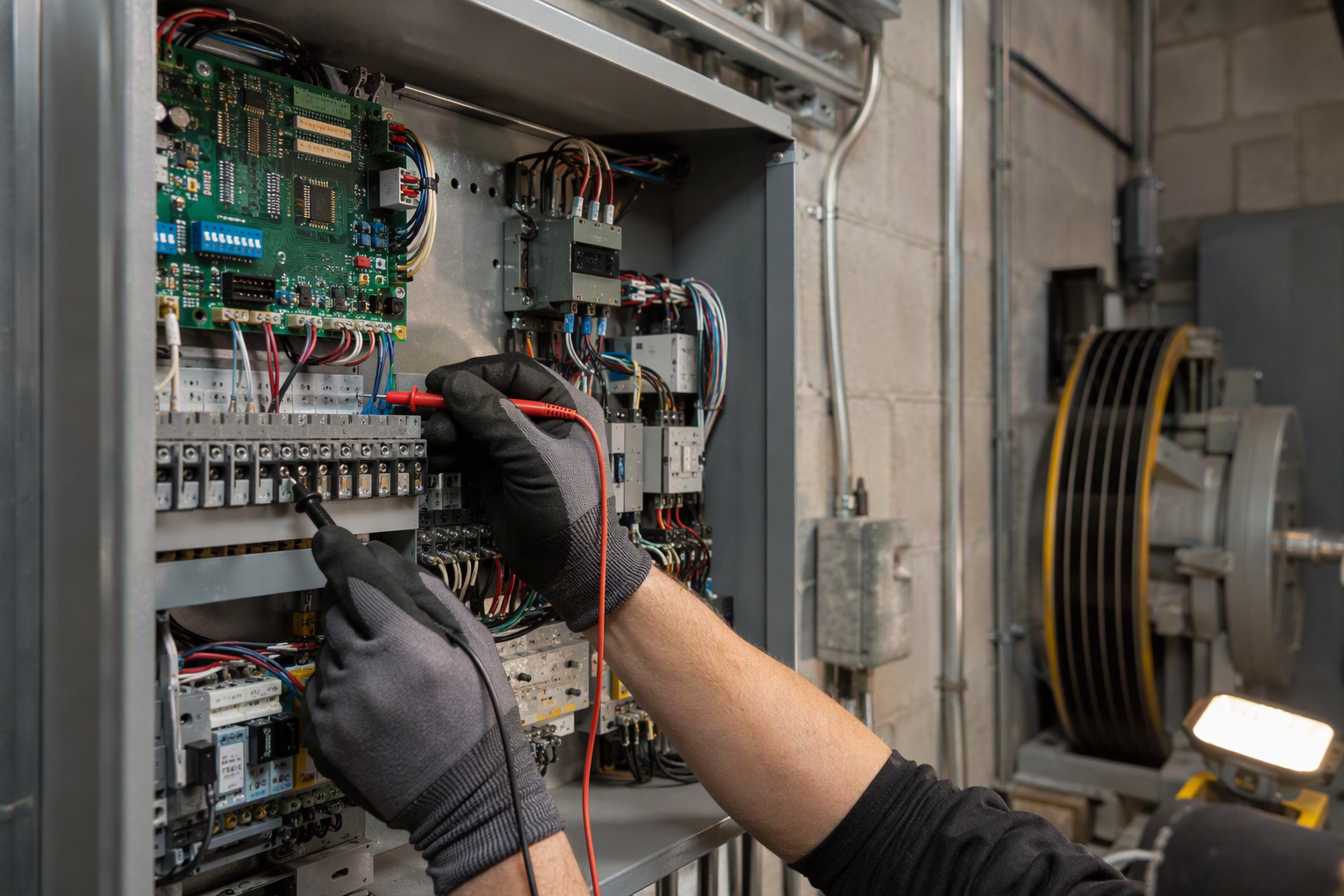
- Machine room or machinery space examination: The inspector checks the drive machine, controller, governor, oil levels (hydraulic units), wiring condition, and emergency lighting.
- Hoistway inspection: The inspector examines the rails, buffers, pit equipment, safety devices, governor tension frame, and clearances from top to bottom of the hoistway.
- Pit inspection: The inspector verifies pit lighting, stop switch, ladder condition, oil contamination, water intrusion, and buffer clearances.
- Door and landing equipment inspection: All hoistway doors, interlocks, sills, and landing operating fixtures are tested for proper function and condition.
- Car inspection: The car frame, platform, enclosure, lighting, emergency communications, capacity posting, and operating controls are evaluated.
- No-load functional tests: Safety circuits, safeties, brakes, speed governor, and all operating modes are tested.
- Witnessed load tests (Category 1 or as required): A licensed elevator mechanic performs required tests while the inspector observes in person.
- Deficiency documentation: All deficiencies are recorded in writing, with code references, and provided to the owner.
- Inspection report submission: The completed report is submitted to the applicable regulatory authority as required by jurisdiction.
Who is qualified to inspect a residential elevator?
Residential elevator inspections must be performed by inspectors who meet the qualifications established by each jurisdiction’s regulator — typically ASME QEI-certified inspectors or inspectors certified under the applicable Uniform Construction Code.
In the District of Columbia, applicants for a DC elevator inspector license must meet the ASME QEI-1 standard or an equivalent. In Maryland, periodic inspections must be conducted by a State inspector or a third-party qualified elevator inspector, and tests must be performed by a licensed elevator mechanic. In Pennsylvania, any UCC-certified elevator inspector may conduct a periodic inspection, and third-party agencies must be certified by the Department of Labor and Industry. In Virginia, local building departments may have inspections and test witnessing conducted by an approved agency or by local certified elevator inspectors. No one may work as an elevator mechanic in Virginia without state certification, unless working under the direct and immediate supervision of a certified mechanic.
What inspection records must be kept on site?
In Maryland, maintenance, repair, test, and inspection records must be kept at a readily accessible central location in the building where the elevator is located.
Good recordkeeping serves multiple regulatory and practical purposes across all four jurisdictions. In DC, inspection reports for the past two years must be submitted to the DOB to obtain a certificate of inspection, making organized records essential. In Pennsylvania, the certificate of operation or a copy must be posted in the elevator car or attached to the controller in the machine room. In Virginia, the current certificate must be displayed in the elevator, kept in the building operator’s office, or posted in an approved conspicuous location. Owners who maintain complete records — including maintenance logs, test results, deficiency correction documentation, and inspector reports — are far better positioned during any regulatory review or in the event of an incident.
What is the inspection and certification process for a new residential elevator?
Before a new residential elevator can be placed in service, it must pass an acceptance inspection conducted by or on behalf of the regulatory authority in the applicable jurisdiction.
The process in Quality Elevator Company’s service markets follows these general steps:
- Permit application: A permit application must be submitted to the appropriate authority (DC DOB, Maryland Department of Labor, Pennsylvania L&I, or the local Virginia building department) before installation begins.
- Installation: Installation is performed by a licensed elevator contractor using licensed elevator mechanics. In DC, elevator permits require a copy of the master electrician license and the elevator contracting license. In Maryland, elevator units must be registered with the Commissioner at least 60 days before planned completion.
- Acceptance inspection: The regulatory authority conducts a final acceptance inspection after the elevator is installed and before it is placed in service. In Maryland, the State conducts this inspection; in Pennsylvania, the Department of Labor and Industry conducts the acceptance inspection; in Virginia, the local building department handles acceptance.
- Certificate issuance: Upon passing the acceptance inspection, the authority issues an initial certificate of operation or certificate of inspection.
- Ongoing periodic inspections: The owner arranges for annual (or more frequent, where required) periodic inspections to maintain the certificate.
What are common deficiencies found during residential elevator inspections?
Common deficiencies include worn or misaligned door interlocks, inadequate pit lighting or stop switches, deteriorated wire ropes or hydraulic hoses, inoperative emergency lighting, expired lubrication on guide rails, and missing or illegible capacity postings.
Safety device issues — particularly door interlock failures — are among the most frequently cited problems. These devices prevent the elevator from operating unless all hoistway doors are fully closed and locked, and a failed interlock is a direct safety hazard. Hydraulic residential elevators may show signs of oil leakage around the cylinder or valve unit, which requires prompt attention both for safety and environmental reasons. Emergency communication systems, required to allow occupants to summon help if trapped, are another common inspection failure point. Quality Elevator Company’s inspection teams document every deficiency with specific code references so owners understand exactly what needs to be corrected and why.
What happens if a residential elevator fails an inspection?
A failed inspection typically results in a deficiency report or order that requires the owner to correct identified problems and pass a follow-up inspection before the elevator can be returned to or remain in service.
The specific consequences vary by jurisdiction. In Pennsylvania, after a major repair, replacement, or alteration, an elevator may not return to service until the Department inspects and passes it. In Maryland, an elevator unit may not be operated unless a valid certificate has been issued. In DC, a DOB permit is required to take an elevator out of service. Owners who operate an elevator without a valid certificate face potential enforcement action. When deficiencies are identified, corrections must be made by a licensed elevator mechanic, and in many cases a follow-up inspection or witnessed test is required before the certificate can be reinstated or renewed.
How do annual inspections differ across Maryland, DC, Philadelphia, and Richmond?
Inspection frequency, certification validity periods, and the identity of the inspecting authority differ meaningfully across the four markets Quality Elevator Company serves.
| Jurisdiction | Inspecting Authority | Periodic Inspection Interval | Certificate Validity | 5-Year Test Required? | Adopted ASME Edition |
|---|---|---|---|---|---|
| District of Columbia | DOB-approved third-party agency (ASME QEI-certified) | Every 12 months (Category 1) | 2 years | Yes — Category 5 every 60 months | ASME A17.1-2013/CSA B44-13 |
| Maryland | State inspector or third-party qualified elevator inspector | Annual | Annual re-registration required | Yes — comprehensive 5-year inspection | ASME A17.1-2022/CSA B44:22 (eff. June 17, 2026) |
| Pennsylvania (Philadelphia) | UCC-certified elevator inspector / PA L&I | Every 6 months | 24 months (6-mo. cycle); 48 months (12-mo. cycle) | Yes — per ASME A17.1 Appendix N schedule | ASME A17.1-2000 w/ A17.1a-2002 (new: A17.1-2016 from Dec. 20, 2026) |
| Virginia (Richmond) | Local building department (City of Richmond Bureau of Permits and Inspections) | Annual (locality may require 6-month) | Annually renewed | Yes — per ASME A17.1 Appendix N | ASME A17.1/CSA B44-2019 (eff. Jan. 18, 2024) |
Does the ADA require residential elevators to be inspected?
The Americans with Disabilities Act (ADA) establishes accessibility requirements for elevators in places of public accommodation and commercial facilities, but it does not itself mandate a specific inspection interval — that obligation comes from ASME A17.1 and state law.
Where a residential elevator also serves common areas of a multi-unit building or a facility covered by the ADA, the elevator must meet ADA accessibility standards for its design and operation. Owners have an ongoing obligation to maintain accessible features in working order. An elevator that is out of service or operating unsafely due to deferred maintenance may create both a code violation under ASME A17.1 and an ADA accessibility compliance issue. Annual inspections are one practical mechanism for ensuring that ADA-required features — such as proper door timing, accessible controls at the required heights, and audible and visual signals — remain functional.
What maintenance should be performed between annual inspections?
Between annual inspections, residential elevator owners should ensure that routine lubrication, hydraulic fluid level checks, door adjustment, safety device function checks, and pit cleanliness are maintained on a schedule consistent with the manufacturer’s recommendations and ASME A17.1 maintenance requirements.
ASME A17.1 requires that elevators be maintained in a safe operating condition, and this obligation runs continuously — not only at inspection time. A planned maintenance program typically includes monthly operational tests, periodic lubrication of guide rails and roller guides, annual oil sampling for hydraulic units, rope inspection and tension equalization for traction elevators, and verification of emergency lighting and communication systems. Maintenance, repair, test, and inspection records must be kept in Maryland at a readily accessible central location in the building. In jurisdictions where inspectors review maintenance logs as part of the inspection, a well-documented maintenance history demonstrates due diligence and can expedite the inspection process.
What should a residential elevator owner do if their elevator is out of service?
An owner whose residential elevator is out of service should immediately contact a licensed elevator contractor to assess the situation, keep the elevator locked out of use, and notify the applicable regulatory authority if the outage affects a certificate-holding installation.
The following steps are recommended when a residential elevator goes out of service:
- Immediately take the elevator out of service: Lock the car at a landing with doors open and place an “Out of Service” notice at all landings.
- Do not attempt DIY repairs: Elevator mechanical and electrical systems involve high voltages and moving counterweights; repairs must be made by a licensed elevator mechanic.
- Contact a licensed elevator contractor: A qualified technician should assess the malfunction and determine whether a permit is required for repair.
- Notify the regulatory authority if required: In DC, a DOB permit is required to take an elevator out of service under ASME A17.1 Section 8.11.1.4 or to place it in temporarily dormant status. In Pennsylvania, owners must submit an accident report to the Department when an elevator accident causes a fatality or requires professional medical care.
- Arrange for repairs and follow-up inspection: After repairs are completed, schedule the required acceptance or return-to-service inspection before resuming operation.
- Update maintenance records: Document the outage, cause, repair performed, parts replaced, and technician information in the building’s maintenance log.
How far in advance should a residential elevator inspection be scheduled?
Scheduling a residential elevator inspection well ahead of the certificate expiration date — ideally at least 60 to 90 days in advance — allows time to address any deficiencies found and complete required re-inspections before the certificate lapses.
Regulatory deadlines are firm. In Maryland, owners must re-register elevator units every year at the time of the periodic annual inspection. In DC, owners submit inspection reports through the Citizen Access Portal to obtain a new certificate; delays in report submission translate directly into delays in certificate issuance. If deficiencies are identified during the inspection, correction and re-inspection take additional time. Elevator contractors and third-party inspection agencies often have scheduling lead times, particularly in busy urban markets like Baltimore and Washington DC. Quality Elevator Company recommends that residential elevator owners track their certificate expiration dates and initiate scheduling conversations well ahead of those deadlines to avoid any lapse in legal operating authority.
Can a residential elevator be modernized and still pass its annual inspection?
Yes — a modernized residential elevator can continue to pass annual inspections, but the modernization work itself requires permits, an acceptance inspection, and must comply with the applicable code edition in force at the time the modernization permit is filed.
Modernization projects — which typically include control system upgrades, new door operators, or drive machine replacements — trigger a permit requirement in all four of Quality Elevator Company’s service jurisdictions. In DC, a certificate may be temporarily suspended while an elevator is under permit for alteration or modernization. In Maryland, the State conducts a final acceptance inspection after an elevator unit is modified or altered and before it is placed in service. In Pennsylvania, after a major repair, replacement, or alteration, an elevator may not return to service until the Department inspects and passes it. After modernization, the elevator’s ongoing inspection obligations continue on the standard schedule. Quality Elevator Company coordinates both the modernization permitting and the post-modernization inspection process for its residential clients.
How can Quality Elevator Company help with residential elevator compliance?
Quality Elevator Company manages the full inspection and compliance cycle for residential elevator owners in Baltimore, Washington DC, Philadelphia, and Richmond — from scheduling and coordinating qualified inspectors to submitting required reports and tracking certificate renewal deadlines.
Residential elevator compliance involves a web of overlapping obligations: selecting an appropriately credentialed inspector, arranging for a licensed mechanic to perform witnessed tests, submitting reports to the correct regulatory portal, maintaining on-site records, and tracking renewal dates across multiple-year certificate cycles. For owners of elevators in jurisdictions with different inspection intervals, code editions, and regulatory contacts, managing these obligations without professional support is a significant administrative burden. Quality Elevator Company serves as a single point of contact for all of these functions, drawing on deep familiarity with the requirements of the DC Department of Buildings, the Maryland Department of Labor, the Pennsylvania Department of Labor and Industry, and the local building departments in Virginia including the City of Richmond Bureau of Permits and Inspections.
Schedule Your Residential Elevator Inspection Today
Annual inspections are not just a regulatory obligation — they are the most reliable way to keep a residential elevator safe for the people who depend on it. Whether a home elevator is subject to mandatory state inspection in Washington DC or Maryland, falls under Pennsylvania’s six-month inspection cycle in Philadelphia, or is due for its annual local inspection in Richmond VA, the inspection process involves real technical complexity and regulatory stakes. Delaying or skipping inspections puts occupants at risk and exposes owners to potential enforcement consequences.
Quality Elevator Company coordinates residential elevator inspections, Category 1 and Category 5 tests, maintenance programs, deficiency corrections, and certificate renewal across all four of its service markets. The company’s teams understand the specific requirements of each jurisdiction’s regulator and can guide owners through every step of the compliance process.
Contact Quality Elevator Company for a free elevator assessment.
Call 301-779-9116 to speak with a specialist about your residential elevator inspection needs in Baltimore MD, Washington DC, Philadelphia PA, or Richmond VA.
Need elevator service you can rely on? Quality Elevator Company is ready to help.