Do Elevator Service Companies Service Residential Elevators? Complete FAQ Guide
Residential elevators are no longer exclusive to large estates or luxury high-rises. As homeowners age in place and multigenerational living becomes more common across Baltimore, Washington DC, Philadelphia, and Richmond, private home elevators, platform lifts, stairlifts, and vertical platform lifts have become standard accessibility solutions. The question most homeowners ask is straightforward: can the same elevator service companies that maintain commercial buildings also service a residential unit? The answer is yes — and the regulatory framework governing that service is more detailed than many homeowners realize.
This FAQ hub covers everything property owners need to know about residential elevator service, from applicable codes and inspection schedules to what happens when a home elevator fails and how to choose a qualified contractor across Maryland, the District of Columbia, Pennsylvania, and Virginia.
1. Do elevator service companies service residential elevators?
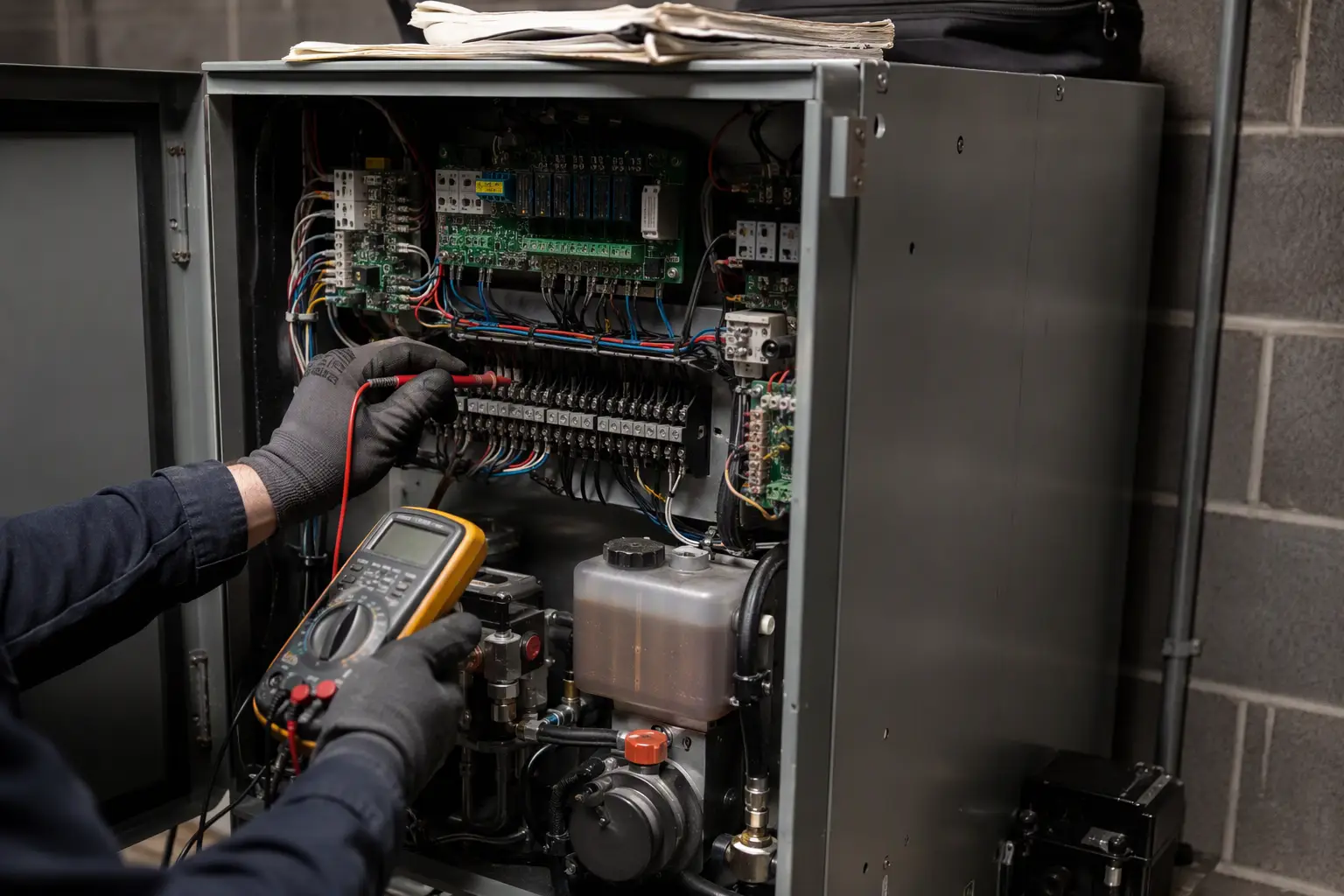
Yes — qualified elevator service companies routinely service residential elevators, including private-residence hydraulic elevators, traction elevators, winding drum elevators, vertical platform lifts, and stairlifts, provided the contractor holds the appropriate license or certification required by the applicable jurisdiction.
Residential elevator service encompasses the same core disciplines as commercial elevator work: routine maintenance, periodic safety inspections, code-required testing, parts replacement, and modernization. The equipment may be smaller and the traffic volume lower, but the mechanical and electrical complexity demands the same professional expertise. Under the ASME A17.1/CSA B44 Safety Code for Elevators and Escalators, private residence elevators are a recognized equipment category with their own design and safety requirements.
In Maryland, Virginia, and the District of Columbia, only licensed or certified elevator mechanics and contractors may perform maintenance, repair, or alteration work on elevator equipment — including residential units covered by those states’ statutes. Pennsylvania’s Uniform Construction Code similarly requires certified inspection and permitting for covered lifting devices, though it explicitly exempts lifting devices used only by the occupants of a single dwelling unit from those rules. Homeowners across Quality Elevator Company’s service area should verify whether their specific unit and jurisdiction fall under state regulation before assuming an exemption applies.
2. What types of residential elevator equipment do service companies cover?
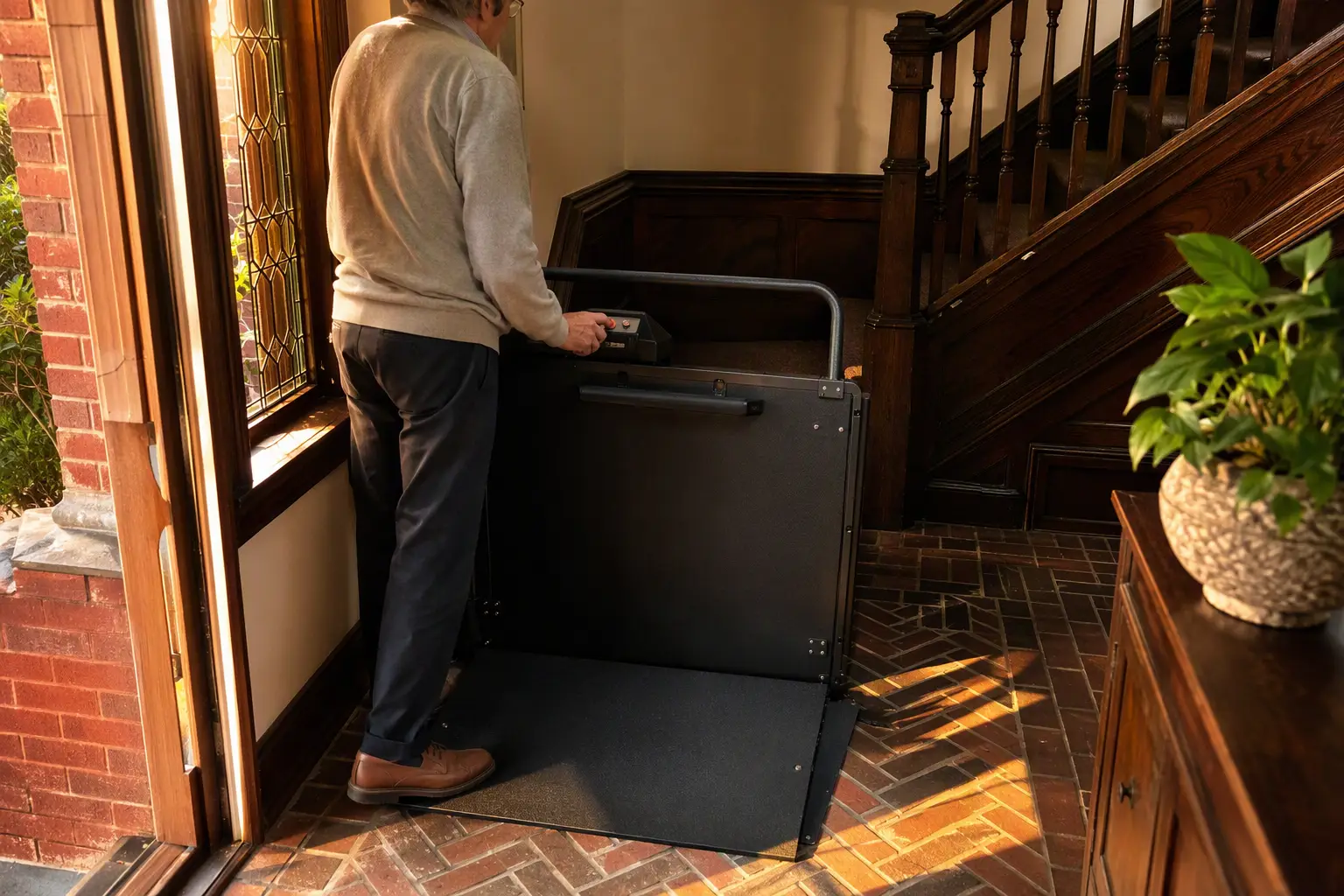
Residential elevator service companies typically cover a broad range of home lifting equipment, including hydraulic elevators, cable-driven traction elevators, pneumatic vacuum elevators, winding drum elevators, vertical platform lifts, inclined platform lifts, and stairlifts.
Each equipment type has different maintenance demands:
- Hydraulic residential elevators use a fluid-powered piston mechanism. Routine service includes fluid level checks, cylinder integrity inspections, valve function testing, and pit condition assessments.
- Winding drum and traction elevators rely on cables and sheaves. Service includes cable tension and wear inspection, brake adjustment, and machine room maintenance.
- Pneumatic vacuum elevators use air pressure differentials. Service involves seal integrity, turbine performance, and control system calibration.
- Vertical platform lifts (VPLs) serve wheelchair users on open or enclosed platforms. They fall under ASME A18.1 Safety Standard for Platform Lifts and Stairway Chairlifts and require their own inspection and maintenance protocols.
- Stairlifts travel along a rail mounted to the staircase. Service includes rail lubrication, drive system inspection, obstruction sensor testing, and battery backup checks.
Quality Elevator Company services all major residential elevator and lift types across Baltimore, Washington DC, Philadelphia, and Richmond, applying manufacturer specifications alongside applicable code requirements for each unit type.
3. Are residential elevators regulated the same way as commercial elevators?
No — residential elevators are often subject to different or more limited regulatory requirements than commercial elevators, and the scope of regulation varies significantly by jurisdiction, though some states extend commercial-grade inspection requirements to home elevators in certain building types.
The key distinction in most jurisdictions is whether the elevator serves a privately owned single-family home versus a multifamily or mixed-use building. Maryland’s elevator inspection and certificate law, for example, generally does not apply to units in privately owned single-family homes. Pennsylvania’s Uniform Construction Code elevator rules do not apply to lifting devices used only by the occupants of a single dwelling unit. Virginia enforces the building code for elevators through local building departments but exempts elevators in single-family homes, two-family homes, and townhouses from those local inspection requirements.
The District of Columbia requires all elevators and escalators in the District to be inspected and certified for operation. DC’s regulatory framework does not carve out a blanket single-family residential exemption in the same explicit manner, making it important for DC homeowners with residential elevators to confirm their compliance obligations with the DC Department of Buildings (DOB).
Even when state inspection statutes do not apply to a private home elevator, the equipment was still installed under a building permit and must comply with the code edition in effect at the time of installation. Ongoing maintenance per the manufacturer’s specifications and the applicable edition of ASME A17.1 remains a practical and legal expectation regardless of whether annual state inspections are mandated.
4. What codes govern residential elevator installation and service in Maryland, DC, Virginia, and Pennsylvania?
Residential elevator installation and service across Quality Elevator Company’s service area are governed primarily by the ASME A17.1/CSA B44 Safety Code for Elevators and Escalators, adopted in different editions by each jurisdiction, along with state-specific rules and statutes.
| Jurisdiction | Regulating Agency | Adopted ASME Edition (as of 2026) | Key Residential Exemption | Official Resource |
|---|---|---|---|---|
| Maryland | Maryland Department of Labor, Division of Labor and Industry, Elevator and Escalator Safety | ASME A17.1-2022/CSA B44:22 (effective June 17, 2026) | Privately owned single-family homes generally exempt from state inspection/certificate law | Maryland DOL Elevator Safety |
| District of Columbia | DC Department of Buildings (DOB) | ASME A17.1-2013/CSA B44-13 (2017 DC Building Code, effective May 29, 2020) | No broad single-family residential exemption confirmed — owners should confirm with DOB | DC DOB Elevators & Conveyances |
| Pennsylvania | PA Department of Labor and Industry, Bureau of Occupational and Industrial Safety, Elevator Section | ASME A17.1-2000/A17.1a-2002; ASME A17.1-2016 for permit applications from Dec. 20, 2026 | Lifting devices used only by occupants of a single dwelling unit are exempt from UCC elevator rules | PA L&I Elevator Section |
| Virginia | Local building departments; mechanics certified and contractors licensed by Virginia Board for Contractors (DPOR) | ASME A17.1/CSA B44-2019 (2021 USBC, effective January 18, 2024) | Single-family homes, two-family homes, and townhouses exempt from local building department elevator inspection | 13VAC5-63 Virginia USBC |
Even where residential exemptions exist, the exemption applies to mandatory state or local inspection programs — not to the underlying safety code obligations or the requirement to use licensed mechanics for any work performed on the equipment.
5. Do residential elevators need to be inspected even if the state doesn’t require it for private homes?
Yes — regular professional inspection of residential elevators is strongly advisable even when a jurisdiction’s mandatory inspection program does not apply, because mechanical and safety systems degrade over time regardless of regulatory oversight, and the consequences of failure in a home setting can be severe.
Manufacturers of residential elevator equipment publish recommended maintenance and inspection intervals that service companies follow when state schedules do not apply. These schedules typically address safety device function, drive system condition, door and gate operation, emergency lowering capability, and pit and hoistway conditions. Skipping routine inspections accelerates wear, can void equipment warranties, and may affect homeowner insurance coverage.
For home elevators in multifamily buildings — such as a private elevator in a condominium penthouse or a luxury apartment — the building classification may bring the elevator under full commercial regulatory requirements, including annual periodic inspections. Owners of elevators in any building type other than a clearly exempt single-family residence should confirm their obligations with the appropriate agency.
6. How often should a residential elevator be serviced?
A residential elevator should receive a professional maintenance visit at least once or twice per year, with specific inspection and testing intervals determined by the equipment type, the jurisdiction, and the manufacturer’s requirements.
For regulated residential elevators — those not covered by a state exemption — the applicable ASME A17.1 edition and state rules set minimum intervals. In Virginia, all elevators and escalators require an annual periodic inspection, and a locality may require a six-month periodic inspection, under 13VAC5-63. In Maryland, each regulated elevator unit must have a periodic annual inspection. In the District of Columbia, a Category 1 inspection is required every 12 months and a Category 5 inspection every 60 months, each by an ASME QEI-certified inspector. In Pennsylvania, electric and hydraulic elevators on a regulated cycle must have periodic inspections at intervals of no more than six months.
For home elevators in exempt classifications, a service company such as Quality Elevator Company can develop a maintenance schedule based on the equipment manufacturer’s specifications, usage volume, age of the unit, and any conditions identified during prior service visits. Annual preventive maintenance at minimum is widely regarded as best practice for private residence elevators.
7. What does a residential elevator maintenance visit typically include?
A standard residential elevator maintenance visit covers a systematic inspection and testing of all major mechanical, electrical, and safety systems on the unit, with any deficiencies documented and corrected or scheduled for repair.
Service technicians conducting routine residential elevator maintenance typically examine and address the following:
- Drive system condition (hydraulic fluid and cylinder integrity, or cable/rope tension and wear)
- Safety device function, including governor, buffers, and safeties where applicable
- Door, gate, and interlocking mechanism operation
- Car and counterweight guide rail lubrication and alignment
- Control system performance and fault code review
- Emergency stop, alarm, and lighting function
- Pit condition: drainage, lighting, stop switches, and cleanliness
- Machine room or motor unit condition and ventilation
- Level accuracy (floor-to-floor stopping precision)
- Cab interior condition and emergency communication system
Findings are documented in maintenance records, which Maryland regulations require to be kept at a readily accessible central location in the building where the elevator is located, even for residential units subject to Maryland’s law.
8. What qualifications must a residential elevator service company have in Maryland, DC, Virginia, and Pennsylvania?
In Maryland, Virginia, and the District of Columbia, elevator contractors and mechanics must hold specific licenses or certifications before legally servicing any elevator equipment, including residential units not otherwise exempt from inspection statutes.
The requirements by jurisdiction are:
- Maryland: A business must be licensed by the Maryland Elevator Safety Review Board as an elevator contractor before engaging in the business of installing, altering, maintaining, repairing, or servicing elevator units. A person must be licensed by the Board as an elevator mechanic before working on elevator units. Elevator contractors must carry at least $1,000,000 in general liability insurance and at least $500,000 in property damage insurance. The Maryland Elevator Safety Review Board operates within the Maryland Department of Labor, Division of Labor and Industry.
- District of Columbia: The DC Board of Industrial Trades licenses elevator contractors, elevator mechanics, and elevator inspectors. DOB elevator permits require a copy of the master electrician license and the elevator contracting license. Inspectors must meet ASME QEI-1 or an equivalent standard. Licensing oversight falls under DC’s Department of Licensing and Consumer Protection (DLCP) Board of Industrial Trades, while elevator certificates are issued by the DC Department of Buildings (DOB).
- Virginia: No one may work as an elevator mechanic in Virginia without state certification unless working under direct and immediate supervision of a certified mechanic. Installing, repairing, improving, or removing elevators in Virginia requires a contractor license with the Elevator/Escalator Contracting (EEC) specialty from the Virginia Board for Contractors (DPOR). Certified mechanics must complete at least eight hours of Board-approved continuing education to renew certification. Enforcement is through local building departments under 13VAC5-63.
- Pennsylvania: Third-party agencies inspecting elevators under the Uniform Construction Code must be certified by the Pennsylvania Department of Labor and Industry. Any UCC-certified elevator inspector may conduct a periodic inspection. Regarding statewide mechanic or contractor licensing in Pennsylvania, the applicable rules should be confirmed directly with the Department.
Quality Elevator Company operates with the licenses and certifications required by each jurisdiction it serves, ensuring residential customers receive compliant, qualified service.
9. Are residential elevators covered under ADA requirements?
The Americans with Disabilities Act (ADA) generally does not apply to private residential dwellings owned or used exclusively as residences, but ADA accessibility standards do apply when a home elevator is installed in a commercial, public, or multifamily housing context.
When a private residence elevator is installed in a building that serves the public — such as a home-based business open to clients, a bed and breakfast, or a residential facility — ADA accessibility requirements for elevator design and operation may be triggered. The ADA Standards for Accessible Design specify requirements for elevator cab dimensions, door timing, control panel heights, auditory and visual signals, and emergency communication.
For purely private home elevators, the Fair Housing Act’s accessibility guidelines may be more relevant than the ADA for certain multifamily buildings with four or more units. Homeowners planning a residential elevator installation should consult with a qualified contractor about which federal accessibility standards, if any, apply to their specific property type and use before equipment selection and permitting.
10. What permits are required before a residential elevator is installed or modified?
A permit from the appropriate authority having jurisdiction (AHJ) is required in all of Quality Elevator Company’s service markets before installing, altering, or making major repairs to a residential elevator, even in jurisdictions where ongoing inspection requirements are limited.
The permitting process typically proceeds as follows:
- The elevator contractor submits a permit application to the AHJ — the state agency or local building department with jurisdiction over the property.
- The application includes engineering drawings, equipment specifications, and in DC, copies of the master electrician license and elevator contracting license.
- The AHJ reviews and approves the plans prior to installation beginning.
- Installation proceeds by licensed mechanics in accordance with the approved plans and the applicable ASME A17.1 edition.
- Upon completion, the AHJ or its approved third-party inspector conducts an acceptance inspection before the elevator is placed in service.
- In Maryland, the owner must register the elevator unit with the Commissioner at least 60 days before planned completion and before it is placed in service.
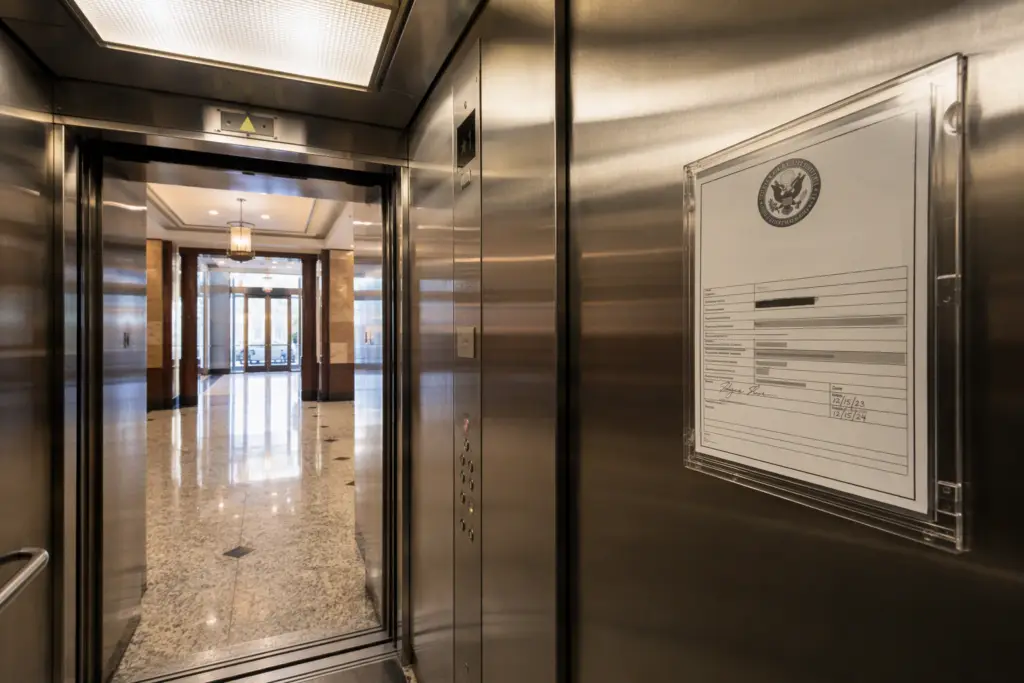
- After a passing acceptance inspection, the appropriate certificate of operation or inspection is issued and posted in or near the elevator as required.
In Pennsylvania, construction, alteration, replacement, or repair of a covered elevator requires a permit application to the Department of Labor and Industry. After a major repair, replacement, or alteration, an elevator may not return to service until the Department inspects and passes it. For permit applications made on or after December 20, 2026, Pennsylvania’s updated regulations under ASME A17.1-2016 will apply.
11. What should a homeowner do immediately if a residential elevator malfunctions or traps a passenger?
A residential elevator malfunction or entrapment is an emergency requiring immediate, methodical response to ensure passenger safety before any service call is placed.
- Remain calm and instruct any trapped occupant not to attempt to force the doors open or exit between floors — waiting for trained help is always safer.
- Use the elevator’s emergency communication system (alarm button or intercom) to alert others in the building.
- Call 911 if the passenger is in medical distress or the elevator shows signs of mechanical failure such as unusual sounds, smoke, or burning odors.
- Contact a licensed elevator service company to dispatch a qualified mechanic for emergency response.
- Do not attempt to free a passenger by manually releasing the brakes or overriding safety systems — doing so can cause the elevator to move unexpectedly.
- Once the passenger is safely freed and the elevator is taken out of service, document the malfunction in writing with date, time, and observed symptoms.
- In Maryland, owners must ensure that maintenance, repair, and inspection records are kept at a readily accessible central location in the building — add the incident details to that record file.
- In Pennsylvania, owners must submit an accident report to the Department of Labor and Industry when an elevator accident causes a fatality or requires professional medical care.
- Do not return the elevator to service until a licensed mechanic has inspected it and determined the cause of the malfunction.
12. How long does a typical residential elevator service visit take?
A routine preventive maintenance visit on a residential elevator typically takes between one and three hours, depending on the equipment type, age, and scope of the service agreement, while more complex repairs or required testing may take longer.
Factors that affect visit duration include the complexity of the drive system, whether any components require adjustment or replacement, the thoroughness of the maintenance protocol, and whether code-required tests such as safety device tests or load tests are being performed during the visit. Older equipment with proprietary parts or discontinued components may require additional time for diagnostics and sourcing. Homeowners should plan for the elevator to be unavailable for the duration of the service visit and coordinate accordingly, particularly in homes where the elevator is the primary means of access for a mobility-limited occupant.
13. Can a residential elevator service company also handle modernization and upgrades?
Yes — licensed elevator contractors routinely perform residential elevator modernization, which may include control system upgrades, drive system replacement, cab interior renovation, safety device updates, and code-compliance retrofits to bring aging equipment in line with current standards.
Modernization is often recommended when a residential elevator is approaching the end of its reliable service life, when repair costs for repeated failures exceed the cost of an upgrade, when updated safety features such as improved door interlock systems or emergency lowering devices are desired, or when the equipment needs to meet current code requirements following a change in use or occupancy. In all four of Quality Elevator Company’s markets, modernization work requires a permit and acceptance inspection before the upgraded equipment returns to service, following the same process as a new installation. In the District of Columbia, an elevator’s certificate may be temporarily suspended while it is under permit for alteration or modernization.
14. What is the difference between a residential elevator service contract and a one-time repair?
A residential elevator service contract provides scheduled preventive maintenance, priority response, and often discounted parts and labor on an ongoing basis, while a one-time repair addresses a specific failure without an ongoing commitment from the service provider.
Service contracts for residential elevators typically specify the number of maintenance visits per year, the scope of each visit, parts and labor coverage, and response provisions for unscheduled service needs. For homeowners who rely on an elevator for daily mobility — particularly aging-in-place residents or individuals with disabilities — a service contract provides continuity and predictability that a call-as-needed approach cannot. For regulated units, a maintenance contract also helps ensure that required inspection and testing deadlines are tracked and met. Quality Elevator Company offers residential service agreements across its Baltimore, Washington DC, Philadelphia, and Richmond service areas, structured to match the equipment type and compliance obligations of each property.
15. Does homeowner’s insurance cover residential elevator repairs or accidents?
Coverage for residential elevator repairs, accidents, or liability varies by homeowner’s insurance policy and insurer, and is not addressed by elevator safety codes — homeowners should review their specific policy terms and consult their insurer directly regarding elevator-related coverage.
Generally speaking, homeowner’s insurance policies may cover sudden and accidental mechanical damage or property damage caused by an elevator malfunction, but routine maintenance, wear and tear, and gradual deterioration are typically excluded. Some insurers may require documentation of regular professional maintenance as a condition of coverage, making a service agreement not only a safety best practice but potentially a coverage requirement. Liability coverage for injuries to visitors or occupants related to elevator malfunction may fall under the liability portion of a homeowner’s policy or a separate umbrella policy. Homeowners should obtain written documentation of all maintenance visits and inspection findings to support any future insurance claims.
16. What are the most common residential elevator problems that require professional service?
The most common residential elevator service calls involve door and gate malfunctions, leveling problems, hydraulic system issues, control system faults, and safety device failures — all of which require a licensed elevator mechanic to diagnose and repair correctly.
Specific issues service technicians frequently encounter on residential elevator calls include:
- Door and gate interlocking failures: The most common cause of elevator stoppages; worn contacts, misaligned rollers, or gate switch failures prevent the elevator from moving.
- Hydraulic fluid leaks: Seal degradation on piston cylinders or hydraulic power units causes fluid loss, slow travel, and potential environmental concerns in the pit area.
- Leveling inaccuracy: The car stops above or below floor level, creating a trip hazard; this is a safety concern requiring prompt correction.
- Control board and wiring faults: Aging printed circuit boards, loose wiring connections, and corrosion-related failures affect all control functions.
- Limit switch failures: Upper and lower limit switches that fail to function correctly can allow the car to travel beyond its designed stop points.
- Safety governor or rope issues: On cable-driven units, rope wear or governor malfunction affects both normal operation and emergency stopping capability.
- Battery backup failure: Emergency lowering systems relying on battery backup may fail silently between maintenance visits, leaving occupants unable to exit during a power outage.
17. How do residential elevator service requirements in Baltimore, DC, Philadelphia, and Richmond differ?
Residential elevator service requirements differ meaningfully across the four cities because each jurisdiction has adopted a different edition of the ASME A17.1 code, assigns regulatory authority to different agencies, and applies different exemptions for home elevators.
In Baltimore, Maryland’s regulatory framework applies: the Maryland Department of Labor, Division of Labor and Industry, Elevator and Escalator Safety oversees regulated units, mechanics must be licensed by the Maryland Elevator Safety Review Board, and contractors must carry the required insurance minimums. Single-family homes generally fall outside the mandatory inspection program, but the licensing requirements for mechanics and contractors apply regardless.
In Washington DC, the DC Department of Buildings (DOB) oversees elevator inspections and certification under 12-A DCMR Chapter 30 and the 2017 DC Building Code incorporating ASME A17.1-2013. DC does not have a blanket single-family residential exemption, so owners of home elevators within District boundaries should confirm their certificate obligations with the DOB directly.
In Philadelphia, the Pennsylvania Department of Labor and Industry (L&I) has statewide jurisdiction over regulated elevator equipment — Philadelphia’s own Department of Licenses and Inspections does not govern elevator certification. Pennsylvania exempts lifting devices used only by occupants of a single dwelling unit, but regulated equipment must meet inspection and certificate requirements, with a significant code update taking effect December 20, 2026.
In Richmond, Virginia, elevator inspection is enforced by local building departments, with the City of Richmond Department of Planning and Development Review, Bureau of Permits and Inspections running Richmond’s elevator program, including final acceptance inspections and annual elevator inspections with test within the city. Single-family homes, two-family homes, and townhouses are exempt from local building department inspection requirements under Virginia law.
18. How should a homeowner choose a residential elevator service company?
A homeowner selecting a residential elevator service company should verify licensing and insurance, confirm familiarity with the specific equipment brand and type, review the scope of offered service agreements, and ensure the contractor operates within the applicable jurisdiction’s regulatory requirements.
A practical evaluation checklist includes:
- Confirming the contractor holds the required elevator contractor license for the state (Maryland Elevator Safety Review Board, DC Board of Industrial Trades, Virginia Board for Contractors DPOR, or Pennsylvania L&I certification as applicable)
- Verifying that mechanics who will perform the work hold the required mechanic licenses or certifications
- Asking whether the company has experience with the specific make, model, and type of residential elevator installed at the home
- Reviewing the scope of the proposed maintenance agreement — what is covered, what is excluded, and how service needs between scheduled visits are handled
- Confirming that the contractor maintains appropriate insurance coverage, particularly important in Maryland where state minimums are specified
- Requesting documentation of prior residential elevator service experience in the relevant market area
Quality Elevator Company serves residential elevator customers throughout Baltimore MD, Washington DC, Philadelphia PA, and Richmond VA, with licensing and regulatory compliance appropriate to each jurisdiction.
19. What happens if a residential elevator fails a required inspection?
When a residential elevator fails a required inspection, the unit must be taken out of service until the deficiencies are corrected and a re-inspection confirms the equipment meets applicable code requirements before the elevator is returned to use.
The specific process after a failed inspection varies by jurisdiction. In Maryland, the elevator may not be operated unless the Commissioner of Labor and Industry has issued a valid certificate, meaning a failed inspection that results in certificate suspension requires corrective work and re-inspection before operation resumes. In the District of Columbia, a DOB permit is required to take an elevator out of service, and the unit must be brought back into compliance before the certificate is reinstated. In Pennsylvania, after a major repair, an elevator may not return to service until the Department of Labor and Industry inspects and passes it. In Virginia, the local code official oversees compliance and reinstatement of certificates after corrections are made.
For homeowners relying on an elevator for mobility access, a failed inspection creating an out-of-service period can be a serious hardship. Proactive maintenance with a qualified service company reduces the likelihood of inspection failures by identifying and correcting deficiencies before formal inspection occurs rather than discovering them during a mandated test.
20. What should a homeowner do if their residential elevator has not been serviced in several years?
A homeowner whose residential elevator has not received professional service for an extended period should schedule a comprehensive condition assessment immediately, before operating the unit further, to identify any safety deficiencies, code compliance gaps, or component failures that could pose a hazard.
Long-deferred maintenance on residential elevators commonly results in accumulated hydraulic fluid degradation, rope or belt wear beyond safe limits, corroded safety device components, expired or non-functional emergency communication systems, and control system faults from moisture or pest infiltration in the pit or machine room. Any of these conditions can present safety risks to occupants or result in sudden equipment failure.
The recommended steps for a homeowner resuming service on a long-dormant residential elevator are:
- Do not operate the elevator until it has been evaluated by a licensed elevator mechanic.
- Contact a licensed elevator service company to schedule a full condition assessment covering all mechanical, electrical, and safety systems.
- Obtain a written report of findings, including any code compliance gaps relative to the edition of ASME A17.1 that applied when the unit was installed.
- Prioritize safety-critical repairs — door interlocks, brakes, buffers, and safety devices — before addressing cosmetic or convenience items.
- Confirm with the applicable regulatory agency whether any permit, registration, or inspection obligations apply to the unit and whether those obligations are current.
- In Maryland, re-register the elevator unit if registration has lapsed, and ensure annual inspection obligations are met going forward.
- Establish a service agreement to maintain the elevator on a regular schedule going forward.
Quality Elevator Company provides residential elevator assessments across all four of its service markets, giving homeowners a detailed baseline of their equipment’s condition and a clear path to safe, compliant operation.
Schedule Your Free Residential Elevator Assessment
Whether a home elevator needs routine maintenance, a code-compliance review, or a full condition assessment after years without service, qualified professional attention is the right first step. Quality Elevator Company serves residential elevator customers in Baltimore MD, Washington DC, Philadelphia PA, and Richmond VA with licensed mechanics and contractor credentials appropriate to each jurisdiction.
Contact Quality Elevator Company for a free elevator assessment. Call today: 301-779-9116
Need elevator service you can rely on? Quality Elevator Company is ready to help.