Elevator Safety Solutions: A Complete FAQ Guide for Building Owners and Facility Managers
Elevator safety solutions are the combination of preventive maintenance, mandatory inspections, code-compliant testing, modernization upgrades, and emergency response procedures that protect passengers, reduce liability, and keep elevators legally authorized to operate. For building owners in Baltimore MD, Washington DC, Philadelphia PA, and Richmond VA, understanding these solutions means knowing which federal standards and state regulations apply — and partnering with a qualified elevator service company to meet them before an inspector or an incident does.
What Are Elevator Safety Solutions and Why Do They Matter?
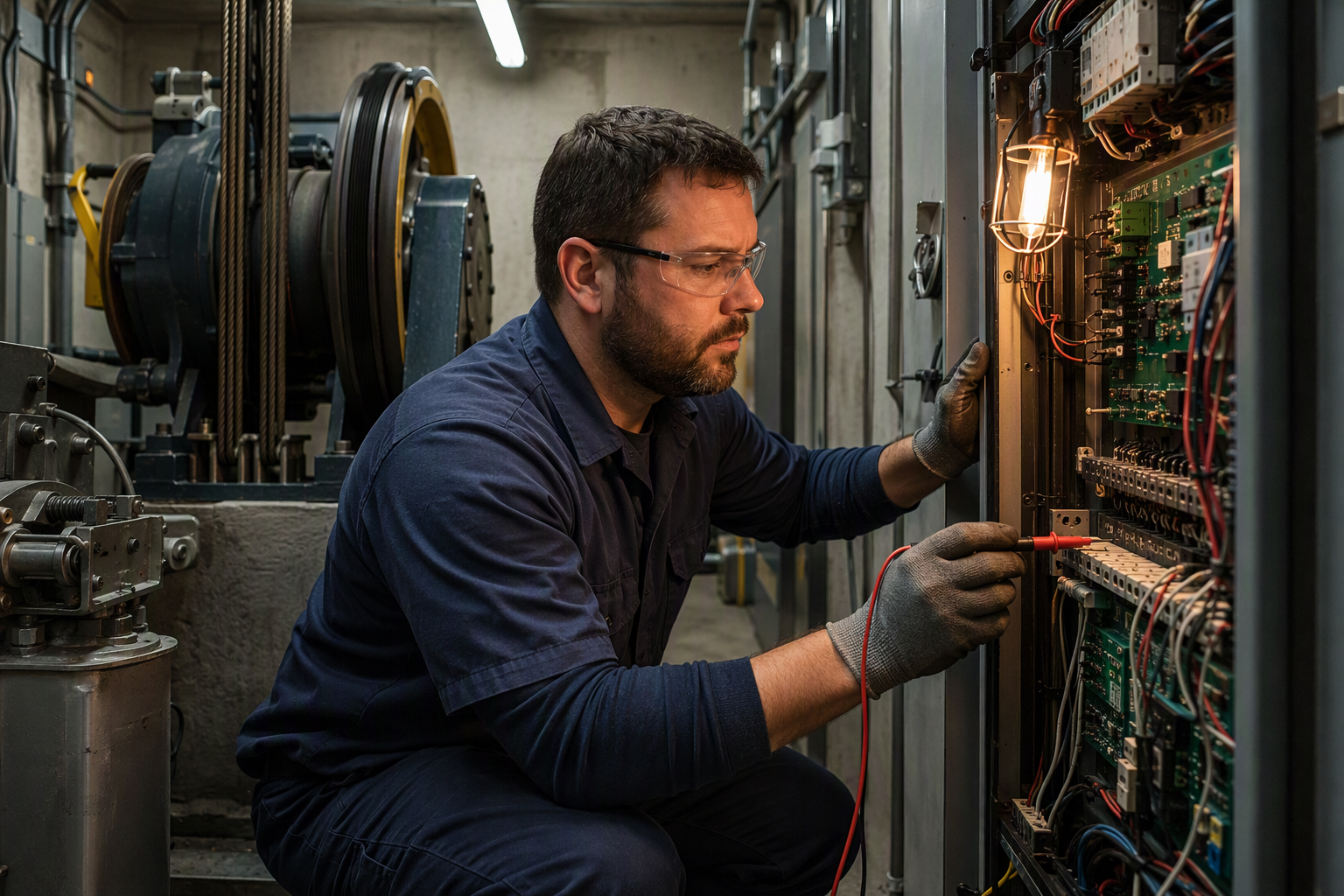
Elevator safety solutions are the full suite of engineering, maintenance, inspection, and compliance services that minimize the risk of elevator failure, injury, and regulatory shutdown.
Every elevator in commercial service operates within a layered framework: federal codes set baseline safety engineering standards, state agencies issue the certificates that legally authorize operation, and local authorities having jurisdiction (AHJs) enforce those rules on the ground. When any layer of that framework is neglected — a missed inspection, a deferred rope replacement, an outdated controller — the elevator becomes both a safety hazard and a compliance liability. A comprehensive elevator safety solution addresses all three layers simultaneously.
For facility managers overseeing properties in the Quality Elevator Company service area, the practical stakes include certificate suspension, emergency shutdowns ordered by state inspectors, ADA complaints, and personal injury litigation. A proactive safety program addresses these risks before they escalate.
Which Federal Codes Govern Elevator Safety in the United States?
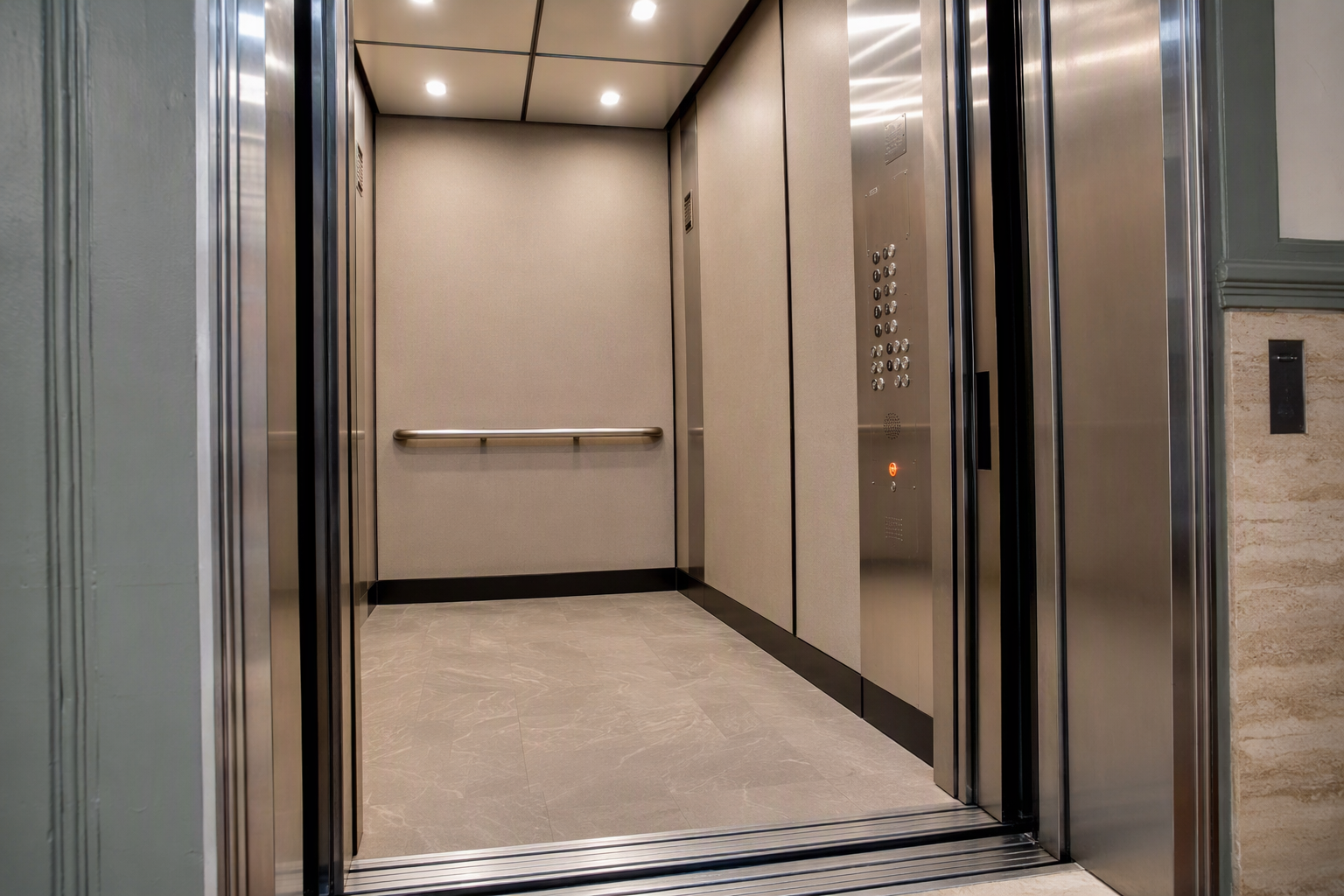
The primary federal engineering standard for elevator safety is the ASME A17.1 Safety Code for Elevators and Escalators, which establishes design, construction, inspection, testing, and maintenance requirements that states adopt by reference.
ASME A17.1 is published by the American Society of Mechanical Engineers and covers new installations, while its companion standard ASME A17.3 addresses safety requirements for existing elevators. Together they define the technical benchmarks — from rated load calculations and governor settings to door-reopening device requirements and emergency lighting — against which inspectors evaluate every elevator in the country.
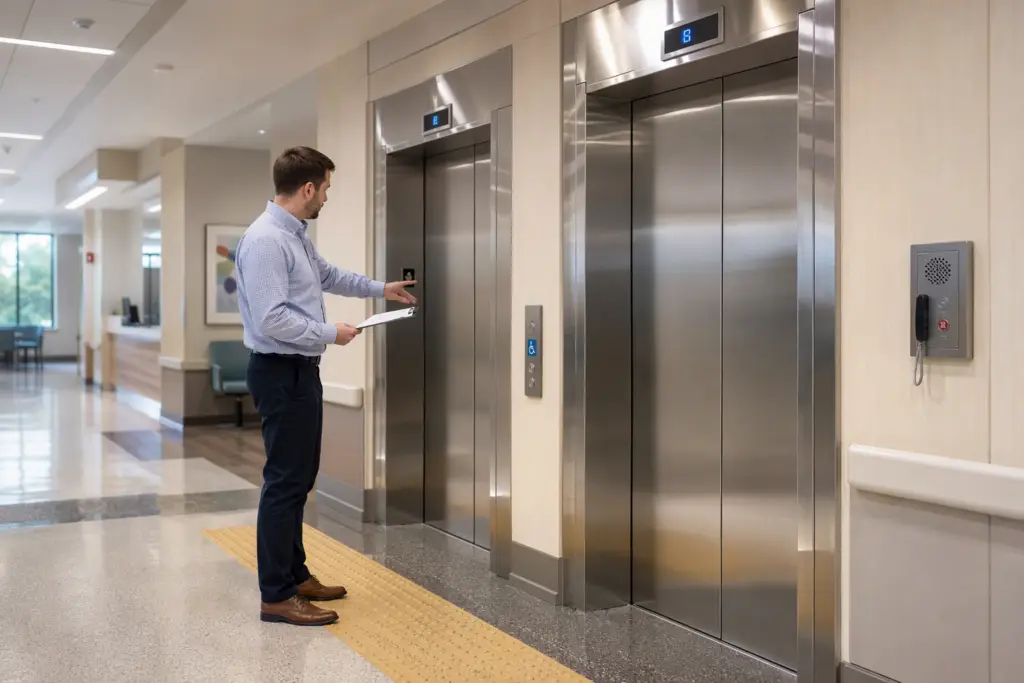
The Americans with Disabilities Act (ADA) adds a civil-rights dimension to elevator safety solutions. The ADA Standards for Accessible Design require that elevators serving multiple floors in public accommodations and commercial facilities provide accessible features including minimum car dimensions, Braille and raised-character floor designations, audible signals, and compliant controls. Non-compliance exposes building owners to federal enforcement and private litigation regardless of whether the elevator passes a state safety inspection.
OSHA regulations apply when workers — including elevator mechanics, construction crews, and maintenance staff — are working on or around elevator equipment. OSHA’s general industry and construction standards address lockout/tagout procedures, fall protection in hoistways, and confined-space protocols that elevator contractors must follow during any service visit.
What Inspection Requirements Apply in Washington DC?
In Washington DC, all elevators and escalators must be inspected and certified for operation by the DC Department of Buildings (DOB), which delegates inspections to DOB-approved third-party agencies staffed by ASME QEI-certified inspectors.
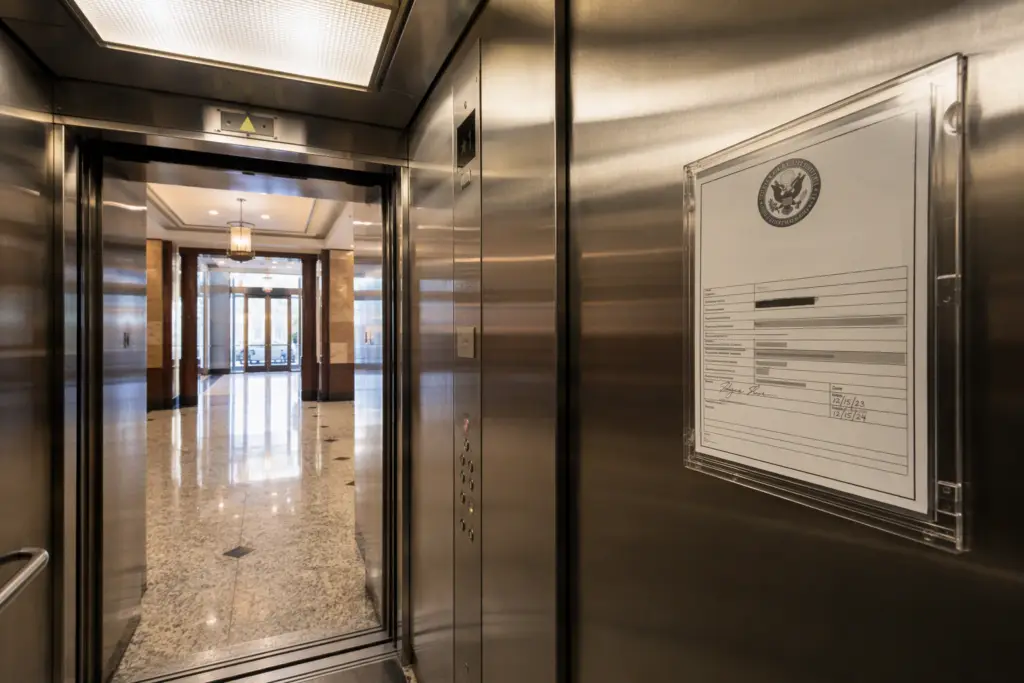
DC’s elevator rules are governed by D.C. Official Code § 6-1409 and implemented through 12-A DCMR Chapter 30, which incorporates the ASME A17.1/CSA B44-2013 edition with District amendments as referenced by the 2017 DC Building Code, effective May 29, 2020. DC requires a Category 1 inspection every 12 months and a Category 5 inspection every 60 months. A DC certificate of inspection is valid for two years, and owners submit third-party inspection reports for the prior two years to DOB through the Citizen Access Portal to obtain that certificate. The current certificate must be conspicuously displayed in the elevator car unless the building operator has an office in the same building and keeps it available for public inspection there.
A critical operational requirement: in DC buildings with passenger elevators, at least one elevator must remain in operation whenever the building is occupied, except in single-elevator buildings. Taking an elevator out of service requires a DOB permit. Elevator contractor licenses and master electrician licenses must accompany permit applications. The DC Board of Industrial Trades licenses elevator contractors, mechanics, and inspectors, with inspector applicants required to meet the ASME QEI-1 standard. DOB plans to adopt new construction codes based on the 2024 model codes by the end of 2027, which will likely bring updated safety requirements.
What Are the Elevator Safety Requirements in Maryland?
In Maryland, no elevator may operate without a certificate issued by the Maryland Department of Labor, Division of Labor and Industry, Elevator and Escalator Safety, and every elevator must undergo a periodic annual inspection by a state inspector or a third-party qualified elevator inspector.
Maryland’s elevator safety program is authorized by the Annotated Code of Maryland, Public Safety Article, Title 12, Subtitle 8 (§§ 12-801 to 12-842) and implemented through COMAR 09.12.81. As of June 17, 2026, Maryland adopted ASME A17.1-2022/CSA B44:22 with Maryland changes, though the applicable edition depends on when the installation contract was signed. The certificate must be posted conspicuously in or on the elevator unit at all times.
Owners of elevators suspended by wire ropes, belts, chains, or similar means must arrange a comprehensive five-year inspection in addition to annual periodic inspections. Tests required for any inspection must be performed by a licensed elevator mechanic, and when a third-party qualified elevator inspector must witness a test, that inspector must be physically present for the entire test — remote witnessing is not permitted. Maintenance, repair, test, and inspection records must be kept at a readily accessible central location in the building. Elevator contractors operating in Maryland must carry at least $1,000,000 in general liability insurance and at least $500,000 in property damage insurance. The Maryland Elevator Safety Review Board licenses both elevator mechanics and contractors.
What Elevator Inspection Rules Apply in Pennsylvania?
In Pennsylvania, elevators may not operate without a certificate of operation issued by the Pennsylvania Department of Labor and Industry (L&I), Bureau of Occupational and Industrial Safety, Elevator Section, which has statewide jurisdiction including Philadelphia.
Pennsylvania’s elevator rules derive from 34 Pa. Code Chapter 405 under the Pennsylvania Construction Code Act (35 P.S. § 7210.101 et seq.). Until December 20, 2026, the governing technical standard for construction, repair, replacement, and alteration is ASME A17.1-2000 with the A17.1a-2002 addenda. Beginning December 20, 2026, Regulation #12-123 takes effect and ASME A17.1-2016 (with Pennsylvania modifications) applies to all new permit applications. Electric elevators, hydraulic elevators, and escalators must have periodic inspections at intervals of no more than six months. A certificate of operation is valid for 24 months for equipment on a six-month inspection cycle and 48 months for equipment on a 12-month cycle.
Starting December 20, 2026, Category 1 tests must be performed every year as a stand-alone requirement, and periodic tests follow ASME A17.1-2016 Table N-1 intervals, witnessed by a construction code official. After any major repair, replacement, or alteration, an elevator may not return to service until L&I inspects and approves it. Owners must report any elevator accident causing a fatality or requiring professional medical care to the Department. Building owners with questions about the December 2026 regulatory transition should work with a qualified elevator service company well in advance of that effective date.
How Do Virginia’s Elevator Safety Requirements Work?
In Virginia, elevator inspection and enforcement authority rests with local building departments under the Virginia Uniform Statewide Building Code (13VAC5-63), not a state-level labor agency, and all elevators and escalators require at least an annual periodic inspection with a locality permitted to require six-month inspections.
The 2021 Virginia USBC, effective January 18, 2024, adopts ASME A17.1/CSA B44-2019 as its technical standard. The Virginia Board of Housing and Community Development adopts the USBC, while the Virginia Board for Contractors (DPOR) certifies elevator mechanics and licenses elevator contractors. No one may work as an elevator mechanic in Virginia without state certification — requiring at least three years of industry experience and a Board-approved examination — unless under the direct and immediate supervision of a certified mechanic. Certified mechanics must complete at least eight hours of continuing education per renewal cycle.
Periodic tests follow ASME A17.1 Appendix N intervals and must be witnessed by the code official or an approved agency. In Richmond specifically, the City of Richmond Department of Planning and Development Review, Bureau of Permits and Inspections, runs the elevator program, conducting final acceptance inspections of new or modernized elevators, annual inspections with tests, and issuing elevator certificates. The current certificate of inspection must be displayed in the elevator car or posted in an approved conspicuous location. Quality Elevator Company coordinates directly with local AHJs across Richmond and the broader Virginia service area to ensure inspection scheduling and certificate compliance remain on track.
What Is a Comprehensive Elevator Maintenance Program?
A comprehensive elevator maintenance program is a structured, documented service regimen that covers lubrication, adjustment, component replacement, safety device testing, and code compliance verification at defined intervals to prevent failures before they occur.
Effective maintenance programs distinguish between three tiers of service. Routine maintenance — performed monthly or quarterly — covers lubrication of moving parts, adjustment of door operators and safeties, cleaning of pit and machine room, and inspection of hydraulic fluid levels and wire rope condition. Periodic testing, required by the adopted ASME A17.1 edition in each jurisdiction, verifies that safety devices such as governors, safeties, buffers, and pressure-relief valves function within code tolerances. Predictive maintenance uses oil analysis, vibration monitoring, and controller diagnostics to identify components approaching end of life before they cause a shutdown or safety event.
Maryland regulations require that maintenance, repair, test, and inspection records be kept at a readily accessible central location in the building — a documentation standard that a well-structured maintenance program satisfies automatically. Quality Elevator Company designs maintenance programs to meet the specific code edition adopted in each jurisdiction it serves, whether that is the 2013 edition in DC, the 2022 edition in Maryland, the 2000/2016 transition in Pennsylvania, or the 2019 edition in Virginia.
What Are the Most Critical Elevator Safety Devices and How Are They Tested?
The most critical elevator safety devices — governors, safeties, buffers, car and counterweight guide rails, door reopening devices, and emergency lighting — must be tested at intervals specified by the adopted ASME A17.1 edition and witnessed by an approved inspector or code official.
The governor and safety system is the elevator’s primary overspeed protection. When the car exceeds a set speed, the governor trips and the safety clamps the guide rails, stopping the car. A Category 5 test (required every 60 months under DC’s rules, for example) physically drops the car at rated speed to verify this system functions correctly. Buffers — located in the pit — absorb energy if the car or counterweight travels past its terminal limit. Oil buffers must be tested under full load to verify correct compression and return-to-extended-position timing. Door reopening devices protect passengers from entrapment and must reverse within code-specified force and time limits under ASME A17.1.
Emergency lighting, communication systems, and firefighters’ emergency operation (FEO) are tested during Category 1 annual inspections. FEO ensures that in a fire, all elevators recall to a designated landing and remain available for firefighter use — a feature whose failure can have life-safety consequences extending far beyond elevator passengers. Hydraulic elevator pressure-relief valves and rupture valves are tested to confirm the car does not descend in the event of a pipe rupture.
What Elevator Modernization Upgrades Improve Safety?
The highest-impact elevator modernization upgrades for safety include controller replacement, door operator and safety edge upgrades, machine and rope replacement, and the installation of destination dispatch or enhanced monitoring systems.
Aging relay-logic controllers are prone to erratic behavior and lack the diagnostic capability of modern solid-state or microprocessor-based systems. Replacing an obsolete controller not only improves reliability but also enables integration with remote monitoring platforms that alert building managers to faults before they strand passengers or cause injuries. Door system upgrades — replacing worn clutches, hangers, and retiring mechanical safety edges in favor of full-door-height light curtains — directly reduce the leading cause of elevator-related injuries: door contact incidents.
Wire rope replacement is governed by ASME A17.1 discard criteria based on broken wire counts, corrosion, and diameter reduction; waiting until a rope fails an inspection creates an emergency, while proactive replacement on a documented schedule is both safer and less disruptive. Hydraulic elevator modernizations often include the addition of submersible pump units and PVC-lined cylinders to eliminate the environmental liability of underground leaks, which some jurisdictions address through environmental regulations independent of elevator safety codes.
ADA compliance upgrades — tactile controls, audible floor announcements, and compliant car dimensions — can be incorporated into a modernization scope to address both safety and accessibility obligations simultaneously. Quality Elevator Company assesses existing equipment and recommends modernization priorities based on the remaining useful life of components, current code compliance status, and the specific inspection requirements of the jurisdiction where the elevator operates.
What Should Building Owners Do Immediately After an Elevator Incident?
- Stop the elevator from operating. Place the elevator out of service immediately by engaging the stop switch or notifying building maintenance to lock out the unit. Do not allow passengers to re-enter until the elevator has been inspected and cleared by a licensed mechanic.
- Ensure the safety of anyone involved. Confirm that all passengers have been safely evacuated. Call emergency services if anyone reports injury, entrapment, or medical distress.
- Document the incident. Record the date, time, elevator identification number, number of people involved, nature of the incident, and any observable equipment conditions. Photograph the car, pit, machine room, and any visible damage without disturbing evidence.
- Contact your elevator service company. Notify the elevator maintenance contractor so a licensed mechanic can perform a safety inspection before the unit returns to service.
- Report to the appropriate state authority. In Pennsylvania, owners must submit an accident report to the Department of Labor and Industry when an incident causes a fatality or requires professional medical care. In Maryland, DC, and Virginia, verify reporting requirements with your elevator contractor and the relevant regulatory agency.
- Preserve all maintenance and inspection records. Regulatory agencies and legal counsel will request maintenance logs, inspection certificates, and test reports. Maryland regulations specifically require these records be kept at a readily accessible central location in the building.
- Do not return the elevator to service until cleared. In Pennsylvania, an elevator may not return to service after a major incident until the Department of Labor and Industry inspects and passes it. In other jurisdictions, confirm reinstatement requirements with your AHJ before resuming operation.
How Do ADA Requirements Interact with Elevator Safety Solutions?
ADA requirements for elevators are distinct from state safety codes but must be addressed simultaneously, as a building can pass a state safety inspection while still being in violation of federal accessibility law under the Americans with Disabilities Act.
The ADA Standards for Accessible Design specify minimum elevator car dimensions, door clear width and timing requirements, Braille and raised-character floor designations on hoistway and car panels, audible and visual floor indicators, and controls mounted within accessible reach ranges. These requirements apply to public accommodations and commercial facilities serving the public, with some exceptions for buildings with fewer than three stories or fewer than three thousand square feet per story (though exceptions have limitations).
During a modernization project, ADA compliance upgrades should be incorporated into the scope from the outset rather than treated as an afterthought. Retrofitting tactile signage and control panels after a controller has already been replaced adds unnecessary cost. An elevator safety solutions provider with ADA expertise can identify gaps through a combined safety and accessibility audit, allowing building owners to address both compliance obligations in a single project mobilization.
What Is the Difference Between a Category 1 and Category 5 Elevator Test?
A Category 1 test is an annual no-load safety test of all safety devices and functions, while a Category 5 test is a full-load, full-speed test performed every five years that physically engages the governor and safety system to verify overspeed protection under operating conditions.
ASME A17.1 establishes a tiered testing schedule — Categories 1 through 5 — that escalates in scope and invasiveness. Category 1 tests, required annually in DC and under the 2016 Pennsylvania standard (effective December 2026), verify that governors, safeties, buffers, car and counterweight guide rails, oil buffers, and door reopening devices operate within code limits, typically without physically loading the car or tripping the safety. Category 5 tests require the car to be run at rated speed and the safety to be mechanically tripped, confirming the complete overspeed protection chain functions as designed under real operating conditions. Because a Category 5 test involves controlled emergency stops, elevators occasionally sustain minor component wear — guide rail scoring or brake lining deposits — that must be addressed immediately after the test.
DC explicitly requires Category 1 inspections every 12 months and Category 5 inspections every 60 months, each by an ASME QEI-certified inspector. Virginia requires periodic tests at ASME A17.1 Appendix N intervals witnessed by the code official. Maryland requires a comprehensive five-year inspection for wire-rope-suspended elevators. Understanding which category of test is due — and scheduling qualified personnel and inspectors in advance — is a core function of a well-managed elevator safety program.
How Should Building Owners Choose an Elevator Safety Solutions Provider?
Building owners should select an elevator safety solutions provider based on verifiable licensure in the applicable jurisdiction, familiarity with the specific code edition adopted by that state or district, documented maintenance processes, and a clear compliance tracking system for inspection deadlines and certificate renewals.
In Maryland, an elevator contractor must be licensed by the Maryland Elevator Safety Review Board and carry at least $1,000,000 in general liability insurance and $500,000 in property damage insurance — these are minimum legal thresholds, not differentiators. In Virginia, the contractor must hold an Elevator/Escalator Contracting (EEC) specialty license from the Virginia Board for Contractors. In DC, the contractor must hold a DOB elevator contracting license. Building owners should request proof of current licensure and insurance before signing any maintenance or repair agreement.
Beyond credentials, the practical differentiator is whether the provider maintains a rigorous documentation system — one that tracks upcoming Category 1 and Category 5 test dates, certificate expiration dates, component replacement schedules, and regulatory filing deadlines across a portfolio of buildings. Quality Elevator Company serves building owners across Baltimore, Washington DC, Philadelphia, and Richmond with compliance tracking designed around each jurisdiction’s specific regulatory calendar.
What Elevator Safety Features Are Required Under ASME A17.1?
Under the ASME A17.1 Safety Code for Elevators and Escalators, required safety features include governors and safeties, buffers, door reopening devices, firefighters’ emergency operation, car lighting and emergency lighting, two-way means of communication, and terminal stopping devices — all of which must meet the specifications of the edition adopted by the applicable jurisdiction.
The two-way means of communication requirement mandates that passengers trapped in an elevator car have a means to communicate with a location with the ability to provide or summon assistance. The specific technical requirements — telephone, intercom, or other system — are governed by the adopted code edition. Note that video or two-way text messaging is not presented as a requirement under DC’s adopted ASME A17.1-2013 or Pennsylvania’s adopted ASME A17.1-2000; building owners should verify current requirements with their AHJ and elevator contractor before specifying a communication system.
Firefighters’ emergency operation (FEO), sometimes called Phase I and Phase II emergency operation, requires elevators to automatically recall to a designated landing when a building fire alarm activates, and to allow firefighters to manually operate the elevator from within the car. This feature is inspected and tested during every Category 1 annual inspection and must remain functional at all times the building is occupied.
How Often Should Elevators Be Inspected in the Quality Elevator Company Service Area?
| Jurisdiction | Periodic Inspection Interval | Major Test Interval | Certificate Validity | Adopted Code Edition | Regulatory Authority |
|---|---|---|---|---|---|
| Washington DC | Annual (Category 1) | Every 60 months (Category 5) | 2 years | ASME A17.1-2013/CSA B44-13 | DC Department of Buildings (DOB) |
| Maryland | Annual periodic inspection | Every 5 years (comprehensive, wire-rope-suspended) | Per state certificate | ASME A17.1-2022/CSA B44:22 (eff. June 17, 2026) | Maryland Dept. of Labor, Division of Labor and Industry |
| Pennsylvania | Every 6 months (electric, hydraulic, escalators) | Category 1 annually (eff. Dec. 20, 2026); per Table N-1 | 24 months (6-mo. cycle); 48 months (12-mo. cycle) | ASME A17.1-2000 / A17.1-2016 (eff. Dec. 20, 2026) | Pennsylvania Dept. of Labor and Industry, Elevator Section |
| Virginia | Annual (locality may require 6-month) | Per ASME A17.1 Appendix N | Per local certificate | ASME A17.1/CSA B44-2019 (eff. Jan. 18, 2024) | Local building department (e.g., Richmond Bureau of Permits and Inspections) |
What Are the Consequences of Operating an Elevator Without a Valid Certificate?
Operating an elevator without a valid certificate of inspection or operation subjects building owners to elevator shutdown orders, civil penalties, and potential liability for any injuries that occur while the unit is operating out of compliance.
In Maryland, an elevator unit may not be operated unless the Commissioner of Labor and Industry has issued a certificate for it — operating without one is a direct violation of the Annotated Code of Maryland, Public Safety Article, Title 12. In Pennsylvania, no elevator may operate without a Department of Labor and Industry certificate of operation. DC requires all elevators and escalators to be inspected and certified, and the DOB can suspend a certificate for non-compliance. Virginia’s local code officials have enforcement authority to order an elevator out of service.
Beyond regulatory penalties, an uncertified elevator creates significant civil liability exposure. In the event of an injury, plaintiffs’ attorneys will treat the absence of a valid inspection certificate as evidence of negligence per se in many jurisdictions. The cost of maintaining a current certificate — scheduling timely inspections and completing any required repairs before the inspection — is a small fraction of the cost of defending a personal injury claim or paying a regulatory fine.
What Is Elevator Entrapment and How Is It Prevented?
Elevator entrapment occurs when passengers become confined in a stopped car between floors, most commonly due to power failure, mechanical malfunction, or door system failure, and it is prevented through proactive maintenance of drive systems, door mechanisms, and emergency communication and lighting equipment.
The most common causes of entrapment are power supply interruptions, hydraulic fluid loss in hydraulic systems, worn or maladjusted door operators, and motor or drive failures. Each of these failure modes has a corresponding maintenance intervention: electrical connection inspection and surge protection for power issues; hydraulic fluid monitoring and valve testing for hydraulic systems; and regular adjustment of door operator timing, torque settings, and safety edge function for door-related entrapments.
ASME A17.1 requires that every elevator have a two-way means of communication allowing trapped passengers to summon assistance, and emergency lighting that activates on loss of normal power. These systems must be tested during annual Category 1 inspections. Building owners should also establish a documented entrapment response protocol — communicated to building staff — that ensures a trained mechanic is dispatched promptly, passengers are kept calm and informed, and no unauthorized attempt is made to force open elevator doors or climb out of the car.
How Does Elevator Pit Safety Factor Into a Comprehensive Safety Program?
The elevator pit is one of the highest-risk work areas in a building, and pit safety — including lighting, stop switches, ladders, drainage, and clearances — is both an ASME A17.1 code requirement and an OSHA concern when mechanics perform service work.
ASME A17.1 specifies minimum pit depth clearances, permanent lighting levels, a stop switch within reach of the access door, and a means of egress for mechanics working in the pit. Pits must be dry; water intrusion is not only a safety hazard for mechanics but also damages electrical equipment and contributes to rope and component corrosion. Pit drainage systems or sump pumps must be maintained in working order, and inspectors routinely cite inadequate pit conditions as deficiencies during periodic inspections.
OSHA’s lockout/tagout standard (29 CFR 1910.147) requires that elevator mechanics isolate and de-energize equipment before performing service — a procedure enforced through written energy control programs that elevator contractors must maintain. Pit access ladders must be in good repair and properly secured. During any pit service visit, proper personal protective equipment, lighting, and communication with a colleague monitoring from above are standard safety practices for qualified elevator mechanics.
What Role Does Remote Monitoring Play in Modern Elevator Safety Solutions?
Remote monitoring systems collect real-time operational data from elevator controllers — door cycle counts, motor temperatures, fault codes, and stop accuracy — allowing elevator service companies to identify developing problems and dispatch technicians before a failure causes passenger entrapment or a safety event.
Modern microprocessor-based controllers generate detailed fault logs that, when transmitted through a cellular or building network connection to a monitoring platform, enable predictive rather than reactive maintenance. A door that is taking progressively longer to close, a motor drawing increasing current at a particular floor, or a hydraulic valve cycling abnormally may each generate a pattern in monitoring data weeks before the component fails. Addressing these patterns during scheduled maintenance visits — rather than in response to a breakdown — reduces both entrapments and the wear on adjacent components that often accompanies an uncontrolled failure.
Remote monitoring does not replace mandatory periodic inspections or Category testing — those obligations are defined by state and local code requirements and must be performed by qualified inspectors in person. Rather, monitoring supplements the inspection-based compliance framework with continuous operational visibility, which is particularly valuable for building portfolios with elevators in multiple jurisdictions, such as those served by Quality Elevator Company across Baltimore, Washington DC, Philadelphia, and Richmond.
How Can Building Owners Prepare for an Elevator Inspection?
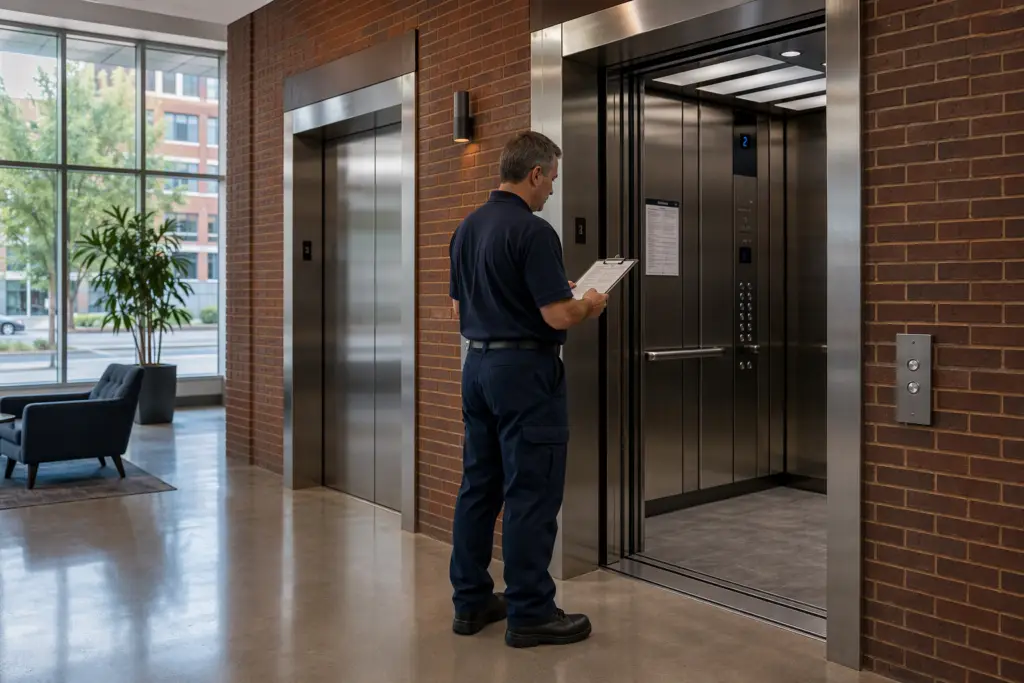
Building owners can maximize inspection readiness by ensuring all required records are available at the building, verifying that machine room and pit access is clear, confirming that all safety devices and lighting are functional, and scheduling a pre-inspection review with their elevator service company.
Maryland regulations specifically require that maintenance, repair, test, and inspection records be kept at a readily accessible central location in the building. DC requires owners to submit inspection reports to DOB through the Citizen Access Portal to obtain or renew a certificate. Pennsylvania requires that the certificate of operation be posted in the elevator car or in the machine room attached to the controller. Virginia requires the certificate to be displayed in the elevator car or in an approved conspicuous location. Non-compliance with posting and recordkeeping requirements is a citable deficiency even when the elevator itself passes all safety tests.
In the weeks before a scheduled inspection, elevator service companies should conduct a pre-inspection walkthrough covering pit condition, machine room cleanliness and temperature, rope condition and lubrication, door operation timing, safety device settings, and emergency lighting and communication function. Deficiencies identified during this walkthrough can be corrected before the official inspection, avoiding the cost and delays associated with a failed inspection and reinspection cycle. Quality Elevator Company structures maintenance agreements around each client’s inspection calendar to ensure pre-inspection readiness is built into the service schedule rather than treated as a last-minute rush.
Get a Free Elevator Safety Assessment from Quality Elevator Company
Whether a building has one elevator or a multi-unit portfolio spanning Baltimore, Washington DC, Philadelphia, and Richmond, a current, code-compliant elevator safety program is not optional — it is a legal requirement and a fundamental obligation to the people who use those elevators every day. From annual inspections and Category 5 testing to full modernization projects and ADA compliance audits, Quality Elevator Company provides the full range of elevator safety solutions that building owners and facility managers need to stay compliant, reduce risk, and keep passengers safe.
Contact Quality Elevator Company for a free elevator assessment: 301-779-9116
Need elevator service you can rely on? Quality Elevator Company is ready to help.