How to Switch Elevator Maintenance Companies: Contract Exit Clauses, Record Transfers, and What to Do Before You Sign with a New Vendor
Direct answer: You can switch elevator maintenance companies without violating your contract by first reviewing your agreement for notice periods, auto-renewal clauses, and early-termination fees, then formally notifying your current vendor in writing, requesting a complete transfer of all inspection and maintenance records, and confirming your replacement vendor holds the correct licenses for your jurisdiction in the District of Columbia, Maryland, Pennsylvania, or Virginia before the transition date.

Switching elevator service vendors is a legitimate and often necessary business decision — whether driven by cost, response quality, compliance concerns, or a change in building management. But the process involves legal, regulatory, and operational steps that, if missed, can result in contract penalties, lapses in inspection records, or compliance gaps that put your certificate of operation at risk. This guide walks building owners and property managers in the DC, Maryland, Pennsylvania, and Virginia region through every stage of a compliant, low-risk vendor transition.
What Should You Do First When Considering Switching Elevator Companies?
Before contacting a new vendor or announcing any change, the single most important first step is a thorough review of your existing maintenance agreement. Elevator service contracts vary widely, but most contain provisions that can expose building owners to financial or compliance liability if they act before understanding what the document requires.
- Locate your current maintenance contract and identify the exact contract end date, any auto-renewal language, and the required notice period to prevent automatic renewal.
- Read the termination clause carefully. Note whether early termination requires a written notice period (commonly 30, 60, or 90 days), an early-termination fee, or the purchase of proprietary parts or tools the vendor has installed.
- Identify any auto-renewal provisions. Many elevator maintenance contracts renew automatically for one-year or multi-year terms if written notice is not delivered by a specific deadline. Missing this window can lock you into another full term.
- Document the current state of your elevator(s). Before the old vendor leaves, photograph control panels, review the most recent inspection reports, and note any open work orders or pending repairs.
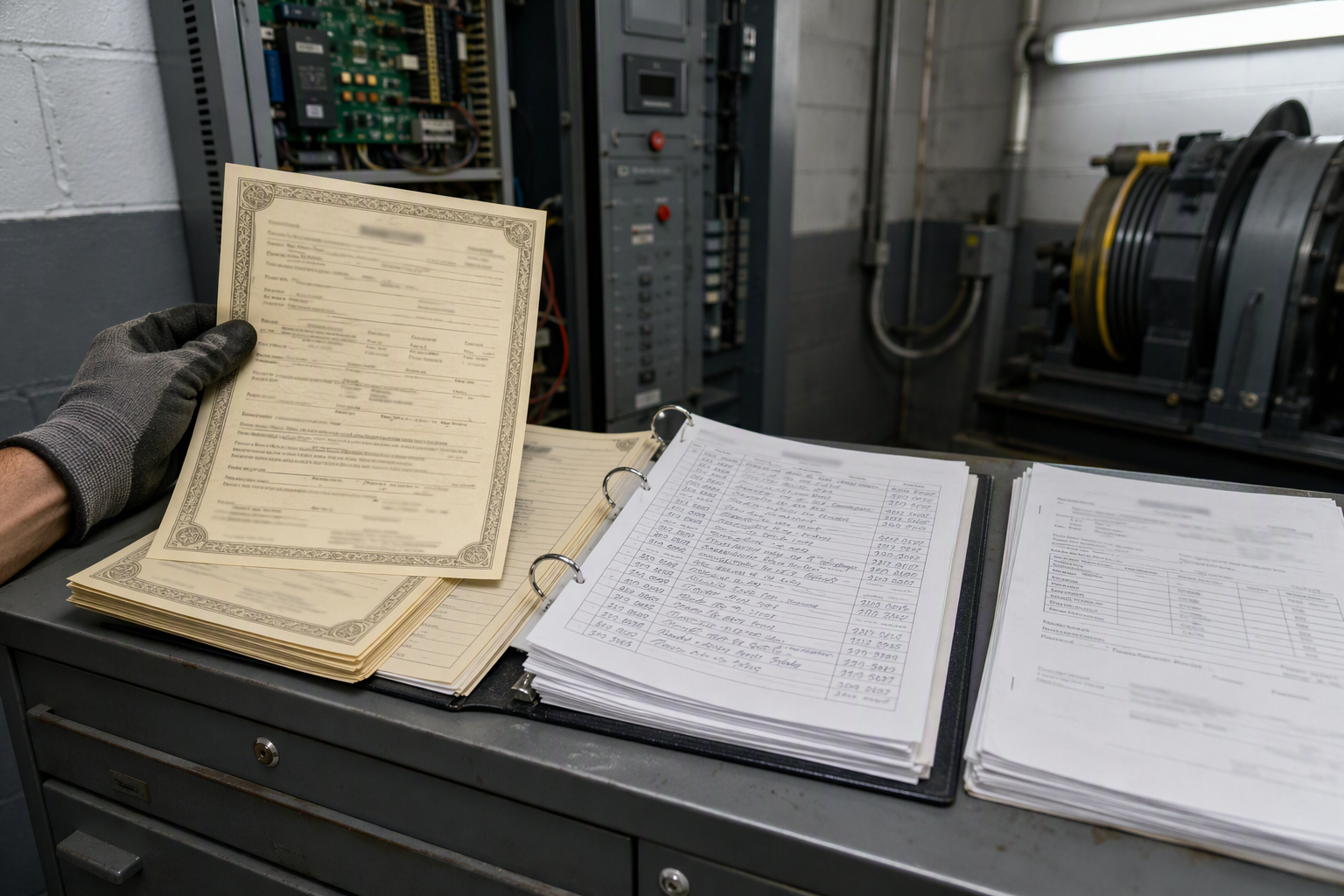
- Request a full record package from your current vendor in writing, including all maintenance logs, inspection certificates, test reports, and any open permit documentation.
- Verify your jurisdiction’s current certificate status with the relevant regulatory authority — the DC Department of Buildings, the Maryland Department of Labor, Division of Labor and Industry, the Pennsylvania Department of Labor and Industry, or your Virginia local building department — to confirm inspection currency before the transition.
- Interview at least two or three replacement vendors and confirm each holds the appropriate licenses and certifications for your jurisdiction before signing anything.
- Set a transition date that aligns with your contract’s permissible exit window and allows your new vendor adequate time to perform a baseline assessment before the old vendor departs.
What Contract Clauses Most Often Trap Building Owners During a Vendor Switch?

Elevator maintenance contracts are drafted by vendors, which means they are typically written to protect the service company’s recurring revenue. Several specific clause types deserve close scrutiny before you attempt to exit.
Auto-Renewal Clauses
These clauses automatically extend the contract for an additional period — often one year — unless written notice of non-renewal is delivered within a defined window before the current term expires. The notice window is frequently 30 to 90 days before the anniversary date, meaning that if a building owner misses the deadline by even one day, they may be contractually bound for another full term.
Early-Termination Fees
Some contracts calculate an early-termination fee as a percentage of the remaining contract value or as a flat fee. Read whether the fee is the vendor’s sole remedy or whether they also retain the right to sue for lost profits.
Proprietary Parts and Software Lock-In
Certain vendors install proprietary controllers or diagnostic systems that only their technicians can access. If your elevator has been updated with such components, transitioning to an independent service provider may require budgeting for a modernization or controller replacement to restore full third-party serviceability. Quality Elevator Company evaluates these compatibility issues as part of a pre-transition assessment.
Record-Retention and Return Provisions
Some contracts are silent on who owns maintenance and inspection records. In practice, under Maryland law (Maryland Department of Labor, Division of Labor and Industry), maintenance, repair, test, and inspection records must be kept at a readily accessible central location in the building where the elevator is located — meaning those records belong at the building, not with the vendor. Confirm your contract does not attempt to assign record ownership to the service company.
Assignment Clauses
If the vendor’s business is sold or assigned to a new company, some contracts allow that assignment without the building owner’s consent. Know whether this has already happened and whether the entity currently servicing your elevators is the same entity named in the original agreement.
Vendor Comparison Table: Independent Service Providers vs. OEM-Affiliated Vendors
| Factor | Independent Service Provider (e.g., Quality Elevator Company) | OEM-Affiliated or National Chain Vendor |
|---|---|---|
| Contract flexibility | Typically shorter initial terms; month-to-month options often available after initial period | Often multi-year contracts with auto-renewal and early-termination fees |
| Proprietary lock-in risk | Lower — trained to service multiple makes and models | Higher — may install proprietary diagnostics or controllers |
| Local regulatory knowledge (DC, MD, PA, VA) | Typically deep familiarity with specific AHJ requirements in the region | May apply national templates; local knowledge varies by branch |
| Record transparency | Records are held at the building or provided directly to the owner | Records sometimes held in proprietary systems; transfer can be delayed or incomplete |
| Parts sourcing | Broad aftermarket and OEM-equivalent parts access | May be restricted to OEM parts at higher cost |
| Licensing coverage (DC, MD, PA, VA) | Quality Elevator Company holds appropriate licenses for the DC–MD–PA–VA region | Verify jurisdiction-by-jurisdiction; staffing levels and licenses vary |
| Inspection coordination | Coordinates directly with AHJ or approved third-party inspection agencies | May bundle inspection coordination but charge separately |
| Accountability | Decision-makers are typically reachable locally | Escalations may route through regional or national call centers |
Transition Timeline: What a Compliant Vendor Switch Looks Like Step by Step
| Phase | Typical Timeframe Before Changeover | Key Actions |
|---|---|---|
| Contract review and exit planning | 90–120 days before desired changeover | Read all termination clauses; identify notice deadline; calendar auto-renewal date |
| Vendor evaluation and selection | 60–90 days before changeover | Collect bids; verify licenses; review references; confirm regulatory compliance posture |
| Written notice to current vendor | Per contract (often 30–90 days) | Send written non-renewal or termination notice; retain delivery confirmation |
| Record transfer request | 30–60 days before changeover | Formally request all maintenance logs, inspection certificates, test records, permit documents |
| New vendor baseline assessment | 15–30 days before changeover | New vendor inspects equipment, identifies deferred maintenance, reviews existing records |
| Transition date and service handover | Changeover day | Confirm certificate of operation is current; new vendor assumes maintenance responsibility |
| Post-transition compliance check | Within 30 days after changeover | Confirm all records are on file at building; verify AHJ notifications if required; address any deferred items |
How Do You Transfer Elevator Inspection Records Without Creating a Compliance Gap?
Inspection record continuity is one of the most overlooked risks in a vendor transition. Each jurisdiction in the Quality Elevator Company service area has specific requirements about where records must be kept and what they must contain.
In Maryland, the Maryland Department of Labor, Division of Labor and Industry requires that maintenance, repair, test, and inspection records be kept at a readily accessible central location in the building where the elevator is located. This means your outgoing vendor cannot legally withhold these records — they belong at the property.
In the District of Columbia, owners submit third-party inspection reports for the past two years to the DC Department of Buildings through the Citizen Access Portal to obtain or renew a certificate of inspection. If those reports are held only by your departing vendor and not transferred to you, a certificate renewal could be delayed.
In Pennsylvania, the Pennsylvania Department of Labor and Industry must have issued a certificate of operation before an elevator may operate. Confirm with L&I that the current certificate remains valid during the transition and that any pending test or inspection obligations are documented so the new vendor can schedule them without interruption.
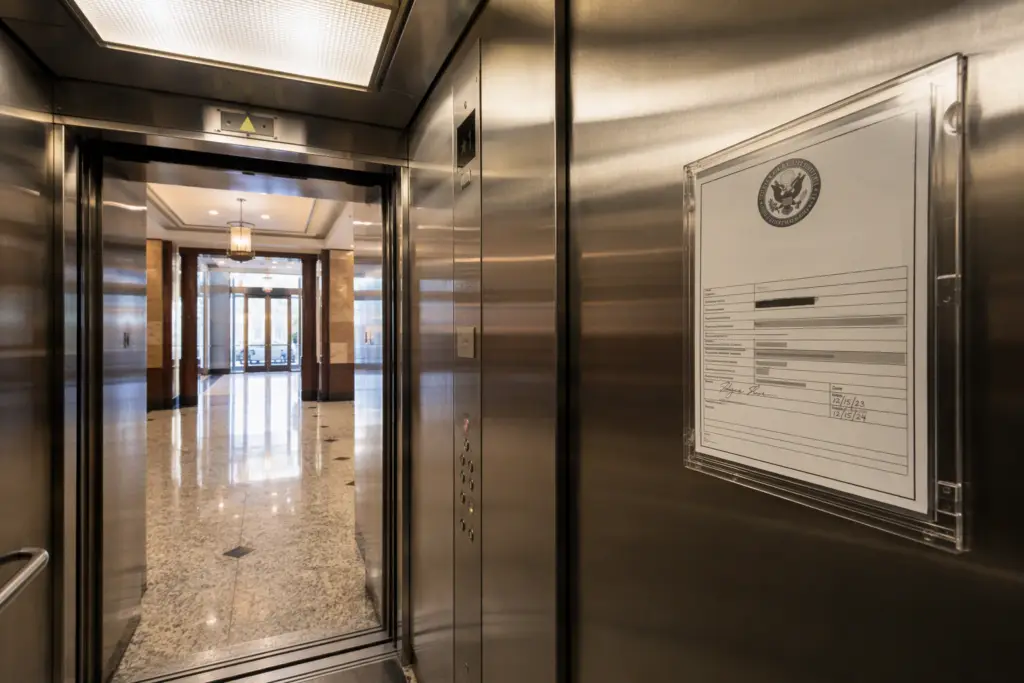
In Virginia, the current certificate of inspection must be displayed in the elevator, kept available in the building operator’s office, or posted in an approved conspicuous location, per the Virginia Uniform Statewide Building Code. Because Virginia enforcement is local, building owners should contact their local building department — such as the City of Richmond’s Bureau of Permits and Inspections for Richmond properties — to confirm what record notifications, if any, are required when changing service vendors.
Best practice for all jurisdictions: Request a complete record package from your current vendor in writing at least 30 to 60 days before the transition date. The package should include all periodic inspection reports, Category 1 and Category 5 test records (where applicable), maintenance logs with dates and technician notes, copies of any open or recently closed permits, and the current certificate of operation or certificate of inspection.
What Licenses Must a New Elevator Vendor Hold in DC, Maryland, Pennsylvania, and Virginia?
Licensing requirements differ by jurisdiction. Engaging an unlicensed vendor can void your insurance coverage, invalidate inspections, and expose the building owner to regulatory liability.
District of Columbia: Elevator contractors and elevator mechanics must be licensed by the DC Board of Industrial Trades (within the Department of Licensing and Consumer Protection). Applicants for a DC elevator inspector license must meet the ASME A17.1 Safety Code for Elevators and Escalators QEI-1 or an equivalent standard. DOB elevator permits require a copy of the elevator contracting license and the master electrician license.
Maryland: Both elevator mechanics and elevator contractors must be licensed by the Maryland Elevator Safety Review Board, within the Maryland Department of Labor. Elevator contractors in Maryland must carry at least $1,000,000 in general liability insurance and at least $500,000 in property damage insurance. Tests performed for a required inspection must be performed by a licensed elevator mechanic.
Pennsylvania: Third-party agencies that inspect elevators under the Uniform Construction Code must be certified by the Pennsylvania Department of Labor and Industry. Confirm that your new vendor’s inspection personnel hold UCC elevator inspector certification if they will be performing or witnessing inspections. Note: Pennsylvania does not have a statewide elevator mechanic or contractor license requirement separate from the UCC certification framework — confirm current requirements directly with L&I.
Virginia: No one may work as an elevator mechanic in Virginia without state certification from the Virginia Board for Contractors (DPOR), unless working under the direct and immediate supervision of a certified mechanic. Installing, repairing, improving, or removing elevators or escalators requires a contractor license with the Elevator/Escalator Contracting (EEC) specialty from the Virginia Board for Contractors. Verify this credential before signing with any new vendor for Virginia properties, per the Virginia Uniform Statewide Building Code.
Quality Elevator Company maintains the required licenses and certifications to perform elevator maintenance, repair, and service coordination across the District of Columbia, Maryland, Pennsylvania, and Virginia.
What Inspection Obligations Continue During a Vendor Transition?
A vendor change does not pause your elevator’s regulatory inspection schedule. Inspection deadlines, test cycles, and certificate validity periods continue regardless of who holds the maintenance contract.
- DC: DC requires a periodic inspection and a Category 1 inspection every 12 months and a Category 5 inspection every 60 months, each by an ASME QEI-certified inspector, per the DC Department of Buildings. A DC elevator certificate of inspection is valid for two years. If a scheduled inspection falls during the transition window, coordinate with your new vendor immediately to ensure it is not missed.
- Maryland: Each elevator unit must have a periodic annual inspection. Owners must also re-register their elevator units with the Commissioner every year, at the time of the periodic annual inspection, per the Maryland Department of Labor. Five-year comprehensive inspections are also required for wire rope–suspended and rack-and-pinion elevators.
- Pennsylvania: Electric elevators, hydraulic elevators, and escalators must have periodic inspections at intervals of no more than 6 months. A certificate of operation is valid for 24 months for equipment on a 6-month inspection cycle and 48 months for equipment on a 12-month cycle, per the Pennsylvania Department of Labor and Industry. Starting December 20, 2026, Category 1 tests must be performed every year as a stand-alone requirement under new Pennsylvania regulations.
- Virginia: All elevators and escalators require an annual periodic inspection, and a locality may require a six-month periodic inspection, per the Virginia Uniform Statewide Building Code. Periodic tests follow ASME A17.1 Safety Code for Elevators and Escalators Appendix N intervals and must be witnessed by the code official.
What Questions Should You Ask a Prospective New Elevator Vendor Before Signing?
A thorough pre-contract interview protects building owners from repeating the same vendor problems that prompted the switch in the first place. Ask every prospective vendor the following questions and evaluate their responses carefully.
- Are your mechanics and your company licensed in every jurisdiction where my elevators are located? Can you provide license numbers for verification?
- What is the contract term, and does it auto-renew? What written notice is required to prevent automatic renewal?
- Is there an early-termination fee, and how is it calculated?
- Will you perform a baseline assessment of my equipment before taking over the contract, and will you provide a written report?
- How do you document maintenance visits, and where are those records kept? Will I have direct access to them at all times?
- Are there any components on my elevator that you do not service or that require a different subcontractor?
- How do you coordinate with the relevant Authority Having Jurisdiction (AHJ) for inspections and certificate renewals?
- What happens to my records if I choose to switch vendors again in the future?
Quality Elevator Company is prepared to answer all of these questions in writing as part of its pre-contract process for building owners in DC, Maryland, Pennsylvania, and Virginia.
What Are the Pros and Cons of Switching Elevator Companies?
| Pros of Switching | Cons / Risks of Switching |
|---|---|
| Opportunity to address deferred maintenance that prior vendor was not completing | Potential early-termination fees if contract is not expired |
| Better contract terms, including shorter initial terms and clearer renewal provisions | Risk of inspection record gaps if records are not transferred before transition |
| Access to independent vendors not locked into proprietary parts | Proprietary controller or diagnostic lock-in may require modernization investment |
| Improved regulatory compliance posture with a vendor familiar with local AHJ requirements | New vendor learning curve during the first few months of service |
| Greater record transparency and owner access to documentation | Scheduling overlap during transition if inspection falls mid-changeover |
| Reduced risk of vendor-induced lock-in for future switches | Time and administrative effort to collect bids, verify licenses, and manage transition logistics |
What Federal Standards Apply Regardless of Which Vendor Services Your Elevator?
Some compliance obligations attach to the building owner and the elevator itself — not to any particular vendor. These do not disappear during a vendor transition.
- ASME A17.1 / ASME A17.3: The ASME A17.1 Safety Code for Elevators and Escalators establishes nationally recognized safety requirements for elevator construction and operation. ASME A17.3 covers existing installations. Each jurisdiction in the Quality Elevator Company service area has adopted a specific edition of these codes — the edition that applies to your equipment depends on when its installation contract was signed and what has been adopted in your jurisdiction.
- ADA: The Americans with Disabilities Act imposes accessibility requirements on elevators in most commercial and public buildings. A vendor transition does not suspend ADA obligations. If your elevator has accessibility deficiencies, they remain the building owner’s responsibility to remedy.
- OSHA: OSHA standards governing construction and general industry may apply when elevator work is performed, including lockout/tagout requirements and confined space rules in elevator pits. Verify that any vendor you engage follows applicable OSHA standards.
Can a Vendor Legally Withhold Your Elevator Inspection Records?
In most circumstances, no — at least not records that regulatory requirements place at the building. In Maryland, state law explicitly requires that maintenance, repair, test, and inspection records be kept at a readily accessible central location in the building. A vendor holding these records off-site is already out of step with Maryland requirements.
In DC, the building owner submits third-party inspection reports to the DC Department of Buildings and the certificate is issued to the owner. The underlying inspection reports belong to the process of certification, not exclusively to the vendor who arranged them.
If a departing vendor refuses to produce records, building owners should:
- Send a formal written demand letter citing the relevant regulatory requirement in their jurisdiction.
- Contact the relevant regulatory authority — the DC Department of Buildings, the Maryland Department of Labor, the Pennsylvania Department of Labor and Industry, or the applicable Virginia local building department — to obtain copies of any inspection reports submitted on their behalf.
- Consult legal counsel if the vendor’s contract contains language purporting to grant them ownership of those records.
How Does a Baseline Assessment Protect You When Onboarding a New Vendor?
A thorough baseline assessment by the incoming vendor is one of the most important protections a building owner can negotiate before signing a new maintenance contract. Without it, any pre-existing equipment deficiencies discovered after the transition can become disputed liability — the outgoing vendor may claim the issue existed before their tenure, while the new vendor may claim it arose after they took over.
A complete baseline assessment should include:
- A physical inspection of all major elevator components, including the machine room, hoistway, pit, car, and landing equipment
- A review of all available maintenance and inspection records from the prior vendor
- Identification of any open or expired permits
- Documentation of any deferred maintenance items, with the new vendor’s recommended timeline and cost estimate for remediation
- Verification that the elevator’s current certificate of operation or certificate of inspection is valid and displayed as required
- Confirmation of the next scheduled inspection or test date under the jurisdiction’s applicable cycle
Quality Elevator Company provides a documented baseline assessment for all new maintenance clients in the DC, Maryland, Pennsylvania, and Virginia region, with written findings delivered to the building owner before the maintenance agreement takes effect.
What Should You Look for in a New Elevator Maintenance Contract Before You Sign?
Once you have selected a new vendor, read the proposed contract as carefully as you read the one you are exiting. Specific provisions to scrutinize include:
- Scope of services: Is full maintenance (parts and labor) included, or is it a limited oil-and-grease agreement that excludes major components?
- Exclusions list: Know exactly what the contract does not cover — some agreements exclude ropes, controllers, hydraulic cylinders, or electronic components.
- Auto-renewal and notice period: Choose a contract with a notice period you can realistically calendar and fulfill.
- Record ownership and access: The contract should explicitly state that all maintenance logs, inspection reports, and test records are the property of the building owner and will be provided to the owner upon request or upon termination.
- Proprietary equipment provisions: The contract should not require the installation of proprietary components that restrict future serviceability by other vendors.
- Termination rights: Look for a termination-for-cause provision that allows you to exit without penalty if the vendor fails to meet the agreement’s service standards.
- Compliance representations: The vendor should warrant that its mechanics and the company hold all required licenses and certifications for your jurisdiction throughout the contract term.
Why Choose Quality Elevator Company for Your Elevator Maintenance in DC, Maryland, Pennsylvania, and Virginia?
Quality Elevator Company is an independent, certified elevator service provider operating exclusively in the District of Columbia, Maryland, Pennsylvania, and Virginia. As an independent service organization, Quality Elevator Company is not tied to a single equipment manufacturer, which means its technicians are trained to maintain and repair elevators across multiple makes and models without the proprietary lock-in that can complicate future vendor transitions.
Quality Elevator Company’s regional focus means its team understands the specific regulatory requirements of each jurisdiction — from DC’s DOB-approved inspection process and 12-month Category 1 cycle, to Maryland’s licensed mechanic and contractor requirements, to Pennsylvania’s evolving UCC inspection framework and the December 20, 2026 regulatory update, to Virginia’s local-AHJ enforcement model and annual inspection requirement under the 2021 USBC.
For building owners transitioning from another vendor, Quality Elevator Company offers a structured onboarding process that includes a written baseline assessment, record review, compliance gap identification, and a plain-language maintenance agreement designed to give owners the contractual transparency and exit flexibility that many large national vendors do not offer.
Ready to Make a Confident, Compliant Transition?
Do not wait until an auto-renewal deadline passes or an inspection record goes missing. Contact Quality Elevator Company for a free elevator assessment. A member of the Quality Elevator Company team will review your current contract situation, evaluate your equipment, and provide a clear picture of what a compliant transition looks like for your DC, Maryland, Pennsylvania, or Virginia property.
Contact Quality Elevator Company for a free elevator assessment: 301-779-9116
Need elevator service you can rely on? Quality Elevator Company is ready to help.