
Switching elevator service companies is a legitimate business decision — one that building owners and property managers across the District of Columbia, Maryland, Pennsylvania, and Virginia make regularly. Done carefully, a transition protects compliance, preserves your inspection history, and avoids the liability gaps that can result from a poorly timed changeover. Done carelessly, it can trigger contract penalties, leave you without a valid certificate of inspection, or create disputes over who owns your equipment’s maintenance records. This guide walks through every stage of the process so you can make an informed decision.
What Does a Typical Elevator Maintenance Contract Actually Obligate You To?
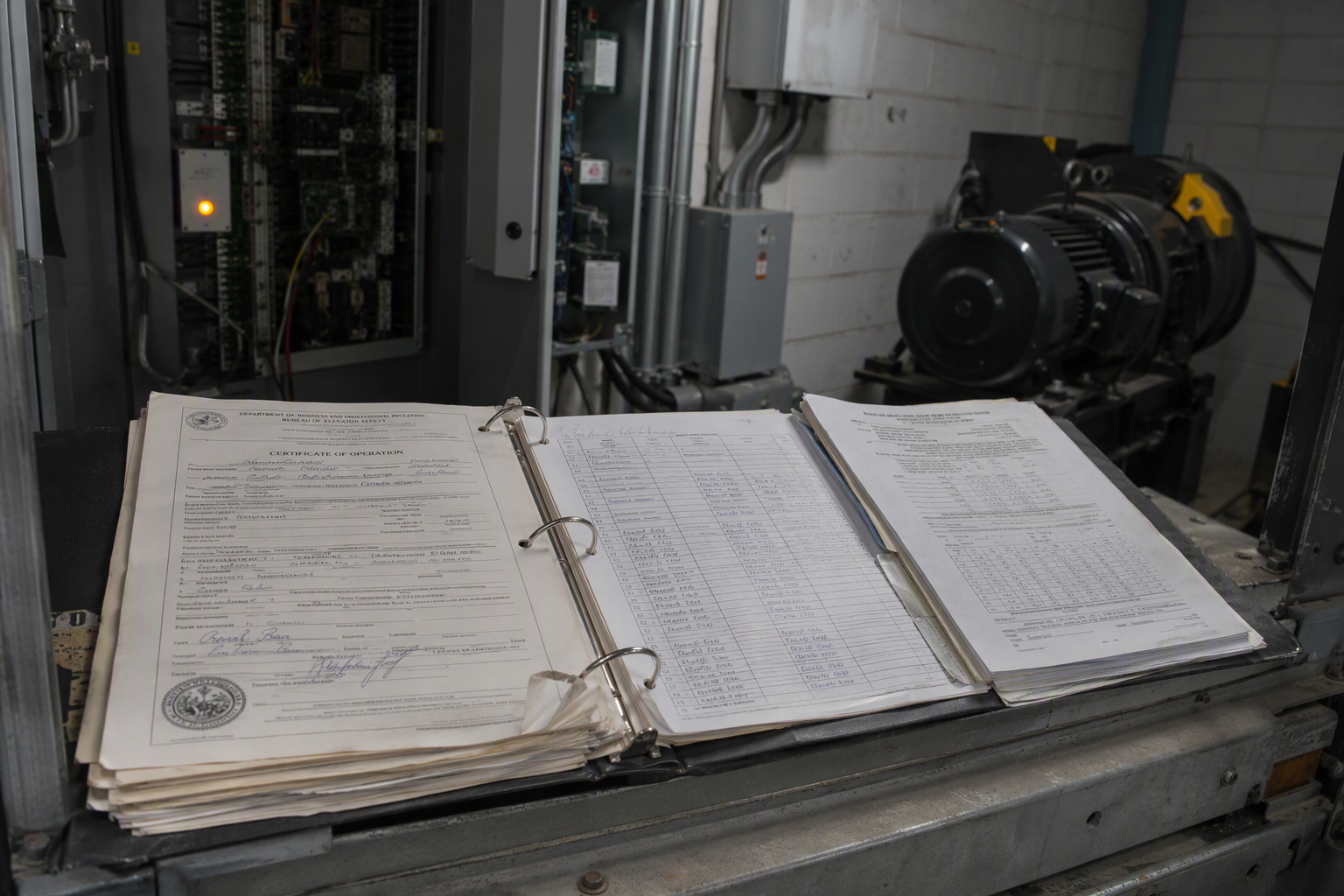
Most commercial elevator maintenance agreements include several provisions that directly affect your ability to switch providers. Understanding these before you serve notice is essential.
- Term and auto-renewal clauses: Many contracts run one to five years and renew automatically unless you provide written notice — often 30 to 90 days — before the renewal date. Missing that window can lock you in for another full term.
- Early-termination fees: Some contracts require payment of remaining monthly fees, a lump-sum penalty, or both if you exit before the term ends.
- Proprietary parts and tools language: Some original equipment manufacturers and their authorized dealers include clauses asserting that proprietary components, software, or diagnostic tools remain their property and cannot be accessed by a competing technician. This can affect your options for independent service.
- Records-ownership language: A critical clause to locate. Some contracts state that maintenance logs, test reports, and inspection records are the contractor’s property. Others acknowledge that building records belong to the building owner. Knowing which applies to your agreement determines how you request a records transfer.
- Warranty implications: If your elevator is under a manufacturer’s warranty tied to the service agreement, verify whether switching providers affects that warranty before giving notice.
Contract Clause Risk Table
| Clause Type | Risk if Ignored | Recommended Action |
|---|---|---|
| Auto-renewal notice window | Locked into another full term | Calendar the notice deadline; serve written notice early |
| Early-termination fee | Unexpected financial penalty | Calculate remaining term cost vs. switching benefit |
| Proprietary parts/software | New provider unable to service key components | Get scope of proprietary restrictions in writing before switching |
| Records ownership | Inspection history unavailable to new provider or regulator | Request all records in writing before final service date |
| Manufacturer warranty tie-in | Warranty voided by provider change | Review warranty terms separately from service agreement |
| Indemnification and liability | Disputes over incidents that occur at transition | Document equipment condition at handoff; get written sign-off |
How Do I Request My Elevator Inspection Records Without Dispute?

Inspection and maintenance records belong functionally to the building, even when a contract’s language is ambiguous. Regulators in all four jurisdictions served by Quality Elevator Company treat the building owner — not the service contractor — as the responsible party for compliance. That means you have both a practical and a regulatory interest in retaining those records.
- Review your contract for any records-ownership clause before making a request. Know whether you are asking for something explicitly yours or negotiating a transfer.
- Send a formal written request to your current provider — via certified mail or traceable email — asking for all inspection reports, test certificates, maintenance logs, repair orders, and deficiency notices for the life of the contract.
- Set a specific deadline for delivery. Tying it to a date at least two weeks before your planned transition gives you time to follow up.
- Contact your state or local elevator authority if your provider refuses. In Maryland, the Maryland Department of Labor, Division of Labor and Industry, Elevator and Escalator Safety requires that maintenance, repair, test, and inspection records be kept at a readily accessible central location in the building where the elevator is located — supporting your right to those records. In DC, Pennsylvania, and Virginia, periodic inspection reports submitted to or maintained for the authority having jurisdiction are likewise building records.
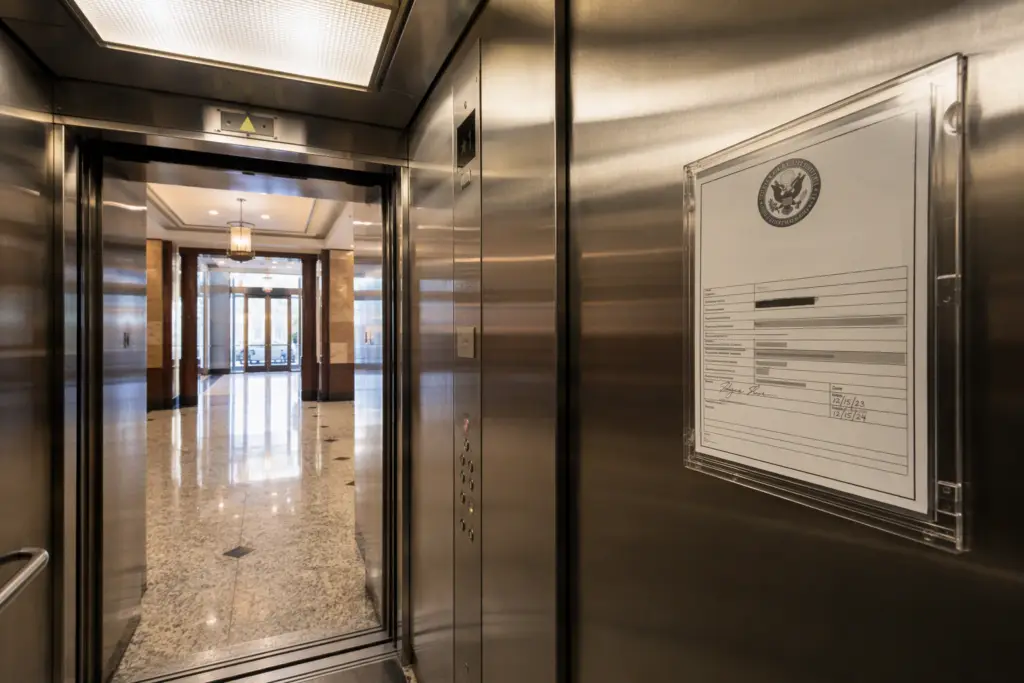
- Cross-reference what you receive against your own copies of certificates of inspection, which are required by regulators in all four jurisdictions to be posted in or near the elevator car.
- Deliver a complete records package to your incoming provider before their first service visit so they can assess actual condition, outstanding deficiencies, and upcoming test due dates.
Will Switching Providers Cause Me to Fail a Mandatory Inspection?
A provider change does not by itself affect your inspection status — but a poorly timed transition can. Each jurisdiction has specific inspection intervals, and a gap in service coverage can mean a required test goes unwitnessed or unperformed.
Inspection Interval Reference by Jurisdiction (2026)
| Jurisdiction | Periodic Inspection Frequency | Long-Cycle Test | Regulator |
|---|---|---|---|
| District of Columbia | Category 1 every 12 months | Category 5 every 60 months | DC Department of Buildings (DOB) |
| Maryland | Annual periodic inspection | Comprehensive five-year inspection (wire-rope and similar elevators) | Maryland Department of Labor, Division of Labor and Industry |
| Pennsylvania | Every 6 months (electric, hydraulic, escalators); 12-month cycle for some equipment | Category 1 annually (starting December 20, 2026); 5-year tests per ASME A17.1 | Pennsylvania Department of Labor and Industry |
| Virginia | Annual (locality may require semi-annual) | Per ASME A17.1 Appendix N intervals, witnessed by code official | Local building department (Virginia USBC) |
When planning your transition, confirm the date of the last completed inspection and calculate when the next one falls. Schedule your new provider’s onboarding well before that date. Under the ASME A17.1 Safety Code for Elevators and Escalators, required periodic tests must be performed by qualified mechanics and, in most jurisdictions, witnessed by an approved inspector or code official. A new provider who is not yet familiar with your equipment may need lead time to review records and prepare for a witnessed test.
Can My Current Provider Legally Withhold My Maintenance Records?
The answer depends on your contract language and jurisdiction. As a practical matter, Maryland law is explicit: maintenance, repair, test, and inspection records must be kept at a readily accessible central location in the building. That statutory requirement, found in Maryland’s elevator safety law (Maryland Department of Labor, Division of Labor and Industry), places records-keeping responsibility on the building — not the contractor — which strengthens an owner’s position in any records dispute.
In the District of Columbia, owners submit third-party inspection reports to DOB through the Citizen Access Portal to obtain certificates of inspection, meaning those reports exist in a government system accessible to the building owner. In Pennsylvania and Virginia, certificates of operation or inspection must be posted on the equipment or kept accessible in the building, giving owners a baseline paper trail regardless of what a contractor retains.
If a contractor refuses to release records, document the refusal in writing, contact your state or local elevator authority, and — if necessary — consult legal counsel. Attempting to retain building records as leverage in a contract dispute is generally viewed unfavorably by regulators.
What Licenses Should My New Elevator Service Provider Hold?
Licensing requirements differ by jurisdiction. Choosing a provider who does not hold the correct credentials in your state or locality puts your building’s compliance at risk and may affect the validity of any work performed.
Licensing Requirements by Jurisdiction
| Jurisdiction | Contractor License Required | Mechanic License/Certification | Inspector Credential |
|---|---|---|---|
| District of Columbia | DC elevator contracting license (DC Board of Industrial Trades) | DC elevator mechanics license (DC Board of Industrial Trades) | ASME QEI-certified (required for Category 1 and Category 5 inspections) |
| Maryland | Licensed elevator contractor (Maryland Elevator Safety Review Board); $1,000,000 general liability / $500,000 property damage minimum insurance | Licensed elevator mechanic (Maryland Elevator Safety Review Board) | Third-party qualified elevator inspector, physically present for entire test |
| Pennsylvania | Third-party inspection agencies must be certified by Pennsylvania Department of Labor and Industry | No statewide mechanic license requirement confirmed at time of publication | UCC-certified elevator inspector |
| Virginia | Contractor license with Elevator/Escalator Contracting (EEC) specialty (Virginia Board for Contractors, DPOR) | State certification required; minimum three years’ experience and examination | Inspections conducted or overseen by local code official or approved agency |
Always ask a prospective provider to show current license or certification documentation for your specific jurisdiction before signing any agreement. Quality Elevator Company holds the appropriate licenses and certifications to perform elevator maintenance, repair, and coordination of inspections across the District of Columbia, Maryland, Pennsylvania, and Virginia.
How Do I Compare Elevator Service Providers Before Switching?
Independent vs. OEM-Affiliated Provider Comparison
| Factor | OEM-Affiliated Provider | Independent Provider |
|---|---|---|
| Parts sourcing | Proprietary parts may be required; non-OEM parts may void certain warranties | Can typically source OEM-equivalent or OEM parts from multiple suppliers |
| Diagnostic access | Full access to proprietary diagnostic software for that manufacturer’s equipment | Access varies by equipment age and manufacturer; newer proprietary systems may limit access |
| Contract flexibility | Often structured, multi-year agreements with auto-renewal | Typically more flexible term options |
| Multi-brand portfolio | Optimized for one manufacturer’s equipment | Experienced across multiple manufacturers and legacy equipment |
| Records portability | Records may be held in proprietary systems | Records typically kept in building-accessible formats |
| Local jurisdiction knowledge | Varies by branch location and staffing | Quality Elevator Company operates exclusively in DC, MD, PA, and VA — deep local regulatory familiarity |
| ADA compliance support | Available, typically at additional cost | Should be included in service scope review; confirm with provider |
What Is the Step-by-Step Process for Switching Elevator Service Companies?
- Audit your current contract. Identify the termination notice window, any early-termination fee, auto-renewal date, records-ownership language, and any proprietary parts or software clauses.
- Calculate your optimal exit date. Target the end of your current term if possible. If an early exit is more cost-effective, factor in any termination fee.
- Request a proposal from prospective providers. Provide them with your equipment inventory, age, usage, and any outstanding deficiencies. Ask each candidate to confirm their licensure in your jurisdiction.
- Verify licensure and insurance. For Maryland, confirm the contractor’s $1,000,000 general liability and $500,000 property damage coverage. For DC, confirm elevator contracting and mechanics licenses through the Board of Industrial Trades. For Virginia, confirm the EEC contractor specialty through DPOR.
- Send written termination notice to your current provider via certified mail or traceable email, referencing the contract section and your termination date. Keep a copy.
- Submit a formal records request at the same time as or immediately after your termination notice. Specify every category of document you expect: inspection reports, test records, maintenance logs, deficiency notices, and permit history.
- Conduct a joint walk-through. Arrange for your new provider to inspect the equipment before the final service date of your current provider. Document equipment condition, outstanding deficiencies, and any items tagged out of service.
- Confirm upcoming inspection and test dates. Cross-reference those dates with your new provider’s onboarding schedule to ensure no mandatory interval lapses. In DC, coordinate with the DOB-approved third-party inspection agency; in Maryland, confirm the annual periodic inspection date with your new contractor; in Pennsylvania, check the six-month or twelve-month cycle; in Virginia, coordinate with the local building department.
- Execute the new service agreement. Review all clauses — particularly records ownership, termination terms, and proprietary parts language — before signing.
- Notify your regulator if required. In Maryland, elevator units must be re-registered with the Commissioner annually. Confirm with your state or local authority whether a provider change triggers any notification obligation.
- File records with the new provider. Transfer the complete records package so your new provider has the full inspection and maintenance history before their first service visit.
How Long Does It Take to Switch Elevator Service Companies?
Typical Transition Timeline
| Phase | Recommended Lead Time | Key Actions |
|---|---|---|
| Planning and review | 60–90 days before desired start date | Audit contract; calculate exit cost; solicit proposals |
| Notice period | Per contract (commonly 30–90 days) | Serve written termination notice; submit records request |
| Vendor selection and credentialing | 30–45 days before start date | Verify licensure; review and execute new agreement |
| Records transfer | At least 14 days before new provider’s first visit | Receive and review all records; deliver to incoming provider |
| Joint equipment walk-through | Before final service date of current provider | Document condition; identify outstanding deficiencies |
| Active transition | Day 1 of new agreement | New provider assumes service; confirm next inspection date |
Starting the planning process at least 90 days before your desired changeover date is strongly recommended. This buffer accommodates contractual notice periods, records disputes, vendor credentialing checks, and any scheduling constraints around mandatory inspections.
Does Switching Elevator Companies Affect My ADA Compliance Obligations?
A provider change does not alter your Americans with Disabilities Act (ADA) obligations as a building owner. The ADA places responsibility for accessible elevator operation on the property owner and operator, not the service contractor. However, a transition period during which elevator service is reduced or an elevator is temporarily out of service raises ADA considerations, particularly in buildings where the elevator is the only accessible route to upper floors.
When planning your transition, ensure that any temporary out-of-service period is minimized, that alternative accessible routes are identified and communicated if an elevator must be taken offline, and that your new provider understands your ADA accessibility requirements as part of their onboarding.
What Are the Most Common Mistakes Building Owners Make When Switching Elevator Companies?
- Missing the auto-renewal window. Failing to serve notice in time locks you into another contract term, often at rates you wanted to renegotiate.
- Not requesting records before the transition date. Once a prior provider has closed out your account, recovering records becomes significantly more difficult.
- Choosing a provider who lacks jurisdiction-specific licensure. Work performed by an unlicensed contractor may not be accepted by your state or local elevator authority, jeopardizing your certificate of inspection or operation.
- Failing to verify upcoming test dates. A transition that inadvertently straddles a required Category 1, five-year, or other periodic test can leave that test unperformed or unwitnessed, triggering regulatory action.
- Not documenting equipment condition at handoff. Without a documented walk-through, disputes about pre-existing deficiencies — and who is responsible for correcting them — become difficult to resolve.
- Signing a new agreement with the same problematic clauses. Review every clause in the new contract before signing. Proprietary language, records-ownership terms, and auto-renewal provisions deserve the same scrutiny you applied to your exiting contract.
- Assuming the new provider will handle regulatory notifications. As the building owner, regulatory obligations — including annual Maryland re-registration, DC certificate submissions through the Citizen Access Portal, and Pennsylvania accident reporting — remain yours. Confirm with your new provider who handles what.
How Does Quality Elevator Company Handle New Client Transitions?
Quality Elevator Company is an independent, certified elevator service provider serving the District of Columbia, Maryland, Pennsylvania, and Virginia. When onboarding a new client transitioning from another provider, Quality Elevator Company conducts a thorough initial assessment of the equipment, reviews all available inspection and maintenance records, identifies any outstanding deficiencies, and maps upcoming mandatory inspection and test dates to ensure no compliance interval lapses.
Because Quality Elevator Company operates exclusively in these four jurisdictions, the team understands the specific regulatory requirements of the DC Department of Buildings, the Maryland Department of Labor, Division of Labor and Industry, the Pennsylvania Department of Labor and Industry, and Virginia’s local building departments under the Virginia Uniform Statewide Building Code. This regional focus means your transition is managed by professionals who understand exactly what your AHJ will require — without the gaps that can occur when a national provider assigns a technician unfamiliar with your local code.
Quality Elevator Company provides maintenance agreements with straightforward records practices: all inspection reports, test records, and maintenance logs are maintained in formats accessible to building owners, and records portability is a standard commitment — not an exception.
What Questions Should I Ask a New Elevator Service Provider Before Signing?
- Are you licensed as an elevator contractor in my jurisdiction, and can you provide documentation?
- Are your mechanics licensed or certified in my jurisdiction?
- Do you maintain records in building-accessible formats, and will I own my maintenance and inspection records?
- What is your process for tracking and scheduling mandatory periodic inspections and tests specific to my state’s requirements?
- How do you handle the onboarding of equipment transitioning from another provider, including review of prior records and identification of outstanding deficiencies?
- What are the auto-renewal and termination terms in your service agreement?
- Do you have any proprietary parts or diagnostic software clauses that would restrict future provider changes?
- How do you coordinate with state or local elevator inspectors for witnessed tests?
Pros and Cons of Switching Elevator Service Providers
| Pros of Switching | Cons / Risks to Manage |
|---|---|
| Opportunity to negotiate better contract terms, including records portability | Early-termination fees if exiting mid-contract |
| Access to providers with stronger local regulatory expertise | Transition period requires careful scheduling around mandatory inspections |
| Potential for improved service responsiveness | Risk of records loss if transfer is not handled proactively |
| Ability to move away from proprietary service lock-in | New provider needs time to learn your specific equipment |
| Fresh assessment of outstanding deficiencies by an independent eye | Warranty implications if manufacturer-affiliated agreement is discontinued |
| Greater contract transparency if you negotiate improved terms upfront | Possible short-term disruption during joint walk-through and records transfer |
Ready to Make a Confident Switch?
Switching elevator service companies does not have to mean lost records, lapsed inspections, or contract penalties — not when the transition is planned carefully and handled by a provider who understands your jurisdiction’s requirements from the ground up.
Contact Quality Elevator Company for a free elevator assessment. The team will review your current equipment condition, identify any upcoming inspection or test obligations under DC, Maryland, Pennsylvania, or Virginia requirements, and walk you through a transition plan that protects your compliance and your records from day one.
Call us today: 301-779-9116
Need elevator service you can rely on? Quality Elevator Company is ready to help.