What Is the Average Cost to Maintain a Commercial Elevator Per Year and What Affects the Price?
Annual commercial elevator maintenance is not a single line item — it is a layered budget that includes a base service contract, mandatory government inspections, periodic code-required testing, parts and labor for unplanned repairs, and, eventually, modernization reserves. The factors that move that total up or down include elevator type, age, number of floors served, local regulatory requirements, and the scope of the maintenance agreement a building owner selects. Understanding each cost driver is the first step to budgeting accurately and avoiding the expensive emergency calls that follow deferred maintenance.
What is typically included in a commercial elevator maintenance contract?
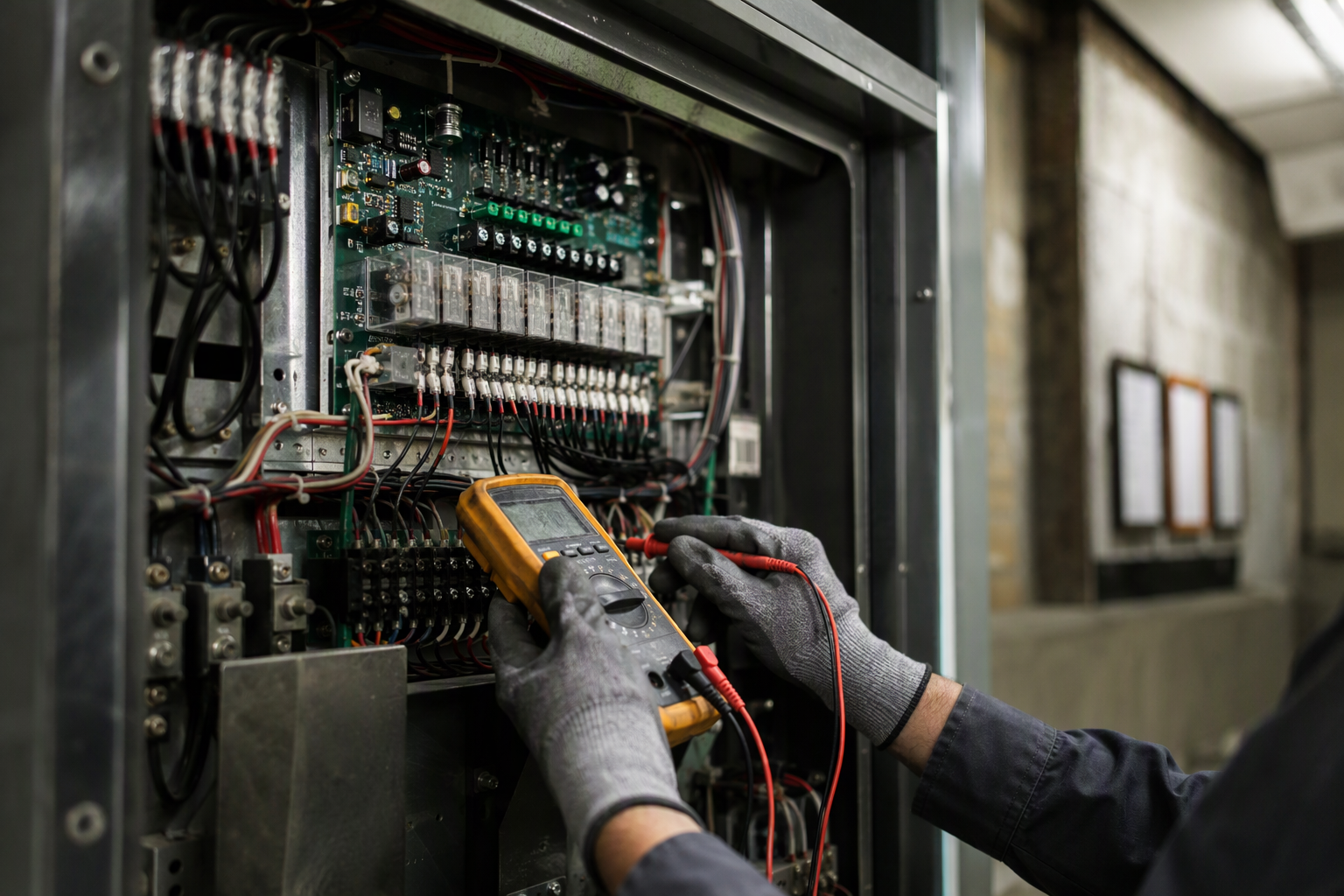
A commercial elevator maintenance contract covers scheduled preventive service visits, lubrication, adjustment, and parts replacement necessary to keep the elevator operating within code tolerances — but the exact scope varies widely between contract tiers.
At the most basic level, an oil-and-grease (OAG) or examination-only contract covers labor for routine visits and a visual check of components but excludes parts. A full-coverage contract, sometimes called a comprehensive agreement, includes both labor and parts for a broader list of components, often covering the motor, controller, door operator, and safety devices. Between those two extremes sit mid-tier contracts that include some parts categories but exclude major components such as the hydraulic cylinder, motor, or microprocessor controller.
Building owners should read contract exclusion lists carefully. Items such as the hydraulic cylinder, rope replacement, cab interior, and door sill are commonly excluded even from contracts marketed as “full coverage.” The gap between what is covered and what is billed at time-and-materials rates is where maintenance budgets are most often blown.
Quality Elevator Company works with building owners across Baltimore, Washington DC, Philadelphia, and Richmond to structure maintenance agreements that align coverage levels with the actual age and condition of each elevator unit, reducing surprise billings while keeping the contract cost proportional to risk.
What factors have the greatest impact on annual elevator maintenance costs?
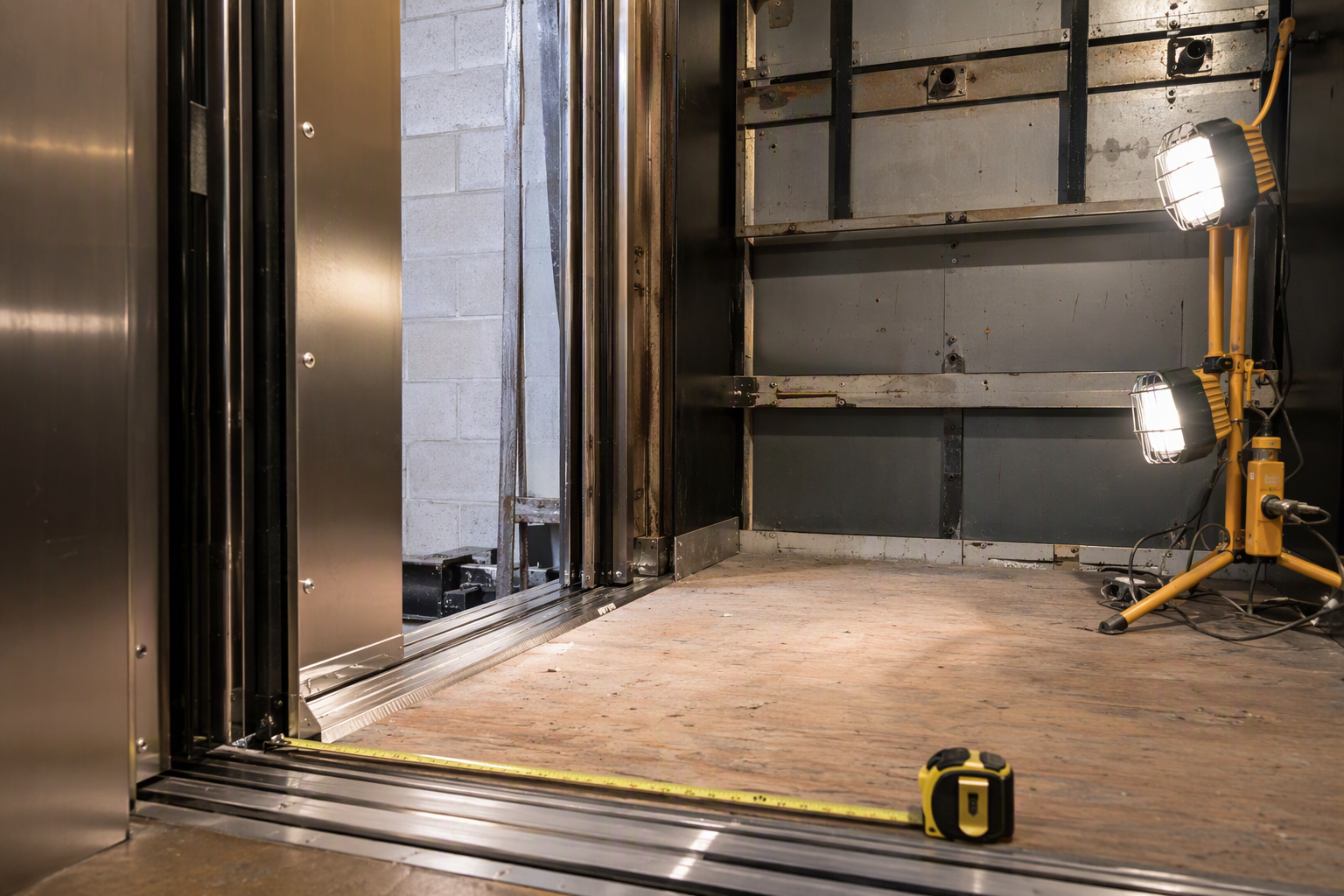
Several well-documented variables move the annual cost total in material ways — no single factor operates in isolation.
The most significant cost drivers are elevator type, age and condition, number of units, floors served, usage intensity, local regulatory requirements, and the tier of maintenance contract selected. Traction elevators — those suspended by wire ropes and driven by a machine — have different maintenance profiles than hydraulic elevators, which use a pump, cylinder, and fluid system. Machine-room-less (MRL) traction elevators require access to in-hoistway components, which can affect labor time and therefore cost. Each type has components that wear at different rates and carry different replacement price points.
Elevator age is a compounding factor. Older equipment that predates current ASME A17.1 Safety Code for Elevators and Escalators editions may require additional safety retrofits as jurisdictions update their adopted codes. An elevator installed under an older code edition will generally cost more to maintain than a recently modernized unit, both because original parts become scarce and because technician time per visit tends to increase as components degrade.
Building location affects cost through two channels: labor market rates in the specific metro area and the specific inspection and testing fees imposed by the state or local authority having jurisdiction (AHJ). A high-rise in Washington DC faces different regulatory touchpoints than a mid-rise in Richmond, Virginia — and both differ from a Philadelphia office building under Pennsylvania’s Uniform Construction Code.
How do elevator type and technology affect maintenance pricing?
Elevator type determines the maintenance labor profile, the consumables required, and the complexity of code-required periodic testing — all of which affect annual cost.
Hydraulic elevators rely on a pump unit, hydraulic fluid, and a cylinder buried in the ground (for conventional units) or mounted above grade (for holeless units). Hydraulic fluid monitoring, seal integrity checks, and cylinder corrosion assessments are maintenance tasks unique to this type. Conventional in-ground cylinders also carry environmental liability considerations that can influence insurance costs for the building. Traction elevators — both geared and gearless — require ongoing attention to wire ropes, sheaves, safeties, and governor mechanisms. MRL traction elevators place the machine and controller inside the hoistway or hoistway adjacent, which changes access logistics during maintenance visits.
Newer elevator systems equipped with electronic controllers and solid-state drives generally offer more precise diagnostics, which can reduce troubleshooting time. However, proprietary software and limited parts availability from a single manufacturer can increase parts costs and, in some cases, lock a building into a single-vendor maintenance relationship. Buildings with legacy proprietary systems may face higher maintenance costs simply due to parts sourcing challenges.
What do state and local inspection requirements cost building owners in DC, Maryland, Pennsylvania, and Virginia?
Mandatory inspections and tests are non-negotiable regulatory costs that every commercial building owner must budget for — and the requirements differ across each jurisdiction Quality Elevator Company serves.
In the District of Columbia, the DC Department of Buildings (DOB) requires all elevators to be inspected and certified by a DOB-approved third-party inspection agency using ASME QEI-certified inspectors. DC requires a Category 1 inspection every 12 months and a Category 5 inspection every 60 months, each as a separate regulatory event. A DC elevator certificate of inspection is valid for two years, and the owner must submit third-party inspection reports for the prior two years through the DOB Citizen Access Portal to obtain or renew that certificate. The cost of retaining a DOB-approved third-party inspection agency and the technician time required to perform the required tests are direct annual cost components for DC building owners.
In Maryland, the Maryland Department of Labor, Division of Labor and Industry, Elevator and Escalator Safety requires each elevator unit to receive a periodic annual inspection by a third-party qualified elevator inspector, and elevator owners must hire that inspector. Maryland also requires a comprehensive five-year inspection for elevators suspended by wire ropes or similar means. Tests must be performed by a licensed elevator mechanic, and when a third-party inspector is required to witness a test, that inspector must be physically present for the entire test. Annual re-registration with the Commissioner is also required at the time of the periodic inspection. These are costs separate from the maintenance contract itself.
In Pennsylvania, the Pennsylvania Department of Labor and Industry (L&I), Bureau of Occupational and Industrial Safety, Elevator Section governs statewide — including Philadelphia. Electric elevators, hydraulic elevators, and escalators must receive periodic inspections at intervals of no more than six months, which means Pennsylvania building owners face at least two inspection events per year. As of December 20, 2026, Category 1 tests become a stand-alone annual requirement under the updated regulation, and periodic tests follow ASME A17.1-2016 Table N-1 intervals, witnessed by a construction code official. Owners should account for this regulatory change when projecting 2026 and forward maintenance budgets.
In Virginia, elevator inspection authority rests with the local building department under the Virginia Uniform Statewide Building Code (13VAC5-63), which adopted ASME A17.1/CSA B44-2019, effective January 18, 2024. All elevators require at least an annual periodic inspection, and a locality may require semi-annual inspections. In Richmond specifically, the City of Richmond Department of Planning and Development Review, Bureau of Permits and Inspections, runs the elevator program, conducting final acceptance inspections and annual inspections with test. Periodic tests must be witnessed by the code official, and the cost of those tests — which require a certified elevator mechanic — is a direct maintenance budget item.
What is the difference between a Category 1 and a Category 5 test, and why do they affect cost?
Category 1 and Category 5 tests are code-mandated periodic tests defined under the ASME A17.1 Safety Code for Elevators and Escalators that test different aspects of elevator safety at different intervals — and they carry different labor and preparation costs.
A Category 1 test verifies that the elevator’s safety devices — such as safeties, governors, buffers, and car and counterweight safeties — function correctly under no-load and rated-load conditions. The test is performed annually in most jurisdictions. A Category 5 test is a full-load, rated-speed test of the governor and safety system, requiring the car to be loaded to its rated capacity and the governor to trip at full speed. Because of the physical demands, the risk of component wear during the test, and the extended technician time required, Category 5 tests are more expensive than Category 1 tests and are required on a five-year cycle by DC and at the intervals specified by ASME A17.1 Appendix N in Virginia. Maryland requires a comprehensive five-year inspection for wire-rope-suspended elevators, which includes analogous high-load testing. These tests must be planned into the maintenance budget in the years they fall due.
How does elevator age and modernization status affect annual maintenance costs?
Elevator age is one of the strongest predictors of total annual maintenance spend — older, non-modernized equipment consistently generates higher parts and labor costs than recently upgraded systems.
As elevator systems age past roughly 20 to 25 years, several cost pressures converge. Original equipment manufacturer (OEM) parts for legacy controllers, relay logic panels, and DC drive systems become scarce, driving up parts prices and lead times. Technician time per visit increases as components require closer inspection and more frequent adjustment. Door operators — statistically among the most common sources of elevator callbacks — wear more frequently on older systems and require more labor to keep aligned and reliable.
Maryland’s regulatory framework acknowledges this dynamic: the safety code edition that applies to a given elevator depends on when the installation contract was signed, meaning that requirements in effect when an elevator was first certified remain in effect for that unit — but maintenance obligations continue regardless of age. Similarly, Pennsylvania’s updated regulation taking effect December 20, 2026, applies to new permit applications, while elevators certified before that date remain under prior standards but still require ongoing inspection and testing.
Modernization — replacing the controller, drive, door operator, and cab — typically resets the maintenance cost curve by introducing current-technology components with established parts supply chains. While modernization carries a significant upfront capital cost, the reduction in ongoing maintenance spend and emergency call frequency often justifies the investment within a planning horizon of several years. Quality Elevator Company provides condition assessments to help building owners evaluate whether a modernization investment is the more cost-effective path compared to continuing maintenance on aging equipment.
How does the number of elevators in a building affect per-unit maintenance cost?
Buildings with multiple elevator units generally achieve a lower per-unit maintenance cost than single-elevator buildings, because service providers can spread fixed visit costs across more units in a single trip.
A high-rise with four traction elevators of the same make and model allows a technician to complete all four units in a single scheduled visit, reducing the travel and mobilization cost allocated to each unit. A single-elevator low-rise carries the full visit cost against one unit. This economy of scale is most pronounced in preventive maintenance visit frequency and in emergency response, where a technician already familiar with a multi-unit building’s equipment can diagnose and address issues more efficiently.
Multi-unit agreements also create negotiating leverage for broader parts coverage and reduced per-incident emergency billing rates. Building owners managing multiple properties or large multi-elevator buildings should request portfolio or campus pricing when evaluating maintenance contracts.
What is the cost impact of emergency service calls versus a preventive maintenance agreement?
Deferred or inadequate preventive maintenance leads predictably to more frequent emergency service calls, and those calls are billed at premium rates that typically far exceed the incremental cost of a more comprehensive maintenance agreement.
Emergency calls generate costs in several ways: the time-and-materials labor rate for unscheduled response, expedited parts sourcing (which often carries a premium over stock pricing), and, in jurisdictions like DC where at least one elevator must remain in service whenever the building is occupied, the potential for regulatory and operational disruption if a building’s only elevator is out of service. Under DC’s 12-A DCMR Chapter 30 requirements, a DOB permit is required to take an elevator out of service or place it in temporarily dormant status, adding an administrative step to any extended outage.
From a pure budget management standpoint, a comprehensive maintenance agreement converts unpredictable emergency repair costs into a known annual line item. The tradeoff is a higher contract premium, but for elevators with high daily ride cycles — such as those in medical office buildings, residential towers, or busy commercial properties — the predictability value is significant.
How does elevator usage intensity affect maintenance costs?
Elevators operating at high daily ride cycles wear faster than those in low-traffic buildings, which directly increases the frequency of component replacement and the technician time needed to maintain safe operation.
Door systems are the clearest example: a hospital elevator cycling its doors hundreds of times per day will wear door operator components, sills, gibs, and door rollers far faster than an elevator in a suburban office building with modest daily traffic. Similarly, high-cycle usage accelerates wear on guide shoes, rope, and brake linings in traction elevators, and on pump seals and valve components in hydraulic systems. Maintenance contracts for high-cycle applications should reflect this reality, either through a more comprehensive parts coverage tier or through agreed-upon replacement schedules for high-wear components.
Building owners should provide accurate usage data — floor count, daily trips, peak hours, and load type — when soliciting maintenance contract proposals. A contract priced for moderate usage applied to a high-cycle elevator will not deliver adequate preventive care and will generate excess emergency billing.
What ADA-related costs should building owners factor into elevator maintenance budgets?
The Americans with Disabilities Act (ADA) imposes ongoing accessibility obligations on commercial buildings that can generate maintenance and repair costs when elevator accessibility features degrade.
ADA-required features on elevators include raised and Braille floor designations, audible floor indicators, minimum door opening width and timing, accessible call button height and size, and two-way emergency communication systems. These features are not merely installation requirements — they must remain functional throughout the elevator’s operational life. When a Braille indicator wears off, an audible chime fails, or a door reopens too slowly for a wheelchair user to pass safely, the building owner is exposed to ADA compliance risk. Maintenance agreements should explicitly address the inspection and functional testing of all ADA-required components as part of each preventive visit, not as an ad-hoc repair item.
How do parts availability and supply chain conditions affect elevator maintenance costs in 2026?
Parts availability is a material cost variable that building owners and their maintenance providers must monitor actively, particularly for elevators with proprietary or legacy components.
Proprietary controller systems — where the original manufacturer is the only authorized source for replacement boards, software, and drive components — give that manufacturer effective pricing power over the parts market. Buildings locked into proprietary systems may face longer lead times and higher parts costs than those with elevators using open-architecture controllers compatible with multiple suppliers. This dynamic is most acute for elevators installed in the 1980s and 1990s, where the original manufacturer may have discontinued the product line or exited the market entirely.
For traction elevators, wire rope is a consumable with both inspection and replacement requirements under ASME A17.1, and rope pricing is subject to commodity market conditions. Hydraulic fluid and seal kits for hydraulic elevators are similarly subject to supply chain dynamics. Building owners evaluating maintenance contracts should ask vendors specifically how parts sourcing is handled for their elevator make and model, and what lead times are typical for critical components.
What should a building owner look for when comparing elevator maintenance contract proposals?
Comparing elevator maintenance proposals requires examining coverage scope, exclusion lists, inspection and test inclusion, emergency response terms, and price escalation provisions — not price alone.
- Request a detailed list of all covered components and cross-reference it against the elevator’s equipment schedule to identify gaps.
- Confirm whether mandatory inspections and periodic tests required by the state AHJ are included in the contract price or billed separately.
- Identify all named exclusions, particularly hydraulic cylinders, wire ropes, cab finishes, and electronic controller boards.
- Review emergency response terms: what constitutes a billable emergency call versus a covered callback, and what rate applies after hours.
- Review the price escalation clause: many multi-year agreements include annual escalators tied to labor indexes that can significantly increase total cost over a five-year term.
- Confirm that the vendor’s technicians are properly licensed for the jurisdiction — Maryland requires licensed elevator mechanics; DC requires elevator contractor licensure from the DC Board of Industrial Trades; Virginia requires state certification from the Virginia Board for Contractors (DPOR); and all applicable code standards under ASME A17.1 must be met.
- Ask for references from comparable properties in the same jurisdiction, as local regulatory familiarity is a meaningful differentiator.
How do maintenance costs compare across elevator types and contract tiers?
The table below presents a qualitative benchmark comparison of maintenance cost variables across common commercial elevator types and contract tiers. These are relative comparisons based on widely acknowledged industry cost drivers — not specific price quotes, as actual pricing depends on equipment specifics, location, building usage, and current labor and parts markets.
| Factor | Hydraulic Elevator | Geared Traction Elevator | Gearless Traction / MRL |
|---|---|---|---|
| Typical maintenance complexity | Moderate (pump, fluid, seals) | Moderate-High (ropes, gear oil, brake) | Higher (in-hoistway machine access) |
| 5-year test cost impact | Moderate | Higher (full-load governor test) | Higher (full-load governor test) |
| Parts availability (legacy) | Generally available | Varies by age/manufacturer | Proprietary risk if MRL system is legacy |
| Emergency call frequency (high-cycle) | Moderate-High (door, pump) | Moderate (door, rope, brake) | Moderate (door, controller) |
| Contract Tier | Typical Inclusions | Typical Exclusions | Best Fit |
|---|---|---|---|
| Oil & Grease (OAG) / Examination Only | Labor for visits, lubrication, adjustments | All parts | Low-budget / newer equipment under warranty |
| Mid-Coverage | Labor + selected parts (door hardware, minor components) | Major components (cylinder, motor, controller) | Moderate-age equipment, managed risk |
| Full / Comprehensive | Labor + broad parts coverage | Named exclusions (cab, cylinder, some electronics) | High-cycle, older equipment, budget certainty |
What happens if a building owner skips or delays required inspections?
Operating an elevator without a valid certificate of inspection or in violation of mandatory testing requirements exposes a building owner to regulatory enforcement, potential equipment shutdown, and liability — consequences that cost far more than the inspections themselves.
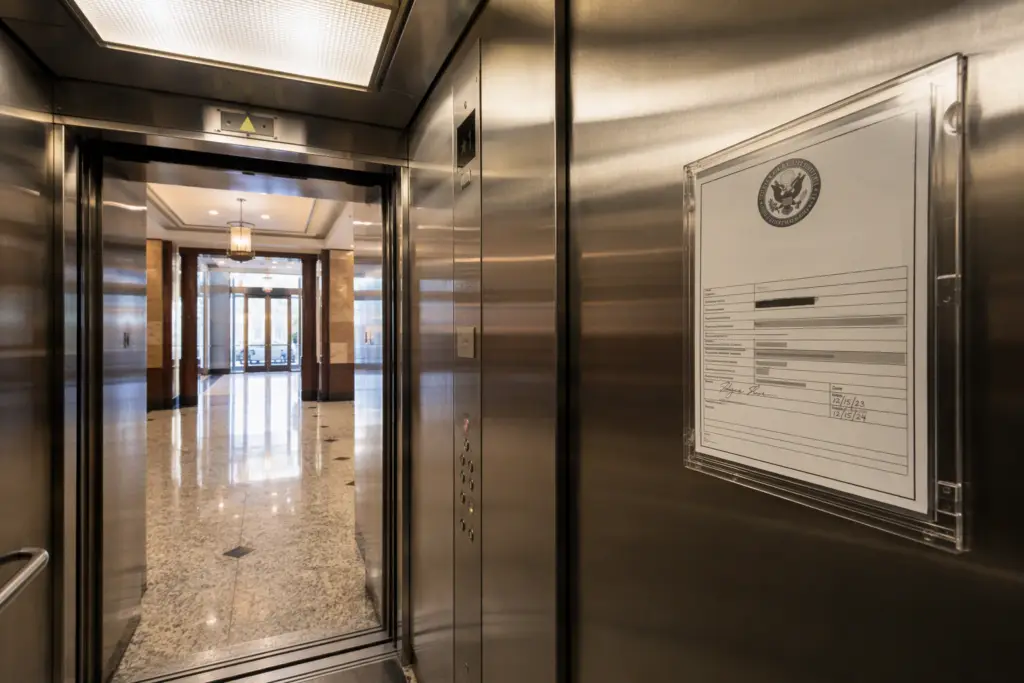
In Maryland, an elevator unit may not be operated unless the Commissioner of Labor and Industry has issued a certificate for it, and the certificate must be posted conspicuously in or on the elevator. Operating without a certificate is a statutory violation under the Annotated Code of Maryland, Public Safety Article, Title 12, Subtitle 8. In Pennsylvania, no elevator may be operated without a certificate of operation from the Department of Labor and Industry. In DC, all elevators must be inspected and certified, and the DOB has authority to take enforcement action on non-compliant equipment. In Virginia, the local building department enforces annual inspection requirements and can order an elevator out of service for non-compliance.
Beyond regulatory penalties, an elevator involved in a passenger incident that is found to be out of compliance with mandatory inspection or testing requirements creates significant liability exposure for the building owner. Courts in personal injury litigation routinely examine maintenance and inspection records, and a gap in those records is difficult to defend. Maryland’s regulations specifically require that maintenance, repair, test, and inspection records be kept at a readily accessible central location in the building where the elevator is located.
How should building owners plan for elevator modernization as part of their long-term cost strategy?
Modernization is not merely a capital expense — it is a strategic cost management tool that, when timed correctly, reduces total elevator ownership cost over a multi-year horizon.
The business case for modernization typically strengthens when any of the following conditions are present: the elevator is experiencing an increasing frequency of emergency calls; the maintenance provider is unable to guarantee parts availability within an acceptable timeframe; the building is approaching a five-year test cycle that requires significant pre-test repairs on aging components; or the jurisdiction has updated its adopted code edition in ways that impose new safety device requirements on existing equipment. When code-required safety retrofits on a non-modernized unit approach the cost of a modernization project, the modernization option typically offers superior value because it resets the entire system rather than patching individual components.
Building owners should request a condition assessment and five-year cost projection from their maintenance provider before each major budget cycle. Quality Elevator Company offers elevator condition assessments for building owners in Baltimore, Washington DC, Philadelphia, and Richmond to support exactly this type of long-range planning.
What OSHA requirements affect elevator maintenance and technician safety costs?
Federal OSHA regulations govern the working conditions under which elevator technicians perform maintenance and testing, and compliance with those requirements affects how maintenance work is structured and priced.
Elevator maintenance work involves confined space entry (machine rooms and pits), lockout/tagout procedures for energy control, and work-at-height exposures in the hoistway. OSHA’s general industry and construction standards impose specific procedural requirements for each of these hazard categories. Reputable elevator maintenance contractors build the time and equipment costs for OSHA-compliant procedures — including pit entry protocols, lockout/tagout documentation, and appropriate personal protective equipment — into their contract pricing. Building owners evaluating proposals from vendors whose pricing seems unusually low should ask specifically how OSHA-required safety procedures are addressed, as cutting corners on technician safety is both a liability risk for the building owner and a leading indicator of overall service quality.
What records should building owners maintain to manage elevator costs effectively?
Comprehensive recordkeeping reduces both regulatory risk and long-term maintenance cost by creating a documented history that supports informed maintenance decisions and demonstrates compliance to inspectors and insurers.
- Maintain the original installation permit and equipment specification documents for each elevator unit.
- Keep all inspection reports, including third-party inspector reports and government agency reports, organized by date and inspection category.
- Retain all test records, including Category 1 and Category 5 (or equivalent five-year) test documentation, with the name and certification number of the technician and inspector involved.
- Log all maintenance visits, noting work performed, parts replaced, and technician identification.
- Record all emergency service calls with date, complaint, diagnosis, and corrective action.
- Store the current certificate of inspection as required by the applicable jurisdiction and keep prior certificates in the building file.
- Document any code compliance retrofits with the code section addressed and the date of completion.
Maryland regulations require these records to be kept at a readily accessible central location in the building. Virginia requires that third-party inspection reports include the name and certification number of the elevator mechanic who performed the witnessed tests. Regardless of jurisdiction, a complete and organized record set is the building owner’s strongest protection in a regulatory audit or personal injury litigation.
How can building owners reduce elevator maintenance costs without compromising safety or compliance?
Cost reduction in elevator maintenance is achievable through strategic contract structuring, proactive planning, and consolidating vendors — but it must never be pursued by deferring mandatory inspections, skipping required tests, or selecting a vendor whose technicians lack proper licensing for the jurisdiction.
Legitimate cost management strategies include: negotiating multi-year agreements with price escalation caps; consolidating maintenance for all elevator units in a portfolio with a single qualified provider to capture volume pricing; scheduling Category 5 and five-year comprehensive tests well in advance to avoid expedited mobilization premiums; addressing minor component wear during routine visits rather than waiting for failure; and investing in modernization when the condition assessment indicates that ongoing maintenance costs on aging equipment will exceed modernization costs within a reasonable planning horizon.
Quality Elevator Company serves building owners in Baltimore, Washington DC, Philadelphia, and Richmond with maintenance programs structured to balance regulatory compliance, equipment reliability, and cost predictability — including guidance on when modernization is the more cost-effective long-term path.
What questions should a building owner ask before signing an elevator maintenance contract?
Selecting an elevator maintenance provider is a consequential decision that affects regulatory compliance, equipment reliability, budget predictability, and building occupant safety — these are the questions that distinguish a well-structured agreement from one that will generate costly surprises.
- Are your technicians licensed or certified as required by the state or local AHJ for this specific jurisdiction (Maryland elevator mechanic license; DC elevator contractor and mechanic license from the Board of Industrial Trades; Virginia state certification from DPOR; Pennsylvania applicable standards)?
- Does this contract include all mandatory inspections and periodic tests required by the state regulator, or are those billed separately?
- What is the complete exclusion list, and can you provide it in writing before contract execution?
- What is your procedure when a part is on backorder — how is equipment availability maintained?
- How are emergency service calls defined in this contract, and what is the billing rate for calls that fall outside the coverage definition?
- What is the annual price escalation mechanism, and is there a cap?
- Can you provide references from commercial properties of similar size and elevator type in this jurisdiction?
- What is your process for notifying the building owner of upcoming five-year test requirements and code compliance deadlines?
Get a Professional Elevator Assessment for Your Building
Understanding the true annual cost to maintain a commercial elevator starts with an honest assessment of the equipment’s current condition, regulatory standing, and contract coverage gaps. Contact Quality Elevator Company for a free elevator assessment — serving commercial building owners in Baltimore, Washington DC, Philadelphia, and Richmond with the technical expertise and jurisdictional knowledge to help you budget accurately, stay compliant, and protect your building’s occupants.
Call Quality Elevator Company today: 301-779-9116
Need elevator service you can rely on? Quality Elevator Company is ready to help.