
Receiving multiple elevator maintenance proposals and not knowing how to read them is one of the most common challenges building owners and facility managers face. A proposal that looks affordable on page one can carry hidden costs that surface only after a contract is signed. This guide walks through every dimension of a fair evaluation — scope, compliance, pricing structure, contractor credentials, and contract terms — so property owners in the District of Columbia, Maryland, Pennsylvania, and Virginia can make an informed decision.
What Should a Complete Elevator Maintenance Proposal Include?
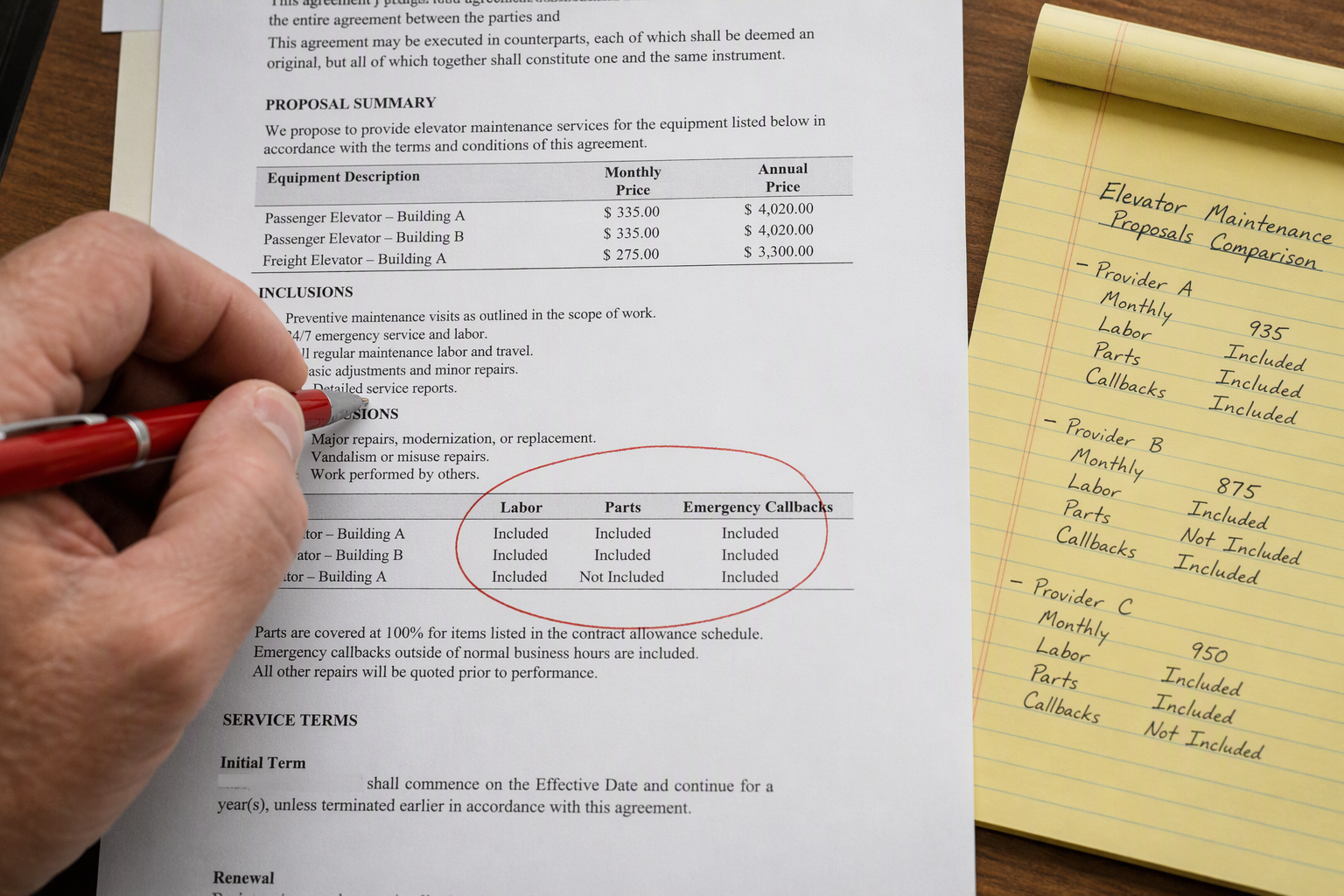
A thorough proposal covers more than a monthly service rate. Before comparing prices, confirm that every proposal before you addresses the following categories. Any proposal that omits a category is not directly comparable to one that includes it.
| Proposal Element | What to Look For | Red Flag |
|---|---|---|
| Scope of Labor | All routine maintenance labor included with no per-visit surcharges | Labor billed separately for each scheduled visit |
| Parts Coverage | Clearly lists which parts are covered and which are excluded | Vague language such as “standard parts” or “as needed” |
| Emergency Callbacks | Emergency or after-hours calls included in the base rate | Callback charges billed at premium hourly rates |
| Inspection Coordination | Provider coordinates with the authority having jurisdiction (AHJ) for required periodic inspections | Inspection coordination listed as an add-on fee |
| Modernization Roadmap | Assessment of equipment age and condition with recommended upgrade timeline | No mention of long-term equipment condition or capital planning |
| Contractor Licensing | Proof of required licenses and insurance for your jurisdiction | Licenses mentioned only verbally or not confirmed in writing |
| Contract Term and Exit Clauses | Clear term length, renewal conditions, and cancellation rights | Auto-renewal clauses with short cancellation windows buried in fine print |
| Record Keeping | Written logs of all service, maintenance, and test activities provided to the owner | Verbal-only reports; no documentation trail for AHJ audits |
How Do Elevator Maintenance Contract Types Differ?
Maintenance contracts generally fall into three tiers. Understanding the tier each proposal represents is the first step to an apples-to-apples comparison.
| Contract Type | What Is Included | Best For | Watch Out For |
|---|---|---|---|
| Examination-Only / Oil & Grease | Visual inspection, lubrication, minor adjustments | Low-traffic residential elevators in good condition | All parts and labor billed separately — costs escalate quickly with any repair |
| Partial Maintenance | Inspection, lubrication, and a defined list of covered parts | Mid-age equipment with predictable wear patterns | Exclusion lists can be long; read every line |
| Full Maintenance (Comprehensive) | All labor, most or all parts, emergency callbacks, and inspection support | High-traffic commercial buildings; older equipment | Major modernization components (motor, controller) may still be excluded — confirm in writing |
A comprehensive proposal that appears more expensive per month often represents lower total cost of ownership when parts and callback charges from lower-tier contracts are added up over the contract term.
What Compliance Requirements Must an Elevator Contractor Meet in DC, Maryland, Pennsylvania, and Virginia?
Regulatory compliance is not optional, and a proposal from a contractor who cannot demonstrate compliance with your jurisdiction’s requirements should be disqualified regardless of price. Below is a jurisdiction-by-jurisdiction summary of the key compliance points to verify.
| Jurisdiction | Regulator | Key Contractor Requirement | Inspection Frequency |
|---|---|---|---|
| District of Columbia | DC Department of Buildings (DOB) | Elevator contracting license issued by DC Board of Industrial Trades; elevator mechanics licensed; permit requires master electrician and elevator contracting license on file | Category 1 inspection every 12 months; Category 5 inspection every 60 months, each by an ASME QEI-certified inspector; DC certificate of inspection valid for two years |
| Maryland | Maryland Department of Labor, Division of Labor and Industry | Elevator contractors must be licensed by the Maryland Elevator Safety Review Board and carry at least $1,000,000 in general liability insurance and at least $500,000 in property damage insurance; elevator mechanics must be licensed | Annual periodic inspection by a qualified elevator inspector; comprehensive five-year inspection for elevators suspended by wire ropes, belts, chains, or similar means |
| Pennsylvania | Pennsylvania Department of Labor and Industry (L&I) | Third-party inspection agencies must be certified by the Department; acceptance inspection required before a repaired, altered, or modified elevator returns to service | Electric and hydraulic elevators and escalators: periodic inspections at intervals of no more than 6 months; certificate of operation valid for 24 months (6-month cycle) or 48 months (12-month cycle) |
| Virginia | Local building department (Virginia Uniform Statewide Building Code) | Contractors must hold an Elevator/Escalator Contracting (EEC) specialty license from the Virginia Board for Contractors (DPOR); mechanics must be state-certified with at least three years of industry experience; minimum eight hours of continuing education per renewal cycle | Annual periodic inspection; locality may require six-month periodic inspection; periodic tests per ASME A17.1 Safety Code for Elevators and Escalators Appendix N intervals, witnessed by the local code official |
When reviewing any proposal, request proof of the relevant license or certification before signing. Unlicensed work can void insurance coverage and expose building owners to liability under the applicable statutes listed above.
What Questions Should You Ask Every Elevator Maintenance Vendor?
These questions cut through marketing language and surface the real differences between proposals.
- Is your company currently licensed as an elevator contractor in my specific jurisdiction, and can you provide a copy of that license? This is the baseline. In Maryland, the Maryland Elevator Safety Review Board issues the license. In Virginia, the Virginia Board for Contractors issues the EEC specialty license. In DC, the DC Board of Industrial Trades issues the license. In Pennsylvania, confirm the inspection agency is certified by L&I.
- Which parts are explicitly excluded from this contract? Ask for the exclusion list in writing. Common exclusions include motor controllers, hydraulic cylinders, and major drive components — all of which can represent significant repair costs.
- How do you handle required periodic inspections and testing, and who coordinates with the authority having jurisdiction? The provider should be able to name your specific AHJ and explain the process for scheduling and documenting inspections.
- What is the process if a deficiency is found during an inspection — is the remediation covered under this contract or billed separately?
- Do you retain maintenance and service records on-site or on a digital platform, and how are they made accessible to the building owner? Maryland law, for example, requires maintenance, repair, test, and inspection records to be kept at a readily accessible central location in the building.
- What are the contract renewal and cancellation terms? Some agreements include automatic multi-year renewals triggered unless cancelled within a narrow window — often 90 to 180 days before the term ends.
- Does the proposal account for the code edition currently adopted in my jurisdiction? For example, Pennsylvania’s updated elevator regulation takes effect December 20, 2026, and affects Category 1 test scheduling for permit applications made on or after that date.
- Are emergency callback visits included, and if so, is there a limit on the number of callbacks per year?
How Do You Compare Elevator Maintenance Costs Fairly?
Monthly service rates are not directly comparable unless all proposals describe the same scope. Use the following framework to normalize competing bids before evaluating price.
- List every service, part category, and activity described in Proposal A.
- For each item in Proposal A, identify whether Proposal B and Proposal C include or exclude it.
- For every exclusion in a lower-cost proposal, obtain a separate quote for that item or service so you can add it back into the comparison total.
- Multiply monthly rates by the full contract term (typically 12, 24, or 36 months) to get a total commitment figure.
- Add estimated callback and repair costs for excluded items based on the vendor’s stated rates for non-contract work.
- Factor in the cost of switching providers if the contract includes early-termination penalties.
A proposal with a lower monthly rate but a long, restrictive contract term and a broad exclusion list can cost substantially more over the life of the agreement than a higher-priced, comprehensive contract.
What Are the Pros and Cons of Manufacturer vs. Independent Elevator Maintenance Providers?
| Factor | Original Equipment Manufacturer (OEM) Provider | Independent Certified Provider |
|---|---|---|
| Parts Access | Proprietary parts may be available faster for their own equipment; may restrict non-OEM parts on their systems | Sources parts from multiple manufacturers; can often use equivalent or OEM parts at competitive cost |
| Pricing | Generally higher; leverage comes from proprietary system lock-in | Competitive pricing; no lock-in premium; encourages transparent bidding |
| Technical Expertise | Deep knowledge of own equipment; limited multi-brand exposure | Experience across multiple brands and equipment generations |
| Contract Flexibility | Often structured to discourage switching; proprietary diagnostic tools may be withheld if switching providers | More flexible terms; not dependent on proprietary system access |
| Compliance Knowledge | Familiar with code as it applies to their own product lines | Must maintain broad compliance knowledge across all equipment types and jurisdictions — stronger incentive to stay current |
| Accountability | Large corporate structure can mean slower local response and less owner-direct communication | Regional accountability; building owner typically has direct access to decision-makers |
What Contract Terms Are Non-Negotiable in an Elevator Maintenance Agreement?
Certain contract provisions protect the building owner regardless of which provider is chosen. If a vendor refuses to include these terms, treat that refusal as a significant warning sign.
- Written scope of work: Every service, part category, and scheduled activity must be described in writing, not incorporated by reference to a separate document that can be changed unilaterally.
- Defined labor rates for out-of-scope work: Any work not covered by the agreement should be billed at pre-agreed, locked rates — not “prevailing rates” that the provider defines later.
- Record ownership: Maintenance logs, inspection reports, and test records must be owned by the building owner and remain on-site, not held exclusively by the provider.
- Termination for cause: The owner must be able to terminate the contract without penalty if the provider fails to meet compliance obligations or misses scheduled service visits.
- License and insurance verification: The agreement should require the provider to maintain required licenses and insurance throughout the contract term and provide proof annually.
- Code compliance warranty: The provider should warrant that all maintenance work is performed in accordance with the applicable adopted code edition for your jurisdiction, including the ASME A17.1 Safety Code for Elevators and Escalators.
- ADA coordination: The provider should flag any maintenance findings that may affect compliance with the Americans with Disabilities Act (ADA), particularly regarding accessible service continuity.
How Do You Evaluate Vendor Qualifications Beyond Price?
Price is only one variable. The following qualitative factors separate a reliable long-term partner from a low-bid risk.
- Demonstrated familiarity with local AHJ processes: A qualified vendor should be able to name the specific authority having jurisdiction for your building — not just “the state” — and explain how they interact with that office for inspections, permits, and deficiency corrections.
- References from comparable buildings: Request references from building types similar to yours (commercial office, multifamily residential, healthcare, or government) in your jurisdiction.
- Transparency about technician qualifications: Confirm that the mechanics who will service your equipment hold the certifications required by your jurisdiction. In Virginia, mechanics must be state-certified. In Maryland, mechanics must be individually licensed by the Maryland Elevator Safety Review Board. In DC, mechanics are licensed by the DC Board of Industrial Trades.
- Clear escalation process: Understand how the provider handles disputes, deficiency notifications, and emergency situations. A proposal that does not describe an escalation path leaves the building owner with no recourse when problems arise.
- Written safety policy: Ask whether the provider has a written safety program and whether it complies with applicable OSHA standards for elevator work environments.
What Inspection and Testing Obligations Does a Maintenance Contract Need to Support?
A maintenance contractor who does not understand your jurisdiction’s inspection schedule cannot reliably keep your elevator in legal operation. Each jurisdiction in Quality Elevator Company’s service area has distinct requirements that a compliant proposal must address.
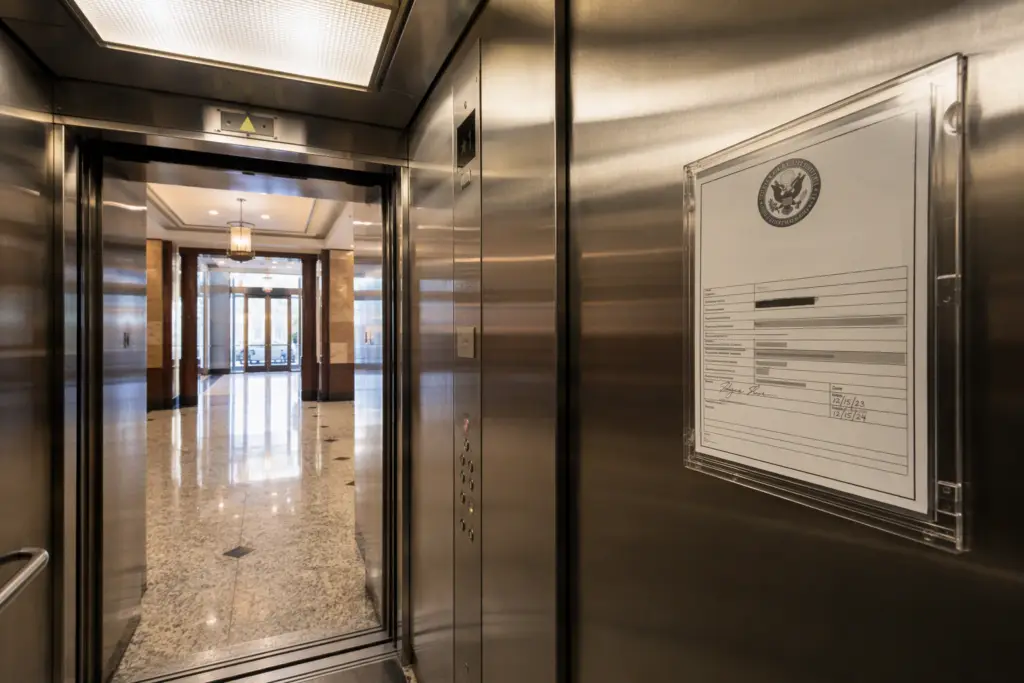
- District of Columbia: The DC Department of Buildings requires a Category 1 inspection every 12 months and a Category 5 inspection every 60 months, each conducted by an ASME QEI-certified inspector from a DOB-approved third-party agency. A DC certificate of inspection is valid for two years. The maintenance provider should facilitate the required tests and ensure reports are submitted through the Citizen Access Portal. The current certificate must be conspicuously displayed in the elevator car. See DC DOB Elevator and Conveyance Inspections for requirements.
- Maryland: Each elevator unit requires an annual periodic inspection by a third-party qualified elevator inspector. Elevators suspended by wire ropes, belts, chains, or similar means also require a comprehensive five-year inspection. Tests must be performed by a licensed elevator mechanic, and the inspector must be physically present for the entire test. Maintenance records must be kept at an accessible central location in the building. See the Maryland Department of Labor, Division of Labor and Industry, Elevator and Escalator Safety for requirements.
- Pennsylvania: Electric elevators, hydraulic elevators, and escalators must have periodic inspections at intervals of no more than six months. Beginning December 20, 2026, Category 1 tests must be performed annually as a stand-alone requirement under updated regulations. After a major repair or alteration, the elevator may not return to service until inspected and approved by the Pennsylvania Department of Labor and Industry. See Pennsylvania L&I Elevator Section for requirements.
- Virginia: All elevators and escalators require an annual periodic inspection; a locality may require a six-month periodic inspection. Periodic tests follow ASME A17.1 Safety Code for Elevators and Escalators Appendix N intervals and must be witnessed by the local code official. The local building department — not a state agency — enforces these requirements. See 13VAC5-63, Virginia Uniform Statewide Building Code for requirements.
What Are the Most Common Ways Elevator Proposals Mislead Buyers?
Understanding common tactics helps building owners avoid contracts that look competitive but deliver less than expected.
- Low introductory rates with aggressive annual escalators: A contract that begins affordably but escalates by a fixed percentage per year — compounded over a multi-year term — can cost far more than a flat-rate agreement. Ask for the maximum annual increase permitted under the contract.
- Broad “exclusion” language: Terms such as “vandalism damage,” “misuse,” or “abnormal wear” can be used to deny coverage for repairs that any reasonable owner would expect to be included. Request specific examples of what has been denied under these exclusions in past contracts.
- Inspection “coordination” fees: Some providers charge separately to schedule or attend required inspections — a function that should be standard in any compliant maintenance agreement.
- Proprietary diagnostic lock-in: If a provider installs proprietary remote monitoring or diagnostic hardware, leaving that provider may require expensive hardware replacement. Clarify ownership of all monitoring equipment before signing.
- Lumping modernization into maintenance: A provider who recommends immediate modernization that is not code-required may be upselling. Ask for a written explanation of how the recommendation ties to a specific code requirement or safety deficiency.
- Unlicensed subcontracting: Some companies subcontract work to mechanics who may not hold the required individual certifications. The agreement should require that all mechanics assigned to your equipment hold the required credentials for your jurisdiction.
How Should You Structure a Decision Matrix to Choose Between Proposals?
A structured scoring approach removes emotion from the decision and creates a defensible record for procurement review.
- List the evaluation criteria that matter most to your building: compliance, scope, price, contract flexibility, vendor qualifications, and record-keeping.
- Assign a weight to each criterion based on its relative importance. For a high-traffic commercial building in DC where downtime is costly, emergency callback inclusion and AHJ familiarity may outweigh raw price.
- Score each proposal on each criterion using a consistent scale (for example, 1 to 5).
- Multiply each score by its weight to get a weighted score per criterion.
- Sum the weighted scores for each proposal. The highest total score represents the best overall value — not necessarily the lowest price.
- For any proposal scoring below a threshold on compliance or licensing, disqualify it before considering price, since regulatory violations expose the building owner to liability under D.C. Official Code § 6-1409, the Annotated Code of Maryland Public Safety Article Title 12, 35 P.S. § 7210.101, or Virginia Code § 36-97, depending on jurisdiction.
Why Do Building Owners in DC, Maryland, Pennsylvania, and Virginia Choose Quality Elevator Company?
Quality Elevator Company is an independent certified elevator service provider serving the District of Columbia, Maryland, Pennsylvania, and Virginia. As an independent company, Quality Elevator Company is not locked into a single manufacturer’s equipment line, which means proposals are built around the building owner’s needs rather than proprietary parts and pricing structures.
Quality Elevator Company’s service approach is built on the compliance frameworks of each jurisdiction it serves — from the annual and five-year inspection requirements governed by the Maryland Department of Labor to the local-enforcement model under the Virginia Uniform Statewide Building Code, the certificate and permit requirements of the DC Department of Buildings, and the semi-annual inspection cycle enforced by Pennsylvania L&I.
Proposals from Quality Elevator Company are written in plain language, with explicit scope descriptions, defined exclusions, and transparent rate structures for out-of-scope work — making them straightforward to compare against any competing bid using the framework in this guide.
Ready to Compare Your Current Proposal Against a Transparent, Compliant Alternative?
Contact Quality Elevator Company for a free elevator assessment. A member of the team will review your current contract, identify gaps in scope or compliance, and provide a clear, itemized proposal for your jurisdiction.
Call Quality Elevator Company today: 301-779-9116
Need elevator service you can rely on? Quality Elevator Company is ready to help.