Cold weather stresses elevator hydraulic fluid, lubricants, door mechanisms, and electrical components, causing slowdowns, misfires, and shutdowns — building owners should schedule pre-winter inspections, verify fluid viscosity ratings, test door sensors, and ensure machine room heating is functional before temperatures drop.
How Cold Weather Affects Elevator Performance in Winter — and What Building Owners Should Do to Prepare
Cold weather in winter affects elevator performance in multiple interconnected ways: hydraulic fluid thickens and loses pressure efficiency, lubricants on guide rails and cables stiffen, door operator mechanisms slow or bind, and temperature-sensitive electronic control boards become vulnerable to condensation and voltage fluctuation. Building owners in Baltimore, Washington DC, Philadelphia, and Richmond should begin preparations in early autumn, not after the first freeze.
Why Does Cold Weather Affect Elevator Hydraulic Fluid?
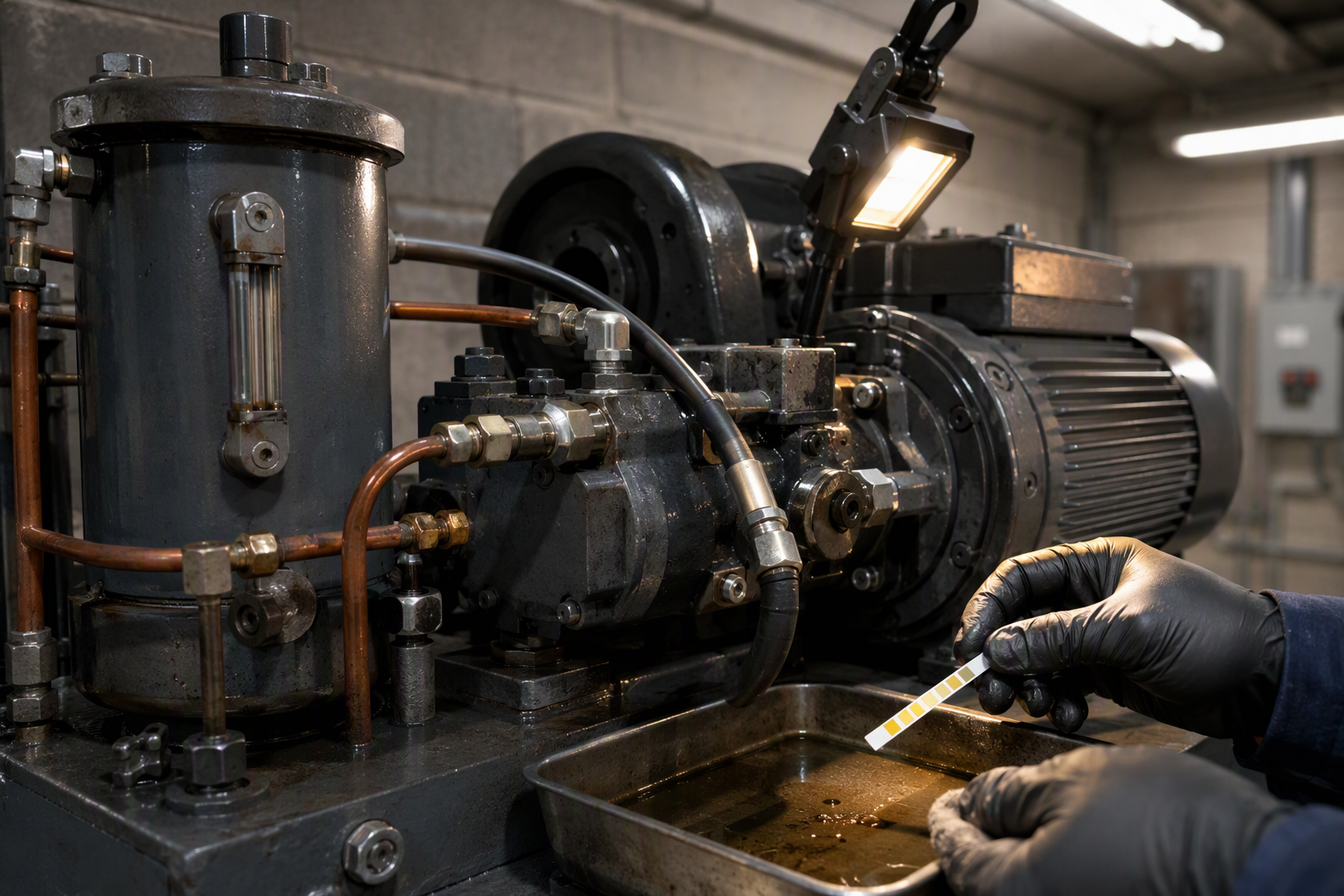
Cold temperatures cause hydraulic fluid to thicken, reducing pump efficiency and causing sluggish car leveling, slow door operation, and in severe cases, a complete failure to move.
Hydraulic elevators — the type most commonly found in low-rise commercial and residential buildings — rely on pressurized fluid to push a piston that raises the car. Hydraulic fluid is formulated to maintain a specific viscosity range, and that range narrows significantly when ambient temperatures drop below manufacturer specifications. When the fluid thickens, the pump must work harder to generate adequate pressure, motor temperatures climb, and the car may rise slowly, fail to level at the floor, or refuse to respond to hall calls altogether.
Machine room temperature is the primary control variable. Most hydraulic elevator manufacturers specify a minimum machine room ambient temperature, and allowing that space to drop below the threshold — even temporarily during a cold snap — can trigger a cascade of performance issues. Building owners should verify that machine room HVAC or dedicated heating equipment is operational before winter arrives and confirm the setpoint against the elevator manufacturer’s specifications.
Fluid type also matters. Some older installations use standard petroleum-based fluids that are far more sensitive to temperature than modern synthetic or fire-resistant fluids. A pre-winter inspection by a qualified service provider such as Quality Elevator Company can identify whether the existing fluid grade is appropriate for the equipment and the climate conditions typical of mid-Atlantic winters.
How Does Cold Weather Affect Elevator Door Operators and Sensors?
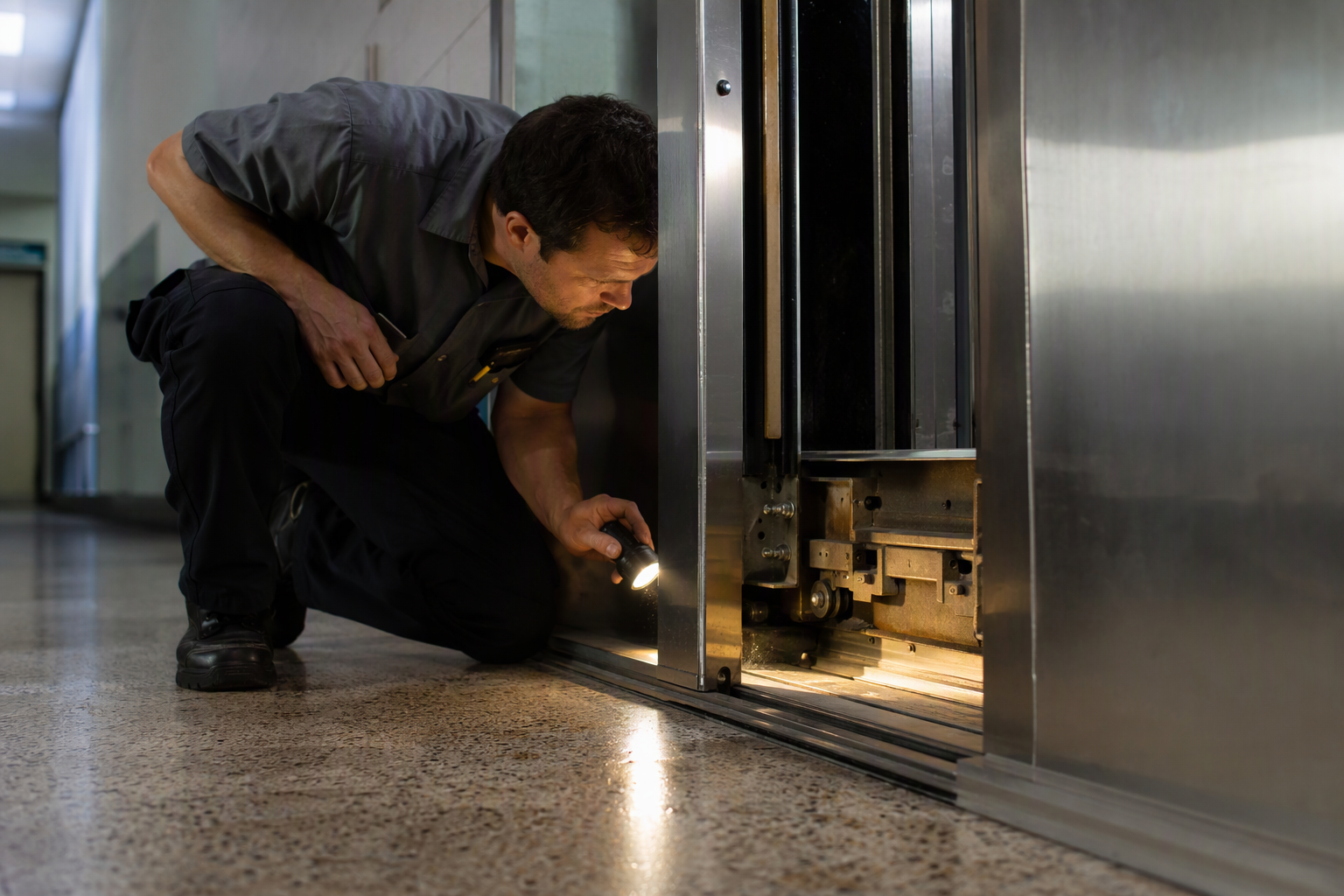
Cold temperatures cause door operator motors, clutch mechanisms, and safety sensor components to stiffen or misread clearances, producing nuisance reopenings, door strikes, and entrapment risk.
Elevator door systems are engineered to precise tolerances. In cold weather, metal expansion and contraction shifts those tolerances enough to cause binding in the door tracks, hesitation in the clutch coupler that connects the car door to the landing door, and erratic behavior in light-curtain or safety-edge sensors whose detection fields can be affected by condensation. When cold air enters the hoistway from poorly sealed machine rooms or pit access points, temperature differentials between the hoistway and the building interior accelerate these effects.
Door strikes — where the door makes contact with a passenger or object — are among the most common elevator-related injury mechanisms, and OSHA holds building owners accountable for maintaining safe equipment. Ensuring that door force and speed remain within the limits prescribed by the ASME A17.1 Safety Code for Elevators and Escalators is not only a safety imperative but a regulatory one — all four jurisdictions served by Quality Elevator Company adopt ASME A17.1 as the technical baseline for elevator safety.
What Happens to Elevator Lubrication in Winter?
Cold weather thickens grease and oil on guide rails, ropes, and mechanical components, increasing friction, accelerating wear, and causing the car to ride unevenly or produce unusual noises.
Traction elevators depend on properly lubricated guide rails and wire ropes to operate smoothly. In cold weather, standard lubricants designed for ambient temperatures can congeal, leaving rail surfaces inadequately coated and causing the guide shoes or roller guides to drag. This produces vibration, noise, and uneven ride quality that passengers notice immediately. More critically, inadequate rope lubrication accelerates wire fatigue and can reduce the effective breaking strength of the suspension system over time.
Pre-winter lubrication service should address guide rails, guide shoes, roller guides, wire rope (where applicable), the governor rope, and any mechanical linkages in the door operator system. Lubricant selection should be verified against the equipment manufacturer’s temperature range recommendations and the climate profile of the region. Mid-Atlantic winters can push overnight lows well below freezing in all four markets served by Quality Elevator Company, so lubricants rated only for moderate climates may be insufficient.
How Does Cold Affect Elevator Electrical and Control Systems?
Cold and moisture together can cause condensation on control boards, relay contacts, and sensor wiring, leading to erratic behavior, nuisance faults, and controller lockouts that require a technician reset.
Modern elevator controllers contain solid-state electronics that are sensitive to condensation. When a machine room is cold overnight and then warms rapidly as the building heats in the morning, moisture can condense on circuit boards, relay contacts, and wiring harnesses. This condensation can cause intermittent ground faults, erratic floor-selector behavior, and failure of the car position encoder — resulting in mis-leveling or door-zone errors that lock the car out of service.
Battery backup systems for emergency lighting and communication also degrade faster in cold conditions. Under the Americans with Disabilities Act (ADA), two-way communication in elevator cars must be functional, and battery-backed systems that are marginally serviceable in summer can fail below freezing temperatures. A winter readiness inspection should include a load test of all backup batteries.
What Are the Risks to the Elevator Pit in Winter?
Cold weather combined with precipitation increases the risk of water infiltration into the elevator pit, which can damage hydraulic lines, corrode buffers, trip sump pumps, and create slip and electrical hazards.
The elevator pit sits at or below grade, making it particularly vulnerable during freeze-thaw cycles common throughout Baltimore, DC, Philadelphia, and Richmond winters. Water enters through foundation cracks, door threshold gaps, and failed pit door seals, and once inside, it can freeze around hydraulic return lines, accelerate corrosion on pit components, and overwhelm sump pumps that may not be maintained for cold-weather operation. A flooded pit is an immediate out-of-service condition under the ASME A17.1 Safety Code and requires evacuation of any trapped passengers and notification to the authority having jurisdiction before the elevator is returned to service.
Building owners should inspect pit drainage and sump pump operation before winter, verify that pit access doors seal properly, and address any foundation waterproofing deficiencies identified during the warmer months.
How Do Mid-Atlantic Winters Specifically Affect Buildings in Baltimore, DC, Philadelphia, and Richmond?
The mid-Atlantic climate produces freeze-thaw cycles, ice storms, and rapid temperature swings that stress elevator systems differently than consistently cold northern climates or milder southern ones.
Unlike northern markets that experience sustained cold, the mid-Atlantic region frequently cycles through freezing overnight temperatures followed by above-freezing daytime highs within the same week. This repeated thermal cycling stresses seals, lubricants, and electronic components in ways that steady cold does not. It also means building owners cannot rely on a single pre-winter preparation event; systems should be monitored through the entire December-through-March window.
Ice storms — more common in the DC, Baltimore, and Richmond corridors than in northern cities — create additional loading on building envelopes, sometimes forcing hoistway doors to shift slightly out of alignment when building structures flex. Philadelphia’s exposure to nor’easters means hydraulic pits in buildings near the Delaware River or in low-lying areas face heightened flooding risk during winter storm surges.
What Does ASME A17.1 Require That Is Directly Relevant to Cold-Weather Preparedness?
The ASME A17.1 Safety Code for Elevators and Escalators requires machine rooms to be maintained at temperatures appropriate for the installed equipment and mandates that maintenance be performed to preserve safe operating condition at all times.
ASME A17.1 does not specify a single universal machine room temperature range — that specification belongs to the equipment manufacturer — but it does require that the equipment owner ensure the machine room environment does not impair the safe operation of the elevator. Failure to maintain adequate machine room temperature, resulting in a hydraulic fluid or lubricant failure that causes an accident, represents a code violation that regulatory agencies in DC, Maryland, Pennsylvania, and Virginia can cite during inspections.
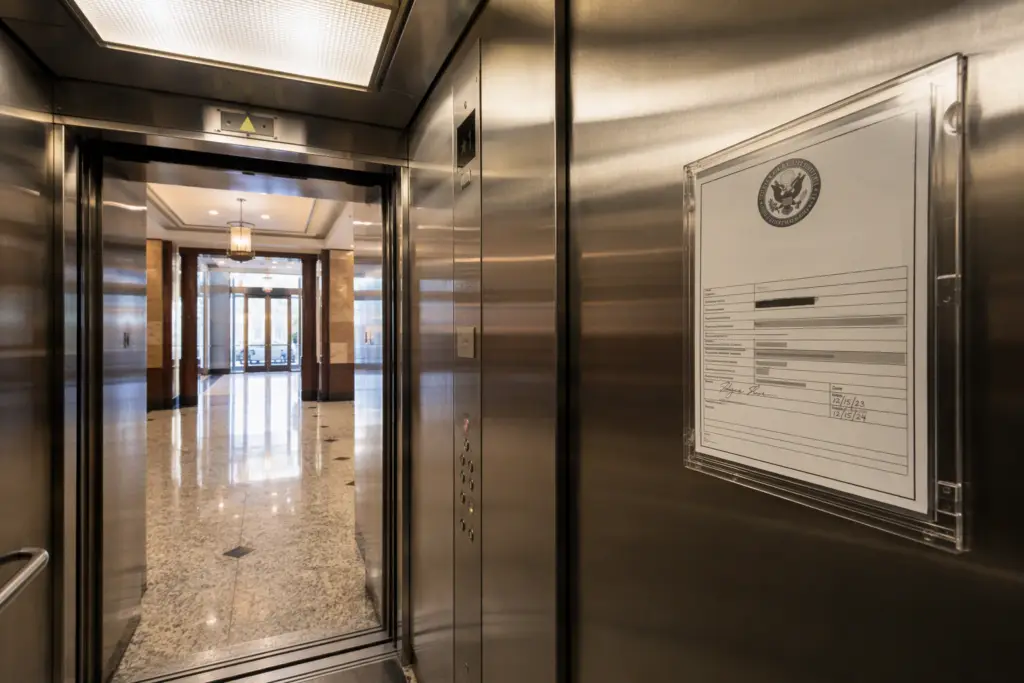
ASME A17.1 also addresses maintenance intervals and record-keeping. All four jurisdictions served by Quality Elevator Company require maintenance and inspection records to be retained and available on site. Cold-weather service visits should be documented and added to the maintenance log in the same manner as any other service call.
What Are the Specific Regulatory Inspection Requirements in DC, Maryland, Pennsylvania, and Virginia?
Each jurisdiction has distinct inspection intervals and authority structures that determine how frequently elevators must be formally inspected and who may conduct those inspections.
| Jurisdiction | Regulator | Adopted ASME Edition | Periodic Inspection Interval | 5-Year/Category 5 Test Required? | Official Resource |
|---|---|---|---|---|---|
| District of Columbia | DC Department of Buildings (DOB) | ASME A17.1-2013 (2017 DC Building Code) | Category 1 every 12 months; Category 5 every 60 months | Yes — Category 5 every 60 months by ASME QEI-certified inspector | DOB Elevators & Conveyances |
| Maryland | MD Dept. of Labor, Division of Labor and Industry, Elevator and Escalator Safety | ASME A17.1-2022 (effective June 17, 2026) | Annual periodic inspection; comprehensive five-year inspection for wire-rope-suspended elevators | Yes — comprehensive five-year inspection | Maryland Elevator Safety |
| Pennsylvania | PA Dept. of Labor and Industry, Bureau of Occupational and Industrial Safety, Elevator Section | ASME A17.1-2000 (A17.1-2016 for new permits from Dec. 20, 2026) | No more than every 6 months for electric and hydraulic elevators | Per ASME A17.1 Appendix N intervals (Category 1 annually as stand-alone from Dec. 20, 2026) | PA L&I Elevator Section |
| Virginia | Local building department (enforces 13VAC5-63, Virginia USBC) | ASME A17.1/CSA B44-2019 (2021 USBC, effective Jan. 18, 2024) | Annual; locality may require six-month periodic inspection | Yes — periodic tests at ASME A17.1 Appendix N intervals, witnessed by code official | Virginia USBC Elevator Regulations |
Because periodic inspections are legally required throughout the year — not just in summer — any elevator that experiences a cold-weather malfunction and is taken out of service must be returned to certified operating condition before it can be placed back in service. In DC, at least one passenger elevator must be kept in operation whenever the building is occupied (except in single-elevator buildings), making winter readiness a compliance priority, not just a comfort issue.
What Should Building Owners Do Before Winter Arrives — Step by Step?
A structured pre-winter protocol addresses the most common cold-weather failure points before the first freeze, reducing the likelihood of an unplanned outage during peak building occupancy.
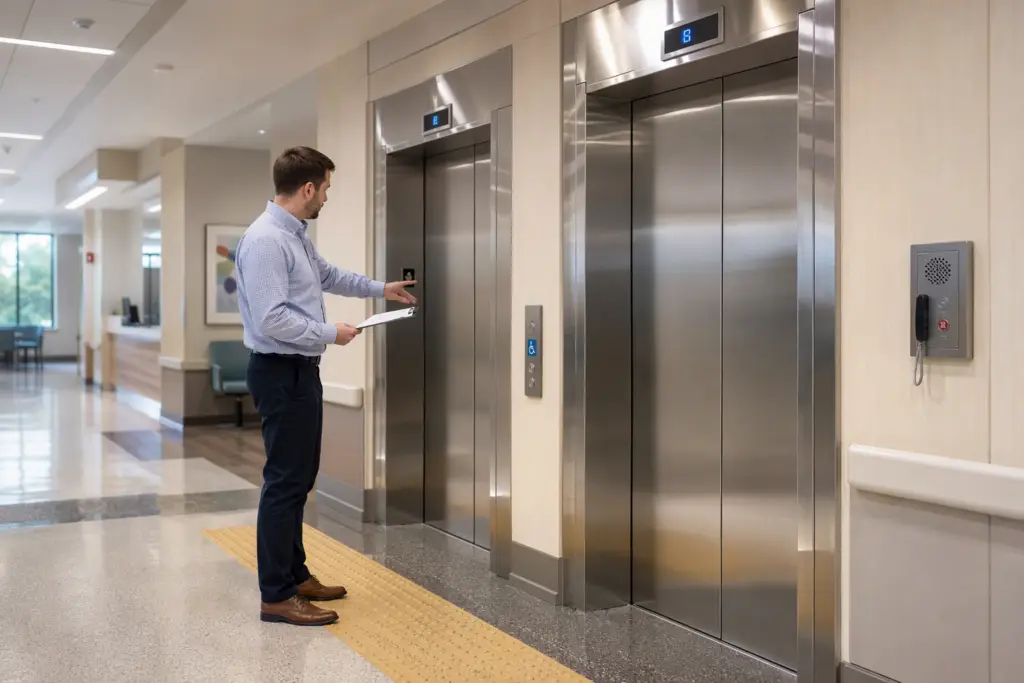
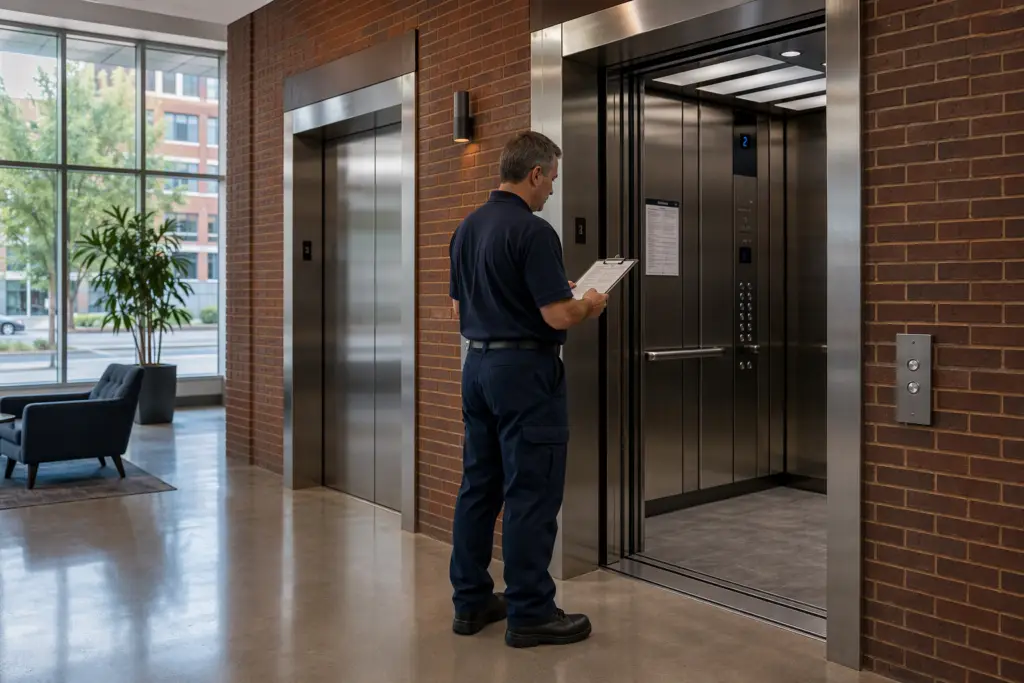
- Schedule a pre-winter maintenance inspection with a licensed elevator service provider — ideally in September or October — before temperatures drop below 50°F overnight.
- Verify machine room heating equipment is operational, the thermostat is calibrated, and the setpoint meets or exceeds the elevator manufacturer’s minimum ambient temperature specification.
- Check hydraulic fluid grade and level. Confirm that the installed fluid viscosity is appropriate for winter ambient temperatures and that the reservoir level is within the manufacturer’s acceptable range.
- Lubricate guide rails, roller guides, wire ropes, and door operator components with lubricants rated for the expected temperature range in your market.
- Inspect and test the sump pump in the elevator pit. Verify that it activates correctly, that the float switch moves freely, and that the discharge line is clear and frost-protected.
- Test all door safety devices — light curtains, safety edges, and clutch mechanisms — for proper operation at current ambient temperatures and again after the first cold event of the season.
- Inspect pit seals, machine room door gaskets, and hoistway ventilation covers for gaps that allow cold air or moisture infiltration.
- Load-test emergency communication batteries to confirm ADA-required two-way communication will remain functional during a power event or extreme cold period.
- Review maintenance and inspection records to confirm all required periodic inspections are current for your jurisdiction and that no outstanding violations exist before winter workload increases.
- Establish a winter monitoring plan — designate a building staff contact who checks elevator performance logs or building automation alerts daily during cold snaps and knows the escalation path to your elevator service provider.
How Does Cold Weather Affect Elevator Rope and Sheave Systems on Traction Elevators?
Cold temperatures reduce the flexibility of wire ropes, stiffen sheave-groove contact, and can cause brake lining materials to behave differently, all of which affect stopping accuracy and ride quality.
Wire ropes used on traction elevators are designed to flex around sheaves under load, and that flexibility is reduced when the steel strands and fiber core are cold. Repeated cold-start cycles, where the elevator begins operation before the machine room has fully warmed, accelerate rope fatigue at the point of maximum bend — typically where the rope passes over the drive sheave. Brake linings made from organic or sintered materials can also behave differently when cold, with some materials exhibiting slightly higher or lower friction coefficients, which affects stopping distance and leveling accuracy.
A pre-winter traction elevator service should include rope inspection for broken wires, sheave groove measurement for wear, and brake adjustment verification. These tasks align with the ongoing maintenance requirements of the ASME A17.1 Safety Code for Elevators and Escalators and should be documented in the on-site maintenance log as required by Maryland, Virginia, and all other jurisdictions in Quality Elevator Company’s service area.
Can Cold Weather Cause an Elevator to Fail Its Required Periodic Inspection?
Yes — cold-weather deficiencies such as sluggish door operation, fluid pressure anomalies, and inoperative lighting or communication equipment are inspectable conditions that can result in a failed inspection or an out-of-service order.
Inspectors examining elevator equipment in winter are looking at actual operating performance, not theoretical design parameters. A hydraulic elevator that levels slowly due to cold fluid, a door that fails the closing-force test because of a stiff clutch, or a communication battery that does not hold load under test are all citable deficiencies. Depending on the jurisdiction, a failed inspection can result in a suspended certificate, an immediate out-of-service order, or a required follow-up inspection at the owner’s expense.
In DC, the certificate of inspection is valid for two years, and ongoing periodic inspections and tests are required during that window. In Pennsylvania, certificates are valid for 24 months (six-month inspection cycle) or 48 months (twelve-month cycle), but the elevator must pass each periodic inspection to remain in service. In Maryland, annual re-registration coincides with the annual periodic inspection — a failed inspection delays re-registration. In Virginia, the local building department issues certificates and can order an elevator out of service immediately upon a failed inspection.
What Should Building Owners Do If an Elevator Stops Working During a Winter Cold Snap?
When a cold-weather elevator outage occurs, building owners must prioritize passenger safety, document the malfunction, notify the elevator service provider, and comply with jurisdiction-specific out-of-service requirements.
- Verify that no passengers are trapped. If entrapment has occurred, call emergency services immediately — do not attempt to manually release a trapped car without a licensed elevator mechanic present.
- Secure the elevator out of service by placing it on independent service or blocking access to all landings, and post clear signage at each floor.
- Contact your licensed elevator service provider to report the malfunction and arrange for a service call. Document the time of the report and the name of the person contacted.
- Check the machine room temperature. If the space is below the manufacturer’s minimum, restore heat before allowing the service technician to attempt a restart — a cold restart on a hydraulic elevator with congealed fluid can damage the pump.
- In DC, comply with the requirement that at least one passenger elevator remain in operation whenever the building is occupied. If you have multiple elevators and one is out of service, prioritize restoring service or confirm that remaining elevators are operational.
- Document the event — time of failure, observed symptoms, ambient temperature, steps taken — and add the record to the on-site maintenance log as required by your jurisdiction.
- In Pennsylvania, report any accident that causes a fatality or requires professional medical care to the Pennsylvania Department of Labor and Industry, Bureau of Occupational and Industrial Safety, Elevator Section.
How Does Cold Weather Affect ADA Compliance for Elevator Users?
Cold-weather malfunctions that render an elevator inaccessible directly affect ADA compliance, because elevators are frequently the designated accessible route for people with disabilities in multi-story buildings.
Under the Americans with Disabilities Act, when an elevator is the only accessible route between floors, its outage can constitute a barrier to access that the building owner is obligated to remedy promptly. This is particularly acute in winter when exterior ramp surfaces may be iced over, making alternative accessible routes even less viable. ADA accessibility standards also require that two-way emergency communication systems be operable, and cold-related battery failures put that requirement at risk.
Building owners should treat cold-weather elevator preparedness as an integral part of their ADA accessibility planning, not just a mechanical maintenance task.
How Often Should Preventive Maintenance Visits Be Scheduled During Winter?
In the mid-Atlantic climate, building owners with older or hydraulic elevators should consider supplementing the standard maintenance schedule with at least one additional cold-weather check between November and February.
Standard maintenance contracts typically specify monthly, bimonthly, or quarterly visits depending on the equipment type, usage volume, and age of the installation. In a climate with pronounced freeze-thaw cycles — typical of Baltimore, DC, Philadelphia, and Richmond — the interval between standard visits may be long enough that a cold snap creates and compounds a deficiency before the next scheduled visit. Owners of older hydraulic equipment, buildings with unheated or poorly heated machine rooms, or buildings near water (increasing condensation risk) are best served by supplemental visits timed around forecast cold events.
Quality Elevator Company provides preventive maintenance services across its entire service area, and service agreements can be structured to include seasonal cold-weather checks tailored to the building’s equipment type and usage profile.
What Is the Role of the Machine Room in Cold-Weather Elevator Performance?
The machine room is the thermal control point for the entire elevator system — if it is cold, every temperature-sensitive component in the system is at risk.
Machine rooms for both traction and hydraulic elevators house the motor, controller, drive unit, and — for hydraulic systems — the pump unit and fluid reservoir. All of these components have manufacturer-specified operating temperature ranges. The machine room must be ventilated to remove heat generated by the motor and drive, but ventilation must be balanced against the need to maintain minimum temperatures in winter. Dampers, louvers, and exhaust fans that are appropriate for summer must not allow cold air infiltration to drop machine room temperatures below the minimum threshold in winter.
ASME A17.1 requires machine rooms to be dedicated spaces, accessible only to authorized personnel, with adequate lighting and the ability to maintain appropriate environmental conditions. Building owners should work with their HVAC and elevator service providers together to verify that machine room heating and ventilation systems are properly balanced for winter operation.
Are There Any Cold-Weather Concerns Specific to Older Elevators in Historic or Older Buildings?
Older elevators — common in Baltimore’s historic rowhouse districts, DC’s pre-war office buildings, Philadelphia’s downtown commercial stock, and Richmond’s older mixed-use properties — face compounded cold-weather risk because aging seals, lubricant systems, and controls are less tolerant of thermal stress.
Older hydraulic systems may use below-grade cylinders that are more susceptible to soil movement during freeze-thaw cycles. Older traction elevators may have relay-based controllers that are more sensitive to condensation than modern solid-state systems. Rope and sheave systems that have not been modernized may be operating with reduced safety factors that cold-weather stiffness compounds. Door operators on older equipment often lack the self-diagnostic capability of modern systems, making it harder for building staff to detect early signs of cold-weather stress.
Maryland law requires that elevators installed before July 1, 1955, still have standard hoistway entrance protection even though they may not be required to meet current code in full. In all four jurisdictions, the authority having jurisdiction can require upgrades if an inspection reveals that an older elevator no longer meets minimum safety standards. Building owners of older properties should discuss the relationship between equipment age and cold-weather risk with a knowledgeable service provider during pre-winter planning.
What Documentation Should Building Owners Maintain for Cold-Weather Elevator Service?
All cold-weather maintenance visits, service calls, and repair events should be documented in the on-site maintenance log and retained in accordance with the requirements of the applicable jurisdiction.
Maryland requires that maintenance, repair, test, and inspection records be kept at a readily accessible central location in the building. Virginia requires third-party inspection reports to include the name and certification number of the elevator mechanic who performed witnessed tests. DC requires that third-party inspection reports for the past two years be submitted to the Department of Buildings through the Citizen Access Portal when renewing a certificate of inspection. Pennsylvania requires accident reports to be submitted to the Department of Labor and Industry when an elevator accident causes a fatality or requires professional medical care.
Beyond regulatory compliance, thorough documentation serves as a baseline for identifying recurring cold-weather patterns. If the maintenance log shows a pit flooding event every January, or a door operator fault every time the temperature drops below a certain threshold, that pattern supports a business case for capital repair or modernization.
How Can Building Owners Budget for Cold-Weather Elevator Preparedness?
Cold-weather elevator preparedness involves both routine maintenance costs and contingency funds for reactive repairs — both of which can be planned once the building’s equipment type, age, and condition are understood.
Routine cold-weather preparation — a pre-winter inspection, lubrication service, fluid check, and battery test — is typically structured as part of an ongoing maintenance agreement and does not require separate capital allocation. Supplemental visits during severe cold events may carry a service call charge if not included in the agreement scope.
Contingency planning is more variable and depends on equipment age and condition. Older hydraulic systems with aging seals, older cylinders, or original pump units are statistically more likely to experience cold-weather failures than modernized or newer equipment. Building owners should discuss equipment age and condition with their elevator service provider during the pre-winter planning conversation and ensure they have an emergency service contact protocol established before the heating season begins. Quality Elevator Company serves building owners throughout Baltimore, Washington DC, Philadelphia, and Richmond and can assist with pre-winter assessments that inform both maintenance planning and capital budgeting.
What Questions Should Building Owners Ask Their Elevator Service Provider Before Winter?
Asking the right questions before winter ensures that the service provider has addressed every major cold-weather failure point and that the building owner understands the current condition of the equipment.
Key questions include: Is the machine room heating system adequate for the expected winter temperature range, and what is the manufacturer’s minimum ambient specification for this equipment? Is the hydraulic fluid grade appropriate for winter temperatures, and when was it last changed? Are all door safety devices — light curtains, safety edges, and clutch mechanisms — performing within ASME A17.1 specifications? Has the pit sump pump been tested and is the discharge line winterized? Are all emergency communication batteries load-tested and rated for cold-temperature operation? Are all required periodic inspections current for this jurisdiction, and are there any outstanding violations or orders? What is the escalation procedure if the elevator fails during a cold snap outside of normal business hours?
A qualified service provider should be able to answer all of these questions specifically, based on the equipment in the building, rather than in general terms.
How Does Quality Elevator Company Approach Winter Elevator Preparedness?
Quality Elevator Company provides winter readiness assessments and preventive maintenance services to building owners in Baltimore MD, Washington DC, Philadelphia PA, and Richmond VA, working to address the specific cold-weather vulnerabilities of each building’s elevator equipment before the heating season begins.
As a certified elevator service company operating across the mid-Atlantic region, Quality Elevator Company is familiar with the regulatory requirements of each jurisdiction — from the DC Department of Buildings inspection and certification process to the Maryland Department of Labor Division of Labor and Industry’s annual inspection requirements, Pennsylvania’s Department of Labor and Industry Elevator Section oversight, and Virginia’s local building department enforcement of the Uniform Statewide Building Code. Winter readiness work performed by Quality Elevator Company is documented and added to the on-site maintenance log in accordance with each jurisdiction’s record-keeping requirements, ensuring that building owners have a complete audit trail for regulatory compliance and insurance purposes.
Schedule Your Pre-Winter Elevator Assessment Today
Cold weather does not wait for a convenient service window. Building owners in Baltimore, Washington DC, Philadelphia, and Richmond who have not yet completed a pre-winter elevator inspection are at elevated risk for cold-weather outages, failed inspections, and ADA accessibility gaps. Contact Quality Elevator Company for a free elevator assessment before the first freeze of the season.
Contact Quality Elevator Company for a free elevator assessment: 301-779-9116
Need elevator service you can rely on? Quality Elevator Company is ready to help.