How Long Does a Commercial Elevator Typically Last — and When Does Replacement Make More Sense Than Continued Repair?
Direct Answer: A commercial elevator typically lasts 20 to 25 years before major modernization or full replacement becomes more cost-effective than continued repair, though well-maintained units in low-traffic buildings can remain serviceable longer, while high-traffic installations often reach that threshold sooner.
For building owners and facilities managers in the District of Columbia, Maryland, Pennsylvania, and Virginia, understanding elevator lifespan is not simply a budgeting exercise — it directly affects regulatory compliance, tenant safety, insurance exposure, and long-term capital planning. This authority guide addresses the full question: what determines how long a commercial elevator lasts, what signals indicate that repair costs are outpacing value, and how the regulatory environments in DC, Maryland, Pennsylvania, and Virginia shape replacement and modernization decisions.
What Is the Typical Lifespan of a Commercial Elevator?
Industry guidance from elevator trade organizations and engineering consultants consistently places the functional lifespan of a commercial elevator at 20 to 25 years for the overall system. However, that figure encompasses several distinct components that age at very different rates:
- Mechanical components (hoisting machinery, sheaves, guides): typically require major service or replacement in the 15–20 year range under normal commercial use.
- Hydraulic systems (pumps, cylinders, fluid): hydraulic elevators often face cylinder and fluid degradation that can begin to accelerate after 15–20 years, particularly in older underground-cylinder designs.
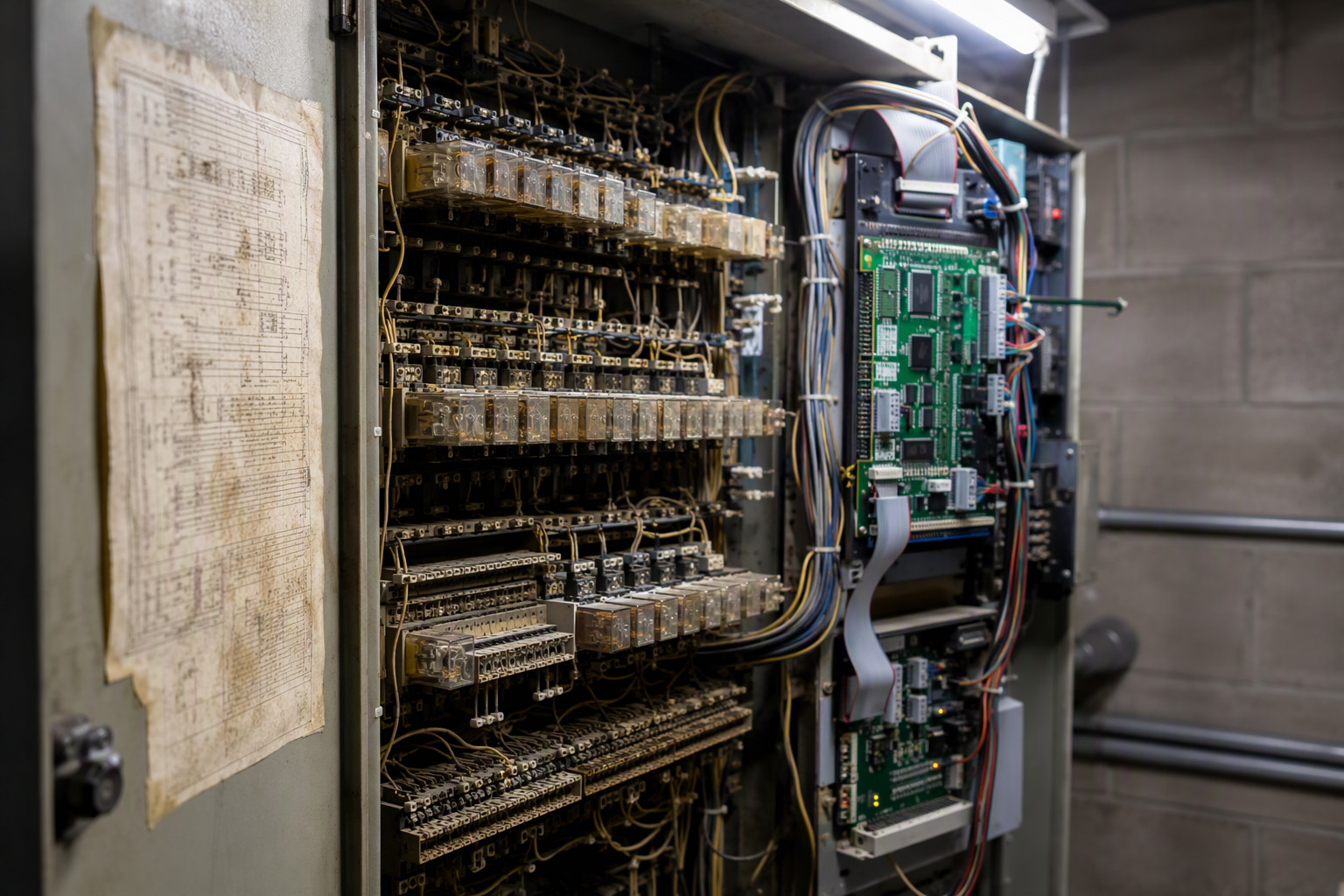
- Control systems and electronics: relay-logic controls from the 1970s and 1980s are now obsolete; microprocessor systems installed in the 1990s and early 2000s are increasingly losing parts support. Control obsolescence often drives modernization decisions before mechanical failure does.
- Door operators and safety devices: these high-cycle components can wear more rapidly in busy commercial or multi-tenant buildings and may need replacement on a shorter cycle.
- Cab interiors and finishes: cosmetic elements have no fixed lifespan but are often refreshed every 10–15 years to maintain tenant satisfaction and property value.
The practical implication is that a “25-year-old elevator” may have a modernized control system, replaced door operators, and a refurbished cab — meaning the structural hoistway and rail system carry the age while other elements are considerably newer. Quality Elevator Company evaluates each of these subsystems independently when advising clients in DC, Maryland, Pennsylvania, and Virginia on whether targeted repair or full modernization makes financial sense.
What Factors Shorten or Extend a Commercial Elevator’s Useful Life?

No two elevators age identically. Several variables substantially influence how long a commercial unit remains serviceable:
- Traffic volume: An elevator in a mid-rise office building serving hundreds of daily trips degrades faster than a comparable unit in a low-occupancy medical office. Door cycles, motor starts, and brake engagements accumulate faster under heavy use.
- Maintenance consistency: Elevators on manufacturer-recommended preventive maintenance schedules — including lubrication, adjustment, and early component replacement — reliably outlast units maintained reactively. Gaps in maintenance also create compounding compliance risk under the regulatory frameworks in DC, Maryland, Pennsylvania, and Virginia.
- Installation quality: Original installation workmanship and component quality affect long-term reliability. Units installed to code at time of construction with quality components tend to provide more years of trouble-free service.
- Environmental conditions: Buildings with high humidity, temperature extremes, or heavy freight use accelerate wear on mechanical and electrical components alike.
- Modernization history: A unit that received a control system upgrade, new door operators, and updated safety devices at year 15 effectively resets portions of its age clock. A unit that received no updates is carrying full age across all systems simultaneously.
- Parts availability: As a unit ages past 20 years, sourcing replacement parts for obsolete controls, relay panels, or discontinued hydraulic components becomes progressively harder and more expensive. Parts scarcity is often what accelerates the replacement decision.
How Do You Know When Repair Costs Exceed Replacement Value?
The repair-versus-replace decision is fundamentally a capital analysis question, but several qualitative thresholds help frame it:
- The 50% rule of thumb: When the projected cost of a single major repair — or the cumulative cost of repairs over 12–24 months — approaches or exceeds 50% of the cost of full modernization, most elevator consultants and building engineers recommend modernization. This is a widely cited industry heuristic, not a codified standard, and should be evaluated alongside the age and condition of remaining components.
- Recurring failures: When the same component or system fails repeatedly within short intervals, the underlying cause is often systemic deterioration rather than isolated defects. Repeated brake adjustments, repeated door-related entrapments, or recurring control board failures signal that the surrounding system is at or near end of life.
- Parts obsolescence: If replacement parts must be fabricated, sourced from salvage, or substituted with non-OEM equivalents, maintenance costs and reliability risk both rise sharply.
- Failed or borderline inspections: Inspection findings that require significant corrective work — particularly those tied to safety devices, governor systems, or buffers — often involve costs that justify reassessing the full system.
- Energy inefficiency: Older hydraulic units and relay-logic traction elevators consume substantially more energy than modern variable-frequency drive (VFD) systems. The long-term energy savings from modernization factor into the total cost of ownership analysis.
- Tenant and occupant impact: Frequent outages in a commercial or multi-tenant building carry economic costs beyond repair invoices — lease concessions, ADA accommodation obligations, and reputational damage to the property.
Quality Elevator Company provides building owners across DC, Maryland, Pennsylvania, and Virginia with structured assessments that weigh repair costs against modernization investment using the actual condition data from the specific unit — not generalized averages.
What Does “Modernization” Mean, and How Is It Different from Full Replacement?
These terms are often used interchangeably but describe distinct scopes of work:
- Modernization replaces specific subsystems — most commonly the control system, door operators, drive, safety devices, and cab interior — while retaining the existing hoistway, rails, structural frame, and in many cases the machine room equipment. Modernization extends the useful life of the existing installation, typically by another 15–20 years depending on scope.
- Full replacement involves removing all equipment and installing new equipment in the existing hoistway. This is typically required when the hoistway structure itself is compromised, when the installation is so old that no component is worth retaining, or when a change in building use requires a completely different elevator configuration.
- Targeted component repair addresses specific failed or failing parts without overhauling the broader system. This is appropriate when the elevator is relatively young or when a well-maintained unit has an isolated failure in an otherwise sound system.
The regulatory implication matters here: in all four jurisdictions served by Quality Elevator Company, alteration or modernization work requires a permit and triggers compliance review against the applicable code edition. A building owner undertaking modernization in DC, Maryland, Pennsylvania, or Virginia should anticipate that the permitting process will include an inspection before the elevator returns to service.
What Are the Regulatory Requirements for Elevator Inspections in DC, Maryland, Pennsylvania, and Virginia?
Inspection requirements directly affect the repair-versus-replace timeline because failed or borderline inspections often prompt the financial analysis that leads to modernization decisions. Here is what applies in each jurisdiction Quality Elevator Company serves:
District of Columbia
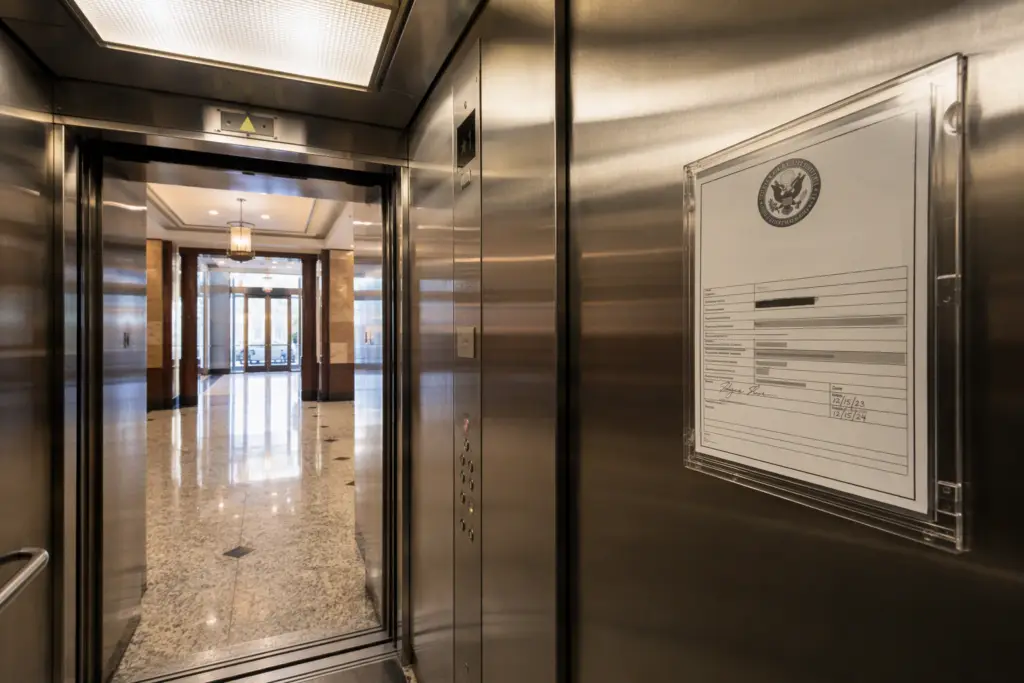
The DC Department of Buildings (DOB) oversees elevator inspections and certificates. DC requires a periodic inspection and a Category 1 inspection every 12 months, and a Category 5 inspection every 60 months, each conducted by an ASME QEI-certified inspector from a DOB-approved third-party agency. A DC certificate of inspection is valid for two years. DC’s adopted elevator safety code is the ASME A17.1-2013/CSA B44-13 edition as referenced by the 2017 DC Building Code, effective May 29, 2020. DOB plans to adopt new construction codes based on the 2024 model codes by the end of 2027. Owners must display a current certificate conspicuously in the elevator car unless an exemption applies. A permit is required for any alteration or modernization, and an elevator’s certificate may be temporarily suspended while it is under permit for alteration.
Maryland
The Maryland Department of Labor, Division of Labor and Industry, Elevator and Escalator Safety (Safety Inspection Unit) oversees elevator regulation. Each elevator unit requires an annual periodic inspection by a State inspector or a third-party qualified elevator inspector. Owners must also ensure that elevators suspended by wire ropes, belts, chains, or similar means receive a comprehensive five-year inspection. Maryland adopted the ASME A17.1-2022/CSA B44:22 edition with Maryland changes, effective June 17, 2026. The edition that applies to a given unit depends on when the installation contract was signed. Elevator mechanics and contractors are licensed by the Maryland Elevator Safety Review Board, and contractors must carry specified minimum insurance coverage. The certificate of operation must be posted conspicuously in or on the elevator unit.
Pennsylvania
The Pennsylvania Department of Labor and Industry, Bureau of Occupational and Industrial Safety, Elevator Section has statewide jurisdiction, including Philadelphia. Electric elevators, hydraulic elevators, and escalators must have periodic inspections at intervals of no more than 6 months. Certificates of operation are valid for 24 months for equipment on a 6-month inspection cycle or 48 months for equipment on a 12-month cycle. Pennsylvania’s updated elevator regulation (Regulation #12-123) takes effect on December 20, 2026, at which point the ASME A17.1-2016 edition (with Pennsylvania modifications) will apply to new permit applications. Until that date, ASME A17.1-2000 with the A17.1a-2002 addenda governs. After any major repair, replacement, or alteration, a Department acceptance inspection is required before the elevator returns to service.
Virginia
In Virginia, local building departments enforce the Virginia Uniform Statewide Building Code (13VAC5-63) and inspect elevators. The 2021 USBC, which incorporated ASME A17.1/CSA B44-19, took effect January 18, 2024. All elevators and escalators require an annual periodic inspection, and a locality may require a six-month inspection. Periodic tests follow ASME A17.1 Appendix N intervals and must be witnessed by the code official. No one may work as an elevator mechanic in Virginia without state certification from the Virginia Board for Contractors (DPOR). Installing, repairing, or removing elevators requires a contractor license with the Elevator/Escalator Contracting (EEC) specialty. The current certificate of inspection must be displayed in the elevator or in an approved conspicuous location.
How Does ADA Compliance Factor Into the Replacement Decision?
The Americans with Disabilities Act (ADA) requires that elevators serving public accommodations and commercial facilities meet accessibility standards. When an elevator undergoes modernization or alteration, the scope of required ADA-compliant upgrades is typically broader than what would apply to routine maintenance. This creates an opportunity: planned modernization can bring a unit into full ADA compliance in a single coordinated project, avoiding piecemeal upgrades over time. Building owners who defer modernization on aging units may find themselves responding to ADA complaints or access-related complaints in addition to mechanical failures, compounding both cost and liability.
What Are the Steps to Evaluate Whether to Repair or Replace a Commercial Elevator?
- Gather the maintenance and inspection history. Collect all service records, inspection reports, and certificates of operation for the past five years. Maryland regulations, for example, require that maintenance, repair, test, and inspection records be kept at a readily accessible central location in the building. A complete record reveals failure patterns and cumulative repair expenditures.
- Commission a condition assessment. Have a qualified elevator technician conduct a thorough physical inspection of all major subsystems — control system, drive, door operators, safety devices, hoisting machinery, and hydraulic components where applicable. Document the current condition and estimated remaining life of each subsystem.
- Identify outstanding code compliance items. Review the most recent inspection reports for any open violations or items requiring correction. Consult the applicable regulatory framework for your jurisdiction to understand which deficiencies must be remediated immediately and which may be addressed on a longer timeline.
- Request a modernization or replacement cost estimate. Obtain detailed estimates for the scope of work that would bring the unit to current code compliance and address all identified deficiencies. Compare this to the projected cost of continued repair over the next five years.
- Calculate total cost of ownership. Factor in not only repair and modernization costs, but also energy consumption differences, downtime costs, parts availability risk, and any ADA-related upgrade requirements associated with triggered alterations.
- Evaluate the building’s future use and capital plan. A building slated for major renovation or sale within five years may warrant a different decision than one with a 20-year ownership horizon.
- Make a documented decision and plan the capital timeline. Communicate the decision and timeline to building management, tenants, and the regulatory authority as appropriate. In jurisdictions requiring permits for alteration, begin the permitting process well in advance of planned work.
What Are the Most Common Signs That a Commercial Elevator Needs Major Attention?
Facilities managers should treat the following as triggers for a formal condition assessment:
- Increasing frequency of service calls for any single type of failure
- Door-related incidents, including entrapments or repeated door reversal failures
- Leveling issues — the cab consistently stopping above or below the floor sill
- Unusual noise from the machine room, drive system, or hoistway during operation
- Control system faults that require technician resets rather than self-clearing
- Oil leaks in hydraulic systems, particularly from underground cylinders
- Inspection reports that cite safety device deficiencies requiring corrective action
- Inability to source replacement parts within a reasonable lead time
How Do Industry Trends in 2025–2026 Affect the Repair vs. Replace Decision?
Several qualitative trends are shaping elevator capital decisions for building owners in the DC, Maryland, Pennsylvania, and Virginia market in 2025 and 2026:
- Accelerating control system obsolescence: A significant volume of commercial elevators installed in the 1990s and early 2000s now carry microprocessor controls that manufacturers have discontinued supporting. As the installed base ages, the urgency of control modernization is rising across the region.
- Code edition transitions: Maryland adopted ASME A17.1-2022 effective June 17, 2026, and Pennsylvania’s Regulation #12-123 takes effect December 20, 2026, applying ASME A17.1-2016 to new permit applications. Building owners planning major repairs or modernizations should understand which code edition will govern their permit application based on its timing.
- Supply chain normalization with continued parts lead times: Component lead times for certain elevator parts — particularly semiconductors used in drive controls — have improved from the peak disruptions of prior years but remain longer than pre-2020 norms. This continued to make parts availability a factor in the repair-versus-replace analysis heading into 2026.
- Energy efficiency as a modernization driver: Growing ESG reporting requirements and energy benchmarking ordinances in commercial real estate markets, including Washington DC, are making the energy efficiency case for modernization more quantifiable for building owners. Modern variable-frequency drive systems and regenerative drives offer meaningful consumption reductions compared to older relay-logic and single-speed drive systems.
- Tenant expectations and amenity competition: In competitive commercial leasing markets, elevator reliability and cab appearance are increasingly cited as tenant satisfaction factors. Deferred modernization on aging units creates risk beyond mechanical failure.
Does the Type of Elevator Affect How Long It Lasts?
Yes. The two dominant commercial elevator types — traction and hydraulic — have meaningfully different aging profiles:
- Traction elevators (electric, using cables and counterweights) are the standard for mid- and high-rise commercial buildings. The hoisting machine, gearbox (on geared machines), ropes, and sheaves are the primary wear components. Gearless traction machines, common in high-rise applications, tend to have longer mechanical lifespans than geared machines under equivalent conditions. Control systems on traction units have historically driven modernization decisions before mechanical end-of-life.
- Hydraulic elevators are common in low-rise commercial applications, typically up to five or six floors. The hydraulic cylinder, pump unit, and fluid are the critical aging components. Older in-ground (underground) hydraulic cylinders raise particular concern: deterioration of the cylinder casing can create environmental contamination risk in addition to mechanical failure risk. Many building owners with aging underground-cylinder hydraulic units choose to convert to above-ground cylinder configurations or to traction systems at the time of major repair, given the environmental exposure.
What Role Does Preventive Maintenance Play in Extending Elevator Life?
Consistent, documented preventive maintenance is the single most controllable factor in elevator lifespan. Properly structured maintenance programs catch early-stage wear before it causes component failure, maintain safety device calibration, and preserve documentation required for inspection compliance in all four jurisdictions Quality Elevator Company serves. A unit with a continuous, uninterrupted maintenance record is also better positioned for inspection outcomes and for any permitting process associated with future repair or modernization work.
In Maryland, for example, maintenance, repair, test, and inspection records must be kept at a readily accessible central location in the building. In Pennsylvania, construction, alteration, replacement, or repair of an elevator requires a permit application to the Department of Labor and Industry, and acceptance inspections are conducted before a unit returns to service. A well-documented maintenance history supports both of these requirements by establishing the operating history of the unit.
How Long Does a Commercial Elevator Modernization Project Typically Take?
The duration of a modernization project depends on its scope, the availability of components, and the permitting timeline in the applicable jurisdiction. Qualitatively:
- A control system modernization on a single elevator, with components in stock, can often be completed within a few weeks of permit approval, though the permitting process itself adds time that varies by jurisdiction and project complexity.
- A full modernization — replacing controls, drive, door operators, safety devices, and cab interior — typically requires several weeks to months of planning, procurement, and installation.
- Full equipment replacement in an existing hoistway involves more extensive demolition, installation, and acceptance inspection coordination and may require extended out-of-service periods.
For multi-elevator buildings, phased modernization schedules allow at least one elevator to remain in service during the project, which is relevant to compliance requirements: DC regulations, for example, require that in buildings with passenger elevators, at least one elevator be kept in operation whenever the building is occupied, except in buildings with only one elevator.
What Should Building Owners Do Immediately After an Elevator Fails Inspection?
- Take the unit out of service immediately if the inspection authority has directed that it not be operated. Operating a unit under a conditional or failed certificate creates significant liability.
- Obtain the full written inspection report and review every cited deficiency with your elevator service provider to understand severity, regulatory urgency, and corrective options.
- Notify building occupants and tenants of the out-of-service status and, where the building has multiple elevators, ensure that ADA-accessible service remains available on remaining units.
- Contact your elevator contractor to evaluate whether the cited deficiencies are addressable through targeted repair or whether they indicate broader system deterioration requiring modernization.
- Initiate the permit process for any required corrective work with the applicable regulatory authority — DOB in DC, the Maryland Department of Labor in Maryland, Pennsylvania L&I in Pennsylvania, or the local building department in Virginia — before beginning repair work.
- Document all corrective actions and retain them in the building’s elevator records file, as required by applicable regulations.
- Schedule the acceptance or follow-up inspection required by the authority having jurisdiction before returning the unit to service.
Is There a Sourced Data Table on Elevator Inspection Requirements Across DC, Maryland, Pennsylvania, and Virginia?
| Jurisdiction | Periodic Inspection Frequency | Five-Year / Category 5 Test | Governing Authority | Adopted Safety Code Edition |
|---|---|---|---|---|
| District of Columbia | Every 12 months (Category 1 inspection) | Every 60 months (Category 5) | DC Department of Buildings (DOB) | ASME A17.1-2013/CSA B44-13 (2017 DC Building Code, eff. May 29, 2020) |
| Maryland | Annual; comprehensive five-year inspection for wire-rope-suspended units | Every five years (wire-rope-suspended and similar) | Maryland Department of Labor, Division of Labor and Industry | ASME A17.1-2022/CSA B44:22 with Maryland changes (eff. June 17, 2026) |
| Pennsylvania | Every 6 months (electric and hydraulic elevators, escalators) | Per ASME A17.1 Table N-1 intervals (eff. December 20, 2026) | Pennsylvania Department of Labor and Industry, Elevator Section | ASME A17.1-2000/A17.1a-2002 (ASME A17.1-2016 for permit apps from Dec 20, 2026) |
| Virginia | Annual (locality may require six-month inspections) | Per ASME A17.1 Appendix N intervals | Local building department (13VAC5-63) | ASME A17.1/CSA B44-19 (2021 USBC, eff. January 18, 2024) |
Sources: DC Department of Buildings; Maryland Department of Labor; Pennsylvania Department of Labor and Industry; Virginia Administrative Code 13VAC5-63; ASME Codes and Standards.
How Does Quality Elevator Company Approach the Repair vs. Replacement Analysis?
Quality Elevator Company serves building owners and facilities managers throughout the District of Columbia, Maryland, Pennsylvania, and Virginia with assessments grounded in the actual condition of each elevator unit, the regulatory requirements of the applicable jurisdiction, and the building’s long-term capital objectives. Rather than defaulting to either continued repair or immediate replacement, Quality Elevator Company evaluates each subsystem independently, identifies which components are approaching end of useful life, and presents building owners with a clear picture of projected repair costs versus modernization investment — allowing ownership decisions to be made on documented facts rather than general averages.
This approach is particularly valuable when a building’s units span a range of ages and conditions, when a lease renewal or property transaction is on the horizon, or when inspection findings have introduced regulatory timeline pressure. Quality Elevator Company also assists clients in navigating the permit and inspection processes with the correct regulatory authority for their jurisdiction — DOB in DC, the Maryland Department of Labor in Maryland, Pennsylvania L&I in Pennsylvania, and the local building department in Virginia — so that repair or modernization work proceeds without unnecessary regulatory delay.
Summary: Key Qualitative Benchmarks for the Repair vs. Replace Decision
- A commercial elevator’s functional lifespan is typically 20 to 25 years for the overall system, with individual subsystems varying significantly.
- When projected repair costs approach or exceed roughly half the cost of full modernization, most industry practitioners recommend modernization — but this threshold should be evaluated against actual component condition and remaining useful life.
- Control system obsolescence — not always mechanical failure — is frequently the trigger that makes continued repair impractical.
- Regulatory code transitions in Maryland (effective June 17, 2026) and Pennsylvania (effective December 20, 2026) mean that the timing of permit applications for major repairs or modernizations matters to which code edition governs the work.
- ADA compliance obligations, energy efficiency, and tenant impact are legitimate factors in the total cost of ownership analysis that extend beyond the repair invoice comparison.
- Consistent preventive maintenance is the most controllable factor in maximizing elevator service life and maintaining regulatory compliance.
Get a Professional Elevator Assessment
If your building’s elevator is approaching 15–20 years of service, has experienced increasing service calls, or has received inspection findings requiring corrective action, now is the time to make a data-driven decision about repair versus modernization.
Contact Quality Elevator Company for a free elevator assessment. Our team serves building owners and facilities managers throughout the District of Columbia, Maryland, Pennsylvania, and Virginia, providing condition evaluations, regulatory guidance, and modernization planning tailored to each jurisdiction’s requirements.
Call us today at 301-779-9116 to schedule your free assessment.
Need elevator service you can rely on? Quality Elevator Company is ready to help.