Who Should I Contact for Elevator Breakdown Immediate Response?

After 15+ years responding to elevator breakdowns across Baltimore, Washington DC, Philadelphia, and Richmond, I’ve seen what happens when building owners and managers don’t have a clear emergency contact plan. Passengers get trapped longer than necessary, liability exposure skyrockets, and small mechanical failures turn into expensive overhauls. This guide answers every critical question about elevator breakdown response — so you know exactly what to do before, during, and after an elevator emergency.
Who Is the First Person I Should Call During an Elevator Breakdown?
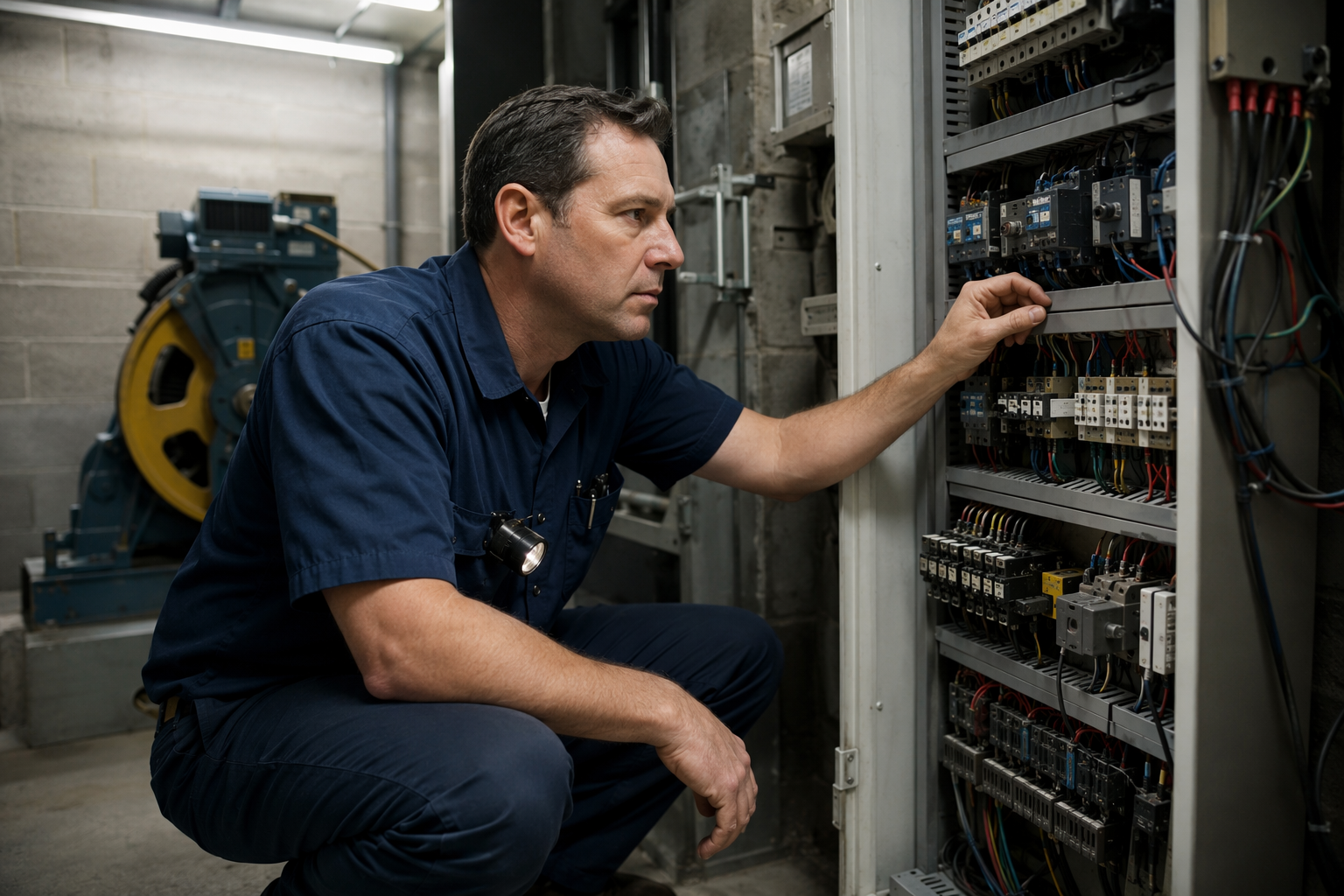
Your first call during an elevator breakdown should always be to your contracted 24/7 elevator service provider, followed immediately by building management if passengers are involved.
The chain of contact matters as much as the speed of contact. In my experience, the single biggest delay in elevator emergency response is confusion about who owns the problem. Here is the correct contact sequence you should have posted in every elevator machine room and building management office:
- Your elevator service contractor (24/7 emergency line) — They dispatch a licensed mechanic immediately.
- Building management or property manager — They coordinate access, tenant communication, and documentation.
- Local fire department (911) — Only if passengers are confirmed trapped and cannot be safely evacuated by building staff using approved procedures.
- Your state elevator inspection authority — Required for reportable incidents in Maryland, DC, Pennsylvania, and Virginia.
Do not attempt to manually operate the elevator or open doors yourself. Under ASME A17.1-2022 Safety Code for Elevators and Escalators, only qualified elevator personnel are authorized to perform emergency operations on elevator equipment.
What Qualifies as an Elevator Emergency Requiring Immediate Response?
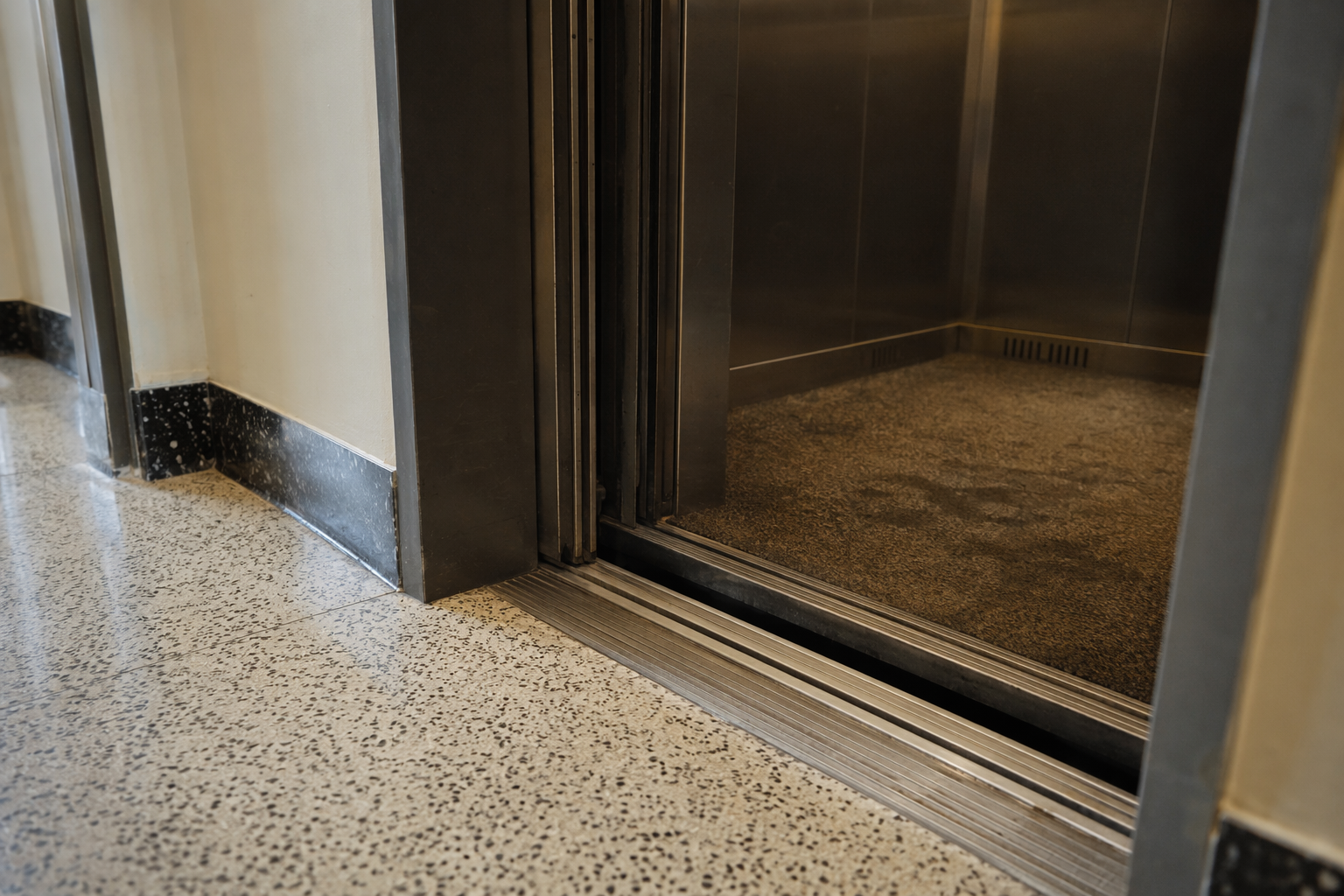
An elevator emergency requiring immediate response includes any situation involving trapped passengers, door malfunctions preventing egress, uncontrolled movement, or complete loss of power to the cab.
Not every breakdown is a life-safety emergency, but the following situations should always trigger your emergency response protocol without hesitation:
- Passengers trapped between floors or inside a stopped cab
- Elevator stopping more than 3 inches above or below a floor landing (a tripping hazard under ASME A17.1 Section 2.26)
- Unusual noises including grinding, banging, or continuous alarm activation
- Doors opening or closing with excessive force or at wrong floor levels
- Smoke, burning smell, or visible sparks in the machine room or cab
- Elevator running continuously without responding to calls
- Complete power failure affecting elevator function
Situations like a single out-of-service button or a slow door are maintenance issues, not emergencies — but they still require same-day service to remain in compliance with local operating codes.
How Quickly Should an Elevator Service Company Respond to a Breakdown?
A qualified elevator service contractor should dispatch a technician within 30 to 60 minutes for emergency calls, with on-site arrival typically within 2 hours depending on location and traffic conditions.
Response time benchmarks vary by contract type. Based on industry standards and my 15+ years in the field, here is what you should expect:
| Response Scenario | Industry Benchmark (2026) | Quality Elevator Target | Unacceptable Threshold |
|---|---|---|---|
| Trapped Passenger (Emergency) | Under 60 minutes | Under 45 minutes | Over 90 minutes |
| Complete Elevator Out-of-Service | 2–4 hours | Under 2 hours | Over 8 hours |
| Intermittent Malfunction (Non-Emergency) | Same business day | Within 4 business hours | Next business day |
| Scheduled Maintenance Callback | Within 48 hours | Within 24 hours | Over 72 hours |
| After-Hours Emergency (Nights/Weekends) | Under 90 minutes | Under 60 minutes | Over 2 hours |
If your current service provider cannot consistently meet these benchmarks, your maintenance contract may be putting you at legal and operational risk. Buildings under ADA Title III accessibility requirements face additional liability when elevator downtime affects accessibility for individuals with disabilities.
What Should Building Managers Do While Waiting for the Elevator Technician?
While waiting for the elevator technician, building managers should communicate with any trapped passengers, post out-of-service signage, secure the machine room, and document the incident start time and conditions.
Here is a step-by-step protocol I recommend to every building I service:
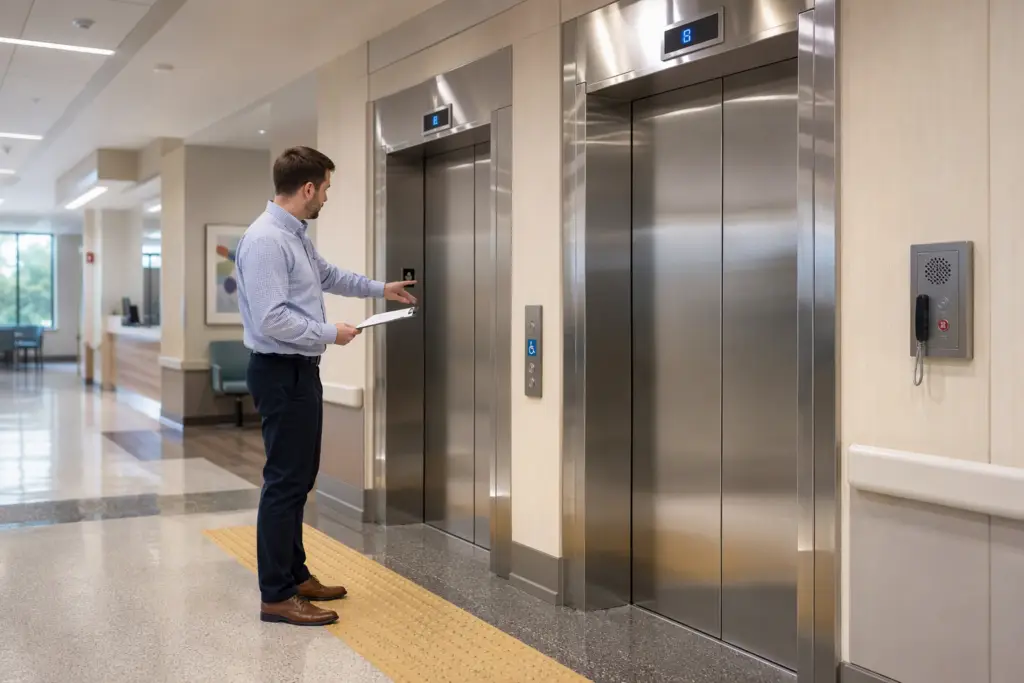
- Make verbal contact with trapped passengers via the emergency intercom. Confirm how many people are in the cab and assess for medical emergencies. Under ASME A17.1 Section 2.27.1.1, all elevators must have a two-way communication device.
- Reassure passengers that help is on the way and advise them not to attempt to exit the elevator themselves.
- Do not attempt manual lowering unless you are trained and authorized under your building’s emergency operation plan.
- Post physical “Out of Service” signs at every floor landing.
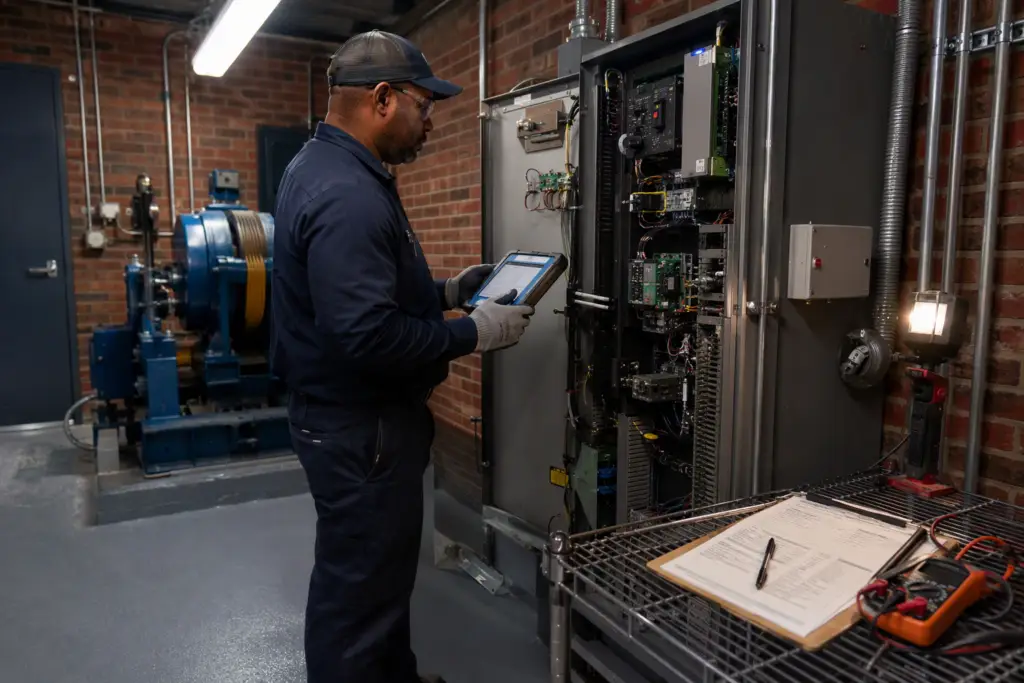
- Secure the machine room and ensure it is accessible to the arriving technician.
- Document everything: time of breakdown, floor where elevator stopped, number of passengers, actions taken. This is critical for your incident report and any regulatory notification.
- Call 911 if any passenger reports a medical emergency or extreme distress.
Are Building Owners Legally Required to Have an Elevator Emergency Contact Plan?
Yes — in Maryland, Washington DC, Pennsylvania, and Virginia, building owners operating passenger elevators are required by state and local regulations to maintain documented emergency response procedures and active service contracts with licensed elevator contractors.
Let me break this down by jurisdiction, since I work across all four of these markets:
- Maryland: The Maryland Department of Labor, Licensing and Regulation (DLLR) requires all conveyances to be maintained under a service contract with a licensed contractor. Failure to respond to a breakdown within a reasonable time can result in operating permit suspension.
- Washington DC: DC DCRA (Department of Consumer and Regulatory Affairs) enforces ASME A17.1 with local amendments. Buildings must have a 24/7 emergency contact posted in the machine room and cab.
- Pennsylvania: The PA Department of Labor and Industry Bureau of Occupational and Industrial Safety requires licensed elevator contractors for all maintenance and emergency repairs. Philadelphia has additional municipal code requirements for response documentation.
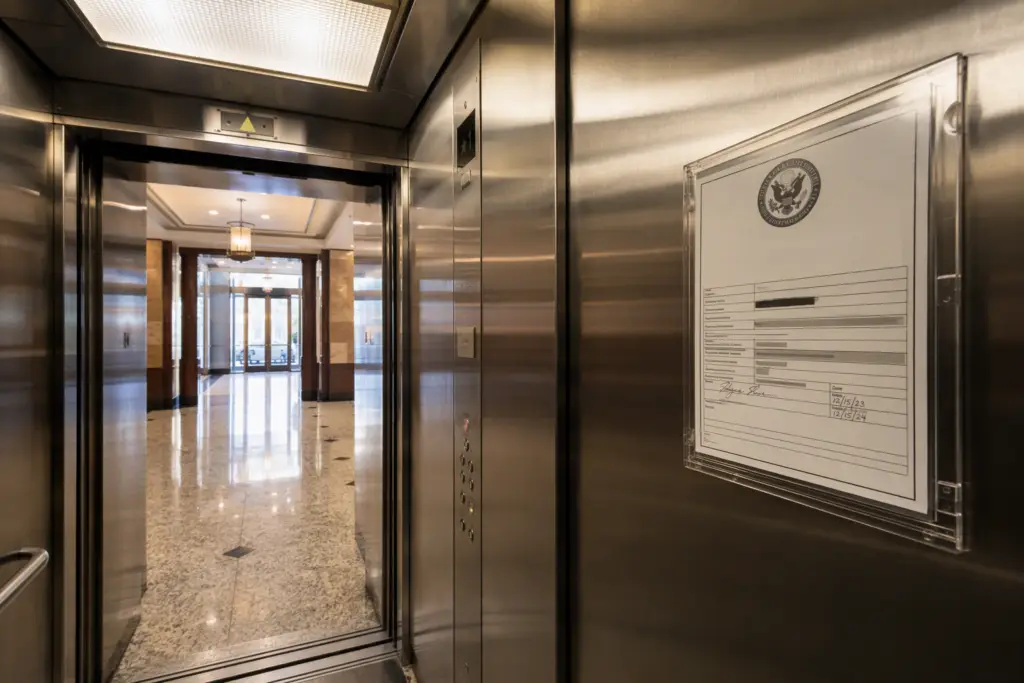
- Virginia: The Virginia Department of Labor and Industry (DOLI) enforces the Virginia Elevator Safety Law under the ASME A17.1 framework. Richmond-area buildings must display current inspection certificates inside each elevator cab.
Non-compliance across all four jurisdictions can result in fines ranging from $500 to $10,000 per violation, forced elevator shutdown, and increased liability in personal injury litigation.
How Do I Know If My Current Elevator Service Contract Covers Emergency Response?
Review your maintenance contract for explicit language about 24/7 emergency dispatch, guaranteed response time windows, trapped passenger rescue coverage, and after-hours labor rate caps.
Many building owners are shocked to discover their “full maintenance” contract doesn’t actually include after-hours emergency response — or charges triple-rate overtime that wasn’t disclosed at signing. When evaluating your contract, look for these specific provisions:
- 24/7/365 emergency dispatch with a dedicated emergency phone number (not an answering machine)
- Defined response time guarantees in writing, with penalties for non-compliance
- Trapped passenger rescue included in base contract, not billed as extra
- Parts availability commitment — how long will repairs take if a part must be ordered?
- Technician certification requirements — are they IUEC-certified? State-licensed?
- Incident reporting assistance — will they file required state notifications with you?
What Information Should I Have Ready When I Call for Emergency Elevator Service?
When calling for emergency elevator service, have the building address, elevator unit number or location, number of trapped passengers if applicable, observed symptoms, and your service contract number ready before the call connects.
Dispatchers can reduce your response time by 15–20 minutes when callers provide complete information immediately. Keep this information posted in your building management office and machine room:
- Full building address including floor and wing if applicable
- Elevator identification number (found on the certificate of inspection inside the cab)
- Number of elevators in the building and which one is affected
- Number of people trapped and any known medical conditions
- Last known position of elevator (floor number, between floors)
- What the elevator was doing when it stopped
- Any error codes displayed on the controller panel
- Whether power is on or off to the unit
What Is the Difference Between an Elevator Maintenance Contract and an Emergency Service Call?
A maintenance contract provides scheduled preventive care and typically includes emergency response, while an emergency service call without a contract is billed at premium rates and may have significantly longer response times.
In 2026, average emergency-only service call rates in the Mid-Atlantic region range from $350 to $800 per hour with no guarantee of priority response. By contrast, a comprehensive maintenance contract with a provider like Quality Elevator Company locks in emergency response time, caps labor rates, and ensures a technician familiar with your specific equipment responds to your calls. Buildings with active maintenance contracts experience 40–60% fewer unplanned breakdowns than those relying on reactive-only service, based on industry data from the National Elevator Industry Inc. (NEII).
How Does Elevator Age Affect Breakdown Frequency and Emergency Response Needs?
Elevators older than 20 years experience breakdown rates 3 to 5 times higher than modern units, making 24/7 emergency response contracts especially critical for aging equipment.
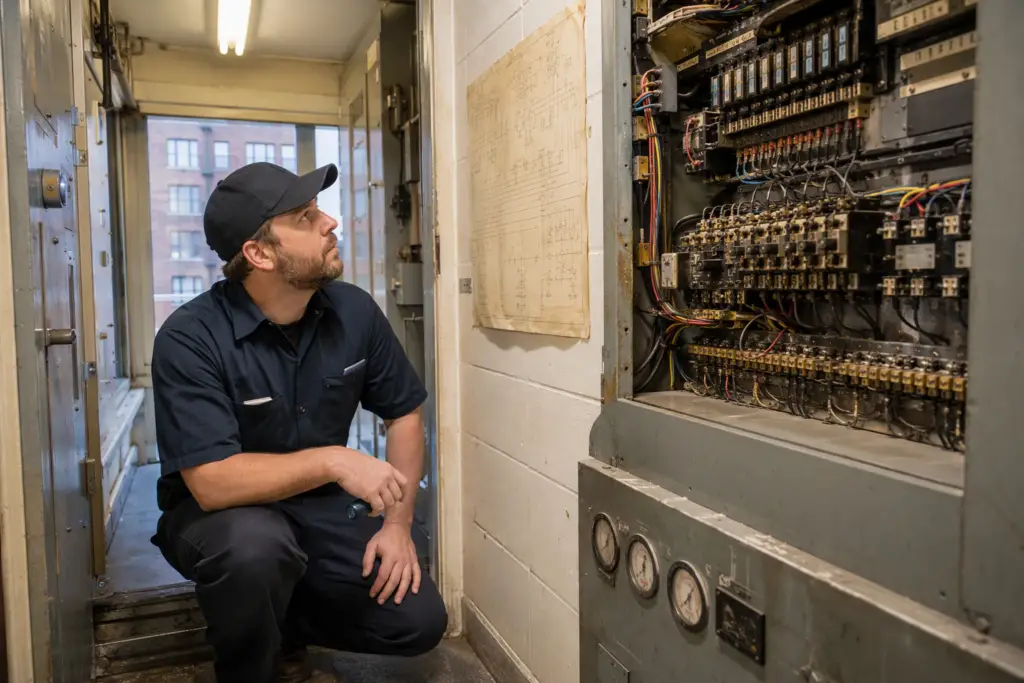
The average elevator in the United States is 20+ years old. In older building stock — which is common across Baltimore’s historic districts, DC’s commercial core, and Philadelphia’s downtown — hydraulic systems, relay-logic controllers, and aging door operators are the most frequent sources of emergency breakdowns. Key failure points by age category:
- 0–10 years: Primarily software/controller issues, door operator adjustments. Low emergency frequency.
- 10–20 years: Hydraulic seal failures, motor wear, increasing door problems. Moderate emergency frequency.
- 20–30 years: Parts obsolescence becomes a serious issue. Emergency response may require sourcing hard-to-find components. High emergency frequency.
- 30+ years: Modernization should be strongly considered. Emergency repairs may be temporary fixes only. Very high emergency frequency.
Should I Call 911 or My Elevator Service Company First When Passengers Are Trapped?
Call your elevator service company and 911 simultaneously when passengers are trapped — your service company begins dispatch while fire department personnel can perform emergency extraction if needed.
This is one of the most common questions I receive, and the answer is nuanced. Fire departments are trained in elevator rescue and should always be notified when passengers are confirmed trapped, but they are not equipped to diagnose or repair elevator systems. Only a licensed elevator mechanic can return the elevator to safe operation. The two calls are complementary, not interchangeable. In jurisdictions like Baltimore City and Washington DC, 911 dispatch will automatically coordinate with elevator companies on record for the address, but you should not rely on this — make the call yourself.
What Are the ADA Compliance Implications of Extended Elevator Downtime?
Under the Americans with Disabilities Act, buildings with elevators as the primary accessible route must take immediate corrective action when an elevator is out of service, or face discrimination liability.
This is an area where building owners routinely underestimate their exposure. Specific ADA implications of elevator downtime include:
- Multi-story buildings where the elevator is the sole accessible means of reaching upper floors must provide equivalent facilitation (an attendant, a temporary accessible route) or face ADA Title III complaints
- Extended downtime without documented repair efforts can be cited as failure to maintain accessible features under 28 CFR Part 36.211
- ADA complaints can result in DOJ investigations, civil litigation, and settlements averaging $25,000–$75,000 for Title III commercial violations
- Federal buildings under ADA Title II have even stricter obligations for restoration timelines
Rapid emergency response isn’t just about convenience — it’s a federal compliance obligation for most commercial properties in Baltimore, DC, Philadelphia, and Richmond.
How Do I Prevent Elevator Breakdowns That Require Emergency Response?
Preventive maintenance performed at regular intervals — typically monthly for high-use elevators — reduces emergency breakdown frequency by up to 70% and is required by ASME A17.1 Section 8.6.
The most effective prevention strategy combines scheduled maintenance with remote monitoring technology. In 2026, predictive maintenance systems using IoT sensors can detect motor temperature anomalies, door timing variances, and hydraulic pressure drops before they cause a failure. The investment in a comprehensive preventive maintenance program typically yields a 3:1 return through avoided emergency repair costs, reduced downtime, and extended equipment lifespan.
What Certifications Should My Emergency Elevator Technician Have?
Your emergency elevator technician must hold a valid state elevator mechanic license for the jurisdiction where your building is located, and should ideally carry IUEC (International Union of Elevator Constructors) certification and ASME QEI (Qualified Elevator Inspector) credentials.
Here are the certification requirements by market:
- Maryland: State elevator mechanic license from MD DLLR required for all repair work
- Washington DC: DC elevator mechanic license required; separate inspector licensing for inspection work
- Pennsylvania: PA Department of Labor and Industry license required; Philadelphia may require additional municipal credentials
- Virginia: DOLI elevator mechanic license required under the Virginia Elevator Safety Law
Always ask to verify credentials before a technician performs emergency work on your elevator. Quality Elevator Company technicians carry current multi-state licensing and IUEC certification, and credentials are available upon request for every dispatch.
What Happens If My Elevator Service Company Cannot Reach My Building in Time?
If your primary elevator service company cannot reach your building within a reasonable emergency response window, you should have a pre-identified secondary contractor and a documented escalation protocol as part of your building emergency plan.
This is a scenario that happens more often than building owners expect — particularly during major weather events like the snowstorms that regularly impact Baltimore and DC, or high-volume periods in commercial districts. My recommendation is to always have a backup service provider identified in advance, with their emergency number posted alongside your primary contractor. Attempting to locate an emergency elevator service company during an active entrapment situation is a preventable crisis. Ensure your backup contractor also holds valid state licenses for your specific jurisdiction.
How Much Does Emergency Elevator Service Cost Compared to Contracted Maintenance?
Emergency elevator service calls without a maintenance contract typically cost $500–$1,500 per incident for basic repairs, while comprehensive maintenance contracts average $200–$600 per month and include emergency response at no additional charge.
Cost breakdown for 2026 Mid-Atlantic market rates:
- Emergency call without contract: $350–$800/hour labor + parts + potential premium surcharge for after-hours (1.5x–2.5x multiplier)
- Trapped passenger rescue (no contract): $800–$2,000 per incident depending on complexity and duration
- Modernization triggered by deferred maintenance: $50,000–$250,000+ depending on elevator type and scope
- Full maintenance contract (includes emergency response): $2,400–$7,200 annually for a single elevator unit
- ADA violation settlement (failure to restore accessible route): $25,000–$75,000+ in civil litigation
The math strongly favors a comprehensive maintenance contract. Beyond the direct cost savings, contracted buildings receive priority dispatch over non-contract emergency calls — meaning faster response when minutes matter most.
What State Agencies Should Be Notified After a Serious Elevator Incident?
After a serious elevator incident resulting in injury, entrapment over 30 minutes, or equipment damage, you must notify the relevant state elevator safety authority within the timeframe specified by local regulations — typically 24 to 72 hours.
Notification requirements by jurisdiction in 2026:
- Maryland: Report to MD Department of Labor, Licensing and Regulation. Serious injuries must be reported within 24 hours.
- Washington DC: Report to DC DCRA Elevator Inspection Program. Incidents involving injury or significant equipment failure require written notice.
- Pennsylvania: Report to PA Bureau of Occupational and Industrial Safety. Philadelphia buildings may also have city-level reporting obligations.
- Virginia: Report to VA DOLI Elevator Safety Unit. All incidents involving injury or extended entrapment must be documented and reported.
Failure to report can result in penalties and may complicate insurance claims. Quality Elevator Company provides incident documentation support as part of our emergency response service in all four of our service territories.
How Do I Evaluate Whether to Repair or Replace an Elevator After a Major Breakdown?
After a major breakdown, the repair-versus-replace decision should be based on the elevator’s age, repair cost as a percentage of modernization cost, parts availability, and compliance with current ASME A17.1-2022 and local code requirements.
Use this general guideline: if the repair cost exceeds 50% of the cost of modernization and the elevator is more than 20 years old, modernization is typically the more economical long-term choice. A certified elevator consultant or your service contractor can perform a formal equipment assessment to provide a documented recommendation. Quality Elevator Company offers comprehensive equipment assessments for buildings across Baltimore, DC, Philadelphia, and Richmond, including code compliance gap analysis.
What Remote Monitoring Technologies Can Reduce the Need for Emergency Response?
Remote elevator monitoring systems using IoT sensors and cloud-based diagnostics can reduce emergency breakdowns by 40–65% by identifying developing faults before they cause complete equipment failure.
In 2026, remote monitoring is no longer a luxury — it is a proven operational risk management tool. Modern systems can monitor:
- Motor temperature and vibration (predicting bearing failure 2–6 weeks in advance)
- Door operator timing and force (detecting misalignment before it causes a door-related breakdown)
- Hydraulic pressure levels (predicting seal failures before fluid loss occurs)
- Controller fault codes (real-time alerting to technicians before the building manager is aware of an issue)
- Cab leveling accuracy (detecting floor-landing drift that creates ADA tripping hazards)
Buildings that integrate remote monitoring with a comprehensive maintenance contract see the lowest total cost of elevator ownership and the fewest emergency service calls over a 10-year period.
How Do I Choose the Right Elevator Service Company for Emergency Response Coverage?
Choose an elevator service company that holds valid state licenses in your jurisdiction, maintains a 24/7 dedicated emergency dispatch line, employs IUEC-certified technicians, and has documented response time guarantees in their service contracts.
When vetting an emergency elevator service provider, ask these specific questions:
- What is your guaranteed emergency response time in writing?
- Do you have technicians stationed in my geographic area, or do they travel from a central hub?
- Are your mechanics licensed in my specific state?
- Is trapped passenger rescue included in the base contract?
- What is your parts availability for my elevator brand and model?
- Can you provide references from buildings similar to mine in my city?
- Do you assist with post-incident state regulatory reporting?
Quality Elevator Company maintains licensed technicians positioned throughout Baltimore, Washington DC, Philadelphia, and Richmond — ensuring genuine local response times, not dispatch from a distant regional hub. Our emergency line is answered by a live dispatcher 24 hours a day, 365 days a year, including all major holidays.
Don’t Wait for a Breakdown to Find Out Your Service Plan Isn’t Enough
Quality Elevator Company serves building owners and managers across Baltimore MD, Washington DC, Philadelphia PA, and Richmond VA with 24/7 emergency response, licensed IUEC-certified technicians, and comprehensive maintenance contracts built for commercial, residential, and institutional properties.
Contact Quality Elevator Company for a free elevator assessment today.
Call us now: 301-779-9116
Our team is available around the clock. When you call, a live dispatcher — not a voicemail — answers immediately.
References and Regulatory Resources:
ASME A17.1-2022 Safety Code for Elevators and Escalators
ADA 2010 Standards for Accessible Design — U.S. Department of Justice
ADA.gov — Americans with Disabilities Act National Network
ASME.org — American Society of Mechanical Engineers
Need elevator service you can rely on? Quality Elevator Company is ready to help.