Elevator Entrapment Rescue Procedure: Complete Guide for Building Owners & Passengers
After more than 15 years responding to elevator entrapments across Baltimore, Washington DC, Philadelphia, and Richmond, I’ve seen every variation of this emergency — from a 10-minute inconvenience to a two-hour ordeal caused entirely by untrained responders making the situation worse. This guide covers everything building owners, property managers, facility teams, and passengers need to know about elevator entrapment rescue procedures, compliance requirements, and how to prevent these situations in the first place.
What Is the Correct Elevator Entrapment Rescue Procedure?
The correct elevator entrapment rescue procedure is a structured, step-by-step protocol where trained personnel use manual lowering devices or hand-winding mechanisms to move a stalled car to the nearest floor landing, then open doors through approved means — never by forcing them from the outside without authorization.
Here is the complete sequence as defined by ASME A17.1/B44 Safety Code for Elevators and Escalators, the governing standard in all four of our service markets:
- Passenger communication: Establish two-way voice contact via the in-car phone or intercom immediately. ASME A17.1 Rule 2.27.1 requires all elevator cars to have a means of two-way communication.
- Call for certified help: Contact your elevator service company (such as Quality Elevator Company at 301-779-9116) and/or 911 depending on severity. Do not rely solely on fire department response — they are trained for life safety extraction, not mechanical rescue.
- Do not force doors: Passengers should never attempt to pry open doors. Falling into an elevator shaft is the leading cause of elevator-related fatalities in the United States.
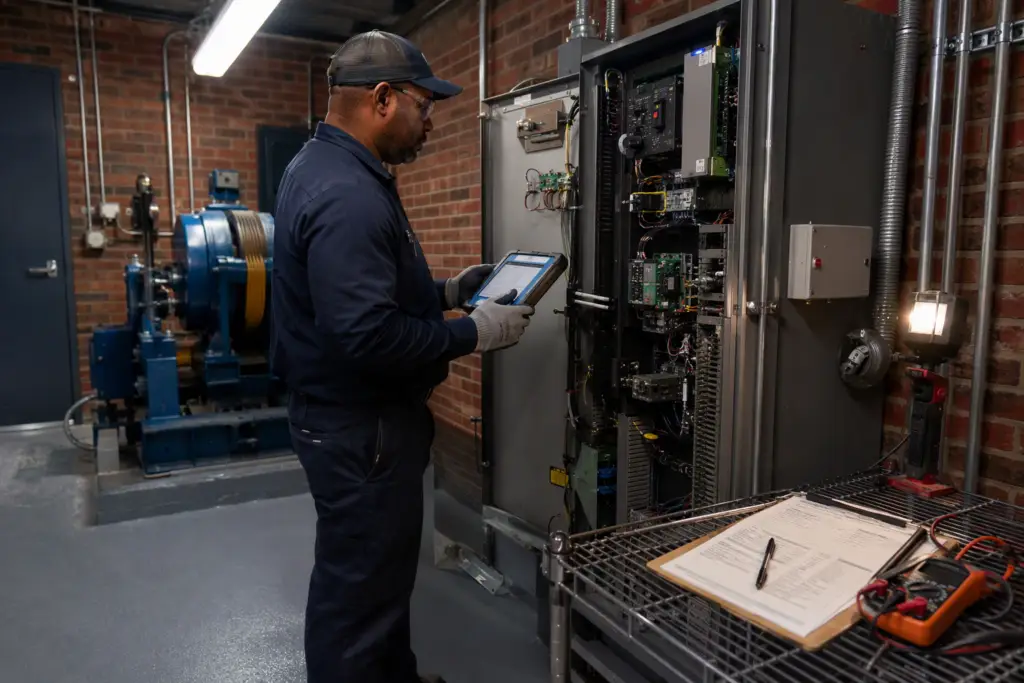
- Technician assessment: A certified elevator mechanic arrives, locks out the system per OSHA 29 CFR 1910.147 (lockout/tagout), and assesses car position using the machine room selector and position indicators.
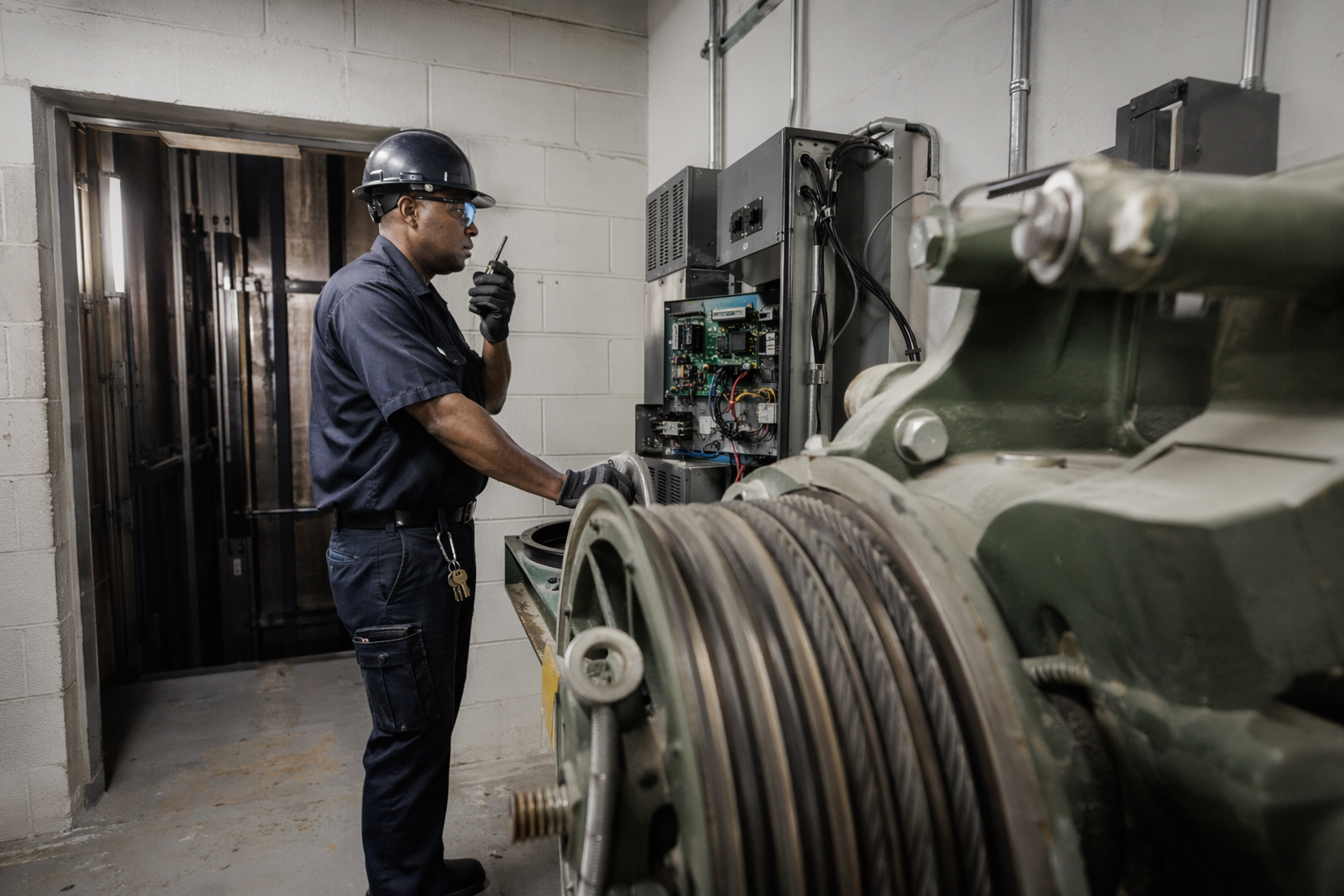
- Manual lowering or raising: Using the hand-winding wheel or manual lowering valve (hydraulic), the technician moves the car to the nearest landing — ideally within 12 inches of floor level per ASME A17.1 requirements.
- Door release: The technician opens hoistway and car doors using the proper emergency unlocking device (triangular key tool) from the landing side.
- Passenger evacuation: Passengers exit calmly. If medical assistance is needed, EMS is called before evacuation begins.
- System inspection: The elevator is taken out of service for a full inspection before being returned to operation.
How Long Does an Elevator Entrapment Rescue Typically Take?
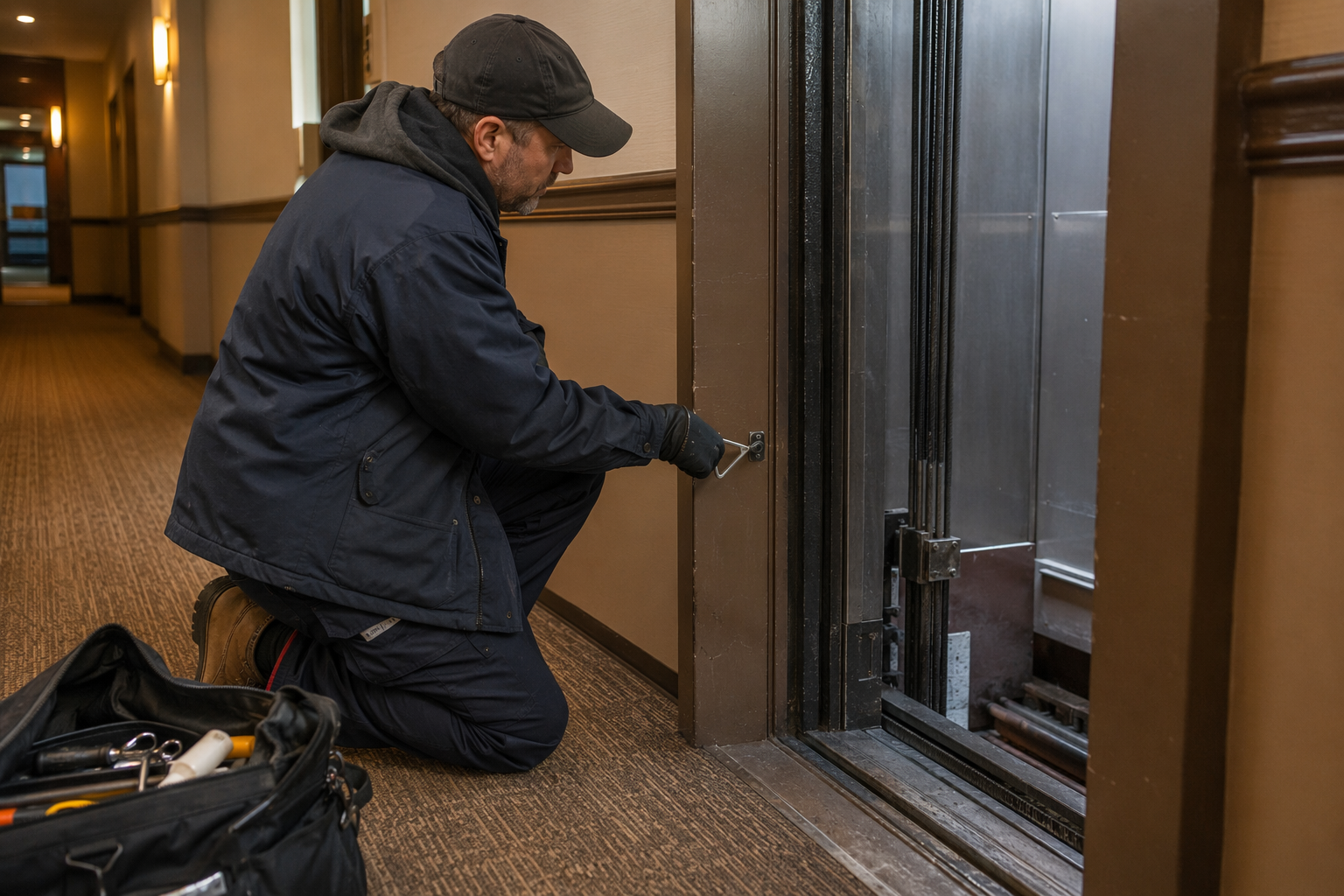
Most elevator entrapment rescues take between 15 and 90 minutes from the moment of entrapment to passenger evacuation, depending on the speed of notification, technician response time, and the cause of the malfunction.
In my 15+ years of responding to entrapments in the Baltimore-DC corridor and throughout Philadelphia and Richmond, the single biggest variable is how quickly the building contacts a certified elevator service company. Buildings with 24/7 service agreements consistently see response times under 30 minutes. Buildings relying on in-house staff or city fire departments alone average 45–75 minutes.
Fire departments are trained and equipped for life-safety extraction in emergencies, but elevator mechanics bring the tools and technical knowledge to perform a safe, code-compliant rescue without damaging equipment or risking secondary failures.
What Are the Legal Requirements for Elevator Entrapment Response in Maryland, DC, Virginia, and Pennsylvania?
All four jurisdictions served by Quality Elevator Company require that building owners maintain a documented emergency response plan for elevator entrapments, with licensed elevator technician access and regular testing of emergency communication devices.
- Maryland: Maryland Department of Labor, Elevator Safety Unit enforces ASME A17.1 and requires annual inspection certificates. Emergency phone testing is required at each inspection.
- Washington DC: DC Department of Consumer and Regulatory Affairs (DCRA) mandates entrapment rescue equipment be inspected semi-annually for high-rise buildings.
- Pennsylvania: Pennsylvania Department of Labor & Industry, Bureau of Occupational and Industrial Safety enforces ASME A17.1 statewide, including requirements for posted emergency procedures in all elevator cabs.
- Virginia: Virginia Department of Labor and Industry (DOLI) enforces ASME A17.1/B44 (2019 edition adopted 2022) and requires building operators to maintain elevator emergency response contracts.
Fines for non-compliance — including missing emergency phones, outdated inspection certificates, or absence of a rescue plan — range from $500 to $10,000 per violation depending on the jurisdiction and severity.
What Equipment Is Required for a Code-Compliant Elevator Entrapment Rescue?
A code-compliant entrapment rescue requires a set of specific tools and equipment including an emergency triangular hoistway door key, a hand-winding device or lowering valve, a flashlight, and proper personal protective equipment (PPE) — all maintained and accessible by qualified personnel only.
Under ASME A17.1 Rule 2.27.3, buildings are required to have the following available in or near the machine room:
- Emergency hoistway access key (triangular keyway, standardized)
- Hand-winding wheel or manual lowering device specific to the elevator model
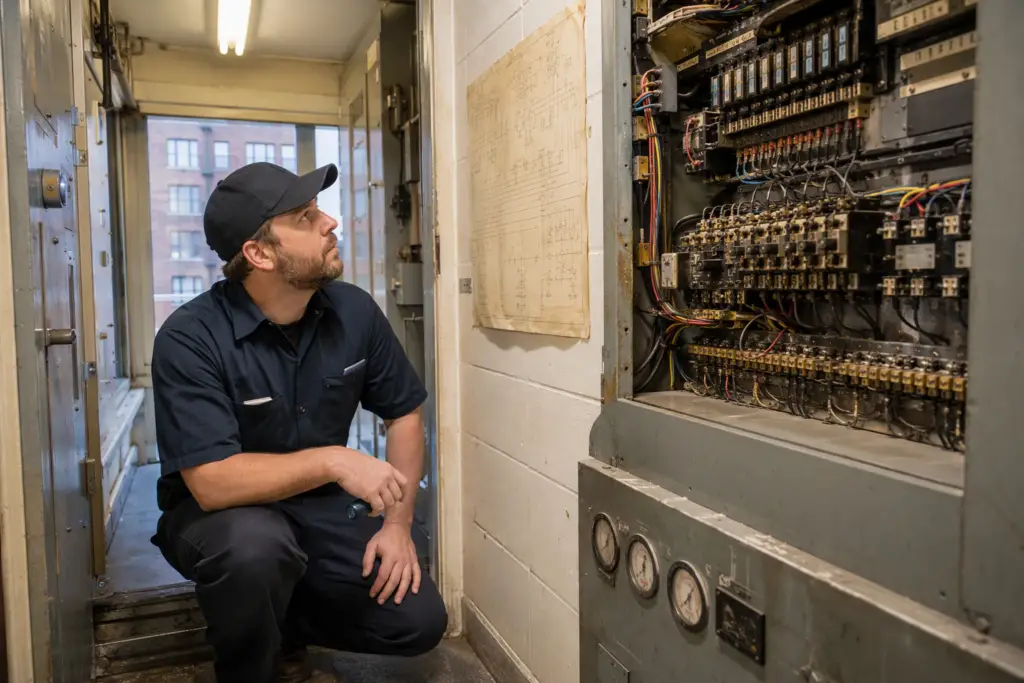
- Wiring diagram and operation manual for the specific unit
- Flashlight or emergency lighting
- Means to communicate with trapped passengers
Hydraulic elevator systems require a separate manual lowering procedure using a valve in the power unit. Traction elevators use hand-winding on the motor sheave. Attempting one procedure on the other type of system is dangerous and can cause uncontrolled car movement — a critical reason why only IUEC-certified mechanics should perform rescues.
What Should Passengers Do When Trapped in an Elevator?
Passengers trapped in an elevator should press and hold the emergency call button, use the two-way phone if available, remain calm, avoid forcing doors, stay seated if possible, and wait for trained rescue personnel to arrive.
Here is what passengers should NOT do, based on real scenarios I’ve responded to:
- Do not pry open doors: Elevator shaft falls are the #1 cause of elevator fatalities. The CPSC estimates approximately 27 deaths per year are related to elevators, with shaft falls being the most common fatal mechanism.
- Do not jump to “help” the car move: This is an urban myth and can trigger safety circuits.
- Do not climb through ceiling hatches: Roof hatches in elevator cars are designed for technician use only and are not safe evacuation routes for passengers under ASME A17.1.
- Do not smoke: Fire inside an elevator cab during entrapment creates a life-threatening situation.
Most importantly, inform the emergency dispatcher if anyone in the car has a medical condition — heart condition, severe anxiety, pregnancy, mobility impairment, or claustrophobia — so appropriate resources can be prioritized.
How Should Building Staff Respond When an Elevator Entrapment Occurs?
Building staff should immediately establish voice contact with trapped passengers, call the elevator service company’s emergency line, notify 911 if there is a medical emergency, keep bystanders away from hoistway doors, and document the incident per building protocol.
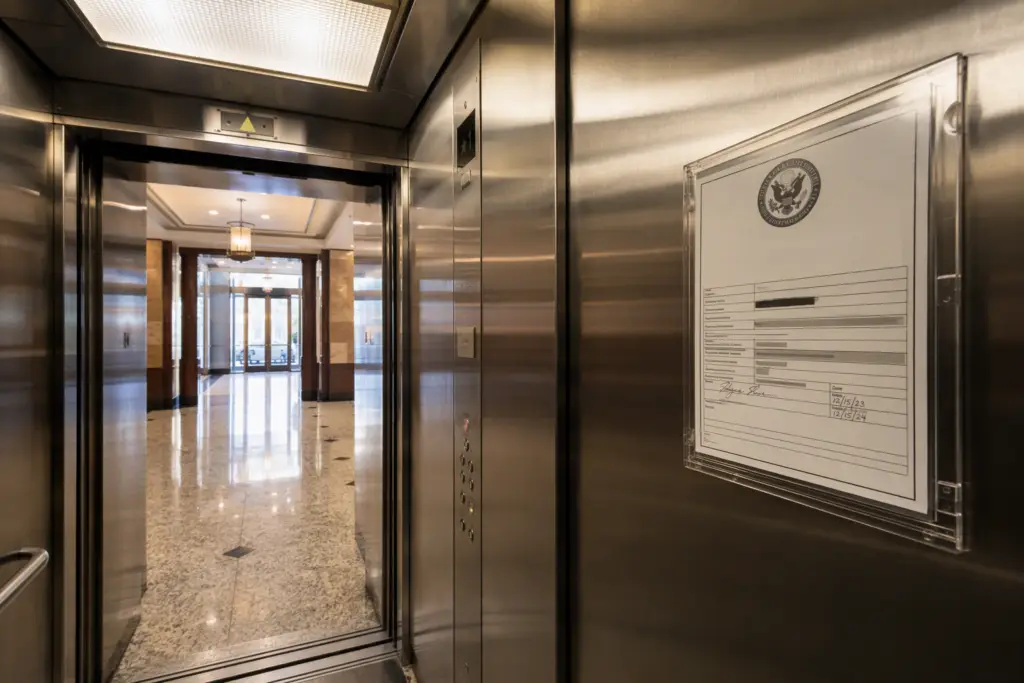
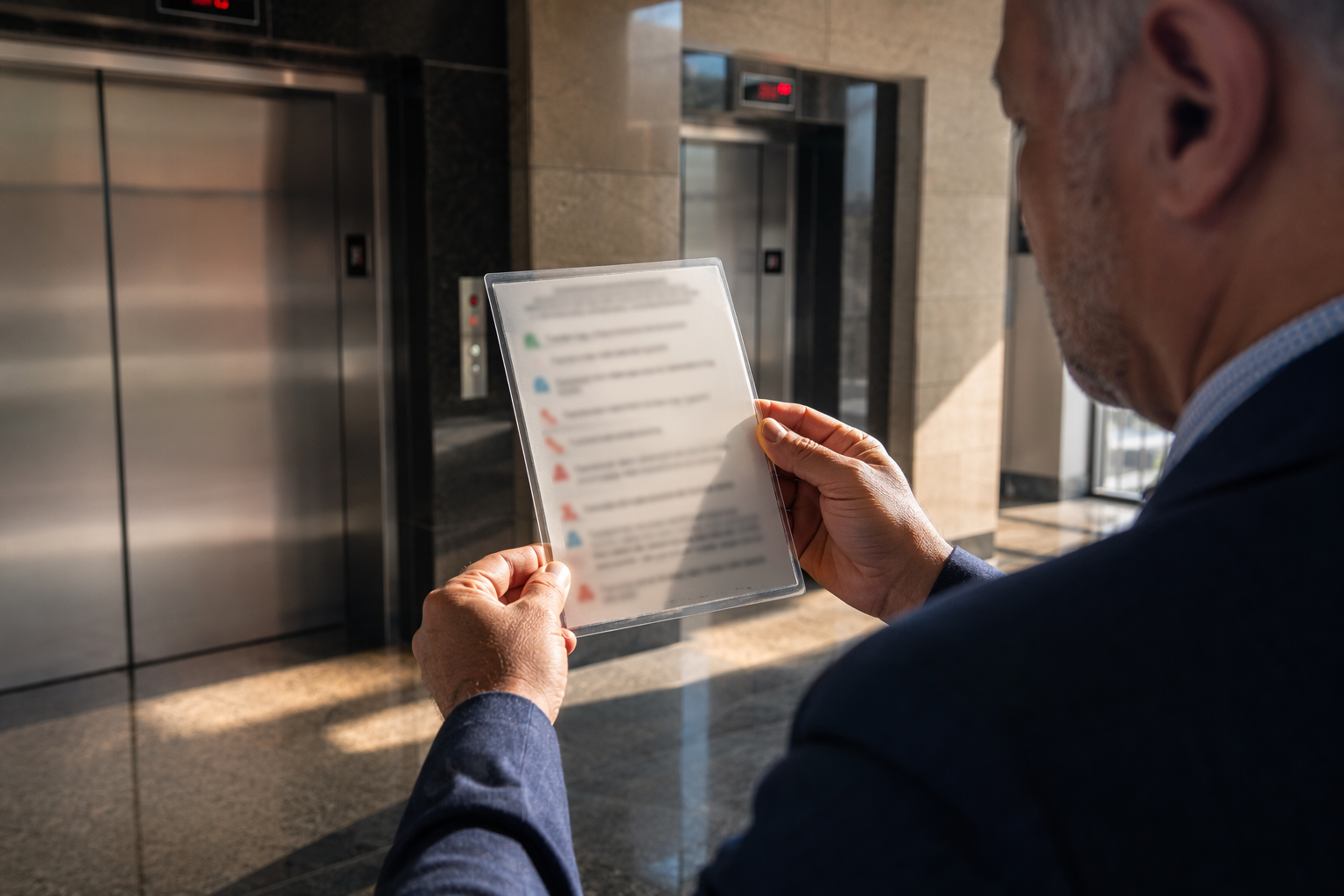
Building management teams in our service markets — Baltimore office towers, Washington DC federal buildings, Philadelphia hospitals, and Richmond mixed-use properties — should have a laminated emergency procedure card posted at each elevator lobby and in the property management office. This card should include:
- Elevator service company emergency phone number (available 24/7)
- Building elevator ID numbers and floor counts
- Location of machine room key
- Local fire department non-emergency line
- Instructions to NOT allow untrained staff to attempt rescue
Quality Elevator Company provides all clients with customized emergency response cards as part of our maintenance agreement onboarding — call 301-779-9116 to learn more.
Can Fire Departments Perform Elevator Entrapment Rescues?
Yes, fire departments are legally authorized and trained to perform elevator entrapment rescues as life-safety operations, but they may not always have elevator-specific mechanical training and their intervention can sometimes damage equipment or create secondary hazards.
Fire departments in Baltimore City, DC, Philadelphia, and Richmond all have elevator rescue protocols consistent with NFPA 1 and local codes. However, there is a critical distinction: fire departments perform extractions for life-safety emergencies (medical crisis, smoke, fire). Certified elevator mechanics perform technical rescues that also restore the elevator to safe operating condition.
When fire departments use tools to force hoistway doors without the car at landing level, they can damage door operators, interlocks, and sill assemblies — resulting in repair costs of $800–$3,500+ and an elevator that is out of service for days. Calling your elevator service company first — if the situation is not immediately life-threatening — is almost always the faster and less damaging option.
How Much Does an Emergency Elevator Entrapment Rescue Cost?
Emergency elevator entrapment rescue costs range from $0 (covered under a full-service maintenance agreement) to $350–$900+ for time-and-material emergency calls, with additional repair costs if equipment was damaged during the entrapment or improper rescue attempt.
| Scenario | Typical Cost Range (2026) | Covered by Maintenance Contract? | Response Time |
|---|---|---|---|
| Full-service maintenance agreement (rescue included) | $0 additional cost | Yes | 1–2 hours typical |
| Time & material emergency call (business hours) | $225–$450 | No | 2–4 hours |
| Time & material emergency call (after hours/weekends) | $350–$900+ | No | 2–5 hours |
| Door interlock repair (post-forced entry) | $400–$1,200 | Depends on contract | Separate service visit |
| Hydraulic valve replacement (post-malfunction) | $600–$2,800 | Depends on contract | Separate service visit |
| Full traction drive/controller repair (major failure) | $3,000–$18,000+ | Partial (varies) | 1–14 days |
Buildings with full-service elevator maintenance agreements through Quality Elevator Company have zero out-of-pocket cost for emergency response calls, including entrapment rescues, in our Baltimore, DC, Philadelphia, and Richmond service areas.
What Are the Most Common Causes of Elevator Entrapments?
The most common causes of elevator entrapments are door operator failures, motor or drive malfunctions, safety circuit trips, power outages, and worn leveling components that cause the car to stop between floors.
Based on service data from across our markets in 2025–2026, door-related failures account for approximately 40–50% of all entrapment events. Here is a breakdown:
- Door operator/gate switch failure (40–50%): Worn door cams, misaligned vanes, or failed clutch mechanisms prevent doors from fully closing, triggering a safety stop.
- Motor drive faults (15–20%): Variable frequency drives (VFDs) faulting on overcurrent, overvoltage, or thermal overload conditions.
- Safety circuit trips (10–15%): Oil buffers, governor switches, or safeties triggered by vibration or mechanical wear.
- Power interruptions (10%): Grid outages, building electrical issues, or phase loss conditions.
- Leveling/selector failures (10–15%): Worn tape selectors or encoder faults causing the car to stop between floors.
The vast majority of these causes are preventable with proper preventive maintenance — quarterly inspections catch door wear and drive faults before they escalate to entrapments.
How Often Should Elevators Be Inspected to Prevent Entrapments?
Elevators should receive a full state-mandated annual inspection plus quarterly preventive maintenance visits at minimum — with monthly visits recommended for high-traffic buildings — to catch wear patterns that lead to entrapments before they occur.
Inspection frequency requirements by jurisdiction in 2026:
- Maryland: Annual inspection required by Maryland Code, Labor & Employment Article §5-301 et seq. Periodic maintenance is left to building owner discretion but strongly recommended quarterly.
- Washington DC: DC Code §2-135 requires annual inspections. High-rise buildings (over 125 feet) require semi-annual inspections of life-safety systems including emergency phones.
- Pennsylvania: Pennsylvania Elevator and Kindred Equipment Act (Act 95 of 1965, as amended) requires annual inspections. Philadelphia additionally mandates 5-year load tests and pressure tests for hydraulic units.
- Virginia: Virginia Code §40.1-51.15 et seq. requires annual inspections. Virginia adopted ASME A17.1-2019 in 2022, replacing the 2013 edition.
What Training Do Building Staff Need for Elevator Entrapment Response?
Building staff do not need to be licensed elevator mechanics, but they should receive training on: how to establish passenger communication, when to call 911 versus the elevator company, how to keep bystanders safe, and how to document the incident for liability and compliance purposes.
OSHA does not require building staff to perform mechanical rescues — that is the exclusive domain of licensed elevator mechanics under ASME A17.1 and state licensing laws. What building staff must know:
- Location and use of the emergency phone override panel (if applicable)
- How to access the two-way intercom from outside the cab
- The elevator company’s 24/7 emergency line (not just the business line)
- How to identify the elevator (car number, floor, building address) for the dispatcher
- How to complete an incident report per their property management policy
Quality Elevator Company offers complimentary building staff emergency training sessions for all clients under maintenance agreements. This 60-minute session covers response protocols specific to your building’s elevator equipment.
Are There ADA Requirements Related to Elevator Entrapment Procedures?
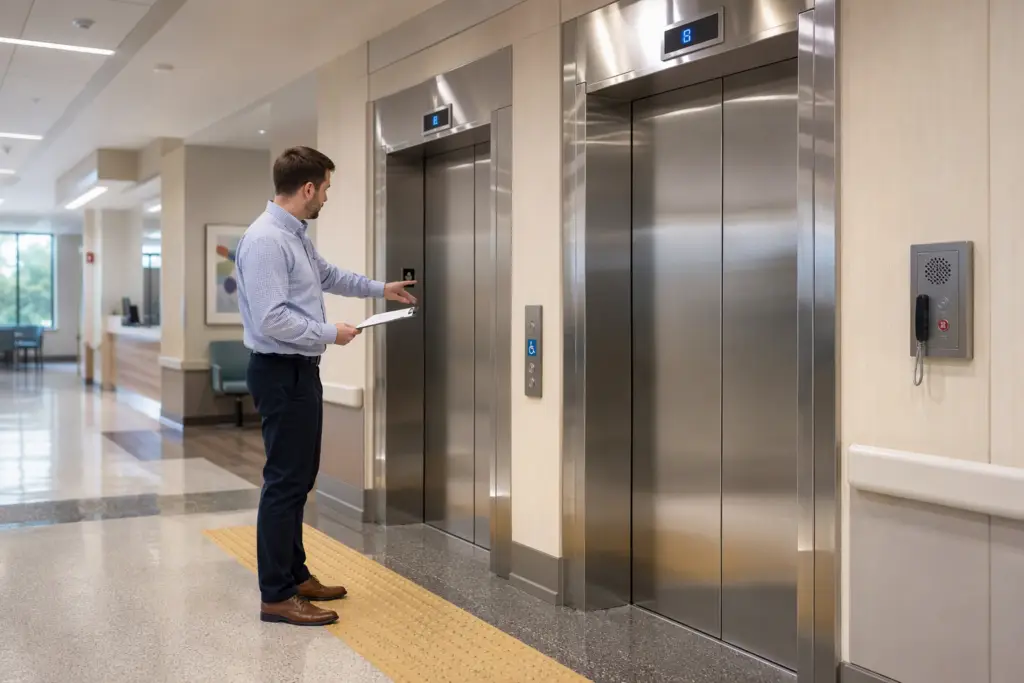
Yes — the Americans with Disabilities Act (ADA) requires that emergency communication systems in elevators be accessible to people who are deaf or hard of hearing, and that entrapment response procedures account for passengers with mobility impairments or other disabilities.
Specifically, ADA Standards for Accessible Design (2010 ADA Standards, Section 407.4.9) require that the two-way communication system in the elevator provide both a voice and a visual signal confirmation that the call has been received. In practice, this means:
- Emergency phones must produce a visible signal (light or display) when the call connects
- Answering services must be capable of TTY/TDD communication or equivalent
- Building entrapment response plans must address passengers who cannot communicate verbally
- Evacuation plans must include protocols for mobility-impaired passengers who may need litter or chair carry evacuation
Many buildings in our service markets — particularly older commercial stock in Baltimore and Philadelphia — are still operating non-compliant emergency phone systems. This is a significant liability exposure. Our technicians flag ADA communication compliance issues during every inspection.
What Is the Difference Between an Emergency Evacuation and a Standard Entrapment Rescue?
A standard entrapment rescue brings the elevator car to a floor landing and evacuates passengers through the normal door opening, while an emergency evacuation may involve removing passengers through the car top, side emergency exits, or adjacent hoistway openings when the car cannot be moved — and is only performed under extreme circumstances by qualified personnel.
Under ASME A17.1 Rule 2.27.3.1 (2019 edition), passenger evacuation through the top of the car or through emergency side exits is permitted only when:
- The car cannot be moved to a landing
- There is an immediate threat to passenger health or life
- Qualified elevator personnel or fire department are present and directing the procedure
Roof hatch evacuations require a second car in the same hoistway or a fixed ladder access — conditions that rarely exist in most commercial buildings. This is why in 15+ years, I have performed fewer than a dozen true top-of-car evacuations. The overwhelming majority of entrapments are resolved by moving the car to the nearest landing.
What Happens After an Elevator Entrapment — Are There Required Follow-Up Steps?
After an elevator entrapment, the elevator must be inspected before returning to service, an incident report must be filed, and depending on the jurisdiction, the entrapment may need to be reported to the state elevator safety authority — especially if it involved injury or a safety device activation.
Post-entrapment required steps in 2026:
- Take elevator out of service: Do not return it to service until a technician has completed a full inspection and identified the root cause.
- Complete an incident report: Document time of entrapment, number of passengers, cause (if known), rescue timeline, and any injuries. This protects building owners in liability claims.
- Report to state authority (if required): Maryland, DC, Pennsylvania, and Virginia all require reporting of entrapments that involve injury or activation of a safety device (e.g., governor, buffers, safeties).
- Obtain clearance from licensed mechanic: The elevator should not be returned to service without written clearance from the certified technician who performed the rescue and inspection.
- Review root cause and preventive measures: Was this a maintenance gap? A part failure? A code issue? Document the corrective action taken.
How Do Hydraulic Elevator Entrapment Rescues Differ From Traction Elevator Rescues?
Hydraulic elevator entrapment rescues use a manual lowering valve to slowly release hydraulic fluid and lower the car to the bottom landing, while traction elevator rescues use a hand-winding wheel to manually move the counterbalanced car up or down — each requiring different tools, knowledge, and safety precautions.
Hydraulic systems: The manual lowering valve is located in the hydraulic power unit, typically in the machine room or a pit-adjacent space. Opening this valve slowly lowers the car due to gravity. The risk is uncontrolled descent if the valve is opened too quickly — which is why this must only be performed by a trained mechanic. Hydraulic units manufactured before 1999 may also have environmental risk factors from hydraulic fluid leaks.
Traction systems (geared and gearless): Hand-winding requires disengaging the brake manually and using the winding wheel on the motor shaft to move the car. Because traction elevators are counterbalanced, the direction and force required depends on load — an empty car and a full car behave very differently. Gearless traction machines (common in high-rise buildings in DC and Philadelphia) may have electronic brakes that require specific release procedures before hand-winding.
MRL (Machine Room-Less) traction elevators: These present additional complexity because the drive and brake components are located in or above the hoistway, not in a separate machine room. Rescue procedures must be performed from the top-of-car or pit access points. MRL entrapments are increasingly common as this technology proliferates in newer construction across all four of our markets.
How Can Building Owners Reduce the Risk of Elevator Entrapments?
Building owners can significantly reduce entrapment risk through quarterly preventive maintenance, proactive door component replacement cycles, modernization of aging control systems, and real-time remote monitoring technology.
The most impactful preventive measures by return on investment:
- Door component maintenance (highest ROI): Replacing door gibs, cams, vanes, and rollers on a schedule (typically every 3–5 years depending on usage) eliminates the #1 cause of entrapments.
- Quarterly oil and buffer inspection: Ensures safety devices are functional and properly lubricated — prevents nuisance safety trips.
- Control system modernization: Older relay-logic controllers from the 1980s–1990s fail far more frequently than modern solid-state systems. Modernization ROI is typically 5–10 years in reduced service calls.
- Remote monitoring systems: IoT-based monitoring (available through Quality Elevator Company) can detect anomalies — unusual door cycle times, drive temperature spikes, leveling errors — before they cause an entrapment. Buildings in our network with remote monitoring see a 35–50% reduction in emergency entrapment calls.
- Passenger load management: Overloaded elevators trigger safety shutdowns. Proper signage and load sensors prevent this.
What Should Building Owners Look for When Hiring an Elevator Company to Handle Entrapment Rescues?
When hiring an elevator company for entrapment rescue coverage, building owners should verify IUEC certification, 24/7 emergency availability with documented response time guarantees, familiarity with local jurisdiction requirements, and references from comparable properties in your market.
Key vetting criteria checklist:
- ✅ IUEC (International Union of Elevator Constructors) certified mechanics
- ✅ State elevator contractor license in your jurisdiction (MD, DC, PA, or VA)
- ✅ 24/7/365 emergency response with response time SLA in writing
- ✅ Documented entrapment rescue procedure specific to your elevator make/model
- ✅ Certificate of insurance including general liability and workers’ comp
- ✅ References from buildings in your market and property type
- ✅ Compliance with ASME A17.1/B44 and applicable state codes
- ✅ Transparent pricing — emergency call rates disclosed in contract, not surprise billed
How Does Quality Elevator Company Handle Entrapment Calls in Baltimore, DC, Philadelphia, and Richmond?
Quality Elevator Company maintains a 24/7/365 emergency dispatch system with IUEC-certified technicians on call throughout all four service markets, with a contractual response time commitment and a complete rescue toolkit staged with each field technician’s vehicle.
When you call our emergency line at 301-779-9116, here is exactly what happens:
- A live dispatcher answers — not a voicemail or answering service — and gathers building address, elevator ID, number of passengers, and any medical concerns.
- The nearest certified technician is dispatched immediately.
- The dispatcher stays with you to coach building staff on passenger communication until the technician arrives.
- The technician arrives with a fully stocked rescue kit including elevator-specific tools, keys, and documentation for major elevator brands (Otis, Kone, Schindler, ThyssenKrupp, Dover, Mitsubishi, and others).
- Post-rescue, we provide a written incident report and root cause analysis within 24 hours — documentation your insurance carrier and state authority will require.
We serve commercial office buildings, healthcare facilities, multifamily residential towers, government buildings, and educational institutions across the Baltimore metro, greater Washington DC, the Philadelphia region, and the greater Richmond area.
What Are Common Myths About Elevator Entrapment That Can Make Situations Worse?
The most dangerous myths about elevator entrapment are that jumping will free a stuck car, that roof hatches are passenger escape routes, and that prying the doors open is safe — all of which are false and can result in serious injury or death.
Let me address the most persistent myths I encounter:
- Myth: “Jump in unison and the car will dislodge.” False. This can trigger additional safety circuits and cause the car to engage its safeties permanently, extending the entrapment significantly.
- Myth: “The emergency hatch is for passenger escape.” False. Car top hatches are for technician access from above. They open outward into the hoistway — an area with moving cables, counterweights, and limited space.
- Myth: “You can suffocate in a stalled elevator.” False. Elevator cabs are not airtight. Ventilation is always present. Calm breathing is perfectly safe during even a lengthy entrapment.
- Myth: “The elevator will free-fall if the cable snaps.” False. ASME A17.1 has required governor-activated safety brakes on all traction elevators since 1894. Modern elevators have multiple redundant fall-prevention systems.
- Myth: “Any strong person can manually open elevator doors.” This is possible, but dangerous. Opening a hoistway door when the car is not level with the floor can result in a fall into the shaft — the most common fatal elevator incident type.
Is Your Building Ready for an Elevator Entrapment?
Don’t wait for an emergency to discover gaps in your response plan. Quality Elevator Company provides free elevator safety assessments — including entrapment preparedness review, emergency phone compliance checks, and maintenance contract analysis — for buildings in Baltimore MD, Washington DC, Philadelphia PA, and Richmond VA.
📞 Contact Quality Elevator Company for a free elevator assessment: 301-779-9116
Available 24/7 for emergency entrapment response. Serving Baltimore, Washington DC, Philadelphia, and Richmond since 1998.
Need elevator service you can rely on? Quality Elevator Company is ready to help.