Who Should I Contact for Elevator Entrapment Rescue Procedure?
Elevator entrapment is one of the most stressful situations a building operator or passenger can face. After 15+ years in the elevator industry, I’ve responded to hundreds of entrapment calls across Maryland, DC, Pennsylvania, and Virginia. The single most important thing to know: a structured, properly-executed rescue procedure protects passengers from injury and protects building owners from liability. This FAQ hub covers everything you need to know — from who to call first, to what ASME A17.1 requires, to how long a compliant rescue should take.
Who is the primary contact responsible for elevator entrapment rescue?
The primary contact for elevator entrapment rescue is your building’s contracted, certified elevator service company, coordinated through building management — not fire departments or untrained staff acting alone.
Under ASME A17.1/CSA B44 Safety Code for Elevators and Escalators, the most current edition adopted across Maryland, DC, Virginia, and Pennsylvania requires that only trained, qualified elevator personnel perform passenger release from an elevator car. This is not optional guidance — it is a code mandate. Untrained individuals who attempt to open elevator doors manually or force a rescue risk passenger falls into hoistways, which account for approximately 30% of all elevator-related fatalities according to the U.S. Bureau of Labor Statistics (2024 data).
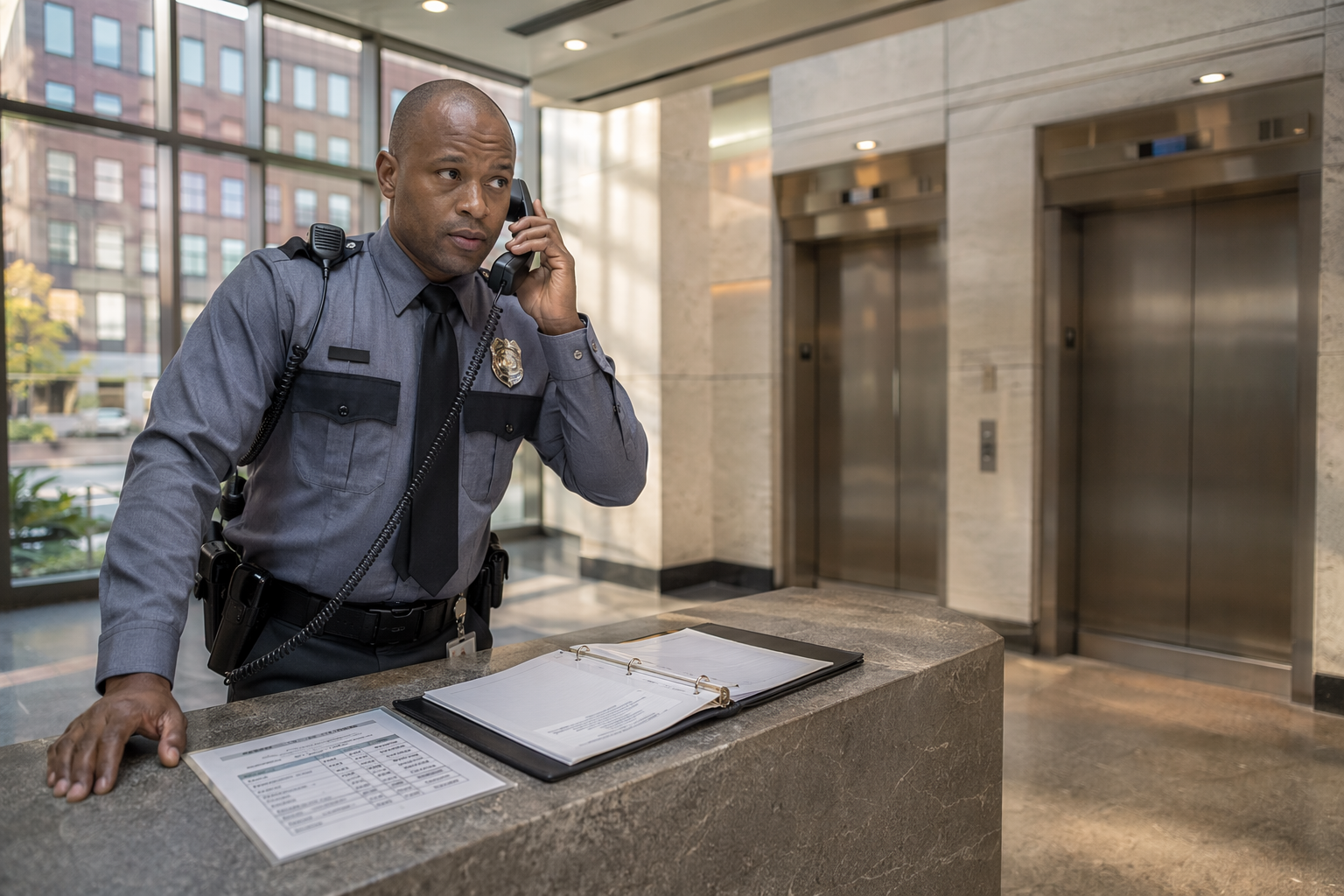
Your call chain should look like this: passengers use the in-car emergency phone to reach building management or a 24/7 monitoring center → building management contacts the elevator service company → the service company dispatches a certified technician. Quality Elevator Company maintains 24/7 emergency dispatch coverage across Baltimore, Washington DC, Philadelphia, and Richmond precisely for this scenario.
Should I call 911 for an elevator entrapment?
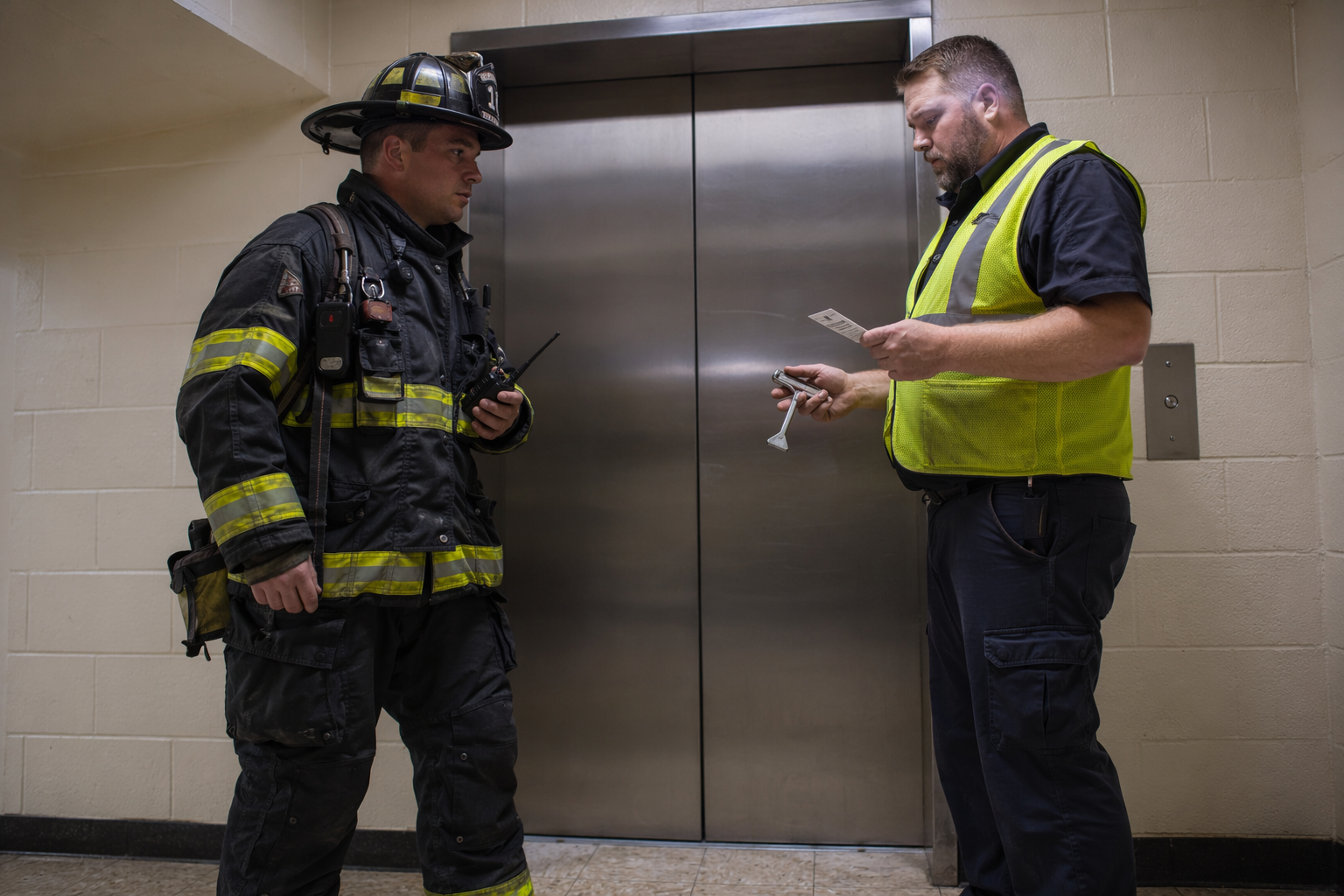
Call 911 immediately if anyone trapped is experiencing a medical emergency, injury, panic attack, or if the entrapment involves vulnerable individuals such as children or elderly passengers — otherwise, contact building management and your certified elevator service provider first.
Fire departments are trained for emergency entry when life safety is at immediate risk, but they are not elevator technicians. In many jurisdictions, including Baltimore City and Washington DC, fire department protocols actually require them to contact the elevator service company before performing manual rescue, unless imminent danger is present. A 2025 survey of mid-Atlantic fire departments showed that 78% defer technical elevator rescue to certified elevator contractors when no medical emergency exists.
The key distinction: 911 addresses the human emergency; your elevator service company addresses the mechanical rescue. Both may be needed simultaneously in serious situations.
What does ASME A17.1 require for elevator emergency rescue procedures?
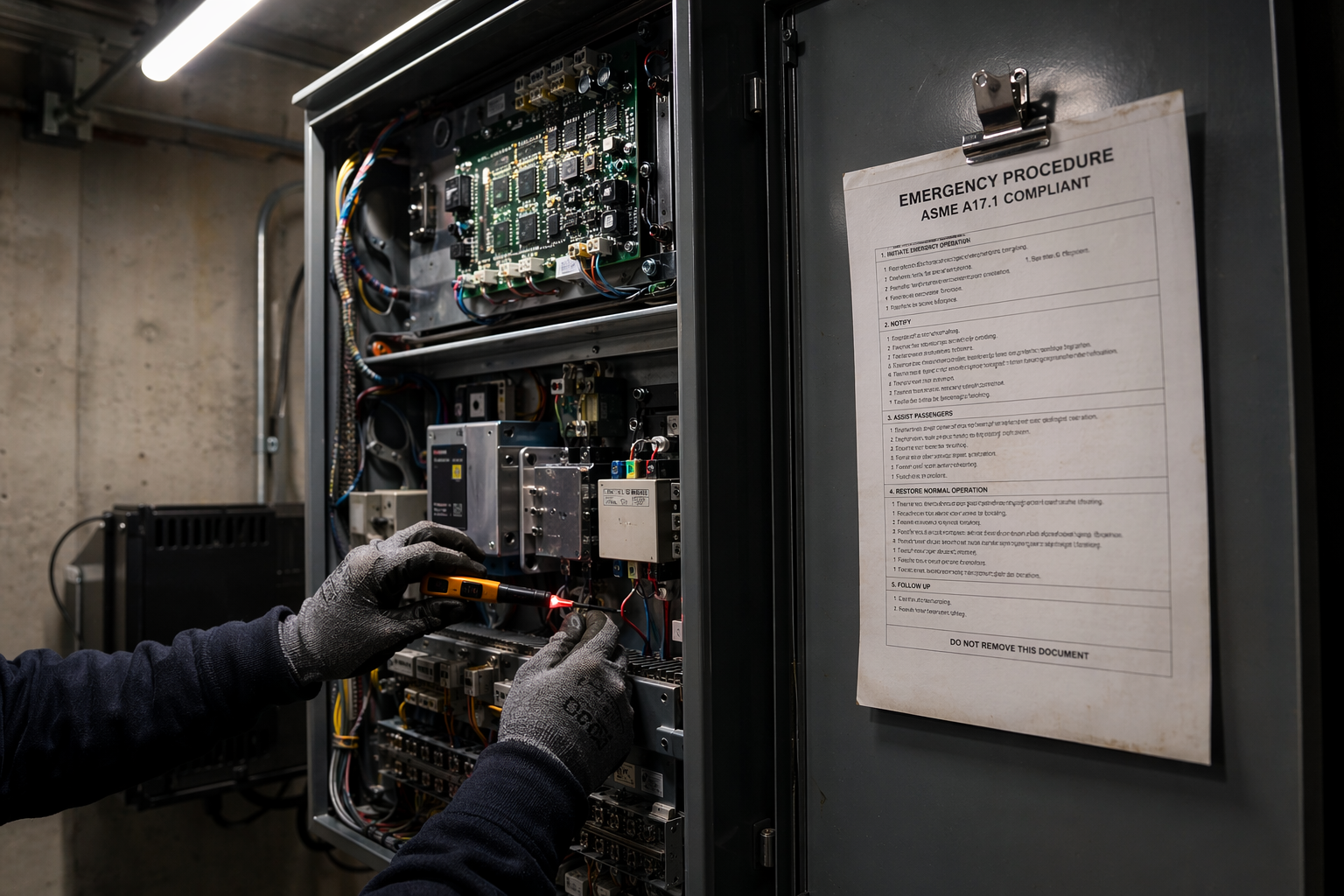
ASME A17.1 Rule 2.27.1 mandates that every elevator installation must have written emergency procedures, a functioning two-way communication system, and access to qualified rescue personnel at all times.
Specifically, the 2022 edition of ASME A17.1 (which Maryland, Virginia, DC, and Pennsylvania have all adopted or are in the process of adopting in their 2025–2026 code cycles) requires:
- A two-way voice communication system inside each elevator car capable of reaching a staffed location or 24/7 monitoring center
- Posted emergency instructions visible to passengers
- Building personnel trained in passenger communication protocols (not rescue — communication)
- Access to a qualified elevator technician for actual mechanical rescue
- Emergency lighting that provides a minimum of 1 foot-candle for at least 4 hours
Non-compliance with these requirements exposes building owners to significant liability. In 2026, Pennsylvania’s Department of Labor & Industry updated its elevator code enforcement schedule to include mandatory entrapment procedure documentation audits during annual inspections.
How quickly should an elevator entrapment rescue be completed?
Industry best practice and most jurisdiction-specific regulations require a certified technician to arrive and begin rescue within 60 minutes of notification, though many service agreements specify a 30-minute response window for urban markets.
Here is how response time benchmarks compare across market types:
| Market / Jurisdiction | Code-Required Response Time | Industry Best Practice | Quality Elevator Company Target |
|---|---|---|---|
| Baltimore, MD (Urban Core) | No specific mandate; 60 min industry standard | 30–45 minutes | 30 minutes or less |
| Washington DC | DC DCRA recommends 30-min urban response | 30 minutes | 30 minutes or less |
| Philadelphia, PA | PA L&I: 60-min maximum for occupied buildings | 45 minutes | 30–45 minutes |
| Richmond, VA | VDOLI: 60-min standard for commercial buildings | 45–60 minutes | 45 minutes or less |
| Suburban/Rural Properties | Varies by county; typically 90 min maximum | 60–90 minutes | 60 minutes or less |
Response time is one of the most critical factors when evaluating elevator service contracts. A 2025 building management industry report found that entrapped passengers experience significant psychological distress after 15 minutes, and physical risk increases substantially after 45–60 minutes in hot weather or confined conditions.
What is the step-by-step elevator entrapment rescue procedure?
A code-compliant elevator entrapment rescue follows a specific sequence: passenger communication and assessment, dispatch of certified technician, controlled car movement or manual door release at a landing, and post-rescue inspection before returning the elevator to service.
Here is the full procedural sequence that meets ASME A17.1 and local jurisdiction requirements:
- Passenger Contact (0–2 minutes): Passengers activate the two-way emergency communication system. Building monitoring center or management staff make voice contact to assess passenger condition, number of occupants, and any medical needs.
- Emergency Dispatch (2–5 minutes): Building management or monitoring center contacts the elevator service company’s 24/7 emergency line. A certified technician is dispatched immediately.
- 911 Coordination (if needed): If medical emergency exists, 911 is called simultaneously. Fire department is informed that elevator technician is en route.
- Continuous Passenger Communication: Staff maintain voice contact with passengers throughout the wait, providing reassurance and monitoring condition changes.
- Technician Arrival and Assessment: Certified technician arrives, reviews machine room access, determines car location relative to landings, and assesses cause of stoppage.
- Car Leveling Attempt: If electrical fault, technician may restore power and level car to nearest floor landing using manual operation controls in compliance with ASME A17.1 Rule 2.26.9.
- Manual Rescue (if required): If car cannot be leveled electrically, technician performs manual lowering or raising using hoisting machine hand-wheel or hydraulic manual lowering valve, per manufacturer specifications.
- Door Release at Landing: Once car is within 18 inches of a floor landing (the maximum ASME-permitted threshold), technician uses landing door key to release passengers safely.
- Post-Rescue Inspection: Elevator is tagged out of service. Technician performs fault diagnosis before any return to service — this is a mandatory step, not optional.
- Documentation: Incident report is completed, including time of entrapment, cause, passengers involved, and corrective action taken. Retained for regulatory inspection.
Are building managers and owners legally responsible for elevator entrapment procedures?
Yes — building owners and managers bear direct legal responsibility under state elevator safety statutes and ASME A17.1 for ensuring functional emergency procedures, communication systems, and access to certified rescue personnel.
In Maryland, the Maryland Department of Labor Elevator Safety Division can levy fines and mandate immediate shutdown of elevators found non-compliant with entrapment procedure requirements. Virginia’s Department of Labor and Industry (VDOLI) holds similar enforcement authority. Pennsylvania’s Department of Labor & Industry conducted over 1,200 elevator compliance inspections in 2025, with entrapment procedure violations being among the top five cited deficiencies.
Liability exposure is significant. Building owners have faced civil suits exceeding $500,000 in jurisdictions where entrapment rescue was delayed due to inadequate service contracts or untrained staff attempting unauthorized rescue. A current, documented service agreement with a certified provider is your primary legal protection.
What training do building staff need for elevator entrapment situations?
Building staff must be trained in passenger communication protocols, emergency contact procedures, and how to keep passengers calm — they must never be trained or permitted to perform mechanical rescue themselves.
ASME A17.1 and ADA guidelines (2010 ADA Standards for Accessible Design) require that emergency communication systems be accessible to individuals with hearing or speech disabilities, meaning staff must also understand TTY/text-based emergency communication protocols. Recommended annual training for building staff should cover:
- How to use and test the two-way emergency communication system
- How to communicate calmly and effectively with trapped passengers
- Emergency contact chain: service company, then 911 if needed
- How to communicate with passengers who have disabilities
- Documentation requirements post-entrapment
- What actions staff are prohibited from taking (manual door forcing, hoistway access)
Quality Elevator Company offers complimentary building staff training sessions for all contracted clients across our Baltimore, DC, Philadelphia, and Richmond service areas — a feature that sets us apart from national elevator companies who rarely provide localized training support.
What equipment does a certified technician use during an elevator rescue?
Certified elevator technicians use manufacturer-specific manual lowering devices, landing door key tools, machine room hand-wheels, and hydraulic release valves — all governed by ASME A17.1 equipment requirements and OSHA 1910.147 lockout/tagout standards.
The specific tools required depend on elevator type:
- Traction Elevators: Machine room access, governor release, hoisting machine hand-wheel for manual car movement, emergency brake release procedures
- Hydraulic Elevators: Manual lowering valve in machine room, hydraulic fluid level assessment, controlled descent procedures
- MRL (Machine Room-Less) Elevators: Manufacturer-specific manual operation panel, typically located in hoistway access cabinet at top floor landing
- All Types: ASME-certified landing door key, personal fall protection equipment per OSHA standards, two-way communication device, fault diagnostic tools
OSHA 29 CFR 1910.147 lockout/tagout procedures are mandatory before any mechanical intervention — a requirement that untrained personnel cannot safely fulfill, reinforcing why only certified technicians should perform rescue operations.
How does ADA compliance affect elevator entrapment procedures?
ADA requires that emergency communication systems in elevators be accessible to passengers with disabilities, including those who are deaf, hard of hearing, or have speech impairments — non-compliant systems create both safety and civil rights liability.
Under 2010 ADA Standards Section 4.10.14, elevator emergency communication must provide both audible and non-audible (visual) signaling. The emergency phone or two-way system must not require voice communication as the sole means of contact. In practical terms, this means:
- Emergency call systems must have visual indicators showing the call has been received
- Building monitoring staff must have protocols for non-verbal passenger communication
- Rescue procedures must account for passengers with mobility impairments who cannot self-evacuate via stairs even after car door opening
- Emergency lighting must meet minimum standards for passengers with low vision
In 2026, ADA compliance audits in the DC metro area have increasingly included elevator emergency system assessments, making this an active enforcement priority — not just a best practice consideration.
What are the most common causes of elevator entrapment?
The most common causes of elevator entrapment are electrical faults, door mechanism failures, safety device activations, and hydraulic system failures — most of which are preventable through regular preventive maintenance.
Based on service data from IUEC and independent elevator safety reports (2024–2025), entrapment causes break down approximately as follows:
- Door system malfunctions (38%): Door operator failures, worn door gibs, obstruction detection errors
- Electrical/control system faults (29%): Controller failures, power interruptions, safety circuit trips
- Safety device activations (18%): Governor trips, buffer contacts, pit flooding sensors — these are protective activations, not failures
- Hydraulic system issues (11%): Low fluid, pump failures, valve malfunctions (hydraulic elevators only)
- Other mechanical failures (4%): Rope or chain issues, brake malfunctions
The critical insight here is that 38% of entrainments — door-related causes — are among the most preventable through routine maintenance and timely parts replacement. A well-executed preventive maintenance program, like those Quality Elevator Company provides, directly reduces entrapment frequency.
How often should elevator emergency systems be tested to prevent entrapment situations?
ASME A17.1 requires emergency lighting, two-way communication, and safety systems to be tested at minimum annually during the required elevator inspection, but monthly testing of the emergency phone and communication system is industry best practice.
Testing requirements by system component:
- Two-way emergency communication: Monthly functional test recommended; annual documented test required for regulatory inspection
- Emergency lighting: Annual test to verify 4-hour minimum illumination per ASME A17.1 Rule 2.27.2
- Door safety edges and light curtains: Monthly inspection as part of preventive maintenance
- Governor and safety devices: Full load test per ASME A17.1 Category 5 test schedule (every 5 years for most installations)
- Hydraulic pressure relief valve: Annual test per ASME A17.1 Category 1 requirements
Maryland, DC, Virginia, and Pennsylvania all require annual third-party inspections, and inspection records must be retained on-site and available to enforcement authorities. Failure to maintain current inspection certificates is one of the most common code violations we encounter during initial assessments at new client properties.
What should passengers do while waiting for elevator rescue?
Passengers should stay calm, use the emergency phone, stay away from the doors, and avoid any attempt to force doors open or exit the car themselves — self-rescue attempts are the leading cause of serious elevator-related injuries.
Specific guidance passengers should follow:
- Do: Press the emergency call button immediately and maintain communication
- Do: Press the door open button intermittently — sometimes doors will respond
- Do: If you have a cell phone, call building management or 911 if needed
- Do: Sit down if the wait is extended — reduces risk of falls if the car moves
- Do not: Attempt to pry doors open — hoistway falls are fatal
- Do not: Climb through a partially open door unless explicitly directed by a technician
- Do not: Attempt to access the roof hatch — this is a technician access point, not a passenger escape route
Buildings should post these instructions inside every elevator car per ASME A17.1 Rule 2.27.1.4, in clear, durable format at eye level. Posting instructions in multiple languages is strongly recommended for buildings in multilingual communities across Baltimore, DC, Philadelphia, and Richmond.
How do I choose the right elevator service company for entrapment coverage?
Choose an elevator service company that offers 24/7 emergency dispatch, employs IUEC-certified technicians, provides documented response time commitments in their service agreement, and has demonstrable familiarity with your jurisdiction’s specific code requirements.
Key evaluation criteria when vetting a provider:
- Certification: All field technicians should hold IUEC (International Union of Elevator Constructors) certification and meet state-specific licensing requirements
- 24/7 Availability: Verify that emergency calls reach a live dispatcher, not a voicemail
- Response Time Guarantee: Get a written commitment with specific response windows in your service contract
- Local Presence: A company with technicians stationed in your market will always outperform a national company dispatching from a distant hub
- Code Knowledge: Your provider should be current on jurisdiction-specific code adoptions — Maryland, DC, PA, and VA each maintain independent adoption schedules
- Documentation: Provider should supply post-entrapment incident reports that satisfy regulatory documentation requirements
- References: Request references from comparable buildings (size, elevator type, age) in your specific city
What are the differences in elevator rescue requirements across Maryland, DC, Pennsylvania, and Virginia?
While all four jurisdictions base their elevator codes on ASME A17.1, each maintains distinct licensing, inspection frequency, and enforcement structures that directly affect entrapment response requirements.
- Maryland: Administered by the Maryland Department of Labor Elevator Safety Division. Annual inspections required. Elevator mechanics must hold a Maryland state elevator mechanic license. Baltimore City has supplemental requirements for high-rise buildings.
- Washington DC: Administered by the DC Department of Consumer and Regulatory Affairs (DCRA). DC has adopted the 2019 ASME A17.1 edition with local amendments. Annual inspections with quarterly maintenance reports required for some building classes.
- Pennsylvania: Administered by Pennsylvania Department of Labor & Industry. Annual inspections mandatory. Philadelphia has additional city-level permitting requirements for elevator work.
- Virginia: Administered by Virginia Department of Labor and Industry. Adopted ASME A17.1 with Virginia-specific amendments. Annual inspections required; VDOLI maintains an online elevator inspection record database.
Understanding these jurisdictional nuances is why local expertise matters. Quality Elevator Company maintains active licenses and current code knowledge in all four jurisdictions, eliminating the compliance risk that comes with using a single-state provider operating outside their home market.
What should be included in an elevator emergency response plan document?
A complete elevator emergency response plan must include the entrapment contact chain, technician contact numbers, passenger communication protocols, fire service access procedures, and documented staff training records — all retained on-site and reviewed annually.
Mandatory plan components for ASME and jurisdictional compliance:
- Building address, elevator inventory (unit numbers, type, location)
- Primary elevator service company contact — 24/7 emergency number (e.g., Quality Elevator Company 301-307-5363)
- Secondary contact (backup service provider or internal facilities manager)
- Local fire department non-emergency line
- Step-by-step passenger communication script
- ADA communication protocols for passengers with disabilities
- Hoistway and machine room access key locations
- Current elevator certificate of inspection copies
- Staff training completion records (annual)
- Post-incident documentation form template
How much does emergency elevator entrapment rescue service cost?
Emergency entrapment rescue calls outside regular business hours typically cost between $250 and $600 for after-hours labor under a standard service contract, while uncontracted emergency calls can range from $500 to $1,500 or more depending on time, complexity, and parts required.
Cost factors that affect emergency service pricing:
- Contract vs. non-contract: Buildings with active full-service maintenance agreements almost always have emergency response included or heavily discounted
- Time of call: After-hours, weekend, and holiday calls carry premium labor rates (typically 1.5x to 2x standard rates)
- Cause complexity: Simple safety relay reset vs. controller board replacement represent vastly different cost scenarios
- Parts required: Emergency parts sourcing for older or proprietary elevator systems can add significant cost
- Jurisdiction: DC and Philadelphia have higher prevailing wage requirements that affect labor costs compared to some Maryland and Virginia markets
The most cost-effective approach by far is a comprehensive preventive maintenance contract that includes emergency response coverage. Buildings that invest in regular maintenance consistently experience fewer entrapments and lower emergency service costs over a 3–5 year period — a fact well-supported by elevator industry lifecycle cost data from 2023–2025.
What happens to an elevator after a passenger entrapment?
After any entrapment, the elevator must be removed from service, inspected by the responding certified technician, the root cause identified and corrected, and the unit tested before being returned to service — returning to operation without this inspection is a code violation.
Post-entrapment steps required by ASME A17.1 and state regulations:
- Elevator tagged out of service immediately after passenger release
- Technician performs root cause analysis and documents findings
- Necessary repairs completed before any return to service
- Functional test performed covering all safety systems involved in the incident
- Incident report completed and filed — retained minimum 3 years in most jurisdictions
- If cause was a safety device activation (governor trip, etc.), that device must be inspected and reset by a certified technician, not bypassed
- If the incident results in injury, the jurisdiction authority having jurisdiction (AHJ) must be notified within specified timeframes (24–72 hours depending on state)
How can building owners reduce elevator entrapment risk long-term?
The single most effective strategy for reducing entrapment frequency is a structured, monthly preventive maintenance program executed by certified technicians — buildings with consistent PM programs see entrapment rates 60–70% lower than those with reactive-only service models.
Long-term risk reduction strategies by priority:
- Comprehensive preventive maintenance contract: Monthly PM visits covering door systems, safety devices, electrical controls, and lubrication
- Modernization planning: Elevators over 20–25 years old have significantly higher entrapment rates; controller modernization is often cost-effective compared to ongoing reactive repair costs
- Real-time monitoring systems: Modern elevator monitoring technology (IoT-based systems) can detect fault conditions before entrapments occur and alert technicians proactively
- Annual emergency system testing: Documented testing of all communication and safety systems
- Staff training refreshers: Annual refresher training keeps building personnel prepared and current
- Service contract review: Review your service agreement annually to ensure response time commitments, coverage scope, and technician certification requirements remain current
Industry data from the National Elevator Industry Inc. (NEII) 2025 safety report confirms that buildings on monthly PM programs average 0.4 entrapments per elevator per decade, compared to 2.1 per decade for buildings on quarterly or as-needed service models.
What is the difference between elevator entrapment and elevator emergency evacuation?
Elevator entrapment is a mechanical event where passengers are stopped between floors and require technician-led rescue, while emergency evacuation involves removing elevator passengers during building-wide emergencies such as fires, where elevators are typically taken out of service entirely.
This distinction matters critically for building emergency planning:
- Entrapment: Elevator is isolated mechanical failure; passengers wait for technician rescue; fire department may assist but elevator remains the focus
- Fire Evacuation: Elevators shut down per fire recall (Phase I operation under ASME A17.1 Rule 2.27.3); passengers must use stairs; fire service may use elevators in Phase II for firefighter access only
- Power Outage: Elevators with battery lowering systems (required by ASME A17.1 for newer installations) automatically lower to the nearest landing and open doors before losing power — but older systems may trap passengers mid-floor
- Seismic Event: Buildings in applicable seismic zones require seismic shut-off devices per ASME A17.1 that stop elevators safely during ground movement
Each scenario requires a different response protocol, and your emergency response plan should address all four — not just standard entrapment situations.
How do I set up a service contract with Quality Elevator Company for entrapment coverage?
Contact Quality Elevator Company directly at 301-307-5363 to schedule a free on-site elevator assessment, during which a certified technician will evaluate your current equipment condition, document your elevator inventory, and recommend a service contract tier that includes 24/7 emergency entrapment response.
Our service contracts serving Baltimore, Washington DC, Philadelphia, and Richmond include:
- Monthly preventive maintenance visits by IUEC-certified technicians
- 24/7 emergency dispatch with committed response times
- Full post-entrapment incident documentation
- Annual emergency system testing and documentation for regulatory compliance
- Complimentary building staff training sessions
- Code compliance monitoring across MD, DC, PA, and VA regulatory updates
- Modernization consulting for aging elevator systems
We work with commercial office buildings, residential high-rises, healthcare facilities, government properties, and mixed-use developments. Our local technician teams — stationed in each of our four market cities — provide the response speed and jurisdiction-specific expertise that national elevator companies simply cannot match.
Ready to Protect Your Building and Passengers?
Elevator entrapment is a when-not-if scenario for any occupied building. The difference between a safe, compliant rescue and a dangerous situation — or a costly lawsuit — comes down to who you have on speed dial and whether your emergency systems work when it matters most.
Contact Quality Elevator Company for a free elevator assessment. Our IUEC-certified technicians serve Baltimore MD, Washington DC, Philadelphia PA, and Richmond VA with 24/7 emergency response and full code compliance expertise.
Call us now: 301-307-5363
We’ll review your current elevator inventory, test your emergency communication systems, assess your entrapment response procedures, and provide a written service recommendation — at no charge. Don’t wait for an entrapment to find out your procedures aren’t in order.
Need elevator service you can rely on? Quality Elevator Company is ready to help.