Office Building Elevator Compliance and Maintenance: A Complete Decision Guide for Maryland, DC, Virginia, and Pennsylvania
—
What Compliance Standards Govern Office Building Elevators in Maryland, DC, Virginia, and Pennsylvania?
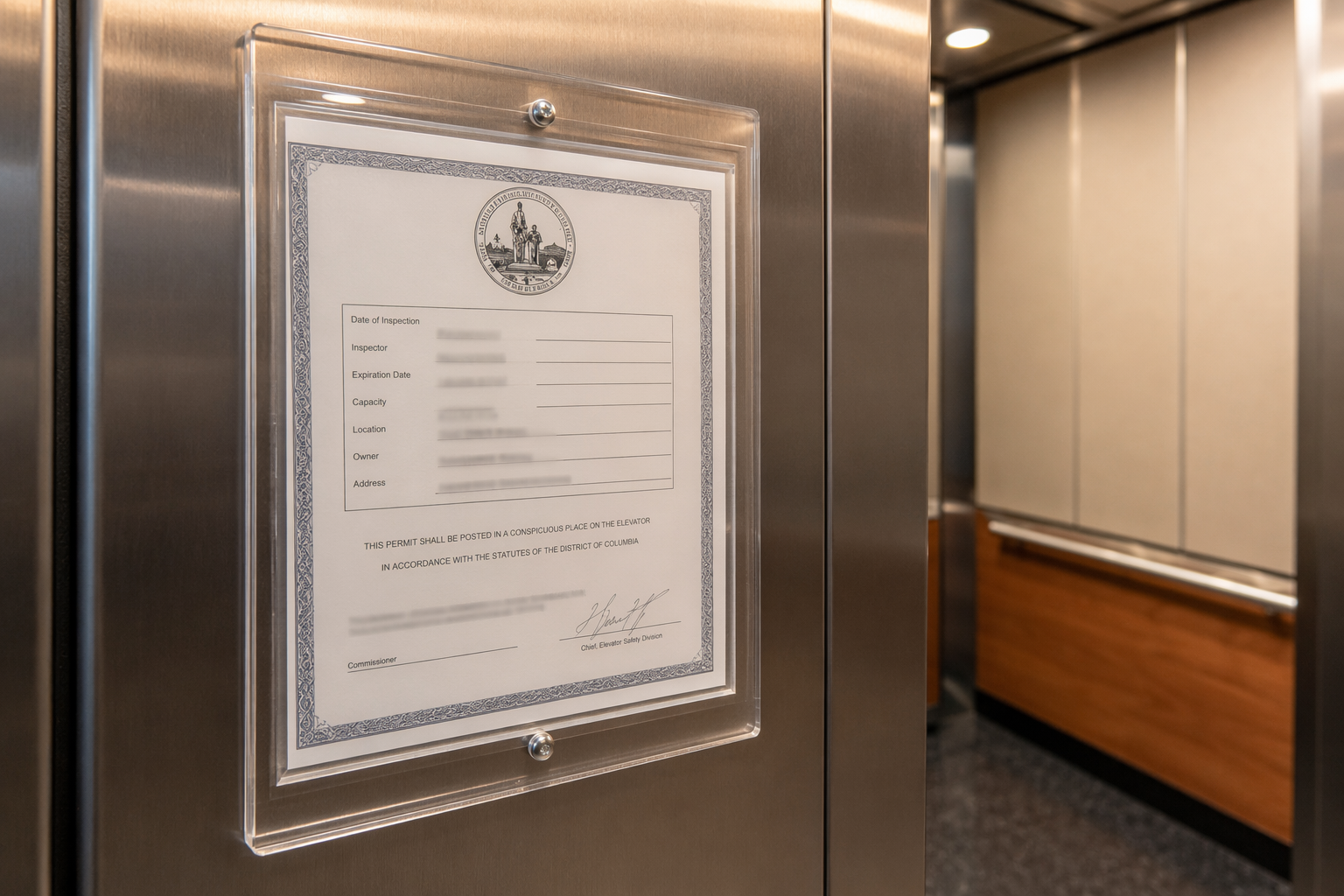
Elevator compliance in the Mid-Atlantic region is governed by a layered framework of federal codes, nationally recognized safety standards, and state- or district-level regulations enforced by each jurisdiction’s AHJ.
The Federal and National Code Layer
- ASME A17.1 Safety Code for Elevators and Escalators — the primary design, installation, and maintenance standard for new and substantially altered elevators across all four jurisdictions.
- ASME A17.3 Safety Code for Existing Elevators and Escalators — governs retroactive safety requirements for elevators already in service, including modernization thresholds that AHJs in Maryland, DC, Virginia, and Pennsylvania actively enforce.
- ADA Title III (Americans with Disabilities Act) — requires that elevators serving buildings with more than two floors meet accessibility standards, including door timing, floor call buttons, Braille signage, and audible floor announcements.
- OSHA Standards — apply to elevator maintenance workers and machine room safety conditions, including lockout/tagout procedures and confined-space protocols.
Jurisdiction-Specific Enforcement
| Jurisdiction | Primary AHJ | Code Basis | Key Requirement |
|---|---|---|---|
| Maryland | Maryland Department of Labor – Division of Labor and Industry | ASME A17.1 / A17.3 | Periodic inspections required; operating permit must be current and posted |
| Washington, DC | DC Department of Consumer and Regulatory Affairs (DCRA) | ASME A17.1 / A17.3 | Annual inspection certificate required; escalators included |
| Virginia | Virginia Department of Labor and Industry (DOLI) – Elevator Safety Unit | ASME A17.1 / A17.3 | Certified inspector required; routine and periodic tests mandated |
| Pennsylvania | Pennsylvania Department of Labor and Industry – Bureau of Occupational and Industrial Safety | ASME A17.1 / A17.3 | Annual inspection; operating permit displayed inside each elevator cab |
Note: Each jurisdiction updates its adoption of ASME editions on its own schedule. Building managers should confirm the current adopted edition with their AHJ or a qualified service provider.
—
What Does a Complete Elevator Maintenance Program Look Like?
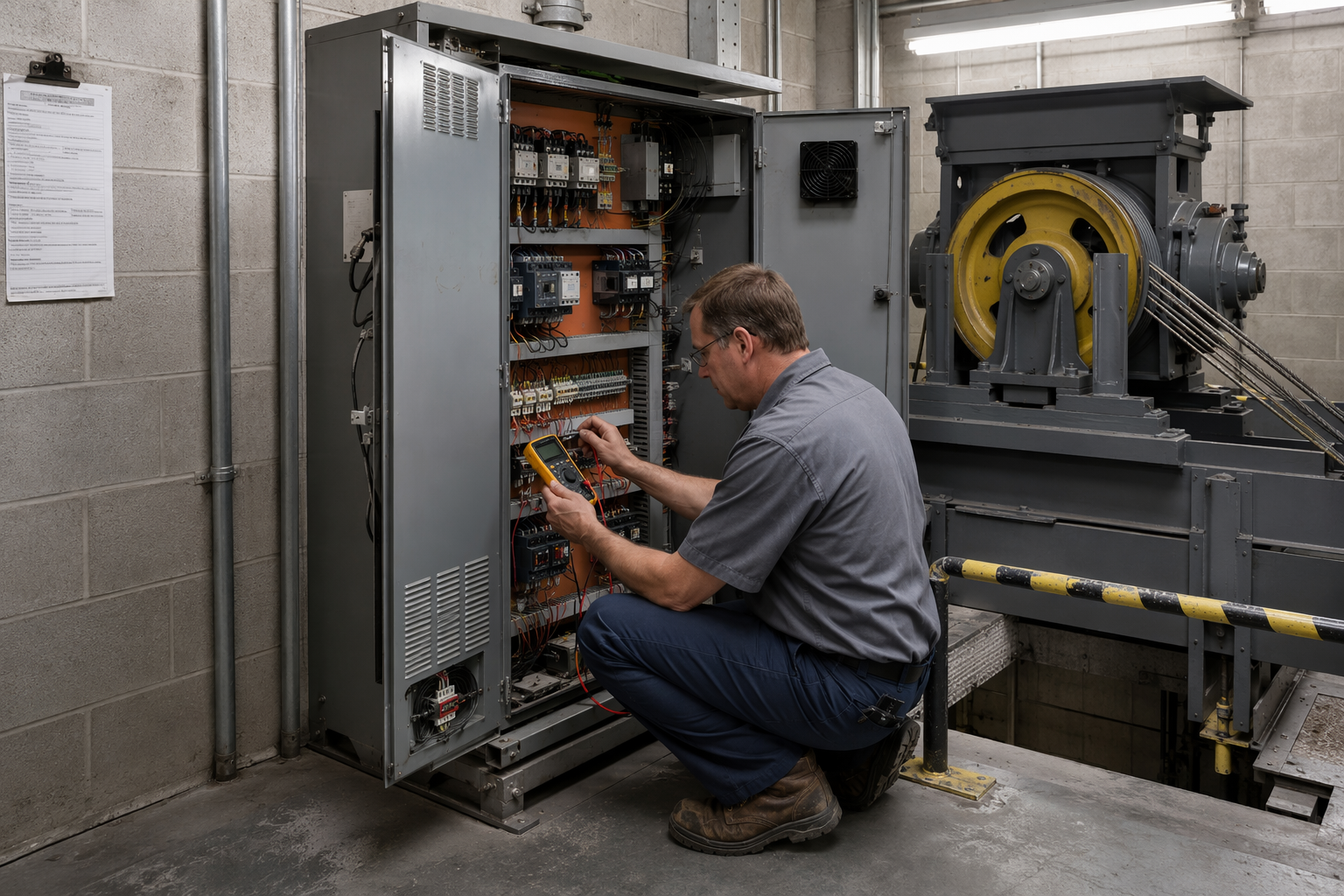
A compliant maintenance program for an office building typically combines three tiers of activity: preventive maintenance visits, mandatory inspections, and corrective repairs. These tiers work together to satisfy both code requirements and tenant safety expectations.
The Three Tiers of Elevator Maintenance
| Tier | Activity | Frequency | Who Performs It | Code Driver |
|---|---|---|---|---|
| Tier 1 | Preventive Maintenance | Monthly or quarterly (varies by contract and usage) | Licensed elevator mechanic | ASME A17.1 maintenance requirements |
| Tier 2 | Periodic Safety Tests (e.g., Category 1 and Category 5) | Annual / five-year cycle | Qualified inspector + mechanic | ASME A17.1 / AHJ rules |
| Tier 3 | Corrective Repairs and Modernization | As-needed / triggered by inspection findings | Licensed elevator contractor | ASME A17.3 retroactive requirements |
—
What Are the Pros and Cons of Different Maintenance Contract Structures?
Office building managers typically choose among three contract models. Each involves different trade-offs in cost predictability, coverage depth, and vendor accountability.
| Contract Type | What Is Covered | Pros | Cons | Best For |
|---|---|---|---|---|
| Oil & Grease (Basic) | Lubrication, minor adjustments only | Lowest monthly cost; flexibility to self-manage repairs | Major repairs billed separately; high variability in annual spend; greater compliance risk | Very low-traffic, low-rise buildings with newer equipment |
| Comprehensive (Parts & Labor) | Preventive maintenance + most parts + labor | Predictable costs; vendor incentivized to prevent failures; faster repair response | Higher monthly fee; exclusions for major components vary by contract | Mid- to high-rise office buildings with moderate to heavy traffic |
| Full Maintenance (All-Inclusive) | Everything above + major components (motors, controllers, etc.) | Maximum cost certainty; aligns vendor interest with equipment longevity | Highest monthly cost; typically requires equipment to meet baseline condition standards at contract start | Large commercial buildings, Class A office properties, buildings with aging equipment |
Key Decision Factor: Building managers should request itemized exclusion lists from any prospective vendor before signing. A “comprehensive” label does not guarantee uniform coverage across providers.
—
How Do Independent Elevator Companies Compare to OEM Service Providers?
| Factor | Original Equipment Manufacturer (OEM) Service | Independent Service Provider (e.g., Quality Elevator Company) |
|---|---|---|
| Parts Access | Proprietary parts readily available; may restrict third-party access | Access to multi-brand parts; not locked into single manufacturer pricing |
| Pricing Flexibility | Less competitive on renewals; proprietary lock-in common | Competitive pricing; contract terms more negotiable |
| Brand Agnostic Service | Typically limited to own brand equipment | Services multiple brands and equipment types in one contract |
| Code Compliance Expertise | Strong on new code for own equipment | Strong across ASME A17.1 / A17.3 and multi-jurisdiction AHJ requirements |
| Local AHJ Relationships | Varies by market presence | Quality Elevator Company maintains dedicated presence in MD, DC, VA, and PA markets |
| Contract Portability | Tied to equipment brand | Follows the building, not the brand |
Quality Elevator Company is a certified independent elevator service provider serving Maryland, Washington DC, Virginia, and Pennsylvania. As a multi-brand independent, Quality Elevator Company manages compliance obligations across all four jurisdictions and works with building managers to maintain AHJ operating certificates without proprietary lock-in.
—
What Happens If an Office Building Elevator Fails an Inspection?
A failed inspection does not always mean immediate shutdown, but it does trigger a defined corrective process that building managers must navigate carefully to avoid operating violations and liability exposure.
- Receive the inspection report — The AHJ inspector documents each deficiency. Deficiencies are typically categorized by severity (immediately dangerous vs. non-immediately dangerous).
- Take the elevator out of service if required — Immediately dangerous conditions require the elevator to be removed from service before the next use. Operating a condemned elevator exposes building owners to significant legal liability.
- Notify your elevator service provider — Contact your maintenance contractor immediately. For buildings served by Quality Elevator Company, the service team coordinates directly with the AHJ on corrective work.
- Obtain repair permits if required — Some corrective work in MD, DC, VA, and PA requires permits before work begins. Confirm with your contractor.
- Complete corrective repairs — A licensed elevator mechanic must perform all code-required repairs.
- Schedule a re-inspection — Contact the AHJ to schedule follow-up inspection. Some jurisdictions allow third-party qualified inspectors to perform re-inspections.
- Obtain updated operating certificate — Once the elevator passes re-inspection, obtain and post the updated certificate inside the cab as required by each jurisdiction.
- Update your maintenance records — Document all repairs in the elevator’s maintenance log. Proper recordkeeping demonstrates ongoing compliance and supports future inspections.
—
What ADA Requirements Apply to Office Building Elevators?
Under the Americans with Disabilities Act, elevators in office buildings with more than two floors are generally required to be accessible. Key accessibility requirements include:
- Door timing: Doors must remain open long enough for a person using a mobility device to enter safely.
- Floor call buttons: Must be within reachable height range and include raised characters and Braille.
- Audible and visual signals: Elevators must provide both audible floor announcements and visible floor indicators.
- Cab dimensions: Interior dimensions must accommodate wheelchair users.
- Emergency communication: The two-way communication system must be accessible to individuals with hearing impairments.
ADA compliance obligations persist regardless of building age, and failure to maintain accessibility features can result in federal complaints and civil litigation. Building managers should verify ADA compliance during every maintenance visit, not only at inspection time.
—
What Is the Typical Timeline for Elevator Modernization in an Office Building?
| Phase | Activity | Typical Duration |
|---|---|---|
| Assessment | Condition audit, code gap analysis, modernization scope definition | Two to four weeks |
| Design & Engineering | Engineering drawings, equipment specification, permit application | Four to eight weeks |
| Permit Approval | AHJ review and permit issuance (varies by jurisdiction) | Two to six weeks |
| Equipment Procurement | Ordering components; lead times vary by equipment type | Four to twelve weeks |
| Installation | Modernization work; elevator out of service during this phase | Two to eight weeks per unit |
| Inspection & Certificate | AHJ final inspection and issuance of new operating permit | One to three weeks |
| Total Estimated Timeline | Four to twelve months depending on scope and jurisdiction |
Timeline variables include permit queue depth at the local AHJ, equipment lead times from manufacturers, and whether the building can phase elevator outages to maintain at least partial service during modernization.
—
How Should Building Managers Evaluate Elevator Maintenance Proposals?
When soliciting maintenance proposals, office building managers should require the following information from every prospective provider before making a decision:
- Scope of coverage: Exact list of included and excluded parts and labor categories
- Mechanic licensing: Confirmation that all technicians hold licenses required by the applicable AHJ in MD, DC, VA, or PA
- Inspection coordination: Whether the vendor manages AHJ inspection scheduling and permit renewals on the building’s behalf
- Recordkeeping: Format and access to maintenance logs, inspection reports, and deficiency records
- Parts sourcing: Whether OEM-equivalent or proprietary parts are used, and how warranty coverage is handled
- Escalation protocol: Documented process for handling inspection failures, major breakdowns, and emergency entrapments
- Contract exit terms: Notice period, equipment condition requirements on termination, and proprietary data rights
—
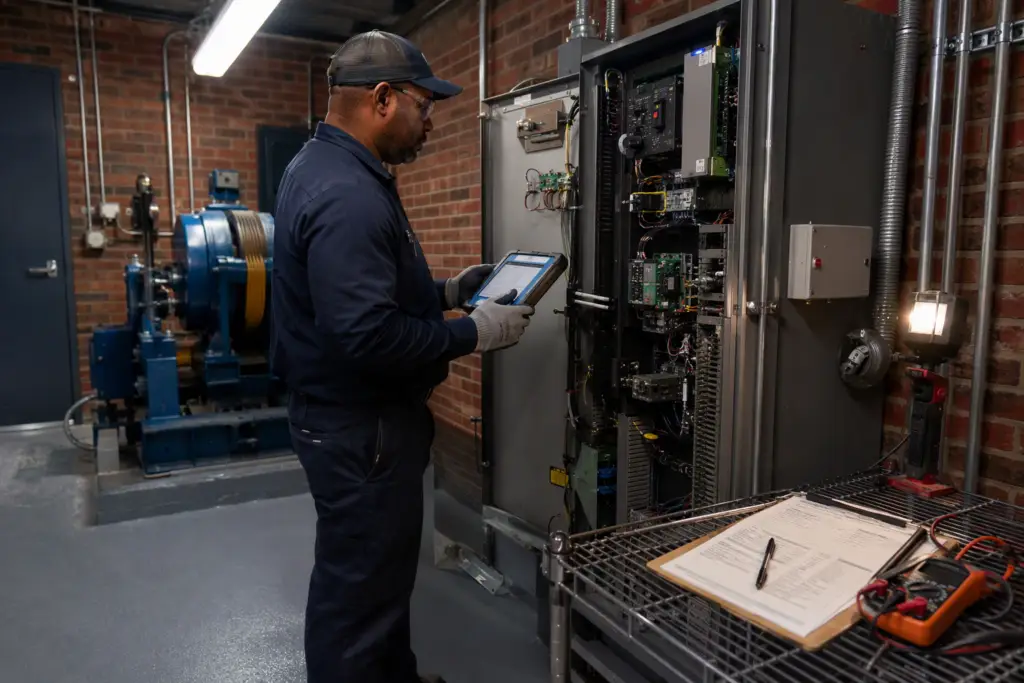
What OSHA Requirements Apply to Elevator Machine Rooms and Maintenance Work?
Under OSHA standards, elevator machine rooms and maintenance activities are subject to several workplace safety requirements that building owners must support through facility management practices:
- Lockout/Tagout (LOTO): Energy control procedures must be in place before any maintenance work on elevator equipment. Building management must not interfere with or remove lockout devices.
- Machine room access control: Machine rooms must be secured against unauthorized entry. Only qualified personnel should have access.
- Adequate lighting and ventilation: Machine rooms must meet OSHA standards for illumination and environmental conditions to protect workers.
- Housekeeping: Machine rooms must be kept free of stored materials, water intrusion, and obstructions to equipment and emergency exits.
Building facility managers bear shared responsibility for maintaining machine room conditions. Deficient machine room conditions can trigger OSHA violations independent of elevator code compliance.
—
What Are the Biggest Compliance Risks for Office Building Elevator Programs?
Based on common AHJ deficiency patterns across the Mid-Atlantic region, the compliance risks most frequently cited for commercial office buildings include:
- Expired operating certificates: Failure to schedule annual inspections on time results in lapsed permits and potential stop-use orders.
- Deferred Category 5 testing: The five-year pressure relief valve and governor test required under ASME A17.1 is frequently delayed, creating accumulated risk and potential code violations.
- ADA maintenance failures: Door timing drift, failed Braille signage, and inoperative audible signals accumulate between inspections when preventive maintenance programs do not include ADA-specific checklist items.
- Inadequate maintenance records: Inspectors and AHJs increasingly require documented maintenance logs. Gaps in records can result in deficiency citations even when physical equipment is in good condition.
- Machine room condition violations: Storage in machine rooms, water intrusion, and inadequate lighting are among the most common correctable violations cited during inspections.
- Unaddressed ASME A17.3 retrofits: Existing elevators may trigger retroactive safety requirements under ASME A17.3 when AHJs update their adopted code edition. Building managers who are unaware of the current edition in their jurisdiction risk operating out of compliance.
—
Why Should Office Buildings Choose Quality Elevator Company for Compliance Management?
Quality Elevator Company is a certified elevator service provider with dedicated operations across Maryland, Washington DC, Virginia, and Pennsylvania. As an independent (non-OEM) contractor, Quality Elevator Company serves buildings with multiple elevator brands under a single maintenance relationship — eliminating the coordination burden that arises when buildings rely on multiple OEM service agreements.
Quality Elevator Company’s compliance management approach includes:
- Coordination of AHJ inspections and operating permit renewals across all four jurisdictions
- Preventive maintenance programs structured to ASME A17.1 maintenance requirements
- ADA accessibility verification integrated into routine maintenance visits
- Documented maintenance recordkeeping to support inspection and legal due diligence
- Modernization assessment and project management for buildings with aging equipment subject to ASME A17.3 retroactive requirements
—
Take the Next Step: Protect Your Building’s Compliance and Tenant Safety
Office building elevator compliance in Maryland, DC, Virginia, and Pennsylvania is complex — but it does not have to be unmanaged. Quality Elevator Company provides comprehensive maintenance programs, inspection coordination, and ADA compliance support tailored to commercial office properties across the Mid-Atlantic region.
Contact Quality Elevator Company for a free elevator assessment.
301-779-9116
Need elevator service you can rely on? Quality Elevator Company is ready to help.