How Fast Can an Elevator Be Repaired? Complete FAQ Guide for Building Owners
After 15 years of diagnosing and repairing elevators across Baltimore, Washington DC, Philadelphia, and Richmond, I’ve answered this question hundreds of times. Building managers want certainty. Tenants want their elevator back. And everyone wants a straight answer about how long they’ll be dealing with an “Out of Service” sign. This comprehensive FAQ breaks down every factor that influences elevator repair timelines — from a tripped breaker to a full controller replacement — so you know exactly what to expect.
How Fast Can a Typical Elevator Be Repaired?
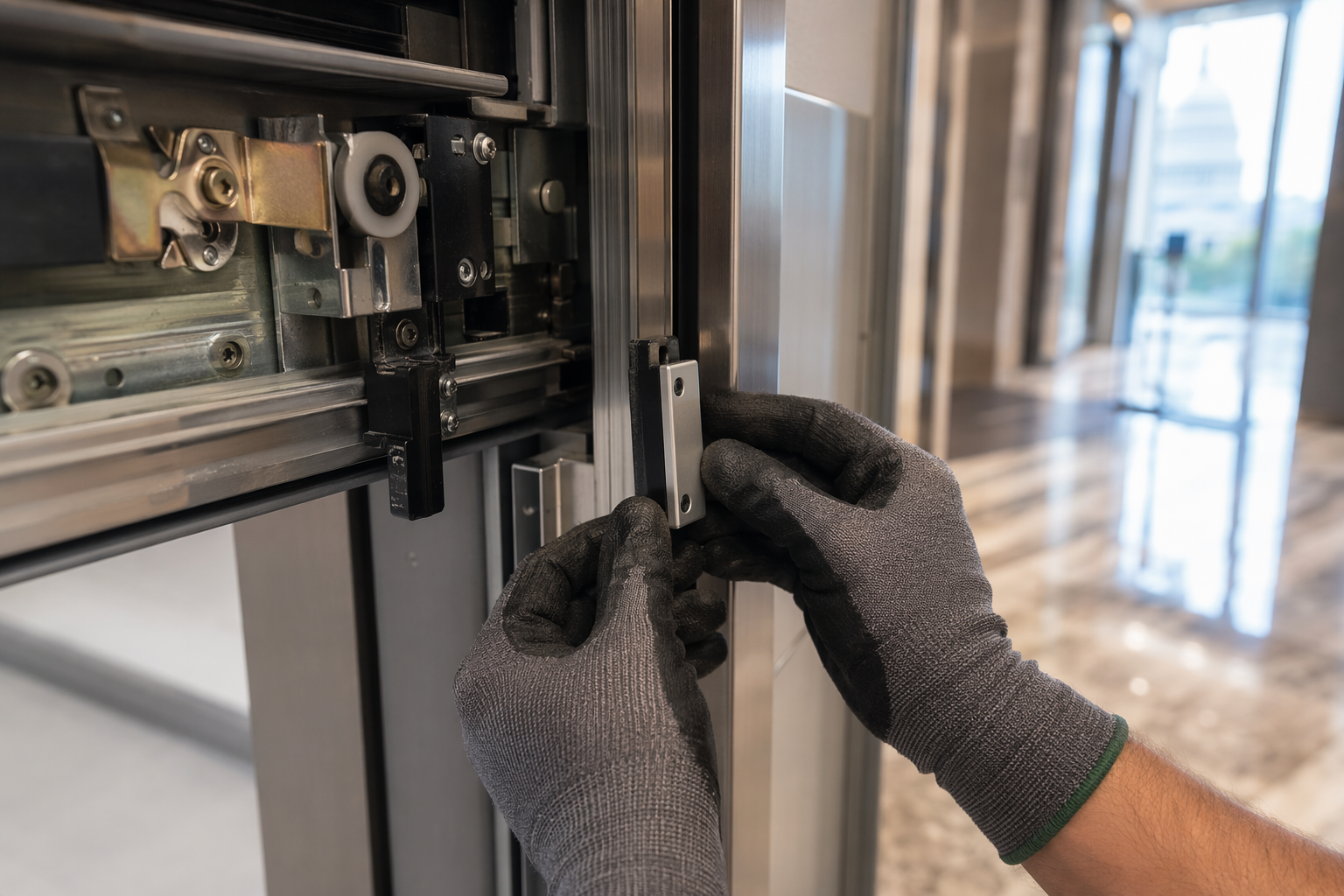
The majority of elevator service calls are resolved the same day, with technicians completing repairs in 2 to 8 hours for the most common issues.
In my experience, roughly 65% of all service calls involve issues that a certified technician can diagnose and resolve within a single visit: door operator malfunctions, door contact problems, minor hydraulic leaks, tripped safety circuits, or burned-out lighting components. These repairs are fast because the parts are standard and technicians carry them on their trucks.
The remaining 35% of repairs require parts that must be ordered — and that’s where timelines stretch from days into weeks. A hydraulic jack replacement, for example, can take 3 to 10 business days just for the part to arrive, followed by a full-day installation. A proprietary controller for an older Otis or Schindler unit can take 4 to 6 weeks if the manufacturer is backordered.
What Are the Most Common Elevator Repairs and How Long Do They Take?

Door-related issues are the single most frequent repair category, typically resolved in 1 to 3 hours on-site.
Below is a benchmark data table drawn from service records and industry averages for the Mid-Atlantic region (2026 data):
| Repair Type | Average Repair Time | Parts Commonly in Stock | Average Cost Range |
|---|---|---|---|
| Door operator adjustment | 1–2 hours | Yes | $150–$400 |
| Door contact / sensor replacement | 1–3 hours | Yes | $200–$600 |
| Safety circuit reset / diagnosis | 1–4 hours | Yes | $175–$500 |
| Hydraulic fluid leak repair | 2–6 hours | Usually | $400–$1,200 |
| Motor starter / contactor replacement | 3–6 hours | Often | $500–$1,800 |
| Controller board replacement | 4–12 hours | Rarely | $1,500–$8,000 |
| Hydraulic jack replacement | 1–3 days | No (must order) | $3,000–$12,000 |
| Traction drive motor replacement | 2–5 days | No (must order) | $4,000–$15,000 |
| Full controller modernization | 3–7 days | No (must order) | $15,000–$40,000 |
| Wire rope / hoist cable replacement | 1–2 days | No (must order) | $2,000–$8,000 |
What Factors Determine How Quickly an Elevator Can Be Repaired?
Five primary variables control elevator repair speed: parts availability, elevator age, technician certification level, local code requirements, and whether the building has an active maintenance contract.
Parts availability is the single biggest variable. A modern elevator with a common platform — such as an Otis Gen2 or Schindler 3300 — will have parts available within 24 to 48 hours in most Mid-Atlantic markets. A 30-year-old hydraulic unit with a proprietary controller can turn a 4-hour repair into a 6-week wait.
Elevator age matters enormously. Units installed before 1995 frequently require custom-fabricated components or refurbished parts, which adds lead time. Buildings in Baltimore’s historic commercial districts and DC’s older office stock are especially prone to this challenge.
Finally, buildings with a preventive maintenance contract through a provider like Quality Elevator Company typically experience faster repairs because technicians are already familiar with the unit, parts are sometimes pre-stocked, and service calls are prioritized on the dispatch schedule.
Does Elevator Type Affect Repair Speed?
Yes — hydraulic elevators and traction elevators have very different repair profiles, with traction elevators generally requiring longer downtime for major component work.
Hydraulic elevators (common in low-rise buildings up to 6 stories) are simpler mechanically. Most hydraulic repairs center on the power unit, jack, or control valve — components that are widely available. The exception is single-bottom hydraulic jacks, which require excavation for replacement and can involve 3 to 5 days of work.
Geared and gearless traction elevators (common in mid- and high-rise buildings) carry more complex drive systems. Machine room-less (MRL) traction units, which are increasingly common in new Philadelphia and DC construction, require specialized tooling and technician training that not every company carries. Quality Elevator Company’s technicians are factory-certified on MRL systems across multiple major manufacturers.
How Does Parts Availability Affect Elevator Repair Timelines?
Parts availability is the single most impactful variable in elevator repair time, with lead times ranging from same-day delivery to 12 weeks for obsolete or proprietary components.
In 2026, global supply chain conditions have improved significantly compared to the 2021–2023 disruption period, but specialty elevator components — particularly solid-state relay boards, proprietary EPROM chips, and older AC motor windings — can still carry 4 to 8 week lead times from overseas manufacturers.
Established elevator service companies maintain regional parts inventories that dramatically cut this time. I’ve personally resolved repairs that another company quoted at “3 weeks” by sourcing a compatible part from our inventory within 48 hours. This is one concrete reason why choosing a company with deep regional roots in Baltimore, DC, Philadelphia, and Richmond makes a measurable difference in how fast your elevator is back in service.
What Is Emergency Elevator Repair and How Quickly Can a Technician Arrive?
Emergency elevator service — particularly for entrapments — requires a technician on-site within 1 hour under most state regulations, with many certified companies targeting a 30-minute response window.
Under ASME A17.1/CSA B44 Safety Code for Elevators and Escalators, elevator owners are required to have 24/7 emergency service capability and a means of two-way communication in every elevator cab. An entrapment is always treated as an emergency regardless of time of day.
Maryland, Virginia, Pennsylvania, and DC all enforce this requirement through their respective elevator safety programs. In practice, the response time depends entirely on the service provider’s staffing model. Quality Elevator Company maintains 24/7/365 emergency dispatch across all four of our service markets, with on-call technicians positioned to reach most Baltimore, DC, Philadelphia, and Richmond locations within 30 to 60 minutes.
How Do Local Code Requirements in Maryland, DC, Virginia, and Pennsylvania Affect Repair Timelines?
State and municipal elevator codes can require permit pulls, inspections, or third-party sign-offs before an elevator can be returned to service after certain repairs, adding 1 to 5 business days to the overall timeline.
Here’s how each of our service markets handles major repairs:
- Maryland: The Maryland Department of Labor’s Elevator Safety Unit requires permits for major modifications and a state inspector sign-off before return to service.
- Washington DC: DC’s Department of Consumer and Regulatory Affairs (DCRA) oversees elevator permits and requires licensed contractor filings for significant repairs and modernizations.
- Virginia: The Virginia Department of Labor and Industry administers elevator safety. Major repairs on units covered under the Virginia Elevator Safety Act require inspection before reopening.
- Pennsylvania: The Pennsylvania Department of Labor & Industry’s Bureau of Occupational and Industrial Safety regulates elevator safety, and major repairs require permit documentation and re-inspection.
A certified contractor who files permits daily — rather than periodically — moves through this bureaucratic layer far faster. Our team at Quality Elevator Company files permits routinely across all four jurisdictions, which means we know the current examiner schedules and typical inspection wait times.
What Happens During an Elevator Entrapment and How Long Does Rescue Take?
A passenger entrapment should be resolved within 30 to 90 minutes from the time of the emergency call, assuming the building has an active 24/7 service contract and the monitoring system functions correctly.
The rescue sequence under ASME A17.1 involves: emergency call received → technician dispatched → on-site arrival → machine room access → manual lowering or raising to a landing → door release and passenger egress. In most cases, passengers are not in physical danger during a routine entrapment, but it must still be treated with urgency.
Buildings without a monitoring contract may wait for a tenant to call 911, at which point the fire department responds, followed by a call to an elevator company — a process that can extend passenger wait times to 2 to 3 hours. This is one of the strongest arguments for maintaining a full-service monitoring contract.
Can Elevator Repairs Be Expedited and What Does It Cost?
Yes, elevator repairs can be expedited through after-hours labor, rush parts sourcing, and priority dispatch — typically at a cost premium of 25% to 75% above standard rates.
After-hours and weekend labor carries overtime billing. Rush parts orders via air freight from manufacturers can add $200 to $1,500 to a parts cost depending on weight and origin. In some cases, a refurbished or remanufactured part available from a regional supplier can bypass a manufacturer backlog entirely — often at a lower total cost than the rush order.
For buildings where elevator downtime has direct financial consequences — a hotel, a hospital, a high-rise residential building — the cost of expediting is almost always justified. A single day of elevator downtime in a 300-unit residential building can generate dozens of tenant complaints, potential lease-break inquiries, and in some jurisdictions, code violations.
How Does ADA Compliance Affect Elevator Repair Decisions?
Under the Americans with Disabilities Act (ADA) Title III, elevators in multi-story commercial facilities must remain accessible, meaning extended elevator outages in buildings where it is the primary means of access for people with disabilities may trigger legal liability.
ADA Standards for Accessible Design (2010 ADA Standards, Section 407) specify requirements for elevator call buttons, door timing, floor indicators, and cab dimensions. When an elevator that serves as the sole accessible route goes out of service, building owners must provide an equivalent accessible means of access or face potential ADA complaints filed with the Department of Justice.
In my 15 years in the field, I’ve seen building owners in DC and Philadelphia receive formal ADA grievance letters within 48 hours of a prolonged elevator outage. Prioritizing repairs on elevators that serve as the primary accessible route isn’t just good practice — it’s a legal necessity. Quality Elevator Company’s dispatch team flags ADA-critical units for immediate priority response.
How Does Preventive Maintenance Reduce Elevator Repair Time?
Buildings on a structured preventive maintenance program experience 40% to 60% fewer unplanned outages and, when breakdowns do occur, they are typically resolved 30% to 50% faster due to technician familiarity with the unit.
Preventive maintenance under ASME A17.1 guidelines means systematic lubrication, adjustment, inspection, and testing of all safety components on a defined schedule — monthly, quarterly, and annually. Technicians who maintain a unit regularly recognize abnormal wear patterns before they become failures. They know the unit’s history, its quirks, and which components are approaching end of life.
Reactive-only maintenance — fixing things only when they break — is almost always more expensive on a per-year basis than a structured PM program. And more importantly, it means your elevator goes down at the worst possible times: during peak building occupancy, on weekends, or during winter when technician availability is already compressed.
What Is the Average Elevator Repair Cost and How Does It Relate to Downtime?
Average elevator repair costs in 2026 range from $200 for a minor adjustment to over $40,000 for a full modernization, and the cost of downtime — in lost productivity, tenant dissatisfaction, and potential ADA liability — often exceeds the repair cost itself.
For commercial buildings in Baltimore, DC, Philadelphia, and Richmond, elevator downtime carries real economic consequences. A law firm on the 12th floor can’t easily relocate. A retail tenant loses foot traffic. A hotel guest writes a review. The hidden cost of a 3-day elevator outage in a 100,000 square foot office building has been estimated at $8,000 to $25,000 in productivity loss and tenant management time — well above the cost of most repairs.
This is the business case for emergency repair contracts: paying a predictable monthly fee for guaranteed response times and labor coverage is cheaper than the unbudgeted cost of an uncontrolled major breakdown.
How Long Do Elevator Modernizations Take Compared to Repairs?
Elevator modernizations — replacing major systems such as controls, drives, or door operators — typically take 2 to 8 weeks depending on scope, compared to hours or days for standard repairs.
A full modernization involves engineering specifications, equipment procurement, permit filing, phased installation (usually floor-by-floor in multi-elevator buildings to maintain partial service), and final inspection. A controller-only modernization on a mid-size hydraulic unit typically runs 3 to 5 days of installation time after a 3 to 6 week parts lead time.
Buildings with multiple elevators can manage modernization with significantly less disruption by staggering units — keeping at least one elevator in service at all times. Our project management team at Quality Elevator Company builds this sequencing into every modernization proposal we deliver across our service markets.
When Should a Building Owner Repair vs. Replace an Elevator?
The repair-versus-replace decision hinges on the 50% Rule: when the cost of a repair exceeds 50% of the cost of modernization, or when repair frequency has pushed annual maintenance spend above 8% to 10% of the elevator’s replacement value, replacement is typically the more economical choice.
Additional triggers for replacement include: the elevator was installed before 1990 (controller technology is often obsolete), the unit has experienced 3 or more major failures in 24 months, genuine parts are no longer manufactured, or the unit cannot be brought into compliance with current ASME A17.1 2019 (or later) code without major expenditure.
In Virginia and Maryland, state elevator authorities periodically issue compliance orders requiring upgrades to older equipment — particularly around Phase I and Phase II firefighters’ emergency operations, seismic requirements, and car enclosure standards. A compliance order that requires $20,000 in upgrades on a 35-year-old elevator is often the financial tipping point toward full modernization.
How Can You Tell If an Elevator Needs Emergency Repair vs. Routine Service?
Emergency repair is warranted when the elevator presents a safety hazard — trapped passengers, unusual sounds or smells, erratic movement, or failure to level at landings — while routine service covers gradual performance degradation that doesn’t pose immediate risk.
Specific warning signs that require immediate shutdown and emergency service include: the elevator car not leveling within 1/2 inch of the floor landing (an ASME A17.1 requirement and a trip-and-fall liability), burning smells from the machine room, hydraulic fluid visible outside the pit, abnormal acceleration or deceleration, or any failure of the door reopening device.
Warning signs that indicate upcoming but non-emergency service include: slow door operation, intermittent floor passing, increasing ride roughness, or unusual noise from the machine room. These should be addressed within 1 to 2 weeks but do not require immediate shutdown. Your technician’s judgment is critical here — when in doubt, shut the unit down and call for service.
How Do You Find a Qualified Elevator Repair Technician Quickly?
A qualified elevator repair technician will hold IUEC (International Union of Elevator Constructors) certification or equivalent state licensure, and their employer should be registered with the relevant elevator authority in your state.
In Maryland, technicians must hold a valid elevator mechanic license issued by the Department of Labor. In Virginia, licensure is administered through the Department of Labor and Industry. Pennsylvania and DC have their own registration requirements. Always verify licensure before allowing work to begin — unlicensed repairs can void your certificate of operation and create significant liability.
Response speed matters as much as qualification. A certified technician who can arrive in 30 minutes is more valuable than a marginally cheaper option who shows up tomorrow. When evaluating elevator service providers, ask directly: What is your average response time for emergency calls in my zip code? What is your parts inventory coverage? Do you self-perform work or subcontract?
How Do Elevator Repair Timelines Compare Between Service Providers?
Service provider response times and repair durations vary widely, with proprietary OEM (Original Equipment Manufacturer) contracts often providing faster parts access but at significantly higher labor costs compared to independent certified service companies.
OEM service agreements (Otis, KONE, Schindler, Thyssenkrupp) typically guarantee faster access to manufacturer-specific parts — a real advantage for newer, proprietary units. However, OEM labor rates in the Mid-Atlantic market run 20% to 40% higher than independent certified companies for equivalent work, and their scheduling is often managed through national call centers with less local flexibility.
Independent certified companies with strong regional presence — like Quality Elevator Company, serving Baltimore, DC, Philadelphia, and Richmond — offer competitive response times, manufacturer-trained technicians, and the flexibility to source parts from multiple suppliers. For units older than 10 years, where proprietary parts are less of an advantage, an independent certified company often delivers faster overall service at a lower total cost.
What Documentation Should a Building Owner Receive After an Elevator Repair?
After every elevator repair, building owners should receive a detailed work order describing the fault found, parts replaced (with model and serial numbers), labor hours, and a notation of any code compliance items identified during the visit.
ASME A17.1 and state regulations require that elevator maintenance records be kept on-site and made available to inspectors. In Maryland, DC, Virginia, and Pennsylvania, inspectors routinely request maintenance logs during annual inspections, and gaps in documentation can result in deficiency notices or delayed certificate renewals.
Additionally, if a repair involved any safety device — governor, safeties, buffers, oil buffers — documentation of testing and reset should be included. Quality service companies provide digital work orders within 24 hours of job completion, giving building managers an automatic audit trail for their records.
Does a Building’s Maintenance Contract Affect How Fast Repairs Are Made?
Yes — buildings with comprehensive maintenance contracts consistently receive faster repair response, often 40% to 60% shorter wait times, compared to buildings with no service agreement.
A full-coverage maintenance contract typically includes: monthly or quarterly preventive maintenance visits, 24/7 emergency response with guaranteed arrival windows, parts and labor coverage up to specified limits, and priority dispatch status. Buildings without a contract are dispatched on an availability basis — meaning they go behind contract customers in the queue.
When evaluating contracts, distinguish between “oil and grease” agreements (basic lubrication only, no parts or labor coverage) and full-coverage contracts. A full-coverage contract from a reputable provider costs more monthly but eliminates the unpredictable expense of major repairs and, critically, guarantees response times that protect building occupants and your ADA obligations.
How Can Building Owners Minimize Elevator Downtime in the Future?
The most effective strategies for minimizing elevator downtime are structured preventive maintenance, remote monitoring technology, and a service contract with guaranteed response times — together capable of reducing unplanned outages by up to 70%.
Remote monitoring systems — now standard on most post-2015 elevator controllers — transmit fault codes and operational data in real time to service companies. This allows technicians to diagnose the issue before arriving on-site, arrive with the correct parts, and often complete the repair in a single visit. Buildings without remote monitoring experience an average of 1.4 additional site visits per repair event, adding hours or days to resolution time.
Building operations staff also play a role. Training your maintenance team to recognize early warning signs — door hesitation, unusual leveling behavior, control panel anomalies — and report them immediately creates a faster feedback loop to your service provider. Small issues caught early take hours to fix. The same issues ignored for weeks can take days and cost 10 times as much.
Get Your Elevator Repaired Fast — Contact Quality Elevator Company Today
Whether you’re dealing with an active breakdown, planning preventive maintenance, or evaluating your service contract options, Quality Elevator Company provides certified, rapid-response elevator repair across Baltimore MD, Washington DC, Philadelphia PA, and Richmond VA. Our IUEC-certified technicians carry deep parts inventories, maintain 24/7 emergency dispatch, and file permits daily across all four jurisdictions — so your elevator gets back in service faster than the industry average.
Contact Quality Elevator Company for a free elevator assessment: 301-307-5363
Available 24 hours a day, 7 days a week, 365 days a year for emergency response.
Need elevator service you can rely on? Quality Elevator Company is ready to help.