The question of how long a building can legally operate with a downed elevator touches on building codes, state elevator laws, the Americans with Disabilities Act, landlord-tenant statutes, and local enforcement policy — all at once. This FAQ hub covers every dimension of that question for building owners, property managers, and facility directors operating in Maryland, Washington DC, Pennsylvania, and Virginia.
How Long Can a Building Legally Operate With an Elevator Out of Service Before Fines Begin?
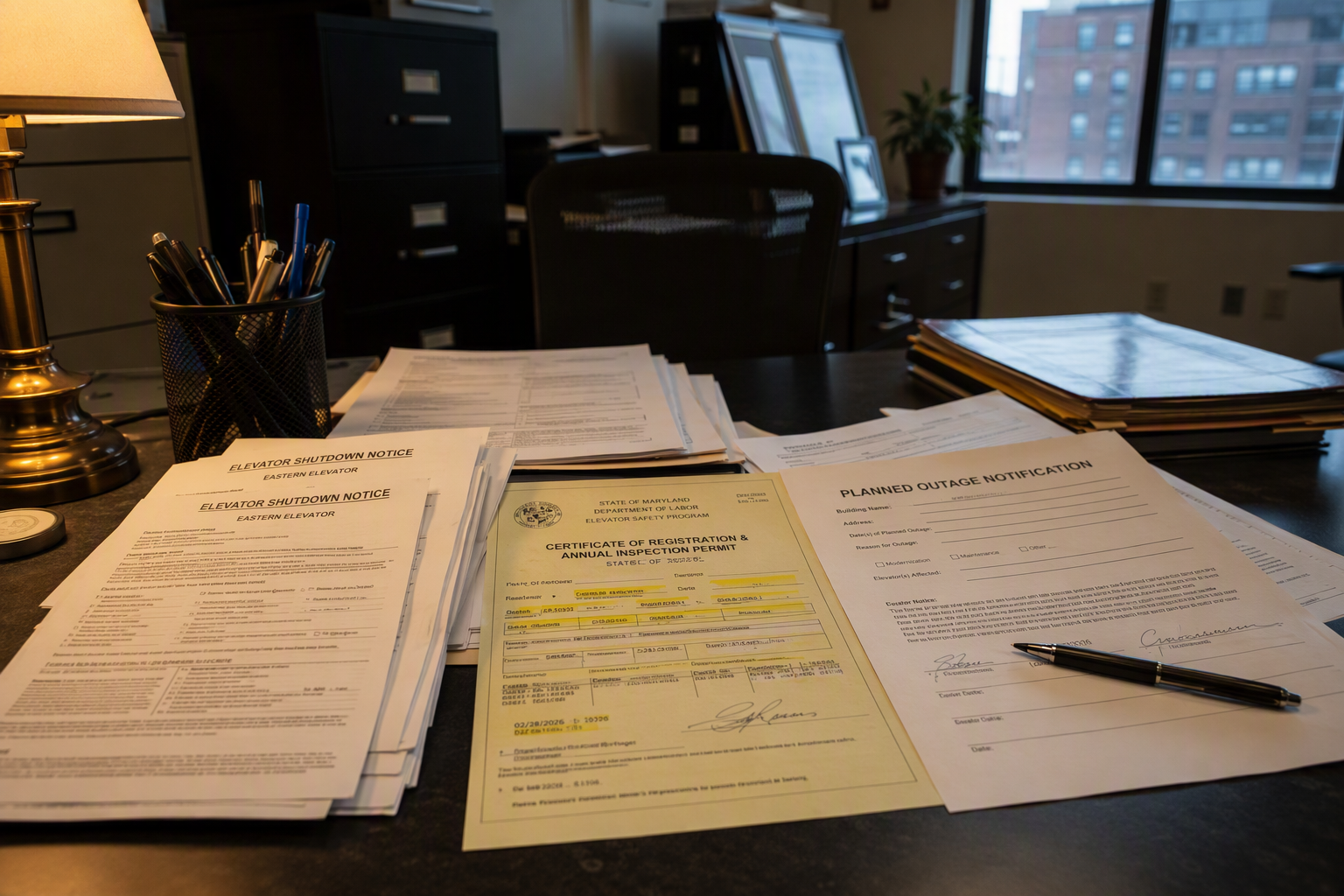
There is no single universal grace period — legal exposure starts immediately upon an unreported outage, and the timeline to formal fines varies by jurisdiction, building type, and whether the owner notified the appropriate authority.
What most building owners do not realize is that the clock does not start when a fine is issued — it starts when the elevator goes out of service. Local elevator inspection authorities, state labor departments, and housing code enforcement agencies can all issue citations independently. In jurisdictions like Washington DC and Philadelphia, housing inspectors have cited building owners within 48 to 72 hours of a reported outage when no remediation plan was on file. The safest legal position is to treat any elevator outage as a compliance event requiring immediate documentation and notification.
What Is the Difference Between a Planned Shutdown and an Emergency Outage?
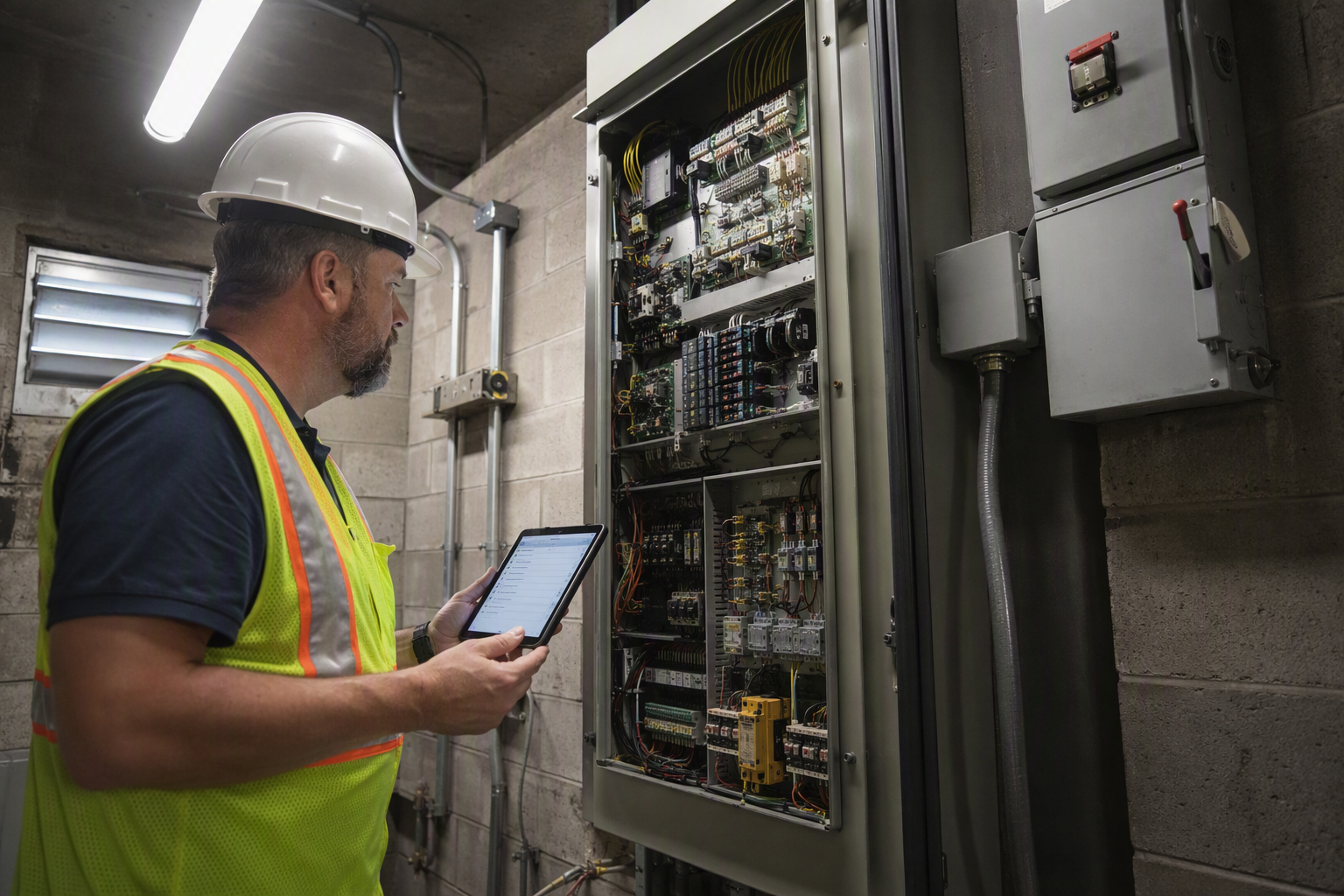
A planned shutdown — one where the building owner notifies the AHJ in advance — typically carries far less immediate legal risk than an unannounced emergency outage that leaves tenants stranded.
When owners schedule modernization, major repairs, or annual maintenance requiring extended downtime, they can file a planned outage notice with the relevant state or local elevator inspection office. This notification creates a paper trail demonstrating good-faith compliance. Emergency outages caused by equipment failure, entrapment events, or safety shutdowns by an inspector are treated differently: enforcement agencies expect prompt notification and a documented repair timeline. Failing to report an emergency outage promptly is one of the fastest paths to code violation notices and daily accumulating fines.
What Federal Laws Govern Elevator Accessibility and Outages?
The Americans with Disabilities Act (ADA) requires that public accommodations and commercial facilities maintain accessible routes, and a broken elevator in a multi-story building can constitute an ADA accessibility failure with its own civil liability exposure.
Title II of the ADA covers government-owned buildings; Title III covers places of public accommodation. Both impose an obligation of program accessibility. An extended elevator outage in a building where elevator access is the only accessible route to upper floors can trigger ADA complaints to the U.S. Department of Justice, private lawsuits, and demand-for-access letters from disability rights organizations. There is no ADA-defined grace period for an inaccessible elevator. Owners are expected to provide equivalent facilitation — such as relocating services to accessible floors — during any outage, even a short one.
Which ASME Code Governs Elevator Safety Standards in These Jurisdictions?
The ASME A17.1 Safety Code for Elevators and Escalators is the foundational technical standard adopted, in varying editions, by Maryland, Washington DC, Pennsylvania, and Virginia.
ASME A17.1 establishes requirements for design, construction, installation, operation, inspection, testing, maintenance, alteration, and repair of elevators. Each state and the District of Columbia adopts specific editions of A17.1 into their elevator safety laws, sometimes with local amendments. The code also governs what constitutes an unsafe condition requiring removal from service. When an inspector places an elevator out of service under ASME A17.1-based authority, returning that elevator to operation without correction and re-inspection is itself a code violation — compounding liability rather than resolving it.
How Do Maryland’s Elevator Laws Affect Buildings in Baltimore?
In Maryland, elevator safety is administered under state law through the Division of Labor and Industry, which has authority to order equipment out of service and impose penalties for non-compliance with its elevator safety regulations.
Baltimore building owners must also comply with Baltimore City Housing Code provisions that address habitability — including functional access to all floors. A broken elevator in a high-rise residential building can trigger housing code complaints to Baltimore City’s Department of Housing and Community Development independently of state elevator enforcement. Residential tenants in Maryland have well-established rights to rent escrow and rent reduction when essential services — including elevator access — are not maintained. Building owners who ignore prolonged elevator outages in Baltimore face layered enforcement from both state elevator inspectors and city housing officials.
What Are the Elevator Compliance Requirements in Washington DC?
Washington DC regulates elevator safety through the DC Department of Consumer and Regulatory Affairs (DCRA), which conducts inspections and has authority to order buildings to correct violations within specified timeframes that can be as short as 24 hours for imminent hazard findings.
DC’s Tenant Bill of Rights and housing regulations also give residential tenants specific remedies when elevator service is impaired, including complaints to the Office of the Tenant Advocate and petitions for rent reduction. DC housing regulations treat elevator service as a required housing service, meaning a prolonged outage in a residential building can constitute a violation of the housing provider’s obligations regardless of the underlying mechanical cause. The combination of DCRA elevator enforcement and tenant protection law makes DC one of the more aggressive enforcement environments in the region.
How Does Pennsylvania Regulate Elevator Outages for Philadelphia Buildings?
In Pennsylvania, elevator safety is governed by the Pennsylvania Uniform Construction Code and the state’s Elevator and Kindred Lifting Appliances Law, administered by the Department of Labor & Industry’s Bureau of Occupational and Industrial Safety.
Philadelphia also enforces the Philadelphia Property Maintenance Code, which independently requires that landlords maintain elevators in residential buildings in good working order. A building owner in Philadelphia who experiences an elevator outage must navigate both the state-level Bureau of Occupational and Industrial Safety for equipment compliance and the city’s Department of Licenses and Inspections for property maintenance compliance. Each agency can issue separate violation notices and fines. The city’s L&I department actively responds to 311 service complaints, meaning tenant-reported outages can trigger inspections within days.
What Are the Elevator Outage Regulations in Richmond, Virginia?
Virginia’s elevator safety program is administered by the Department of Labor and Industry under the Virginia Amusement Device and Elevator Safety Act, and building owners in Richmond must also comply with the City of Richmond’s property maintenance and zoning codes.
Virginia adopts editions of ASME A17.1 with state-specific supplements. When a Virginia-inspected elevator is placed out of service, the owner must contact a licensed elevator contractor — such as Quality Elevator Company — to perform required repairs before reinspection and return to service. Operating an elevator that has been formally taken out of service by a Virginia DOLI inspector without completing that process is a misdemeanor-level violation under state law. Richmond’s residential landlord-tenant obligations further expose owners of multi-unit residential buildings to habitability claims when elevator access is unavailable.
What Is the Typical Timeline From Outage to Formal Fine Across These Four Markets?
The table below summarizes the general enforcement framework across the four markets served by Quality Elevator Company. Specific timelines depend on the nature of the outage, building type, and agency workload — these are structural framework descriptions, not guaranteed enforcement windows.
| Jurisdiction | Primary Enforcement Agency | Residential Tenant Remedy | ADA Exposure | Key Trigger for Formal Action |
|---|---|---|---|---|
| Baltimore, MD | MD Division of Labor & Industry + Baltimore City Housing | Rent escrow, rent reduction | Yes — multi-story public-access buildings | Tenant complaint or failed inspection |
| Washington, DC | DC DCRA + Office of the Tenant Advocate | Rent reduction petition, habitation complaint | Yes — all covered buildings | DCRA complaint; can escalate in 24–48 hrs for hazard |
| Philadelphia, PA | PA Bureau of Occupational & Industrial Safety + City L&I | Property maintenance violation, 311 complaint | Yes — public accommodation buildings | 311 complaint or routine inspection finding |
| Richmond, VA | VA DOLI + Richmond Property Maintenance | Landlord-tenant habitability claim | Yes — covered buildings | Inspector order; criminal exposure for operating after shutdown order |
What Steps Should a Building Owner Take Immediately When an Elevator Goes Out of Service?
Immediate, documented action is the most effective legal and practical protection when an elevator goes out of service — the following protocol applies in all four markets served by Quality Elevator Company.
- Post visible out-of-service notices at every elevator entrance on every floor, stating the date the elevator went out of service and the reason if known.
- Notify the authority having jurisdiction (AHJ) — the relevant state elevator inspection office and, for residential buildings, the local housing authority — in writing within the timeframe their regulations require, typically as soon as practicable.
- Contact a licensed elevator service contractor to assess the cause, document the failure, and provide a written repair scope and estimated timeline.
- Provide equivalent facilitation for tenants or visitors with disabilities — this may include relocating accessible services to ground floor, providing assisted access protocols, or temporarily modifying service delivery.
- Notify tenants in writing of the outage, expected repair duration, and any accommodation measures being taken.
- Document everything — photographs, service call logs, contractor invoices, and all agency correspondence — in a dedicated file for this outage event.
- Schedule and confirm the repair timeline with the licensed contractor in writing, and communicate updates to tenants and the AHJ as the repair progresses.
- Arrange reinspection through the AHJ before returning the elevator to service after repair — operating without a reinspection certificate after a formal shutdown is itself a violation.
How Long Do Elevator Repairs Typically Take, and How Does That Affect Compliance Timelines?
Repair duration depends entirely on the nature of the failure — a controller board replacement may take days, while a major hydraulic system overhaul or cab modernization can take weeks — and documenting the repair timeline with the AHJ is what separates a compliant extended outage from a fined one.
Parts availability is one of the most significant variables in repair timelines, particularly for older equipment where components may need to be sourced from specialty suppliers or manufactured to specification. Building owners should request written documentation from their elevator contractor confirming parts have been ordered, expected delivery dates, and scheduled installation windows. Submitting this documentation proactively to the AHJ demonstrates good-faith effort and is frequently the difference between a warning notice and an accumulating daily fine.
Can Tenants Sue a Building Owner Over an Elevator Outage?
Yes — residential and commercial tenants in all four jurisdictions have legal avenues to pursue claims against building owners for elevator outages that impair their use and enjoyment of the premises or breach the implied warranty of habitability.
In Maryland, DC, Pennsylvania, and Virginia, residential leases carry an implied warranty of habitability. Courts in these jurisdictions have found that prolonged loss of elevator access in a building where stairs are not a practical alternative — particularly for tenants with mobility limitations — can constitute a breach of that warranty. Commercial tenants may have express lease provisions requiring elevator service as a building amenity. Beyond habitability claims, tenants with disabilities who cannot access their units or places of business due to an elevator outage may have independent claims under the ADA or applicable state civil rights laws.
Does the ADA Require Elevators in All Multi-Story Buildings?
No — the ADA does not require elevators in all multi-story buildings, but where an elevator is the only accessible route to program areas or required accessible units, maintaining that elevator in working order is an ADA accessibility obligation.
The ADA exempts new construction of facilities under three stories or with fewer than 3,000 square feet per floor from the elevator requirement, subject to specific exceptions. However, once an elevator exists and serves as the primary or sole accessible route, it falls within the ADA’s maintenance-of-accessible-features obligation. This means a building that chose to install an elevator — even one not strictly required by the ADA — must maintain it in working order for accessible individuals. An extended outage on that elevator can still create Title III or Title II liability even if the original installation was voluntary.
What Constitutes an Unsafe Elevator That Must Be Removed From Service?
Under ASME A17.1 and applicable state codes, an elevator must be removed from service when it poses a risk to the safety of passengers — including conditions such as door malfunctions, control system failures, broken safeties, hydraulic leaks posing fire or slip hazards, and rope or suspension system deficiencies.
Building owners sometimes attempt to continue operating elevators with known deficiencies while awaiting parts or contractor availability. This is legally and practically dangerous. If a passenger is injured on an elevator with a documented, unrepaired safety deficiency, the building owner’s liability exposure expands dramatically. Inspectors and elevator contractors are required under ASME A17.1 to tag and lock out equipment that presents a safety hazard. Operating a locked-out elevator is a criminal offense in most states.
How Often Must Elevators Be Inspected to Remain in Legal Service?
In all four markets served by Quality Elevator Company, elevators must undergo periodic inspections — typically annual or more frequent — by a licensed inspector under the authority of the state elevator safety program and in accordance with inspection and test requirements in ASME A17.1.
Operating an elevator with an expired inspection certificate is itself a compliance violation independent of whether the elevator is functioning correctly. Building owners are responsible for tracking inspection due dates and ensuring inspections are scheduled before current certificates expire. Many properties find it useful to engage a single licensed elevator service company to manage both maintenance contracts and inspection coordination, reducing the risk of administrative lapses that create compliance exposure.
What Are the Workplace Safety Obligations for Elevator Outages in Commercial Buildings?
The Occupational Safety and Health Administration (OSHA) has jurisdiction over workplace conditions, and a broken elevator in a commercial or industrial building can create OSHA-reportable conditions if employees must use unsafe alternative routes or if the elevator failure was caused by an unsafe maintenance practice.
OSHA’s General Duty Clause requires employers to provide a workplace free from recognized hazards. If an elevator outage forces employees to carry heavy materials up multiple flights of stairs — a recognized ergonomic hazard — or if the outage was caused by failed lockout/tagout procedures during maintenance, OSHA citations can follow. Building owners who manage commercial tenants should ensure that any elevator outage notification plan includes the building’s commercial tenants so they can comply with their own OSHA obligations as employers.
How Should Building Owners Communicate With Tenants During an Extended Elevator Outage?
Proactive, written, and frequent communication with tenants during an elevator outage is both a legal best practice and a powerful tool for reducing formal complaints to enforcement agencies — a tenant who receives clear updates is far less likely to file a complaint that triggers an inspection.
Communication should include the initial outage notice (posted physically and sent in writing), a repair timeline update as soon as one is available from the contractor, interim status updates if the timeline changes, notification when the repair is completed, and confirmation that the elevator has passed reinspection. For residential buildings with ADA-accessible units above the ground floor, building management should make direct personal contact with those residents to discuss accommodation options rather than relying solely on posted notices.
What Should Building Owners Look for in an Elevator Service Provider During an Outage?
During an outage, the most critical qualities in an elevator service provider are licensed technician credentials in the applicable state, demonstrated familiarity with the AHJ notification and reinspection process, documented parts sourcing capability, and the ability to provide written repair scopes that meet evidentiary standards for regulatory submissions.
Quality Elevator Company serves building owners across Baltimore, Washington DC, Philadelphia, and Richmond with the technical expertise and regulatory familiarity needed to navigate multi-jurisdiction compliance requirements during an outage. An elevator contractor who understands how each jurisdiction’s AHJ operates — what documentation they require, how they process reinspection requests, and what they consider adequate remediation — can significantly reduce a building owner’s compliance exposure compared to a provider who treats the repair as purely mechanical without regard for the regulatory dimension.
Can Preventive Maintenance Reduce the Risk of Extended Outages and Associated Fines?
Yes — a documented, properly executed preventive maintenance program is the single most effective risk management tool available to building owners for reducing both the frequency and duration of elevator outages and their associated compliance and liability exposure.
Under ASME A17.1, equipment owners are responsible for ensuring that maintenance is performed according to code requirements. A preventive maintenance agreement with a licensed contractor like Quality Elevator Company creates documented evidence of compliance that is valuable in regulatory proceedings, insurance claims, and tenant disputes. Maintenance logs showing regular inspection, lubrication, adjustment, and parts replacement demonstrate that the building owner exercised reasonable care — a significant factor in both regulatory enforcement decisions and civil litigation outcomes. Buildings with active maintenance agreements also benefit from earlier detection of developing component failures, reducing the likelihood of sudden outages and the compressed timelines they create.
What Should a Building Owner Do If They Disagree With an Inspector’s Order to Take an Elevator Out of Service?
Every state elevator safety program has an appeal or variance process — but invoking that process does not automatically stay the out-of-service order, and attempting to operate a locked-out elevator during an appeal is a separate violation.
Building owners who believe an out-of-service order was issued in error should immediately contact a licensed elevator service contractor to document the elevator’s actual condition independently. They should then engage the AHJ’s formal appeal process, which typically involves submitting a written objection or variance request with supporting technical documentation. An experienced elevator contractor can provide the technical affidavit or engineering documentation the appeals process requires. During this period, the elevator should remain out of service unless the AHJ explicitly grants a temporary operating permit. Quality Elevator Company can assist building owners in preparing the technical documentation required for compliance appeals in all four markets it serves.
Get Expert Help Now: Free Elevator Assessment From Quality Elevator Company
If your building has an elevator currently out of service — or if you want to get ahead of the compliance exposure described throughout this guide — the next step is a professional assessment from a licensed, experienced elevator service provider who knows the regulatory landscape in Baltimore, Washington DC, Philadelphia, and Richmond.
Quality Elevator Company provides comprehensive elevator assessments that document current equipment condition, identify code compliance gaps, coordinate with the authority having jurisdiction, and develop repair timelines designed to minimize your legal exposure and get your building’s elevator back in service as quickly as possible.
Contact Quality Elevator Company for a free elevator assessment: 301-779-9116
Serving building owners, property managers, and facility directors throughout Baltimore MD, Washington DC, Philadelphia PA, and Richmond VA.
Need elevator service you can rely on? Quality Elevator Company is ready to help.