To transfer or renegotiate an elevator maintenance contract when taking over building management, request a copy of the existing agreement immediately, review its assignment and termination clauses, notify the current elevator contractor in writing, and use the transition period to solicit competing bids — ideally before assuming formal management responsibility.

How to Transfer or Renegotiate an Elevator Contract When Taking Over Building Management
Assuming management of a building means inheriting its elevator service agreements — often without knowing what those contracts actually say. Elevator maintenance contracts are legally binding documents that govern equipment safety, regulatory compliance, and operational liability. Getting them right from day one protects the building, its occupants, and the incoming management company. This FAQ hub covers every aspect of the transition process, from reading the fine print to negotiating better terms and ensuring continuous compliance with ASME A17.1 Safety Code for Elevators and Escalators and applicable state and local regulations.
What should I do first when I take over a building that has an existing elevator contract?

Request a complete copy of the existing elevator maintenance contract from the outgoing manager or building owner before your management responsibilities formally begin.
Time is critical at transition. Incoming property managers should request all elevator-related documentation at the earliest opportunity — ideally during due diligence, before the management agreement is signed. Documentation to collect includes the full maintenance contract, all addenda or amendments, the most recent inspection certificates, violation notices, maintenance logs, and any open permits. These records establish the baseline condition of the equipment and the legal obligations that may transfer with the building.
Failure to obtain these records immediately can result in inheriting unresolved violations, lapsed inspection certificates, or auto-renewal clauses that lock the incoming manager into unfavorable terms for another multi-year cycle.
Can an elevator maintenance contract be legally assigned to a new property management company?
Whether a contract can be assigned depends entirely on the assignment clause within the agreement — many elevator contracts prohibit assignment without the contractor’s written consent.
Most commercial elevator service agreements include an “anti-assignment” clause stating that neither party may transfer the contract to a third party without mutual written consent. When a management company changes, the contract technically remains between the building owner and the elevator contractor. If the owner is not changing — only the management agent — the new manager typically steps into the owner’s existing relationship, but this should be confirmed in writing with the contractor. If ownership is also transferring, a formal contract novation (replacing one party with another) or a new standalone agreement may be required. Engaging a real estate attorney to review the assignment language before closing is strongly advisable.
What clauses in an elevator contract should incoming managers review most carefully?
The four clauses that most directly affect a new manager’s flexibility are the term and auto-renewal clause, the termination-for-convenience provision, the scope-of-service definition, and the liability and indemnification language.
The term and auto-renewal clause specifies how long the agreement runs and whether it renews automatically — often by 30, 60, or 90 days’ written notice before the anniversary date. Missing this window can trap the building in another full contract cycle. The termination-for-convenience provision (if one exists) outlines any penalties or liquidated damages for early exit. The scope-of-service definition determines what maintenance tasks are included versus billed separately, which has a direct impact on budget planning. The liability and indemnification language allocates responsibility for elevator-related injuries or code violations — something no incoming manager should inherit without careful legal review.
How much advance notice is typically required to terminate or modify an elevator service contract?
Most elevator maintenance contracts require written notice of termination or non-renewal between 30 and 90 days before the contract anniversary or expiration date, though specific terms vary by agreement.
Because notice windows vary so widely — and because missing them has significant financial consequences — incoming managers should calendar the notice deadline immediately after receiving the contract. If the contract is already past the notice window and has auto-renewed, the building may be committed for another full term. In that case, negotiating an early termination settlement with the current contractor, or negotiating improved terms for the remaining period, becomes the practical path forward.
What is the process for renegotiating an elevator contract with an existing contractor?
Renegotiating an elevator contract involves a structured process of documenting existing service gaps, obtaining competitive bids, and presenting a formal proposal to the incumbent contractor with specific, measurable changes requested.
- Obtain and read the full existing contract, noting term dates, renewal deadlines, and scope limitations.
- Audit the current equipment condition by requesting maintenance logs and reviewing any open violations or outstanding inspection certificates.
- Identify specific deficiencies in the current service — missed maintenance visits, unresolved callbacks, slow response to outages, or excessive exclusions in the scope.
- Solicit at least two to three competing bids from qualified, licensed elevator contractors in your market so you have a credible benchmark for pricing and scope.
- Prepare a written renegotiation proposal to the incumbent contractor listing the specific terms you want changed — scope inclusions, pricing adjustments, performance guarantees, and reporting requirements.
- Negotiate in writing rather than verbally, so all agreed changes can be incorporated into a formal contract amendment.
- Have any amended agreement reviewed by legal counsel before signing.
Property managers in Baltimore, Washington DC, Philadelphia, and Richmond should be aware that local market conditions affect what terms are achievable. Quality Elevator Company can provide a no-obligation assessment that gives incoming managers a concrete benchmark for evaluating whether their existing agreement reflects current market standards.
What happens to elevator compliance and inspections during a management transition?
Elevator inspection and compliance obligations do not pause during a management transition — the building remains legally responsible for maintaining valid inspection certificates and resolving any open violations throughout.
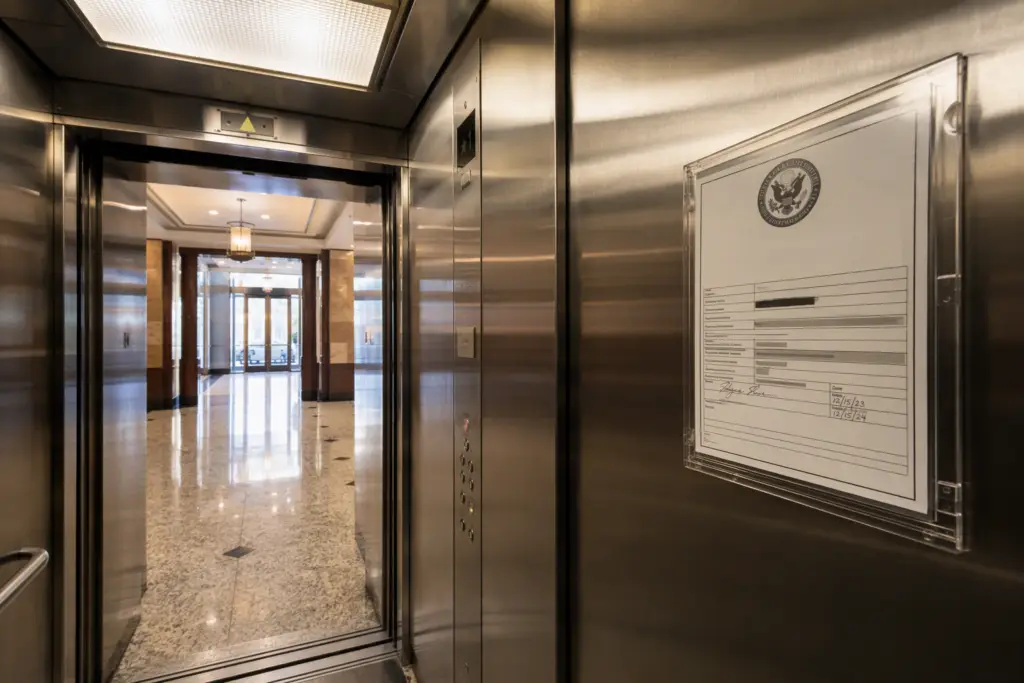
In Maryland, Virginia, Pennsylvania, and Washington DC, elevators must be inspected at intervals defined by state and local authority. Inspections are performed by third-party inspectors or jurisdictional inspectors, not by the elevator maintenance contractor. The contractor’s role is to ensure the equipment is in a condition that will pass inspection and to address any deficiencies identified. Incoming managers should verify that current inspection certificates are posted in the elevator cab as required, and that no active violations exist with the relevant jurisdiction. Unresolved violations become the new manager’s liability the moment management responsibility transfers.
All safety requirements derive from the ASME A17.1 Safety Code for Elevators and Escalators, which most jurisdictions adopt by reference into their local codes.
What are the different types of elevator maintenance contracts and which is best for a new manager?
Elevator maintenance contracts generally fall into four categories — oil-and-grease, parts-included, full-maintenance, and modernization — and the right choice depends on equipment age, budget, and the incoming manager’s risk tolerance.
| Contract Type | What Is Included | Best For | Risk to Manager |
|---|---|---|---|
| Oil & Grease (Basic) | Lubrication and minor adjustments only; parts and labor billed separately | New equipment under manufacturer warranty | High — major repairs are unpredictable expenses |
| Parts-Included | Routine maintenance plus most replacement parts; major components excluded | Mid-age equipment in good condition | Moderate — large component failures still billable |
| Full-Maintenance (Comprehensive) | All labor, parts, callbacks, and minor repairs; major structural items may be excluded | Older equipment or managers seeking budget predictability | Low — most costs are fixed |
| Modernization-Inclusive | Full maintenance plus a capital reserve or scheduled upgrade scope | Buildings planning equipment upgrades | Low operational risk; requires higher monthly commitment |
For incoming managers who do not yet have a clear picture of equipment condition, a full-maintenance contract offers the most budget predictability while the manager gets up to speed. Quality Elevator Company works with incoming managers throughout the Baltimore, Washington DC, Philadelphia, and Richmond markets to identify which contract structure fits both the equipment age and the management company’s risk profile.
How do ADA requirements affect elevator contracts and what must a new manager verify?
The Americans with Disabilities Act (ADA) requires that elevators in multi-story buildings open to the public remain operational and accessible — meaning maintenance contracts must provide for prompt restoration of service when an elevator serving disabled individuals is out of service.
Incoming managers should verify that the existing or new maintenance contract includes explicit response-time commitments for outages affecting accessibility. The ADA does not specify a numeric response-time standard for elevator repairs, but extended outages that effectively deny access to people with disabilities can constitute an ADA violation. The maintenance contract should also specify that the contractor is responsible for ensuring that cab controls meet ADA height and braille requirements, and that any replacement components installed during the contract term maintain ADA compliance. Building managers should document all outages and contractor response activity as part of their ADA compliance recordkeeping.
What state-specific elevator regulations apply in Maryland, Virginia, Pennsylvania, and Washington DC?
Each jurisdiction served by Quality Elevator Company operates under its own elevator safety program, and incoming managers must verify compliance with the specific authority having jurisdiction (AHJ) for their building’s location.
Maryland regulates elevator safety through the Division of Labor and Industry. Virginia elevator safety is administered through the Virginia Department of Labor and Industry. Pennsylvania operates its elevator inspection program through the Pennsylvania Department of Labor and Industry’s Bureau of Occupational and Industrial Safety. Washington DC elevator inspections fall under the DC Department of Buildings. All four jurisdictions adopt versions of ASME A17.1 as the baseline safety standard, though each may adopt different editions or local amendments. Incoming managers should contact the relevant AHJ directly to confirm which code edition is currently enforced and whether the building’s equipment meets that standard.
Should a new manager conduct an independent elevator audit before signing any contract?
Yes — an independent elevator condition assessment before signing or renewing any contract is one of the most valuable steps an incoming manager can take, because it reveals equipment deficiencies that affect both maintenance costs and negotiating leverage.
An independent assessment — performed by a qualified elevator contractor with no stake in the existing agreement — evaluates the mechanical and electrical condition of the equipment, identifies any deferred maintenance or code deficiencies, and provides an objective basis for evaluating what contract type and pricing are appropriate. This assessment also documents the baseline condition of the equipment at the time of management transition, which protects the incoming manager if the departing contractor later claims that damage or deficiencies arose after the transition. Quality Elevator Company offers free elevator assessments for incoming managers in Baltimore, Washington DC, Philadelphia, and Richmond.
What performance standards and service level requirements should be included in a new elevator contract?
A well-written elevator maintenance contract should include defined preventive maintenance visit frequencies, maximum entrapment response commitments, callback limits, and mandatory reporting requirements.
Preventive maintenance frequency should be specified — monthly visits are standard for moderate-to-high-use commercial elevators. Entrapment response is a life-safety matter and should be explicitly addressed in the contract. Callback limits define how many unscheduled service calls are included before additional charges apply. Mandatory reporting requirements should obligate the contractor to provide written maintenance logs after every visit, document all parts replaced, and notify management immediately of any condition that could affect safety or inspection compliance. Contracts that lack these provisions leave managers without recourse when service quality declines.
How long does it typically take to transition from one elevator contractor to another?
A contractor transition typically takes between 30 and 90 days from the decision to switch through full transfer of records, key exchange, and assumption of maintenance responsibility by the new contractor.
The timeline is driven primarily by the notice period in the existing contract and the new contractor’s onboarding process. During the transition period, the outgoing contractor remains obligated to maintain service under the existing agreement. The incoming contractor should conduct a thorough equipment review before the effective start date so there are no surprises after the handoff. Key items that must transfer include all keys and access tools, maintenance logs, wiring diagrams, equipment serial numbers and specifications, and outstanding permit or inspection records. Incomplete record transfer is one of the most common sources of disputes between outgoing and incoming contractors.
What records must an outgoing elevator contractor provide at contract end?
At contract termination, the outgoing elevator contractor must return all proprietary and non-proprietary items needed for another contractor to assume maintenance — including maintenance logs, wiring diagrams, keys, and any equipment documentation supplied by the original equipment manufacturer.
Some contractors attempt to withhold proprietary controller codes or software access as leverage to retain the account. Whether they are entitled to do so depends on the contract language. Incoming managers and their legal counsel should ensure that the contract — or any termination negotiation — explicitly requires the return of all such materials. OSHA regulations at OSHA.gov address equipment safety recordkeeping obligations that are relevant when maintenance history is incomplete. Gaps in maintenance records can also complicate insurance claims and regulatory inspections.
What are common red flags in an inherited elevator contract that signal poor terms?
Common red flags include automatic multi-year renewals with short notice windows, broad exclusions for parts and callbacks, unilateral price escalation clauses, and vague or absent performance standards.
Contracts that renew automatically for two or three years unless cancelled within 30 days are particularly problematic for incoming managers who may not identify the renewal deadline in time. Price escalation clauses that allow the contractor to raise rates unilaterally — without a defined cap or index — expose the building to unpredictable cost increases. Broad exclusions that classify most parts as “non-standard” shift financial risk heavily to the building. Incoming managers should treat any contract that lacks defined service visit frequencies and entrapment response language as a contract that needs immediate renegotiation or replacement.
How should a competitive bid process for elevator maintenance be structured?
A competitive bid process for elevator maintenance should include a written scope of work, equipment data, a site walk for each bidder, and standardized response requirements so that bids can be compared on equal terms.
- Prepare a written Request for Proposal (RFP) that includes building address, elevator count, equipment manufacturer and model, approximate age, current inspection status, and required contract type.
- Include a defined scope of work specifying minimum maintenance visit frequency, entrapment response expectations, reporting requirements, and any known deficiencies.
- Invite a minimum of three qualified, licensed elevator contractors to submit proposals.
- Schedule a site walk so each bidding contractor can inspect the equipment directly — this prevents post-award disputes about equipment condition.
- Require standardized bid responses that break out monthly maintenance cost, parts inclusions and exclusions, and any additional fees.
- Evaluate bids on total cost of ownership, not just monthly rate — a lower monthly rate with broad exclusions may cost more overall.
- Check references from comparable properties managed by each bidding contractor.
What questions should a new property manager ask an elevator contractor before signing a new agreement?
Before signing any elevator maintenance agreement, a new property manager should ask about the contractor’s licensing status in the relevant jurisdiction, the qualifications of the technicians who will service the equipment, and the contractor’s process for managing code violations and inspection failures.
Specific questions should include: How frequently will preventive maintenance visits occur, and will they be documented in writing? What parts are explicitly included versus excluded from the monthly fee? What is the process when equipment fails inspection — who is responsible for correction costs? How are after-hours entrapment calls handled? What notice is required to terminate the agreement, and under what conditions? Is the contract assignable if the building ownership changes? How are annual price adjustments calculated? Getting written answers to these questions before signing prevents ambiguity that invariably arises later.
How does building ownership change affect elevator contracts differently from management company change?
A change of building ownership is a more significant legal event than a management company change, because ownership transfers may trigger contract novation requirements or give the contractor grounds to renegotiate the entire agreement.
When a building is sold, the elevator maintenance contract is typically an assumed liability that transfers with the property unless the purchase agreement specifies otherwise. Buyers should review all elevator contracts during due diligence and negotiate representations from the seller that no violations, unresolved callbacks, or missed inspections exist. If the contract contains an anti-assignment clause, the contractor’s written consent to the transfer should be obtained before closing. In some cases, buyers use the ownership transition as an opportunity to put the elevator maintenance contract out to competitive bid, particularly if the existing agreement is unfavorable or if equipment is approaching the age where modernization decisions need to be made.
What modernization obligations might a new manager discover when reviewing an inherited elevator?
Older elevator equipment may be subject to mandatory modernization requirements under local code adoption timelines, ADA accessibility standards, or safety directives issued by the authority having jurisdiction.
Many jurisdictions have enacted mandatory upgrades for hydraulic elevator units containing older oil formulations, or have issued safety bulletins requiring upgrades to door safety devices, pit lighting, or emergency communication systems. The ASME A17.1 Safety Code for Elevators and Escalators is updated on a regular cycle, and jurisdictions that adopt newer editions may impose retroactive requirements on existing equipment. An incoming manager who discovers that a building’s elevator requires mandatory modernization should factor the cost into budget planning and determine whether the existing maintenance contract addresses modernization at all — most basic contracts do not.
How should elevator contract transitions be documented to protect the incoming manager from liability?
Incoming managers should create a contemporaneous written record of every step in the contract transition process, including the condition of equipment at handoff, the status of inspections and violations, and all communications with the outgoing contractor.
A transition documentation file should include a copy of the existing contract and all amendments, written confirmation of the notice of termination or assignment, a summary of the independent equipment assessment conducted at transition, copies of current inspection certificates and any open violation notices, all maintenance logs received from the outgoing contractor, and a written record of any outstanding issues acknowledged by the outgoing contractor. This file protects the incoming manager in the event of a liability claim related to an elevator incident that pre-dates their management period, and it establishes the baseline against which future maintenance performance can be measured.
When is it better to renegotiate the existing contract versus switching to a new elevator contractor?
Renegotiation with the incumbent contractor is generally preferable when the equipment and service history are satisfactory but contract terms are unfavorable; switching contractors is preferable when service quality, equipment condition, or contractor responsiveness has been consistently poor.
Continuity of service provider has real operational value — a contractor familiar with a building’s specific equipment can often resolve issues faster and with fewer errors. However, that familiarity does not justify below-standard service or uncompetitive pricing. Incoming managers should approach renegotiation armed with competing bids and a documented list of service deficiencies. If the incumbent contractor declines to improve terms or address documented shortcomings, transitioning to a new contractor is often the more prudent course. Quality Elevator Company routinely assists incoming managers across Baltimore, Washington DC, Philadelphia, and Richmond in evaluating whether their existing service relationship merits renegotiation or replacement.
Get Expert Guidance on Your Elevator Contract Transition
Taking over building management means making critical decisions about elevator maintenance quickly and correctly. Quality Elevator Company provides free elevator assessments for incoming property managers throughout Baltimore MD, Washington DC, Philadelphia PA, and Richmond VA — giving you an objective evaluation of equipment condition and existing contract terms so you can negotiate from a position of knowledge.
Contact Quality Elevator Company for a free elevator assessment: 301-779-9116
Need elevator service you can rely on? Quality Elevator Company is ready to help.