Elevator Breakdown Immediate Response: Complete FAQ Guide
An elevator breakdown demands a coordinated, step-by-step response from passengers, building staff, and a licensed elevator service provider. This FAQ hub covers every dimension of elevator breakdown response — from the first seconds of entrapment to code-compliant repairs, vendor selection, and long-term prevention — serving building owners, property managers, and facilities teams in Baltimore MD, Washington DC, Philadelphia PA, and Richmond VA.
What Is the Immediate Response Protocol When an Elevator Breaks Down?
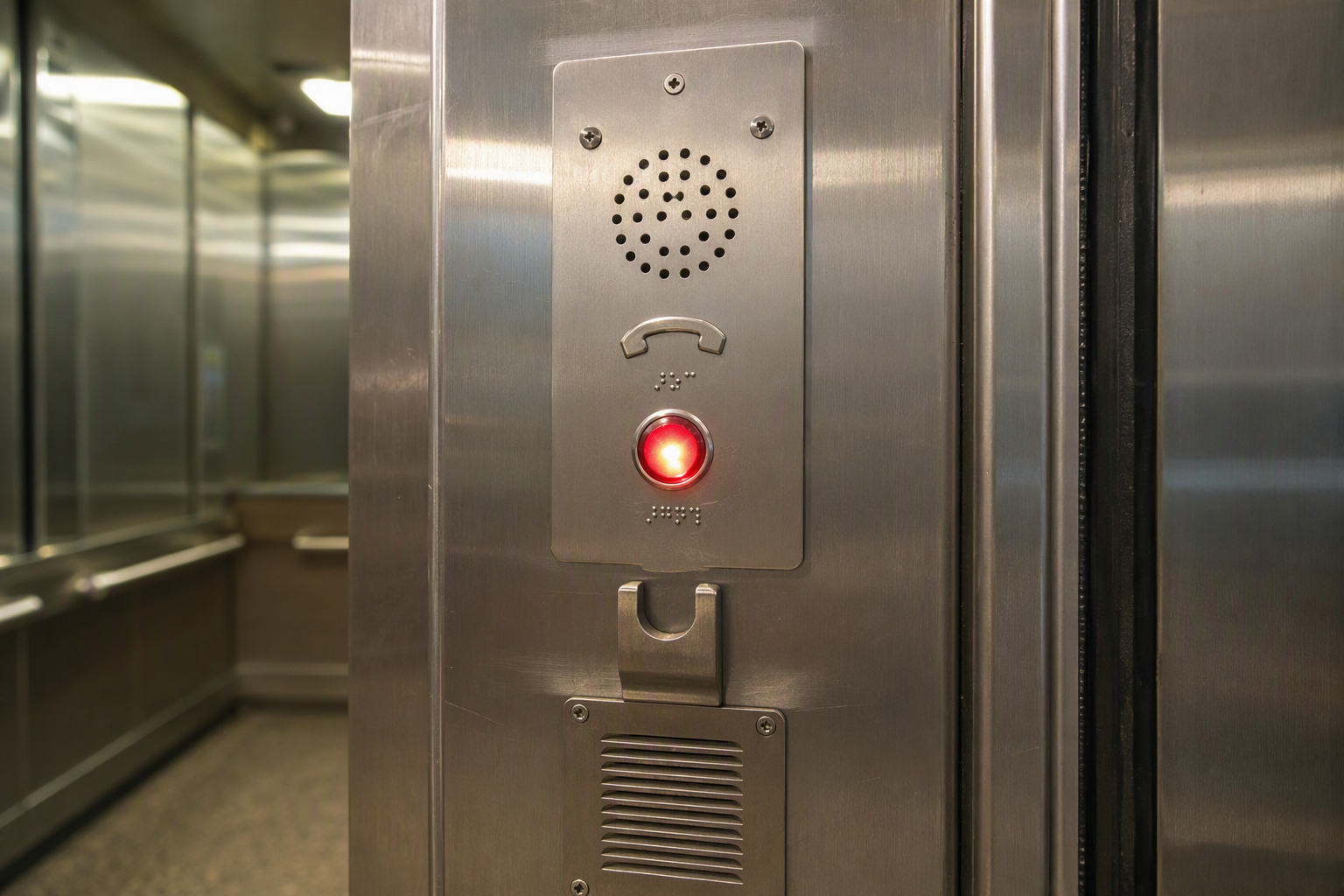
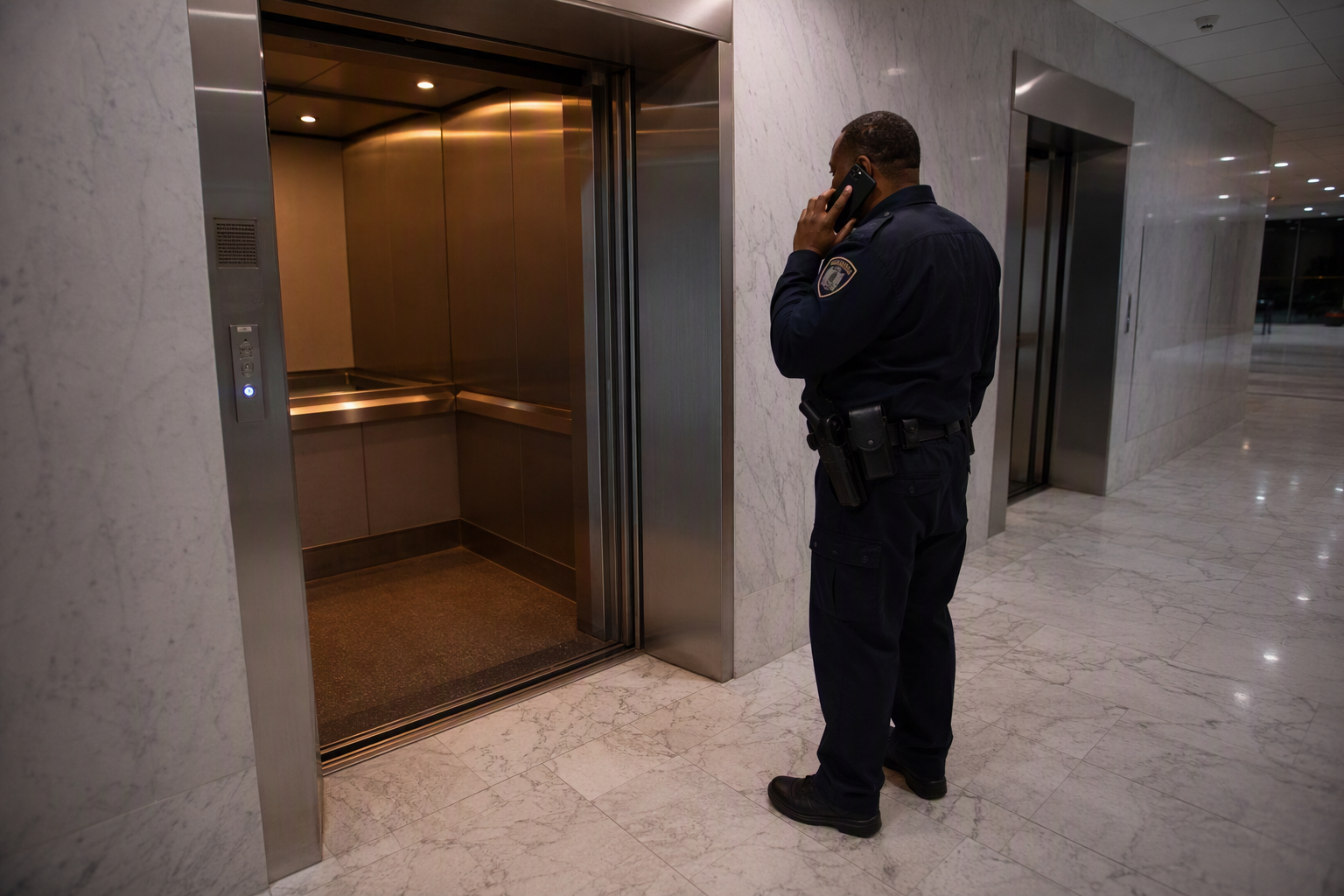
The immediate response to an elevator breakdown follows a defined sequence: passengers activate the emergency intercom, building staff call a licensed elevator mechanic, and emergency services are contacted only if communication with trapped passengers fails or a medical emergency exists.
A swift, calm response protects passenger safety and limits liability. The steps below represent the industry-standard protocol aligned with requirements under ASME A17.1 Safety Code for Elevators and Escalators, which mandates emergency communication devices, lighting, and ventilation within every elevator cab.
- Passengers: Stay inside the cab. Attempting to force open doors or climb out of a stalled elevator creates a serious fall and crush hazard. The safest location is inside the cab.
- Use the emergency intercom or phone. Every compliant elevator must have a two-way communication device. Press the alarm button or intercom and announce the situation clearly.
- Notify building management or the front desk. A designated staff member should receive the call and initiate the response chain immediately.
- Building staff: contact a licensed elevator service company. The service company dispatches a trained mechanic to perform a safe passenger extraction and diagnose the failure.
- Call 911 if communication fails or a passenger requires medical attention. Firefighters are trained in elevator rescue; however, a licensed elevator mechanic should still be called simultaneously to assist with the mechanical reset.
- Document the incident. Record the time of breakdown, cab number, floor, and any error codes displayed. This information is required for the maintenance log and may be requested by the Authority Having Jurisdiction (AHJ).
- Do not return the elevator to service until a licensed mechanic has inspected, repaired, and cleared the unit.
What Are the Most Common Causes of an Elevator Breakdown?
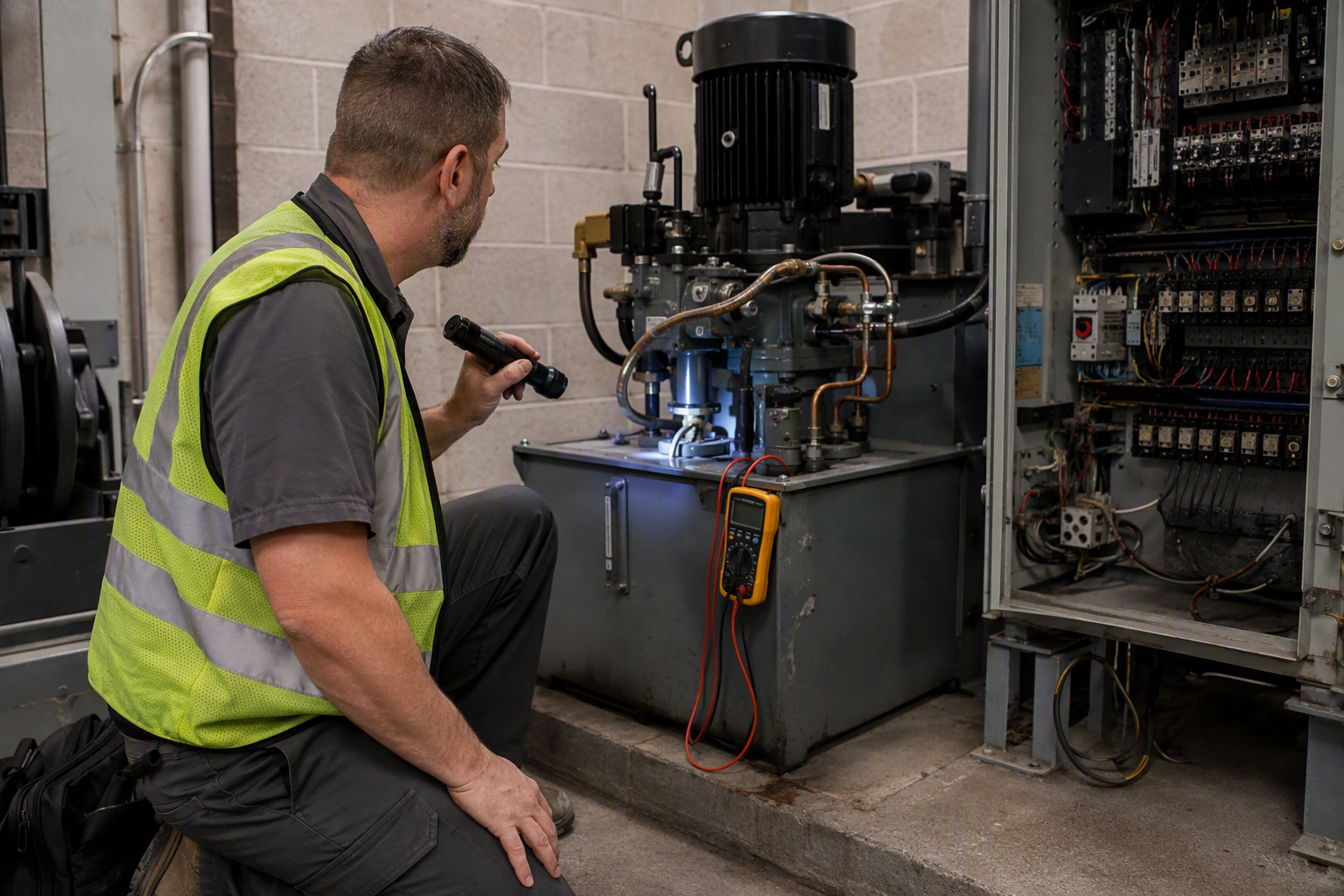
The most common causes of elevator breakdowns include door system malfunctions, worn electrical components, hydraulic fluid issues in hydraulic elevators, and software or controller faults — door problems alone account for a large share of service calls industry-wide.
Door operator failures are the leading category of elevator malfunctions. Worn rollers, misaligned tracks, and faulty door sensors prevent cabs from opening or closing properly, triggering the unit to go out of service as a safety precaution. Understanding root causes helps building owners prioritize preventive maintenance schedules and budget accordingly.
Electrical and control system faults — including relay failures, worn contacts, and circuit board issues — are the second major category. Hydraulic elevators face additional vulnerabilities related to fluid leaks, pump wear, and seal deterioration. Traction elevators may experience rope stretch, sheave wear, or brake adjustment issues over time.
Who Is Responsible for Responding to an Elevator Breakdown?
Building owners and property managers bear primary legal responsibility for ensuring a functional emergency response plan, a valid elevator maintenance contract, and prompt dispatch of a licensed elevator mechanic when a breakdown occurs.
Under most state elevator safety statutes in Maryland, Virginia, Pennsylvania, and Washington DC, the building owner is the responsible party before the Authority Having Jurisdiction. This means maintaining a current inspection certificate, a code-compliant maintenance agreement, and clear emergency contact procedures posted in or near every elevator lobby.
Tenants and passengers bear no operational responsibility but should be informed of basic safety procedures — particularly that they must never attempt self-rescue from a stalled cab. Facilities teams should train staff annually on the building-specific emergency response sequence.
Is It Safe for Passengers to Stay Inside a Stalled Elevator?
Yes — remaining inside a stalled elevator cab is nearly always the safest option, because the cab is engineered with multiple redundant safety devices and will not free-fall under any normal failure scenario.
Modern elevators compliant with ASME A17.1 Safety Code for Elevators and Escalators are equipped with governor-activated safeties, buffers, and interlocks designed to hold the cab securely in the event of a malfunction. The greatest risk to trapped passengers comes not from the stalled cab itself but from attempts to exit through partially open doors or climb out of the top hatch without proper training and equipment. A licensed mechanic can level the cab to the nearest floor and open the doors safely within the hoistway.
What Should Building Staff Do While Waiting for the Elevator Mechanic?
While waiting for a licensed elevator mechanic to arrive, building staff should maintain two-way communication with trapped passengers, keep the elevator lobby clear, and provide regular verbal updates to reassure passengers inside the cab.
Staff members should position themselves near the elevator machine room if accessible, so they can assist the arriving mechanic with access. Do not attempt to operate any machine room controls without authorization from a licensed elevator technician. If the building has a monitoring or dispatch center managing the elevator communication system, confirm that the center has already notified the service company.
Document every action taken — the time the intercom call was received, the time the service company was called, the estimated arrival time given, and any passenger communications. This log protects the building owner and demonstrates due diligence to the AHJ.
When Should 911 Be Called During an Elevator Breakdown?
911 should be called immediately if the elevator’s emergency intercom is non-functional, if a passenger reports a medical emergency, if there is smoke or fire in the building, or if passengers become severely distressed and cannot be calmed through verbal communication.
Firefighters trained in elevator rescue can force open hoistway doors and assist passengers from above or below the cab. However, OSHA guidance on confined space and elevated rescue reinforces that trained elevator mechanics should be on scene alongside fire personnel to manage mechanical controls safely during extraction. Calling 911 and calling your elevator service company are not mutually exclusive — both calls should happen simultaneously when the situation warrants emergency services.
What Are the Legal and Code Requirements for Elevator Emergency Equipment?
ASME A17.1 requires every elevator cab to have an emergency lighting source, a two-way communication system capable of contacting a responsible party, and adequate ventilation — all of which must be functional at all times the elevator is in service.
The Americans with Disabilities Act (ADA) further requires that emergency communication systems be accessible to individuals who are deaf or hard of hearing, which in practice means that the monitoring center must have TTY/TDD capability or an equivalent alternative. Building owners in Baltimore, Washington DC, Philadelphia, and Richmond should verify that their elevator’s emergency phone is connected to a live monitoring service — not a voicemail box — and that the monitoring service meets ADA communication requirements.
State-level elevator safety codes in Maryland, Virginia, Pennsylvania, and the District of Columbia each adopt ASME A17.1 by reference with local amendments. Building owners should confirm the edition currently adopted by their jurisdiction’s AHJ, as adoption cycles vary.
How Quickly Should an Elevator Mechanic Arrive After a Breakdown Is Reported?
Response time depends on the terms of the maintenance or service contract in place — contracts differ significantly between providers, and building owners should review and negotiate response-time commitments before a breakdown occurs rather than after.
The table below shows common contract tiers and the response-time benchmarks that building owners and property managers should look for when evaluating elevator service agreements. These ranges reflect general industry practice and should be confirmed with any service provider in writing.
| Contract Tier | Typical Coverage | Entrapment Response Expectation | Standard Breakdown Response | Best For |
|---|---|---|---|---|
| Basic Maintenance | Scheduled visits only | No guaranteed response | Next available appointment | Low-traffic buildings with secondary elevators |
| Standard Full Service | Scheduled visits + callback | Defined in contract (varies) | Same-day or next-day | Mid-rise commercial or residential buildings |
| Priority Full Service | Scheduled + priority callback | Faster defined window in contract | Same-day priority dispatch | High-traffic, ADA-critical, or healthcare facilities |
| Premium/Emergency Coverage | Full service + emergency coverage | Fastest contractual commitment | Immediate dispatch priority | Hospitals, government buildings, high-rise residential |
Building owners in Baltimore, Washington DC, Philadelphia, and Richmond should discuss contract tier options with Quality Elevator Company to identify the service level appropriate for their occupancy type, passenger volume, and regulatory obligations.
What Happens During a Professional Elevator Rescue and Reset?
A licensed elevator mechanic performing a rescue will safely level the cab to the nearest landing, manually open the doors, assist passengers out, and then conduct a diagnostic inspection before determining whether the elevator can be returned to service or requires further repair.
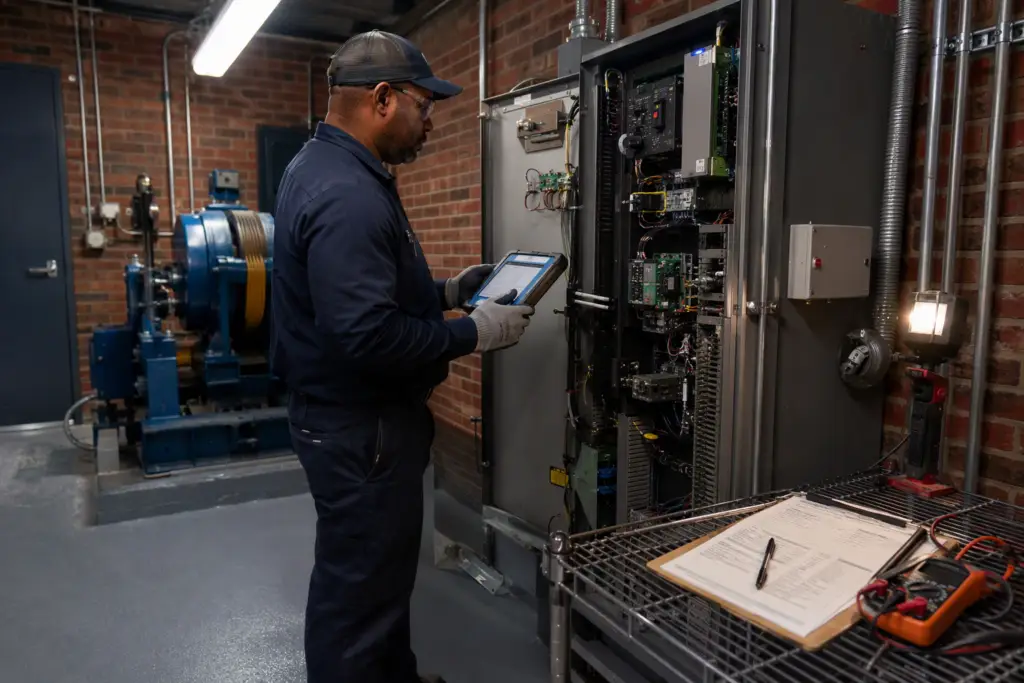
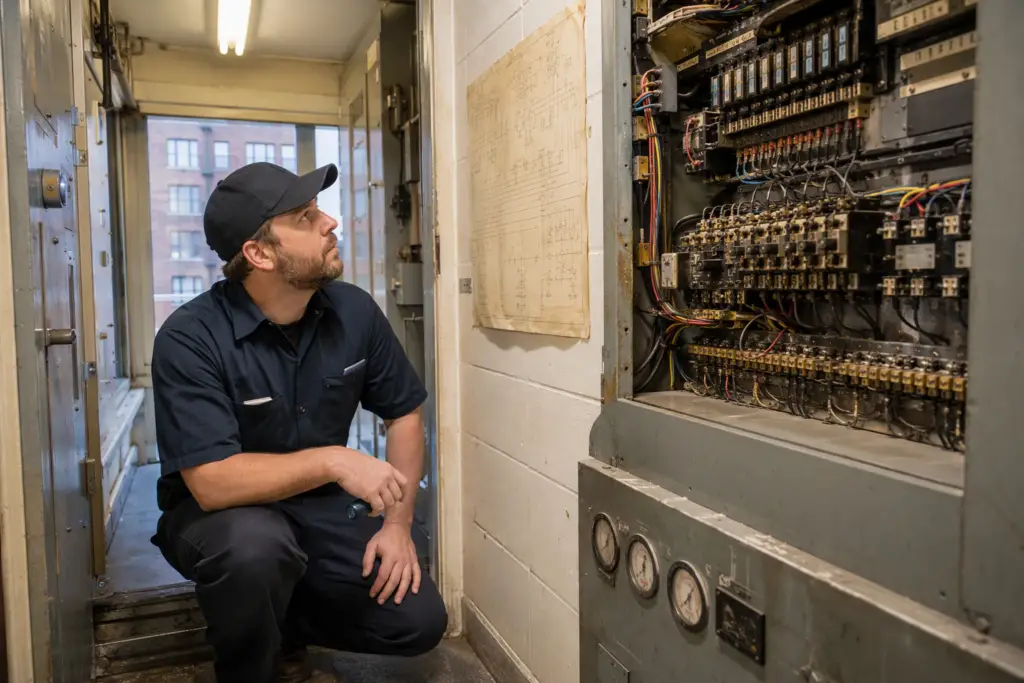
The mechanic will enter the machine room to assess controller fault codes, check brake function, and review drive system status. In hydraulic units, the mechanic evaluates the pump and fluid level. In traction units, the mechanic inspects the motor, drive, and rope system. No elevator should be returned to normal operation until the root cause of the breakdown has been identified and corrected — placing a malfunctioning unit back in service without repair creates liability and re-entrapment risk.
How Can Building Owners Reduce the Risk of Elevator Breakdowns?
Proactive, code-compliant preventive maintenance performed by a licensed elevator company is the most effective strategy for reducing breakdown frequency and the severity of unplanned outages.
Preventive maintenance involves regular lubrication of guide rails and ropes, inspection and adjustment of door operators and safeties, testing of emergency lighting and communication systems, and review of controller diagnostics. Buildings that operate under a comprehensive maintenance agreement with a qualified provider like Quality Elevator Company generally experience fewer unplanned outages because developing faults are identified and corrected before they cause a service interruption.
Building managers should also maintain an up-to-date equipment history log, act on mechanic recommendations promptly, and not defer repairs identified during routine service visits. Deferred maintenance accelerates component wear and increases the likelihood and cost of emergency breakdowns.
What Information Should Be Gathered Immediately After an Elevator Breakdown?
Immediately after a breakdown, building staff should document the elevator unit number, floor where the cab stopped, time of incident, number of passengers involved, nature of any fault codes or alarms displayed, and the sequence of contacts made — this record protects the building owner and satisfies AHJ reporting requirements.
Most jurisdictions require that serious incidents — including entrapments resulting in injury — be reported to the state elevator inspection authority within a defined timeframe. Building owners should consult their state’s elevator safety division for specific reporting timelines. The written incident record also supports the service mechanic’s diagnostic process and forms part of the equipment’s permanent maintenance history.
Does an Elevator Breakdown Require a New Inspection Before Returning to Service?
Whether a post-breakdown inspection by the Authority Having Jurisdiction is required depends on the nature of the malfunction — minor adjustments may not trigger mandatory inspection, but repairs involving safety components, control systems, or structural elements typically require AHJ sign-off before the unit can legally return to service.
Under the state elevator codes in Maryland, Virginia, Pennsylvania, and DC — each of which references ASME A17.1 Safety Code for Elevators and Escalators — alterations and significant repairs require a new certificate of inspection. Building owners should confirm with their licensed elevator service provider which category of repair was performed and whether a new inspection is required before reopening the unit to passengers. Quality Elevator Company coordinates with the applicable AHJ to ensure all post-repair inspection requirements are met without unnecessary downtime.
What Is the Difference Between an Elevator Entrapment and an Elevator Breakdown?
An elevator entrapment means passengers are physically unable to exit the cab, while a breakdown may simply mean the unit is out of service without any passengers inside — the response protocols and urgency levels differ significantly between these two scenarios.
Entrapments are life-safety events requiring immediate dispatch of both a licensed elevator mechanic and, where communication has failed, emergency services. Out-of-service breakdowns without passengers are still urgent — particularly in ADA-required accessible buildings or facilities serving populations dependent on elevator access — but do not carry the same immediate life-safety urgency. Both situations should be addressed promptly. Building owners serving healthcare, senior living, or ADA-primary facilities should treat any unplanned out-of-service as a priority event regardless of entrapment status.
Are Building Owners Liable When Passengers Are Trapped in an Elevator?
Building owners can face significant liability exposure from elevator entrapments when they have failed to maintain current inspection certificates, neglected documented maintenance recommendations, or cannot demonstrate a reasonable emergency response effort — legal counsel and adequate insurance coverage are essential safeguards.
Liability is typically assessed against whether the building owner acted reasonably: Was the elevator under a valid maintenance contract? Was the inspection certificate current? Was emergency response initiated promptly? Was the emergency communication system functional? Documented maintenance records, a code-compliant service agreement, and trained staff who follow a written emergency response procedure are the most defensible positions a building owner can maintain. Working with a certified elevator service company like Quality Elevator Company provides documentation that supports due diligence claims.
What Should Be Included in a Building’s Elevator Emergency Response Plan?
A complete elevator emergency response plan must include emergency contact numbers for the licensed elevator service company and 911, the location of the machine room and emergency keys, staff roles and responsibilities during an entrapment, and passenger communication scripts — the plan should be reviewed and updated annually.
The plan should be physically posted in the building manager’s office, the security desk, and any staffed front desk area. Digital copies should be accessible to on-call maintenance staff. Emergency response procedures should be practiced through tabletop exercises at least once per year so that all relevant staff are familiar with their roles before an actual event occurs. Buildings with multiple elevator units should have unit-specific documentation identifying each cab’s location, machine room access point, and any known characteristics relevant to emergency procedures.
How Do Elevator Breakdowns Affect ADA Compliance Obligations?
When an elevator breakdown renders the only accessible route to a floor non-functional, the building may be in violation of ADA accessibility requirements — property managers must have alternative accommodation plans in place and restore service as quickly as possible.
The Americans with Disabilities Act (ADA) requires that programs and services remain accessible even when physical features are temporarily out of service. For multi-story buildings where the elevator is the sole accessible route, this means building management should have a written procedure for providing equivalent service access — such as temporarily relocating a service or meeting to an accessible floor — and must restore the elevator to service without unreasonable delay. Failure to plan for accessible alternatives during elevator downtime creates both ADA exposure and reputational risk.
What Is the Role of Remote Monitoring in Elevator Breakdown Response?
Remote monitoring systems continuously track elevator performance data and can alert a service provider to developing faults — and in some configurations, automatically notify a monitoring center when a passenger activates the emergency intercom — enabling faster response before a full breakdown occurs.
Modern elevator monitoring platforms capture door cycle counts, leveling accuracy, trip frequency, and fault codes in real time. Anomalies that precede common failures — such as increasing door reopening cycles — can be flagged for proactive service intervention. For buildings requiring the highest service reliability, remote monitoring integrated with a maintenance contract represents a meaningful upgrade in breakdown prevention and emergency communication capability. Building owners in the Quality Elevator Company service area should ask about monitoring options when discussing their maintenance agreement.
How Long Does It Typically Take to Repair an Elevator After a Breakdown?
Repair duration depends on the nature of the failure — a door adjustment or software reset may take less than an hour, while failures requiring replacement parts for older equipment can extend the outage to multiple days depending on parts availability.
Parts availability is one of the most significant variables affecting repair timelines, particularly for proprietary elevator systems where components must come directly from the original manufacturer. Buildings with older or proprietary equipment should discuss parts stocking options with their service provider. Maintaining a relationship with a full-service company like Quality Elevator Company, which services multiple elevator brands and system types across Baltimore, Washington DC, Philadelphia, and Richmond, supports access to a broader parts network and reduces the likelihood of extended outages due to supply chain delays.
What Questions Should Building Owners Ask When Hiring an Elevator Service Company for Emergency Response?
Building owners should ask prospective elevator service companies about their licensing and insurance status, their specific contractual response-time commitments for entrapments, their parts inventory and multi-brand service capability, their familiarity with local AHJ requirements, and their emergency escalation procedures.
Additional questions worth asking include: Does the company provide documentation after every service call? How are emergency callbacks handled after business hours? What is the escalation path if the first-dispatched mechanic cannot resolve the issue? Are technicians licensed under the applicable state elevator safety statute? Can the company provide references from comparable properties in the same jurisdiction? A qualified service provider will answer all of these questions transparently and provide written commitments in the service agreement.
How Can Quality Elevator Company Help with Elevator Breakdown Response in Baltimore, Washington DC, Philadelphia, and Richmond?
Quality Elevator Company provides certified elevator maintenance, repair, and emergency response services across Baltimore MD, Washington DC, Philadelphia PA, and Richmond VA — offering building owners a licensed, knowledgeable partner for both routine maintenance and unplanned breakdown situations.
Serving commercial, residential, government, and healthcare properties throughout the region, Quality Elevator Company works with building owners and property managers to establish code-compliant maintenance programs, develop written emergency response procedures, and ensure that every elevator in the portfolio meets current ASME A17.1 and ADA requirements. When a breakdown occurs, having a pre-established relationship with a licensed service company streamlines dispatch, reduces passenger wait time, and provides the documentation that protects building owners before the AHJ.
Property managers who want to assess their current elevator emergency preparedness — including maintenance contract coverage, inspection certificate status, and emergency communication compliance — are encouraged to schedule a professional review with Quality Elevator Company before the next unplanned outage occurs.
Get Your Free Elevator Assessment Today
Don’t wait for a breakdown to discover gaps in your elevator emergency response plan. Contact Quality Elevator Company for a free elevator assessment and ensure your building in Baltimore MD, Washington DC, Philadelphia PA, or Richmond VA is prepared, compliant, and protected.
Call us at 301-779-9116 to speak with a member of our team and schedule your no-obligation assessment.
Need elevator service you can rely on? Quality Elevator Company is ready to help.