Elevator Entrapment Rescue Procedure: Complete FAQ Guide
Elevator entrapments are an inevitable reality for any building that operates vertical transportation equipment. Whether the cause is a power failure, mechanical malfunction, software fault, or a tripped safety relay, the entrapment rescue procedure is a life-safety protocol governed by federal codes, state regulations, and local fire department standards. This comprehensive FAQ hub covers every aspect of the process — from the moment passengers are trapped to post-rescue inspection requirements — so building owners, facility managers, first responders, and passengers in Baltimore MD, Washington DC, Philadelphia PA, and Richmond VA understand exactly what to expect.
What is the standard elevator entrapment rescue procedure?
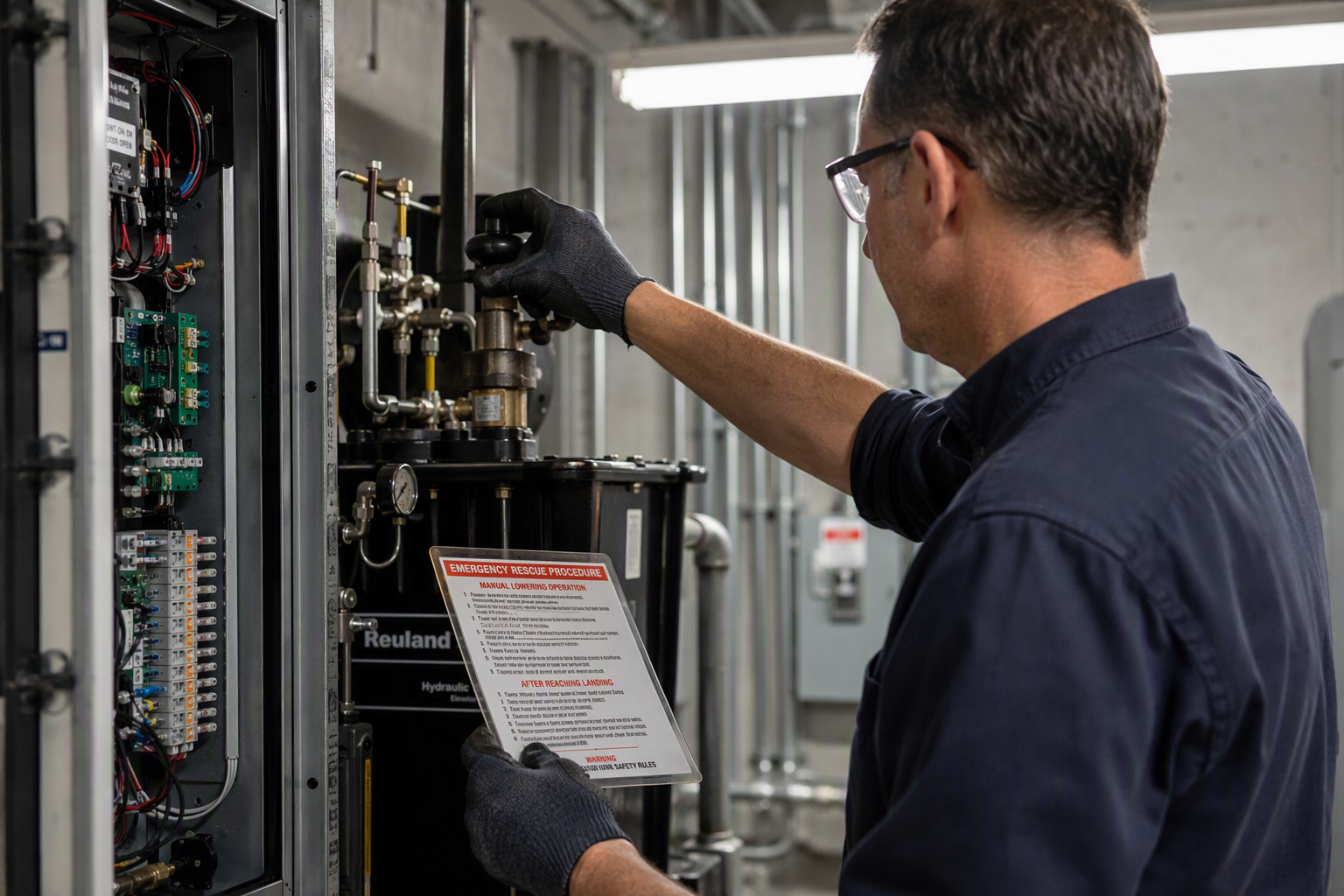
The standard elevator entrapment rescue procedure is a structured, code-compliant sequence in which trained personnel — either a licensed elevator mechanic or coordinated emergency responders — safely release trapped passengers from a stalled elevator cab without exposing them or rescuers to additional hazard.
The procedure is governed by ASME A17.1 Safety Code for Elevators and Escalators, which mandates that every elevator be equipped with specific features — including an emergency lighting source, a two-way communication device, and a means for authorized personnel to manually operate the unit. The rescue process is never improvised; it follows a defined sequence that protects both the occupants and the rescuers.
At a high level, the procedure unfolds in three phases: passenger communication and stabilization, controlled mechanic or responder arrival, and manual or assisted car movement to the nearest landing for safe egress. Each phase has specific requirements under applicable code, and deviation from this sequence is what turns a manageable entrapment into a serious injury event.
What should trapped passengers do immediately during an elevator entrapment?
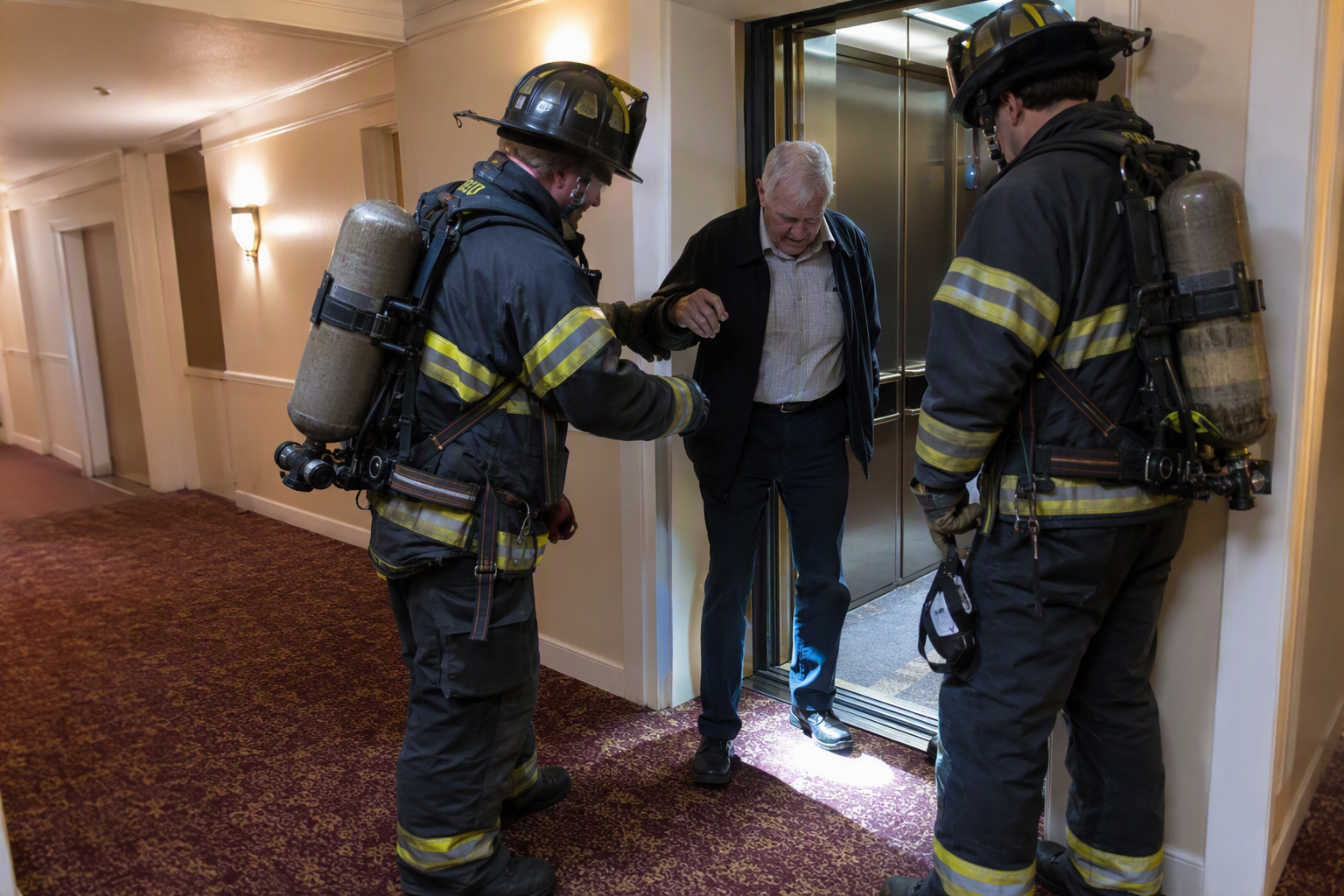
Trapped passengers should immediately activate the in-cab emergency communication system, remain calm and stationary, and wait for trained personnel — attempting to force doors open or exit through the ceiling hatch without assistance is dangerous and strictly discouraged by code.
- Press the emergency call button. Every elevator is required by ASME A17.1 to have a two-way communication device inside the cab. Press and hold the button and speak clearly to the monitoring center or building staff.
- Use a mobile phone if the communication button is unresponsive. Call 911 or the building’s main number and report your location, the floor you believe you are on, and the number of people in the cab.
- Turn on emergency lighting if available. Many modern cabs have automatic emergency lighting, but some require passengers to locate and activate a switch.
- Move away from the doors. Passengers should stand clear of door panels. Doors can move unexpectedly when technicians begin the manual release sequence from outside.
- Sit down if the wait is prolonged. Sitting reduces the risk of fall injury if the car moves suddenly during the rescue operation.
- Do not attempt to pry open doors or access the top-of-car hatch. Top-of-car egress is authorized only for trained technicians and is explicitly restricted under ASME A17.1 unless performed by qualified personnel.
- Communicate any medical emergencies. If any passenger has a medical condition exacerbated by the entrapment — cardiac events, severe anxiety, asthma — relay this immediately to the monitoring operator or 911 so emergency medical services can be dispatched simultaneously.
- Confirm the cab is stable before any movement. Once technicians announce they are beginning the rescue, passengers should confirm they are all seated or standing away from doors and acknowledge the instruction before any car movement begins.
Who is legally authorized to perform an elevator entrapment rescue?
In most jurisdictions, elevator entrapment rescue must be performed by a licensed elevator mechanic or, in the mechanic’s absence and only under specific emergency conditions, by trained fire department personnel following defined protocols — building staff and general maintenance workers are not authorized to attempt mechanical rescue.
Each state in Quality Elevator Company’s service territory has its own licensing framework. Maryland, Washington DC, Pennsylvania, and Virginia all require elevator mechanics to hold state-issued licenses and comply with ASME A17.1 training standards. Fire departments in these jurisdictions receive specialized elevator rescue training, but department protocols typically require them to contact the building’s elevator service contractor before initiating a mechanical intervention.
Building engineers or property managers may assist with communication and access — for example, unlocking machine room doors — but they must not attempt to manually operate the elevator machinery themselves unless they hold the appropriate license and have been specifically trained on that equipment.
What equipment is required for a proper entrapment rescue?
A proper entrapment rescue requires a functioning machine room, specific hand tools for manual lowering or raising operations, a reliable flashlight or portable lighting source, a two-way radio, and — depending on elevator type — a hydraulic manual lowering valve tool or a hand-winding device for traction machines.
For traction elevators, technicians use a hand wheel or brake release lever located in the machine room to slowly move the car to the nearest landing. For hydraulic elevators, technicians operate a manual lowering valve that releases hydraulic fluid at a controlled rate, descending the car. The specific procedure varies by equipment manufacturer and model, which is why ASME A17.1 requires that instructions for manual emergency operation be posted permanently in the machine room.
Modern elevator controllers may also require a technician to reset safety relays or override a fault condition through a diagnostic interface before manual movement is possible. This underscores why building staff — who lack manufacturer-specific training — should never attempt independent rescue operations.
What are the step-by-step procedures a licensed elevator mechanic follows during rescue?
A licensed elevator mechanic follows a precise sequence during entrapment rescue to ensure the car is positioned safely at a landing before passengers are allowed to exit, protecting both passengers and the technician from falls or mechanical hazard.
- Contact the trapped passengers. Upon arrival, the mechanic communicates with occupants via the in-cab phone or by shouting through the door to confirm the number of passengers, their condition, and approximate car position.
- Shut off main line power to the elevator. Before entering the machine room or hoistway, the mechanic confirms electrical isolation to prevent uncontrolled car movement during manual operations.
- Access the machine room. The mechanic uses building-provided keys to access the dedicated machine room. By code, machine rooms must remain locked and accessible only to authorized personnel.
- Identify car position relative to the nearest landing. Using the machine room indicator or a physical check through the hoistway access door, the technician determines how far the car needs to travel for safe egress.
- Perform manual lowering or hand-winding operation. For traction machines, the mechanic releases the brake in controlled increments while monitoring car movement. For hydraulic units, the manual lowering valve is opened slowly. Both operations require two-person teams when possible — one to operate the brake/valve, one to monitor the car via the machine room indicator.
- Confirm car is level with the landing floor. The car must be positioned within the leveling zone — typically within a few inches of the landing — before doors can be opened safely. Exiting a car that is not level with the landing floor is a primary cause of entrapment-related injuries.
- Unlock and open the hoistway door from the landing side. Using a hoistway door unlock key (also known as a drop key), the mechanic opens the landing door and assists passengers out of the cab one at a time.
- Assist passengers and account for all occupants. The technician confirms all passengers have exited and are safe before closing and re-locking the hoistway door.
- Tag the elevator out of service. The elevator is immediately placed out of service with appropriate lockout/tagout procedures in compliance with OSHA lockout/tagout standards until the root cause is identified and repaired.
- Document the incident and notify the authority having jurisdiction (AHJ). Depending on state regulations, certain entrapment events must be reported to the state elevator inspection authority within a defined timeframe.
How long does an elevator entrapment rescue typically take?
The duration of an elevator entrapment rescue depends on factors including the technician’s travel distance, the type of elevator, the complexity of the fault condition, and whether fire department coordination is required — straightforward cases at a mechanically accessible location can resolve more quickly than complex faults in high-rise buildings.
Buildings with active elevator service maintenance contracts typically experience shorter resolution windows because the responsible service company already has familiarity with the specific equipment and machine room access protocols. This is one of the strongest operational arguments for maintaining a full-service maintenance agreement rather than relying on reactive, on-demand calls. Quality Elevator Company recommends that building owners in Baltimore, Washington DC, Philadelphia, and Richmond maintain current service agreements specifically to improve entrapment response logistics.
What are the most common causes of elevator entrapments?
The most common causes of elevator entrapments are power failures, door system malfunctions, hydraulic fluid leaks, worn safety components triggering protective shutdowns, and controller faults — the majority of entrapment events are preventable through routine preventive maintenance.
Door-related failures are particularly prevalent because elevator doors contain mechanical, electrical, and electronic components — sensors, operator motors, clutch mechanisms, and safety edges — all of which wear over time. A door that fails to fully close prevents the elevator from moving, leaving passengers stranded. Hydraulic leaks cause the car to drift downward until the system’s low-oil safety switch triggers a shutdown. Worn brake linings, deteriorated hoist ropes, and aging controllers are additional contributors. Comprehensive preventive maintenance programs address all of these failure modes proactively.
What does ASME A17.1 require specifically for emergency operations?
ASME A17.1 Safety Code for Elevators and Escalators requires that every elevator installation include a means for authorized personnel to manually move the car to a landing, that two-way communication be provided inside the cab, and that clear instructions for emergency manual operation be posted in the machine room.
The 2019 edition of ASME A17.1 (widely adopted through 2026) includes specific sections addressing firefighters’ service operation (Phase I and Phase II), emergency lighting, car emergency signal devices, and requirements for two-way communication systems that connect to a location that is monitored continuously. The code also specifies the design of hoistway door unlocking devices — ensuring that drop keys can only be operated by trained personnel who understand the fall hazard associated with an open hoistway.
States in Quality Elevator Company’s service territory adopt ASME A17.1 by reference into their own elevator safety regulations, with amendments specific to local conditions. Building owners should confirm with their elevator service contractor which edition of the code is currently enforced by their state authority having jurisdiction.
What role do fire departments play in elevator entrapment rescue?
Fire departments serve as first responders when a trapped passenger reports a medical emergency or when the elevator service company cannot reach the scene within an acceptable timeframe — however, fire departments are trained to assess and assist, not to replace the licensed elevator mechanic who must ultimately resolve the mechanical fault.
Most fire departments in major metro areas — including those serving Baltimore, Washington DC, Philadelphia, and Richmond — maintain dedicated elevator rescue training programs for their personnel. Firefighters are typically trained to use drop keys, communicate with trapped passengers, and perform basic manual lowering in traction elevators. However, they are generally instructed to defer to the elevator mechanic for complex fault conditions and to request the building’s elevator service company be contacted immediately upon arrival.
The coordination between fire departments and elevator service contractors is most effective when building management has current emergency contact information for their service company posted in the lobby, near the elevator machine room, and in their emergency response plan. ADA requirements also mandate that emergency communication systems inside elevator cabs be accessible to individuals with hearing disabilities, which affects how fire departments and technicians communicate with passengers during a rescue.
What are the ADA requirements related to elevator entrapment communication?
The Americans with Disabilities Act (ADA) requires that elevator emergency communication systems provide equivalent service to individuals with hearing impairments, meaning visual and text-based communication options must be available in addition to voice communication.
Specifically, ADA standards for accessible design require that the emergency communication device in an elevator cab not be solely dependent on voice communication. This has led to the widespread installation of two-way text messaging interfaces, visual display screens, and strobe light acknowledgment systems in compliant elevators. During an entrapment, monitoring centers that receive emergency calls must be equipped to communicate effectively with passengers who are deaf or hard of hearing.
Building owners undergoing elevator modernization should ensure that new communication systems meet both ASME A17.1 and ADA requirements simultaneously, as an entrapment event involving a passenger with a hearing disability and a non-compliant communication system can expose the building owner to significant legal liability.
What is firefighters’ emergency service (Phase I and Phase II) and how does it relate to entrapment?
Firefighters’ emergency service, defined under ASME A17.1, is a mandatory operational mode that allows firefighters to recall elevators to a designated landing (Phase I) and to manually control car movement floor by floor (Phase II) — a functioning firefighters’ service system is critical infrastructure for managing elevator entrapments during building emergencies.
Phase I is activated by a smoke detector signal or a key switch in the lobby. When activated, the elevator returns all cars to the main landing, opens the doors, and holds them open for firefighter access. Phase II, activated by a key switch inside the car, allows a firefighter to manually drive the car to any landing with doors held open only while the door-open button is continuously depressed. This design prevents the car from trapping a firefighter in the event of a further system fault.
During a building fire or emergency evacuation, elevator entrapments can occur when firefighters’ service is activated while passengers are already riding the car — the sudden recall can confuse passengers who do not understand why the elevator is returning to the lobby. Ensuring that firefighters’ service key switches are tested during routine inspections is a required part of annual elevator maintenance.
How should building managers prepare an emergency response plan for elevator entrapments?
Building managers should maintain a written elevator emergency response plan that includes the elevator service company’s 24-hour contact number, fire department and EMS contact protocols, machine room access instructions, a current list of all elevator equipment serial numbers and locations, and a clear policy confirming that building staff will not attempt mechanical rescue.
The plan should be reviewed annually and updated whenever elevator equipment is modified, a new service contractor is engaged, or building management personnel change. Quality Elevator Company advises clients throughout its service territory to integrate elevator emergency procedures into their broader building emergency response plans rather than treating them as isolated documents.
Training building staff on what they can and cannot do during an entrapment is equally important. Staff should know how to communicate with trapped passengers, how to unlock machine room access for arriving technicians, and how to coordinate with fire departments — but they should be clearly instructed that mechanical intervention is not within their authority or training.
What inspection and reporting requirements apply after an elevator entrapment?
After an elevator entrapment, the elevator must be inspected by a licensed mechanic before being returned to service, and depending on the jurisdiction and cause of the entrapment, the incident may be required to be reported to the state elevator inspection authority within a defined regulatory timeframe.
Maryland, Virginia, Pennsylvania, and the District of Columbia each have elevator safety divisions within their state labor or licensing departments that regulate post-incident reporting. Generally, entrapments resulting from equipment failure — as opposed to a power outage — require written documentation of the root cause, corrective action taken, and confirmation that the equipment has been returned to a safe operating condition. This documentation may be reviewed during subsequent periodic inspections.
Beyond regulatory requirements, post-entrapment inspections serve as a critical opportunity to identify systemic maintenance deficiencies that contributed to the event. A thorough inspection should evaluate not just the immediate cause but the overall condition of the equipment to prevent recurrence.
What are the most dangerous mistakes made during elevator entrapments?
The most dangerous mistakes during elevator entrapments are passengers attempting to force open doors, exiting a car that is not level with the landing, climbing through the ceiling hatch without assistance, and building staff attempting mechanical rescue without the required licensing and equipment-specific training.
Hoistway falls are among the most severe injuries associated with elevator incidents. When a car stops between floors and passengers attempt to exit through partially opened doors, the gap between the car sill and the landing represents a fall hazard into the hoistway pit or onto the car top. Even a car that appears to be close to a landing may be far enough misaligned to present a serious fall risk, particularly in low-light conditions.
Top-of-car hatch egress is another common source of serious injury. While hatches are designed as rescue access points for trained technicians, they are not designed for passenger self-rescue. A passenger who opens a ceiling hatch and attempts to exit faces electrical hazards from exposed wiring, fall risks onto moving or stationary equipment, and the danger of the car suddenly moving once mechanical systems are manipulated. OSHA standards governing confined space and fall protection are directly applicable to anyone in a hoistway environment.
How does preventive maintenance reduce the risk of elevator entrapments?
Comprehensive preventive maintenance directly reduces entrapment risk by identifying and correcting worn components — particularly door operator parts, safety circuits, hydraulic seals, and brake assemblies — before they fail under load and cause an unplanned shutdown with passengers aboard.
The connection between maintenance quality and entrapment frequency is well-established in the elevator industry. Door system components are the single highest-frequency maintenance item on most elevator units, and a well-maintained door system eliminates the most common cause of entrapment. Quality Elevator Company provides preventive maintenance programs to commercial and residential building owners throughout Baltimore, Washington DC, Philadelphia, and Richmond designed to address these high-risk components on a scheduled basis.
Maintenance contracts should specify the frequency of lubrication, adjustment, and safety test cycles in alignment with ASME A17.1 requirements and manufacturer recommendations. Buildings with older equipment may require more frequent service intervals to maintain equivalent reliability to newer installations.
What are the state-specific elevator safety regulations in Maryland, Washington DC, Pennsylvania, and Virginia?
Each jurisdiction in Quality Elevator Company’s service territory enforces elevator safety through a dedicated regulatory authority that adopts ASME A17.1 by reference, mandates periodic inspections by licensed inspectors, and requires elevator mechanics to hold state-issued licenses — specific requirements vary by jurisdiction.
| Jurisdiction | Regulatory Authority | Code Adopted | Inspection Frequency (General) | Mechanic License Required | Entrapment Reporting |
|---|---|---|---|---|---|
| Maryland | MD Dept. of Labor — Division of Labor and Industry | ASME A17.1 (with amendments) | Annual | Yes — state-issued license | Required for equipment-caused entrapments |
| Washington DC | DC Dept. of Consumer and Regulatory Affairs (DCRA) | ASME A17.1 (with local amendments) | Annual | Yes — DC license required | Required; AHJ notification protocol applies |
| Pennsylvania | PA Dept. of Labor and Industry — Bureau of Occupational and Industrial Safety | ASME A17.1 (with amendments) | Annual (semi-annual for some classifications) | Yes — PA license required | Required for incidents resulting in injury or equipment fault |
| Virginia | VA Dept. of Labor and Industry — DOLI Elevator Safety Unit | ASME A17.1 (with amendments) | Annual | Yes — VA license required | Required; written report to DOLI for equipment-caused events |
Note: Regulatory details are subject to change. Building owners should verify current requirements directly with the applicable state or local authority having jurisdiction. The ASME A17.1 base code is updated on a regular cycle; confirm which edition your jurisdiction has adopted.
How do modernization projects affect entrapment rescue procedures?
Elevator modernization projects that replace controllers, door operators, or drive systems require updated emergency operating instructions to be posted in the machine room and may change the specific tools and procedures required for manual rescue — building emergency plans and fire department familiarity must be updated accordingly.
When an elevator is modernized with a new microprocessor-based controller, the fault codes, diagnostic interfaces, and manual override sequences may differ substantially from the legacy system. A fire department that has trained on the old system’s manual lowering procedure may find that the procedure has changed after modernization. Building owners and elevator service contractors have a shared responsibility to communicate these changes to the building’s fire safety plan and to ensure that updated emergency operating instruction placards are installed in the machine room as required by ASME A17.1.
Quality Elevator Company includes post-modernization documentation updates and coordination with building management as part of its modernization project scope for clients in its service territory.
What communication systems are required inside elevator cabs to support entrapment rescue?
ASME A17.1 requires that every elevator cab contain a two-way communication device capable of connecting passengers to a location staffed by a person capable of responding — the system must function on emergency power if main power fails and must meet ADA accessibility requirements for passengers with hearing disabilities.
Modern elevator communication systems go beyond a simple telephone connection. Current installations typically include digital two-way voice communication, automatic dialing to a 24-hour monitoring center, visual display screens for text communication, and emergency lighting that activates automatically upon power failure. Some advanced systems provide GPS-like floor identification to help responders locate the cab without relying on passenger reports of their floor position.
Legacy buildings with older intercom systems that connect to an unstaffed location — such as a machine room speaker that no one monitors — are out of compliance with current code requirements. ADA requirements further specify that the activation button must be identified with raised characters and Braille, and the system must provide a visual signal confirming that the emergency call has been received.
How should building owners select an elevator service company for entrapment response readiness?
Building owners should select an elevator service company based on verifiable state licensing, documented familiarity with the specific elevator equipment installed in their building, clearly defined emergency contact protocols, and a structured preventive maintenance program that addresses the most common entrapment causes proactively.
When evaluating service providers, building owners in Baltimore, Washington DC, Philadelphia, and Richmond should request documentation of the service company’s state licenses in each applicable jurisdiction, evidence of technician training on the specific elevator makes and models installed, and a written description of how emergency calls are handled outside of standard business hours. The service contract should explicitly address entrapment response protocols and documentation requirements.
Quality Elevator Company serves commercial, residential, and institutional building owners across its four-market service territory with elevator maintenance, inspection, repair, and modernization services designed to meet applicable state regulations and ASME A17.1 requirements. The company’s technicians hold state-required licenses in each jurisdiction served.
What should building owners document after an elevator entrapment to protect against liability?
After an elevator entrapment, building owners should document the date, time, and duration of the event, the number of passengers involved and their reported condition, the name of the service company and technician who performed the rescue, the root cause identified by the mechanic, corrective actions taken, and the date the elevator was returned to service.
This documentation serves multiple purposes: it satisfies state regulatory reporting requirements, it creates a defensible record demonstrating that the building owner responded appropriately and returned the equipment to safe condition, and it provides data for evaluating whether the incident reflects a systemic maintenance deficiency requiring a change in service scope or frequency. Legal counsel familiar with premises liability in the applicable jurisdiction should be consulted if any passenger reports injury related to the entrapment.
Maintaining organized service records — including all inspection reports, maintenance logs, and incident reports — is a best practice that Quality Elevator Company supports for its clients through structured service documentation as part of its maintenance agreements.
Frequently Asked Questions — Quick Reference
Q: Can a building maintenance engineer rescue trapped elevator passengers?
A: No. Building maintenance engineers are not authorized to perform mechanical elevator rescue unless they hold a state elevator mechanic license. Their role is to communicate with passengers, contact the elevator service company, and provide machine room access to licensed technicians.
Q: Is it safe to exit an elevator that has stopped between floors?
A: No. Exiting through partially opened doors when the car is not level with a landing presents a serious fall-into-hoistway hazard. Passengers must wait for a licensed technician to move the car to a landing and confirm it is safe to exit.
Q: Do entrapments need to be reported to state regulators?
A: In most cases where the entrapment was caused by equipment failure, yes — Maryland, Washington DC, Pennsylvania, and Virginia all have reporting requirements administered by their respective elevator safety authorities.
Q: How quickly should a building owner contact their elevator service company after an entrapment?
A: Immediately. The elevator service company should be contacted simultaneously with calling 911 if passengers are reporting a medical emergency. The service company is responsible for the mechanical rescue and the post-rescue inspection.
Get Professional Elevator Safety Support
Elevator entrapments are manageable events when building owners have the right service partner, a current emergency response plan, and equipment maintained to ASME A17.1 standards. The best time to review your entrapment readiness is before an event occurs — not during one.
Contact Quality Elevator Company for a free elevator assessment. Quality Elevator Company serves building owners and facility managers in Baltimore MD, Washington DC, Philadelphia PA, and Richmond VA with comprehensive elevator maintenance, inspection, modernization, and emergency support services.
Call today: 301-779-9116
Need elevator service you can rely on? Quality Elevator Company is ready to help.