Elevator Out of Service: Who to Contact and What to Do
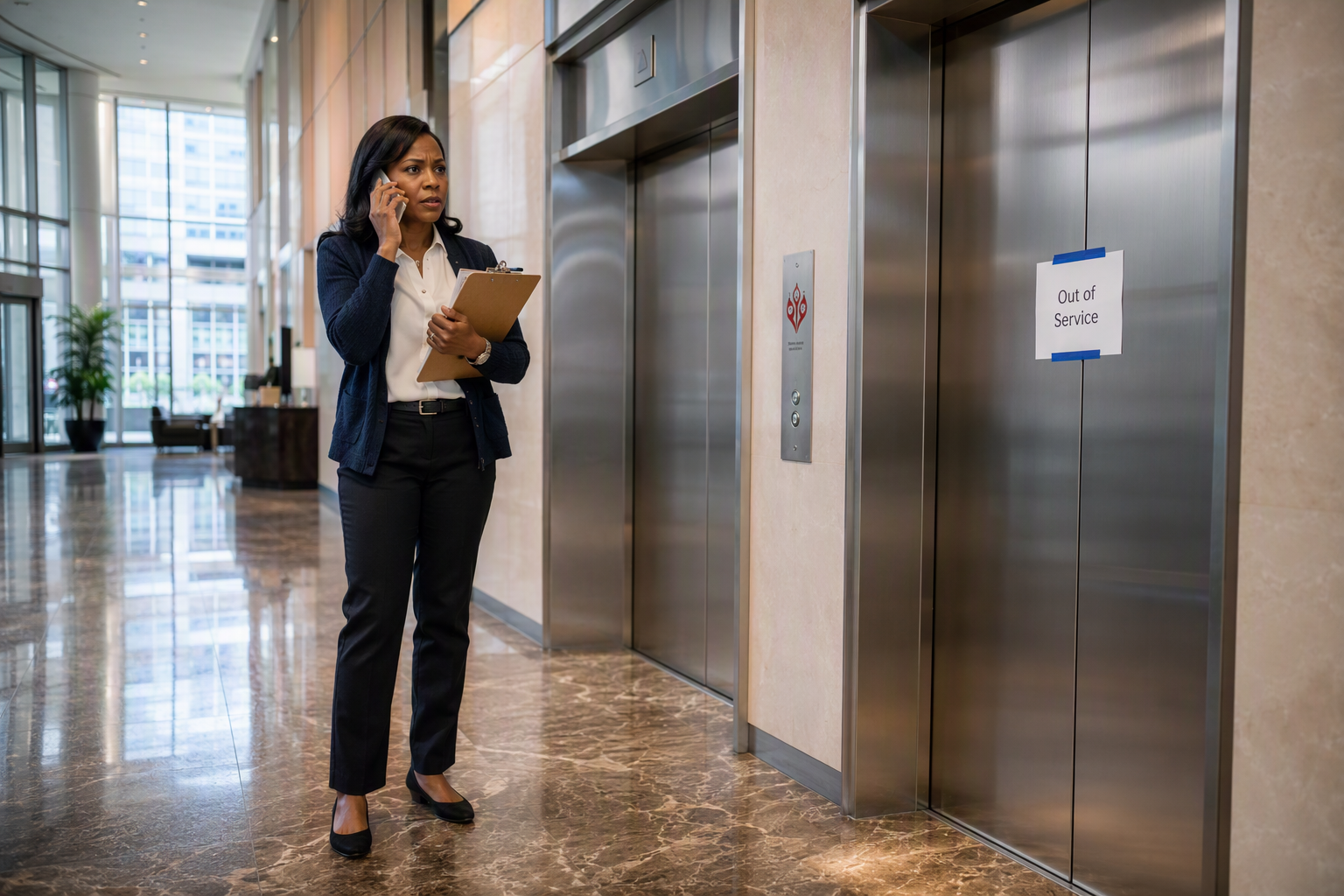
An elevator going out of service can disrupt a building’s operations, create accessibility barriers, and — in the case of entrapments — become a safety emergency within minutes. Knowing exactly who to call, in what order, and what steps to take protects passengers, limits liability, and helps restore service as quickly as possible. This comprehensive FAQ covers every scenario building owners, property managers, and tenants encounter when an elevator stops working.
Who should I contact first when an elevator is out of service?
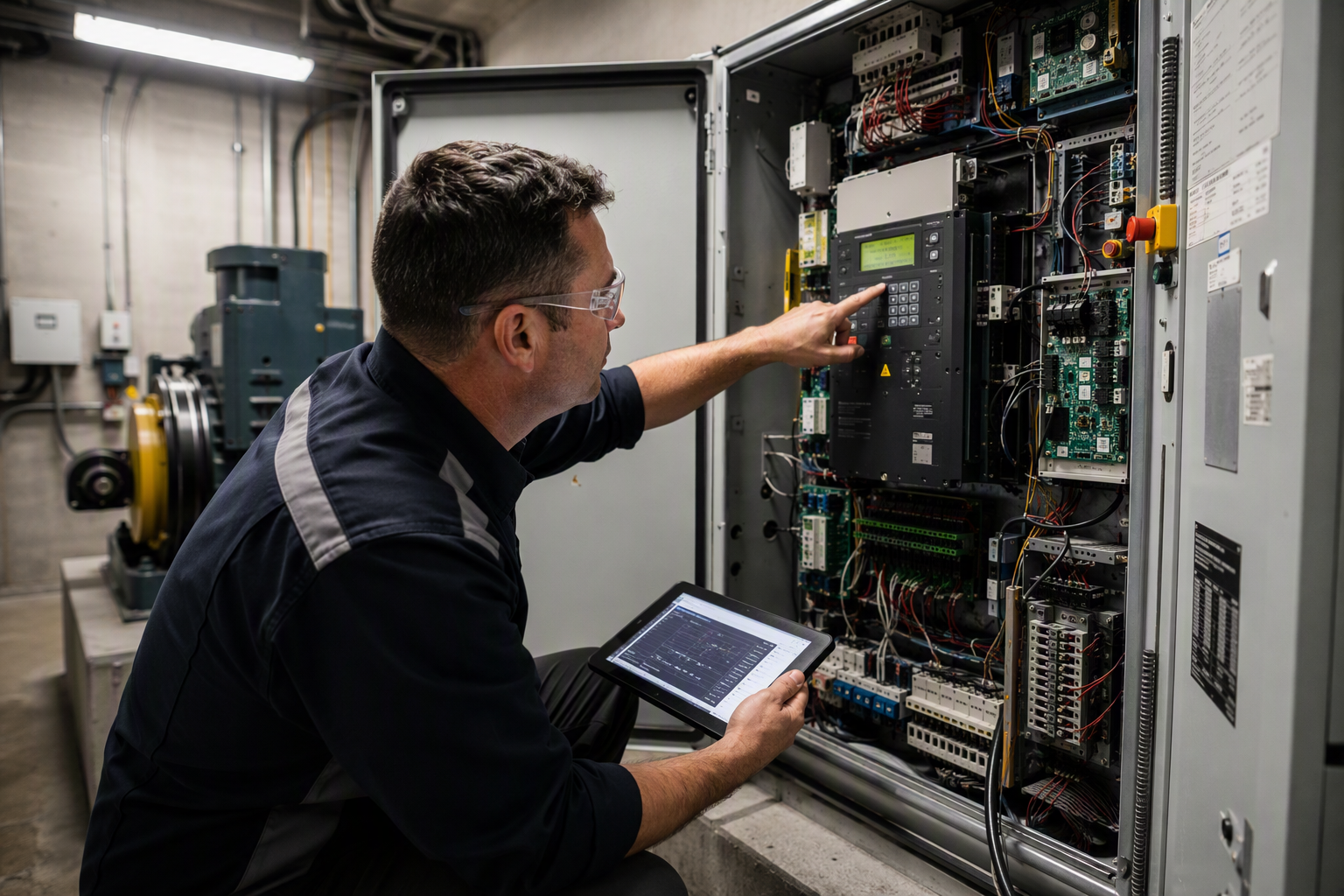
Contact your building’s elevator maintenance contractor immediately as the first call, followed by building management if you are a tenant — and call 911 first if any passenger is trapped inside.
Elevator systems are specialized equipment governed by strict codes including the ASME A17.1 Safety Code for Elevators and Escalators. Only licensed elevator mechanics are authorized to diagnose, repair, and return a unit to service. Attempting to fix the problem without a qualified technician — or allowing untrained personnel to manually open doors — creates serious injury risk and potential code violations.
Property managers in Baltimore, Washington DC, Philadelphia, and Richmond should keep their elevator service contractor’s emergency contact number posted in the machine room, the elevator lobby, and the building management office. Quality Elevator Company provides service across all four of these markets and maintains contact information accessible to building teams at any hour.
What is the very first thing to do when an elevator stops working?
The very first thing to do is determine whether anyone is trapped inside the elevator car before taking any other action.
- Listen and communicate: Stand at the elevator doors and call out clearly. Most elevator cabs have an emergency phone or intercom — verify it is functioning and establish two-way communication with any passenger inside.
- Call 911 if anyone is trapped: Entrapments are treated as emergencies. Local fire departments in Baltimore, DC, Philadelphia, and Richmond have trained rescue units equipped to safely release passengers without damaging the equipment further.
- Do not force the doors: Manually forcing elevator doors open without knowing the car’s position risks a passenger falling into the hoistway — a potentially fatal hazard.
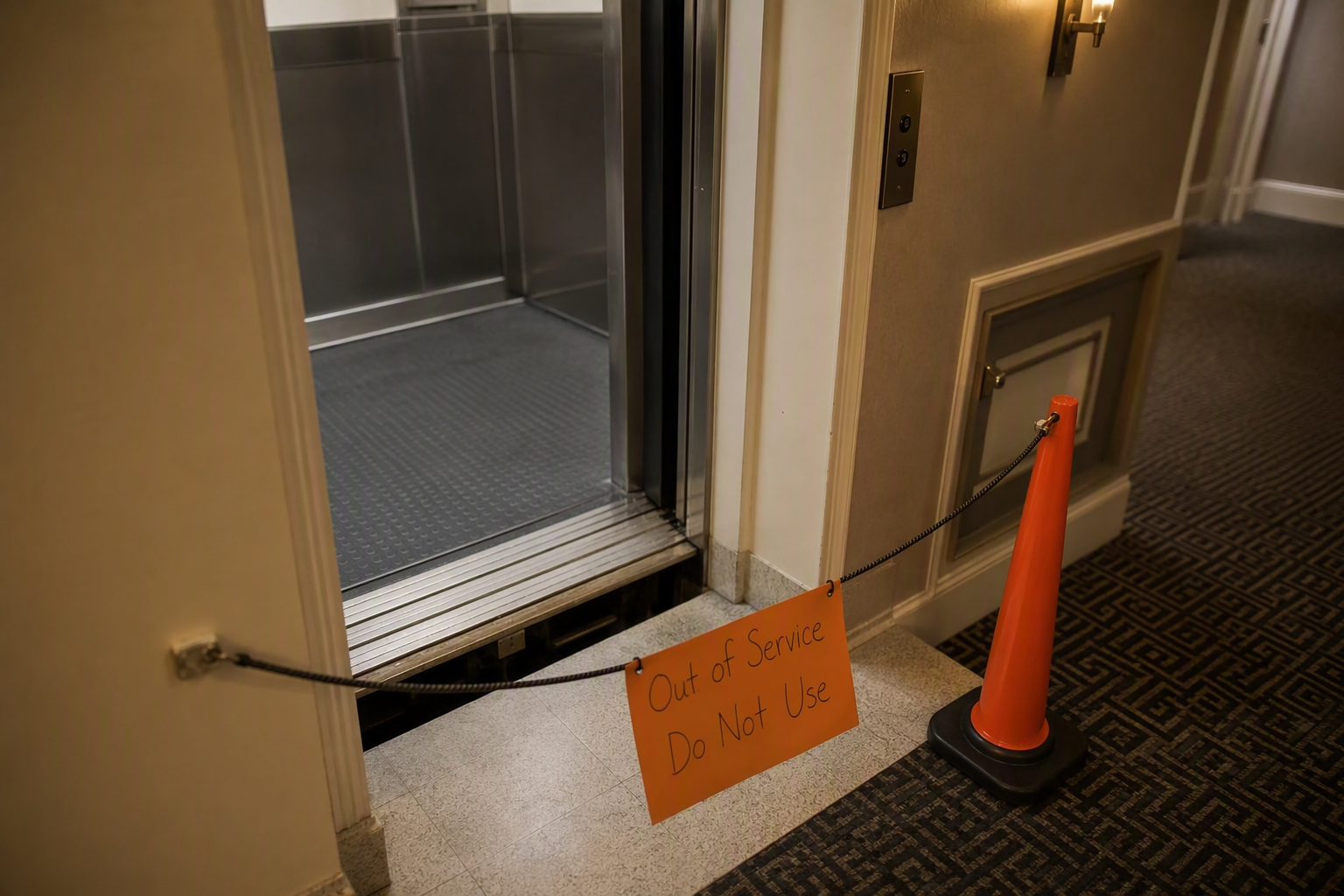
- Secure the lobby: Block access to the elevator call buttons with rope barriers or cones and place clearly visible “Out of Service — Do Not Use” signage on every floor where the unit serves.
- Notify building management: Alert the property manager or building operations team so they can coordinate alternative access, particularly for ADA-dependent occupants who rely on the elevator under the Americans with Disabilities Act.
- Contact your elevator service contractor: Provide the contractor with the elevator unit number, the last known position of the car (floor number), any error codes displayed on the controller panel, and a description of what the elevator was doing before it stopped.
- Document the incident: Note the time, date, any unusual sounds or behavior observed before the shutdown, and the names of any witnesses. This record supports maintenance logs, insurance claims, and regulatory inspections.
Is a trapped passenger in an elevator a 911 emergency?
Yes — any passenger trapped inside a stalled elevator car is a 911 emergency, regardless of how stable the situation appears.
Passengers may have medical conditions, anxiety disorders, or physical vulnerabilities that escalate quickly in confined spaces. Heat buildup inside an elevator cab can also become a health risk within a short period, particularly during summer months in cities like Washington DC and Philadelphia. Fire departments have the authority and equipment to perform safe rescues from elevator hoistways.
Building owners and managers should never attempt to lower or raise the car manually to free a passenger unless they have been specifically trained and authorized to perform emergency lowering procedures under the elevator’s maintenance agreement and local jurisdiction requirements.
Who is legally responsible for a broken elevator in a commercial building?
Legal responsibility for a broken elevator typically rests with the building owner, who is required by state and local law to maintain the equipment in safe operating condition and keep inspections current.
In Maryland, Virginia, Pennsylvania, and the District of Columbia, building owners must hold valid elevator operating permits and ensure periodic inspections are conducted by a state-authorized inspector. Failure to maintain an elevator in safe condition can expose owners to liability under negligence law, civil penalties from the relevant state labor or building department, and permit suspension. Consulting legal counsel for jurisdiction-specific obligations is strongly advised.
What information should I have ready when I call an elevator service company?
Before calling, gather the elevator’s unit ID number, the building address, the car’s last known floor position, any displayed fault codes, and a description of the malfunction.
The more detail a technician receives before arriving on site, the faster the diagnostic process. Useful information includes:
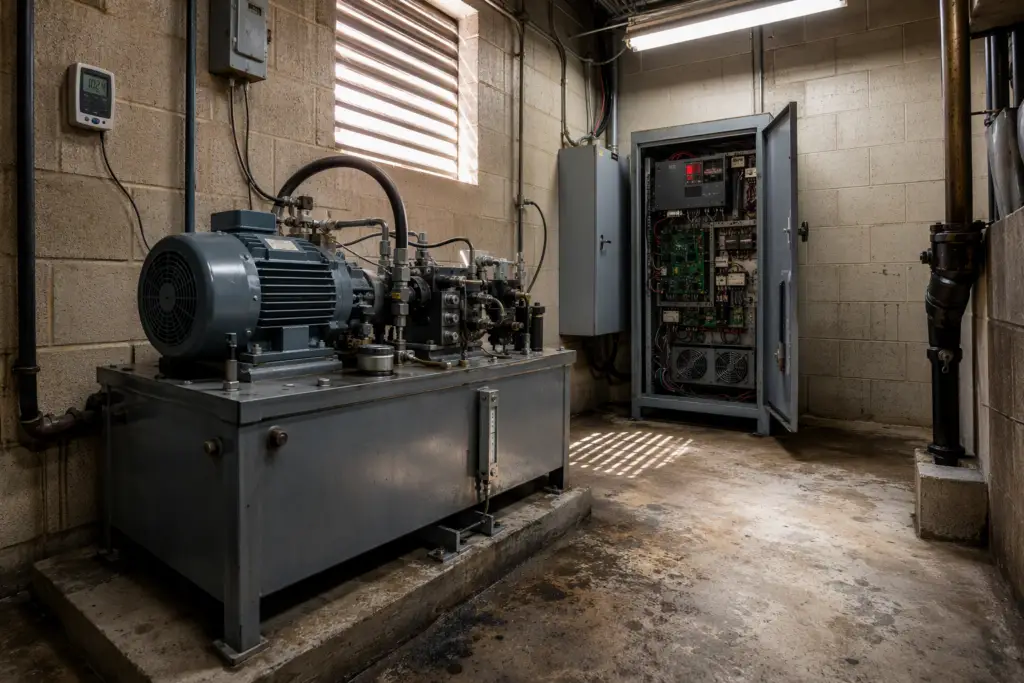
- Elevator make and model (found on the equipment data plate in the machine room)
- Permit or certificate number (posted inside the cab by law in most jurisdictions)
- Whether the elevator is hydraulic, traction, or machine-room-less (MRL)
- Number of stops the unit serves
- Any recent maintenance history or known recurring issues
- Whether the building has a machine room and where it is located
Quality Elevator Company serves buildings across Baltimore, Washington DC, Philadelphia, and Richmond and uses this intake information to dispatch the right equipment and parts, reducing unnecessary return trips.
What are the most common reasons an elevator goes out of service?
The most common causes of elevator outages include door malfunctions, electrical faults, hydraulic fluid issues, worn mechanical components, and failed safety device trips.
Door systems account for a large proportion of elevator service calls. Misaligned door panels, worn gibs, faulty door operators, or obstructed safety edges can cause a unit to stop and refuse to move. Electrical issues — such as blown fuses, tripped circuit breakers, or controller board failures — are also frequent culprits. Hydraulic elevators may stop due to low fluid levels, leaking cylinders, or pump motor failures. Traction elevators can trip on safety devices including governors, safeties, and buffer conditions that trigger when the system detects an out-of-tolerance speed or load condition.
Regular preventive maintenance — as outlined in ASME A17.1 — is the most effective way to reduce unplanned outages.
How long can a building legally operate with an elevator out of service?
There is no universal allowable “downtime” period written into elevator codes, but buildings subject to ADA accessibility requirements must provide equivalent access and may face complaints or regulatory action if an accessible route is unavailable for an extended time.
Under the Americans with Disabilities Act, facilities covered by Title II (state and local government) and Title III (places of public accommodation) must maintain accessible features in operable condition. Extended elevator outages without alternative accommodations may constitute an ADA violation. Local jurisdictions — including Baltimore City, DC, the City of Philadelphia, and Richmond — may have additional ordinances governing how quickly an out-of-service unit must be reported and restored.
Building owners should contact their elevator service contractor as soon as a unit goes down and request a documented timeline for repair to protect themselves legally.
Do I need to report an elevator outage to a government agency?
In many jurisdictions, elevator outages — especially those involving accidents, injuries, or entrapments — must be reported to the state elevator inspection authority within a specified timeframe.
| Jurisdiction | Governing Body | Incident Reporting Required? | Reporting Timeframe (Accidents/Injuries) | Permit Renewal Tied to Inspections? |
|---|---|---|---|---|
| Maryland (Baltimore) | MD Dept. of Labor – Elevator Safety Unit | Yes – accidents and entrapments | As soon as practicable; check current MD regulations | Yes |
| Washington DC | DC Dept. of Consumer & Regulatory Affairs (DCRA) | Yes – accidents and entrapments | Promptly; check current DCRA requirements | Yes |
| Pennsylvania (Philadelphia) | PA Dept. of Labor & Industry – Elevator Division | Yes – accidents and injuries | As soon as practicable; check current PA regulations | Yes |
| Virginia (Richmond) | VA Dept. of Labor & Industry (DOLI) | Yes – accidents, injuries, entrapments | Promptly; check current VA DOLI regulations | Yes |
Note: Reporting requirements change. Always verify current requirements with the relevant state agency or your licensed elevator contractor. The above table is a general reference only.
Even when reporting is not legally mandated for a non-injury outage, documenting the event in your maintenance log is considered best practice and may be required during the next periodic inspection.
What should building staff never do when an elevator is out of service?
Building staff should never attempt to manually open elevator doors, enter the hoistway, operate controls they are not trained for, or reset the elevator without understanding the cause of the shutdown.
Hoistways present severe fall hazards. The Occupational Safety and Health Administration (OSHA) classifies hoistways as confined spaces and fall-hazard areas with specific requirements for authorized entry. Building engineers or maintenance personnel — unless they are licensed elevator mechanics — should treat the hoistway as a restricted zone. Improperly resetting an elevator that tripped a safety device can mask a dangerous underlying condition and create risk for the next passenger who uses the unit.
Can a building engineer or janitor reset an elevator after it stops?
A non-licensed building employee may only perform very limited actions — such as pressing a reset button on a machine room controller if explicitly trained and authorized to do so — but should not perform any diagnostic or repair work.
Some elevator controllers have a simple reset procedure (similar to a circuit breaker reset) that clears a nuisance trip. Whether a building employee is permitted to perform this action depends on the jurisdiction, the terms of the maintenance contract, and the nature of the shutdown. If there is any uncertainty about why the elevator stopped, the safest course is to contact a licensed contractor. Quality Elevator Company can advise building managers on what limited in-house actions are appropriate for specific equipment types in Baltimore, DC, Philadelphia, and Richmond properties.
What is the role of the elevator maintenance contract when a unit goes out of service?
A maintenance contract defines the contractor’s obligations for response, repair scope, parts coverage, and documentation when an elevator goes out of service.
Maintenance contracts typically fall into three categories:
- Oil and Grease (Lubrication Only): The contractor handles routine lubrication and minor adjustments. Parts and major repairs are billed separately.
- Examination and Adjustment: Broader coverage that includes inspections, adjustments, and cleaning, but typically excludes parts.
- Full Maintenance (Comprehensive): Covers most parts, labor, and adjustments. This type provides the most predictable cost and typically includes priority response provisions.
Building owners should review their contract carefully to understand what is covered during an unplanned outage. Contract terms also affect who is responsible for scheduling state inspections and obtaining operating permits — a critical compliance detail in all four markets served by Quality Elevator Company.
How does ADA compliance factor in when an elevator is out of service?
Under the Americans with Disabilities Act, covered facilities must maintain accessible routes and cannot simply close an elevator without providing an alternative means of access for people with disabilities.
When an elevator goes out of service in a multi-story building, facilities covered under the ADA must consider interim accommodations — such as relocating services to an accessible floor, providing temporary assistance, or posting accessible alternatives — to avoid complaint or enforcement action. Documenting all steps taken to maintain access during an outage is strongly advisable. Extended or repeated outages may trigger ADA complaints with the U.S. Department of Justice or the relevant state civil rights office.
What happens during an elevator service call after a breakdown?
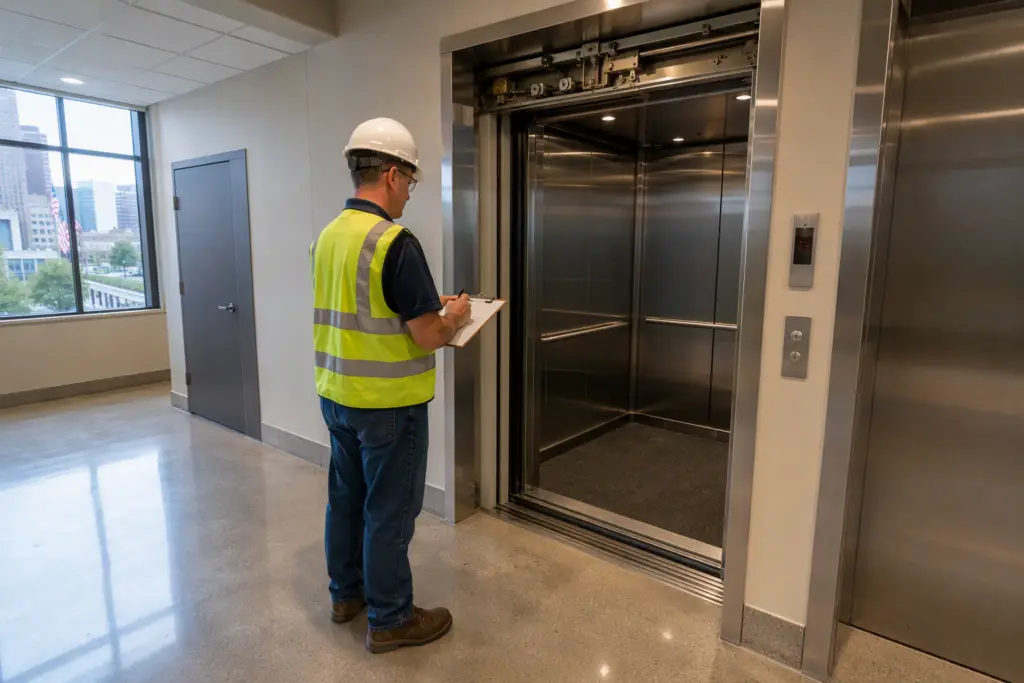
During a breakdown service call, a licensed elevator mechanic assesses the unit, identifies the fault condition, performs authorized repairs, tests all safety devices, and conducts an operational test before returning the elevator to service.
The sequence typically follows this process:
- The technician reviews the maintenance history and any fault codes logged by the controller.
- A visual and mechanical inspection of the machine room, controller, and drive system is performed.
- The technician enters the hoistway only if necessary and only with proper lockout/tagout procedures per OSHA standards.
- The root cause is identified and repaired using authorized replacement parts.
- All safety devices — including door interlocks, safeties, governors, and buffers — are tested as required by ASME A17.1.
- A full operational run test is performed across all floors.
- The mechanic documents the repair in the maintenance log, which must be kept on site.
How often should elevators be inspected to prevent unplanned outages?
Most jurisdictions require annual periodic inspections by a state-authorized inspector, and ASME A17.1 prescribes specific test intervals for safety devices — preventive maintenance visits are recommended far more frequently.
The ASME A17.1 Safety Code for Elevators and Escalators provides a detailed maintenance control program (MCP) framework that defines the tasks and intervals required for different elevator components. State jurisdictions in Maryland, DC, Pennsylvania, and Virginia adopt versions of ASME A17.1 as their base code and layer additional local inspection requirements on top. Periodic inspections catch developing issues — worn brake linings, fraying hoist ropes, deteriorating buffers — before they cause an unplanned outage or a safety incident.
What is the difference between a periodic inspection and a safety test for elevators?
A periodic inspection is a regular visual and operational check of the elevator’s components, while a safety test is a formal, load-bearing or performance test of specific safety systems performed at intervals defined by code.
Under ASME A17.1, safety tests — such as the Category 1 and Category 5 tests for traction elevators, and pressure tests for hydraulic units — must be performed by a licensed contractor and witnessed by the jurisdiction’s inspector. Failing a required safety test typically results in a “do not operate” order, meaning the elevator is legally out of service until deficiencies are corrected and a passing test is witnessed. Staying ahead of test due dates is one of the most effective ways to avoid unexpected forced shutdowns.
What should tenants and occupants do if they notice an elevator acting strangely before it breaks down?
Tenants should immediately report unusual elevator behavior — such as rough rides, unusual sounds, slow leveling, or doors that hesitate — to building management in writing so it can be documented and conveyed to the service contractor.
Early warning signs of an impending elevator failure include:
- Doors that do not open or close smoothly or fully on the first attempt
- Excessive vibration or swaying during travel
- Unusual grinding, clicking, or humming sounds from the machine room or pit
- The car stopping slightly above or below the floor level (poor leveling)
- Delays in response to hall calls or car calls
- Intermittent loss of lighting or button illumination inside the cab
Building managers who receive these reports should log them and contact their elevator contractor. Proactive intervention based on symptom reports frequently prevents full outages.
How should a building communicate an elevator outage to its occupants?
Buildings should post clear, prominent “Out of Service” notices at every floor landing, communicate via email or building management system alerts, and specifically identify alternative accessible routes for occupants with mobility needs.
Effective outage communication reduces frustration, minimizes repeated passenger attempts to use the unit (which can worsen the malfunction or cause injuries), and demonstrates that management is responding proactively. For buildings serving vulnerable populations — senior living facilities, medical offices, or government buildings — direct individual notification of affected occupants may be necessary to meet duty-of-care obligations.
Are elevator contractors required to keep records of repairs and inspections?
Yes — ASME A17.1 and state regulations in Maryland, DC, Pennsylvania, and Virginia require that maintenance and inspection records be kept on site and made available to inspectors upon request.
The maintenance log is a legal document. It records every service visit, inspection, test, and repair performed on the unit. In the event of an accident or injury, the log is among the first documents requested by investigators, attorneys, and regulatory agencies. Gaps in the log — or missing records — can be used as evidence of negligent maintenance. Building owners should confirm with their service contractor that records are being maintained in the format required by their jurisdiction.
What factors affect how long it takes to repair an out-of-service elevator?
Repair time depends on the nature of the fault, parts availability, the elevator’s age and make, and whether the repair requires a follow-up inspection by a state inspector before the unit can return to service.
Minor repairs — such as replacing a worn door contact or resetting a tripped safety device — may be completed within hours. Major repairs — such as replacing a hydraulic cylinder, a controller board, or hoist ropes — may require parts that need to be ordered and lead times that vary by equipment manufacturer. Older or proprietary elevator systems can present parts availability challenges. After certain major repairs, a state inspector may need to conduct a follow-up inspection before the elevator is cleared to operate, which introduces scheduling variables outside the contractor’s control. Quality Elevator Company maintains relationships with parts suppliers across the Baltimore, DC, Philadelphia, and Richmond regions to help reduce lead times on common components.
When should a building owner consider replacing rather than repairing an out-of-service elevator?
Replacement becomes the more practical option when repair costs approach or exceed a significant portion of modernization cost, when parts are no longer available, when the unit repeatedly fails, or when the equipment cannot be brought into compliance with current code requirements.
A licensed elevator contractor can provide a written condition assessment comparing the cost and risk profile of continued repair versus a full modernization. Modernization replaces the elevator’s major systems — controller, drive, cab, and sometimes the hoistway equipment — while retaining the existing shaft structure. Modern systems typically offer improved energy efficiency, enhanced safety features aligned with the current edition of ASME A17.1, and better reliability. Building owners who are making this decision should obtain a formal assessment rather than relying solely on the judgment of whoever responded to the most recent service call.
How do I choose the right elevator service company for an emergency repair?
Choose a licensed elevator contractor with technicians holding valid state mechanic licenses for your jurisdiction, verifiable experience with your elevator type, and a clear emergency response process — not simply the lowest price.
Key criteria to evaluate include:
- State licensure in the jurisdiction where your building is located (Maryland, DC, Pennsylvania, or Virginia each have their own requirements)
- Familiarity with the specific make and model of your equipment
- Transparent maintenance contracts with clearly defined scope
- A documented process for emergency response, dispatch, and follow-up
- References from comparable building types in your market
- Proper insurance and bonding
Quality Elevator Company is a certified elevator service provider operating across Baltimore MD, Washington DC, Philadelphia PA, and Richmond VA, bringing the technical resources and local regulatory knowledge needed to handle both emergency breakdowns and ongoing compliance requirements across all four markets.
Get Professional Help for Your Out-of-Service Elevator
An elevator out of service is not just an inconvenience — it is a liability, an accessibility obligation, and potentially a safety emergency. The right move is to contact a licensed, experienced elevator contractor immediately.
Contact Quality Elevator Company for a free elevator assessment. Serving Baltimore MD, Washington DC, Philadelphia PA, and Richmond VA, Quality Elevator Company’s licensed technicians are equipped to diagnose breakdowns, restore service, and keep your elevator in full code compliance.
Call now: 301-307-5363
Need elevator service you can rely on? Quality Elevator Company is ready to help.