How to Get Multiple Elevator Service Bids and Compare Them Fairly in Healthcare Facilities
Healthcare facilities in Baltimore, Washington DC, Philadelphia, and Richmond depend on elevators around the clock. A patient transport elevator that goes offline during a shift change or a surgical supply lift that stalls between floors is not simply an inconvenience—it is a patient safety event. That reality makes choosing the right elevator service contractor one of the most consequential facilities management decisions a hospital or medical office building can make. The bidding process, done correctly, protects both the budget and the people inside the building.
What Should Every Healthcare Elevator Service Bid Include?

A complete, comparable bid for healthcare elevator maintenance or modernization must cover each of the following elements. If a proposal you receive omits any of these, it is not a fair basis for comparison.
- Scope of inspection and maintenance tasks — a line-by-line list of what is inspected and serviced during each visit, not a generic “full maintenance” descriptor.
- Compliance with ASME A17.1 Safety Code for Elevators and Escalators — the baseline safety code governing new and existing elevator installations, including hospitals and medical buildings.
- Compliance with ASME A17.3 Safety Code for Existing Elevators and Escalators — this code governs retroactive requirements for older equipment and is particularly relevant for legacy hospital infrastructure.
- ADA accessibility compliance — the Americans with Disabilities Act sets specific requirements for elevator cab dimensions, door timing, control panel height, and Braille signage that are especially critical in patient-facing environments.
- State and local inspection coordination — Maryland, Virginia, Pennsylvania, and the District of Columbia each have their own elevator inspection authorities. Bids should specify who coordinates with the Authority Having Jurisdiction (AHJ) and who is responsible for obtaining and posting inspection certificates.
- Parts and labor terms — are replacement parts billed separately, and what is the markup? Is labor for callbacks included in the contract price?
- Emergency and callback provisions — what defines an emergency, and what triggers a callback visit?
- Documentation and reporting — does the contractor provide written maintenance logs after every visit? Healthcare facilities often require detailed records for accreditation purposes.
How Many Bids Should a Healthcare Facility Collect?
Facilities management professionals generally recommend soliciting a minimum of three bids for any elevator service contract. Three proposals give procurement teams a meaningful range of pricing structures, service philosophies, and contract terms. Fewer than three limits the comparison; more than five can create administrative burden without proportionate benefit. Quality Elevator Company recommends that healthcare clients issue a written Request for Proposal (RFP) rather than accepting verbal or informal quotes, because only a written RFP guarantees that all bidders are responding to identical requirements.
What Is a Scope of Work Document and Why Does It Matter for Fair Bidding?
A Scope of Work (SOW) document is the single most important tool for ensuring that competing bids are genuinely comparable. When each contractor receives the same SOW, every proposal addresses the same elevator inventory, the same inspection frequencies, the same compliance requirements, and the same performance expectations. Without a shared SOW, one contractor may price a basic lubrication-and-inspection contract while another prices a comprehensive parts-inclusive agreement—and the lower number on paper is almost certainly not the lower cost over the life of the contract.
A healthcare-specific SOW should itemize every elevator and lift in the facility, including patient transport elevators, service elevators, dumbwaiters, and any pneumatic or hydraulic lifts used for medical supplies or linen. It should also specify whether the contract covers modernization, routine maintenance, or both.
Which Compliance Codes Apply Specifically to Healthcare Elevators in Maryland, Virginia, Pennsylvania, and DC?
Healthcare elevator compliance in the Quality Elevator Company service region is governed by a layered set of federal and state-level requirements:
- ASME A17.1 Safety Code for Elevators and Escalators — the nationally recognized design and construction standard adopted by reference in Maryland, Virginia, Pennsylvania, and the District of Columbia.
- ASME A17.3 Safety Code for Existing Elevators and Escalators — governs retroactive safety upgrades for existing installations and is directly relevant to older hospital buildings throughout the region.
- Americans with Disabilities Act (ADA) — Title III requirements apply to hospitals and medical office buildings as places of public accommodation; Title II applies to government-operated healthcare facilities. Both mandate accessible elevator design.
- State-specific inspection requirements — each jurisdiction (Maryland Department of Labor, Virginia Department of Labor and Industry, Pennsylvania Department of Labor and Industry, and the DC Department of Consumer and Regulatory Affairs) sets its own inspection intervals and certificate-posting requirements. Any bid you receive should demonstrate the contractor’s familiarity with the specific AHJ for your facility’s location.
- OSHA standards — elevator maintenance workers operating in healthcare environments are subject to federal OSHA requirements, including lockout/tagout procedures (29 CFR 1910.147) that protect both technicians and facility staff during service visits.
Any bid that does not explicitly reference the applicable AHJ for your jurisdiction should be questioned before acceptance.
How Do You Evaluate Total Cost of Ownership Instead of Just the Monthly Fee?
The monthly maintenance fee is only one component of what a healthcare facility actually pays for elevator service. A fair comparison accounts for the following cost categories across every bid received:
- Base contract price — the recurring monthly or annual fee for scheduled maintenance visits.
- Parts coverage — determine whether parts are included, excluded, or covered up to a per-incident cap. Excluded-parts contracts can appear inexpensive until a major component fails.
- Callback and emergency labor rates — identify the hourly rate for after-hours service calls and whether callbacks within a defined period are billed separately.
- Modernization and capital repair provisions — some contracts bundle modernization recommendations; others do not. Understand what triggers a capital recommendation and what the projected costs would be.
- Inspection and permit fees — clarify whether state or local inspection fees are included in the contract or billed as pass-throughs.
- Contract escalation clauses — review whether the contract price can increase annually, by how much, and under what conditions.
- Termination terms — understand the notice period and any early termination penalties before signing.
What Red Flags Should a Healthcare Procurement Team Watch for in Elevator Bids?
Not every bid is submitted in good faith, and some proposals are structured to win on price while building in recovery through callbacks and parts markups. Watch for these warning signs:
- No itemized list of covered tasks — generic language like “full maintenance” without specifics.
- Parts excluded entirely — creates unlimited liability for the facility once a component wears.
- No mention of ASME A17.1 or A17.3 compliance — a contractor unfamiliar with applicable codes is a compliance risk.
- No documented AHJ coordination plan — in Maryland, Virginia, Pennsylvania, and DC, inspections are mandatory and certificates must be current.
- Verbal-only quotes — anything not in writing cannot be enforced.
- Unusually short contract terms offered without explanation — may indicate a contractor who cannot commit to long-term parts availability or staffing.
Questions Your Inspector Will Ask
When a state-authorized elevator inspector visits your healthcare facility—whether in Maryland, Virginia, Pennsylvania, or the District of Columbia—they will typically review the following. Knowing these questions in advance helps your facility and your service contractor stay audit-ready:
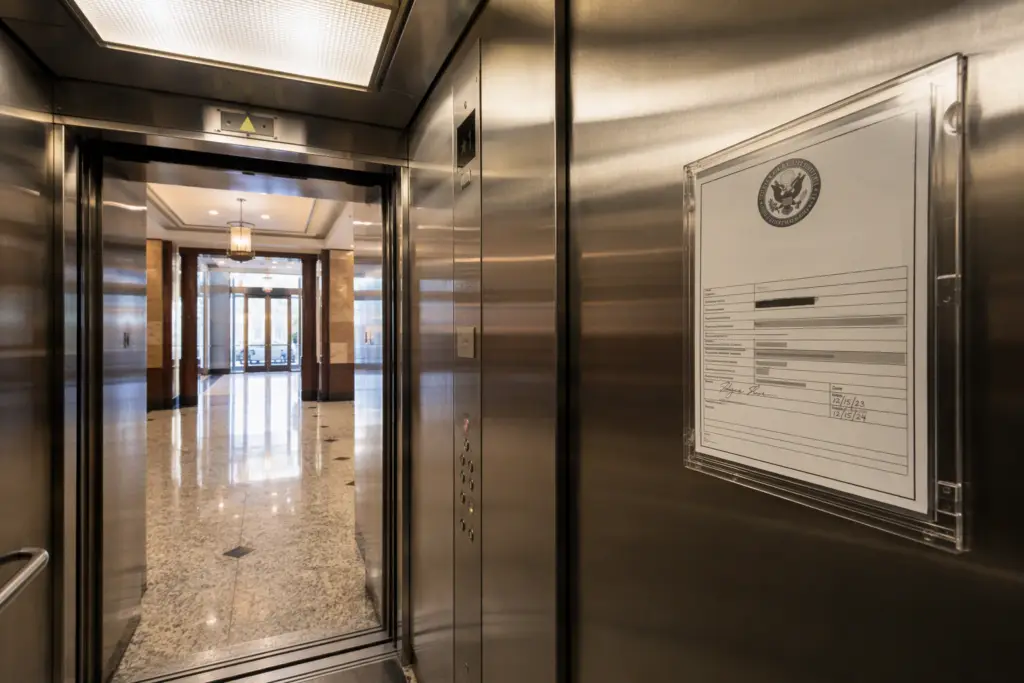
- Is the current inspection certificate posted inside the elevator cab as required by the applicable state or DC regulation?
- Is the maintenance logbook current, and does it document each service visit with date, technician identification, and tasks performed?
- Have all deficiencies from the previous inspection been corrected and documented?
- Are safety devices—including governors, safeties, buffers, and door protective devices—tested and recorded at the required intervals under ASME A17.1?
- Do elevator controls comply with ADA requirements, including control height, tactile characters, and audible signals?
- Is the machine room secure, properly ventilated, and free of storage unrelated to elevator equipment?
- Has the contractor performed and documented the required periodic tests, including full-load tests for hydraulic elevators where applicable under the jurisdiction’s adopted code?
- Are emergency communication systems functional and tested in accordance with ASME A17.1 requirements?
Quality Elevator Company structures its maintenance programs to ensure clients can answer every one of these questions affirmatively before an inspector arrives.
How Should a Healthcare Facility Verify a Contractor’s Qualifications Before Awarding a Bid?
Before awarding a contract based on the lowest bid, facilities management teams should verify the following from each competing contractor:
- Confirm that the contractor holds the elevator contractor license or registration required by the state or jurisdiction where your facility operates.
- Request a current certificate of insurance, including general liability and workers’ compensation coverage appropriate for healthcare environments.
- Ask for references from other healthcare clients—hospitals, medical office buildings, or long-term care facilities—in the same region.
- Confirm that the contractor’s technicians hold certifications recognized by the applicable AHJ for your jurisdiction.
- Review the contractor’s familiarity with your elevator manufacturer’s equipment, since proprietary systems may require manufacturer-authorized service.
- Ask how the contractor documents and communicates compliance status to facility management after each visit.
Is a Lower Bid Always Better for a Healthcare Facility?
In healthcare settings, elevator downtime has consequences that extend well beyond inconvenience. A patient transport elevator out of service may require staff to manually relocate patients, delay procedures, or trigger incident documentation. When evaluating bids, facilities management teams should weigh service reliability, documentation quality, compliance expertise, and contractor responsiveness alongside price. The facility that selects a contractor solely on the lowest monthly fee and experiences repeated callbacks, failed inspections, or extended downtime will often pay more in aggregate than one that invested in a comprehensive contract from a qualified provider. Quality Elevator Company advises healthcare clients throughout Baltimore, Washington DC, Philadelphia, and Richmond to request a formal scope-matched comparison before making a final decision.
How Often Should Healthcare Elevators Be Inspected and Maintained?
Inspection and maintenance intervals for healthcare elevators are governed by the applicable state AHJ and the edition of ASME A17.1 or A17.3 adopted in each jurisdiction. Routine maintenance—lubrication, adjustment, and safety checks—is typically performed more frequently than the minimum inspection interval required for certificate renewal. Healthcare facilities should ask each bidding contractor to specify the proposed maintenance visit frequency in writing and to explain how that frequency aligns with both the manufacturer’s recommendations and the applicable code requirements in Maryland, Virginia, Pennsylvania, or DC.
What Role Does Documentation Play in Ongoing Healthcare Elevator Compliance?
Accreditation bodies that evaluate hospitals and healthcare systems often review facilities management records, including elevator maintenance logs and inspection certificates, as part of their site reviews. A contractor who provides thorough written documentation after every visit—recording tasks completed, safety device status, any deficiencies noted, and corrective actions taken—gives the facility a defensible compliance record. Quality Elevator Company provides detailed maintenance documentation to healthcare clients after every service visit, supporting both regulatory compliance and internal facilities management reporting. Facilities in Baltimore, Washington DC, Philadelphia, and Richmond that are subject to accreditation review should confirm documentation practices with every contractor before awarding a contract.
Get a Fair, Scope-Matched Elevator Assessment for Your Healthcare Facility
Comparing elevator service bids is only meaningful when every proposal covers the same ground. Quality Elevator Company provides healthcare facilities throughout Baltimore, Washington DC, Philadelphia, and Richmond with transparent, itemized proposals built around the specific compliance requirements and equipment inventory of each client’s building. Before you sign any elevator service contract, make sure you have the full picture.
Contact Quality Elevator Company for a free elevator assessment: 301-779-9116
Need elevator service you can rely on? Quality Elevator Company is ready to help.