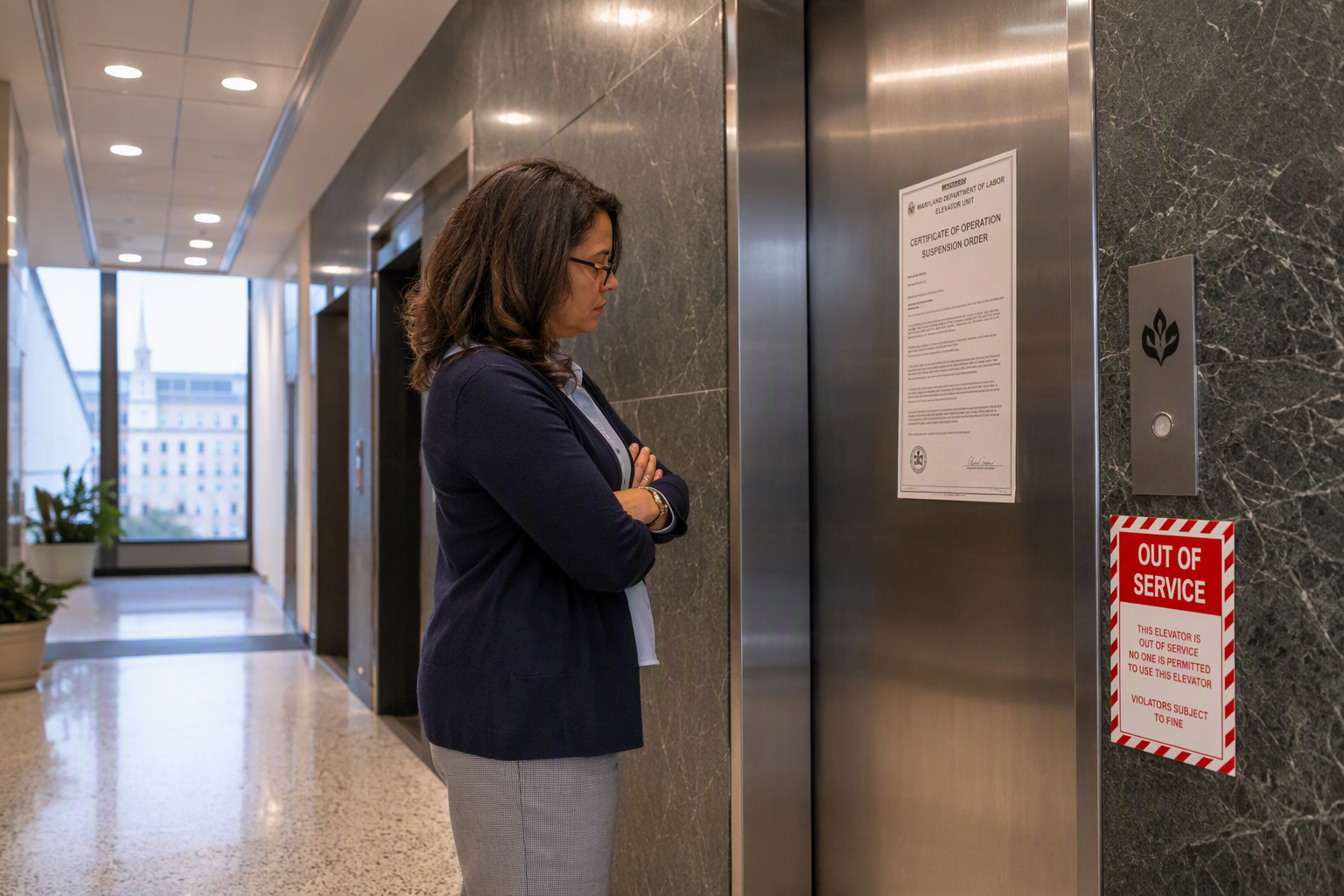
What Should I Do When My Elevator Fails Inspection and Gets Shut Down by the State?
An elevator shutdown by a state or local Authority Having Jurisdiction (AHJ) is a serious compliance event that affects building operations, tenant access, and — depending on your property type — ADA obligations. This FAQ hub covers every step of the process, from the moment the inspector posts the shutdown order through reinspection and return to service, with specific guidance for building owners and facility managers in Maryland, Washington DC, Pennsylvania, and Virginia.
What exactly happens when an elevator fails a state inspection?
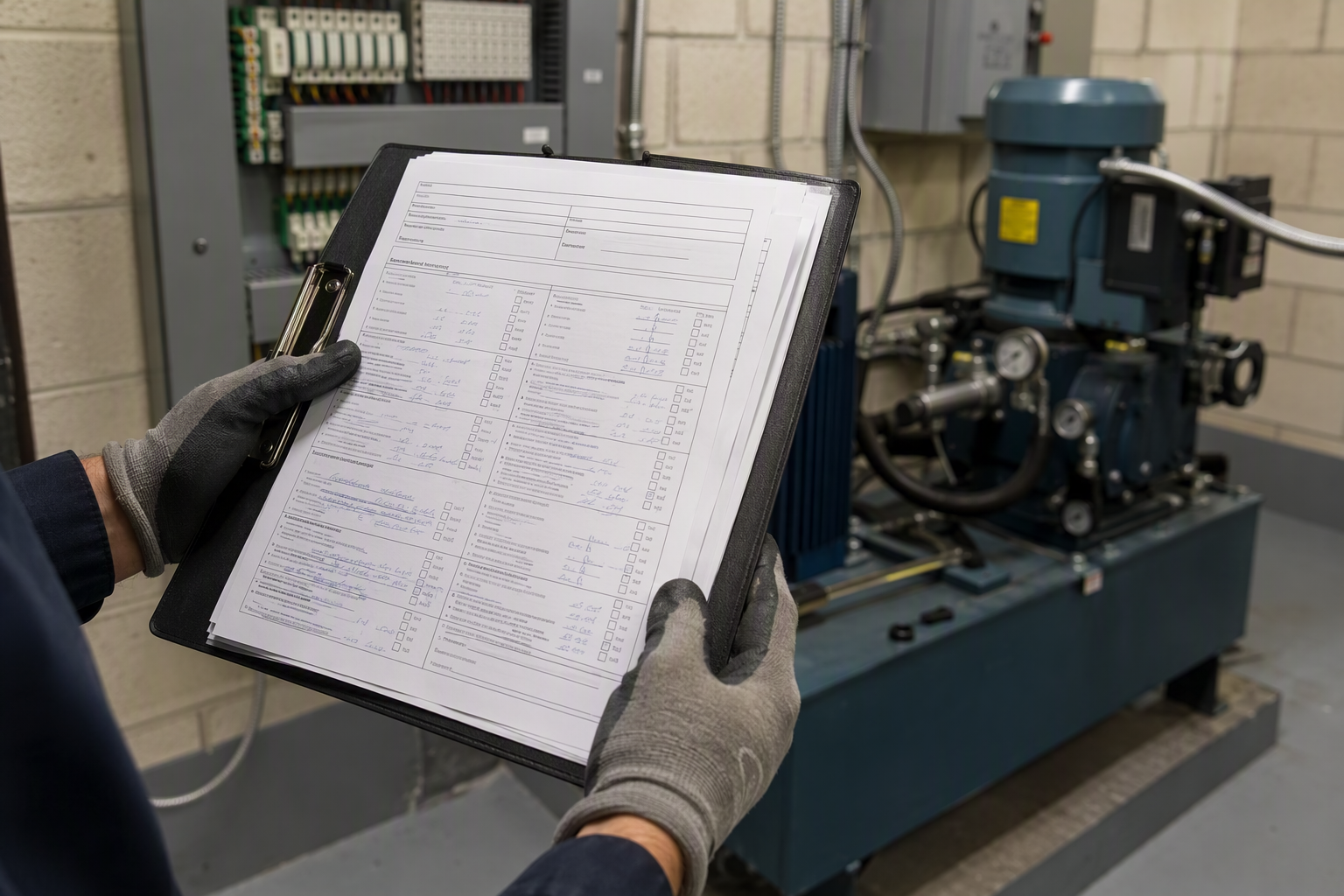
When an elevator fails inspection, the AHJ inspector issues a written violation notice, affixes an out-of-service tag or placard to the elevator, and may immediately order the car to remain at the lowest landing with doors open until repairs are completed and the unit passes reinspection.
The written notice will list each cited deficiency by code reference, typically under the ASME A17.1 Safety Code for Elevators and Escalators for newer installations or ASME A17.3 for existing installations. The inspector assigns a correction deadline — which can range from 24 hours for an imminent safety hazard to 30 or 90 days for lower-priority items — and specifies whether partial or full shutdown is required. Failure to comply by the deadline can result in civil penalties, increased reinspection fees, or referral to the jurisdiction’s legal enforcement office.
What are my immediate legal obligations the moment an elevator is shut down?
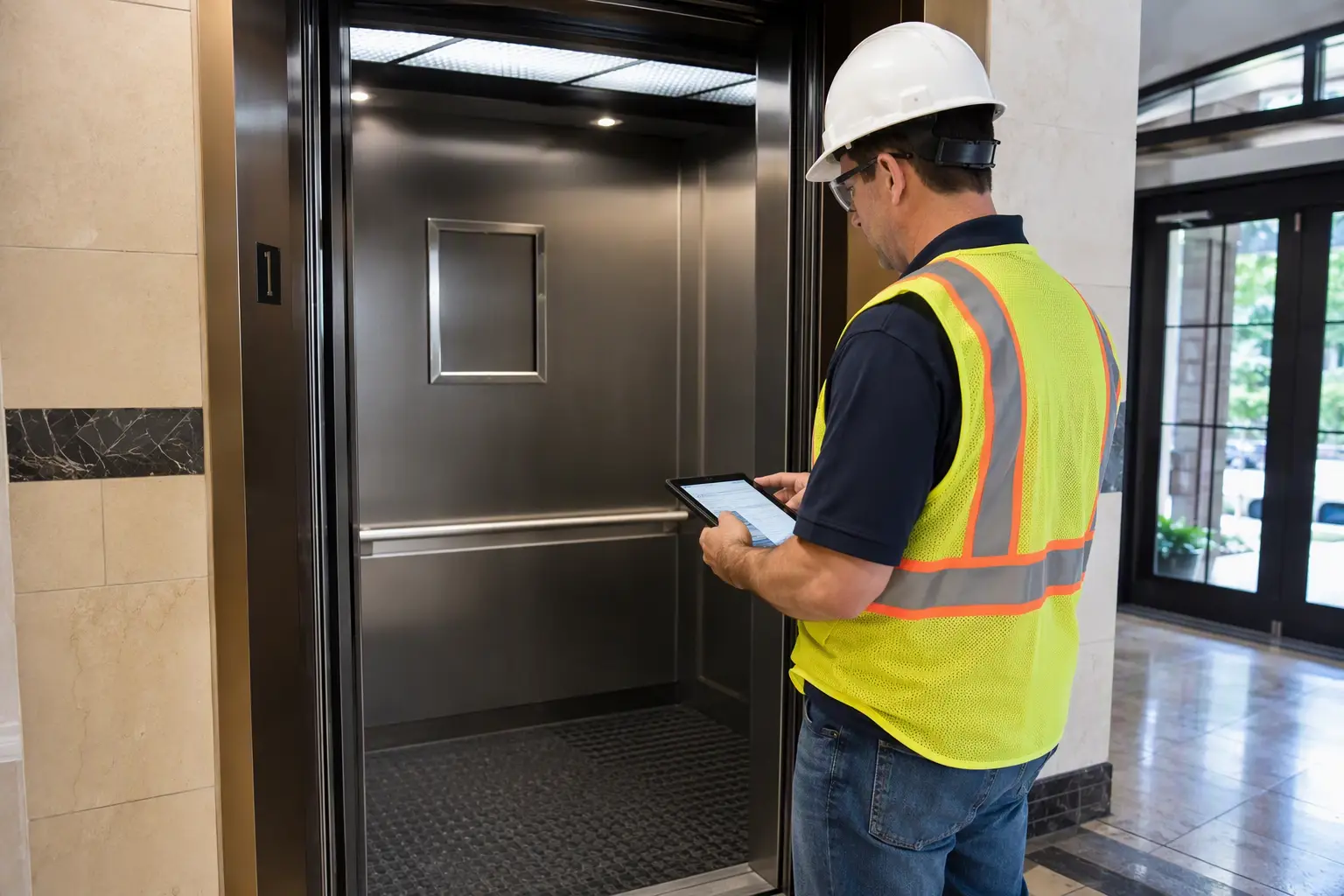
The moment an elevator is placed out of service by the AHJ, the building owner is legally obligated to ensure the unit is not operated, to post the required notices, and to notify affected tenants or building users of alternate vertical access.
Specific obligations vary by jurisdiction. In Maryland, the occupational safety framework and state elevator safety regulations require that only licensed elevator mechanics perform corrective work. Washington DC building code enforcement requires the owner to maintain documentation of the shutdown order on file. Pennsylvania’s Department of Labor and Industry administers elevator safety under its Uniform Construction Code, and Virginia’s Department of Labor and Industry (DOLI) oversees conveyance safety statewide — both require permit applications before repairs begin. Do not attempt to restore power or operate the elevator under any circumstances until the AHJ provides written clearance.
What are the exact steps I should take immediately after the shutdown order is issued?
Following a structured, sequential response reduces liability exposure and gets the elevator back in service as quickly as the AHJ allows.
- Secure the elevator. Ensure the car is parked at the lowest landing with doors open (or per the inspector’s specific instruction) and that all power to the unit is isolated if directed by the shutdown order.
- Post required notices. Affix an “Out of Service” placard at every call station on every floor served by the elevator. Removing or concealing an inspector’s tag is a separate violation.
- Read the violation notice in full. Identify every cited deficiency, the associated code references, and the compliance deadline for each item.
- Notify occupants and management. Alert tenants, staff, and building management immediately. For multi-tenant commercial properties, this is often a lease obligation as well as a courtesy.
- Assess ADA impact. If the elevator is the only accessible route to any floor, consult the ADA Title II or Title III requirements relevant to your property type and develop a temporary accommodation plan.
- Contact a licensed elevator contractor. Engage a licensed elevator company to conduct a technical assessment of all cited deficiencies before pulling permits. Quality Elevator Company provides assessments for building owners throughout Baltimore, Washington DC, Philadelphia, and Richmond.
- Obtain repair permits. In Maryland, DC, Pennsylvania, and Virginia, repair work on a shut-down elevator requires a permit from the AHJ before work begins. Your elevator contractor handles this on your behalf.
- Complete all corrective repairs. All cited deficiencies — not just the most obvious ones — must be resolved. Addressing only partial violations will result in a failed reinspection.
- Request reinspection. Once repairs are complete, submit the reinspection request to the AHJ. Processing times vary by jurisdiction (see the timeline table below).
- Receive written clearance before restoring service. Do not return the elevator to service until you have the inspector’s written approval and, where required, an updated operating certificate posted in the car.
How long will my elevator be out of service after a shutdown?
The total downtime depends on the severity of the cited violations, parts availability, permit processing timelines, and AHJ reinspection scheduling — and can range from a few days for minor deficiencies to several weeks or more for major mechanical or structural repairs.
The table below provides general benchmark timeframes across the four jurisdictions Quality Elevator Company serves. These are typical ranges based on publicly available AHJ guidance and are not guarantees of any specific outcome.
| Jurisdiction | AHJ / Enforcement Agency | Permit Issuance (Typical) | Reinspection Scheduling (Typical) | Governing Code Reference |
|---|---|---|---|---|
| Maryland | Maryland Dept. of Labor, Licensing & Regulation (DLLR) | 3–10 business days | 5–15 business days after repair completion | ASME A17.1 / A17.3 |
| Washington DC | DC DCRA Elevator Inspection Program | 3–7 business days | 7–14 business days after repair completion | ASME A17.1 / A17.3 |
| Pennsylvania | PA Dept. of Labor & Industry, Elevator Safety Division | 5–14 business days | 10–21 business days after repair completion | ASME A17.1 / A17.3 |
| Virginia | VA Dept. of Labor & Industry (DOLI), DPOR oversight | 5–10 business days | 7–21 business days after repair completion | ASME A17.1 / A17.3 |
Expedited reinspection may be available in some jurisdictions for an additional fee. A qualified elevator contractor familiar with local AHJ processes can advise on whether expedited review is possible for a given situation.
What are the most common reasons elevators fail inspection and get shut down?
The most frequently cited shutdown violations involve safety devices, door systems, and code-required equipment that has exceeded its service life or drifted out of calibration — all of which are addressed under ASME A17.1 Safety Code for Elevators and Escalators.
Common shutdown-triggering violations include: malfunctioning door reopening devices or door operator failures; defective safeties, governors, or buffers; failed or missing firefighters’ emergency operation (FEO) compliance; broken or non-functional emergency lighting and alarm systems; oil leaks in hydraulic units exceeding permissible levels; pit conditions including water intrusion or missing required lighting and stop switches; non-functioning leveling accuracy (excessive under- or over-travel); and expired or missing operating certificates. In older buildings across Baltimore and Philadelphia in particular, legacy equipment that has not been modernized is frequently cited for ASME A17.3 retroactive safety requirements.
Does a failed elevator inspection create ADA liability for building owners?
Yes — if the failed elevator is the only accessible means of vertical access in a building covered by the Americans with Disabilities Act, the shutdown may simultaneously create an ADA accessibility barrier that requires an immediate accommodation plan.
Under ADA Title II (state and local government facilities) and Title III (places of public accommodation), building owners and operators must ensure that goods, services, and facilities remain accessible to people with disabilities even when equipment is temporarily out of service. While the ADA contains a limited exception for equipment that is “temporarily out of service due to maintenance or repairs,” this exception is narrow. If the shutdown extends beyond a short period, the building owner may need to provide alternative accommodations — such as staff assistance, relocated services, or a temporary accessible lift — and should consult legal counsel. Proactively reducing elevator downtime is the most effective way to limit ADA exposure.
Can I appeal a shutdown order if I believe the inspection findings are incorrect?
Yes — each jurisdiction in the Quality Elevator Company service area has a formal appeals or variance process through which building owners can contest inspection findings or request additional time to complete repairs.
In Maryland, appeals are directed to the Department of Labor. In Washington DC, the DCRA maintains an administrative appeals process. Pennsylvania’s Department of Labor and Industry provides a variance petition procedure under its elevator safety regulations. Virginia building owners may appeal through DOLI’s administrative process. Critically, filing an appeal does not automatically stay a shutdown order — the elevator typically remains out of service while the appeal is pending unless the AHJ grants an explicit temporary variance. Appeals should be pursued with the assistance of a licensed elevator contractor who can provide technical documentation supporting the challenge.
What permits are required before repair work can begin on a shut-down elevator?
Repair permits from the AHJ are required in all four jurisdictions before any corrective work on a shut-down elevator may legally commence, and only licensed elevator mechanics holding the appropriate jurisdiction-specific license may perform that work.
The permit application typically requires: a description of all deficiencies to be corrected, the specific repair scope and replacement parts, the contractor’s license number, and in some cases engineering documentation for structural or major component changes. Pulling permits is part of the standard process that Quality Elevator Company manages on behalf of building owners, coordinating directly with the relevant AHJ to avoid delays. Performing unpermitted repairs on a shut-down elevator is a separate violation that can result in additional penalties and may void the reinspection pathway entirely.
What code standards govern elevator repairs in Maryland, DC, Pennsylvania, and Virginia?
All four jurisdictions base their elevator safety requirements on the ASME A17.1 Safety Code for Elevators and Escalators for new installations and ASME A17.3 Safety Code for Existing Elevators and Escalators for existing equipment.
ASME A17.1 establishes the design, construction, installation, and testing requirements that apply when new equipment is installed or when modernization triggers a full code upgrade. ASME A17.3 establishes retroactive safety requirements — meaning older elevators must be brought into compliance with specified provisions even if they were built under an earlier code edition. The edition of ASME A17.1 adopted by each jurisdiction may differ; as of 2026, jurisdictions update adoption on varying legislative schedules. Each AHJ also publishes local amendments. Your elevator contractor must be current on which edition and amendments apply in the specific jurisdiction where the equipment is located.
What is the difference between a violation that causes an immediate shutdown versus a notice of deficiency?
Inspectors classify violations by risk level: an immediate shutdown (also called an imminent hazard or emergency order) means the elevator poses a direct risk to life safety and must be taken out of service at once, while a notice of deficiency allows the elevator to continue operating temporarily with a mandatory correction deadline.
Imminent hazard categories under ASME A17.1 typically include: inoperative safeties or governors, failed door interlock systems, broken suspension ropes below minimum discard criteria, and hydraulic cylinder failures. Notices of deficiency — sometimes called Category 1 or Category 5 test overdue notices depending on jurisdiction — allow continued operation but require documented corrective action within the specified timeframe. Missing a deficiency deadline can elevate the item to a shutdown order at the next inspection cycle. Building owners should treat all violation categories with urgency, not just those that trigger an immediate shutdown.
How does the reinspection process work after repairs are completed?
After all cited deficiencies have been corrected and verified by the elevator contractor, the building owner or contractor submits a reinspection request to the AHJ, which then schedules a return visit by a state or third-party inspector to verify that every cited item has been fully resolved and the elevator is safe for return to service.
The reinspection typically involves the inspector witnessing operational tests relevant to the repaired components — for example, if door operators were cited, the inspector will cycle doors through multiple sequences and verify that reopening devices function correctly. If even one cited item is not resolved to the inspector’s satisfaction, the elevator remains out of service and an additional reinspection is required, often with an additional fee. Some AHJs in Pennsylvania and Virginia use state-employed inspectors, while others use ASME-certified third-party inspection agencies; your contractor will confirm which applies to your location.
Who is financially responsible for elevator repairs after a state shutdown?
Financial responsibility for correcting code violations rests entirely with the building owner or, in some lease structures, may be partially allocated to a tenant — but the AHJ holds the building owner accountable regardless of any private contractual arrangements.
Building owners in commercial properties should review lease agreements to determine whether maintenance and repair responsibilities for vertical transportation equipment have been allocated to tenants. Regardless of lease terms, the AHJ will pursue enforcement action against the property owner on record. For condominium buildings, the condominium association is typically the responsible party for common-area elevator compliance. Owners should also notify their property insurer promptly when a shutdown occurs, as some policies have notification requirements that affect claims coverage for liability arising from the shutdown period.
Can a partial shutdown be negotiated — for example, keeping some floors accessible while repairs are made?
In some cases, inspectors may allow restricted operation — such as limiting the elevator to certain floors or reducing the maximum load — while repairs are underway, but this is a decision made solely by the AHJ inspector based on the specific nature and location of the violations.
A partial operation variance is more likely when the cited violations affect one specific component or portion of the travel rather than a fundamental safety system. For example, if a landing zone deficiency exists only above a certain floor, the inspector may permit operation up to that floor. These arrangements are documented in writing by the AHJ and are strictly conditioned — any deviation from the authorized restricted operation constitutes a separate violation. Building owners should never assume partial operation is permissible without explicit written authorization from the inspector.
What documentation should I retain throughout the shutdown and repair process?
Building owners should maintain a complete documentation file including the original shutdown order, all violation notices, permit applications and approvals, contractor repair records, parts replacement documentation, correspondence with the AHJ, and the final reinspection clearance certificate.
This documentation serves multiple purposes: it demonstrates good-faith compliance to the AHJ; it supports insurance claims; it provides a defense record if legal action arises from injuries or disruptions during the shutdown period; and it forms part of the elevator’s maintenance history, which is a factor inspectors review at future periodic inspections. In Maryland and Virginia, operating certificates must be posted inside the elevator car — retain a copy of the renewed certificate issued after reinspection for your records as well as for posting. Quality Elevator Company provides repair documentation packets to building owners upon completion of all corrective work.
How can building owners prevent future elevator shutdowns?
Consistent preventive maintenance performed by a licensed elevator contractor, combined with proactive compliance testing required under ASME A17.1, is the most reliable strategy for preventing the conditions that lead to inspection failures and shutdowns.
ASME A17.1 requires periodic Category 1 and Category 5 tests (the frequency and type depending on the drive system and jurisdiction) that must be performed by a qualified elevator mechanic and witnessed or reviewed by the AHJ. Buildings that stay current on these required tests, maintain complete records, and perform interim maintenance visits are far less likely to encounter surprise violations at annual inspections. A maintenance agreement with a licensed elevator service provider that specifies the required test intervals for your jurisdiction — not a generic national schedule — is the standard of care in Maryland, DC, Pennsylvania, and Virginia.
What should I look for when hiring an elevator contractor to handle a shutdown repair?
When selecting an elevator contractor to manage a shutdown repair, building owners should verify that the company holds an active elevator contractor license in the specific jurisdiction where the equipment is located, that the mechanics assigned to the job hold the required individual elevator mechanic licenses, and that the company has documented experience performing reinspection work with the relevant AHJ.
In Maryland, elevator contractors must be licensed through the Department of Labor. Washington DC requires licensure through DCRA. Pennsylvania requires licensure through the Department of Labor and Industry. Virginia requires licensure through the Department of Labor and Industry and the Department of Professional and Occupational Regulation (DPOR). Beyond licensing, look for a contractor who communicates proactively with the AHJ, manages permit applications directly, and provides written repair documentation — all of which are standard practice at Quality Elevator Company across its Baltimore, Washington DC, Philadelphia, and Richmond service areas.
Are there civil penalties for operating a shut-down elevator?
Yes — operating an elevator that has been placed out of service by the AHJ is a serious violation in all four jurisdictions and can result in civil monetary penalties, criminal referral in egregious cases, increased scrutiny of all elevators in the building, and potential personal liability for injuries that occur during unauthorized operation.
Penalty structures differ by jurisdiction: Maryland, DC, Pennsylvania, and Virginia each set their own penalty schedules through statute or administrative regulation. Some jurisdictions assess per-day penalties for each day of continued non-compliance after the correction deadline, which can accumulate rapidly. The risk of civil liability is particularly acute if a person is injured while riding an elevator the owner knew was under a shutdown order. Legal counsel and a licensed elevator contractor should both be engaged promptly when a shutdown order is issued.
Does OSHA have any role in elevator shutdowns in these jurisdictions?
OSHA’s role in elevator incidents is primarily focused on worker safety rather than building-code compliance inspections, but OSHA General Industry standards can apply when elevator maintenance workers or construction workers are exposed to elevator-related hazards during repair activities following a shutdown.
When corrective repair work is performed on a shut-down elevator, the worksite must comply with applicable OSHA standards for lockout/tagout (LOTO) procedures, confined space entry into elevator pits, and fall protection in hoistways. In states with OSHA-approved State Plans — Virginia operates under the Virginia Occupational Safety and Health (VOSH) program administered by DOLI — state plan standards apply and may have requirements equivalent to or more stringent than federal OSHA. Maryland, DC, and Pennsylvania operate under federal OSHA jurisdiction. Elevator contractors performing repair work must implement compliant LOTO and hoistway safety protocols regardless of the underlying AHJ enforcement structure.
What happens if a building owner cannot afford the repairs within the AHJ’s deadline?
Building owners facing financial constraints should communicate proactively with the AHJ before the deadline — many jurisdictions have a formal process for requesting a time extension or phased compliance plan, but these must be requested in writing before the deadline expires, not after.
An AHJ is more likely to grant additional time when the building owner can demonstrate: that a licensed contractor has been engaged, that a repair plan is in place, that parts have been ordered, and that there is a realistic completion timeline. In some cases, violations can be prioritized so that the most critical life-safety items are addressed first, allowing the elevator to return to restricted service while secondary items are remediated on an agreed schedule. Building owners should not ignore deadlines hoping the AHJ will not follow up — enforcement actions for missed deadlines are a routine part of elevator safety administration in all four jurisdictions.
How does an elevator modernization differ from a standard repair, and when does a shutdown make modernization the better option?
A repair addresses the specific cited deficiencies without upgrading other components, while a modernization replaces major systems — drive, controller, doors, cab, or combination thereof — and typically triggers a full code upgrade to the current adopted edition of ASME A17.1, making modernization a more comprehensive investment that may reduce recurring violations in older equipment.
When an elevator has repeated inspection failures, is over 20 years old, or has components that are no longer supported by the original manufacturer, modernization often delivers better long-term value than successive rounds of targeted repairs — particularly when parts availability for legacy equipment is limited, which extends repair timelines and exacerbates shutdown durations. A licensed elevator contractor can conduct a condition assessment comparing the projected cost and timeline of a targeted repair versus a modernization scope, giving the building owner the information needed to make an informed business decision. Quality Elevator Company performs these condition assessments for building owners across Maryland, DC, Pennsylvania, and Virginia as part of its consulting services.
Ready to Get Your Elevator Back in Service?
A state shutdown order demands an immediate, expert response. Quality Elevator Company works directly with AHJs in Baltimore, Washington DC, Philadelphia, and Richmond to manage violation assessments, permits, corrective repairs, and reinspection scheduling — so building owners can restore service, maintain compliance, and minimize liability as efficiently as possible.
Contact Quality Elevator Company for a free elevator assessment: 301-307-5363
Need elevator service you can rely on? Quality Elevator Company is ready to help.