Full Maintenance vs Oil and Grease Contract: The Complete Data & Statistics Guide

Choosing the right elevator service contract is one of the most consequential facility management decisions a building owner or property manager can make. The difference between a full maintenance contract and an oil and grease contract goes far beyond price — it affects regulatory compliance, equipment longevity, liability exposure, and total cost of ownership. This guide presents sourced data, code requirements, and expert qualitative analysis to help decision-makers understand exactly what each contract type delivers.
—
What Is a Full Maintenance Elevator Contract?
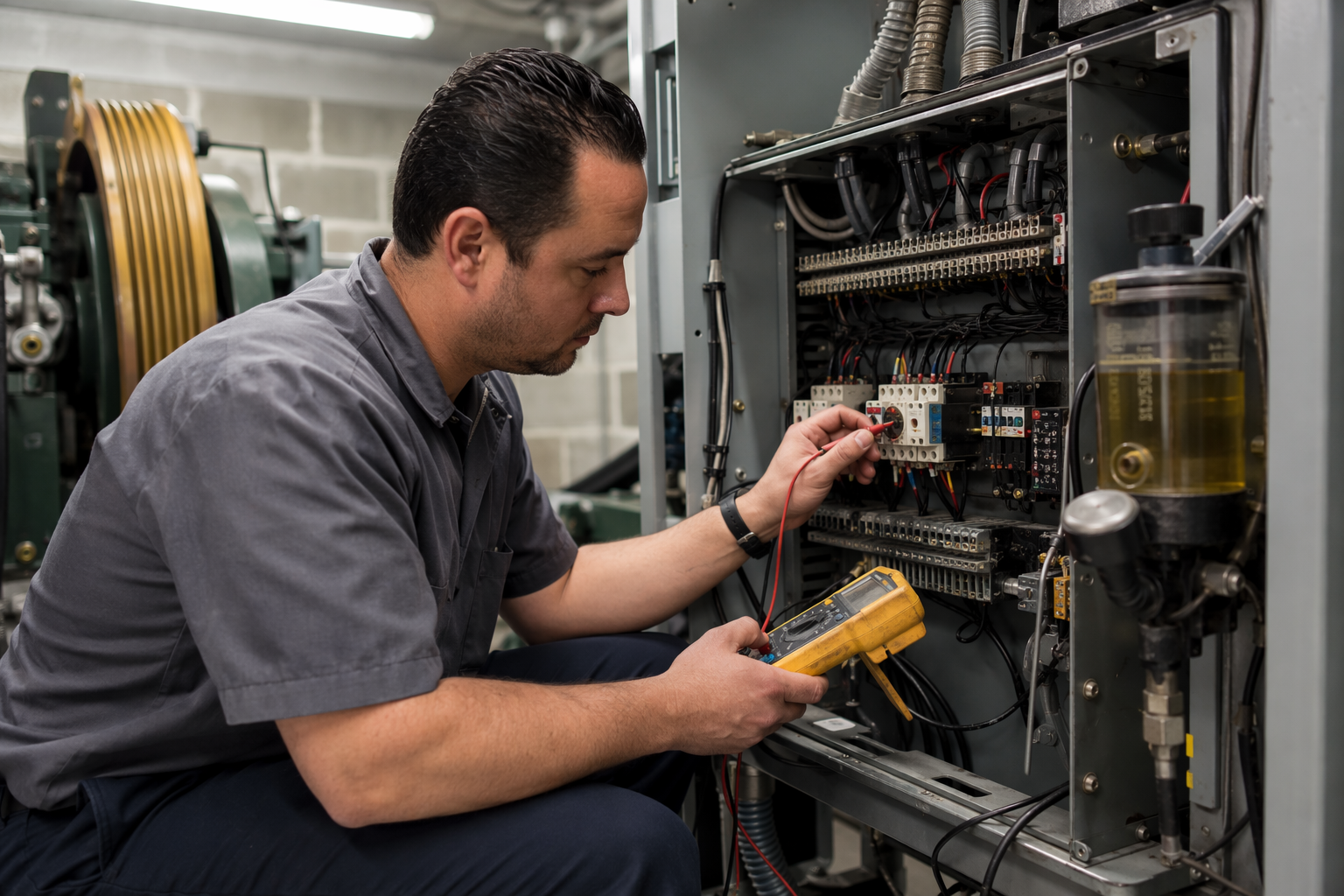
A full maintenance contract — sometimes called a comprehensive maintenance agreement — is a service arrangement in which the elevator contractor assumes responsibility for keeping the elevator in safe, code-compliant operating condition. Under this structure, the contractor typically provides:
- All scheduled preventive maintenance visits
- Lubrication of moving components
- Adjustment and testing of safety devices
- Parts replacement when components wear or fail (subject to contract exclusions)
- Emergency callback service
- Labor costs for repairs covered under the agreement
The key defining feature is predictability: the building owner pays a fixed recurring fee, and the contractor absorbs most of the financial risk associated with unexpected repairs. This model is particularly valuable for high-rise buildings, high-traffic commercial properties, hospitals, and any facility where elevator downtime carries significant operational or life-safety consequences.
What Is an Oil and Grease Elevator Contract?
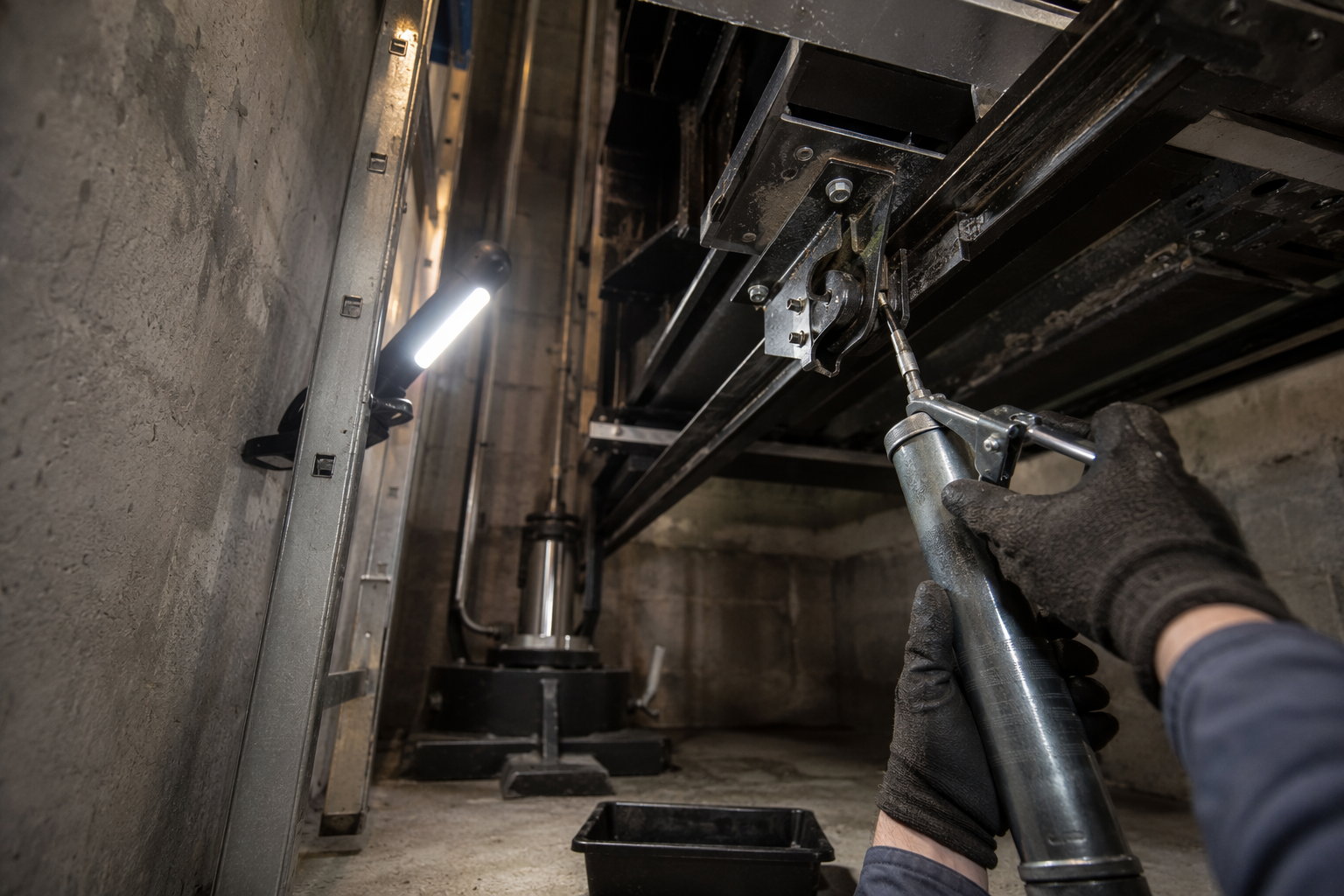
An oil and grease contract — also referred to as a lubrication-only or examination-only agreement — is the most basic tier of elevator service. Under this arrangement, a technician visits the equipment on a scheduled basis to:
- Lubricate bearings, rails, cables, and other friction points
- Perform visual inspections
- Make minor adjustments within a limited scope
- Report findings to the building owner
Critically, an oil and grease contract does not include parts or labor for repairs beyond the lubrication scope. When components fail — whether a contactor, a door operator, a hydraulic seal, or a rope — the building owner is billed separately, typically at time-and-materials rates. This transfers nearly all financial risk back to the property owner.
—
How Do Code Requirements Affect Both Contract Types?
Regardless of which contract type a building owner chooses, elevators in the United States must comply with the ASME A17.1 Safety Code for Elevators and Escalators, which establishes mandatory maintenance, inspection, and testing requirements. The 2019 edition (referenced in many jurisdictions through 2026 adoptions) requires that elevators be maintained in a safe condition and that maintenance procedures follow the manufacturer’s recommendations and the code’s own maintenance control program (MCP) requirements.
The ASME A17.1 Maintenance Control Program mandates that elevator contractors maintain documented procedures for each unit they service. This requirement exists regardless of whether the building owner has selected a full maintenance or an oil and grease contract. However, the practical compliance implications differ significantly:
- Under a full maintenance contract, the contractor is contractually incentivized to proactively address deficiencies before they become code violations, because repair costs come out of the contractor’s revenue margin.
- Under an oil and grease contract, the contractor’s financial incentive is different — identifying a deficiency generates a separate billable repair order. Building owners must be vigilant about acting on all inspection reports promptly to maintain compliance.
Workplace safety on elevator work sites is also governed by OSHA regulations, including those covering lockout/tagout procedures, confined spaces, and fall protection — standards that apply to technicians performing work under both contract types.
For buildings open to the public, elevator accessibility features must meet standards under the Americans with Disabilities Act (ADA). If a component failure under an oil and grease contract results in prolonged inaccessibility, the building owner may face ADA compliance exposure in addition to the repair cost itself.
—
What Are the Core Differences Between Full Maintenance and Oil and Grease Contracts?
| Feature | Full Maintenance Contract | Oil & Grease Contract |
|---|---|---|
| Scheduled lubrication visits | Included | Included |
| Minor adjustments | Included | Included (limited scope) |
| Parts replacement | Typically included (per contract terms) | Not included — billed separately |
| Labor for repairs | Included | Billed at time-and-materials rates |
| Emergency callback service | Typically included | Billed separately |
| Budget predictability | High — fixed monthly/annual cost | Low — variable repair costs |
| Financial risk allocation | Contractor absorbs most risk | Building owner absorbs most risk |
| Best suited for | High-traffic, older, or complex equipment | New equipment under warranty, low-traffic units |
Note: Specific contract terms vary by contractor and jurisdiction. Always review the contract language carefully.
—
Which Contract Type Is Better for Older Elevators?
Equipment age is one of the most important variables in this decision. As elevators age, the probability of component failures increases. Hydraulic seals degrade, electrical contacts wear, door operators develop faults, and rope condition deteriorates — all of which require parts and labor that fall outside an oil and grease contract’s scope.
For equipment that is more than roughly 15 to 20 years old — a threshold where most elevator professionals observe meaningfully higher repair frequency — a full maintenance contract tends to provide stronger total cost protection. The fixed fee model means that a bad year for the equipment does not translate directly into a bad year for the building’s budget.
Conversely, newer elevators still covered by manufacturer warranties, or low-traffic residential units with limited daily cycles, may represent appropriate candidates for an oil and grease arrangement, provided the building owner maintains adequate capital reserves for unplanned repairs and actively monitors all inspection reports.
—
How Should Building Owners Evaluate a Full Maintenance Contract?
- Define equipment scope clearly. Confirm which elevators and which components are covered. Some contracts exclude major capital items such as motor generators, pumping units, or cab interiors.
- Review exclusion language carefully. Every full maintenance contract contains exclusions. Vandalism damage, modernization-level components, and obsolete parts may be carved out. Understanding exclusions prevents billing surprises.
- Assess callback terms. Verify what counts as an emergency callback, whether callbacks outside business hours carry additional charges, and what the expected response protocol looks like.
- Confirm MCP documentation. Under ASME A17.1, the contractor must maintain a documented Maintenance Control Program. Request to see how that documentation is maintained for your specific equipment.
- Understand escalation clauses. Multi-year contracts often include annual price escalation provisions tied to labor indices or CPI. Model these costs over the full contract term before signing.
- Evaluate parts sourcing transparency. Ask whether OEM parts, equivalent parts, or rebuilt components are used, and how parts availability for aging equipment is handled.
- Check insurance and liability provisions. The contract should clearly allocate responsibility for property damage and personal injury arising from maintenance activities.
—
What Are the Hidden Costs of an Oil and Grease Contract?
The headline appeal of an oil and grease contract is a lower base monthly cost. However, building owners who choose this path should plan carefully for several categories of potential expense that do not appear in the monthly line item:
- Time-and-materials repair rates: Emergency labor rates — particularly after hours, on weekends, or on holidays — can be substantially higher than standard rates. These costs are unpredictable by definition.
- Parts procurement markups: When parts are billed separately, contractors typically apply a markup to the parts cost in addition to the labor charge.
- Downtime costs: Lost productivity, tenant complaints, ADA exposure, and the reputational impact of extended outages all carry real economic value that does not appear in a maintenance invoice.
- Deferred repairs: Without a contractual incentive to proactively replace aging components, oil and grease contractors may identify but not urgently flag deteriorating parts. Building owners who defer recommended repairs to manage budget often face larger, more expensive failures later.
- Re-inspection fees: If a deferred repair results in a failed annual inspection, the cost of re-inspection and any associated city or state fees falls to the building owner.
—
How Does Contract Type Affect Regulatory Compliance and Inspections?
Annual or periodic elevator inspections are mandated in virtually every U.S. jurisdiction, with specific testing intervals and procedures governed by state-adopted editions of the ASME A17.1 Safety Code for Elevators and Escalators. Whether a building holds a full maintenance or oil and grease contract, the inspection process is the same — but the pre-inspection preparation differs substantially.
Under a full maintenance contract, the contractor has a strong financial motivation to ensure the equipment is in compliance before the inspector arrives, since any deficiency discovered during inspection that falls within the maintenance scope becomes the contractor’s obligation to repair at no additional charge.
Under an oil and grease contract, any deficiency identified during an inspection results in a separate repair proposal. Building owners should budget for this scenario and maintain proactive communication with their service contractor in the weeks leading up to scheduled inspections.
Workplace safety compliance under OSHA standards applies to all elevator maintenance work regardless of contract type, and building owners have a duty to ensure their contractors are following applicable safety protocols on their property.
—
What Industry Trends Are Shaping Elevator Maintenance Contracts in 2025–2026?
Several qualitative trends are influencing how building owners and elevator contractors structure service agreements as of 2025 and into 2026:
- Remote monitoring and connected equipment: IoT-enabled elevator systems are becoming more common in commercial and residential high-rises. These platforms generate real-time performance data that can flag component degradation before failure occurs — a capability that tends to increase the value proposition of full maintenance contracts by reducing emergency callouts.
- Parts supply chain complexity: Global supply chain disruptions have made lead times for certain elevator components less predictable. Under a full maintenance contract, the contractor assumes the risk of sourcing delays. Under oil and grease arrangements, those delays translate directly into extended downtime for the building owner.
- Tightening code enforcement: Jurisdictions across the United States have been progressively adopting more recent editions of ASME A17.1, which include expanded maintenance documentation and testing requirements. This trend increases the compliance complexity of managing an oil and grease contract responsibly.
- Sustainability and energy efficiency goals: Green building certifications and tenant ESG expectations are driving interest in elevator modernizations. Many building owners are using contract renewal periods as a natural trigger for evaluating whether aging equipment should be modernized rather than maintained under existing service terms.
- Labor market pressures: Elevator technician labor costs have trended upward in recent years, a dynamic that makes the predictable cost structure of full maintenance contracts increasingly attractive compared to open-ended time-and-materials billing.
—
How Does Quality Elevator Company Approach Contract Recommendations?
Quality Elevator Company takes a data-driven approach to service contract recommendations. Rather than applying a one-size-fits-all model, the team evaluates each building’s equipment profile — including unit age, usage cycles, maintenance history, and compliance status — to identify which contract structure best aligns with the owner’s risk tolerance, budget model, and operational requirements.
This analysis-first methodology reflects a core belief that the right contract recommendation depends on facts specific to each elevator installation, not generic industry averages. Building owners working with Quality Elevator Company receive a clear picture of what each contract tier covers, what it excludes, and what financial exposure each option creates.
—
What Happens When an Elevator Fails Under an Oil and Grease Contract?
- Document the failure. Note the date, time, symptoms, and any error codes displayed on the controller panel.
- Contact your service contractor immediately. Report the failure and request a service call. Obtain a work order number.
- Post required out-of-service notices. Most jurisdictions require that out-of-service elevators be clearly marked. Check your local authority having jurisdiction (AHJ) requirements.
- Assess ADA impact. If the failed elevator is a primary means of accessible egress, consult your facility’s ADA compliance officer or legal counsel. Refer to guidance at ADA.gov.
- Request a written repair proposal. Under an oil and grease contract, repairs are billed separately. Obtain a written estimate covering parts, labor, and expected timeline before authorizing work.
- Authorize the repair in writing. Maintain documentation of all authorizations for your compliance and insurance records.
- Confirm code compliance before return to service. Ensure the technician certifies that the repair meets applicable ASME A17.1 requirements before placing the unit back in service.
—
Is a Full Maintenance Contract Always More Expensive Than Oil and Grease?
On a monthly invoice basis, a full maintenance contract carries a higher stated cost than an oil and grease arrangement for the same equipment. However, total annual expenditure is a more useful comparison metric, and the answer becomes less clear-cut when repair frequency is factored in.
For equipment with predictable reliability — such as relatively new, low-use installations — an oil and grease contract can represent a cost-effective choice when paired with disciplined capital reserve planning. For equipment that is aging, heavily used, or has a history of callbacks, the cumulative cost of time-and-materials repairs, parts markups, and emergency labor under an oil and grease arrangement can exceed the premium paid for a full maintenance contract.
The break-even analysis is equipment-specific. Building owners are well served by requesting a detailed breakdown of what a full maintenance contract covers for their specific units and comparing that against their actual repair and callback history from prior years.
—
What Questions Should a Building Owner Ask Before Signing Either Contract Type?
- What specific components are included and excluded from coverage?
- How are parts sourced, and are OEM components used?
- What is the process for major repairs or modernization-level replacements?
- How is the Maintenance Control Program documented under ASME A17.1?
- What does the contract specify about inspection preparation?
- Are there performance standards or uptime guarantees, and how are disputes resolved?
- What are the contract cancellation and renewal terms?
- How is price escalation handled in multi-year agreements?
—
Can a Building Switch from Oil and Grease to Full Maintenance Mid-Contract?
Contract upgrade options vary by contractor and agreement language. Many service providers offer a mid-term upgrade from oil and grease to full maintenance, though the upgrade premium may reflect any deferred maintenance or known equipment deficiencies that existed at the time of the switch. Contractors will often conduct a condition assessment before accepting a unit under full maintenance terms to establish a baseline and identify any pre-existing issues that may be excluded from the new agreement.
Building owners considering an upgrade should request a written inspection report as part of the transition process, so that the scope of any pre-existing exclusions is clearly defined before the new contract takes effect.
—
Summary: Key Takeaways for Decision-Makers
- Full maintenance contracts transfer financial risk to the contractor and provide predictable budgeting — best suited for aging, high-traffic, or complex equipment.
- Oil and grease contracts lower the base monthly cost but expose building owners to variable, potentially significant repair expenses.
- Both contract types require compliance with ASME A17.1, and the building owner retains ultimate responsibility for code compliance regardless of contract structure.
- ADA accessibility obligations under ADA.gov do not pause during equipment outages — extended downtime carries legal exposure.
- The right contract choice depends on equipment age, usage intensity, maintenance history, and the building owner’s risk tolerance and budgeting model.
- Quality Elevator Company uses equipment-specific analysis rather than generic recommendations to help building owners make informed contract decisions.
—
Get Expert Guidance on the Right Elevator Contract for Your Building
Understanding whether a full maintenance or oil and grease contract is appropriate for your specific equipment requires an honest assessment of the unit’s condition, usage history, and compliance status. Quality Elevator Company provides free, no-obligation elevator assessments to help building owners make data-informed decisions — without pressure toward any particular contract tier.
Contact Quality Elevator Company for a free elevator assessment: 301-307-5363
Need elevator service you can rely on? Quality Elevator Company is ready to help.