Do commercial elevator preventive maintenance contracts include on-site visits?
Yes. A commercial elevator preventive maintenance contract is built around scheduled, in-person site visits by qualified elevator mechanics who physically inspect, test, adjust, and service elevator equipment on-site. Remote monitoring complements but does not replace these visits, because federal and state codes in Maryland, Washington DC, Pennsylvania, and Virginia mandate witnessed physical tests and documented in-person inspections that cannot be performed remotely.
Under the ASME A17.1 Safety Code for Elevators and Escalators, the governing safety standard adopted in some form by all four jurisdictions where Quality Elevator Company operates, maintenance must be performed by qualified personnel following the manufacturer’s recommendations and the requirements of the code. That work happens on-site, in machine rooms, pits, hoistways, and car tops. A well-structured preventive maintenance contract defines the frequency, scope, and documentation requirements for every one of those visits so that building owners have a clear, auditable record of compliance.
What does a commercial elevator preventive maintenance contract typically cover?
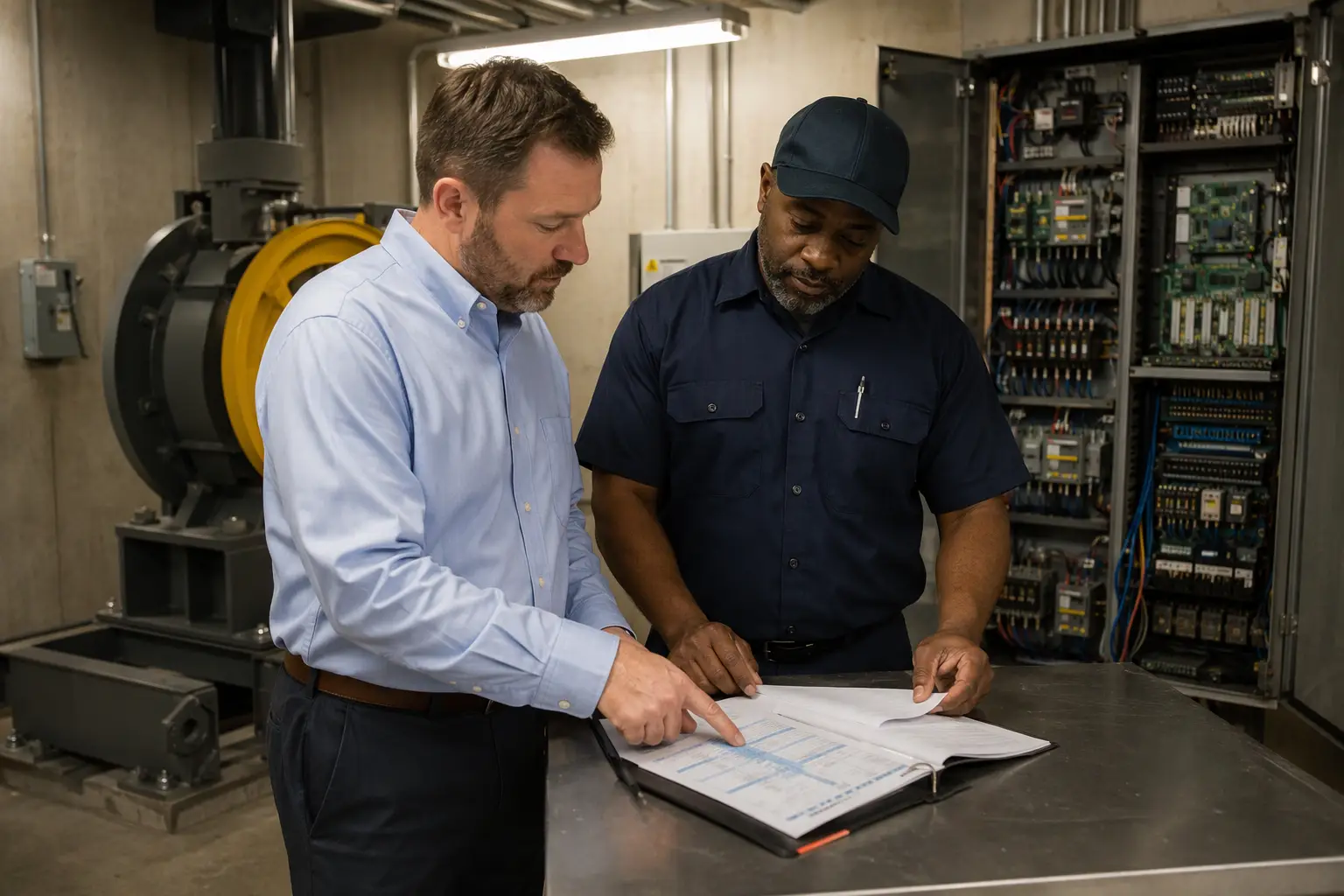
A comprehensive contract covers all mechanical, electrical, hydraulic, and safety systems required to keep an elevator operating safely and in compliance with applicable codes.
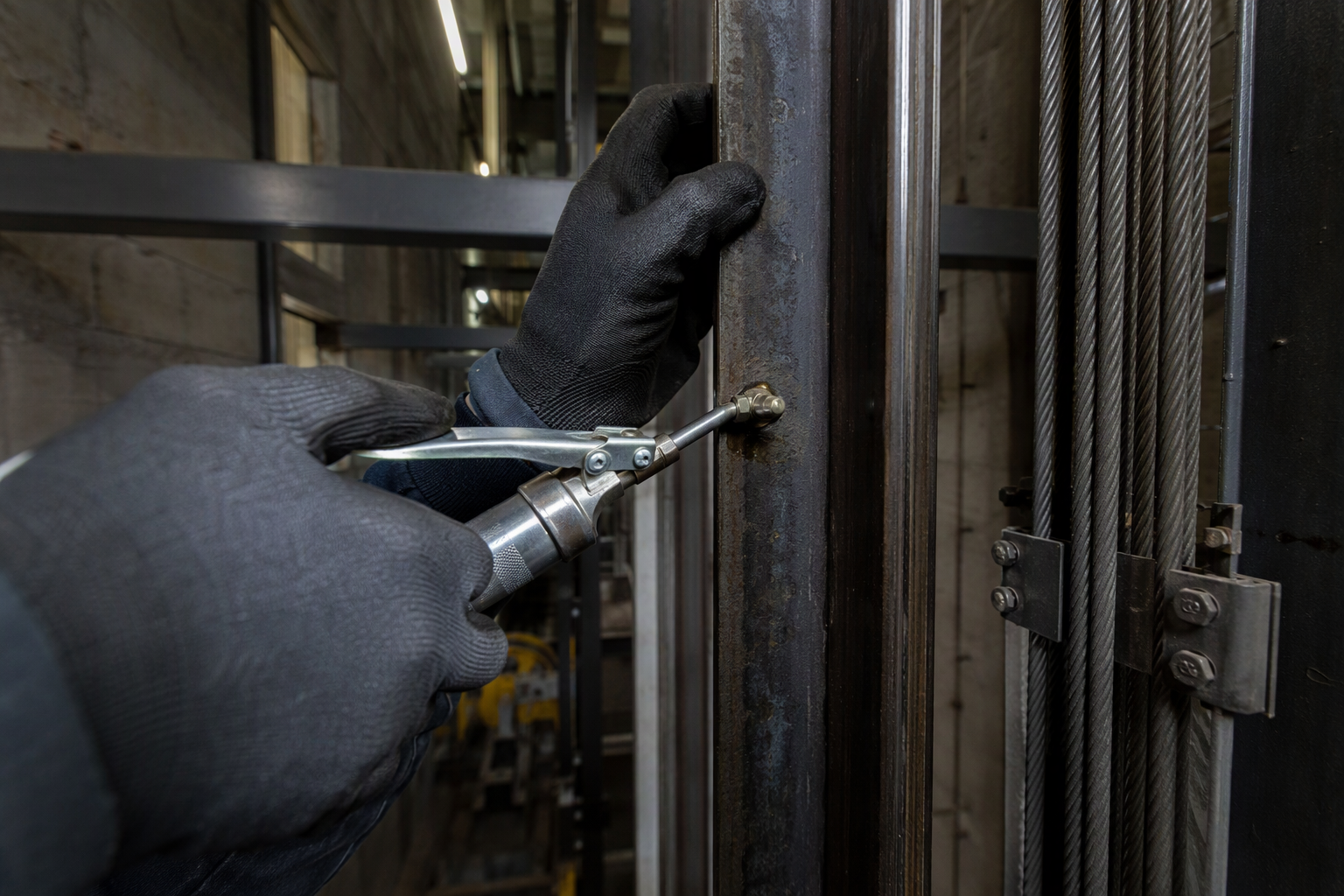
Standard scope items addressed during site visits include lubrication of guide rails, sheaves, and traveling cables; inspection and adjustment of door operators, door contacts, and safety edges; testing of safeties, governors, and buffers on the schedule required by the adopted safety code; inspection of hydraulic fluid levels and cylinder seals on hydraulic units; examination of control wiring, contactors, and relays; verification of emergency lighting, two-way communication devices, and fire service operation; and review of the hoistway, pit, and machine room for housekeeping and code compliance. Technicians document findings at each visit, and deficiencies are categorized by urgency so building owners can prioritize corrective work.
Quality Elevator Company structures its maintenance contracts to align with the specific code edition adopted in each jurisdiction, ensuring that the scope of each site visit satisfies both the owner’s operational needs and the regulatory inspection requirements of the applicable authority having jurisdiction (AHJ).
How often do preventive maintenance site visits take place?
Visit frequency depends on the type of equipment, usage intensity, applicable state code, and the terms negotiated in the contract, but most commercial elevators in the Mid-Atlantic region receive visits monthly or quarterly at minimum.
High-traffic commercial elevators in office towers, hospitals, hotels, and retail centers typically benefit from monthly maintenance visits given the volume of starts and the wear that accumulates quickly. Lower-use elevators in smaller commercial buildings may operate safely on quarterly visit schedules. Regardless of maintenance frequency, state-mandated inspection intervals set a minimum floor. For example:
- In Maryland, each elevator unit must have a periodic annual inspection by a qualified elevator inspector under the Maryland Department of Labor, Division of Labor and Industry, Elevator and Escalator Safety, and owners must also ensure a comprehensive five-year inspection for elevators suspended by wire ropes or similar means. Maintenance records must be kept at a readily accessible central location in the building.
- In Washington DC, the DC Department of Buildings (DOB) requires a Category 1 inspection every 12 months and a Category 5 inspection every 60 months, each by an ASME QEI-certified inspector using an approved third-party agency.
- In Pennsylvania, electric elevators, hydraulic elevators, and escalators must have periodic inspections at intervals of no more than six months under the Pennsylvania Department of Labor and Industry.
- In Virginia, all elevators and escalators require an annual periodic inspection under the Virginia Uniform Statewide Building Code, with localities authorized to require six-month inspections.
A preventive maintenance contract from Quality Elevator Company is designed so that site visit intervals keep equipment code-ready ahead of these mandated inspection dates rather than scrambling to correct deficiencies at inspection time.
What is the difference between preventive maintenance and a code-required inspection?
Preventive maintenance is the ongoing service work performed by the elevator contractor’s mechanics to keep equipment running; a code-required inspection is an independent evaluation by a qualified inspector or state official to verify that the elevator is safe and compliant.
Preventive maintenance visits are performed by licensed elevator mechanics employed by or contracted through the maintenance provider. These visits focus on servicing components, correcting minor deficiencies, and generating operational records. Code-required inspections, by contrast, are performed by independent, often state-employed or state-approved third-party inspectors who evaluate the results of maintenance and testing work. In Maryland, tests performed for a required inspection must be performed by a licensed elevator mechanic, and when a third-party qualified elevator inspector is required to witness a test, that inspector must be physically present for the entire test. In DC, all inspections must be conducted by an ASME QEI-certified inspector from a DOB-approved agency. In Virginia, periodic tests must be witnessed by the local code official or an approved agency.
A strong preventive maintenance contract ensures that all required tests are scheduled, that a licensed mechanic performs them, and that the building owner has the documentation needed to pass independent inspections and renew operating certificates.
What are the most critical components inspected during a maintenance site visit?
Safety-critical components inspected during each maintenance visit include the governor, safeties, buffers, door system, control system, and emergency features, because failures in these systems pose the greatest risk of injury or entrapment.
During a thorough site visit, qualified mechanics examine and service:
- Governor and safeties — The governor triggers the safety device if car speed exceeds the rated speed. These are tested on the intervals required by the adopted safety code.
- Hoist ropes or hydraulic cylinders — Wire rope condition, lubrication, and tension are checked on traction elevators; cylinder seals, fluid levels, and pressure are checked on hydraulic units.
- Door systems — Door operators, clutches, gibs, hangers, safety edges, and door contacts are among the most common sources of entrapment and malfunction. Mechanics adjust closing force and speed to meet ASME A17.1 limits.
- Control system and wiring — Contactors, relays, fuses, and software parameters are reviewed. Modern microprocessor controllers require firmware-level review during visits.
- Emergency systems — Emergency lighting, the two-way communication device, and Phase I and Phase II fire service are tested to ensure they function when needed.
- Pit and machine room — Both areas are inspected for water intrusion, housekeeping compliance, temperature, and equipment clearances as required by the adopted safety code.
- Buffers and traveling cables — Buffer condition and travel are verified; traveling cables are inspected for insulation damage and proper routing.
How does a preventive maintenance contract help with regulatory compliance in Maryland?
A maintenance contract in Maryland supports compliance by ensuring that required annual inspections and five-year comprehensive inspections are scheduled, that a licensed elevator mechanic performs any tests, and that records are maintained at the building in accordance with state law.
Under the Annotated Code of Maryland, Public Safety Article, Title 12, Subtitle 8, an elevator unit may not be operated unless the Commissioner of Labor and Industry has issued a certificate, and the certificate must be posted conspicuously in or on the elevator. Owners must re-register elevator units with the Commissioner annually at the time of the periodic inspection. The Maryland Department of Labor, Division of Labor and Industry, Elevator and Escalator Safety regulates this process, and contractors must be licensed by the Maryland Elevator Safety Review Board and carry at least $1,000,000 in general liability insurance. A well-structured maintenance contract from a licensed contractor keeps the owner ahead of these requirements rather than reacting to violations after the fact.
How does a preventive maintenance contract support compliance in Washington DC?
In Washington DC, a maintenance contract supports compliance by coordinating with DOB-approved third-party inspection agencies, ensuring annual Category 1 inspections and 60-month Category 5 inspections are completed, and maintaining documentation needed to submit inspection reports through the Citizen Access Portal for certificate renewal.
The DC Department of Buildings issues elevator certificates of inspection valid for two years, but periodic inspections and tests must continue during that period under 12-A DCMR Chapter 30. Owners submit third-party inspection reports for the past two years to DOB through the Citizen Access Portal. The adopted safety code is ASME A17.1-2013/CSA B44-13 as referenced by the 2017 DC Building Code, effective May 29, 2020. DOB plans to adopt new construction codes based on the 2024 model codes by the end of 2027. A current copy of the inspection certificate must be displayed conspicuously in the elevator car or in the building operator’s office. Quality Elevator Company coordinates site visits and documentation to ensure that building owners in Washington DC have the complete inspection record required for certificate submission.
How does a preventive maintenance contract support compliance in Pennsylvania?
In Pennsylvania, a maintenance contract supports compliance by scheduling the six-month periodic inspections required by the Pennsylvania Department of Labor and Industry, coordinating acceptance inspections after repairs, and preparing documentation for the certificate of operation renewal cycle.
Under 34 Pa. Code Chapter 405 and the Pennsylvania Construction Code Act, electric elevators, hydraulic elevators, and escalators must have periodic inspections at intervals of no more than six months. A certificate of operation is valid for 24 months for equipment on a six-month inspection cycle. Pennsylvania’s updated elevator regulation takes effect December 20, 2026, at which point permit applications will be governed by ASME A17.1-2016 with Pennsylvania modifications, and Category 1 tests will become a stand-alone annual requirement. The Pennsylvania Department of Labor and Industry has statewide jurisdiction, including Philadelphia. After a major repair or alteration, the elevator may not return to service until the Department inspects and passes it. Maintenance contracts that document all service work and coordinate with certified inspectors help owners navigate both the current standards and the December 2026 transition.
How does a preventive maintenance contract support compliance in Virginia?
In Virginia, a maintenance contract supports compliance by ensuring all elevators receive at least an annual periodic inspection, that required tests under ASME A17.1 Appendix N are witnessed by the local code official or an approved agency, and that a current certificate of inspection is properly displayed.
Under the Virginia Uniform Statewide Building Code (13VAC5-63), local building departments enforce elevator requirements, and in Richmond the City of Richmond Department of Planning and Development Review, Bureau of Permits and Inspections, runs the local elevator program including annual inspections and certification. The 2021 Virginia Uniform Statewide Building Code, effective January 18, 2024, incorporates ASME A17.1/CSA B44-2019. No one may work as an elevator mechanic in Virginia without state certification from the Virginia Board for Contractors under DPOR. Quality Elevator Company’s contracts in Virginia are designed to coordinate with local AHJs so that witnessed test scheduling and certificate display requirements are met for each individual locality.
What should building owners look for when comparing elevator maintenance contracts?
Building owners should evaluate contract scope, visit frequency, mechanic licensing, documentation practices, parts coverage, and the contractor’s familiarity with the AHJ requirements in the specific jurisdiction where the building is located.
| Contract Feature | Minimum Acceptable Standard | Stronger Standard |
|---|---|---|
| Site visit frequency | Quarterly | Monthly for high-traffic equipment |
| Mechanic licensing | State-licensed or certified where required | Licensed plus ASME QEI-certified inspector coordination |
| Documentation | Visit logs kept at building | Signed visit reports, deficiency tracking, digital records |
| Parts coverage | Labor only | Labor plus scheduled-replacement parts included |
| Inspection coordination | Owner schedules independently | Contractor coordinates with AHJ and third-party inspector |
| Code adoption tracking | Current adopted edition only | Proactive review of pending code transitions (e.g., PA Dec. 2026) |
| Emergency callback coverage | Business hours only | Defined callback protocol per contract terms |
| ADA compliance review | Not included | Periodic review of ADA requirements |
Does ADA compliance factor into elevator preventive maintenance?
Yes, the Americans with Disabilities Act establishes accessibility requirements for elevators in commercial facilities, and a preventive maintenance program should include periodic review to ensure that accessible features remain operational.
ADA requirements for elevators in commercial and public buildings include operational controls at accessible heights, Braille and raised character floor designations, audible and visual signals, door reopening devices, and minimum car dimensions. During maintenance visits, mechanics should verify that door reopening devices function reliably, that call buttons and floor buttons respond correctly, that the cab leveling accuracy keeps the floor within the tolerance required for accessible entry and exit, and that visual floor indicators and audible signals are operational. When ADA-required features fail between visits, they should be prioritized for prompt correction because inaccessibility may expose the building owner to legal liability under Title III of the ADA.
What records should be maintained as part of a preventive maintenance program?
Maintenance records should include signed visit reports for every site visit, test results, parts replaced, deficiencies identified and their resolution status, and copies of all inspection certificates and regulatory correspondence.
In Maryland, maintenance, repair, test, and inspection records must be kept at a readily accessible central location in the building where the elevator is located, as required by state law. In Pennsylvania, the certificate of operation or a copy must be posted in the elevator car or attached to the controller in the machine room. In DC, owners submit the third-party inspection reports for the past two years to DOB through the Citizen Access Portal for certificate renewal. In Virginia, the current certificate of inspection must be displayed in the elevator or kept available in the building operator’s office or another approved conspicuous location. A maintenance contract from Quality Elevator Company includes systematic documentation practices that satisfy the record-keeping requirements across all four jurisdictions where the company operates.
What is the process for setting up a commercial elevator preventive maintenance contract?
Establishing a maintenance contract involves a site assessment, equipment inventory, scope and frequency negotiation, contract execution, and transition of service from any prior provider.
- Schedule a site assessment. A qualified representative evaluates the number of elevators, equipment type (traction, hydraulic, MRL), age, usage patterns, and condition of key components.
- Review existing documentation. Collect any available maintenance logs, prior inspection reports, certificates of operation, and outstanding deficiency notices from the AHJ.
- Define contract scope. Agree on visit frequency, tasks performed at each visit, parts and materials coverage, and documentation deliverables.
- Confirm regulatory requirements. Identify the applicable state agency, adopted code edition, inspection intervals, and licensing requirements for the jurisdiction.
- Execute the contract. Both parties sign the agreement, and the new contractor obtains any permits or notifications required by the AHJ to begin service.
- Conduct an initial baseline visit. The first site visit establishes the current condition of all equipment, identifies any existing deficiencies, and sets priorities for the maintenance program going forward.
- Coordinate the inspection schedule. The contractor aligns maintenance visit timing with the required periodic inspection dates to ensure the equipment is fully serviced before the inspector arrives.
What types of commercial buildings most commonly need elevator preventive maintenance contracts?
Any commercial building with a passenger elevator, freight elevator, escalator, or other conveyance is a candidate for a preventive maintenance contract, and the complexity of the program scales with the number of units and the criticality of vertical transportation to the building’s function.
Common commercial building categories served by maintenance contracts include office towers and multi-tenant office buildings, hospitals and healthcare facilities where elevator downtime directly affects patient care, hotels and hospitality properties with high-cycle passenger elevators, retail centers and shopping malls with both passenger and freight equipment, residential apartment and condominium buildings with commercial elevator systems, government and institutional buildings subject to public access requirements, warehouses and distribution centers relying on freight elevators and vertical reciprocating conveyors, and educational facilities including universities and schools. Each category presents distinct usage patterns, regulatory obligations, and maintenance priorities that should be reflected in the structure of the contract.
How does preventive maintenance reduce elevator downtime and emergency repairs?
Preventive maintenance reduces downtime by identifying and correcting developing failures before they cause a shutdown, which is far less disruptive and costly than emergency repairs that strand passengers or halt freight operations.
Routine lubrication prevents accelerated wear on guide rails, roller guides, and sheaves. Regular door adjustment prevents the most frequent cause of elevator shutdowns — door faults — by keeping closing force, speed, and contact alignment within specification. Scheduled inspection of hoist ropes or hydraulic systems allows deteriorating components to be replaced during planned maintenance windows rather than during peak building hours. Control system checks catch relay failures, software faults, and wiring issues before they result in a service interruption. Buildings that operate on a reactive basis, calling for service only after a breakdown, typically experience longer cumulative downtime and higher repair costs than buildings with active maintenance contracts.
Can a preventive maintenance contract include modernization planning?
Yes, an experienced elevator contractor can incorporate equipment lifecycle assessments into the maintenance program, providing building owners with objective data on when modernization or component replacement becomes more cost-effective than continued repair.
As elevator equipment ages, the cost of maintaining obsolete control systems, sourcing discontinued parts, and meeting evolving code requirements through piecemeal repairs can exceed the investment in a planned modernization. A maintenance contract that includes periodic condition assessments gives owners advance notice of approaching end-of-life for major components such as controllers, motors, door operators, and hydraulic cylinders. This allows capital budgeting for modernization projects that bring elevators into compliance with current code editions — including the ASME A17.1 edition adopted in each jurisdiction — and may also address ADA accessibility improvements. Quality Elevator Company provides maintenance programs that include this long-range planning perspective, helping commercial owners avoid costly emergency modernizations driven by equipment failure rather than planned capital investment.
What OSHA requirements apply to elevator maintenance personnel?
Elevator maintenance work is subject to OSHA general industry and construction standards covering lockout/tagout, confined space entry for pits, fall protection for car tops and hoistways, and electrical safety.
Mechanics working in elevator pits must follow OSHA requirements for permit-required confined spaces when pit conditions meet the definition. Work on energized electrical components requires compliance with OSHA lockout/tagout (LOTO) procedures under 29 CFR 1910.147, which mandates that energy sources be isolated and controlled before maintenance begins. Car-top work involves fall hazards that require appropriate personal protective equipment and work practices. Building owners benefit from confirming that their maintenance contractor has documented OSHA compliance programs, because an injury during on-site maintenance can expose both the contractor and the building owner to regulatory scrutiny.
What questions should building owners ask a potential elevator maintenance contractor?
Building owners should ask about mechanic licensing, the contractor’s familiarity with the local AHJ, what is included versus excluded from site visits, how deficiencies are reported and tracked, and how the contractor handles coordination with third-party inspectors.
Specific questions worth asking include: Are your mechanics licensed or certified as required by the state where my building is located? Have you worked with the specific AHJ that inspects buildings in my city or county? What documentation will I receive after each maintenance visit? How do you handle deficiencies that require additional work beyond the maintenance scope? Do you coordinate directly with the independent inspection agency or state inspector for required tests? What is your process when an elevator must be taken out of service for repairs? How do you stay current with pending code changes, such as Pennsylvania’s December 2026 regulation update? How do you handle the transition from a prior maintenance contractor and review existing records? A contractor who answers these questions with specific, jurisdiction-aware responses demonstrates the depth of knowledge required to manage regulatory compliance across multiple jurisdictions.
How do preventive maintenance contracts address fire service and emergency operation requirements?
Every maintenance site visit should include a functional test of Phase I Emergency Recall and Phase II Emergency In-Car Operation, because these features are life-safety systems required by the adopted safety code and must function reliably for firefighter access.
Under the ASME A17.1 Safety Code for Elevators and Escalators, passenger elevators must be equipped with firefighters’ emergency operation. Phase I Emergency Recall returns the elevator to the designated level when smoke is detected on any floor or when manually activated. Phase II allows firefighters to control the elevator from within the car. These systems must be tested at the intervals required by the adopted safety code, and test results must be documented. Many building owners and fire marshals inspect these records during fire safety reviews. Emergency lighting and the two-way communication system required for trapped-passenger communication are also tested during maintenance visits, confirming that passengers can summon help if the elevator becomes stuck between floors.
What should a building owner do if an elevator fails a state inspection despite having a maintenance contract?
If an elevator fails a state inspection, the building owner should immediately review the inspector’s written report with the maintenance contractor, determine whether deficiencies were identified in prior maintenance records, and establish a corrective action plan with specific deadlines before the elevator is returned to service.
- Obtain the written inspection report. Request the full report from the inspector or the AHJ, noting every cited deficiency and any applicable code reference.
- Notify the maintenance contractor immediately. Share the report and request a meeting to review whether any cited items appear in prior maintenance visit records.
- Classify deficiencies by urgency. Some deficiencies require immediate correction before the elevator may return to service; others may have a correction period specified by the AHJ.
- Post any required out-of-service notice. In jurisdictions where the elevator may not operate with an open safety violation, ensure that the unit is taken out of service and appropriate notices are posted as required.
- Execute the corrective work. Schedule the repair work with licensed mechanics. In Pennsylvania, an elevator may not return to service after a major repair until the Department of Labor and Industry inspects and passes it.
- Request a re-inspection. Contact the AHJ or the approved third-party inspection agency to schedule the follow-up inspection needed to lift the violation and restore the certificate of operation.
- Update the maintenance program. Review whether the inspection failure reveals a gap in the maintenance contract scope or visit frequency, and adjust accordingly to prevent recurrence.
Contact Quality Elevator Company for a free elevator assessment at 301-779-9116.
Need elevator service you can rely on? Quality Elevator Company is ready to help.