How to Switch Elevator Service Providers and Get a Maintenance Contract for a Healthcare Building
Hospitals, medical office buildings, outpatient surgery centers, and long-term care facilities depend on elevators around the clock. A service gap, a lapsed certificate of inspection, or a non-compliant cab is not merely an inconvenience — it can interrupt patient transport, trigger a Joint Commission citation, and expose a facility to regulatory action. This guide walks healthcare facilities managers in Baltimore, Washington DC, Philadelphia, and Richmond through every step of a compliant provider transition.
What Should a Healthcare Facility Do First When Switching Elevator Service Providers?
Before notifying the outgoing contractor, gather the following documents and complete these steps in order:
- Pull your current service contract. Identify the notice period required to cancel — most commercial elevator contracts require 30 to 90 days’ written notice. Missing this window can extend your obligation by a full contract term.
- Collect all maintenance and inspection records. State regulations in Maryland, Virginia, DC, and Pennsylvania require that records be kept at the building. Request originals or certified copies from the outgoing provider.
- Obtain your current certificates of inspection. Each jurisdiction issues certificates that must be displayed in the cab or kept on file; a new provider needs to see them to understand the inspection timeline.
- Document the equipment. Record each unit’s make, model, serial number, drive type (hydraulic, traction, MRL), and year of installation. Healthcare facilities often have specialty units such as stretcher elevators and service lifts that require specific maintenance expertise.
- Identify any open permits or outstanding violations. Contact the relevant authority having jurisdiction (AHJ) in your market to confirm no violations are attached to your equipment before transitioning.
- Issue a request for proposal (RFP) or request quotes. Provide prospective contractors with the equipment list, inspection history, current certificates, and any known deficiencies.
- Verify contractor licensing and insurance. Confirm the prospective provider meets your state’s requirements before signing anything.
- Execute a written transition agreement. Ensure the outgoing contractor agrees to release records and keys and that the incoming contractor schedules a baseline assessment before the first billing period begins.
What Compliance Standards Govern Healthcare Elevators in DC, Maryland, Pennsylvania, and Virginia?
Healthcare elevators must meet layered requirements from federal codes, state regulations, and facility accreditation standards.
Federal baseline — ASME A17.1 and ADA. The ASME A17.1 Safety Code for Elevators and Escalators governs construction, installation, maintenance, and inspection. The Americans with Disabilities Act (ADA) requires that elevators in multi-story commercial and public facilities provide accessible service, including compliant cab dimensions, door timing, control height, and audible signals. Healthcare facilities serving patients with mobility limitations must pay particular attention to ADA cab sizing and door-open dwell times.
District of Columbia. The DC Department of Buildings (DOB) regulates elevator inspections and certificates under 12-A DCMR Chapter 30 and the 2017 DC Building Code, which references ASME A17.1-2013. DC requires a Category 1 inspection every 12 months and a Category 5 inspection every 60 months, each conducted by an ASME QEI-certified inspector from a DOB-approved third-party agency. A certificate of inspection is valid for two years. Healthcare buildings with passenger elevators must keep at least one elevator in service whenever the building is occupied. Certificates must be displayed conspicuously in the cab.
Maryland. The Maryland Department of Labor, Division of Labor and Industry, Elevator and Escalator Safety administers COMAR 09.12.81 under Public Safety Article, Title 12, Subtitle 8. Maryland adopted ASME A17.1-2022/CSA B44:22 effective June 17, 2026. Annual periodic inspections are mandatory, and owners must hire a third-party qualified elevator inspector. Elevators suspended by wire ropes or similar means require a comprehensive five-year inspection. Contractors must carry at least $1,000,000 in general liability insurance and at least $500,000 in property damage insurance. Maintenance, repair, test, and inspection records must be kept at a readily accessible central location in the building.
Pennsylvania. The Pennsylvania Department of Labor and Industry (L&I), Bureau of Occupational and Industrial Safety, Elevator Section enforces 34 Pa. Code Chapter 405. Electric and hydraulic elevators must have periodic inspections at intervals of no more than six months. Under Regulation #12-123, effective December 20, 2026, new permit applications must comply with ASME A17.1-2016 with Pennsylvania modifications, and Category 1 tests become an annual stand-alone requirement. Philadelphia elevators fall under statewide Pennsylvania L&I jurisdiction, not the city’s Department of Licenses and Inspections.
Virginia. Under the Virginia Uniform Statewide Building Code (13VAC5-63), the local building department enforces elevator requirements. The 2021 USBC, effective January 18, 2024, adopts ASME A17.1/CSA B44-2019. All elevators require at least annual periodic inspections; a locality may require semi-annual inspections. In Richmond, the City’s Bureau of Permits and Inspections handles elevator certificates and annual inspections. No one may work as an elevator mechanic in Virginia without state certification from the Virginia Board for Contractors (DPOR).
Healthcare-specific accreditation. Facilities seeking or maintaining Joint Commission accreditation should ensure elevator maintenance programs are documented and that inspection records are immediately retrievable during a survey. Fire service and emergency operation features required by ASME A17.1 — including Phase I recall and Phase II firefighter service — are especially scrutinized in hospitals and assisted living facilities.
How Do You Evaluate a New Elevator Service Contract for a Healthcare Facility?
Not all maintenance agreements are structured the same way. When reviewing a proposed contract, healthcare facilities managers should confirm the following elements are addressed:
- Scope of covered services. Distinguish between a “full maintenance” agreement (parts, labor, and callbacks included) and an “oil and grease” or “examination only” contract, which excludes most repairs.
- Inspection coordination. The contract should specify who schedules and coordinates state-required periodic inspections with the AHJ and who is responsible for submitting reports.
- Emergency response language. Healthcare facilities operate 24 hours a day. Confirm the contract addresses after-hours callback procedures.
- Entrapment protocol. Verify the contractor’s process for passenger entrapment rescues, which is a patient-safety concern in medical settings.
- Record-keeping obligations. Maryland and other jurisdictions require maintenance records to remain on-site. The contract should state who maintains the log and in what format.
- Permit and violation responsibility. Clarify which party pulls permits for repairs and who is responsible for resolving open violations.
- Termination and transition clauses. To avoid repeating the current situation, negotiate a reasonable notice period and a records-release obligation on the outgoing contractor’s part.
Quality Elevator Company provides prospective clients with a written equipment assessment before quoting a maintenance contract, so both parties understand the current condition of the equipment before the agreement is signed.
What Information Is Needed to Get an Accurate Maintenance Quote?
Providing complete information upfront results in a more accurate quote and avoids change orders after the contract begins. Prepare the following for each unit:
- Unit type (traction, hydraulic, MRL, escalator, dumbwaiter, platform lift)
- Make, model, and approximate installation year
- Number of stops and total travel distance
- Current certificate of inspection and expiration date
- Last Category 1 and Category 5 (or equivalent) test dates and results
- Any outstanding violations, correction orders, or open permits
- Known deficiencies or recurring issues
- Building occupancy hours and estimated elevator usage volume
- Special requirements such as stretcher cab dimensions, hospital-grade door timings, or isolation switch requirements for infection control
How Long Does It Take to Switch Elevator Service Providers?
A transition timeline depends primarily on the cancellation notice required by the outgoing contract and the scheduling of a baseline inspection. In practical terms:
- Review the existing contract and serve written notice of cancellation according to its terms — typically 30 to 90 days.
- Issue an RFP or request quotes — allow at least two weeks for providers to assess the equipment and respond.
- Execute the new maintenance agreement before the outgoing contract expires to avoid a coverage gap.
- Schedule a baseline assessment and equipment walk-through with the incoming contractor.
- Transfer keys, access credentials, and all maintenance and inspection records.
- Notify the AHJ of the new contractor of record if required by local procedure.
Quality Elevator Company can typically complete a baseline assessment and begin service without disrupting the facility’s existing inspection schedule when given adequate lead time before the transition date.
What Are the ADA Requirements Specific to Healthcare Elevator Cabs?
Under the ADA, passenger elevators in commercial and public facilities must meet accessibility standards that are particularly relevant in healthcare settings. Key requirements include compliant car dimensions to allow wheelchair and mobility device access, door reopening devices that respond to obstructions, control button height and Braille labeling, floor designations on cab interior panels, and two-way communication systems. Healthcare facilities that have modified cabs — for example, by adding handrails, fold-down seats, or infection control surfaces — should confirm those modifications do not reduce ADA-required clear floor space or obstruct controls.
What Happens If a Healthcare Elevator Has an Outstanding Violation During a Provider Switch?
Outstanding violations attach to the equipment and the owner, not the contractor. A change in service provider does not automatically clear a violation or stop a correction-order deadline. Before completing a transition, the facilities manager should:
- Contact the AHJ to get a written list of any open violations or orders for each unit.
- Disclose all known violations to the incoming contractor in writing as part of the RFP process.
- Confirm in the new contract which party is responsible for resolving each outstanding item and by what deadline.
- Obtain a permit for any repair work required to clear a violation, as required by state law.
- Schedule the correction inspection with the AHJ once repairs are complete.
Attempting to operate an elevator with an uncorrected order in a healthcare facility creates compounded liability — both regulatory and clinical. Quality Elevator Company includes a violation review as part of its pre-contract assessment process.
What Should a Maintenance Contract Include for Stretcher Elevators and Specialty Healthcare Lifts?
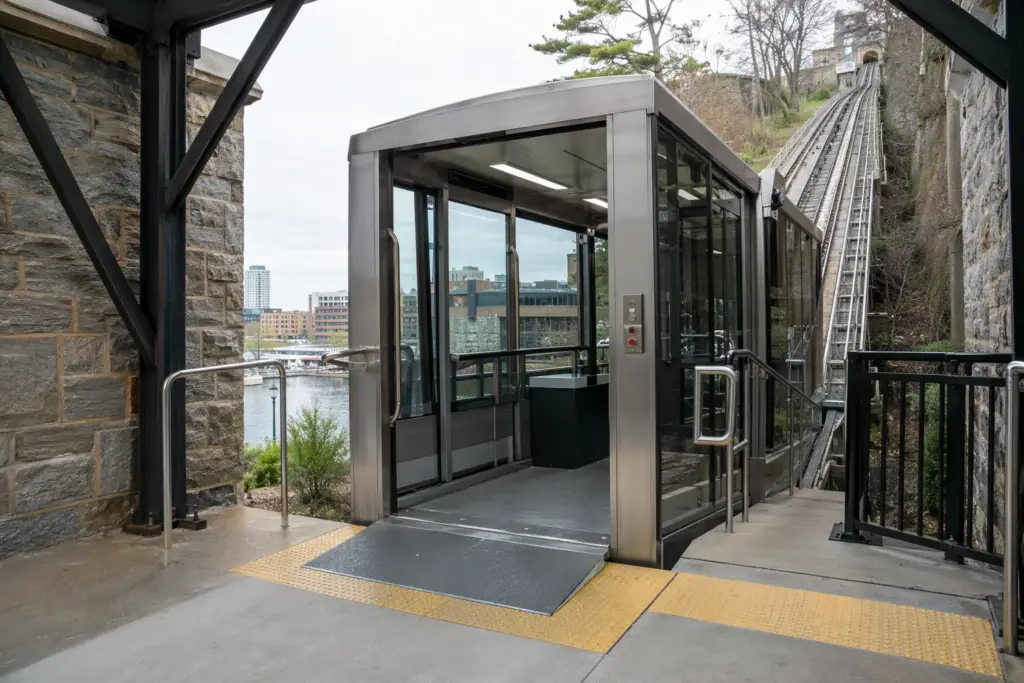
Maryland requires that each new building constructed after July 1, 1985, with at least one planned elevator include a passenger elevator capable of carrying a rescue litter horizontally — a requirement that aligns with the practical need for stretcher-capable cabs in healthcare facilities. Stretcher elevators and other specialty units such as service lifts, wheelchair platform lifts, and dumbwaiters used for medication or specimen transport should each be listed separately in the maintenance contract with their own inspection schedule. ASME A17.1 applies to most of these unit types, and the AHJ may require separate certificates for each unit. Confirm that the prospective contractor has demonstrated experience maintaining these unit types, not just standard passenger elevators.
Questions Your Inspector Will Ask
During a periodic inspection or a state acceptance inspection following a provider change, the AHJ inspector is likely to ask or verify the following:
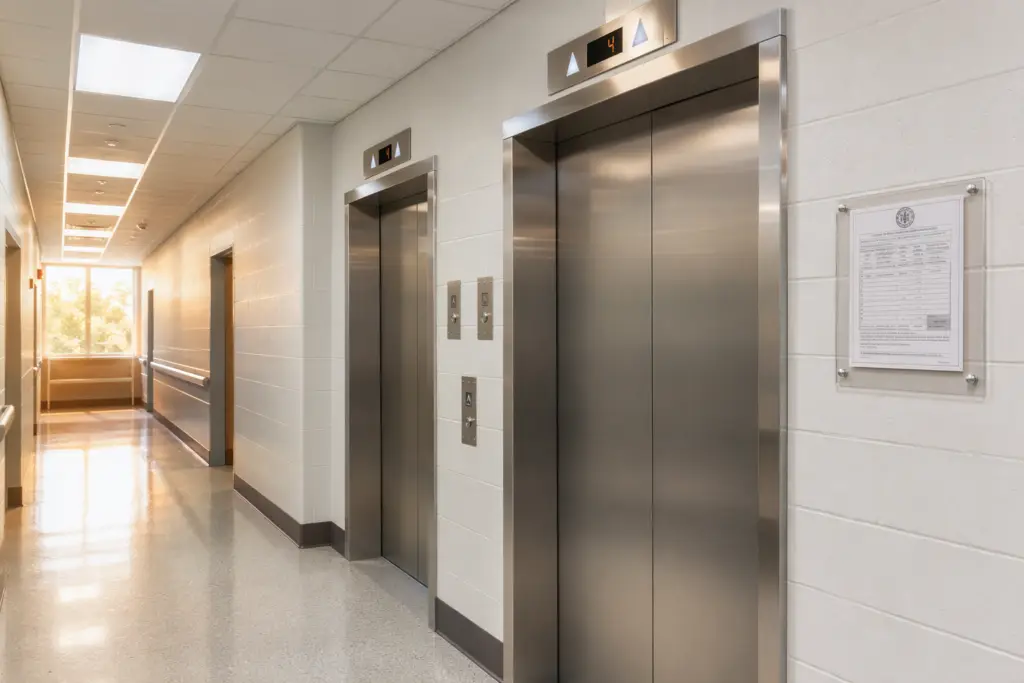
- Is the current certificate of inspection displayed in the cab or available as required by your jurisdiction?
- Are maintenance, test, and inspection records present in the building and organized by unit?
- When was the last Category 1 test performed, and is a witnessed test record on file?
- When is the next Category 5 (or five-year comprehensive) test due?
- Is Phase I emergency recall and Phase II firefighter service operational and documented?
- Are all safety devices — buffers, safeties, governors, door interlocks — in proper working condition?
- Has any alteration or repair work been performed since the last inspection, and if so, was a permit obtained?
- Is the licensed elevator contractor’s information on file with the building, and is the mechanic who performs tests state-certified (required in Virginia; required in Maryland)?
- Are there any outstanding correction orders, and what is the remediation status?
- For DC facilities: has the inspection report been submitted to DOB through the Citizen Access Portal?
How Does Quality Elevator Company Handle the Transition Process for Healthcare Clients?
Quality Elevator Company serves healthcare facilities in Baltimore, Washington DC, Philadelphia, and Richmond. The transition process begins with a no-obligation equipment assessment that documents the current condition of each unit, identifies any compliance gaps, and provides the information needed for an accurate maintenance contract quote. Findings are presented in writing so the facilities manager has documentation to share with administration and risk management. Quality Elevator Company coordinates directly with the AHJ in each market to ensure inspection schedules are uninterrupted and certificates remain current during and after the transition. All work is performed by mechanics holding the certifications and licenses required in the applicable jurisdiction.
What Should Be in the Maintenance Records Handed Over During a Provider Switch?
When the outgoing contractor transfers records, the incoming provider and the building owner should verify that the package includes:
- All certificates of inspection issued in the past inspection cycle
- Third-party inspection reports and test records, including witnessed-test sign-off sheets
- Maintenance visit logs showing dates, work performed, and mechanic identification
- Records of any repairs, parts replacements, or modernization work
- Copies of permits issued for any alteration or repair work
- Manufacturer documentation, wiring diagrams, and parts manuals where available
- Any correspondence with the AHJ, including correction orders and responses
Maryland regulations explicitly require that records be kept at a readily accessible central location in the building. Even in jurisdictions where the specific storage location is not mandated by statute, keeping complete records on-site protects the facility during surprise inspections and simplifies future provider transitions.
Contact Quality Elevator Company for a free elevator assessment at 301-779-9116.
Need elevator service you can rely on? Quality Elevator Company is ready to help.