Elevator Service in Baltimore, MD | Quality Elevator Company
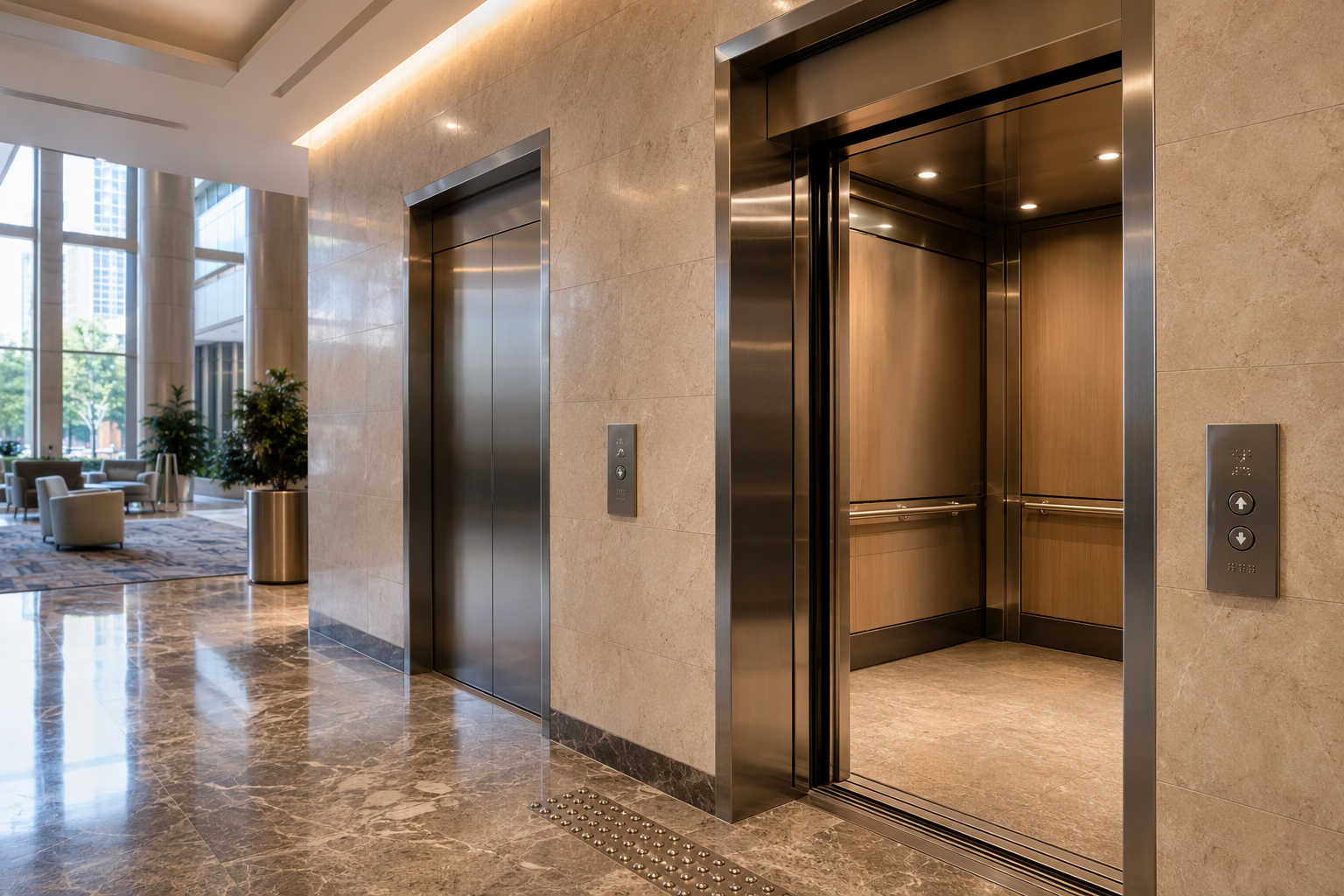
ADA elevator compliance is a critical obligation for building owners and property managers across Baltimore, MD. Whether a facility is newly constructed, undergoing renovation, or operating under existing building conditions, the Americans with Disabilities Act establishes baseline accessibility standards that apply to elevators in most commercial and multi-story public buildings. Quality Elevator Company provides ADA elevator installation, modernization, maintenance, and inspection services to help Baltimore property owners meet those obligations and keep their equipment in safe, compliant operation.
What Is an ADA Elevator and Who Needs One?
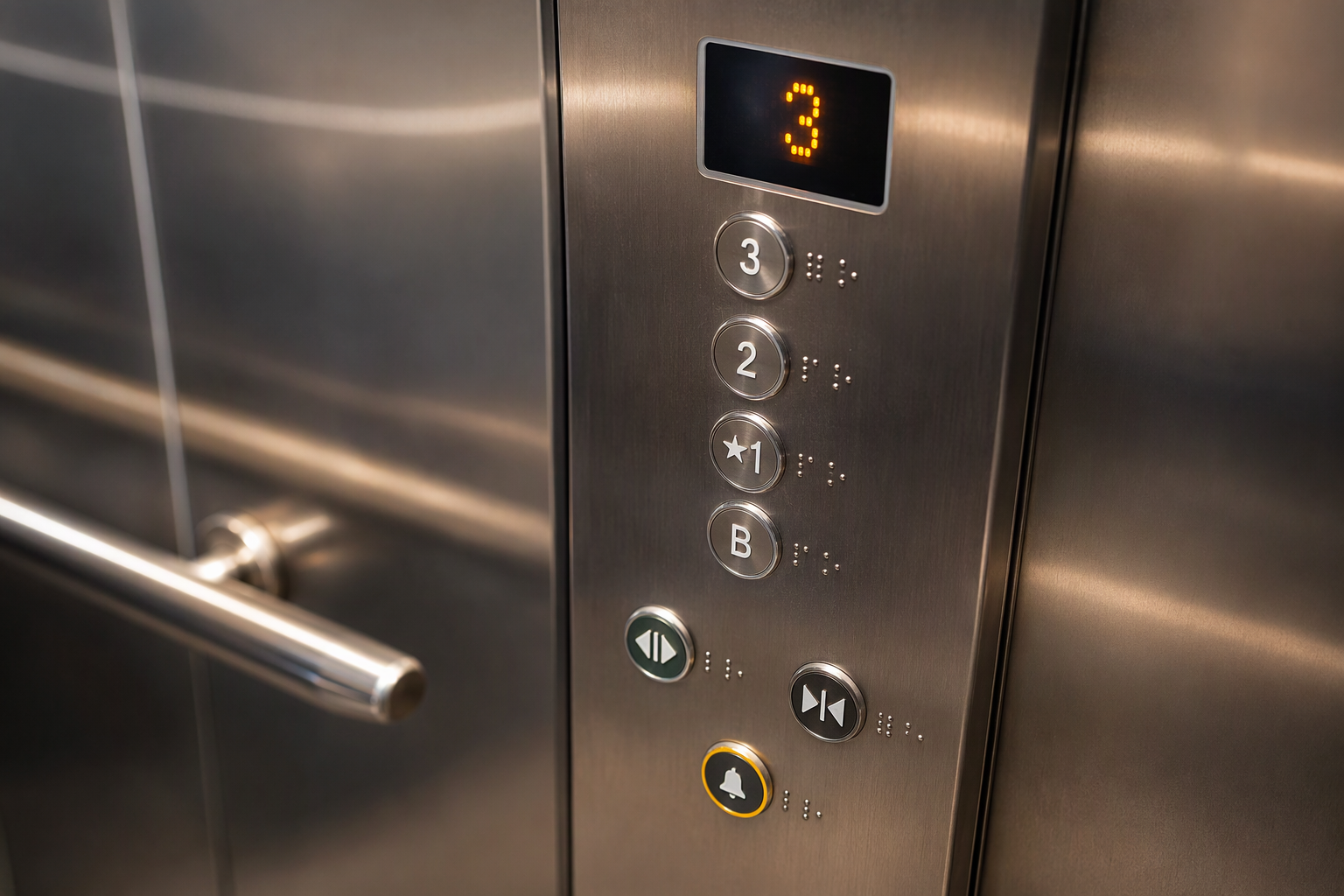
An ADA elevator is a passenger elevator or platform lift that conforms to the accessibility standards set out under the Americans with Disabilities Act. The ADA requires that newly constructed and altered facilities provide accessible routes to all levels, and elevators are the primary means of satisfying that requirement in multi-story buildings. Buildings covered by Title II (state and local government facilities) and Title III (places of public accommodation and commercial facilities) in Baltimore must generally provide elevator access unless a specific exemption applies—such as the limited exception for small facilities with fewer than three stories or fewer than 3,000 square feet per floor in certain occupancy categories.
In practice, most commercial office buildings, hotels, hospitals, retail centers, government offices, and mixed-use properties in Baltimore are required to have at least one ADA-compliant elevator. Property owners planning new construction or significant alterations should consult with a qualified elevator contractor and legal counsel to determine exactly which standards apply to their project.
What Features Must an ADA Elevator Include?
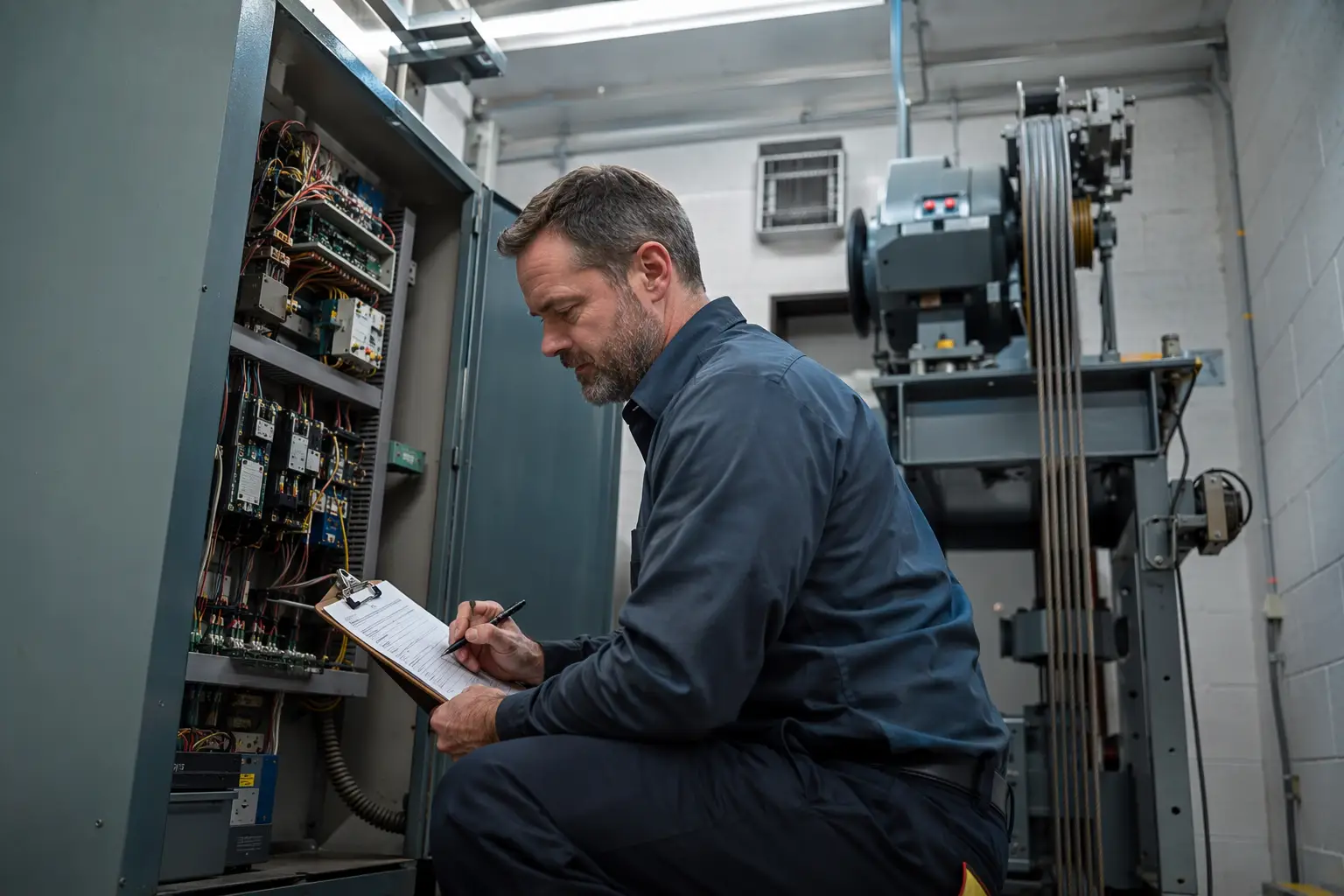
ADA elevator requirements address a wide range of design and operational features. While the ADA Standards for Accessible Design govern the specifics, the following are among the key elements Quality Elevator Company evaluates and addresses during ADA installations and modernizations in Baltimore:
- Car dimensions: The elevator car must be large enough to accommodate a wheelchair user and allow maneuvering, meeting minimum floor space requirements.
- Door width and timing: Doors must provide sufficient clear opening width and remain open long enough for a person using a mobility device to enter and exit safely.
- Call controls and buttons: Hall call buttons and car operating panels must be positioned at accessible heights, with raised characters and Braille designations.
- Floor designations: Raised and Braille characters must identify each floor level in the elevator car.
- Audible and visual signals: The elevator must provide both audible signals and visible indicators for door operation, floor arrival, and direction of travel.
- Emergency communication: A two-way communication system must be provided to allow passengers to contact emergency services or building personnel.
- Leveling accuracy: The car must level precisely at each floor to eliminate gaps or steps that could impede wheelchair users.
- Handrails: Where required, handrails must be installed at the appropriate height and configuration.
Quality Elevator Company’s service teams are familiar with these requirements and work with building owners in Baltimore to identify gaps between existing equipment and current ADA standards, recommending targeted modernization or repair solutions accordingly.
How Does Maryland’s Elevator Safety Law Apply to ADA Elevators in Baltimore?
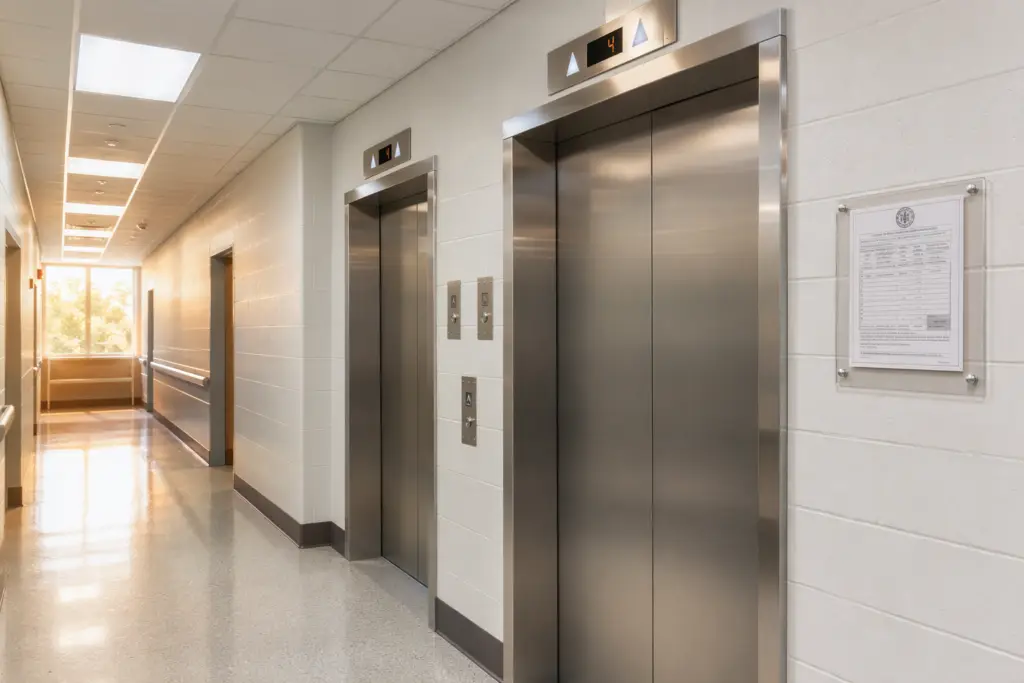
ADA compliance and Maryland’s elevator safety regulations are separate but overlapping obligations. Under the Maryland Department of Labor, Division of Labor and Industry, Elevator and Escalator Safety, no elevator unit in Maryland may be operated without a certificate issued by the Commissioner of Labor and Industry. That certificate must be posted conspicuously in or on the elevator.
Maryland’s elevator safety rules require each elevator unit to undergo a periodic annual inspection, conducted by a third-party qualified elevator inspector. Tests required as part of that inspection must be performed by a licensed elevator mechanic. Additionally, elevators suspended by wire ropes, belts, chains, or similar means must receive a comprehensive five-year inspection. All inspection and maintenance records must be kept at a readily accessible central location in the building.
Elevator contractors operating in Maryland must be licensed by the Maryland Elevator Safety Review Board and must carry at least $1,000,000 in general liability insurance and at least $500,000 in property damage insurance. Elevator mechanics must hold a Maryland license before working on elevator units. Quality Elevator Company operates in full compliance with Maryland’s licensing and insurance requirements.
As of 2026, Maryland has adopted the ASME A17.1/CSA B44, 2022 edition as its elevator safety code, with Maryland changes, effective June 17, 2026. The edition that applies to a specific elevator depends on when the installation contract was signed, so owners of both new and existing equipment in Baltimore should work with a licensed contractor to confirm which code edition governs their unit.
What Is the Process for Installing or Modernizing an ADA Elevator in Baltimore?
- Assess the existing conditions. Quality Elevator Company conducts a site evaluation to document current elevator dimensions, controls, door systems, leveling accuracy, and signage relative to ADA and Maryland safety code requirements.
- Identify the scope of work. Based on the assessment, the team identifies whether full installation, partial modernization, or targeted component upgrades are needed to achieve ADA compliance.
- Register the unit with the state. Under Maryland law, each elevator unit must be registered with the Commissioner at least 60 days before its planned completion and before it is placed in service. Quality Elevator Company assists owners in meeting this requirement.
- Obtain the required permits. All construction, alteration, or repair work on a Maryland elevator requires appropriate licensing and documentation before work begins.
- Complete installation or modernization. Licensed elevator mechanics perform the work in accordance with the applicable edition of ASME A17.1/CSA B44 and all ADA standards.
- Pass the state acceptance inspection. The Maryland Department of Labor conducts a final acceptance inspection after installation, modification, or alteration before the elevator is placed in service. The elevator may not operate until it passes.
- Post the certificate. Once issued, the certificate of operation must be posted conspicuously in or on the elevator.
- Establish an ongoing maintenance and inspection schedule. Annual inspections, five-year comprehensive tests (where applicable), and annual re-registration with the Commissioner are required to maintain compliance.
Does an Existing Elevator in Baltimore Need to Be Upgraded to ADA Standards?
The ADA requires that alterations to existing facilities be made accessible to the maximum extent feasible. If a building undergoes renovation that affects the path of travel to a primary function area, the accessible route—including any elevator serving that area—must be brought into compliance as part of that project. Even outside of a formal alteration project, building owners have ongoing obligations under the ADA to remove barriers where doing so is readily achievable.
This means many Baltimore property owners with older elevator installations may need to evaluate whether their equipment meets current ADA Standards for Accessible Design, even if the elevator passed inspection under Maryland safety regulations at the time of installation. Quality Elevator Company assists building owners with gap assessments that identify which ADA elements are present and which may require modernization.
What Is the Difference Between ADA Compliance and Maryland Elevator Safety Certification?
These are two distinct legal frameworks with different enforcement mechanisms. Maryland’s elevator safety certification, administered by the Maryland Department of Labor, Division of Labor and Industry, focuses on the structural, mechanical, and operational safety of elevator equipment. It governs inspections, testing, licensing, and certificates of operation.
ADA compliance, governed by the U.S. Department of Justice and enforced through federal civil rights law, focuses on accessibility for people with disabilities. An elevator can hold a valid Maryland safety certificate and still fail to meet ADA accessibility standards—or vice versa. Building owners in Baltimore are responsible for satisfying both sets of requirements independently.
How Often Does an ADA Elevator in Baltimore Need to Be Inspected?
Under Maryland law, each elevator unit must undergo a periodic annual inspection by a third-party qualified elevator inspector. Owners are responsible for hiring that inspector. Additionally, elevators suspended by wire ropes, belts, chains, or similar means must receive a comprehensive five-year inspection. Owners must re-register their elevator units with the Commissioner every year at the time of the periodic annual inspection.
Beyond these regulatory minimums, Quality Elevator Company recommends that building owners in Baltimore establish a proactive maintenance schedule to address wear on ADA-specific components—door operators, leveling systems, control panel buttons, and communication devices—before they create accessibility failures or safety hazards.
What Should a Building Owner in Baltimore Do If Their ADA Elevator Goes Out of Service?
- Document the issue immediately. Note the nature of the malfunction, when it began, and which components appear to be affected.
- Post notice at the elevator. Inform building occupants and visitors that the elevator is temporarily out of service and direct them to any available alternative accessible route.
- Contact a licensed elevator contractor. Quality Elevator Company provides emergency elevator service to Baltimore properties and responds to service calls throughout Maryland.
- Assess ADA impact. If the out-of-service elevator is the only accessible means of reaching a primary function area, the building owner may have an obligation under the ADA to provide a temporary alternative accommodation.
- Coordinate any required inspections. If the outage involves a significant repair or alteration, Maryland law requires a state acceptance inspection before the unit returns to service.
- Restore and document. Once repairs are complete, ensure all maintenance and repair records are updated and kept at the accessible central location required by Maryland law.
Why Do Baltimore Building Owners Choose Quality Elevator Company for ADA Elevator Service?
Quality Elevator Company brings focused expertise in ADA elevator installation, modernization, and maintenance across Baltimore and throughout Maryland. The company’s service teams are well-versed in the intersection of federal ADA requirements and Maryland’s elevator safety regulations, allowing building owners to address both accessibility and safety obligations through a single, coordinated provider. Quality Elevator Company also serves properties in Virginia, Pennsylvania, and the District of Columbia, giving regional building owners and property managers a consistent point of contact across multiple jurisdictions.
From initial ADA gap assessments and equipment specification through state acceptance inspections and ongoing annual maintenance, Quality Elevator Company supports Baltimore property owners at every stage of the elevator compliance lifecycle.
Schedule a free consultation with Quality Elevator Company at 301-779-9116.
Need elevator service you can rely on? Quality Elevator Company is ready to help.