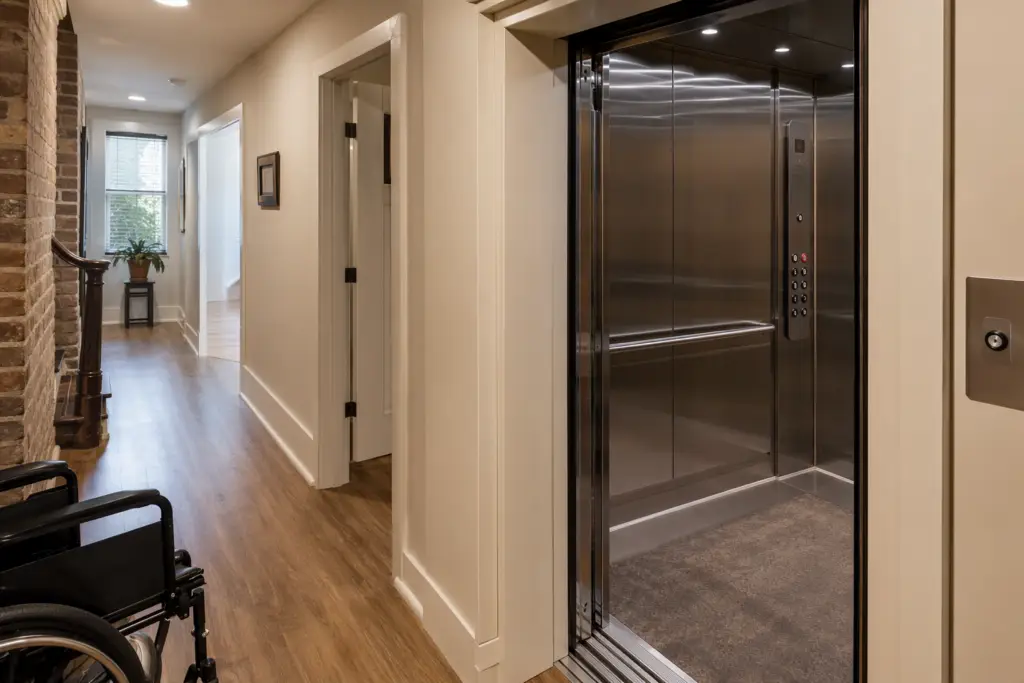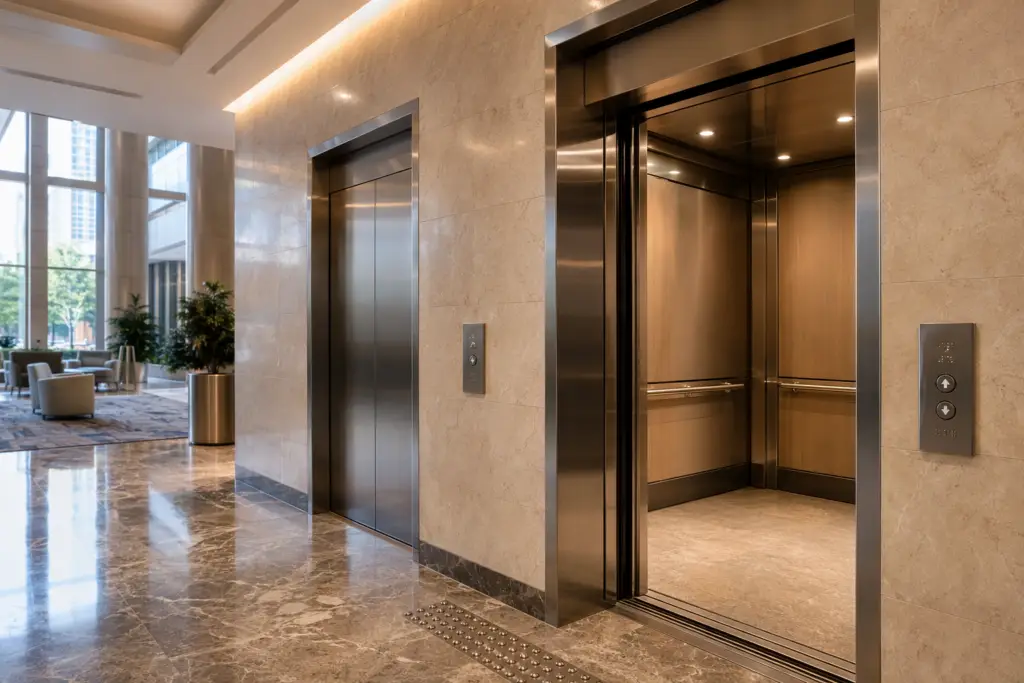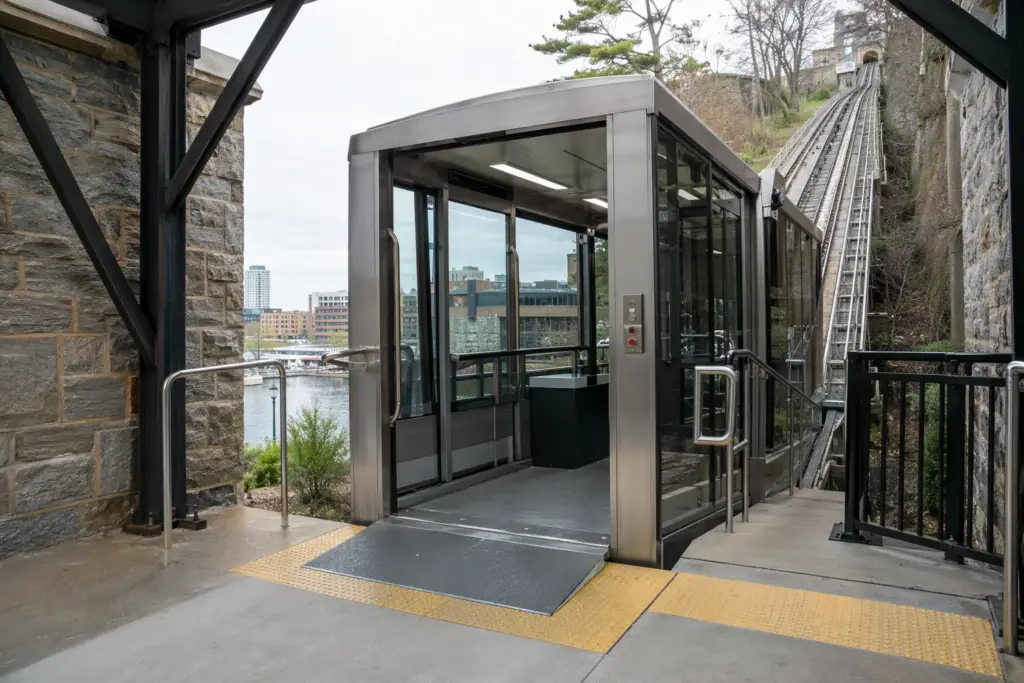
To confirm whether Quality Elevator Company performed a past inspection on a specific elevator, the fastest path is to contact the company directly with the building address, elevator unit number, and approximate date range in question. In addition to company records, every jurisdiction served — the District of Columbia, Maryland, Pennsylvania, and Virginia — requires that a certificate of inspection be posted in or near the elevator car, and that inspection records be kept on site or filed with the state regulatory agency. Checking both sources provides an independently verifiable trail.
Why Does Past Inspection History Matter for Elevator Owners and Managers?
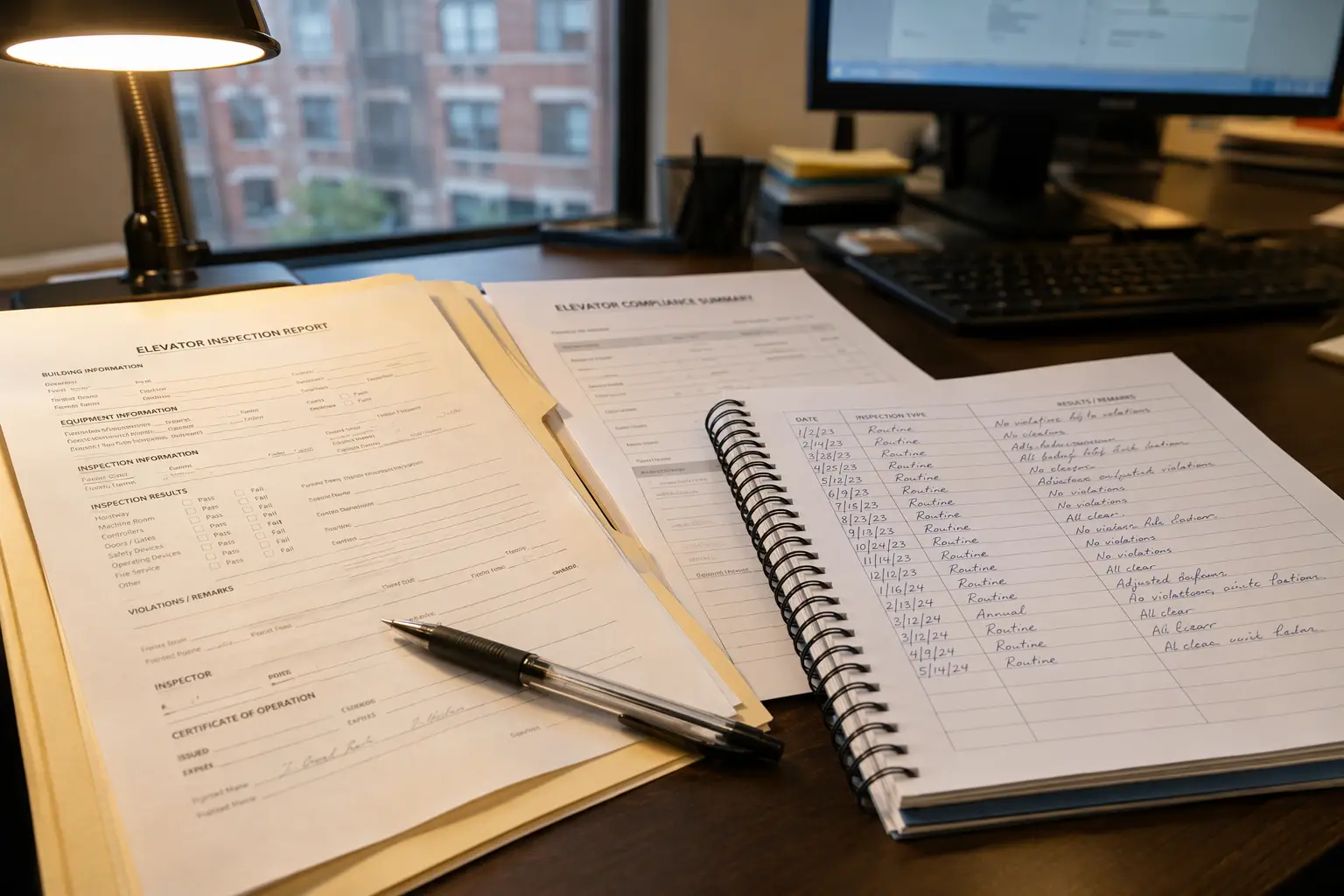
Past inspection history establishes whether an elevator has been maintained in compliance with applicable safety codes and whether required periodic tests have been completed on schedule.
Gaps in inspection history can create legal liability for building owners, slow down insurance renewals, and complicate the sale or lease of a property. Regulatory agencies in each jurisdiction Quality Elevator Company serves — the DC Department of Buildings, the Maryland Department of Labor, the Pennsylvania Department of Labor and Industry, and local building departments in Virginia — may request documentation of prior inspections when issuing or renewing a certificate of operation. A continuous, documented inspection record is therefore a business asset, not just a regulatory formality.
When a new property manager or building owner takes over a facility, confirming who performed prior inspections — and whether those inspections were conducted by ASME QEI-certified inspectors — helps determine whether the elevator is in good standing or whether catch-up work is needed before the next scheduled inspection window.
How Can I Locate the Certificate of Inspection Currently Posted on My Elevator?
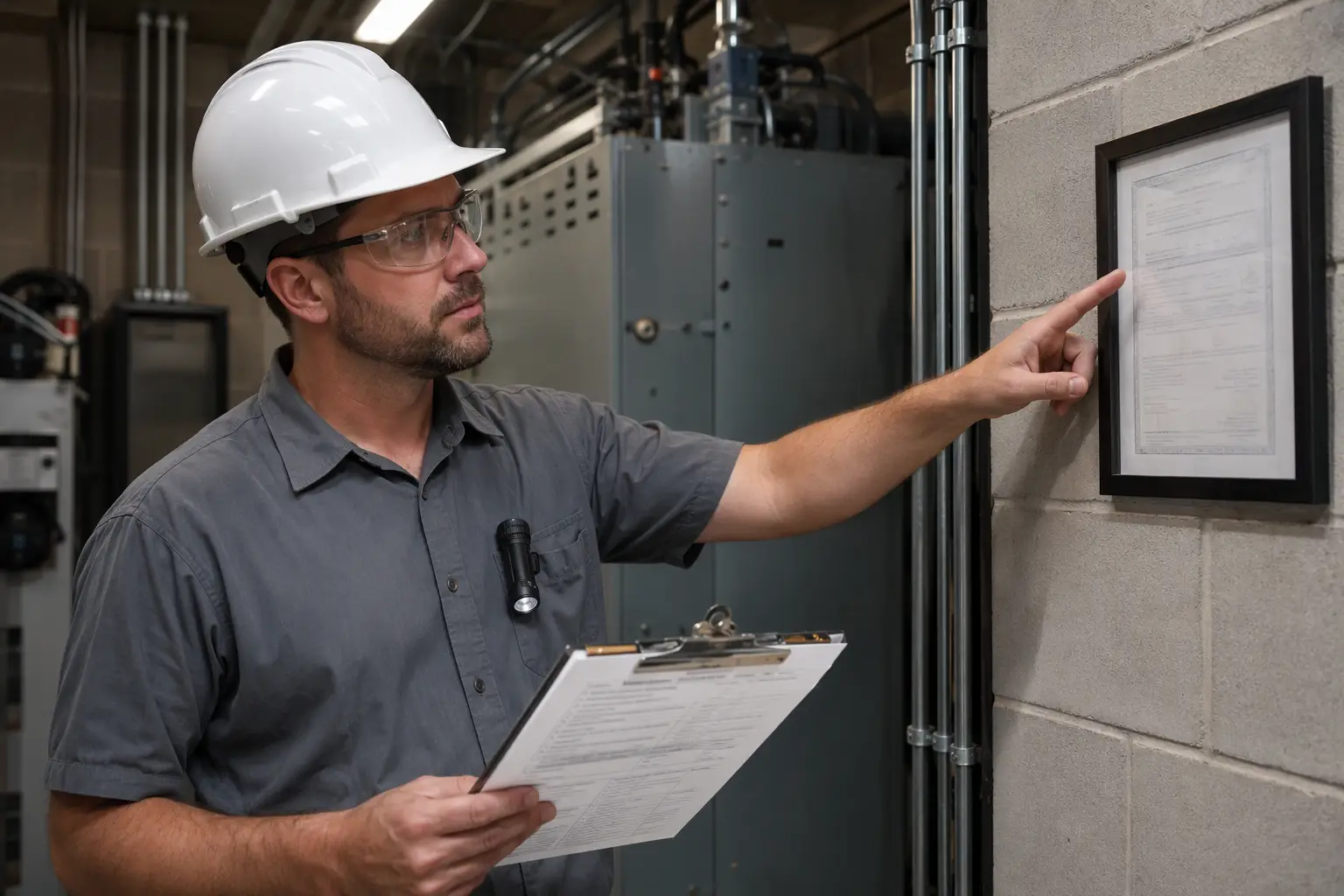
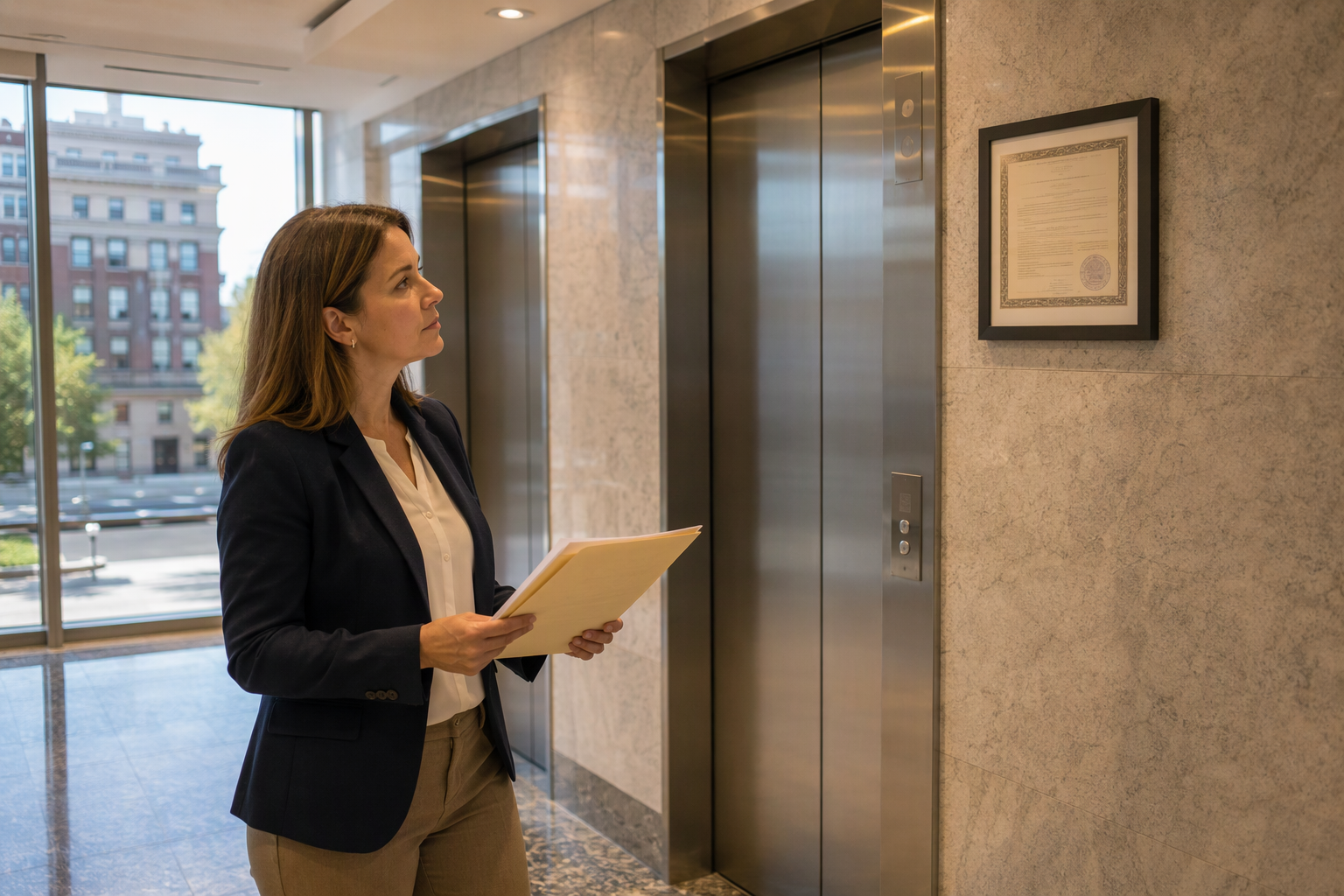
Every jurisdiction in the Quality Elevator Company service area legally requires a current certificate of inspection to be displayed in or near the elevator, making the posted certificate the first and most immediate source of inspection history.
In the District of Columbia, DC Department of Buildings (DOB) regulations under 12-A DCMR Chapter 30 require that a copy of the current certificate of inspection be conspicuously displayed in the elevator car or attached to the conveyance — unless the building operator maintains an office in the same building where the certificate is kept available for public inspection. In Maryland, the Maryland Department of Labor, Division of Labor and Industry, Elevator and Escalator Safety requires under the Annotated Code of Maryland, Public Safety Article, Title 12, Subtitle 8, that the certificate be posted conspicuously in or on the elevator unit. In Pennsylvania, the Pennsylvania Department of Labor and Industry requires that the certificate of operation be posted in the elevator car or attached to the controller in the machine room for equipment with a machine room. In Virginia, under 13VAC5-63, the Virginia Uniform Statewide Building Code, the current certificate must be displayed in the elevator, kept in the building operator’s office, or posted in an approved conspicuous location.
The certificate typically identifies the inspection agency, the inspector, and the date of the most recent inspection. If Quality Elevator Company conducted the inspection, that information will appear on the face of the certificate.
How Do I Contact Quality Elevator Company to Look Up a Specific Inspection Record?
Reaching out to Quality Elevator Company directly is the most efficient method for retrieving detailed inspection records, including dates, inspector credentials, and test results that may not appear on the posted certificate alone.
When calling or emailing, having the following information ready will significantly speed up the lookup process:
- The full street address of the building, including suite or floor if applicable.
- The elevator unit number or device number as it appears on the posted certificate or on the elevator controller panel.
- The approximate year or date range for which you need inspection confirmation.
- Your name, title, and relationship to the property (owner, property manager, legal representative, or prospective buyer).
- Any prior inspection certificate numbers or state-issued device registration numbers you have on hand.
With that information, the service team can cross-reference records against the state registration number assigned by the applicable regulatory authority and confirm whether Quality Elevator Company appears in the inspection chain for that unit.
What State Agency Records Can I Check to Verify an Elevator’s Inspection History?
Each regulatory authority in the Quality Elevator Company service area maintains official records of elevator registrations, certificates, and inspection filings that building owners and managers can access independently of the service company.
In the District of Columbia, owners submit third-party inspection reports for the past two years to DOB through the Citizen Access Portal; that portal is the authoritative government record for DC elevator inspections. In Maryland, elevator units must be registered with the Commissioner of Labor and Industry, and re-registration occurs annually at the time of the periodic inspection — those registration and inspection records are held by the Maryland Department of Labor, Division of Labor and Industry. In Pennsylvania, the Pennsylvania Department of Labor and Industry issues certificates of operation tied to each elevator unit and maintains records of permit applications, acceptance inspections, and periodic inspection cycles. In Virginia, because elevator inspection is enforced by local building departments, records reside at the applicable city or county office — in Richmond, for example, the City of Richmond Department of Planning and Development Review, Bureau of Permits and Inspections, runs the elevator program and holds annual inspection records and certificates.
Where Are On-Site Inspection and Maintenance Records Required to Be Kept?
State regulations require on-site record retention, meaning a building’s own maintenance file is often the fastest place to find historical inspection data without contacting either the service company or the state agency.
Under Maryland’s COMAR 09.12.81 framework, maintenance, repair, test, and inspection records must be kept at a readily accessible central location in the building where the elevator is located. Prospective buyers conducting due diligence, property managers who have recently changed vendors, or building owners responding to a regulatory inquiry should begin by checking the mechanical room files or the building manager’s records cabinet before escalating to the state database. For buildings in the DC, Pennsylvania, or Virginia markets, similar on-site documentation practices are considered industry-standard under the ASME A17.1 Safety Code for Elevators and Escalators, which governs maintenance record requirements for covered conveyances.
What Information Appears on an Elevator Certificate of Inspection?
An elevator certificate of inspection is a formal regulatory document, not simply a sticker, and it contains specific data fields that help confirm inspection provenance.
Depending on the jurisdiction, a certificate typically includes: the name of the inspection agency or inspector, the ASME QEI certification number of the inspector (required in DC and by industry standard elsewhere), the device registration or unit number assigned by the state or local authority, the date of the most recent periodic inspection, the date of any Category 1 or Category 5 test performed, the certificate issue date and expiration date, and any conditions or deficiencies noted. Reviewing these fields against company records allows both the building owner and the service provider to confirm continuity of inspection history.
How Long Are Elevator Certificates Valid in Each Jurisdiction Quality Elevator Company Serves?
Certificate validity periods differ by state and affect how far back an owner needs to look to establish a complete inspection record.
| Jurisdiction | Regulatory Authority | Certificate Validity | Periodic Inspection Frequency | Major Periodic Test |
|---|---|---|---|---|
| District of Columbia | DC Department of Buildings (DOB) | 2 years | Category 1 every 12 months | Category 5 every 60 months |
| Maryland | MD Dept. of Labor, Division of Labor and Industry | Tied to annual re-registration | Annual periodic inspection | Comprehensive 5-year inspection for wire rope, belt, chain, and rack-and-pinion elevators |
| Pennsylvania | PA Dept. of Labor and Industry | 24 months (6-month cycle) / 48 months (12-month cycle) | Every 6 months for electric elevators, hydraulic elevators, and escalators | Category tests per ASME A17.1 Table N-1 (witnessed by code official; annual Category 1 test required as standalone from December 20, 2026) |
| Virginia | Local building department; 13VAC5-63 USBC | Annual (locality may require 6-month) | Annual; locality may require semi-annual | Periodic tests per ASME A17.1 Appendix N; witnessed by local code official |
Understanding the certificate validity period for the relevant jurisdiction tells an owner exactly how many inspection cycles should have occurred within a given timeframe — and how many corresponding records should exist in the file.
What Is the Difference Between a Periodic Inspection and a Periodic Test, and Why Does It Matter for Record-Keeping?
A periodic inspection and a periodic test are distinct regulatory events, and both generate separate documentation that should appear in a complete inspection history.
Under the ASME A17.1 Safety Code for Elevators and Escalators, periodic inspections involve a visual and operational check of elevator components by a qualified inspector. Periodic tests — such as the Category 1 annual test and the Category 5 full-load safety test — require the elevator to be physically operated under specific load and speed conditions, typically performed by a licensed elevator mechanic and witnessed by an inspector or code official. In Maryland, for example, the state requires that when a third-party qualified elevator inspector witnesses a test, the inspector must be physically present for the entire test — a remote or paper witness does not satisfy the requirement. A thorough inspection history will contain documentation for both events, separately identified by date, inspector name, and test category.
Who Is Authorized to Inspect Elevators in Each Market Quality Elevator Company Serves?
Inspector authorization requirements vary by jurisdiction, and knowing who is qualified to perform an inspection helps confirm whether a historical inspection on file is regulatory compliant.
In the District of Columbia, owners must use a DOB-approved third-party elevator inspection agency; all inspectors must hold ASME QEI certification. DC’s Board of Industrial Trades (operating under the Department of Licensing and Consumer Protection) licenses elevator trades, while the DC Department of Buildings issues certificates. In Maryland, owners must hire a third-party qualified elevator inspector for periodic inspections; tests must be performed by a licensed elevator mechanic, and the Maryland Elevator Safety Review Board within the Maryland Department of Labor licenses both mechanics and contractors. In Pennsylvania, any UCC-certified elevator inspector may conduct a periodic inspection, and third-party agencies must be certified by the Pennsylvania Department of Labor and Industry. In Virginia, the local building department enforces inspection requirements; no one may work as an elevator mechanic without state certification through the Virginia Board for Contractors (DPOR), which requires at least three years of industry experience and a passing examination score.
What Should I Do If There Is a Gap in My Elevator’s Inspection History?
A gap in inspection history — meaning a period during which no documented periodic inspection or required test occurred — is a compliance issue that should be addressed proactively rather than discovered during a regulatory audit or after an incident.
- Pull all available on-site records, including any maintenance logs, work orders, and prior certificates stored in the mechanical room or building manager’s files.
- Contact the regulatory authority for the applicable jurisdiction (DOB in DC, the Maryland Department of Labor in Maryland, the Pennsylvania Department of Labor and Industry in Pennsylvania, or the relevant local building department in Virginia) to request the official device history associated with the elevator’s registration number.
- Contact Quality Elevator Company to determine whether any inspections, maintenance visits, or repair permits were recorded under that address or device number during the gap period.
- If an inspection was genuinely missed, schedule a current periodic inspection immediately — operating an elevator without a valid certificate is a violation in all four jurisdictions.
- Document the corrective action in writing and retain that documentation on site alongside the newly issued certificate.
- Consult with legal counsel if the gap may affect a property transaction, insurance claim, or pending regulatory proceeding.
Does a Change in Elevator Service Company Affect My Inspection Record?
Changing service companies does not erase prior inspection records, but it does mean that historical documentation may be held by the previous provider rather than the current one.
State regulatory databases — particularly Maryland’s registration system and Pennsylvania’s certificate-of-operation system — maintain records independently of the service company. DC inspection reports submitted through the DOB Citizen Access Portal are likewise held by the government, not the inspector. However, detailed field notes, test data sheets, and internal service records generated by the prior company remain the property of that company and may not transfer automatically. When transitioning to a new service provider such as Quality Elevator Company, building owners should formally request copies of all inspection reports, test data sheets, and maintenance records from the outgoing company and retain those documents on site as part of the building’s permanent elevator file.
How Can a New Property Owner Establish the Full Inspection History of an Elevator They Just Acquired?
Property acquisitions create a critical moment for elevator compliance review because the new owner inherits both the physical equipment and the regulatory obligations associated with it.
- Request the elevator inspection file from the seller during due diligence — this should include all certificates of inspection, periodic test reports, and maintenance records for at least the prior five years.
- Verify the current certificate of inspection displayed in the elevator car is valid and has not expired.
- Contact the state regulatory authority (or local building department in Virginia) to confirm the elevator’s registration status and whether any open violations or orders exist against the device.
- Contact Quality Elevator Company or the prior service provider to request a copy of any inspection or service records on file for that unit.
- Schedule a baseline assessment with a qualified service provider to evaluate current condition, identify any deferred maintenance, and establish a forward-looking compliance calendar.
Are There ADA Requirements Related to Elevator Inspection Records?
The Americans with Disabilities Act (ADA) does not itself mandate elevator inspection recordkeeping, but it establishes accessibility standards that apply to elevator equipment — and ADA compliance is relevant context when reviewing an elevator’s service history.
Under the ADA, elevators in facilities covered by Titles II and III must meet specific accessibility requirements, including cab dimensions, door width, control height, and auditory signals. If an elevator’s inspection history reveals a period during which the unit was out of service or operating with known deficiencies, ADA compliance during that period may be a question a new owner or legal counsel wants to evaluate. Routine inspection records that document the operational status of accessibility features — such as door reopening devices and emergency communication systems — provide evidence of ongoing ADA compliance maintenance.
What Is a Device Registration Number and How Does It Help Trace Inspection History?
A device registration number is the unique identifier assigned to an elevator unit by the state regulatory authority, and it is the most reliable key for retrieving official inspection records from government databases.
In Maryland, each elevator unit must be registered with the Commissioner of Labor and Industry at least 60 days before planned completion and before it is placed in service, and re-registration occurs annually. In Pennsylvania, the device number is tied to the certificate of operation and appears on the face of that certificate. In DC, the device appears in the DOB’s Citizen Access Portal under the property address. In Virginia, the device registration is held by the local building department — in Richmond, this is managed by the Bureau of Permits and Inspections under the Department of Planning and Development Review. When contacting any of these agencies or contacting Quality Elevator Company, providing the device registration number eliminates ambiguity about which elevator is being referenced, especially in multi-elevator buildings.
Can I Request Inspection Records for an Elevator I Do Not Own?
The ability to request inspection records for an elevator you do not own depends on your legal relationship to the property and the public-records policies of the applicable jurisdiction.
Regulatory agencies in Maryland, Pennsylvania, DC, and Virginia are government bodies subject to public-records law. Elevator certificates and registration status are generally considered public records, accessible to anyone with a legitimate inquiry — prospective buyers, tenants, legal representatives, or lenders. Detailed inspection reports filed with the state may be accessible through a formal public records request. Company-held service records, however, are proprietary business documents, and Quality Elevator Company, like any service provider, would typically require authorization from the building owner or a lawful subpoena before releasing detailed records to a third party not affiliated with the property.
What Codes Govern the Inspection Requirements That Generate the Records I Am Trying to Find?
The inspection records being sought exist because specific federal and state codes legally require those inspections to occur and be documented.
The foundational standard is the ASME A17.1 Safety Code for Elevators and Escalators, which establishes inspection categories, test intervals, and documentation requirements. Each jurisdiction in the Quality Elevator Company service area has adopted a specific edition: DC adopted ASME A17.1-2013 (effective May 29, 2020, with District amendments under 12-A DCMR Chapter 30 and the 2017 DC Building Code); Maryland adopted ASME A17.1-2022 (effective June 17, 2026, under COMAR 09.12.81); Pennsylvania operates under ASME A17.1-2000 with A17.1a-2002 addenda for existing permit applications, transitioning to ASME A17.1-2016 for applications from December 20, 2026; and Virginia adopted ASME A17.1/CSA B44-2019 under the 2021 USBC effective January 18, 2024. The edition in effect at the time an inspection was performed governs the standards against which that inspection was measured — a fact relevant when evaluating the adequacy of historical records.
What Should I Do If the Posted Certificate in My Elevator Has Expired?
An expired certificate of inspection is a regulatory violation in all four jurisdictions served by Quality Elevator Company and requires immediate action — not simply a note to follow up later.
- Do not take the elevator out of service unilaterally without checking jurisdiction-specific requirements — in DC, for example, a DOB permit is required to take an elevator out of service or place it in temporarily dormant status under ASME A17.1 Section 8.11.1.4.
- Contact the elevator’s current service provider — or Quality Elevator Company if no current provider is under contract — to schedule an inspection as soon as possible.
- Contact the applicable regulatory authority to disclose the expired certificate and ask for guidance on interim compliance while inspection is pending.
- Ensure the inspection is conducted by a properly authorized inspector — a DOB-approved third-party agency in DC, a third-party qualified elevator inspector in Maryland, a UCC-certified inspector in Pennsylvania, or a local-code-official-approved inspector in Virginia.
- Once the inspection is complete and the new certificate is issued, post it immediately in the required location and retain all documentation on site.
How Does Quality Elevator Company Document Inspections It Performs?
Understanding how a service company documents its work helps building owners know what records to request when tracing past inspections.
Quality Elevator Company produces inspection reports that include the device registration number, date of inspection, inspection category (periodic, Category 1, Category 5, or acceptance), the name and ASME QEI certification number of the inspector, a description of any deficiencies observed, and any corrective actions recommended or completed. For jurisdictions requiring third-party report submission — particularly DC, where reports are submitted to DOB through the Citizen Access Portal — the company files those reports as part of the certificate-issuance process, creating a government-held record that the building owner can independently verify. For Maryland elevators, inspection and maintenance records are retained in a format suitable for on-site storage at the building, consistent with the COMAR 09.12.81 requirement for readily accessible records.
What Is the Role of ASME QEI Certification in Confirming the Validity of a Past Inspection?
ASME QEI (Qualified Elevator Inspector) certification is the professional credential that establishes whether an inspector was qualified to perform a legally valid inspection under the applicable code edition.
In DC, the regulatory framework under 12-A DCMR Chapter 30 explicitly requires ASME QEI-certified inspectors for periodic and Category 5 inspections. In Maryland, the state requires third-party qualified elevator inspectors, and QEI certification is the recognized benchmark for that qualification. In Virginia, third-party inspection reports must include the name and certification number of the elevator mechanic who performed the witnessed tests — a requirement that creates a verifiable credential trail. When reviewing historical inspection records, confirming that the named inspector held valid QEI certification at the time of the inspection is a key step in establishing whether that inspection satisfies the applicable regulatory standard. The ASME codes and standards page provides reference information on the QEI-1 standard governing inspector qualification.
How Often Should I Review My Elevator’s Complete Inspection and Maintenance File?
Elevator inspection and maintenance files should be reviewed at minimum annually — ideally before each scheduled periodic inspection — and whenever a triggering event occurs such as a property sale, change of service provider, equipment incident, or regulatory inquiry.
Annual review ensures that all required inspection certificates are current, that test documentation matches the inspection cycle mandated by the applicable jurisdiction, and that any deficiencies noted in prior reports have been addressed and documented. In Maryland, annual re-registration coincides with the periodic inspection, making that event a natural prompt for a full file review. In Pennsylvania, the semi-annual inspection cycle for electric and hydraulic elevators means records should be checked at least twice per year. Proactive file management reduces the risk of discovering compliance gaps only when they create a legal, insurance, or regulatory problem. Property managers who engage Quality Elevator Company as their service provider have access to a structured documentation process designed to support this kind of ongoing compliance review.
Contact Quality Elevator Company for a free elevator assessment at 301-779-9116.
Need elevator service you can rely on? Quality Elevator Company is ready to help.