Does Your Company Service Elevators in Virginia? Complete FAQ
Yes. Quality Elevator Company serves elevator owners and building operators in Richmond, VA, along with Baltimore, MD, Washington, DC, and Philadelphia, PA. The company provides full-service elevator maintenance, repair, modernization, and compliance support for commercial, residential, and institutional properties throughout its service territory. Virginia elevator owners must navigate local building department enforcement, state contractor licensing through the Virginia Board for Contractors, and the requirements of the ASME A17.1/CSA B44-2019 Safety Code for Elevators and Escalators as adopted by the 2021 Virginia Uniform Statewide Building Code, effective January 18, 2024. The FAQs below cover every major aspect of elevator service, compliance, and ownership in Virginia.
Does Quality Elevator Company service elevators in Virginia?
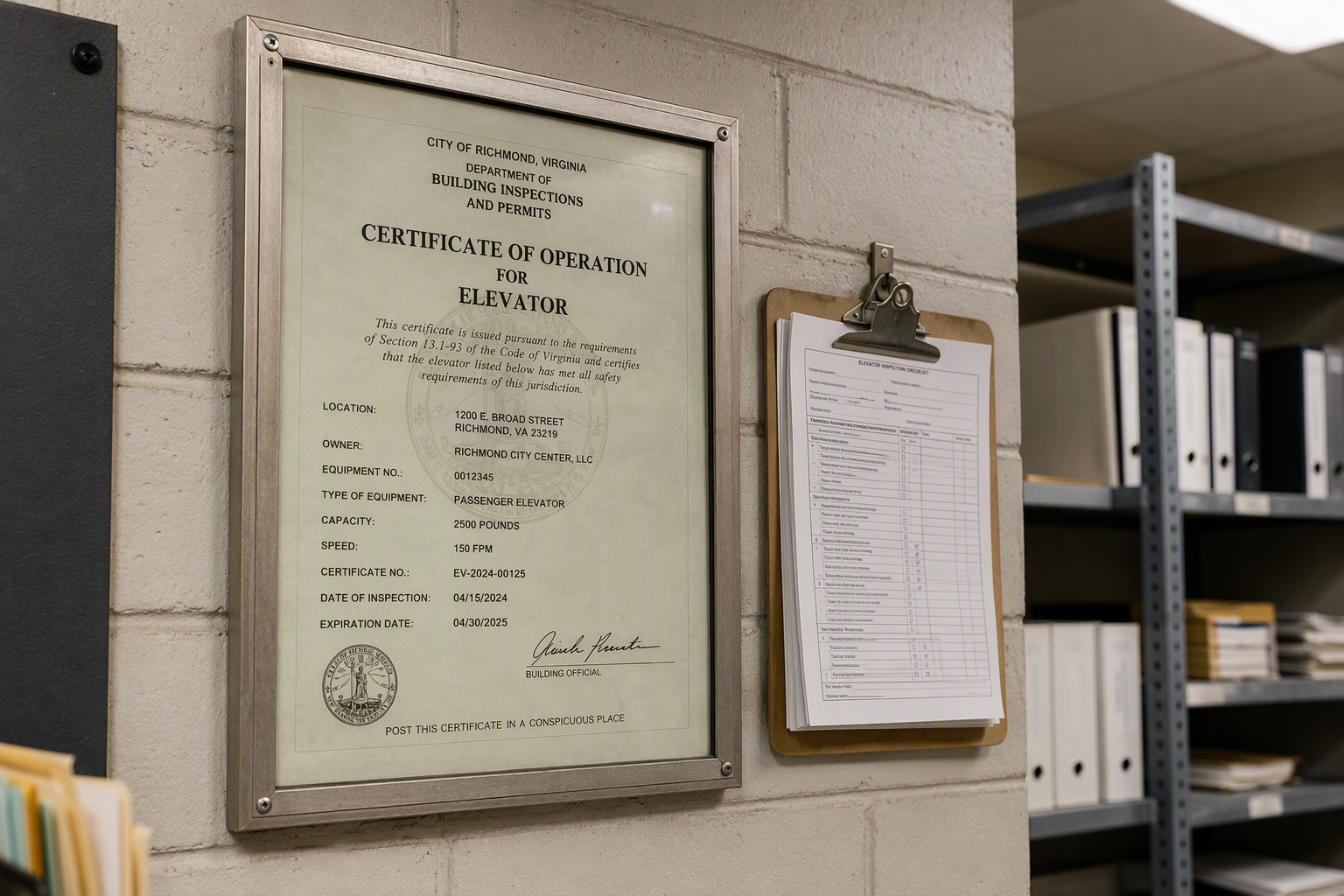
Yes — Quality Elevator Company services elevators in Richmond, VA, and the surrounding region as part of its four-market service territory.
Richmond is one of four core markets served by Quality Elevator Company, alongside Baltimore, MD, Washington, DC, and Philadelphia, PA. The company works with commercial property owners, property managers, hospitals, multifamily housing operators, and government facilities throughout the Richmond area to keep elevators operating safely, legally, and efficiently.
Services available in Virginia include preventive maintenance programs, emergency repair, code compliance consulting, modernization planning, and support for the annual and periodic inspections required under Virginia’s elevator regulations. Because Virginia’s elevator inspection and enforcement responsibilities sit with local building departments rather than a state labor agency, Richmond elevator owners work closely with the City of Richmond Department of Planning and Development Review, Bureau of Permits and Inspections, which runs the City’s elevator program — including final acceptance inspections of new or modernized elevators, annual inspections with testing, and issuance of elevator certificates.
Which Virginia locations does Quality Elevator Company cover?
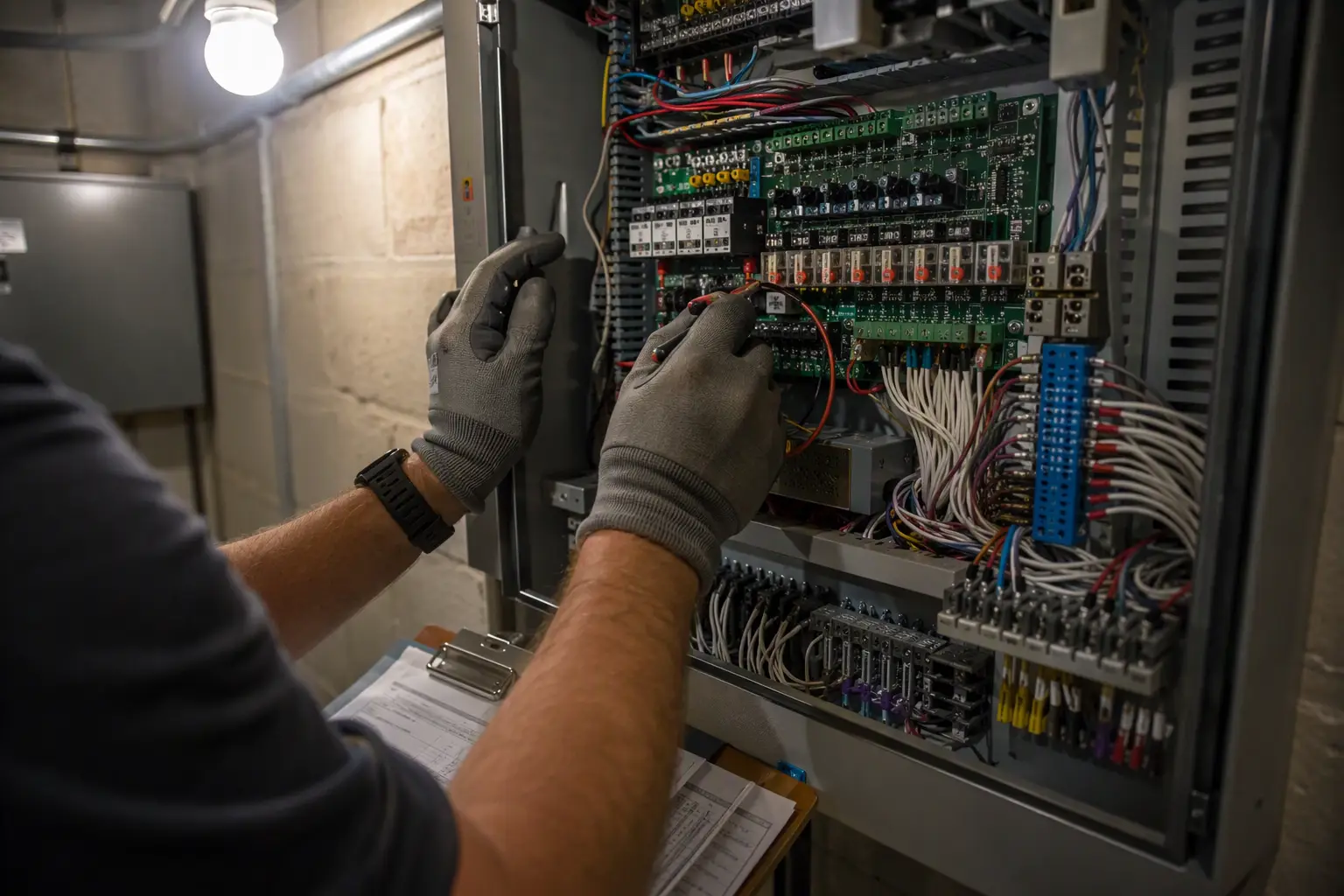
Quality Elevator Company’s Virginia service area is centered on Richmond, VA, and serves properties throughout the greater Richmond region.
Richmond’s elevator program is administered locally by the City of Richmond Department of Planning and Development Review, Bureau of Permits and Inspections, which handles elevator annual inspections and certification for properties within city limits. Properties in surrounding localities fall under their respective local building departments, consistent with how Virginia’s Virginia Uniform Statewide Building Code (13VAC5-63) assigns enforcement authority to local governments across the Commonwealth.
Building owners and property managers in the greater Richmond area who need a licensed elevator contractor should confirm their specific jurisdiction with their local building department and verify that the contractor holds the required Elevator/Escalator Contracting (EEC) specialty license from the Virginia Board for Contractors through the Department of Professional and Occupational Regulation (DPOR).
What elevator services are available in Virginia?
Quality Elevator Company provides preventive maintenance, repair, modernization, code compliance support, and inspection coordination for Virginia elevator owners.
A comprehensive elevator service program in Virginia typically covers:
- Preventive maintenance: Routine lubrication, adjustment, safety device testing, and component inspection to reduce unplanned outages and extend equipment life.
- Emergency repair: Response to entrapments, mechanical failures, door malfunctions, and control system faults.
- Modernization: Replacement of obsolete control systems, cab interiors, door operators, drive machines, and safety components to bring aging equipment into alignment with current ASME A17.1/CSA B44-2019 requirements.
- Code compliance consulting: Guidance on meeting Virginia’s current adopted code, preparing for annual inspections, and addressing deficiencies identified by the local building department.
- Inspection coordination: Working with the local building department’s certified elevator inspectors to schedule periodic and acceptance inspections, ensure required testing is performed by a certified mechanic, and facilitate certificate issuance.
- ADA compliance review: Assessing elevator features against ADA Standards for Accessible Design requirements, including cab dimensions, door timing, control height, and audible signals.
Who regulates elevator inspections in Virginia?
In Virginia, elevator inspections are enforced by local building departments — not a state labor agency — under the Virginia Uniform Statewide Building Code.
The Virginia Uniform Statewide Building Code (13VAC5-63), adopted under Code of Virginia § 36-97 et seq., assigns elevator inspection and enforcement authority to local governments. Each city or county is responsible for inspecting elevators and enforcing the building code within its jurisdiction, with limited exceptions for single-family homes, two-family homes, and townhouses.
For properties within the City of Richmond, that authority rests with the City of Richmond Department of Planning and Development Review, Bureau of Permits and Inspections. This office conducts final acceptance inspections of new or modernized elevators, annual elevator inspections with testing, and issues elevator certificates.
The Virginia Board of Housing and Community Development adopts and amends the statewide building code. The Virginia Board for Contractors through DPOR certifies elevator mechanics and licenses elevator contractors — but neither of those bodies inspects elevators. That responsibility belongs exclusively to local building departments.
What elevator safety code applies in Virginia?
Virginia has adopted the ASME A17.1/CSA B44-2019 Safety Code for Elevators and Escalators, incorporated by the 2021 Virginia Uniform Statewide Building Code, which took effect January 18, 2024.
The ASME A17.1/CSA B44 Safety Code for Elevators and Escalators is the foundational technical standard governing elevator design, construction, installation, operation, inspection, testing, maintenance, alteration, and repair. Virginia’s 2021 Uniform Statewide Building Code references the 2019 edition of that standard, which became effective for Virginia properties on January 18, 2024.
For existing elevators, the Virginia Existing Building Code’s referenced-standards table lists ASME A17.1/CSA B44-2016, which governs maintenance and alteration requirements for equipment already in service. Elevator owners should work with a licensed contractor to determine which edition applies to their specific equipment based on its installation date and permit history.
All periodic tests required under Virginia’s code must be witnessed by the local code official. The code official may delegate inspection and test witnessing to an approved third-party agency or to other locally certified elevator inspectors.
How often must elevators be inspected in Virginia?
Virginia requires an annual periodic inspection for all elevators and escalators, and a locality may require inspections as frequently as every six months.
Under 13VAC5-63 and the requirements incorporated from ASME A17.1, every elevator and escalator in Virginia must receive a periodic inspection at least once per year. Individual localities have the authority to require a six-month inspection cycle if local conditions or equipment history warrant it.
In addition to periodic inspections, ASME A17.1 Appendix N establishes a schedule of periodic tests — including Category 1 tests (annual), Category 3 tests (every three years for certain hydraulic elevators), and Category 5 tests (every five years for traction elevators) — that must be performed and witnessed by the local code official. These tests verify the function of safety devices, buffers, safeties, governors, and pressure-relief systems, among other critical components.
The current certificate of inspection must be displayed in the elevator car, attached to the escalator, kept available in the building operator’s office, or posted in an approved conspicuous location — it must be accessible to the public and the local authority.
Who is allowed to work on elevators in Virginia?
Only state-certified elevator mechanics and licensed elevator contractors may legally perform elevator work in Virginia, with limited exceptions for supervised apprentices.
Virginia law prohibits anyone from working as an elevator mechanic without state certification issued by the Virginia Board for Contractors through DPOR, unless working under the direct and immediate supervision of a certified mechanic. Certification requires at least three years of experience in the elevator industry and passing an examination offered or approved by the Board. Certified mechanics must complete at least eight hours of Board-approved continuing education to renew their certification.
On the contractor side, installing, repairing, improving, or removing elevators or escalators in Virginia requires a contractor license with the Elevator/Escalator Contracting (EEC) specialty from the Virginia Board for Contractors. Building owners and property managers should always verify that their elevator service contractor holds the current EEC specialty license before authorizing any work.
Third-party elevator inspection reports in Virginia must include the name and certification number of the elevator mechanic who performed the witnessed tests — giving building owners a straightforward way to verify compliance.
What happens after a new or modernized elevator is installed in Virginia?
A new or modernized elevator in Virginia must pass a final acceptance inspection by the local code official before it is placed into service.
The acceptance inspection process in Virginia follows this general sequence:
- The licensed elevator contractor completes installation or modernization work in accordance with the applicable permit and ASME A17.1/CSA B44-2019 requirements.
- The contractor contacts the local building department — for Richmond properties, the City of Richmond Department of Planning and Development Review, Bureau of Permits and Inspections — to schedule the final acceptance inspection.
- A certified elevator mechanic performs required acceptance tests while the local code official or an approved inspection agency witnesses the tests.
- The code official reviews the inspection report, including the mechanic’s name and certification number.
- If the elevator passes, the local building department issues a certificate of inspection authorizing the elevator to be placed into service.
- The current certificate of inspection is displayed in or near the elevator in compliance with the display requirements of 13VAC5-63.
Elevators that fail acceptance inspection must have deficiencies corrected before re-inspection. Quality Elevator Company coordinates with local building departments throughout this process to help owners avoid delays and ensure first-time pass rates.
How does ADA compliance apply to elevators in Virginia?
The Americans with Disabilities Act requires that newly constructed and altered elevators serving public accommodations and commercial facilities meet the ADA Standards for Accessible Design, regardless of state or local building code requirements.
Key ADA elevator requirements that apply in Virginia include minimum cab dimensions, door clear width of at least 36 inches, door timing controls, hall and car call buttons at accessible heights, raised and Braille characters on controls, audible and visible floor indicators, and two-way emergency communication systems. These federal requirements run parallel to — and in some cases exceed — state and local code requirements.
For existing buildings, the ADA requires that elevators be made accessible when alterations are undertaken, to the extent technically feasible. Building owners in Richmond and across Virginia who are planning modernization projects should have their elevator’s ADA compliance reviewed alongside state code compliance. A service provider such as Quality Elevator Company can help identify gaps and recommend upgrades that satisfy both federal and state requirements simultaneously, avoiding the cost of sequential remediation projects.
How does Virginia’s elevator code compare to neighboring jurisdictions?
Virginia, Maryland, and Washington, DC each enforce different editions of the ASME A17.1 code and assign inspection authority differently, creating meaningful compliance differences for multi-market building owners.
| Jurisdiction | Adopted ASME A17.1 Edition | Inspection Frequency | Inspection Authority | Certificate Display |
|---|---|---|---|---|
| Virginia | ASME A17.1/CSA B44-2019 (eff. Jan. 18, 2024) | Annual (local may require 6-month) | Local building department | In car, on escalator, operator’s office, or approved location |
| Maryland | ASME A17.1/CSA B44-2022 (eff. June 17, 2026) | Annual periodic + 5-year comprehensive | Maryland Dept. of Labor, Division of Labor and Industry | Posted conspicuously in or on the elevator unit |
| Washington, DC | ASME A17.1-2013/CSA B44-13 (eff. May 29, 2020) | Annual (Cat. 1) + 5-year (Cat. 5) | DC Dept. of Buildings (DOB), via approved third-party agencies | Conspicuously displayed in elevator car or on conveyance |
| Pennsylvania | ASME A17.1-2000 (A17.1-2016 for new permits from Dec. 20, 2026) | Every 6 months (electric, hydraulic, escalators) | PA Dept. of Labor and Industry (statewide, including Philadelphia) | In elevator car or attached to controller in machine room |
This table illustrates why property owners or management companies operating across Virginia, Maryland, and DC face meaningfully different compliance obligations in each market. A contractor familiar with all four jurisdictions — such as Quality Elevator Company — reduces the administrative complexity of multi-market compliance.
What are the most common elevator code violations found during Virginia inspections?
Common deficiencies identified during Virginia elevator inspections include overdue periodic tests, missing or expired certificates, door safety device failures, and inadequate maintenance records.
Virginia’s local code officials and their approved inspection agencies look for the following categories of issues during annual and periodic inspections:
- Expired or missing certificates: The certificate of inspection must be current and properly displayed. An expired certificate is a direct compliance failure that can result in the elevator being taken out of service.
- Overdue ASME Appendix N tests: Category 1 (annual), Category 3 (three-year), and Category 5 (five-year) tests must be completed on schedule and witnessed by the code official or approved agency. Missed test cycles are a frequent source of violations.
- Door and gate malfunctions: Automatic door reopening devices, door contact safety edges, and door timing are closely scrutinized because door-related incidents are among the most common causes of elevator injuries.
- Governor and safety device deficiencies: Governors, safeties, and buffers must be tested and found to operate within ASME A17.1 tolerances.
- Lighting and emergency power: Elevator cab lighting, emergency lighting, and emergency communication systems must function properly.
- Unresolved repair orders: Items noted on prior inspection reports that have not been corrected become priority findings at the next inspection.
A structured preventive maintenance program — reviewed against the current inspection checklist used by the local building department — is the most reliable way to avoid violations and the cost of re-inspection.
What should a Virginia building owner do if an elevator fails inspection?
If a Virginia elevator fails inspection, the owner must correct all identified deficiencies and request a re-inspection from the local building department before returning the elevator to service.
Follow these steps if your elevator receives a failing inspection report in Virginia:
- Review the inspection report carefully and note every deficiency identified by the code official or approved inspection agency.
- Contact a licensed elevator contractor holding the EEC specialty license immediately to evaluate the deficiencies and propose corrective action.
- Do not operate the elevator if the code official has ordered it out of service — operating a non-certified elevator creates significant legal and liability exposure.
- Authorize the necessary repairs. All repair work must be performed by certified elevator mechanics under a licensed contractor.
- Contact the local building department to schedule a re-inspection once repairs are complete. For Richmond properties, that is the City of Richmond Department of Planning and Development Review, Bureau of Permits and Inspections.
- Ensure that the mechanic performing any required tests during re-inspection is certified and that their name and certification number appear in the inspection report.
- Once the elevator passes re-inspection, obtain and display the updated certificate of inspection in compliance with 13VAC5-63 display requirements.
What is elevator modernization and when does a Virginia elevator need it?
Elevator modernization replaces obsolete mechanical, electrical, or control components with current-technology equivalents, and is typically warranted when maintenance costs rise significantly, safety device testing begins to fail, or the equipment no longer meets code requirements for existing buildings.
Virginia’s Existing Building Code references ASME A17.1/CSA B44-2016 for alterations and maintenance of existing equipment. When an alteration reaches a defined scope threshold, it may trigger additional code requirements for the entire elevator installation, not just the components being replaced. Understanding that threshold before beginning a project is critical to budget accuracy.
Common modernization triggers in Virginia include:
- Control system components that are no longer manufactured or supported, making parts sourcing unreliable
- Repeated failures during Category 5 (five-year) safety device tests
- Door operator failures that cannot be economically repaired with available parts
- Energy efficiency improvements required by building ownership or sustainability mandates
- ADA compliance upgrades tied to building renovation projects
- Insurance underwriter requirements following an inspection or incident
A modernization assessment should include a review of the current equipment condition, the applicable code edition for the alteration, the scope of work needed to satisfy the local building department’s acceptance inspection, and the ADA compliance status of the upgraded cab and controls.
How should building owners maintain elevator records in Virginia?
Virginia elevator owners should maintain current certificates, inspection reports, test records, and maintenance logs in a readily accessible location in the building, as required by the code and best practice for managing local building department inquiries.
While Virginia’s code specifically requires the certificate of inspection to be displayed or accessible, good recordkeeping extends well beyond the certificate. Best practice for Virginia elevator owners includes:
- Retaining all periodic inspection reports and ASME Appendix N test records for the life of the equipment, with easy retrieval for any local building department inquiry or audit
- Keeping a maintenance log that documents every service visit, including the date, work performed, parts replaced, and the name and certification number of the mechanic
- Tracking the due dates for Category 1, Category 3, and Category 5 tests to avoid missed test cycles
- Storing records of any permits issued for installation, alteration, or major repair work
- Maintaining documentation of ADA compliance reviews and any modifications made to satisfy ADA Standards
Organized records significantly reduce friction during annual inspections, simplify the sale or transfer of a building, and provide a defensible record in the event of an incident or complaint.
Does OSHA have any role in elevator safety for Virginia workplaces?
Yes — OSHA regulations apply to elevator safety in Virginia workplaces, covering construction-site hoists, worker protection during maintenance and repair operations, and the general duty to provide a hazard-free workplace.
For construction elevators and personnel hoists, OSHA’s construction standards impose requirements that operate independently of Virginia’s building code elevator program. For maintenance and repair technicians working on elevators in Virginia workplaces, OSHA’s general industry standards govern lockout/tagout procedures, confined space protocols, electrical safety, and fall protection. Employers who allow elevator maintenance to be performed on their premises have an obligation under OSHA’s General Duty Clause to ensure that the work is conducted safely by qualified personnel.
Virginia operates its own state-plan OSHA program, the Virginia Occupational Safety and Health (VOSH) program, which adopts and enforces standards at least as effective as federal OSHA requirements. Building owners should confirm with their elevator service contractor that all maintenance and repair work is conducted in accordance with applicable OSHA and VOSH requirements.
What should Virginia elevator owners look for when selecting an elevator service contractor?
Virginia building owners should verify that any elevator contractor holds the Elevator/Escalator Contracting (EEC) specialty license from the Virginia Board for Contractors, employs certified elevator mechanics, and demonstrates familiarity with local building department procedures in their jurisdiction.
A structured contractor selection process for Virginia elevator work should include the following verification steps:
- Confirm the contractor’s current EEC specialty license status through the Virginia Department of Professional and Occupational Regulation (DPOR) license lookup.
- Verify that the mechanics who will perform work on your equipment hold current Virginia elevator mechanic certifications, as the certification number must appear on inspection reports.
- Assess the contractor’s experience with the specific type and brand of elevator equipment in your building — control systems, drive machines, and safety components vary significantly across manufacturers.
- Confirm that the contractor has established working relationships with the local building department that will conduct acceptance and annual inspections for your property.
- Review the contractor’s approach to ASME Appendix N test scheduling to ensure Category 1, Category 3, and Category 5 tests are tracked and completed on time.
- Evaluate the contractor’s familiarity with ADA requirements for elevator accessibility, particularly if any renovation or modernization work is contemplated.
How do Virginia elevator requirements differ for residential versus commercial buildings?
Virginia’s elevator inspection and certification requirements under 13VAC5-63 generally do not apply to elevators in single-family homes, two-family homes, and townhouses, but apply fully to commercial, multifamily, and institutional buildings.
For commercial, mixed-use, multifamily, and institutional properties in Virginia, the full suite of requirements applies: annual periodic inspections, ASME Appendix N test schedules, local building department oversight, certificate display, and the use of certified mechanics and licensed contractors. These obligations apply regardless of elevator type — traction, hydraulic, or limited-use/limited-application (LULA).
For multifamily residential buildings such as apartment complexes, the annual inspection requirement applies and is enforced by the local building department. Property managers of multifamily buildings in Richmond should coordinate with the City of Richmond Department of Planning and Development Review, Bureau of Permits and Inspections to confirm the current inspection schedule and certificate status for each elevator in the building.
Privately owned single-family homes, two-family homes, and townhouses are exempt from the local building department’s elevator inspection program, though the equipment must still be installed and maintained safely and any alterations still require permits.
What is the role of ASME A17.3 for existing elevators in Virginia?
ASME A17.3, the Safety Code for Existing Elevators and Escalators, provides a framework for bringing older elevator installations into closer alignment with current safety standards through retroactive safety requirements, and is referenced as a resource even where ASME A17.1 governs primary code compliance.
While Virginia’s Uniform Statewide Building Code directly adopts ASME A17.1/CSA B44-2019 for new installations and ASME A17.1/CSA B44-2016 for existing building alterations, ASME A17.3 identifies safety features that are considered critical enough to require retrofitting on older equipment even if those features were not required when the elevator was originally installed. Retroactive requirements under A17.3 have historically included items such as door reopening devices, leveling accuracy requirements, and certain lighting standards.
Building owners with older elevator installations — particularly those constructed before the 1990s — should have their equipment reviewed against current retroactive requirements as part of any modernization assessment. The local building department’s code official is the authoritative source for which retroactive requirements apply in a specific jurisdiction.
What should Virginia property managers do before scheduling an annual elevator inspection?
Before the annual inspection, Virginia property managers should confirm that all outstanding maintenance items are resolved, that required ASME Appendix N tests due in that cycle are scheduled, and that the elevator mechanic who performs tests holds a current Virginia certification.
A pre-inspection preparation checklist for Virginia elevator owners includes:
- Review the prior year’s inspection report and confirm that every deficiency noted has been corrected and documented.
- Confirm with your elevator service contractor which ASME Appendix N test categories (Category 1, Category 3, or Category 5) are due in the current inspection cycle.
- Verify that the mechanic assigned to perform tests holds a current Virginia elevator mechanic certification — their name and certification number must appear in the inspection report submitted to the local building department.
- Ensure that the current certificate of inspection is properly displayed in the elevator car or an approved alternative location and has not expired.
- Check that elevator cab lighting, emergency lighting, and the two-way emergency communication system are all functioning correctly.
- Confirm that all door safety devices, hall lanterns, and position indicators are operating as required.
- Notify tenants of the scheduled inspection date and arrange appropriate access to the machine room, pit, and cab.
- Contact the City of Richmond Department of Planning and Development Review, Bureau of Permits and Inspections (for Richmond properties) or the relevant local building department to confirm the inspection date and any specific local requirements.
How can multi-property owners manage elevator compliance across Virginia, Maryland, and Washington, DC?
Multi-property owners operating across Virginia, Maryland, and Washington, DC benefit from a single elevator service partner who understands the distinct regulatory frameworks of each jurisdiction and can coordinate compliance activities across all markets.
Managing elevator compliance across these three jurisdictions involves tracking meaningfully different requirements:
- In Virginia, inspection authority is local — each city or county building department runs its own program, and the ASME A17.1/CSA B44-2019 edition applies to new work effective January 18, 2024.
- In Maryland, the Maryland Department of Labor, Division of Labor and Industry, Elevator and Escalator Safety oversees a statewide inspection program with annual periodic inspections and a five-year comprehensive inspection requirement under ASME A17.1/CSA B44-2022, effective June 17, 2026.
- In Washington, DC, the DC Department of Buildings (DOB) issues certificates through DOB-approved third-party inspection agencies, with annual Category 1 and five-year Category 5 inspections required under ASME A17.1-2013.
Consolidating elevator service under a single contractor familiar with all three markets reduces the risk of a missed inspection cycle in one jurisdiction, simplifies record retrieval across a portfolio, and creates a single point of accountability for compliance. Quality Elevator Company’s presence in all four markets — Richmond, VA, Baltimore, MD, Washington, DC, and Philadelphia, PA — is specifically designed to serve multi-market property owners and management companies with this need.
Contact Quality Elevator Company for a free elevator assessment at 301-779-9116.
Need elevator service you can rely on? Quality Elevator Company is ready to help.