Elevator chimes stop working after a modernization because the new controller communicates with audio hardware through digital signal protocols or low-voltage relay outputs that differ from the wiring scheme the original chime unit expected. When a modernization project replaces the controller, dispatch system, or car operating panel without explicitly accounting for the chime subsystem, the audio circuit is left without a valid trigger signal, an adequate power source, or the correct software commands to activate. Restoring chime function requires a systematic diagnostic that traces the signal path from the controller output through the wiring harness to the chime module, then corrects whatever link in that chain is broken — whether that is a miswired terminal, a missing parameter in controller firmware, a failed chime amplifier, or an incompatible replacement module.
What exactly causes elevator chimes to fail during or after a modernization project?
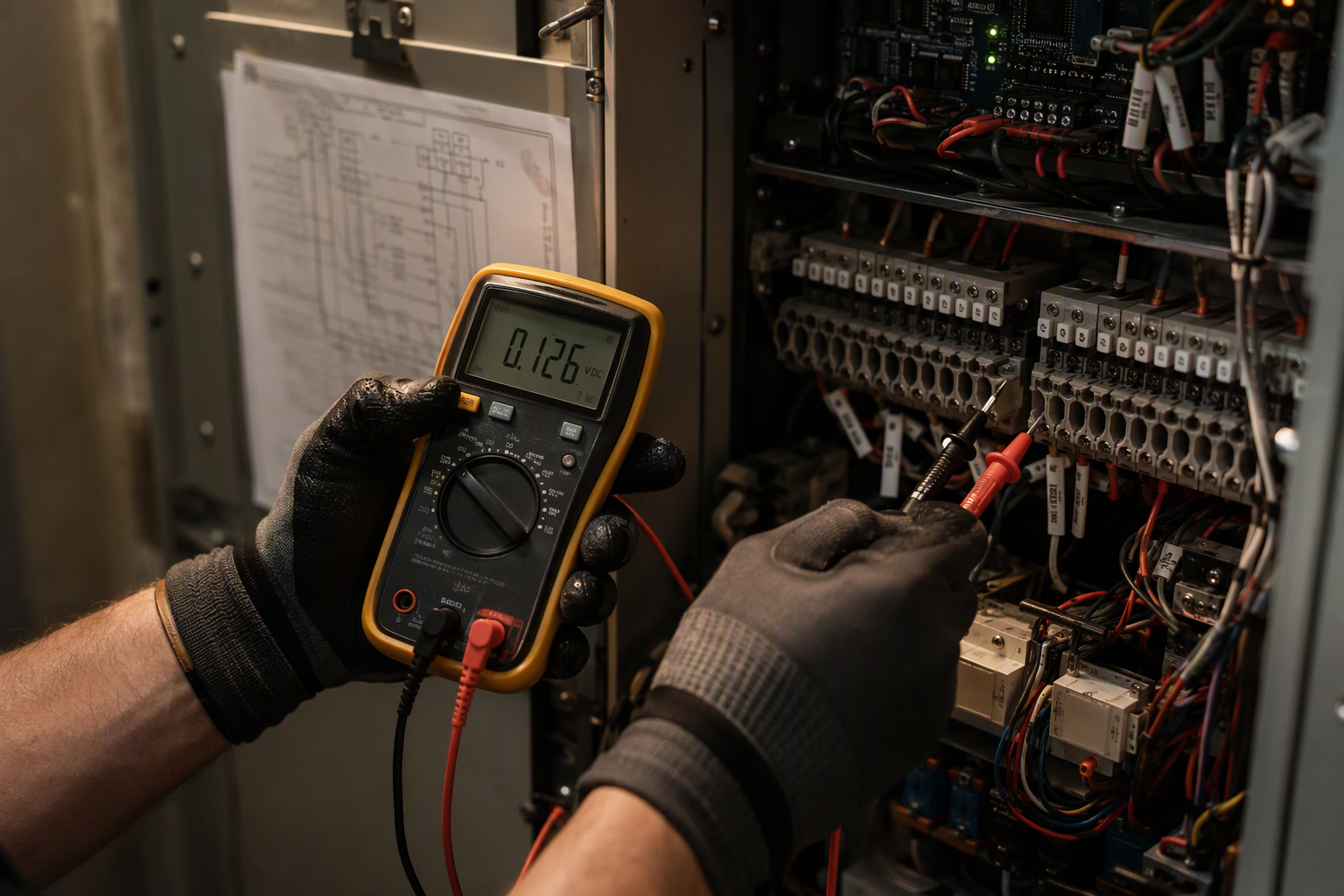
The root cause is almost always a mismatch between how the new controller generates its floor-arrival signal and how the chime hardware expects to receive it.
Modern elevator controllers communicate with auxiliary devices — including chime units, voice annunciators, and hall lanterns — through serial data buses, CAN bus protocols, or discrete low-voltage relay outputs. Legacy chime units wired to older controllers often relied on a simple 24-volt DC or 120-volt AC contact closure to trigger the chime coil. When a new controller replaces the old one and outputs a serial data command instead of a voltage pulse, the standalone chime coil sees no signal at all and remains silent.
A second common cause is scope exclusion. Modernization contracts are often written to replace specific components — the machine, drive, controller, and car operating panel — while treating the chime as an “existing” item that will be reused. If the technician does not verify that the existing chime module is compatible with the new controller’s output before commissioning, the chime simply does not function when the elevator is returned to service.
A third cause is firmware configuration. Most modern controllers ship with floor announcement and chime outputs disabled by default. A parameter table must be populated with the building’s floor designations, and the chime output relay or serial command must be enabled and assigned the correct floor sequence. If that programming step is skipped or saved incorrectly, the hardware may be fully wired and still produce no sound.
How do technicians diagnose which part of the chime circuit has failed?
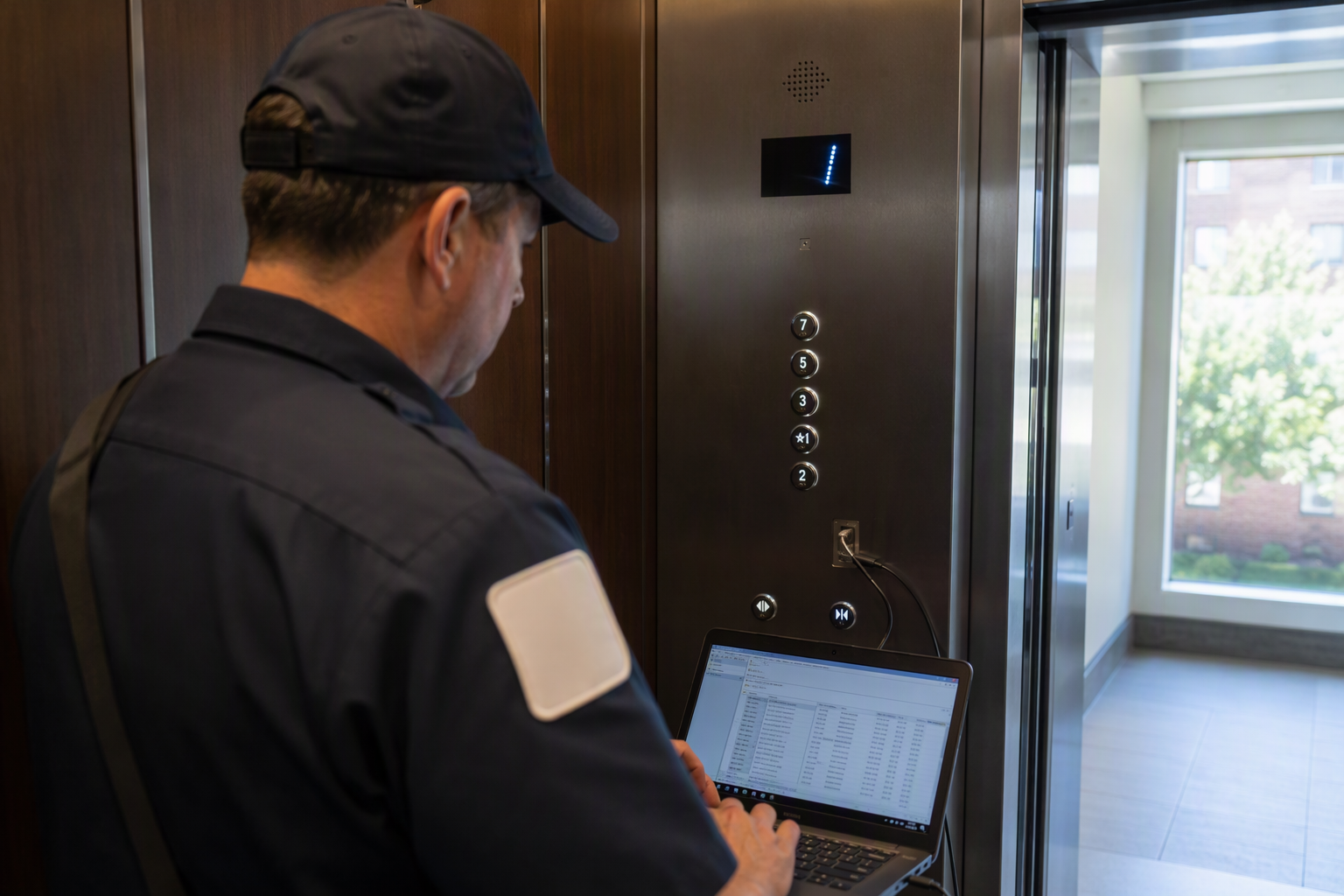
Diagnosis follows a logical signal-path approach that begins at the controller output and ends at the chime speaker or chime coil.
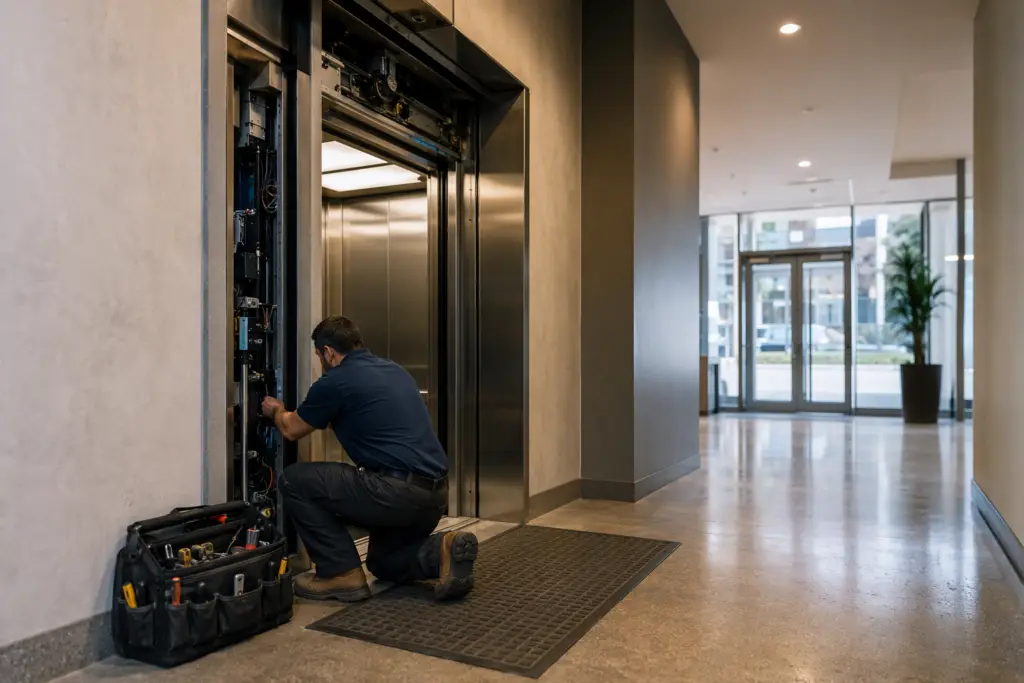
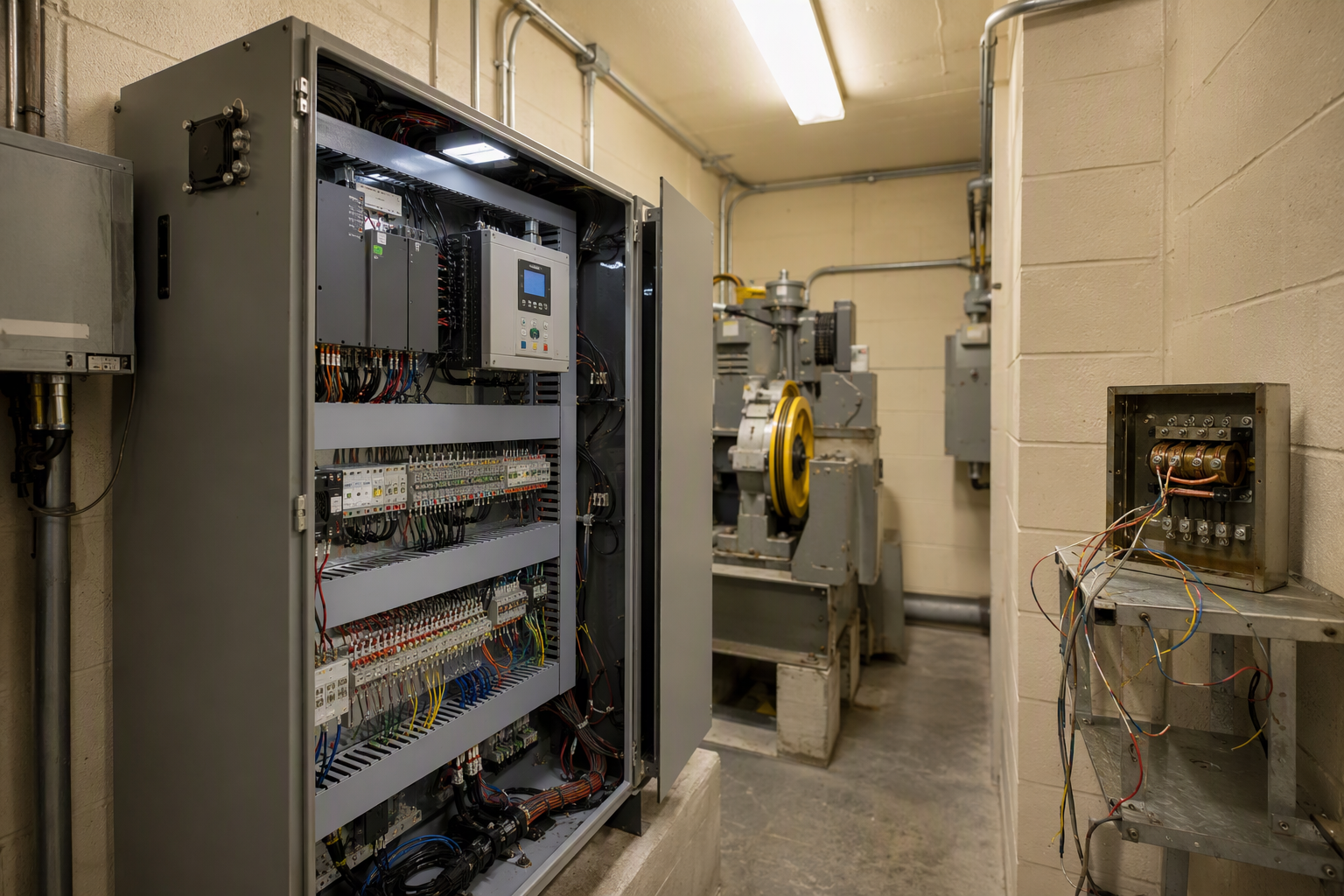
A licensed elevator mechanic will first pull the controller’s wiring diagram and identify the terminal or serial port designated for the chime output. Using a multimeter or oscilloscope, the technician verifies whether a voltage pulse or data signal is present at that terminal when the car arrives at a floor. If the signal is present at the controller but absent at the chime module terminals, the fault lies in the field wiring between them — a broken conductor, a loose terminal lug, or a blown inline fuse. If no signal is present at the controller output, the fault is in the controller firmware configuration or in a failed output relay on the controller board itself. If the signal is present all the way to the chime module but no sound is produced, the chime amplifier, speaker, or chime coil has failed and the module must be repaired or replaced.
What are the most common repair steps for restoring elevator chime function after modernization?
Restoring chime function after a modernization typically follows a structured repair sequence.
- Pull the as-built wiring diagrams for both the old and new controller and identify the chime output terminal designations on each.
- Inspect the field wiring from the controller panel to the chime module for continuity, proper terminal seating, and correct wire gauge.
- Access the controller’s parameter or configuration menu and confirm that the chime output is enabled and that each floor’s designation is programmed correctly.
- Measure the voltage or data signal at the controller’s chime output terminal during a simulated floor arrival and compare it to the chime module’s input specification.
- If the signal type is incompatible (for example, a serial data output connected to a coil-type chime expecting a voltage pulse), install a signal interface relay or replace the chime module with a model rated for the controller’s output protocol.
- If the wiring is correct and the signal is present but the module produces no sound, test the chime speaker for continuity and replace the speaker or the entire module as needed.
- After repairs, perform a full floor-by-floor chime test in both the up and down directions to confirm correct tone and volume at every landing.
- Document all parameter changes and wiring modifications in the building’s maintenance and inspection records, which in Maryland must be kept at a readily accessible central location in the building under Maryland Department of Labor, Division of Labor and Industry, Elevator and Escalator Safety recordkeeping requirements.
Does a non-functioning chime create a code compliance problem under ASME A17.1?
Yes — for elevators where audible signals are required by the applicable edition of the ASME A17.1 Safety Code for Elevators and Escalators, a non-functioning chime is a code deficiency that must be corrected before the elevator is placed back in regular service.
ASME A17.1 requires that elevators intended to serve persons with visual impairments provide audible signals indicating the car’s direction of travel and floor position. The specific requirements are carried forward into the editions adopted by each jurisdiction. In the District of Columbia, the adopted edition is ASME A17.1-2013/CSA B44-13 as referenced by the 2017 DC Building Code, administered by the DC Department of Buildings (DOB). Maryland adopted ASME A17.1-2022/CSA B44:22 effective June 17, 2026, enforced through the Maryland Department of Labor, Division of Labor and Industry. Pennsylvania operates under ASME A17.1-2000 with A17.1a-2002 addenda until December 20, 2026, when ASME A17.1-2016 applies to new permit applications, regulated by the Pennsylvania Department of Labor and Industry. Virginia adopted ASME A17.1/CSA B44-2019 through the 2021 Uniform Statewide Building Code effective January 18, 2024, with enforcement by local building departments as described in 13VAC5-63, Virginia Uniform Statewide Building Code.
How does the ADA interact with elevator chime requirements?
The Americans with Disabilities Act (ADA) establishes accessibility requirements for elevators in places of public accommodation and commercial facilities, and audible signals are a core component of those requirements.
The ADA Standards for Accessible Design require that elevators provide audible signals that sound as each car passes or is about to stop at a floor, and that the signal indicate the direction of travel. For hall call systems with in-car lanterns, an audible tone must sound each time the lantern is activated. These ADA requirements operate in parallel with ASME A17.1 requirements, meaning a modernization that disables the chime system may simultaneously create both a code violation under the adopted ASME edition and an ADA accessibility deficiency. Building owners should confirm with their elevator service contractor that chime function is verified as part of any ADA compliance walk-through following a modernization.
What is the difference between a chime, a gong, and a voice annunciator, and does the repair approach differ?
Each of these audio devices serves the same functional purpose — announcing car arrival at a floor — but they differ in their hardware and signal requirements, which affects the repair approach.
A chime is an electronically generated two-tone sound, typically produced by a small amplifier and speaker driven by a digital audio file stored on the controller board or on a dedicated chime module. A gong is an electromechanical device in which a solenoid strikes a metal bar or bell; it requires a discrete voltage pulse to fire the solenoid coil. A voice annunciator is a digital audio system that plays a recorded floor designation (“Third floor, doors opening”) and typically communicates with the controller via a serial data interface. When a modernization replaces a gong-type system with a controller that outputs serial data rather than a voltage pulse, the solenoid will never fire and the gong is silent — the repair involves either installing an interface relay to convert the serial command to a relay output, or replacing the gong with a compatible digital chime module. Voice annunciators require firmware matching and may need a firmware update or replacement module when controllers change product generations.
Can the chime volume or tone be adjusted after a modernization repair?
Yes — volume, tone, and chime behavior are configurable parameters on virtually all modern elevator controllers and chime modules.
Once the chime is confirmed to be receiving the correct trigger signal, volume is typically adjusted either through a physical potentiometer on the chime amplifier board or through a parameter in the controller’s configuration menu. Tone selection — the number of chimes, the pitch, and whether a single tone or double tone sounds for up versus down travel — is usually a software setting. A licensed elevator mechanic with access to the controller’s programming interface can adjust these parameters without disturbing the wiring. Building owners in all four of Quality Elevator Company’s service markets — Baltimore, Washington DC, Philadelphia, and Richmond — frequently request volume adjustments after modernization because new amplifiers can be significantly louder than the units they replace.
How long does it typically take to repair elevator chimes after a modernization?
The repair duration depends on the root cause identified during diagnosis, but most chime repairs fall into categories that range from a same-visit firmware fix to a scheduled return visit for a module replacement.
A firmware configuration correction — enabling the chime output parameter and programming floor designations — is typically completed within the same service call once the technician has access to the controller programming interface and the correct software. A wiring correction, such as reconnecting a loose terminal or replacing a broken conductor in the traveling cable, is also usually completed within one service call. A module replacement — either a new chime amplifier, a replacement gong solenoid, or an interface relay — requires that the correct part be on the truck or ordered; if the part must be sourced, a second visit is needed. Quality Elevator Company technicians serving Maryland, DC, Philadelphia, and Richmond carry commonly used interface components and chime modules, helping minimize unnecessary return trips.
What inspection or permit obligations apply when repairing elevator chimes in DC, Maryland, Pennsylvania, and Virginia?
The permit requirements for chime repairs depend on whether the work constitutes a repair to an existing component or an alteration that changes the design or function of the elevator.
In the District of Columbia, alterations and repairs to existing elevators follow the DC Existing Building Code and require DOB oversight. A DOB permit for elevator work requires a copy of the master electrician license and the elevator contracting license. In Maryland, a licensed elevator contractor and licensed elevator mechanic must perform any repair work under the authority of the Maryland Department of Labor, Division of Labor and Industry; elevator contractors must carry at least $1,000,000 in general liability insurance and at least $500,000 in property damage insurance. In Pennsylvania, construction, alteration, or repair of an elevator requires a permit application to the Pennsylvania Department of Labor and Industry, and after a major repair the elevator may not return to service until the Department inspects and passes it. In Virginia, elevator repair work requires a contractor licensed with the Elevator/Escalator Contracting (EEC) specialty through the Virginia Board for Contractors, and local building departments administer the inspection program under 13VAC5-63.
What should building owners document after a chime repair to satisfy inspection requirements?
Documentation requirements vary by jurisdiction but generally include records of the repair itself, the technician’s credentials, and any parameter changes made to the controller.
In Maryland, maintenance, repair, test, and inspection records must be kept at a readily accessible central location in the building where the elevator is located. In DC, third-party inspection reports for the past two years must be submitted to DOB through the Citizen Access Portal when applying for a certificate of inspection, meaning any post-modernization repair that affects a reportable system — including audible signals — should be captured in the inspection record. In Pennsylvania, the acceptance inspection process following major repairs requires that documentation accompany the permit application. In Virginia, third-party elevator inspection reports must include the name and certification number of the elevator mechanic who performed witnessed tests. Quality Elevator Company provides complete repair documentation packages to building owners following any post-modernization service call, supporting compliance with all applicable jurisdiction recordkeeping requirements.
How do chime failures differ between hydraulic and traction elevator modernizations?
The chime signal pathway differs between hydraulic and traction systems primarily because of how the controller tracks floor position, which affects how the chime trigger is generated.
In a traction elevator, floor position is typically tracked by a encoder on the motor or sheave combined with a landing zone sensor, and the chime trigger is generated when the controller’s position logic confirms the car is within a defined window of a floor level. In a hydraulic elevator, position is often tracked by a selector tape, reed switches, or a linear encoder in the cylinder assembly. When a hydraulic controller is modernized, the new controller’s position-sensing method may differ from the old one, requiring that the chime trigger logic be reconfigured to match the new position-sensing signal. Hydraulic modernizations also sometimes introduce variable-frequency drives that replace simple on/off power circuits, and the new electrical environment can introduce noise that interferes with low-voltage chime wiring if that wiring is not properly shielded and routed.
What role does the traveling cable play in post-modernization chime failures?
The traveling cable carries the electrical conductors that connect the controller in the machine room to the devices inside the elevator car, including the chime module, and it is a frequent source of post-modernization chime failures.
When a modernization replaces the controller but retains the existing traveling cable, the available conductors in the old cable may not match the new controller’s wiring scheme for the chime circuit. Spare conductors may be repurposed, which can introduce routing errors. Additionally, traveling cables degrade over time — insulation becomes brittle, conductors develop micro-fractures, and moisture ingress can cause intermittent shorts — and a modernization that adds load to marginal conductors can expose pre-existing cable faults. A thorough post-modernization chime diagnosis should include a continuity and insulation resistance test of the traveling cable conductors assigned to the chime circuit.
What is the signal interface relay, and when is it required to restore chime function?
A signal interface relay is a small electromechanical or solid-state relay module that converts the controller’s output signal format into the voltage and contact type that the chime hardware requires.
Interface relays are required when a new controller outputs a low-current serial or digital logic signal but the installed chime module — particularly an electromechanical gong — requires a higher-current voltage pulse to operate its solenoid coil. The relay is wired so that when the controller’s output transistor activates, it energizes the relay coil, and the relay’s normally-open contact then closes to deliver the required voltage pulse to the gong. Interface relays are compact, inexpensive, and can typically be installed in the controller cabinet or on a small DIN rail without requiring a separate permit if they are part of a like-for-like repair. However, the technician must verify that the interface relay’s operating characteristics — coil voltage, contact rating, and response time — match both the controller output and the chime module input to prevent premature relay failure.
How do multi-car or group-controlled elevator systems complicate chime repairs after modernization?
In group-controlled elevator banks, chimes for hall lanterns are typically managed by the group controller rather than individual car controllers, and a modernization that replaces the group controller adds a layer of configuration complexity to the chime repair.
When a building modernizes a two- or three-car group, the new group controller must be programmed with the correct chime output assignments for each car’s hall lanterns at every floor. If the controller vendor’s technician programs the group dispatch parameters without a detailed floor-by-floor chime mapping document, some floors may receive chime signals for the wrong car or for neither car. Repairing this in a group system requires access to the group controller’s configuration software and a systematic test of each car’s hall lantern and chime at every landing — a process that is more time-consuming than a single-car chime repair and is best performed during off-peak hours to minimize disruption to building occupants.
What benchmark data helps building managers evaluate chime system performance after a modernization?
The table below provides reference benchmarks that building managers and elevator service contractors can use to evaluate chime system performance and identify abnormal conditions after a modernization.
| Performance Parameter | Typical Acceptable Range | Condition Requiring Investigation | Governing Reference |
|---|---|---|---|
| Chime trigger delay (time from car leveling to chime activation) | 0 – 1 second | Delay greater than 2 seconds or no activation | ASME A17.1 (audible signal requirements); controller manufacturer specification |
| Chime module supply voltage (typical low-voltage DC module) | 22 – 26 V DC (for 24 V rated modules) | Voltage below 20 V DC or above 28 V DC | Chime module manufacturer data sheet |
| Speaker/chime sound level at car threshold | Audible above ambient lobby noise; ADA guidance references audibility as the functional standard | Inaudible at 3 feet from the speaker or excessive distortion | ADA Standards for Accessible Design |
| Traveling cable conductor insulation resistance | At or above 1 megohm (typical industry minimum for low-voltage circuits) | Below 1 megohm; indicates insulation degradation or moisture ingress | ASME A17.1 maintenance requirements; NFPA 70 (NEC) wiring standards |
| Chime activation at every served floor (functional test) | 100% of served floors — both up and down directions | Any floor missing activation in either direction | ASME A17.1 Safety Code for Elevators and Escalators |
| Interface relay coil voltage (when used) | Within ±10% of rated coil voltage | Voltage out of tolerance; coil overheating or chattering | Relay manufacturer specification |
How does a building owner know whether the chime issue is a warranty repair versus a separate billable service call?
Whether a post-modernization chime failure is covered under the modernization contract warranty depends on the specific language of the warranty and what was explicitly included in the modernization scope of work.
If the modernization contract listed the chime system as an item to be retained and made operational, a chime failure discovered after commissioning is generally a warranty deficiency. If the chime was not mentioned in the scope of work, the contractor may take the position that it was outside the project scope and that restoring it is a separate service. Building owners should review the scope of work and the warranty provisions before the modernization begins and specifically request that the contract include language requiring the contractor to verify and document chime operation at commissioning. When evaluating a modernization proposal, building owners in the Quality Elevator Company service area — Baltimore, Washington DC, Philadelphia, and Richmond — should ask the contractor to provide a written commissioning checklist that includes audible signal verification.
What preventive steps reduce the risk of chime failure during a future modernization?
Proactive planning during the pre-modernization engineering phase is the most effective way to prevent chime failures after a modernization project is completed.
Before work begins, the building owner or their representative should request that the modernization contractor document the existing chime system — module model number, input voltage and signal type, wiring terminal designations, and speaker specifications. That documentation should be cross-referenced with the new controller’s chime output specifications, and any compatibility gap should be resolved in the engineering phase before equipment is ordered. The commissioning plan should include a mandatory floor-by-floor chime test witnessed by the building owner or property manager before the elevator is returned to regular service. Specifying that the modernization contractor be responsible for chime operation at commissioning — not just at the time of acceptance inspection — closes the most common gap that leads to post-modernization chime disputes.
How does a modernization affect the elevator’s existing certificate of inspection?
A modernization triggers a fresh acceptance inspection in all four jurisdictions served by Quality Elevator Company, and the existing certificate of inspection is affected differently in each market.
In the District of Columbia, an elevator’s certificate of inspection may be temporarily suspended while the elevator is under permit for alteration or modernization, as administered by the DC Department of Buildings (DOB). In Maryland, the State conducts a final acceptance inspection after an elevator unit is modified or altered and before it is placed in service. In Pennsylvania, after a major repair, replacement, or alteration, an elevator may not return to service until the Pennsylvania Department of Labor and Industry inspects and passes it. In Virginia, the local building department conducts final acceptance inspections of new or modernized elevators; in Richmond specifically, the Bureau of Permits and Inspections administers the elevator program under the City’s Department of Planning and Development Review. A chime failure discovered at the acceptance inspection can delay return-to-service authorization, making pre-commissioning chime verification critical.
When should a building owner call a certified elevator service contractor rather than attempting to troubleshoot chime issues with building maintenance staff?
Building maintenance staff should never attempt to work inside elevator controller cabinets or on elevator wiring, as this is restricted to licensed or certified elevator mechanics in all jurisdictions where Quality Elevator Company operates.
In Maryland, a person must be licensed by the Maryland Elevator Safety Review Board as an elevator mechanic before working on elevator units. In Virginia, no one may work as an elevator mechanic without state certification, unless working under the direct and immediate supervision of a certified mechanic. In the District of Columbia, the DC Board of Industrial Trades licenses elevator mechanics and contractors. In Pennsylvania, work inside elevator controller panels constitutes elevator repair work subject to permitting by the Department of Labor and Industry. Beyond the regulatory requirements, controller programming errors made by unqualified personnel can introduce safety-critical faults that affect more than just the chime circuit. Building maintenance staff can appropriately report the symptom to the elevator service contractor and confirm the building maintenance and inspection records are accessible, but all hands-on diagnostic and repair work must be performed by a qualified, licensed elevator mechanic.
How does Quality Elevator Company approach post-modernization chime repairs in Baltimore, Washington DC, Philadelphia, and Richmond?
Quality Elevator Company approaches post-modernization chime repairs using a structured diagnostic protocol that follows the signal path from the controller output to the chime device, resolving the root cause rather than substituting components until the sound returns.
After confirming the failure mode through electrical measurement and controller parameter review, Quality Elevator Company technicians document the repair in a format that meets the recordkeeping requirements of the applicable jurisdiction — whether that is Maryland’s central-location record requirement, DC’s DOB reporting process, Pennsylvania’s L&I documentation standards, or Virginia’s local building department inspection records. For building owners whose post-modernization chime failure is discovered at an annual or acceptance inspection, Quality Elevator Company can coordinate the repair, re-test, and re-inspection sequence to restore the certificate of inspection as efficiently as the jurisdiction’s process allows.
Contact Quality Elevator Company for a free elevator assessment at 301-779-9116.
Need elevator service you can rely on? Quality Elevator Company is ready to help.