Elevator Companies: The Complete FAQ Guide for Building Owners in Baltimore, Washington DC, Philadelphia, and Richmond
Elevator companies provide a critical service that touches nearly every commercial, residential, and institutional building with vertical transportation. Whether a building owner is evaluating a new installation, scheduling a required inspection, or planning a modernization project, understanding how elevator companies operate — and what regulators require — is essential to maintaining safe, legally compliant equipment. This comprehensive guide addresses the most common questions building owners, property managers, and facility directors ask when selecting and working with elevator companies in the Mid-Atlantic region.
What do elevator companies actually do?
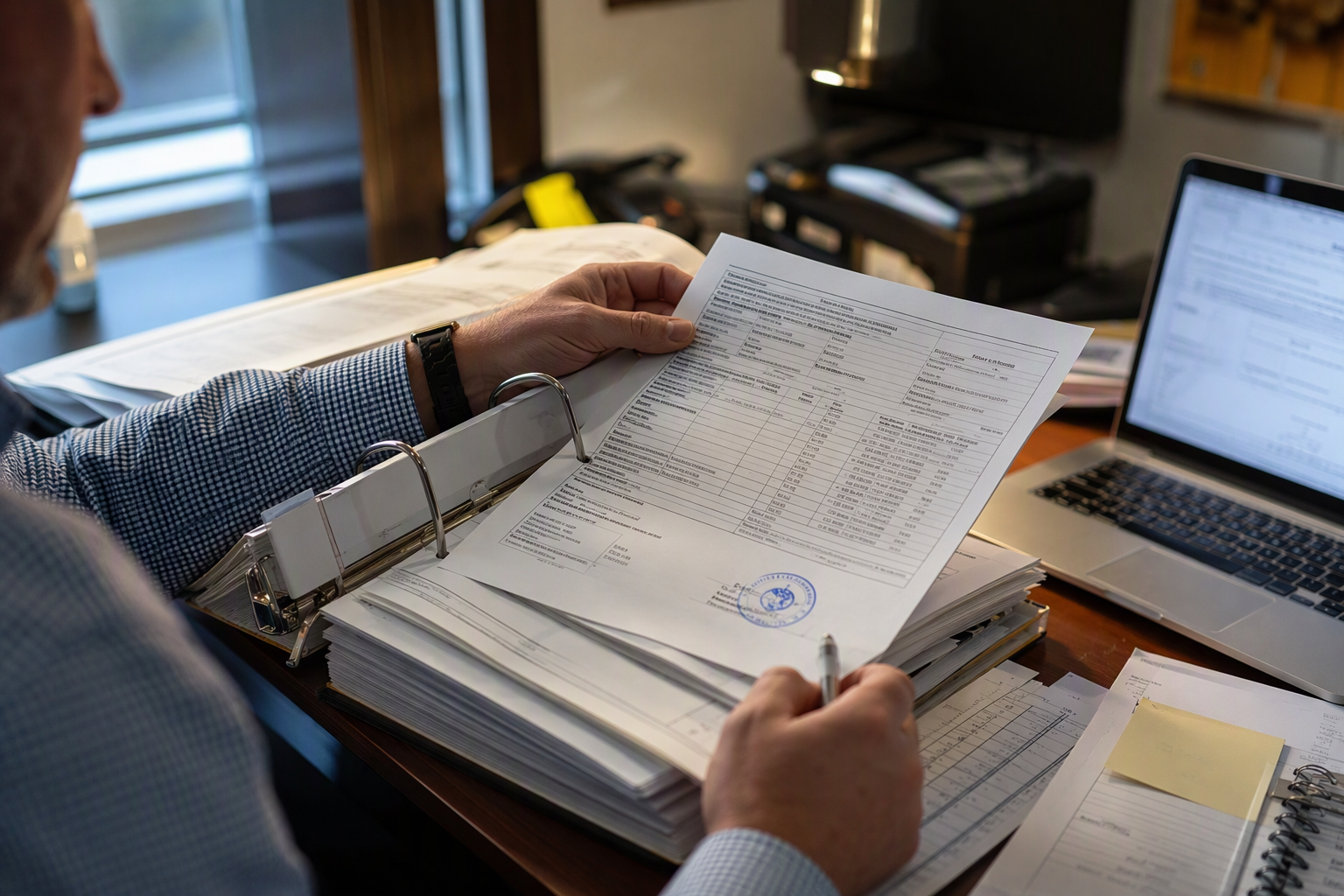
Elevator companies provide the full lifecycle of vertical transportation services, including new installation, routine maintenance, code-required inspections, modernization, and emergency repair of passenger elevators, freight elevators, escalators, and related conveying systems.
The scope of an elevator company’s work extends well beyond simply fixing breakdowns. A full-service elevator company manages equipment from permit application through final acceptance inspection, maintains ongoing maintenance contracts to prevent failures, coordinates with authorities having jurisdiction (AHJs) to schedule and witness required tests, and guides building owners through modernization projects when aging equipment no longer meets current safety codes.
Quality Elevator Company delivers this complete range of services to building owners across Baltimore MD, Washington DC, Philadelphia PA, and Richmond VA, operating within the distinct regulatory frameworks that govern elevator work in each jurisdiction.
What types of elevators do elevator companies service?
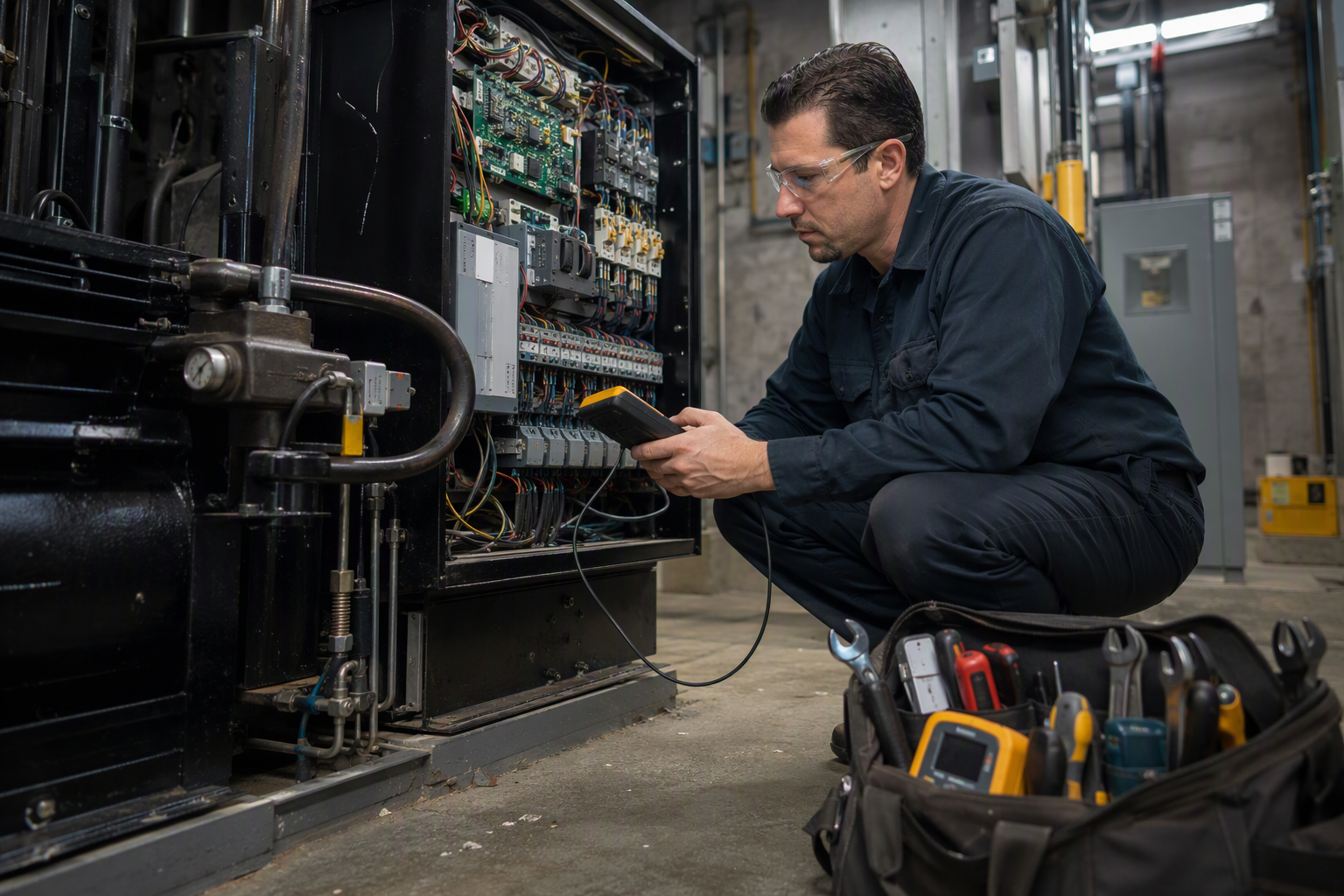
Elevator companies typically service traction (cable-driven) elevators, hydraulic elevators, machine-room-less (MRL) elevators, freight elevators, escalators, moving walkways, dumbwaiters, platform lifts, and limited-use/limited-application (LULA) elevators.
Each equipment type carries its own inspection category, test frequency, and maintenance profile under the ASME A17.1 Safety Code for Elevators and Escalators. Electric traction and hydraulic elevators are the most common in commercial buildings across the Mid-Atlantic region, but platform lifts and LULA elevators are increasingly common in facilities seeking ADA-compliant vertical access solutions in buildings where full-shaft construction is not feasible.
Understanding equipment type matters when evaluating elevator companies because not every firm carries the tooling, parts inventory, and technician training required for all categories. Building owners should confirm that the company they engage has documented experience with their specific equipment type before signing a service agreement.
How are elevator companies regulated in Washington DC?
In Washington DC, elevator companies must hold an elevator contracting license issued by the DC Board of Industrial Trades, and all inspection work must be performed by a DOB-approved third-party agency whose inspectors hold ASME QEI certification, under the oversight of the District of Columbia Department of Buildings (DOB).
DC elevator work is governed by 12-A DCMR Chapter 30 and the 2017 DC Building Code, which adopts ASME A17.1-2013/CSA B44-13 with District amendments, effective May 29, 2020. Every elevator and escalator in the District must be inspected and certified for operation. Owners must engage a DOB-approved third-party elevator inspection agency that inspects elevators on DOB’s behalf using ASME QEI-certified inspectors.
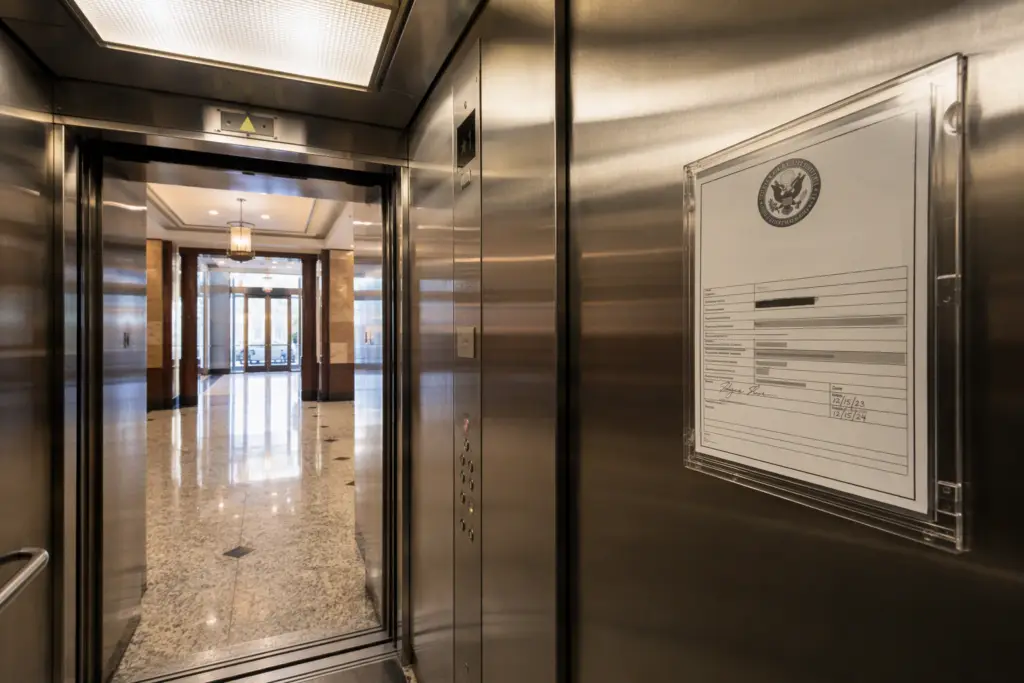
DC requires a periodic inspection and a Category 1 inspection every 12 months, and a Category 5 inspection every 60 months. A DC certificate of inspection is valid for two years, and periodic inspections and tests continue during that period. To obtain a certificate, owners submit third-party inspection reports for the prior two years to DOB through the Citizen Access Portal. A copy of the current certificate must be conspicuously displayed in the elevator car unless an exemption applies. Authority for elevator certificates rests with DOB; the DC Board of Industrial Trades (within the Department of Licensing and Consumer Protection) licenses the elevator trades.
How are elevator companies regulated in Maryland?
In Maryland, elevator contractors must be licensed by the Maryland Elevator Safety Review Board, carry at least $1,000,000 in general liability insurance and at least $500,000 in property damage insurance, and all elevator work is overseen by the Maryland Department of Labor, Division of Labor and Industry, Elevator and Escalator Safety.
Maryland’s program is governed by the Annotated Code of Maryland, Public Safety Article, Title 12, Subtitle 8 (§§ 12-801 to 12-842) and COMAR 09.12.81. As of June 17, 2026, Maryland adopted ASME A17.1-2022/CSA B44:22 with Maryland-specific changes, though the applicable edition depends on when the installation contract was signed.
Every elevator unit in Maryland must receive a periodic annual inspection by a State inspector or a third-party qualified elevator inspector, and the owner must hire that third-party inspector. Tests must be performed by a licensed elevator mechanic, who must be physically present for the entire test when inspection witnessing is required. A person must be licensed by the Maryland Elevator Safety Review Board as an elevator mechanic before performing work on elevator units, and a business must be licensed as an elevator contractor before installing, altering, maintaining, repairing, or servicing elevators in the state. Owners must re-register their elevator units annually and keep maintenance, repair, test, and inspection records at an accessible central location in the building.
How are elevator companies regulated in Pennsylvania?
In Pennsylvania, elevator work is regulated statewide — including in Philadelphia — by the Pennsylvania Department of Labor and Industry (L&I), Bureau of Occupational and Industrial Safety, Elevator Section, which issues certificates of operation and oversees inspections under 34 Pa. Code Chapter 405.
Pennsylvania currently requires compliance with ASME A17.1-2000 including the A17.1a-2002 addenda for existing permit applications. Beginning December 20, 2026, Pennsylvania’s updated elevator regulation (Regulation #12-123) takes effect, and permit applications made on or after that date must comply with ASME A17.1-2016 with Pennsylvania modifications. Electric elevators, hydraulic elevators, and escalators must have periodic inspections at intervals of no more than six months.
A certificate of operation is valid for 24 months for equipment on a six-month inspection cycle and 48 months for equipment on a 12-month cycle. No elevator may be operated without a current certificate, and no elevator may return to service after a major repair, replacement, or alteration until the Department inspects and passes it. The certificate or a copy must be posted in the elevator car or attached to the controller in the machine room for equipment with a machine room.
How are elevator companies regulated in Virginia?
In Virginia, elevator inspections and code enforcement are carried out by local building departments under the Virginia Uniform Statewide Building Code, elevator mechanics must be state-certified, and contractors must hold an Elevator/Escalator Contracting (EEC) specialty license from the Virginia Board for Contractors (DPOR).
Virginia’s elevator program operates under 13VAC5-63, the Virginia Uniform Statewide Building Code, which took effect January 18, 2024 and incorporates ASME A17.1/CSA B44-2019. Local governments inspect elevators and enforce the building code for them, with the Virginia Board of Housing and Community Development adopting and amending the statewide code. All elevators and escalators require an annual periodic inspection, and a locality may require a six-month periodic inspection. Periodic tests must follow ASME A17.1 Appendix N intervals and be witnessed by the code official or an approved agency.
No one may work as an elevator mechanic in Virginia without state certification — at least three years of elevator industry experience and a passing score on a Board-approved examination — and certified mechanics must complete at least eight hours of continuing education per renewal cycle. In Richmond specifically, the City of Richmond Department of Planning and Development Review, Bureau of Permits and Inspections, runs the local elevator program including final acceptance inspections, annual elevator inspections with test, and elevator certificates.
What should building owners look for when choosing between elevator companies?
Building owners should evaluate elevator companies on their licensure status in the relevant jurisdiction, their inspectors’ ASME QEI certification, their familiarity with local AHJ requirements, the breadth of equipment types they service, and the transparency of their maintenance contract terms.
A checklist approach helps narrow the field:
- Verify that the company holds the required contractor license for the jurisdiction — the Maryland Elevator Safety Review Board for Maryland work, the DC Board of Industrial Trades for DC work, and the Virginia Board for Contractors EEC specialty for Virginia work.
- Confirm that the mechanics who will perform tests are licensed elevator mechanics (Maryland) or certified elevator mechanics (Virginia), as applicable.
- Ask whether the company works with DOB-approved third-party inspection agencies (DC) or UCC-certified inspectors (Pennsylvania).
- Request documentation of the company’s familiarity with the code edition currently enforced in the jurisdiction — ASME A17.1-2013 in DC, ASME A17.1-2022 in Maryland, ASME A17.1-2000 in Pennsylvania (transitioning to A17.1-2016 after December 20, 2026), and ASME A17.1/CSA B44-2019 in Virginia.
- Review the maintenance contract for clarity on what is included, how callbacks are handled, and how records are maintained — Maryland law, for example, requires that maintenance, repair, test, and inspection records be kept at an accessible central location in the building.
- Evaluate the company’s experience with ADA vertical access requirements if the building serves the public.
How often must elevators be inspected, and who performs those inspections?
Inspection frequency varies by jurisdiction and equipment type, but all four markets served by Quality Elevator Company require at minimum an annual periodic inspection, with some jurisdictions requiring inspections every six months and five-year comprehensive tests at longer intervals.
| Jurisdiction | Adopted Code Edition | Periodic Inspection Frequency | 5-Year / Category 5 Test | Who Performs Inspections | Regulator |
|---|---|---|---|---|---|
| Washington DC | ASME A17.1-2013/CSA B44-13 | Every 12 months (Category 1 annually) | Every 60 months (Category 5) | DOB-approved third-party agency; ASME QEI-certified inspector | DC Department of Buildings (DOB) |
| Maryland | ASME A17.1-2022/CSA B44:22 (eff. June 17, 2026) | Annual periodic inspection | Comprehensive five-year inspection for wire-rope and rack-and-pinion units | State inspector or third-party qualified elevator inspector; tests by licensed elevator mechanic | MD Dept. of Labor, Division of Labor and Industry |
| Pennsylvania | ASME A17.1-2000 / A17.1-2016 (new permits from Dec. 20, 2026) | Every 6 months (electric, hydraulic, escalators) | Per ASME A17.1 Table N-1 (eff. Dec. 20, 2026) | UCC-certified elevator inspector; third-party agency certified by the Department | PA Dept. of Labor and Industry, Elevator Section |
| Virginia (Richmond) | ASME A17.1/CSA B44-2019 (eff. Jan. 18, 2024) | Annual (locality may require 6-month) | Per ASME A17.1 Appendix N intervals | Local building department code official or approved agency; certified elevator mechanic performs tests | Local building department (USBC); Richmond: Dept. of Planning and Development Review |
What happens if an elevator is found out of compliance during an inspection?
When an inspection reveals a code violation, the elevator company and building owner must correct the deficiency before the equipment is returned to service, and in some jurisdictions the elevator may be placed out of service immediately until repairs are completed and re-inspected.
The specific process depends on jurisdiction. In Pennsylvania, an elevator may not return to service after a major repair, replacement, or alteration until the Department of Labor and Industry inspects and passes it. In DC, an elevator’s certificate may be temporarily suspended while it is under permit for alteration or modernization, and a DOB permit is required to take an elevator out of service. In Maryland, the State conducts a final acceptance inspection after modification or alteration before the unit is returned to service.
Building owners in Virginia who dispute a code official’s determination should work through the local building department’s process; Pennsylvania owners may appeal a code official’s decision by petitioning the Elevator Safety Board within 30 days of the decision.
What does elevator modernization involve, and when is it necessary?
Elevator modernization is the process of upgrading major components — controls, drive systems, door operators, cab finishes, or safety devices — to extend the useful life of the equipment, improve reliability, and bring the installation into closer alignment with current code requirements.
Modernization is typically warranted when a building experiences frequent breakdowns, when replacement parts for older proprietary control systems become unavailable, or when energy consumption and ride quality no longer meet tenant expectations. Elevator companies assess the condition of the drive machine, roping, controller, and safety systems to develop a scope of work that balances capital investment against the cost of continued reactive maintenance.
Each jurisdiction treats modernization as an alteration requiring a permit. In DC, alterations and repairs of existing elevators follow the Existing Building Code. In Maryland, the State conducts a final acceptance inspection after an elevator is modified or altered and before it is placed in service. In Pennsylvania, a permit application must be submitted to the Department of Labor and Industry before construction, alteration, replacement, or repair begins. In Virginia, the Existing Building Code’s referenced-standards table applies to modernization projects. Quality Elevator Company guides building owners through the permitting, alteration, and acceptance inspection process across all four markets.
What ADA requirements apply to elevators, and how do elevator companies help meet them?
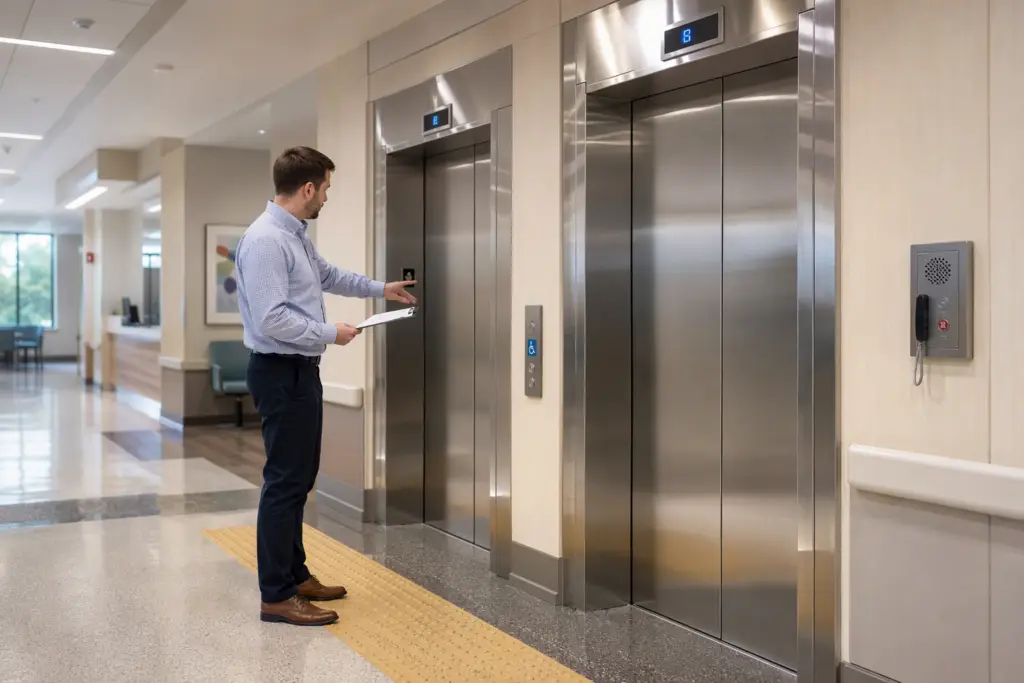
The Americans with Disabilities Act (ADA) requires that passenger elevators in buildings subject to ADA Title II and Title III be accessible to people with disabilities, including requirements for cab dimensions, door timing, floor leveling accuracy, accessible controls, and two-way communication systems.
Elevator companies contribute to ADA compliance by ensuring that door reopening devices function correctly, that car leveling meets the tolerance thresholds that allow wheelchair users to enter and exit safely, that control button heights and Braille/tactile markings meet ADA specifications, and that the two-way communication system required in elevator cabs is operational. When a building undergoes renovation that triggers ADA path-of-travel obligations, the elevator company may need to coordinate cab alterations as part of a broader accessibility upgrade.
Building owners should note that ADA compliance and elevator safety code compliance are separate obligations enforced by different authorities. Meeting ASME inspection requirements does not automatically satisfy ADA standards, and vice versa.
What is a maintenance contract, and what should it cover?
An elevator maintenance contract is a formal agreement between a building owner and an elevator company that defines the scope of preventive maintenance services, callback obligations, parts coverage, and exclusions that govern the ongoing care of elevator equipment.
A well-structured maintenance contract should clearly address: the frequency of scheduled maintenance visits; which components are covered for parts and labor; how the company handles callbacks outside scheduled visits; documentation practices for maintenance records; and procedures for coordinating required inspections. In Maryland, for instance, maintenance, repair, test, and inspection records must be kept at a readily accessible central location in the building — a requirement that a responsible elevator company should help owners satisfy through organized record-keeping practices.
Contracts range from basic lubrication-and-adjustment agreements to comprehensive full-coverage agreements that include major component replacements. Building owners should read exclusions carefully, particularly around proprietary parts and obsolete equipment, and should confirm that the maintenance scope aligns with what inspectors will expect to see documented during periodic inspections.
What should a building owner do immediately after an elevator incident or accident?
When an elevator incident occurs that results in injury, entrapment, or significant equipment damage, the building owner’s immediate priorities are passenger safety, notification of emergency services if needed, and compliance with mandatory accident reporting obligations.
- Ensure the safety of all passengers. If passengers are entrapped, contact the elevator company’s emergency service line and local fire or rescue services if the entrapment cannot be resolved quickly.
- Take the elevator out of service immediately and post a clear out-of-service notice.
- Preserve the scene as much as possible and document conditions with photographs before any repairs begin.
- Contact the elevator company to dispatch a technician for emergency assessment and repair.
- In Pennsylvania, submit an accident report to the Department of Labor and Industry when an elevator accident causes a fatality or requires professional medical care.
- In DC, contact the Department of Buildings and obtain any required permits before returning the elevator to service.
- In Maryland and Virginia, notify the applicable AHJ — the Maryland Department of Labor or the local building department in Virginia — per their respective reporting procedures.
- Do not return the elevator to service until the elevator company has completed required repairs and the applicable AHJ has cleared the equipment for operation.
How long does a new elevator installation typically take?
New elevator installation timelines depend on equipment type, building conditions, permit processing time with the AHJ, and equipment lead times from the manufacturer, making each project unique — but building owners should plan for a multi-phase process that spans permit approval, construction, acceptance inspection, and certificate issuance before the equipment enters service.
In every jurisdiction served by Quality Elevator Company, the elevator cannot operate until the relevant authority has issued a certificate of operation or certificate of inspection after a final acceptance inspection. In Maryland, owners must register elevator units with the Commissioner at least 60 days before planned completion and before placing the unit in service. In Pennsylvania, the Department of Labor and Industry conducts an acceptance inspection before a new elevator is put into service. In DC, the elevator’s certificate is issued after DOB processes third-party inspection reports. In Virginia, the local building department conducts a final acceptance inspection of new or modernized elevators.
Coordinating the acceptance inspection and certificate issuance into the project schedule from the outset avoids delays at project completion. Working with an elevator company that has an established relationship with the local AHJ is a practical advantage in managing this process efficiently.
What is the difference between elevator repair and elevator modernization?
Elevator repair addresses a specific failed or deteriorated component to restore current function, while modernization is a planned upgrade of major systems — controls, drive, safety devices, or cab — intended to improve performance, extend equipment life, and align the installation with contemporary standards.
The distinction matters for permitting and regulatory purposes. Repairs may or may not require a permit depending on scope and jurisdiction; modernization projects are consistently treated as alterations requiring permit applications, inspections, and in some cases updated compliance with the code edition in force at the time of the alteration. Elevator companies should help building owners understand when a pattern of recurring repairs has crossed the threshold where modernization delivers better long-term value.
Do elevator companies handle ADA-compliant platform lifts and limited-use elevators?
Yes — reputable elevator companies service platform lifts and LULA elevators in addition to full-capacity passenger and freight elevators, and these units are subject to their own inspection and maintenance requirements under applicable state regulations.
Platform lifts and LULA elevators are governed by ASME A17.1 provisions for limited-use/limited-application elevators and are an important option for facilities seeking ADA-accessible vertical transportation where full shaft construction is not practical. Each jurisdiction’s inspection and certificate requirements apply to these units, and building owners should confirm that the elevator company they engage has experience with LULA and platform lift equipment. Virginia’s inspection program, for example, covers elevators inspected by the local building department but generally excludes units serving only single-family homes, two-family homes, and townhouses.
How do elevator companies handle elevator certificate compliance?
Elevator companies help building owners track inspection due dates, coordinate with approved inspection agencies or AHJs to schedule required tests, ensure that test documentation is complete and submitted correctly, and follow up until a current certificate is issued and properly displayed.
Certificate display requirements vary by jurisdiction. In DC, a copy of the current certificate of inspection must be conspicuously displayed in the elevator car or, if the building operator has an office in the same building, kept available there for public inspection. In Maryland, the certificate must be posted conspicuously in or on the elevator unit. In Pennsylvania, the certificate of operation or a copy must be posted in the elevator car, or attached to the controller in the machine room for equipment with a machine room. In Virginia, the current certificate must be displayed in the elevator, kept available in the building operator’s office, or posted in an approved conspicuous location.
A proactive elevator company maintains a compliance calendar for each unit under its care and alerts building owners well in advance of inspection due dates to avoid lapses that could force equipment out of service.
What role does OSHA play in elevator company operations?
The Occupational Safety and Health Administration (OSHA) governs the workplace safety of elevator mechanics and technicians, covering fall protection, lockout/tagout procedures, confined space entry, and electrical safety standards that elevator companies must follow during installation, maintenance, and repair work.
OSHA’s jurisdiction focuses on worker safety in the course of elevator work rather than on the safety of the elevator equipment itself for passengers — that function belongs to the ASME codes and the state AHJs. However, a building owner’s duty to provide a safe workplace extends to conditions in mechanical rooms and hoistways where elevator company personnel work, making OSHA compliance a shared concern between building management and elevator service providers.
What questions should a building owner ask when getting elevator service quotes?
Building owners should ask prospective elevator companies about their licensure in the specific jurisdiction, which code edition their work will follow, how they coordinate acceptance and periodic inspections, what is and is not included in the maintenance contract, and how they document and retain service records on the owner’s behalf.
Additional questions worth asking include: How does the company handle parts availability for the specific equipment brand installed? What is the process when an inspection reveals a deficiency that requires a permit for correction? How does the company support building owners in preparing submissions to the AHJ — such as DC’s Citizen Access Portal submissions for certificate renewal? Does the company carry the insurance levels required by the jurisdiction — for example, Maryland’s minimum of $1,000,000 in general liability and $500,000 in property damage?
Getting specific, written answers to these questions before selecting an elevator company protects building owners from discovering gaps in service coverage after a problem arises.
Why should building owners choose Quality Elevator Company for elevator services in the Mid-Atlantic region?
Quality Elevator Company is a certified elevator service company operating across Baltimore MD, Washington DC, Philadelphia PA, and Richmond VA, providing building owners with a single point of accountability for installation, maintenance, inspection coordination, and modernization across four distinct regulatory environments.
Navigating the different code editions, AHJ relationships, licensing structures, and certificate processes across DC, Maryland, Pennsylvania, and Virginia simultaneously is a significant compliance burden for building owners managing properties in multiple markets. Quality Elevator Company’s familiarity with each jurisdiction’s specific requirements — from Maryland’s Maryland Elevator Safety Review Board licensing mandate to DC’s DOB-approved third-party inspection process, Pennsylvania’s six-month inspection cycle, and Virginia’s local building department enforcement model — positions the company to manage compliance proactively rather than reactively.
Building owners seeking a consistent, accountable elevator service partner across the Mid-Atlantic should consider Quality Elevator Company as their first call for any elevator-related need, from routine maintenance to complex modernization projects.
Get a Free Elevator Assessment from Quality Elevator Company
Whether a building needs a routine maintenance review, a compliance check ahead of an upcoming inspection, or guidance on a modernization project, Quality Elevator Company provides expert elevator services across Baltimore MD, Washington DC, Philadelphia PA, and Richmond VA.
Contact Quality Elevator Company for a free elevator assessment. Call us today at 301-779-9116 to schedule your consultation with a knowledgeable elevator service professional in your market.
Need elevator service you can rely on? Quality Elevator Company is ready to help.