
When an elevator fails at 2 AM with a passenger inside or a hydraulic line ruptures on a holiday weekend, the difference between a 20-minute response and a 4-hour wait can mean liability exposure, regulatory violations, and real danger to building occupants. After 15 years in this trade, I’ve seen what happens when building managers don’t have the right emergency contact on speed dial. This guide answers every question you need to ask before that call becomes urgent.
Who exactly should I call for 24 hour elevator repair service?

You should call a state-licensed, IUEC-certified elevator service contractor that maintains a staffed 24/7 emergency dispatch center — not a general contractor or a building maintenance crew.
Elevator repair is a licensed trade regulated at the state level. In Maryland, Virginia, Pennsylvania, and the District of Columbia, only contractors holding the appropriate elevator contractor license are legally permitted to perform repair work on vertical transportation equipment. Calling an unlicensed handyman or relying on a building engineer who lacks elevator-specific certification is not only ineffective — it can invalidate your liability insurance and put you in violation of local elevator safety codes.
When you call, confirm that the company dispatches a mechanic who holds an active IUEC (International Union of Elevator Constructors) journeyman card or equivalent state certification. Quality Elevator Company employs certified mechanics available around the clock across the Baltimore, Washington DC, Philadelphia, and Richmond service areas, with typical emergency response times under 60 minutes for entrapments.
What qualifies as a true elevator emergency requiring immediate service?
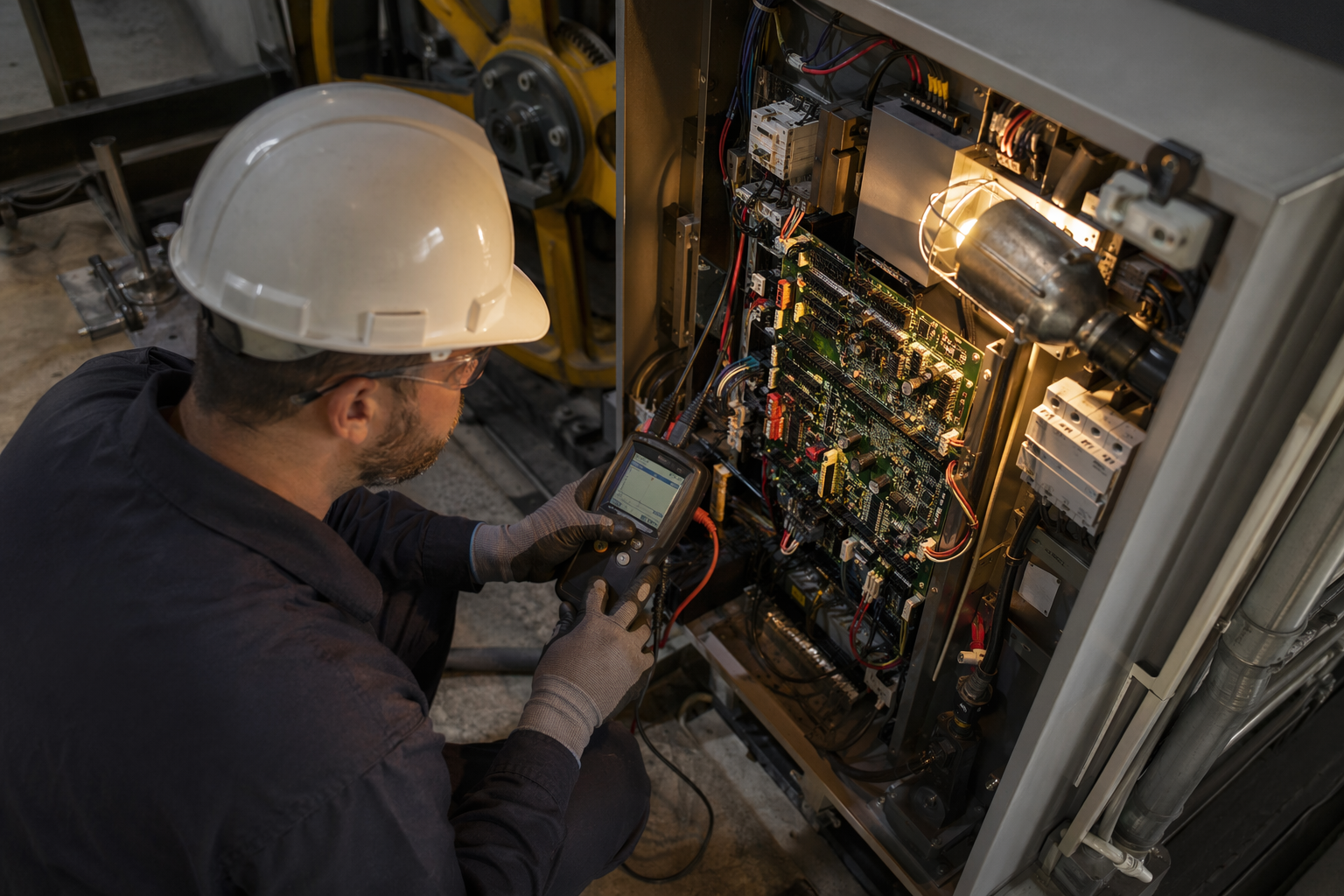
A true elevator emergency is any situation involving passenger entrapment, uncontrolled movement, smoke or fire in the shaft, flooding of the pit, or a safety circuit fault that prevents the car from leveling correctly at the floor.
These situations require immediate 911 contact first if there is any risk to life, followed immediately by your licensed elevator service company. Under ASME A17.1-2022 (the Safety Code for Elevators and Escalators), elevators involved in an accident or entrapment must be removed from service until a qualified mechanic inspects and clears the unit. Do not attempt to restart the elevator yourself.
Non-emergency situations that still warrant same-day urgent service include: door hesitation, nuisance tripping, rough ride, unusual noise, and leveling errors greater than ½ inch. These are not immediately dangerous, but ASME A17.1 Section 8.11 requires that known deficiencies be corrected within a reasonable time — which most state jurisdictions define as 30 days or fewer.
What is the typical emergency response time I should expect?
A reputable local elevator service company should guarantee on-site emergency response within 60 minutes for entrapments and within 2–4 hours for urgent non-entrapment breakdowns during nights, weekends, and holidays.
Response time benchmarks vary significantly by provider type. The table below compares realistic response windows across common service provider categories based on 2026 industry standards:
| Provider Type | Entrapment Response | Urgent Non-Entrapment | Holiday/Weekend Coverage | Licensing Verified |
|---|---|---|---|---|
| National OEM Service Division (e.g., OTIS, Schindler) | 45–120 min | 2–8 hours | Limited (dispatch queued) | Yes |
| Regional Independent (e.g., Quality Elevator Company) | 30–60 min | 1–4 hours | Full 24/7 staffed | Yes |
| General Building Maintenance Contractor | Not qualified | Not qualified | Not qualified | No |
| Unlicensed “Handyman” Service | Not qualified | Not qualified | N/A | No |
Geography matters significantly. A national OEM contractor may route your call through a regional dispatch hub hundreds of miles away. A local independent company with mechanics stationed in Baltimore, Washington DC, Philadelphia, or Richmond can physically reach you faster because their technicians live and work in the same metro areas they serve.
What should I do immediately when an elevator breaks down?
Follow these steps in order to protect passengers, limit liability, and comply with regulatory requirements.
- Call 911 first if any passenger is trapped, injured, or in distress. Fire departments in Baltimore, DC, Philadelphia, and Richmond are trained for elevator entrapment rescue.
- Do not attempt to force open elevator doors or encourage passengers to exit between floors — this is the leading cause of elevator-related fatalities according to the U.S. Bureau of Labor Statistics.
- Use the in-car emergency phone (required by ASME A17.1, Rule 2.27.1.2) to maintain communication with trapped passengers. Test this phone monthly as part of your maintenance routine.
- Place physical “Out of Service” signs on all lobby landings for the affected elevator. Do not allow other passengers to attempt to use the unit.
- Call your licensed elevator service company (24/7 emergency line) and provide: building address, elevator number or cab ID, nature of the problem, number of passengers trapped if applicable, and the last known floor position.
- Notify your building’s insurance carrier if the breakdown involves a reported injury or property damage — document everything with timestamps before the mechanic arrives.
- Do not restart or reset the elevator from the machine room until the certified mechanic has assessed the unit. Premature resets after a safety trip can damage equipment and create additional liability.
How do I verify that an elevator repair company is properly licensed?
Request the company’s state elevator contractor license number and verify it through the official licensing database for your jurisdiction before any work begins.
Each state in Quality Elevator Company’s service area maintains a public license lookup portal:
- Maryland: Verify through the Maryland Department of Labor Elevator Safety Unit.
- Washington DC: Check with the DC Department of Buildings (formerly DCRA), which oversees elevator contractor licensing.
- Pennsylvania: Verify through the Pennsylvania Department of Labor & Industry, Bureau of Occupational & Industrial Safety.
- Virginia: Check the Virginia Department of Professional and Occupational Regulation (DPOR).
Additionally, ask for proof of general liability insurance (minimum $1 million per occurrence is standard) and workers’ compensation coverage. Any legitimate elevator contractor will provide these documents without hesitation. If a vendor is reluctant to share license numbers, walk away.
What are the most common causes of emergency elevator breakdowns?
The five most frequent causes of after-hours elevator failures are door system faults, hydraulic oil leaks, controller board failures, worn hoist ropes, and safety chain interruptions — most of which are preventable through scheduled maintenance.
Door system problems account for approximately 70–80% of all elevator service calls industry-wide in 2026. Door operator motors, clutch mechanisms, and safety edges wear at predictable rates, and most failures are preceded by weeks of intermittent hesitation that a trained mechanic would catch during a routine inspection. If you’re experiencing more than two emergency calls per year on the same unit, your maintenance contract is underperforming.
Hydraulic elevator failures are particularly common in buildings constructed between 1970 and 1995. Older single-bottom cylinders are prone to underground oil leaks, which can trigger environmental violations in Maryland, DC, Pennsylvania, and Virginia in addition to the equipment failure itself. Underground hydraulic cylinder replacement or liner installation is a scheduled repair, not an emergency fix — identify it early.
What does 24 hour elevator repair service typically cost?
Emergency elevator repair service typically costs between $350 and $900 for the first two hours of after-hours labor, plus parts, with total emergency call costs commonly ranging from $500 to $3,500 depending on the fault type and components required.
Here is a realistic cost breakdown for common 2026 emergency repair scenarios in the Mid-Atlantic region:
| Repair Type | Typical Labor Cost (After-Hours) | Typical Parts Cost | Estimated Total |
|---|---|---|---|
| Door operator motor replacement | $400–$600 | $300–$700 | $700–$1,300 |
| Controller board replacement | $500–$800 | $800–$3,000+ | $1,300–$3,800 |
| Hydraulic pump/valve repair | $500–$900 | $400–$1,500 | $900–$2,400 |
| Safety chain/circuit reset + inspection | $350–$500 | $0–$200 | $350–$700 |
| Hoist rope emergency inspection | $400–$600 | Variable | $400–$600 + rope cost |
Building owners with a full-service maintenance agreement typically receive after-hours emergency labor at a reduced rate or included within the contract — one of the strongest financial arguments for proactive maintenance over reactive emergency spending. Over a 5-year window, reactive-only buildings in the Mid-Atlantic typically spend 2.3x more on elevator costs than buildings under comprehensive maintenance agreements.
Does my building’s elevator maintenance contract cover emergency repairs?
It depends on the contract type — comprehensive full-service agreements typically include emergency labor, while basic “oil and grease” inspection contracts do not cover parts or after-hours call costs.
There are three primary maintenance contract structures used in the elevator industry:
- Oil & Grease (Examination Only): Covers routine lubrication and visual inspection only. All repairs, parts, and emergency calls are billed separately. This is the lowest-cost contract but offers no financial protection against breakdowns.
- Parts Included: Covers routine maintenance plus parts replacement during normal business hours. Emergency and after-hours calls are billed at time-and-material rates.
- Full Service / Comprehensive: Covers routine maintenance, parts, and emergency callback labor 24/7. Some contracts exclude major components like motors, controllers, and hydraulic cylinders — read the exclusions carefully.
When reviewing any maintenance contract, ask specifically: “Does this contract include 24/7 emergency callback labor with no additional charge?” and “What components are explicitly excluded?” A reputable provider will answer both questions in writing before you sign.
Are building owners legally required to have an emergency elevator service plan?
Yes — all four states in our service region require that elevators under active use have a maintenance provider of record, and entrapment response capability is a practical legal obligation tied to building occupancy and liability law.
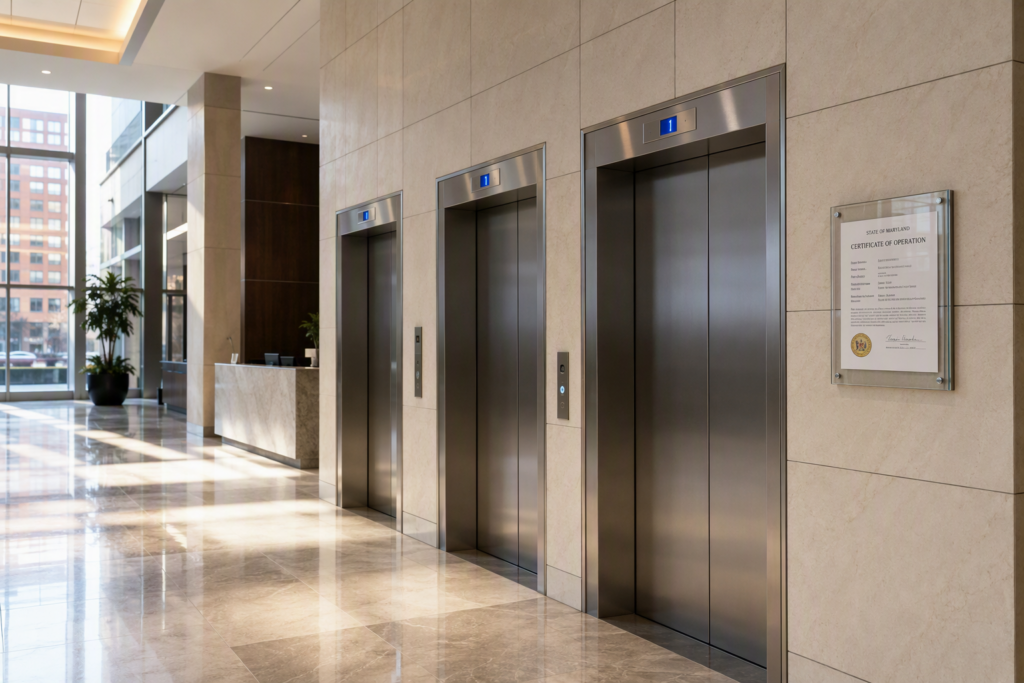
Under Maryland’s Elevator Safety Act, Pennsylvania’s Elevator Safety Law (Act 95 of 1994), and Virginia’s Amusement Device and Elevator Safety Regulations, elevators must be maintained by licensed contractors and inspected on state-mandated schedules. Operating an elevator without a current Certificate of Operation is a code violation that can result in fines exceeding $10,000 per day in some jurisdictions.
From a liability standpoint, if a passenger is injured during an entrapment and you cannot document a timely call to a licensed emergency service provider, your exposure increases substantially. Courts in Maryland and Virginia have held building owners to a “reasonable care” standard that includes maintaining accessible 24/7 service contacts.
How quickly must a passenger entrapment be resolved under safety codes?
Under ASME A17.1-2022 and local fire codes, passenger entrapments must be responded to immediately, with resolution — meaning the passenger is safely out of the car — typically expected within 60–90 minutes of the emergency call.
ASME A17.1 Rule 2.27.1.2 mandates that a means of two-way communication must be available inside every elevator car and must connect to a location staffed 24 hours a day. This is not optional — it is a hard code requirement. The intent is precisely to ensure that entrapments can be reported and resolved rapidly.
Fire codes in Baltimore, Washington DC, Philadelphia, and Richmond also specify that local fire departments maintain entrapment rescue capability, but their response is a safety backstop — not a substitute for having your licensed elevator service company on-site. Fire departments do not repair elevators; they extract passengers and then the unit remains out of service until a mechanic clears it.
What information should I have ready when I call for emergency elevator service?
Have the building address, elevator unit number or cab ID, the nature of the malfunction, the number of passengers involved, the last known floor position, and your maintenance contract number ready before you dial.
The faster a dispatcher can route the right mechanic with the right parts, the faster your elevator is back in service. Additional details that help: the elevator manufacturer and model (usually on a data plate inside the machine room), the approximate year of installation, whether the unit is hydraulic or traction, and whether the fault occurred after a power interruption. If you manage multiple buildings or multiple elevators, maintain a single laminated reference card in each machine room with the elevator unit ID, your service provider’s 24/7 number, the local fire department non-emergency dispatch, and your building’s insurance contact.
How do I choose between a local independent elevator company and a national OEM service provider?
For 24/7 emergency responsiveness and local accountability, a well-credentialed regional independent company typically outperforms national OEM service divisions — particularly for multi-brand portfolios and mixed-equipment buildings.
National OEM service providers (the service arms of manufacturers like OTIS, Schindler, KONE, and ThyssenKrupp) are often proprietary — they preferentially stock and support their own equipment, and contract terms can make it difficult to switch providers or obtain parts through third parties. This creates leverage that can drive up service costs over time.
Regional independents like Quality Elevator Company are factory-trained to service all major elevator brands and are not financially incentivized to recommend their manufacturer’s newer equipment over a legitimate repair. They are also governed by the same ASME A17.1 code and state licensing requirements as OEM providers, so there is no technical quality gap — only a difference in corporate structure and local accountability.
What questions should I ask a 24 hour elevator repair company before hiring them?
Ask these seven questions before signing any emergency service agreement or maintenance contract with a 24/7 elevator repair provider.
- “What is your guaranteed response time for entrapments in my specific city?” — Get this in writing, not as a verbal estimate.
- “Are your mechanics IUEC-certified or hold the equivalent state license?” — Verify independently through the state licensing database.
- “Do you carry the parts inventory to repair major brands on a first-visit basis?” — Multiple return visits for parts procurement extend downtime.
- “Is your 24/7 line staffed by a live dispatcher or an answering service?” — Answering services add 15–45 minutes to response chains.
- “What are your after-hours labor rates and how are they billed?” — Confirm whether rates are per-trip, hourly, or flat-fee.
- “Can you provide three references from commercial buildings in my city?” — Local references confirm actual local capacity.
- “What is your process for documenting emergency repairs for state inspection records?” — All jurisdictions require written records of repairs; your contractor must produce them.
Does the Americans with Disabilities Act (ADA) affect elevator repair obligations?
Yes — under ADA Title III, elevators in most commercial buildings are a required accessibility feature, and extended elevator downtime in a building subject to ADA can constitute a failure to provide accessible services to people with disabilities.
The ADA does not specify a repair timeline, but courts and the Department of Justice have interpreted prolonged elevator outages in multi-story ADA-covered facilities as potential Title III violations when no reasonable alternative access is provided. This is especially relevant for healthcare facilities, government buildings, hotels, and retail spaces in Baltimore, DC, Philadelphia, and Richmond. As a practical matter, any building required to have an elevator under ADA should treat repairs as urgent — not merely scheduled maintenance.
What preventive steps can reduce my reliance on emergency elevator service calls?
The single most effective step is enrolling in a comprehensive monthly maintenance program with a licensed elevator company — buildings under regular maintenance experience 60–80% fewer emergency calls than those on reactive-only service models.
Specific preventive measures that reduce emergency call frequency include: monthly lubrication of all running gear per ASME A17.1 requirements, quarterly adjustment of door timing and clutch clearances, annual load testing, semi-annual inspection of hoist ropes for broken wires per ASME A17.1 Section 8.6.5, and real-time remote monitoring systems that detect anomalies before they become failures. Several modern elevator controllers support IoT-based monitoring that can alert your service company to door hesitation, motor temperature spikes, or unusual leveling variance before a passenger experiences a breakdown.
How often are elevators required to be inspected in Maryland, DC, Pennsylvania, and Virginia?
Most elevators in these four jurisdictions require a full periodic inspection annually, with witnessing by a state-licensed inspector or approved third-party Qualified Elevator Inspector (QEI) certified by ASME.
Specific inspection frequencies as of 2026:
- Maryland: Annual periodic inspection required; Certificate of Operation must be posted in the elevator cab or machine room.
- Washington DC: Annual inspection required by DC Department of Buildings; certificates must be current and accessible.
- Pennsylvania: Annual inspection required under Act 95; hydraulic elevators additionally require a five-year pressure test.
- Virginia: Annual inspection required; DPOR oversees the QEI certification and inspection program statewide.
Failing an inspection does not automatically mean the elevator is shut down, but cited violations must be corrected within the timeframe specified in the inspection report — typically 30 to 90 days depending on severity. Uncorrected violations at re-inspection can result in permit revocation and forced shutdown.
What happens if I operate an elevator without a valid Certificate of Operation?
Operating an elevator without a valid Certificate of Operation is a code violation in all four jurisdictions we serve, and penalties can include daily fines, mandatory shutdown orders, and increased liability exposure in personal injury litigation.
In Maryland, fines for elevator code violations can reach $1,000 per day per violation. In Pennsylvania under the Elevator Safety Law, the Department of Labor & Industry has authority to order immediate shutdown and assess civil penalties. In Virginia, DPOR can refer persistent violators to the Attorney General’s office. Beyond regulatory penalties, operating without a current certificate is routinely used by plaintiffs’ attorneys as evidence of negligence in elevator injury lawsuits — it is one of the most avoidable liability exposures a building owner can face.
Can I use a remote monitoring system as a substitute for a 24 hour emergency service contract?
No — remote monitoring is a valuable early-warning tool, but it cannot substitute for a 24/7 emergency service contract because monitoring systems detect and report faults; only a licensed mechanic on-site can diagnose, repair, and return the elevator to safe operation.
Modern remote monitoring systems can reduce emergency response time by alerting your service company before a fault becomes a full breakdown, and some systems integrate directly with service dispatch platforms. However, ASME A17.1 requires physical inspection and certified mechanic sign-off before any elevator that has undergone a safety trip can return to service. No monitoring system can perform that function remotely. Think of monitoring as a tool that makes your 24/7 service contract work faster and smarter — not as a replacement for it.
How do I set up a 24 hour elevator emergency service contract for multiple buildings?
Work with a regional elevator service company to negotiate a portfolio maintenance and emergency services agreement that covers all properties under a single contract with unified response time guarantees, consolidated billing, and a dedicated account manager.
Portfolio agreements typically offer 10–20% cost savings over per-building contracts and simplify compliance tracking across multiple Certificate of Operation renewal dates. Key contract elements to specify for a multi-building agreement include: individual response time guarantees per address, a unified after-hours dispatch number, monthly reporting on callback volume and resolution times per unit, and annual rate escalation caps (typically CPI-indexed at 2–4% per year). Quality Elevator Company serves commercial property managers, healthcare systems, and government facility operators across Baltimore, Washington DC, Philadelphia, and Richmond with exactly this type of consolidated service structure.
Why is Quality Elevator Company the right choice for 24 hour elevator repair in the Mid-Atlantic region?
Quality Elevator Company combines IUEC-certified technicians, a fully staffed 24/7 emergency dispatch center, and deep local presence across four major Mid-Atlantic markets — giving building owners faster response times and greater regulatory accountability than most national competitors can deliver.
Every mechanic dispatched by Quality Elevator Company holds current state licensure in the applicable jurisdiction and is trained on all major elevator brands including OTIS, Schindler, KONE, ThyssenKrupp, Dover, and Hydraulic systems. The company maintains local parts inventories in each metro area to maximize first-visit resolution rates. Maintenance programs are structured to keep your Certificate of Operation current, document all repairs in compliance with state recordkeeping requirements, and proactively flag components approaching end-of-life before they fail during occupied hours.
For building managers who have experienced the cost and stress of a 3 AM entrapment call with no certified mechanic available, the value of a pre-established relationship with a responsive, licensed local provider is not theoretical — it is measured in response time, liability protection, and tenant trust.
Get a Free Elevator Assessment — Before the Next Emergency
Don’t wait for a breakdown to find out whether your current service provider can actually respond at 2 AM. Contact Quality Elevator Company for a no-cost elevator assessment covering your equipment condition, Certificate of Operation status, and emergency response plan across Baltimore MD, Washington DC, Philadelphia PA, and Richmond VA.
Call us 24/7: 301-307-5363
Our certified technicians are standing by. We’ll review your current maintenance coverage, identify any compliance gaps, and provide a transparent proposal — with no obligation and no pressure.
Need elevator service you can rely on? Quality Elevator Company is ready to help.