An inspector’s order to cease operation is one of the most disruptive events a building owner can face. Understanding why shutdowns happen, what the reinstatement path looks like across the District of Columbia, Maryland, Pennsylvania, and Virginia, and what repair work typically involves can help owners prepare — and avoid — costly downtime. Quality Elevator Company serves as an independent service provider across all four jurisdictions and can guide owners through every step of the process.
What Are the Most Common Reasons an Inspector Shuts Down an Elevator?
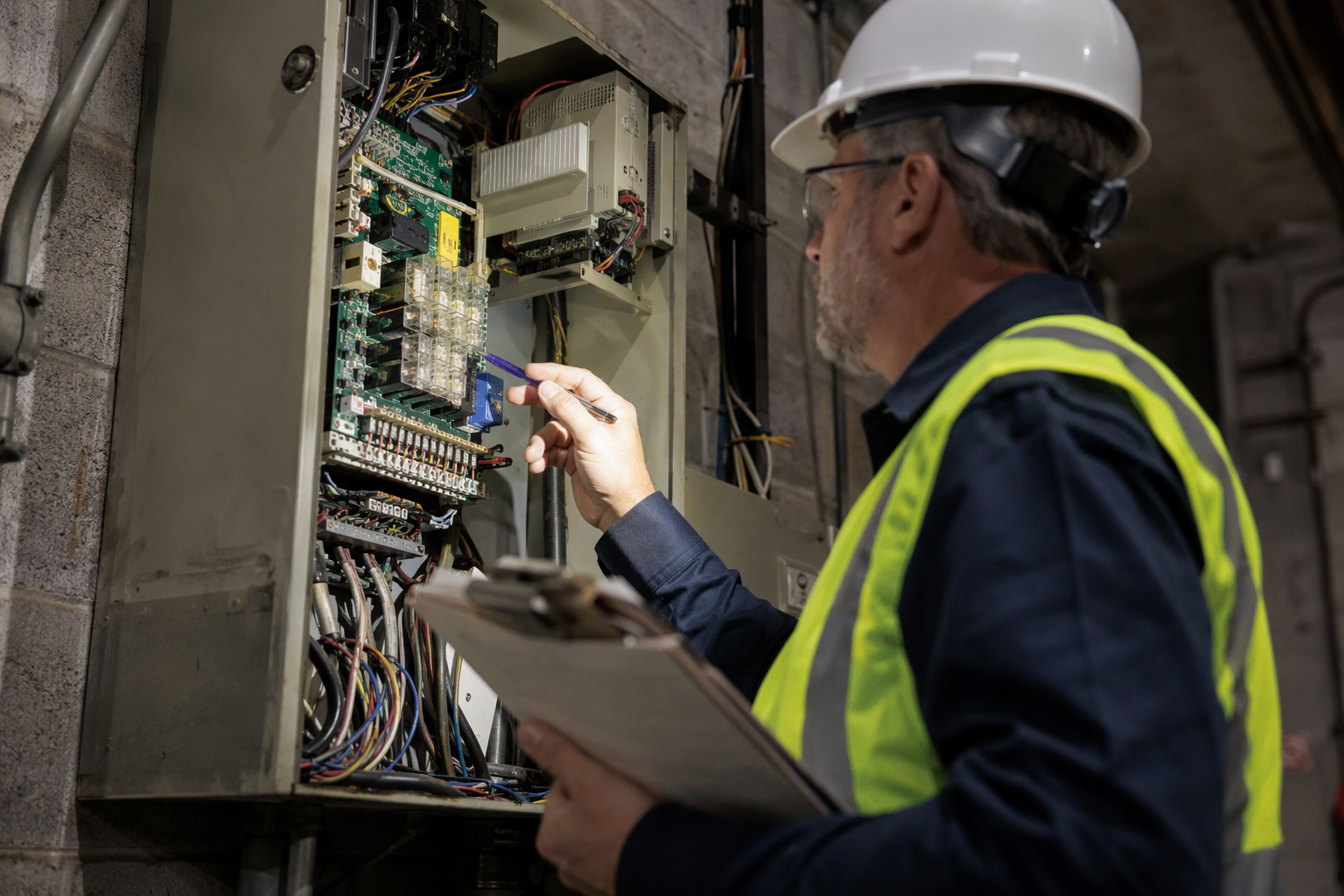
Inspectors issue a shutdown order — sometimes called an out-of-service order or stop-use notice — when an elevator presents conditions that cannot be allowed to continue while the building remains occupied. The most frequently cited categories include:
- Safety device failures: Governors, safeties, buffers, interlocks, or overspeed devices that test outside acceptable parameters under ASME A17.1.
- Door and gate malfunctions: Landing doors or car gates that do not close, latch, or interlock properly — one of the leading causes of entrapment and falls.
- Hoist rope or chain deterioration: Wire ropes, belts, or chains that show broken wires, excessive wear, corrosion, or improper tension.
- Hydraulic system deficiencies: Leaking cylinders, faulty pressure-relief valves, or rupture-valve failures on hydraulic elevators.
- Emergency lighting and communication failures: An inoperative emergency light or a two-way means of communication that does not function.
- Pit and machine room hazards: Water accumulation in the pit, missing fire protection, obstructed clearances, or electrical violations.
- Overdue or failed Category tests: Missing the required Category 1 or Category 5 (comprehensive) tests at the intervals mandated by the adopted code edition in the applicable jurisdiction.
- Expired certificate of operation: An elevator operated after its certificate has lapsed is in immediate violation in every jurisdiction Quality Elevator Company serves.
- Missing or improperly posted certificate: Each jurisdiction requires the current certificate to be conspicuously displayed or available; absence alone can trigger a deficiency notice.
- Structural or guide-rail defects: Bent or misaligned rails, deteriorated brackets, or damaged car frames that affect safe travel.
- ADA accessibility non-compliance: Where alterations trigger ADA requirements, inaccessible controls or inadequate cab dimensions can be cited.
Not every deficiency results in an immediate shutdown. Inspectors generally distinguish between imminent hazards — which require the elevator to stop operating at once — and non-imminent deficiencies, which carry a correction deadline. The severity classification determines how quickly the reinstatement clock starts.
How Do Inspection Requirements Differ Across DC, Maryland, Pennsylvania, and Virginia?
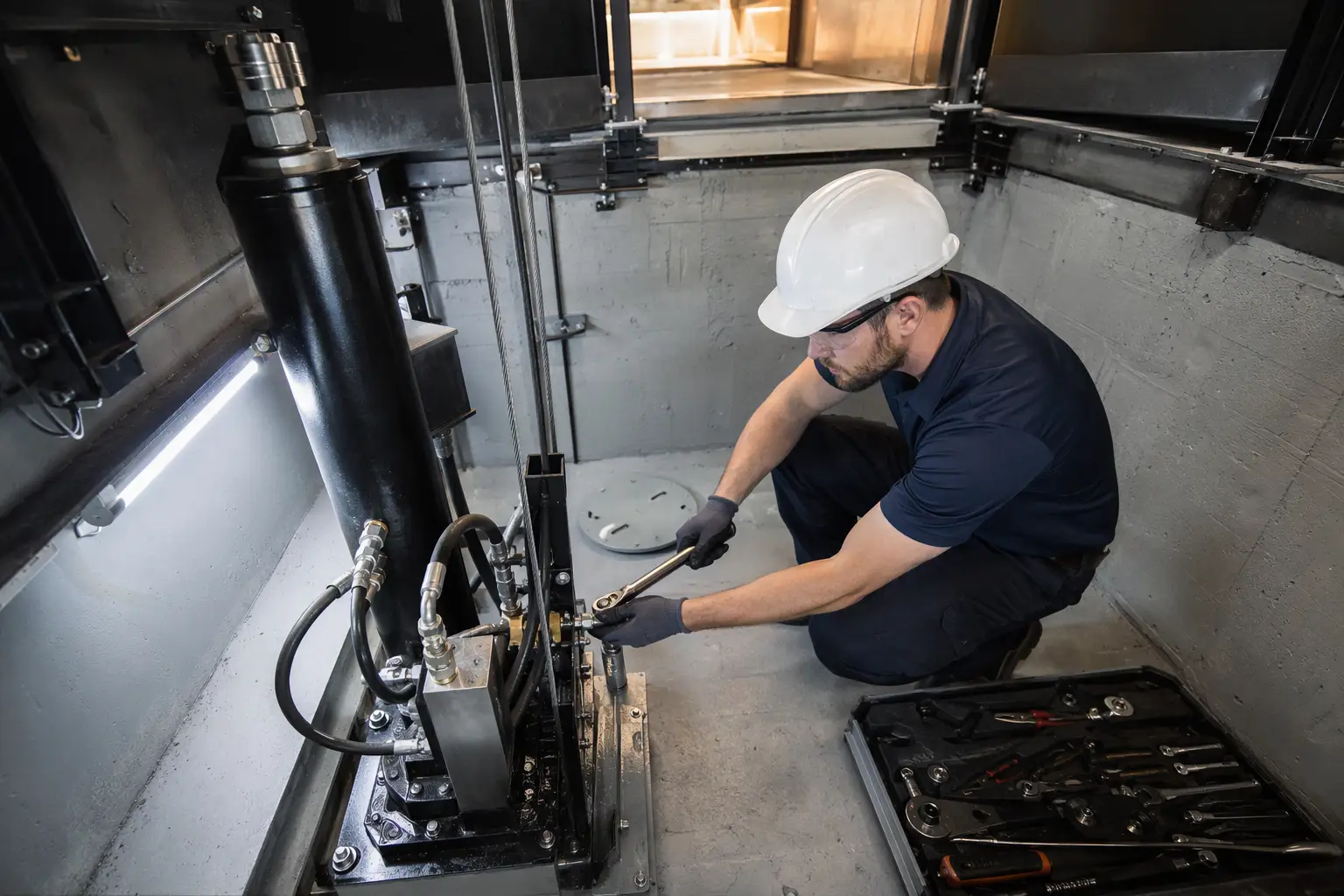
Each jurisdiction Quality Elevator Company serves has adopted a specific edition of the ASME A17.1 safety code and assigns enforcement to a different authority. The table below summarizes the key differences as of 2026.
| Jurisdiction | Regulating Authority | Adopted Code Edition | Periodic Inspection Interval | Comprehensive / Category 5 Test | Certificate Validity |
|---|---|---|---|---|---|
| District of Columbia | DC Department of Buildings (DOB), using DOB-approved third-party agencies | ASME A17.1-2013/CSA B44-13 (2017 DC Building Code, effective May 29, 2020) | Category 1 inspection every 12 months; periodic inspections continue throughout the certificate period | Category 5 every 60 months | 2 years |
| Maryland | Maryland Department of Labor, Division of Labor and Industry, Elevator and Escalator Safety | ASME A17.1-2022/CSA B44:22 with Maryland changes (effective June 17, 2026); prior edition applies to elevators installed earlier | Annual periodic inspection by a third-party qualified elevator inspector | Comprehensive five-year inspection for wire-rope-suspended and similar elevators | Annual re-registration required |
| Pennsylvania | Pennsylvania Department of Labor and Industry (L&I), Bureau of Occupational and Industrial Safety, Elevator Section | ASME A17.1-2000 with A17.1a-2002 addenda (permits before Dec. 20, 2026); ASME A17.1-2016 with PA modifications for new permit applications on or after Dec. 20, 2026 | Every 6 months for electric, hydraulic, and escalator equipment | Category tests per ASME A17.1 Appendix N intervals; Category 1 becomes a standalone annual requirement Dec. 20, 2026 | 24 months (6-month cycle); 48 months (12-month cycle) |
| Virginia | Local building department; mechanics certified and contractors licensed by the Virginia Board for Contractors (DPOR) under 13VAC5-63 | ASME A17.1/CSA B44-2019 (2021 USBC, effective Jan. 18, 2024) | Annual; locality may require semi-annual | Periodic tests per ASME A17.1 Appendix N; must be witnessed by the code official | Renewed upon passing annual inspection |
Because the authority having jurisdiction (AHJ) differs by location, the specific paperwork, submission portals, and reinstatement procedures also differ. Quality Elevator Company is familiar with the requirements in all four jurisdictions.
What Happens Immediately After an Inspector Issues a Shutdown Order?
When an inspector determines that an elevator must cease operation, the following sequence typically unfolds. Building owners and facility managers should follow these steps in order:
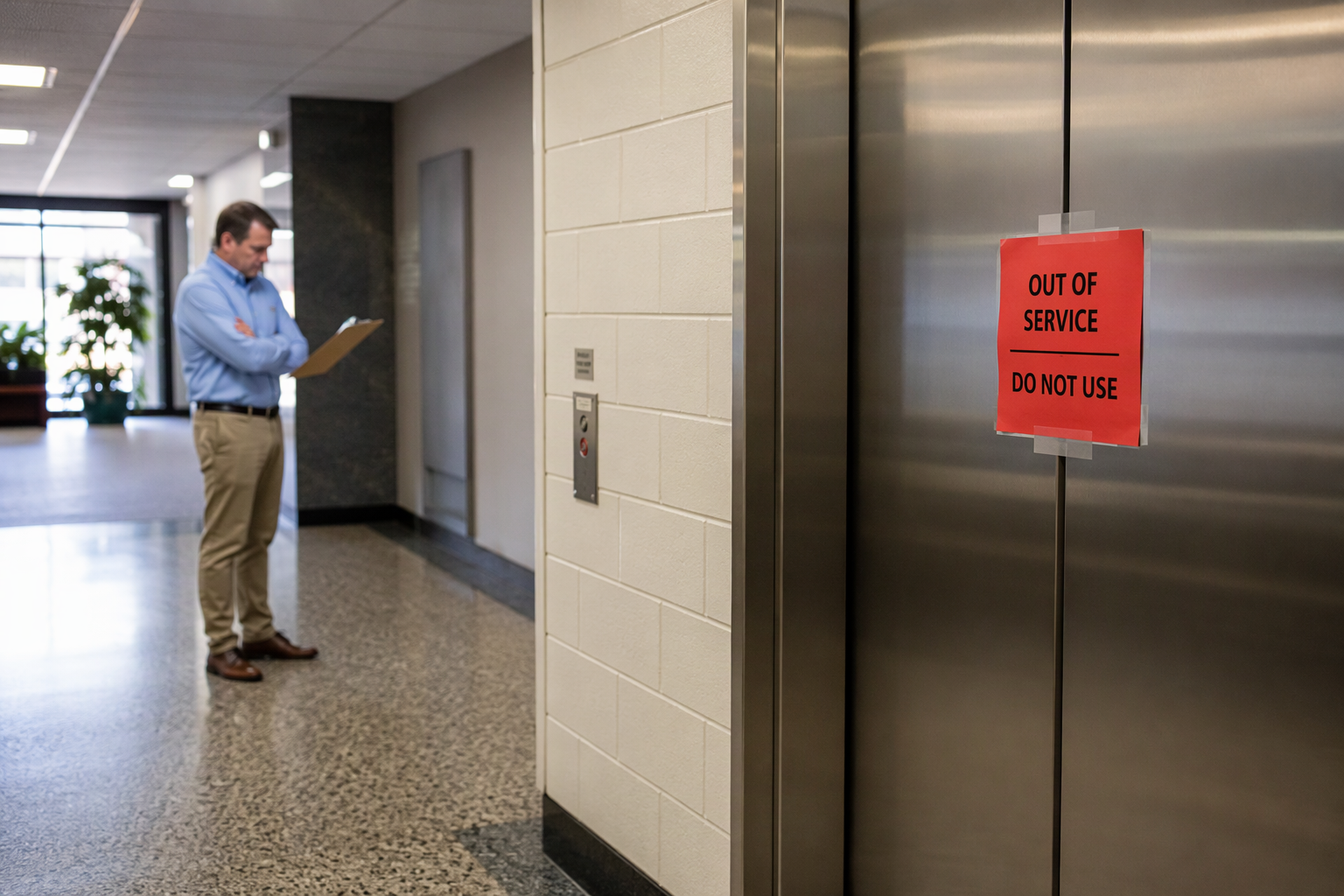
- Secure the elevator. Lock the cab at a landing, barricade the hoistway entrance, and post visible out-of-service notices on every landing door. No personnel — including maintenance staff — should enter the hoistway until a licensed elevator mechanic assesses the situation.
- Obtain the written violation or deficiency notice. The inspector’s written order will specify each cited deficiency, the code reference or standard violated, and any deadline for correction. Keep this document; it governs the entire reinstatement process.
- Notify building occupants and implement alternative access measures. Where ADA and life-safety obligations require vertical access, alternative arrangements — such as temporary platform lifts or occupant assistance protocols — may be necessary while the elevator is out of service.
- Contact a licensed elevator contractor immediately. In Maryland, only a contractor licensed by the Maryland Elevator Safety Review Board may perform repairs. In Virginia, the contractor must hold an Elevator/Escalator Contracting (EEC) specialty license through DPOR. In DC, the elevator contracting license is issued by the DC Board of Industrial Trades and must be presented with any permit application to the DOB. In Pennsylvania, owners should verify contractor qualifications with the Department of L&I.
- Obtain any required repair permits before work begins. In DC, a DOB permit is required for repairs. In Pennsylvania, construction, alteration, replacement, or repair requires a permit from the Department of L&I. Virginia requires a contractor license with the EEC specialty for all installation, repair, improvement, or removal work. Maryland requires the State to conduct a final acceptance inspection after any modification or alteration before the elevator returns to service.
- Complete all cited repairs. Every item on the deficiency notice must be addressed. Partial repairs that leave open violations will not result in reinstatement.
- Schedule the follow-up inspection. Depending on the jurisdiction, this may be a reinspection by the same third-party agency (DC, Maryland), a Pennsylvania L&I acceptance inspection, or a local code official’s acceptance inspection (Virginia). Allow adequate scheduling lead time, as inspector availability varies.
- Obtain the new certificate and return the elevator to service. In DC, updated third-party inspection reports covering the past two years must be submitted to DOB through the Citizen Access Portal. In Maryland, re-registration with the Commissioner accompanies the annual inspection. In Pennsylvania, the elevator may not return to service until the Department inspects and passes it. In Virginia, the local building department issues the new certificate of inspection.
How Long Does It Take to Get an Elevator Back in Service After a Shutdown?
Reinstatement timelines depend on three variables: the severity and nature of the violation, parts availability, and inspector scheduling. The table below provides a qualitative framework — no specific timelines are stated as guarantees, because they depend heavily on individual circumstances.
| Violation Category | Examples | Typical Repair Complexity | Approximate Reinstatement Timeframe | Key Delay Factors |
|---|---|---|---|---|
| Administrative / Documentation | Expired certificate, missing posting, overdue registration | Low — paperwork and filing | Days to 1–2 weeks | Portal processing times, inspector availability |
| Minor Mechanical / Electrical | Faulty door contact, inoperative emergency light, communication device failure | Low to moderate — component replacement | 1 day to 1 week (parts in stock) | Part sourcing, permit issuance speed |
| Moderate Mechanical | Governor adjustment, buffer replacement, interlock replacement, rope tension correction | Moderate — requires licensed mechanic and witnessed test | 1–3 weeks | Permit approval, witnessed-test scheduling, parts lead time |
| Major Mechanical / Structural | Hoist rope replacement, hydraulic cylinder repair or replacement, guide-rail replacement, safety device overhaul | High — may require engineering review and multiple inspections | Several weeks to multiple months | Engineering drawings, long-lead parts, permit review, final acceptance inspection queue |
| Modernization Required | Control system failure on obsolete equipment, structural deficiency requiring full cab replacement | Very high — partial or full modernization | Months; may extend beyond 6 months | Design, permitting, procurement, construction, final inspection |
Pennsylvania’s rules are notably specific: after a major repair, replacement, or alteration, an elevator may not return to service until the Pennsylvania Department of Labor and Industry inspects and passes it — there is no self-certification option. Maryland similarly requires a State final acceptance inspection after any modification or alteration. These mandated inspection steps add scheduling time that is entirely outside the contractor’s or owner’s control.
What Does It Cost to Reinstate an Elevator After an Inspector Shuts It Down?
Cost ranges for elevator reinstatement vary widely and depend on the nature of the violations, the age and type of the equipment, labor rates in the specific jurisdiction, and the cost of replacement parts. Because authoritative industry-wide pricing data is not available from a citable source, specific dollar figures are not presented here. What owners can expect to budget for includes:
- Permit fees: Each jurisdiction charges fees for repair or alteration permits; fee schedules are published by the DOB in DC, Maryland Department of Labor, Pennsylvania L&I, and the applicable local building department in Virginia.
- Licensed contractor labor: Labor costs reflect the jurisdiction’s licensing requirements and prevailing wage conditions. Maryland requires elevator contractors to carry at least $1,000,000 in general liability insurance and at least $500,000 in property damage insurance, which is reflected in contractor overhead.
- Parts and materials: Component costs range from modest (a single interlock or lamp) to substantial (a full hoist rope set, hydraulic cylinder, or control panel). Obsolete equipment may require custom fabrication, extending both timelines and costs.
- Third-party inspection fees: In DC, the owner pays the DOB-approved third-party inspection agency directly. In Maryland, the owner hires a third-party qualified elevator inspector. Pennsylvania requires a certified third-party agency for periodic inspections. Virginia local building departments may delegate witnessed testing to approved agencies.
- Downtime costs: These indirect costs — tenant complaints, ADA accommodation measures, potential lease obligations — often exceed the direct repair cost for commercial and multifamily buildings.
The clearest cost-containment strategy is a proactive maintenance contract that catches deficiencies before an inspector does. Quality Elevator Company provides independent maintenance and assessment services across DC, Maryland, Pennsylvania, and Virginia.
What Is the Difference Between a Deficiency Notice and an Immediate Shutdown Order?
Not every inspection finding results in the elevator being taken out of service on the spot. Inspectors distinguish between conditions that pose an immediate hazard to life and safety — which trigger an immediate cease-operation order — and conditions that are non-compliant but do not present an imminent risk. A non-imminent deficiency notice typically sets a correction deadline; the elevator may remain in operation until that deadline, provided the deficiency does not worsen into an imminent hazard. If correction does not occur by the deadline, the AHJ may escalate to a shutdown order. Building owners should treat every deficiency notice with urgency, because the progression from notice to shutdown can happen quickly if the underlying condition deteriorates.
Can an Elevator Operate Under a Temporary Permit While Repairs Are Being Made?
In the District of Columbia, a DOB permit is required to take an elevator out of service under ASME A17.1 Section 8.11.1.4 or to place it in temporarily dormant status. A DC elevator’s certificate may also be temporarily suspended while it is under permit for alteration or modernization. Outside of these specific statuses, DC requires that in buildings with passenger elevators, at least one elevator must be kept in operation whenever the building is occupied — except in buildings with only one elevator. Owners of single-elevator buildings in DC should plan carefully around the shutdown period to meet their obligations to occupants. In Pennsylvania, Maryland, and Virginia, any continued operation during repair work depends on the nature of the violation and the specific written guidance from the AHJ. Owners should never assume an elevator may continue to run during repairs without explicit written authorization from the governing authority.
How Do DC, Maryland, Pennsylvania, and Virginia Handle Violations Differently?
| Factor | District of Columbia | Maryland | Pennsylvania | Virginia |
|---|---|---|---|---|
| Who issues the shutdown? | DOB-approved third-party inspection agency, acting on DOB’s behalf | Maryland Department of Labor, Division of Labor and Industry inspector or third-party qualified elevator inspector | Pennsylvania L&I inspector or certified third-party agency | Local building department code official or approved agency |
| Who must do the repairs? | Licensed elevator contractor (DC Board of Industrial Trades license required) | Licensed elevator mechanic; contractor licensed by Maryland Elevator Safety Review Board | Qualified elevator contractor; verify credentials with Pennsylvania L&I | Contractor with EEC specialty license from DPOR; mechanic must be Virginia-certified |
| Who clears the elevator for return to service? | DOB-approved third-party inspection agency; owner submits reports to DOB via Citizen Access Portal | State final acceptance inspection by Maryland Department of Labor after alteration/modification; third-party QEI for annual periodic | Pennsylvania L&I acceptance inspection required before return to service after major repair | Local building department code official or approved agency issues new certificate |
| Certificate display requirement? | Yes — conspicuously displayed in elevator car (or in building operator’s office in same building) | Yes — posted conspicuously in or on the elevator unit | Yes — in elevator car or attached to controller in machine room | Yes — displayed in elevator, attached to escalator, in operator’s office, or approved conspicuous location |
| Record-keeping location | Reports submitted to DOB; certificate kept per posting rules | Maintenance, repair, test, and inspection records at a readily accessible central location in the building | Certificate posted per rules; accident reports submitted to L&I | Inspection reports must include certified mechanic’s name and certification number |
What Should Building Owners Do to Prevent an Inspector-Ordered Shutdown?
The most effective strategy for avoiding an inspection-triggered shutdown is a structured preventive maintenance program combined with proactive compliance tracking. Key practices include:
- Track certificate expiration dates. In DC, certificates are valid for two years. In Pennsylvania, 24 or 48 months depending on inspection cycle. In Maryland, annual re-registration is required. In Virginia, the annual inspection renews the certificate. A lapsed certificate is a violation in every jurisdiction.
- Schedule Category tests well ahead of deadlines. DC requires a Category 5 test every 60 months. Maryland requires a comprehensive five-year inspection for suspended elevators. Virginia and Pennsylvania follow ASME A17.1 Appendix N intervals. Waiting until the last month risks a gap in coverage if the inspector is unavailable.
- Maintain records at the building. Maryland law specifically requires maintenance, repair, test, and inspection records to be kept at a readily accessible central location in the building. Good record-keeping protects owners in every jurisdiction during an inspection.
- Address deficiencies between inspections. Minor issues caught during routine maintenance — a dragging door, a flickering emergency light, a pit with standing water — are far less costly to fix proactively than after an inspector cites them.
- Verify contractor credentials before authorizing work. Using an unlicensed contractor can void the inspection result and expose the owner to liability. Quality Elevator Company operates with the credentials required in each jurisdiction it serves.
- Plan around the Pennsylvania December 20, 2026 regulatory change. Pennsylvania’s updated elevator regulation takes effect December 20, 2026, introducing new test intervals and a standalone annual Category 1 requirement for permit applications filed on or after that date. Owners with aging equipment should evaluate their compliance posture before that date.
Does the ADA Create Separate Grounds for an Elevator Shutdown?
The Americans with Disabilities Act (ADA) does not itself give building inspectors the power to shut down an elevator, but ADA non-compliance can interact with shutdown situations in important ways. When an elevator alteration is triggered — for example, by a major repair that qualifies as an alteration under the adopted building code — ADA accessibility requirements may apply to the altered elements. An elevator that returns to service after an alteration without meeting applicable ADA standards can expose the building owner to a separate federal complaint or lawsuit. Additionally, when an elevator is shut down in a building where it is required for ADA accessibility, the owner must implement alternative accessible measures during the outage period or risk ADA violations independent of the state inspection matter.
What Role Does OSHA Play When an Elevator Is Shut Down?
OSHA jurisdiction over elevators primarily covers worker safety during construction, maintenance, and repair work — not the public-use certification process. When elevator mechanics enter a pit, work in a machine room, or perform maintenance in an occupied building, OSHA’s General Industry and Construction standards govern the safety of that work environment. Building owners should ensure that any contractor performing reinstatement repairs follows all applicable OSHA requirements, including lockout/tagout procedures and confined-space protocols for pit entry. A workplace injury during repair work can compound the costs and legal exposure of an already difficult shutdown situation.
How Does Quality Elevator Company Help During an Inspector-Ordered Shutdown?
Quality Elevator Company serves as an independent elevator service provider across the District of Columbia, Maryland, Pennsylvania, and Virginia. When an inspector shuts down an elevator, building owners benefit from working with a service provider that understands the specific regulatory framework of the jurisdiction — the correct agency to contact, the permit pathway, the inspection sequencing, and the documentation requirements for reinstatement. Quality Elevator Company also provides proactive assessments designed to identify potential violations before an inspector does, helping owners avoid the operational disruption and cost of an unplanned shutdown.
Pros and Cons: Reactive vs. Proactive Elevator Compliance Strategies
| Factor | Reactive (Fix After Shutdown) | Proactive (Preventive Maintenance + Compliance Tracking) |
|---|---|---|
| Cost of repairs | Often higher — emergency labor premiums, expedited parts | Lower — deficiencies caught early, standard scheduling |
| Downtime | Unpredictable; can extend to weeks or months | Planned maintenance windows; minimal unplanned downtime |
| Tenant / occupant impact | High — unannounced outages, ADA concerns, complaints | Low — planned outages communicated in advance |
| Regulatory risk | High — shutdown order on record, potential escalation if delayed | Low — certificates current, records maintained |
| Equipment longevity | Shorter — deferred maintenance accelerates wear | Longer — regular lubrication, adjustment, and inspection extend component life |
| Record-keeping readiness | Often gaps — scramble to reconstruct history | Complete — inspection and maintenance logs current and accessible |
| Contractor availability | May be limited in emergency situations | Planned scheduling ensures technician availability |
Contact Quality Elevator Company for a free elevator assessment at 301-779-9116.
Need elevator service you can rely on? Quality Elevator Company is ready to help.