Who Should I Contact for Elevator Maintenance & How Much Does It Cost?
After more than 15 years servicing elevators across Maryland, Washington DC, Pennsylvania, and Virginia, I’ve answered this question hundreds of times from building owners, facility managers, and property managers who are trying to get a handle on their elevator budgets. The answer isn’t always simple — but it’s always worth knowing. Let me walk you through everything you need to understand about elevator maintenance costs, who to call, and how to make sure you’re getting the coverage your building actually needs.
Who Should I Contact for Elevator Maintenance?

You should contact a state-licensed, IUEC-certified elevator service company that holds the appropriate contractor license in your jurisdiction and has verifiable experience with your elevator type and manufacturer.
Not every company that advertises elevator maintenance is qualified to perform it. In Maryland, Washington DC, Pennsylvania, and Virginia, elevator maintenance must be performed by licensed mechanics working under a licensed elevator contractor. Look for companies that hold current contractor licenses in each state where they operate, employ International Union of Elevator Constructors (IUEC) mechanics, carry adequate liability insurance (minimum $1 million per occurrence is standard), and can provide references from buildings similar to yours. Quality Elevator Company holds active contractor licenses across all four of its service markets — Baltimore MD, Washington DC, Philadelphia PA, and Richmond VA — and assigns dedicated certified mechanics to each account.
Avoid any vendor who cannot produce their state license number on request, quotes a price that seems dramatically below market without explanation, or pressures you into a long-term contract before performing any inspection. These are red flags that experienced facility managers know to watch for.
What Does Annual Elevator Maintenance Cost on Average?
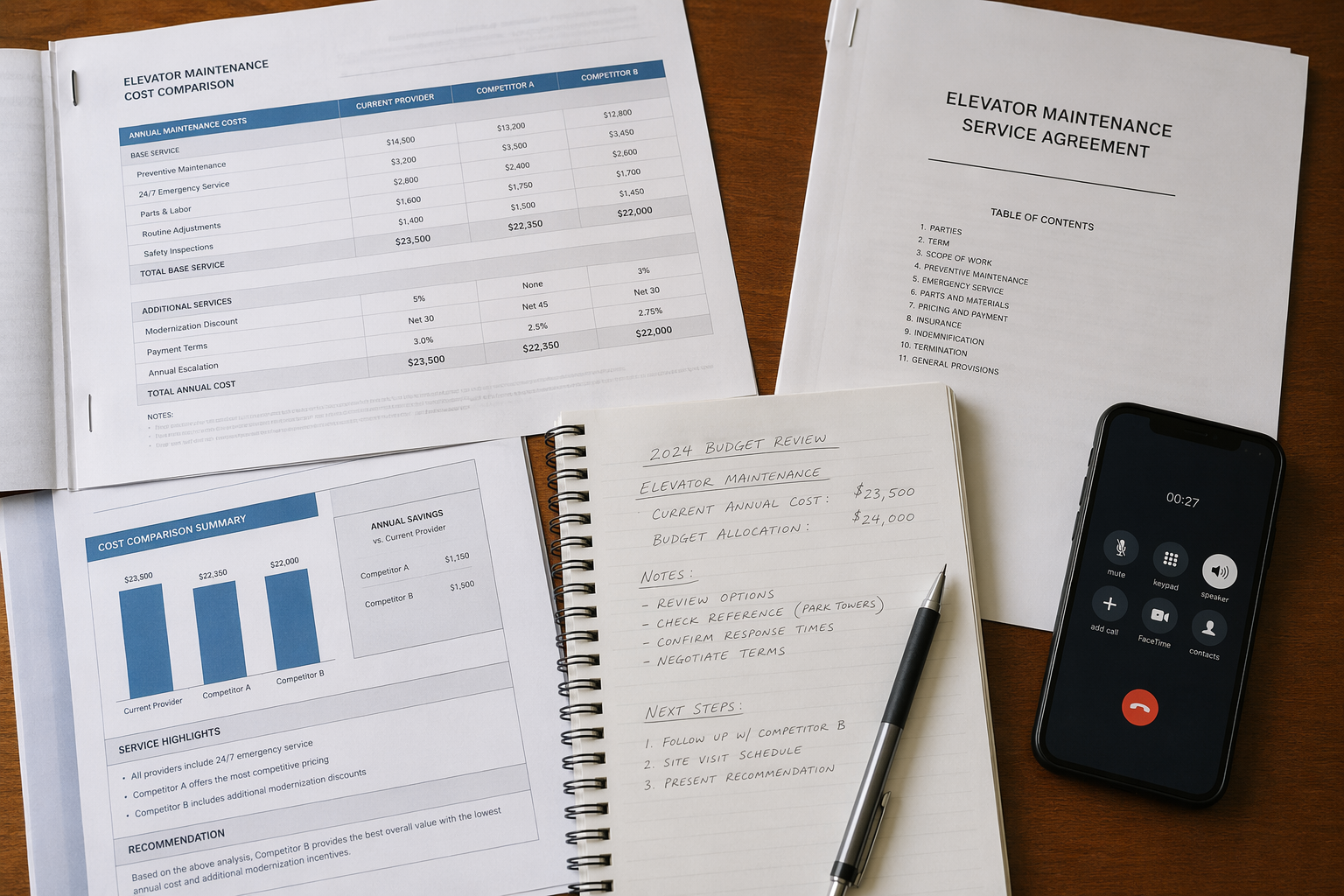
In 2026, annual elevator maintenance costs in the mid-Atlantic region typically range from $2,500 to $8,500 per elevator depending on contract type, elevator age, and building location.
Cost variability is significant in this industry, so let me break it down honestly. A basic oil-hydraulic elevator in a suburban office building will cost considerably less to maintain than a high-speed traction elevator in a downtown Baltimore or Washington DC high-rise. Geographic market also matters — urban markets like DC and Philadelphia command higher labor rates than suburban Richmond or Baltimore County.
The following table provides 2026 benchmark cost ranges for the markets Quality Elevator Company serves:
| Elevator Type | Contract Level | Baltimore, MD (Annual) | Washington, DC (Annual) | Philadelphia, PA (Annual) | Richmond, VA (Annual) |
|---|---|---|---|---|---|
| Hydraulic (2–4 stops) | Basic PM | $2,500–$3,500 | $3,000–$4,200 | $2,800–$3,800 | $2,200–$3,200 |
| Hydraulic (2–4 stops) | Full Service | $4,500–$6,000 | $5,200–$7,000 | $4,800–$6,500 | $4,000–$5,500 |
| Traction / MRL (4–10 stops) | Basic PM | $3,800–$5,200 | $4,500–$6,000 | $4,000–$5,500 | $3,500–$4,800 |
| Traction / MRL (4–10 stops) | Full Service | $6,000–$8,500 | $7,000–$10,000+ | $6,500–$9,000 | $5,500–$7,800 |
| Commercial Dumbwaiter | Basic PM | $1,200–$1,800 | $1,400–$2,200 | $1,300–$2,000 | $1,100–$1,600 |
| Platform Lift / LU-LA | Basic PM | $900–$1,400 | $1,100–$1,700 | $1,000–$1,500 | $800–$1,200 |
Note: Prices reflect 2026 market rates and are approximate. Final pricing depends on elevator age, condition, traffic volume, and specific building requirements. Contact Quality Elevator Company at 301-307-5363 for a precise quote.
What Is the Difference Between a Basic PM Contract and a Full-Service Contract?
A basic preventive maintenance (PM) contract covers scheduled lubrication, adjustment, and inspection visits, while a full-service contract also includes parts replacement and most repair labor at no additional cost.
This distinction is one of the most important cost decisions a building owner makes. Under a basic PM contract, you pay a lower monthly or annual fee, but when something breaks — a door operator motor, a hydraulic pump seal, a controller board — you receive a separate invoice for parts and labor. For older elevators with aging components, those repair invoices can easily exceed $5,000–$15,000 in a single year.
A full-service agreement converts most of those unpredictable repair costs into a fixed budget line. For finance directors and property managers who need predictability, this is often the better value even at higher premium. The one consistent exclusion from full-service contracts is major modernization work — if the entire control system needs replacement, that’s a capital project, not a maintenance event.
When evaluating contracts, always read the exclusions section carefully. Some vendors advertise “full service” but exclude commonly failing parts like door contacts, hall buttons, or hydraulic fluid. Ask every prospective vendor to list their specific exclusions in writing before you sign.
How Often Should Elevators Be Inspected and Maintained?
Under the ASME A17.1 Safety Code for Elevators and Escalators, most commercial elevators require periodic maintenance visits ranging from monthly to quarterly, plus an annual state inspection by a certified inspector.
In practice, the frequency of maintenance visits depends on traffic volume. A low-traffic hydraulic elevator in a 4-story medical office building may be adequately served by quarterly visits. A high-traffic traction elevator in a Washington DC office tower or a Philadelphia hospital likely needs monthly visits to maintain reliability and compliance. Your service provider should be able to recommend the appropriate visit frequency based on actual usage data, not just what fits their routing schedule.
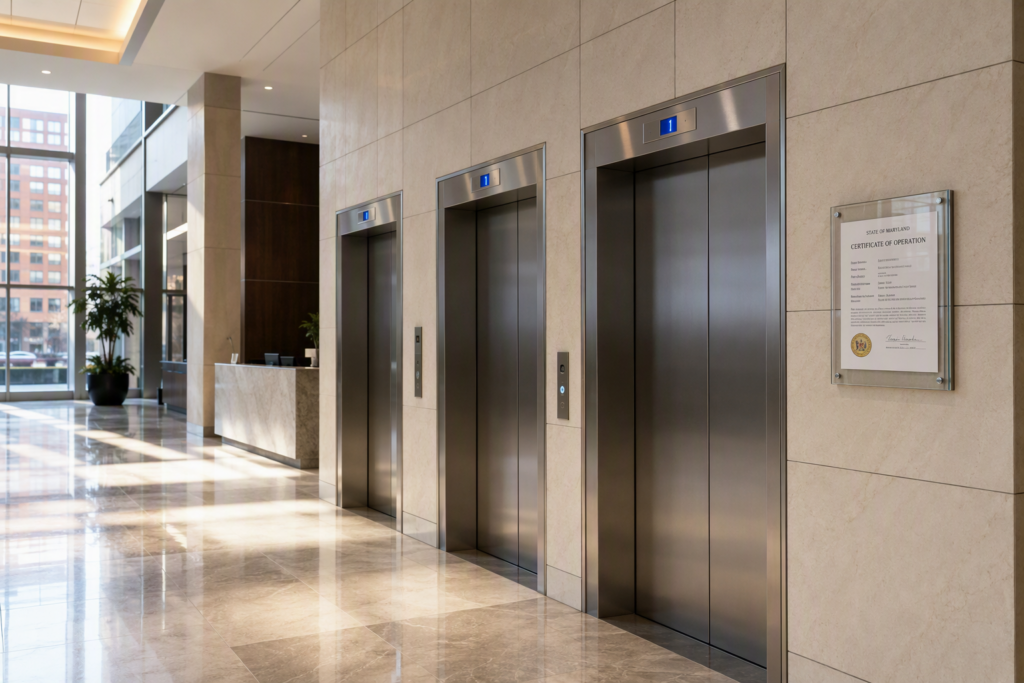
State annual inspections are separate from — and in addition to — your maintenance contract. Maryland, DC, Pennsylvania, and Virginia all require annual certificates of inspection, and in most jurisdictions the current certificate must be posted in the elevator cab. Failure to maintain a current certificate can result in fines, forced shutdown, and liability exposure if an incident occurs.
What Happens If I Don’t Maintain My Elevator Regularly?
Neglecting elevator maintenance leads to increased breakdown frequency, failed state inspections, potential ADA compliance violations, and significant liability exposure if a passenger is injured.
I’ve inspected dozens of elevators over the years that were running on deferred maintenance — and the pattern is always the same. What starts as a skipped quarterly visit turns into worn contacts, degraded hydraulic fluid, frayed ropes, or contaminated safeties. What would have cost $300 to maintain eventually costs $12,000 to repair, or results in an unplanned shutdown that costs a healthcare facility or retail tenant far more in lost business and tenant relations.
From a liability standpoint, building owners have a duty of care to elevator passengers. If a passenger is injured and your maintenance records show gaps, you have significantly weakened your legal position. Courts and insurance carriers look specifically at maintenance logs when evaluating elevator incident claims. Consistent, documented maintenance is your best legal and financial protection.
What Are the State-Specific Elevator Regulations in Maryland, DC, Pennsylvania, and Virginia?
Each jurisdiction in Quality Elevator Company’s service area adopts a version of the ASME A17.1 Safety Code for Elevators and Escalators and enforces it through a state or local elevator inspection bureau with annual certificate requirements.
Here is a brief jurisdiction-by-jurisdiction overview for 2026:
- Maryland: The Maryland Department of Labor, Licensing and Regulation (DLLR) governs elevator safety. Elevators must have a current Maryland Elevator Safety Certificate posted in the cab. Contractors must hold a Maryland elevator contractor license.
- Washington, DC: The DC Department of Consumer and Regulatory Affairs (DCRA) administers elevator inspections. DC follows ASME A17.1 and requires annual inspections with a posted certificate. Violation fines can be substantial — up to $2,000 per day for operating without a valid certificate.
- Pennsylvania: The Pennsylvania Department of Labor and Industry enforces elevator safety under the Pennsylvania Elevator Safety Law. Philadelphia also has its own city-level inspection program layered on top of state requirements, which means Philadelphia building owners may face both state and city inspections.
- Virginia: The Virginia Department of Labor and Industry (DOLI) oversees elevator safety. Contractors must hold a Virginia Class A or B license depending on scope of work. Annual inspections are required and certificates must be current.
Non-compliance with state regulations can result in mandatory shutdown orders. I have personally seen buildings in Baltimore and Richmond shut down their elevators mid-business-day due to expired certificates — a situation that is entirely avoidable with a proactive service partner.
What Is Included in a Quality Elevator Maintenance Visit?
A comprehensive maintenance visit covers safety device testing, lubrication, adjustment of all mechanical and electrical components, ride quality assessment, and documentation of findings in a written service report.
When a Quality Elevator Company technician arrives for a scheduled maintenance visit, the process is systematic and documented. Every visit includes a full safety device check — governor, safeties, buffers, and interlocks — plus lubrication of all friction points per manufacturer specifications, door system adjustment and testing, controller diagnostics, and a functional test of all floors and emergency systems. A written service report is provided to the building contact after every visit, and records are retained to support your compliance documentation.
Don’t accept a maintenance provider who cannot show you written service reports for every visit. Verbal reports don’t protect you in an inspection or a legal proceeding.
What Should I Do Immediately If My Elevator Breaks Down?
If your elevator breaks down or traps a passenger, follow these steps immediately to protect passenger safety and meet your legal obligations.
- Communicate with anyone trapped in the cab — use the emergency phone or intercom to confirm their safety and tell them help is on the way. Do not allow untrained personnel to attempt to manually open doors or extract passengers.
- Call your elevator service company’s emergency line immediately — a licensed technician must perform the rescue. Quality Elevator Company provides 24/7 emergency response across all service markets.
- Call 911 if there is a medical emergency — if any passenger reports a medical condition, shortness of breath, or distress, contact emergency services simultaneously.
- Post the elevator as “Out of Service” — place visible signage at all lobbies and floors to prevent additional passengers from attempting to use the elevator.
- Do not attempt to reset the elevator — cycling the main disconnect or pressing reset buttons without knowing the cause of the fault can create additional safety hazards.
- Document the incident — note the time of the breakdown, the number of passengers affected, the reported symptoms (unusual noise, sudden stop, door issue), and the name of the technician dispatched.
- Report the incident per your state’s requirements — some jurisdictions require written incident reports to the state elevator bureau within a specified timeframe, particularly if injury occurred.
How Do Elevator Age and Condition Affect Maintenance Costs?
Elevators more than 20 years old typically cost 30–60% more to maintain annually than newer units due to parts obsolescence, increased wear, and the need for more frequent corrective repairs between scheduled visits.
This is one of the most important financial conversations I have with building owners. An elevator installed in 1998 or 2002 is running on components that may no longer be manufactured, meaning parts must be sourced from specialty suppliers at premium prices, or custom-fabricated. Controller boards that cost $400 on a modern system may cost $2,200 on an older relay-logic system — if they can be found at all.
From a lifecycle cost perspective, when annual maintenance and repair costs on an aging elevator approach 20–25% of modernization cost, it is typically time to evaluate a full or partial modernization. A modernization project can reduce ongoing maintenance costs by 30–50% while also bringing the elevator into compliance with current ASME A17.1 and ADA requirements — which is increasingly important as accessibility enforcement has intensified in 2025 and 2026.
Does ADA Compliance Affect My Elevator Maintenance Obligations?
Yes — under the Americans with Disabilities Act, buildings subject to ADA must keep accessible elevators operational and available, which means responsiveness to breakdowns affecting accessibility is a legal requirement, not just a service preference.
The ADA requires that elevators in covered buildings be maintained in operable working condition, with only isolated or temporary interruptions in accessibility permitted. If your elevator serves as the primary accessible route in a building, an extended outage can constitute an ADA violation regardless of whether the breakdown was your “fault.” This is why response time guarantees in your maintenance contract matter — a contract that promises 4-hour emergency response is meaningfully different from one that promises “next business day.”
ADA also specifies physical requirements for elevator cab dimensions, control panel height and reach ranges, door timing, audible and visual signals, and Braille markings on controls. If your elevator is aging and these features are not functioning properly, your maintenance contract should include regular testing and adjustment of all ADA-required features.
How Do I Compare Elevator Maintenance Contracts from Different Vendors?
Compare vendors on five dimensions: scope of coverage (what is included and excluded), response time guarantees, technician qualifications, contract flexibility, and transparency of pricing.
Price alone is a poor comparison metric in elevator maintenance. A contract at $3,000/year with broad exclusions may actually cost you $7,000/year once repair invoices are added. Use this checklist when comparing proposals:
- Ask each vendor to provide a written list of all excluded parts and labor.
- Confirm the emergency response time guarantee is written into the contract — not just promised verbally.
- Verify the technician assigned to your account holds current IUEC certification or equivalent state licensure.
- Confirm whether the contract auto-renews and what the notice period is to cancel or renegotiate.
- Ask for references from buildings of similar size and elevator type in your market.
- Verify the vendor’s state contractor license number independently through your state labor department’s public license lookup.
- Confirm the vendor carries a minimum of $1 million general liability and workers’ compensation insurance.
Quality Elevator Company provides fully transparent, itemized contract proposals with all exclusions listed clearly — no hidden fee surprises at service time.
What Is a Preventive Maintenance Schedule and Why Does It Matter?
A preventive maintenance schedule is a documented plan specifying what tasks are performed at each visit, at what intervals, and to what standards — and it is the single most important document in demonstrating compliance during a state inspection or legal proceeding.
Per ASME A17.1 requirements, elevator owners and their service contractors are required to maintain records of all maintenance activity. An inspector who arrives to find no maintenance logs, or logs with significant gaps, will flag the elevator for additional scrutiny — and in some jurisdictions will issue a violation or require additional testing at the owner’s expense.
Your PM schedule should document: lubrication intervals for each component per manufacturer specs, safety device test intervals and acceptance criteria, door system inspection and adjustment procedures, and hydraulic fluid sampling and change intervals for hydraulic units. Ask your prospective service provider to show you a sample PM schedule before signing — if they can’t produce one, that tells you something important about their operational standards.
How Does Elevator Traffic Volume Affect Maintenance Frequency and Cost?
High-traffic elevators in hospitals, hotels, mixed-use residential towers, and busy commercial buildings require more frequent maintenance visits and experience faster component wear, which directly increases annual service costs.
A traction elevator in a 200-unit residential building in Baltimore or a busy government office building in DC may make 200–400 trips per day. That same elevator type in a low-traffic professional building may make 30–50 trips per day. The difference in wear accumulation over a year is enormous — ropes, sheaves, door operators, and controller components all degrade in proportion to usage cycles.
When I assess a new client’s elevator, I always ask for an approximate daily trip count or review the elevator’s diagnostic log if available. This directly informs my recommendation for visit frequency and contract level. A building owner who under-budgets for high-traffic maintenance will spend far more on emergency repairs than they saved on the contract.
Are There Additional Costs Beyond the Maintenance Contract I Should Budget For?
Yes — building owners should budget separately for state inspection fees, modernization reserves, emergency callback charges (if not covered), and hydraulic fluid disposal costs.
Even with a full-service maintenance contract, there are line items that typically fall outside the contract scope:
- State inspection fees: Annual inspection fees payable to the state range from approximately $150–$500 per elevator depending on jurisdiction. These are separate from your service contract.
- Five-year / Category 1 and Category 5 testing: ASME A17.1 requires Category 1 (annual) and Category 5 (5-year) tests depending on elevator type. The Category 5 full-load safety test can cost $1,500–$4,000 per elevator and is sometimes outside basic contract scope.
- Hydraulic fluid disposal: Virginia and Maryland have specific environmental regulations for hydraulic fluid disposal. Budget $300–$600 for proper disposal when fluid is changed.
- Major modernization capital reserve: Industry guidance recommends reserving 2–4% of elevator replacement value annually toward future modernization. For a mid-size traction elevator, that may be $4,000–$8,000/year in reserve contributions.
- Emergency after-hours callbacks: If your basic PM contract does not include after-hours emergency response, budget $250–$500 per callback incident.
What Questions Should I Ask Before Signing an Elevator Maintenance Contract?
Before signing any elevator maintenance agreement, ask these specific questions to ensure full clarity on coverage, obligations, and service standards.
- What is your state contractor license number, and can I verify it independently?
- Which specific parts and labor are excluded from this contract?
- What is your guaranteed emergency response time, and is that guaranteed in writing?
- Who specifically will be assigned to my account, and what are their certifications?
- How do you document maintenance visits, and will I receive a copy of each service report?
- Does this contract include coordination of the annual state inspection?
- What is the contract term, and what are the terms for cancellation or renegotiation?
- How do you handle parts pricing if a repair falls outside the contract scope?
How Does Elevator Modernization Affect Ongoing Maintenance Costs?
A properly executed elevator modernization typically reduces annual maintenance costs by 25–50% by replacing obsolete components with current-generation systems that are more reliable, energy-efficient, and parts-available.
Modernization is a capital investment, typically ranging from $40,000 for a partial hydraulic upgrade to $150,000+ for a full traction elevator modernization in a DC or Philadelphia high-rise. However, when you factor in the reduction in repair callbacks, parts costs, and emergency service incidents, the payback period is often 5–8 years — and the elevator will meet current ASME A17.1 and ADA standards upon completion, reducing compliance risk significantly.
In some cases, jurisdictions require code compliance upgrades when a certain scope of modernization is performed — your service provider should walk you through these trigger points before you commit to a scope of work. Quality Elevator Company provides detailed modernization assessments that include both the capital cost estimate and the projected maintenance savings over a 10-year horizon.
Does OSHA Have Requirements That Affect Elevator Maintenance?
Yes — OSHA regulations apply to elevator work environments, including machine room access, lockout/tagout procedures, and pit safety requirements, and non-compliance can result in significant fines.
OSHA 29 CFR 1910 and 1926 standards govern the safety of workers who service elevators. Machine rooms must be clean, dry, properly lit, and accessible only to authorized personnel. Pit ladders, lighting, and stop switches must meet OSHA standards. Lockout/tagout procedures must be documented and followed during maintenance and repair work.
Building owners share responsibility for ensuring that the spaces where elevator mechanics work — machine rooms, pits, and hoistways — meet OSHA standards. If an OSHA inspector finds violations in your machine room, you can be cited even if the condition predates your ownership of the building. A reputable service company will flag OSHA-relevant deficiencies they observe during maintenance visits.
How Do I Know If I’m Overpaying for Elevator Maintenance?
You may be overpaying if your contract price is significantly above the benchmark rates for your market and elevator type, if you are paying for visit frequencies higher than your traffic volume requires, or if your current contractor frequently invoices for repairs that industry standard would include in a full-service contract.
The most common overpayment scenario I encounter is a building owner locked into a legacy contract with a national elevator OEM at rates 40–60% above market, with limited exclusions and slow response times. Large national companies have high overhead structures, and their pricing often reflects that overhead rather than the actual cost of servicing your specific elevator.
Independent regional contractors like Quality Elevator Company frequently offer more competitive pricing, faster response times, and more personalized service — because your account represents a meaningful portion of their business rather than one of thousands. Get competitive bids every 3–5 years even if you’re satisfied with your current provider. The market moves, and your leverage increases when vendors know you’re actively comparing.
What Are the Signs That My Elevator Needs Immediate Attention Beyond Scheduled Maintenance?
Call your elevator service provider immediately if you observe unusual noises, doors that fail to open or close properly, leveling issues where the cab does not align with the floor, visible hydraulic fluid leaks, or any passenger reports of a jolt, drop, or unexpected stop.
These are not “wait until the next scheduled visit” symptoms. Hydraulic fluid leaks can indicate seal failure that precedes a sudden pressure loss. Leveling issues can cause trip-and-fall hazards at every threshold — one of the most common elevator-related personal injury claims. Door failures are the single most frequent cause of elevator entrapment incidents. Any of these symptoms warrants an unscheduled service call, and a good maintenance contract will cover that call without additional charge.
Document what you observe — time of occurrence, floor level, direction of travel, sound description, frequency of occurrence. The more specific your report to the technician, the faster the diagnosis and repair. Quality Elevator Company’s dispatch team is trained to ask the right intake questions to ensure the responding technician arrives prepared with likely parts and tools.
How Do I Get an Accurate Elevator Maintenance Quote for My Building?
To receive an accurate maintenance quote, a qualified technician must physically inspect each elevator, review current maintenance records, and assess the condition of all major systems before pricing can be finalized.
Be skeptical of any company that provides a firm annual price without first inspecting your equipment. Elevator condition varies enormously between units of the same age and model depending on prior maintenance quality, traffic history, and building environment. A quote given without inspection is either padded to account for unknown risk or so low it will be revised upward after the first visit reveals deferred maintenance issues.
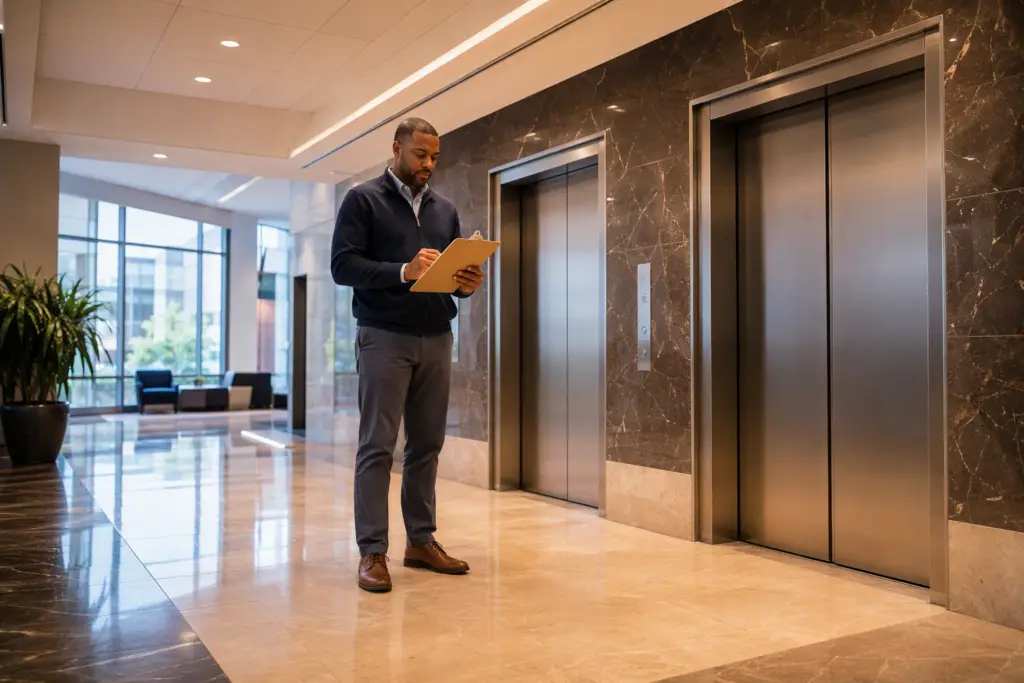
A proper pre-contract assessment should include a review of the machine room, pit, and cab; a test of all safety devices; a review of the last state inspection report; and a conversation with whoever currently manages the elevator about known issues and recent repair history. This due diligence takes 60–90 minutes per elevator and is the basis for an honest, accurate contract proposal.
Ready to Get an Accurate Elevator Maintenance Quote?
Whether you manage a single-elevator medical office in Richmond or a multi-elevator commercial tower in Washington DC, Quality Elevator Company provides certified, transparent, and responsive elevator maintenance built around your building’s specific needs. Our IUEC-certified technicians serve Baltimore MD, Washington DC, Philadelphia PA, and Richmond VA with same-day assessments and no-obligation contract proposals.
Contact Quality Elevator Company for a free elevator assessment. Call us today at 301-307-5363 to schedule your complimentary on-site inspection and receive a detailed, itemized maintenance proposal with no pressure and no hidden fees.
Need elevator service you can rely on? Quality Elevator Company is ready to help.