Who Should I Contact and How Fast Can an Elevator Be Repaired? Complete FAQ Guide
Elevator downtime is disruptive for building owners, property managers, and the people who depend on vertical transportation every day. Whether the issue is a minor door adjustment or a major mechanical failure, knowing who to call, what to expect, and how code requirements shape the repair timeline can make an enormous difference in how quickly an elevator returns to safe operation. The 20 questions below cover every dimension of the repair process — from the first emergency call through final inspection and code compliance.
1. Who should I contact when an elevator needs to be repaired?
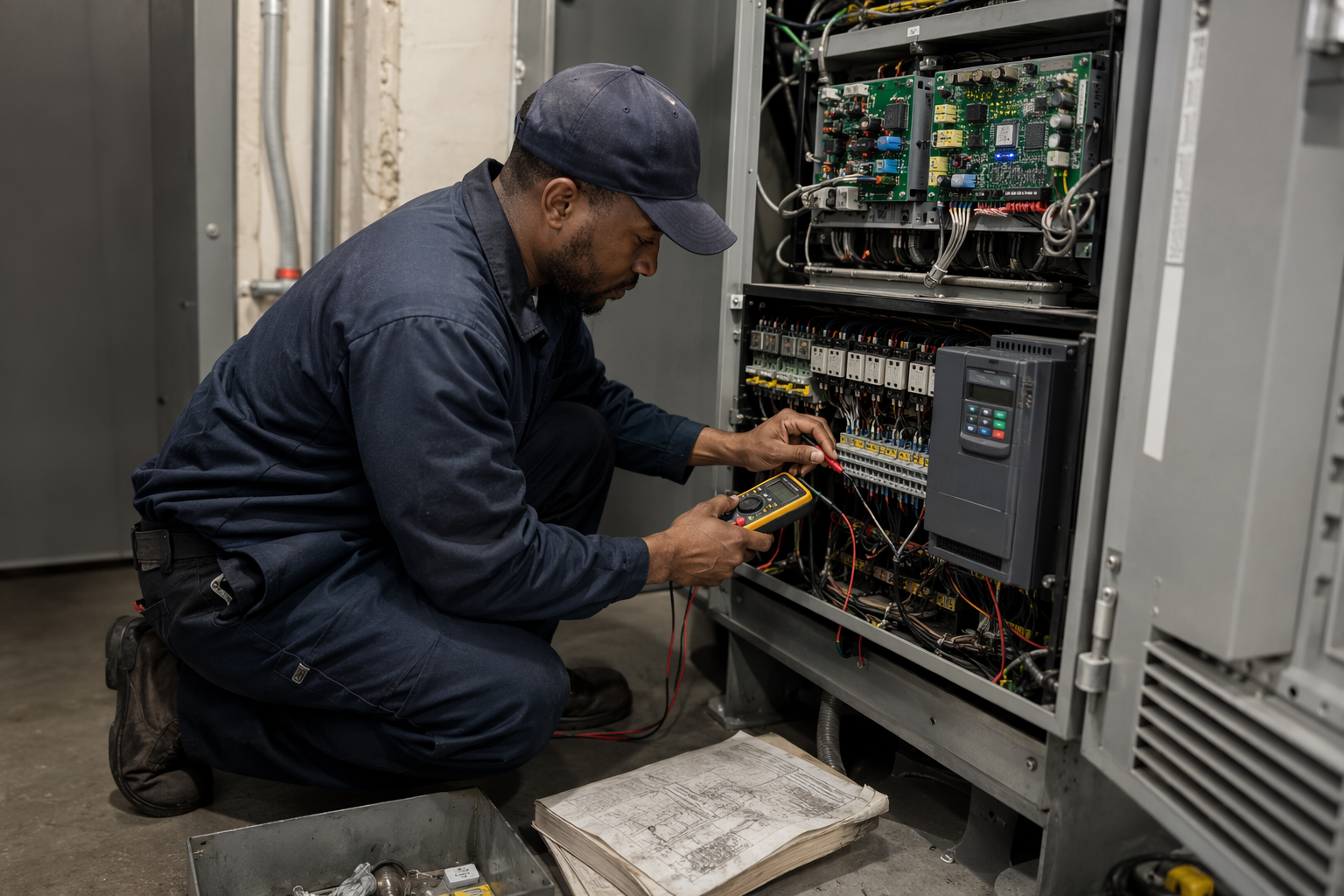
Contact a licensed elevator service company and, depending on the jurisdiction, notify the local elevator inspection authority as required by state or municipal law.
Building owners and property managers in Baltimore MD, Washington DC, Philadelphia PA, and Richmond VA are responsible for ensuring their elevators are maintained and repaired by qualified personnel. The appropriate first call is to a certified elevator contractor who can diagnose the problem, perform the repair, and coordinate any mandatory re-inspection with the Authority Having Jurisdiction (AHJ). Quality Elevator Company serves all four of these markets and can connect building teams with the right technical resources immediately.
In most cases, the elevator manufacturer’s service agreement — if one exists — governs whether repairs go through the OEM or an independent contractor. Independent full-service companies often offer faster response and broader parts sourcing than manufacturer-tied programs.
2. How fast can an elevator typically be repaired?
Repair timelines range from less than an hour for minor adjustments to several weeks for major component replacements, depending on the nature of the failure and parts availability.
Simple issues — such as door sensor misalignment, a tripped circuit breaker, or a faulty call button — can frequently be resolved during a single service visit. Mid-range repairs involving motors, controllers, or hydraulic components may take one to several days once parts are confirmed available. Major modernizations or replacements of traction machines and controllers can extend into weeks or months.
Parts availability is the most common variable. Proprietary components for older or discontinued equipment may require longer lead times, which is why proactive maintenance and parts inventory planning are strongly recommended.
3. What information should I have ready before calling for elevator repair?
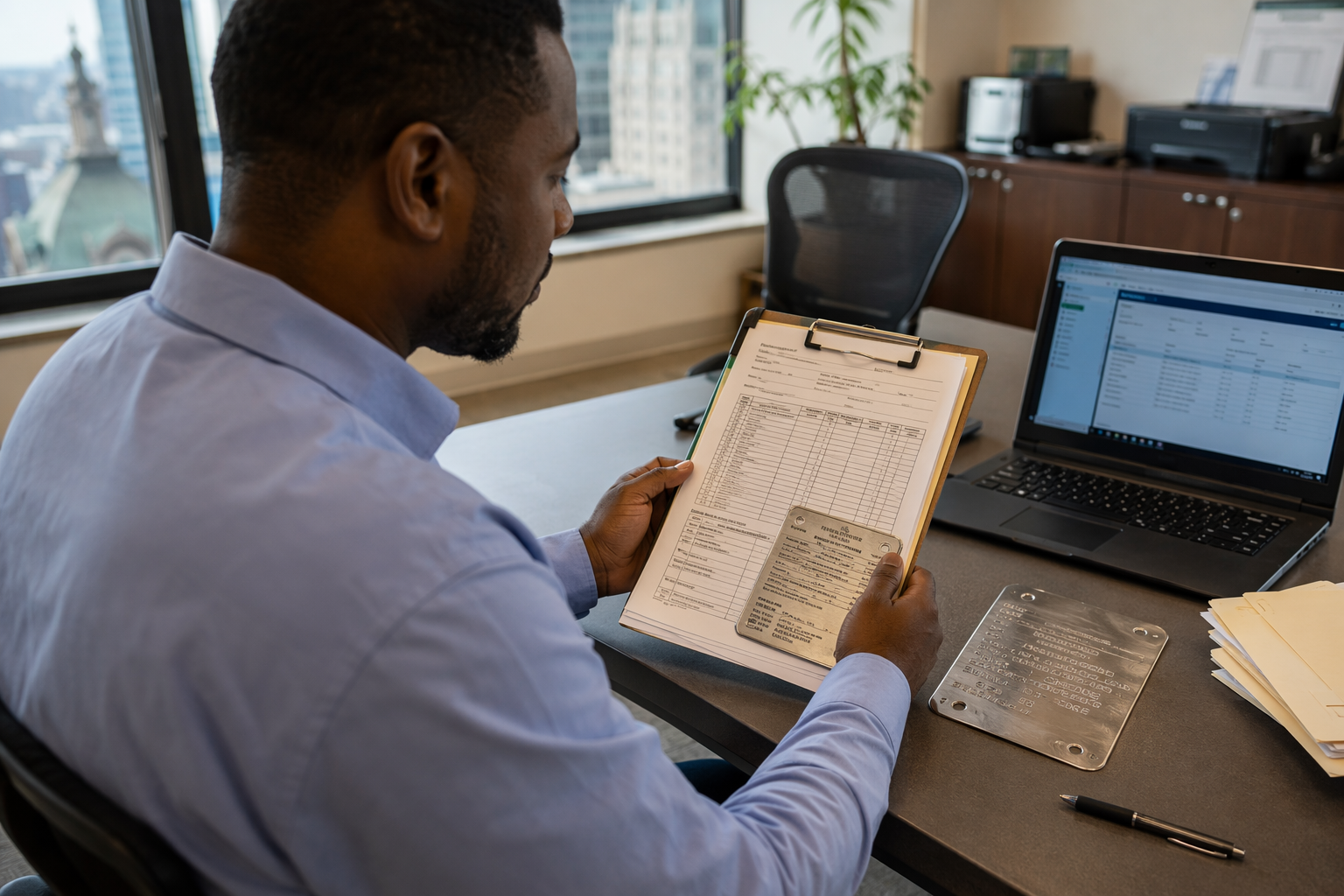
Have the elevator’s make, model, serial number, maintenance certificate number, and a clear description of the malfunction ready before calling the service company.
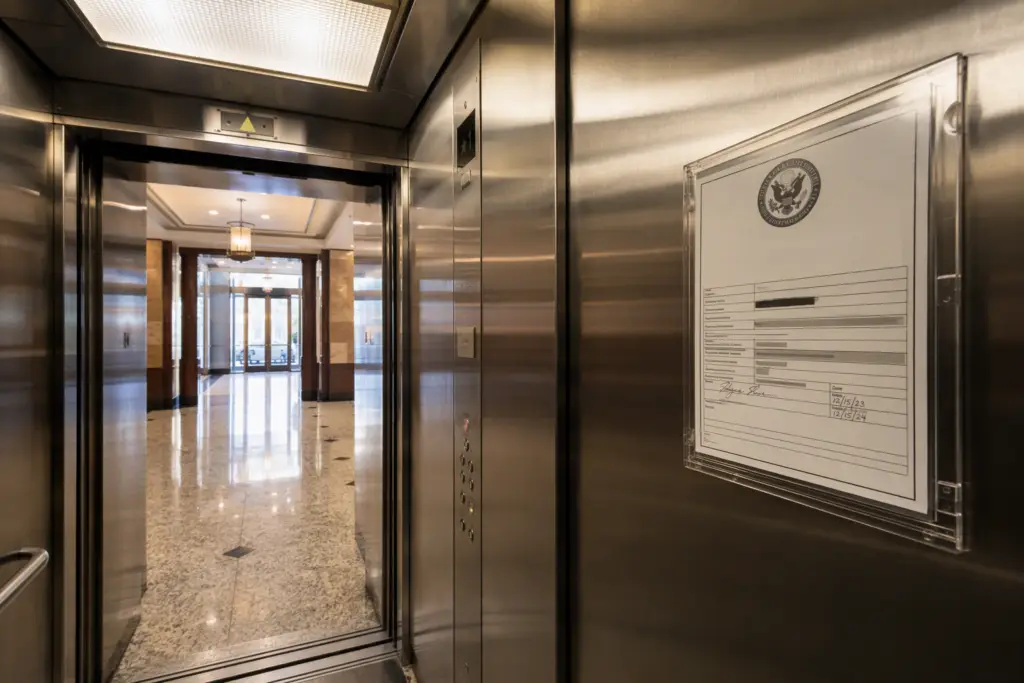
This information allows the dispatching technician to identify the correct parts, review service history, and determine whether any special tools or components need to be brought to the site. The serial number is typically located on a metal plate inside the machine room or on the elevator car itself. Having the most recent inspection certificate on hand is also useful, as it documents the elevator’s current compliance status and last inspection date.
4. What are the immediate steps to take when an elevator breaks down?
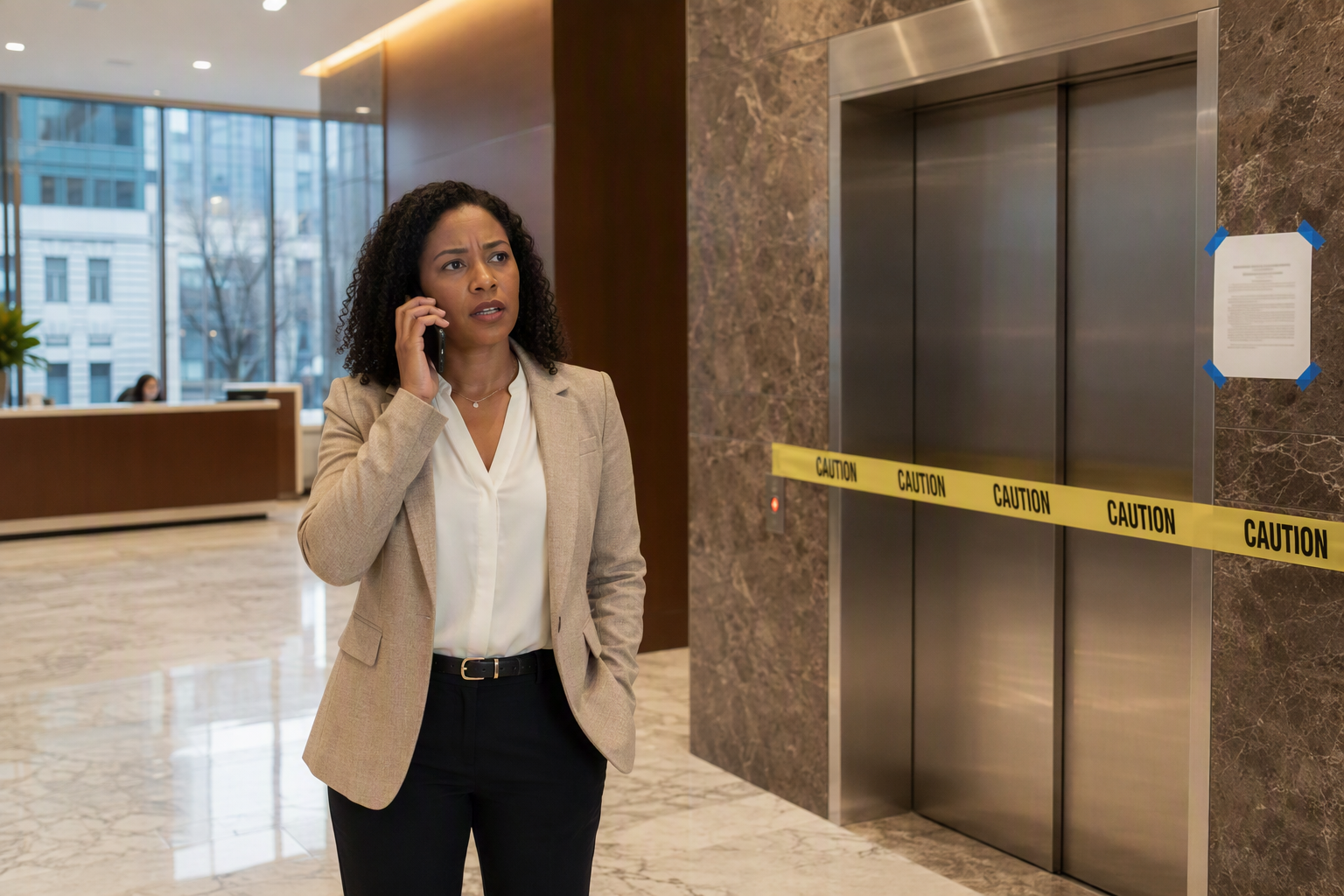
Immediately secure the elevator from use, communicate with any trapped passengers, and contact a licensed elevator service company.
- Determine whether anyone is trapped. If passengers are inside a stalled car, communicate with them through the emergency intercom system and reassure them that help is on the way. Do not attempt to open doors manually without trained personnel present.
- Call emergency services if passengers are trapped. In most jurisdictions, fire departments are authorized to perform passenger rescues from stalled elevator cars. Call 911 if any passenger requires immediate medical attention or if rescue is needed.
- Place the elevator out of service. Post clear signage at all landings indicating the elevator is out of service. In buildings with a building management system, disable the elevator from the control panel if possible.
- Contact a licensed elevator service company. Provide the technician with the make, model, location, and a description of what happened before or during the failure.
- Notify building management and affected occupants. Ensure that individuals with mobility impairments are accommodated through alternative means as required by the Americans with Disabilities Act.
- Document the incident. Record the date, time, nature of the failure, and any passenger involvement for insurance and compliance records.
- Do not attempt DIY repairs. Elevator systems involve high-voltage electrical components, hydraulic pressure, and complex mechanical systems. Unauthorized repairs can void permits and create serious safety hazards.
5. Does elevator repair require a licensed technician?
Yes — in virtually all U.S. jurisdictions, including Maryland, Washington DC, Pennsylvania, and Virginia, elevator repair work must be performed by licensed elevator mechanics and supervised by a licensed elevator contractor.
Licensing requirements are established at the state and sometimes municipal level. Work performed by unlicensed individuals can result in fines, permit revocations, and potential civil liability. Furthermore, the ASME A17.1 Safety Code for Elevators and Escalators specifies that maintenance and repair work must be performed by qualified personnel following documented procedures. Quality Elevator Company employs technicians who meet the regulatory requirements of each jurisdiction it serves.
6. What codes and standards govern elevator repair timelines and procedures?
The primary governing standard is the ASME A17.1 Safety Code for Elevators and Escalators, which each of the four states and DC adopts and supplements with local regulations.
The ASME A17.1 Safety Code for Elevators and Escalators establishes minimum safety requirements for the construction, installation, operation, inspection, testing, maintenance, alteration, and repair of elevators and escalators in the United States. The 2019 and 2022 editions are widely referenced, and 2026 code guidance continues to build on these frameworks.
Each jurisdiction layers additional requirements on top of ASME A17.1:
- Maryland: The Maryland Department of Labor oversees elevator safety and requires permits for all alterations and repairs.
- Washington DC: The DC Department of Buildings administers elevator inspections and enforces the local elevator safety code.
- Pennsylvania: The Pennsylvania Department of Labor and Industry regulates elevator safety under the Elevator and Escalator Safety Law.
- Virginia: The Virginia Department of Labor and Industry enforces the Virginia Elevator Safety Law and aligns closely with ASME standards.
Building owners should also be aware of ADA requirements, which mandate that elevators in covered buildings remain accessible to individuals with disabilities. Extended outages without alternative accessible routes can create ADA compliance exposure.
7. How does the type of elevator affect repair time?
The elevator type — hydraulic, traction, or machine-room-less — significantly affects repair complexity, parts sourcing, and overall downtime.
| Elevator Type | Common Failure Points | Typical Parts Availability | Complexity of Repair | Key Code Reference |
|---|---|---|---|---|
| Hydraulic (older) | Hydraulic cylinder, pump unit, seals, control valve | Moderate — some legacy parts scarce | Moderate to high for cylinder work | ASME A17.1 |
| Hydraulic (modern) | Pump motor, valve assembly, fluid contamination | Good for current-generation equipment | Low to moderate | ASME A17.1 |
| Geared Traction | Gearbox, brake, controller, sheave wear | Moderate — gearbox components can have lead times | High for gearbox/motor work | ASME A17.1 |
| Gearless Traction | Machine brake, encoder, controller board | Variable — proprietary controllers can be scarce | High for machine or controller replacement | ASME A17.1 |
| Machine-Room-Less (MRL) | Controller, drive unit, rope, door operator | Variable — often OEM-specific | Moderate to high | ASME A17.1 |
8. What is the difference between a minor repair and a major alteration?
Under ASME A17.1 and most state regulations, a minor repair restores equipment to its existing design condition, while a major alteration changes the performance, capacity, speed, or safety devices of the elevator and typically requires a new permit and inspection.
This distinction matters because major alterations trigger a more extensive regulatory process, including plan submission, permit issuance, and a formal inspection by the AHJ before the elevator can return to service. Examples of alterations include replacing a traction machine, upgrading a controller to a new generation, or changing the rated speed or capacity. Minor repairs — such as replacing a door operator board with the same-model component — generally do not require a permit in most jurisdictions, though local rules vary and should always be confirmed with the AHJ.
9. When is an elevator required to be taken out of service?
An elevator must be taken out of service when it fails a safety test, presents an imminent hazard to occupants, or when a jurisdictional authority issues an order to cease operation.
Under the ASME A17.1 Safety Code for Elevators and Escalators, specific unsafe conditions — such as a failed safety device, broken or badly worn ropes, or a leveling issue that creates a tripping hazard — require the elevator to be removed from service until repairs are completed and the unit is re-inspected. Building owners who operate elevators with known hazardous conditions face significant liability exposure. The relevant state elevator authority in Maryland, DC, Pennsylvania, and Virginia each have the power to post “out of service” tags on non-compliant equipment.
10. Does an elevator need to be re-inspected after repair?
Whether a re-inspection is required depends on the nature and scope of the repair — major alterations almost always require a formal re-inspection by the AHJ before the elevator returns to service.
For minor repairs, a maintenance record and technician sign-off are typically sufficient. For any work that qualifies as an alteration under ASME A17.1 or state law, a certified elevator inspector must verify that the work was performed correctly and that all safety requirements are met before the elevator can be placed back into service. Building owners should always obtain written confirmation from their service company regarding whether a specific repair requires a formal inspection, and they should retain all service records as documentation of compliance.
11. How do ADA requirements affect elevator repair urgency?
Under the Americans with Disabilities Act, buildings covered by the ADA must maintain accessible routes, and an out-of-service elevator that eliminates the only accessible path to a floor can create an immediate ADA compliance issue.
The ADA requires that programs, services, and facilities remain accessible to individuals with disabilities. When an elevator is the only means of accessing upper or lower floors for wheelchair users and others with mobility impairments, an extended outage without a reasonable alternative accommodation can expose building owners to complaints and potential legal action. Prioritizing rapid repair in these situations is not only a best practice — it is a legal consideration. Quality Elevator Company advises building teams in all four service markets to treat ADA-accessible elevator outages as high-priority service events.
12. What role does the building owner play in the repair process?
The building owner or property manager is ultimately responsible for ensuring the elevator is maintained in a safe, code-compliant condition and for coordinating access, documentation, and permit compliance during any repair.
Practical responsibilities include providing technician access to machine rooms and associated spaces, retaining service records on site, ensuring current inspection certificates are posted as required by local law, and communicating outage status to tenants and users. The building owner is also responsible for ensuring that all work is performed under the appropriate permits and that re-inspections are scheduled promptly after major repairs or alterations are complete.
13. How does preventive maintenance affect repair frequency and downtime?
Elevators on structured preventive maintenance programs experience fewer unplanned failures because inspections identify developing issues before they become failures.
Preventive maintenance visits typically include lubrication of mechanical components, inspection and adjustment of door operators and safety devices, testing of emergency systems, and review of electrical connections. The ASME A17.1 Safety Code for Elevators and Escalators requires that elevators be maintained in accordance with a documented maintenance program. Buildings without formal maintenance contracts frequently face longer repair timelines because service history is incomplete and no parts inventory is pre-positioned for the specific equipment.
14. What should I look for when choosing an elevator repair company?
Choose a company that holds the required state contractor licenses, demonstrates familiarity with the specific equipment type in the building, and can coordinate the full regulatory cycle from repair through re-inspection.
Key criteria include state licensing in the jurisdiction where the building is located, the ability to service a wide range of elevator makes and models (not just proprietary service), parts sourcing capability, and a clear process for permit and inspection coordination with the AHJ. An independent full-service elevator company is often better positioned than an OEM-tied contractor to source alternative parts quickly and provide unbiased repair recommendations. Quality Elevator Company operates across Baltimore MD, Washington DC, Philadelphia PA, and Richmond VA with the regulatory knowledge required in each market.
15. Are there OSHA requirements that affect elevator repair work?
Yes — OSHA regulations govern the safety of elevator mechanics while performing repair and maintenance work, including lockout/tagout procedures, confined space entry, and working at heights.
The OSHA standards most relevant to elevator repair work include those covering the control of hazardous energy (lockout/tagout) under 29 CFR 1910.147, which requires that all energy sources be isolated and locked out before maintenance or repair work begins on powered equipment. OSHA standards also address fall protection and electrical safety for workers operating in elevator shafts and machine rooms. Building owners who allow unauthorized or improperly equipped individuals to perform elevator repairs may face OSHA citations if an incident occurs.
16. What is the typical process for an emergency elevator repair call?
An emergency elevator repair call typically follows a standardized process: initial call intake, dispatch of a qualified technician, on-site diagnosis, repair or temporary remediation, and documentation of the service.
- Call intake: The building contact calls the elevator service company and provides the building address, elevator location, make and model, and a description of the problem.
- Dispatch: The service company dispatches a qualified technician to the site. The technician may request additional diagnostic information over the phone to prepare the correct tools and parts.
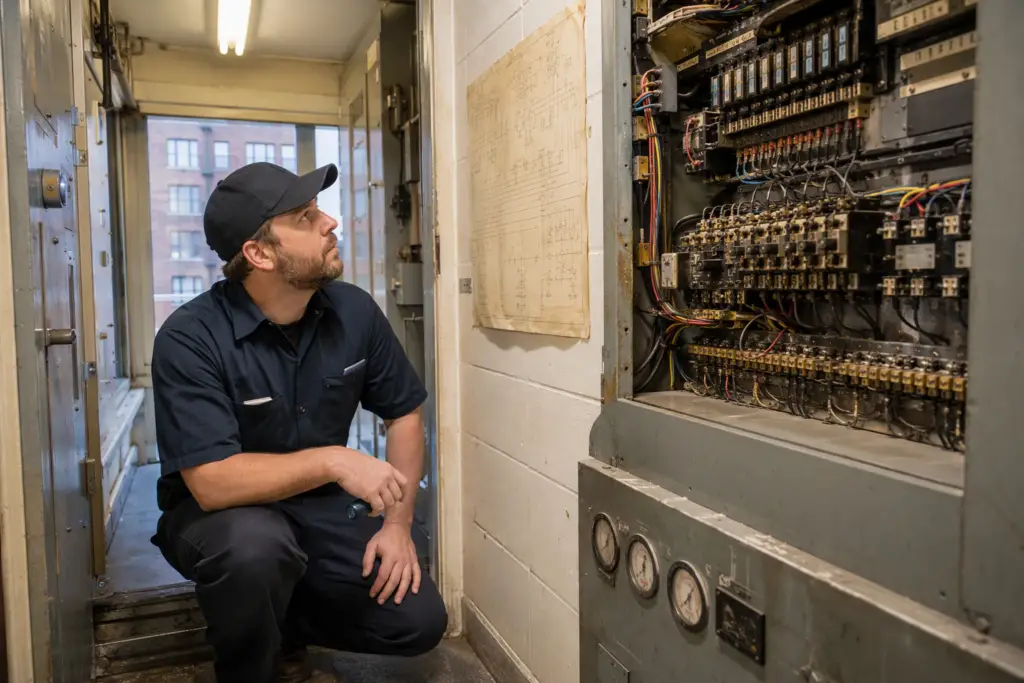
- On-site diagnosis: The technician performs a systematic inspection of the reported failure, reviewing the controller, mechanical components, safety devices, and related systems.
- Repair or temporary remediation: If the required parts are on hand, the repair proceeds. If parts must be ordered, the technician may implement a temporary remediation to minimize downtime where safely possible, or the elevator remains out of service until parts arrive.
- Safety verification: After repair, the technician verifies that all safety devices are operational and that the elevator performs within specification before returning it to service.
- Documentation: The technician provides a written service record documenting the diagnosis, parts replaced, and work performed. This record should be retained by the building owner for compliance purposes.
- Permit and inspection coordination: If the repair qualifies as an alteration, the service company assists with permit filing and scheduling the required re-inspection with the AHJ.
17. How does elevator age affect repair complexity and cost?
Older elevators generally present greater repair complexity because of parts scarcity, obsolete controllers, and the potential for cascading failures when one worn component stresses related systems.
Equipment that is several decades old may use controller technology and mechanical components that are no longer manufactured, requiring either custom fabrication, salvaged parts, or a modernization decision. When the cost of maintaining aging equipment approaches or exceeds the cost of modernization, many building owners find that a full or partial modernization provides better long-term value and code compliance. A qualified elevator service company can provide an objective assessment of whether repair or modernization is the more prudent path for a specific unit.
18. What documentation should I keep after an elevator repair?
Building owners should retain the technician’s written service record, any permits issued, the re-inspection certificate if applicable, and updated maintenance logs for the life of the equipment.
Most jurisdictions require that elevator maintenance and inspection records be kept on file and made available to inspectors upon request. Under ASME A17.1, a complete maintenance record supports demonstration that the equipment has been maintained in accordance with the code. In the event of an incident or legal claim, thorough service documentation is essential. Some state programs, including those in Maryland and Pennsylvania, have specific retention requirements that building owners should confirm with their AHJ or legal counsel.
19. How can building owners in Baltimore, Washington DC, Philadelphia, and Richmond minimize elevator repair downtime?
The most effective strategies for minimizing repair downtime are proactive maintenance, a relationship with a responsive local service company, and keeping current inspection and permit status in good standing.
Buildings served by Quality Elevator Company across Baltimore MD, Washington DC, Philadelphia PA, and Richmond VA benefit from a service partner that understands the specific regulatory environment, AHJ relationships, and local parts resources in each market. Practically, building owners can reduce downtime by ensuring machine rooms are accessible and unobstructed, maintaining an updated equipment profile with their service company, and addressing minor deficiencies identified during routine maintenance before they progress to failures.
Keeping inspection certificates current also prevents situations where a repair is complete but the elevator cannot legally return to service until a delayed inspection occurs — a scenario that can extend downtime significantly beyond the actual repair period.
20. When should building owners consider elevator modernization instead of repair?
Modernization becomes the more practical and cost-effective choice when an elevator experiences frequent breakdowns, requires obsolete parts that are difficult to source, or no longer meets current safety code requirements.
The decision between repair and modernization involves evaluating the remaining useful life of the equipment, the availability and cost of replacement parts, the frequency of recent service calls, current code compliance status, and the operational needs of the building. Elevators that fall significantly behind current editions of the ASME A17.1 Safety Code for Elevators and Escalators may also present ADA accessibility gaps that a modernization can address holistically. A comprehensive assessment by a qualified elevator contractor can quantify the long-term cost trajectory of continued repairs versus a modernization investment.
Ready to Get Your Elevator Back in Service?
Whether facing an emergency breakdown, a routine repair need, or questions about code compliance in Baltimore MD, Washington DC, Philadelphia PA, or Richmond VA, the right first step is connecting with a qualified elevator service partner. Contact Quality Elevator Company for a free elevator assessment — their team can evaluate current equipment condition, identify compliance gaps, and recommend the most efficient path to restoring safe operation.
Call Quality Elevator Company today: 301-779-9116
Need elevator service you can rely on? Quality Elevator Company is ready to help.