Elevator Certificate of Compliance for Healthcare Facilities
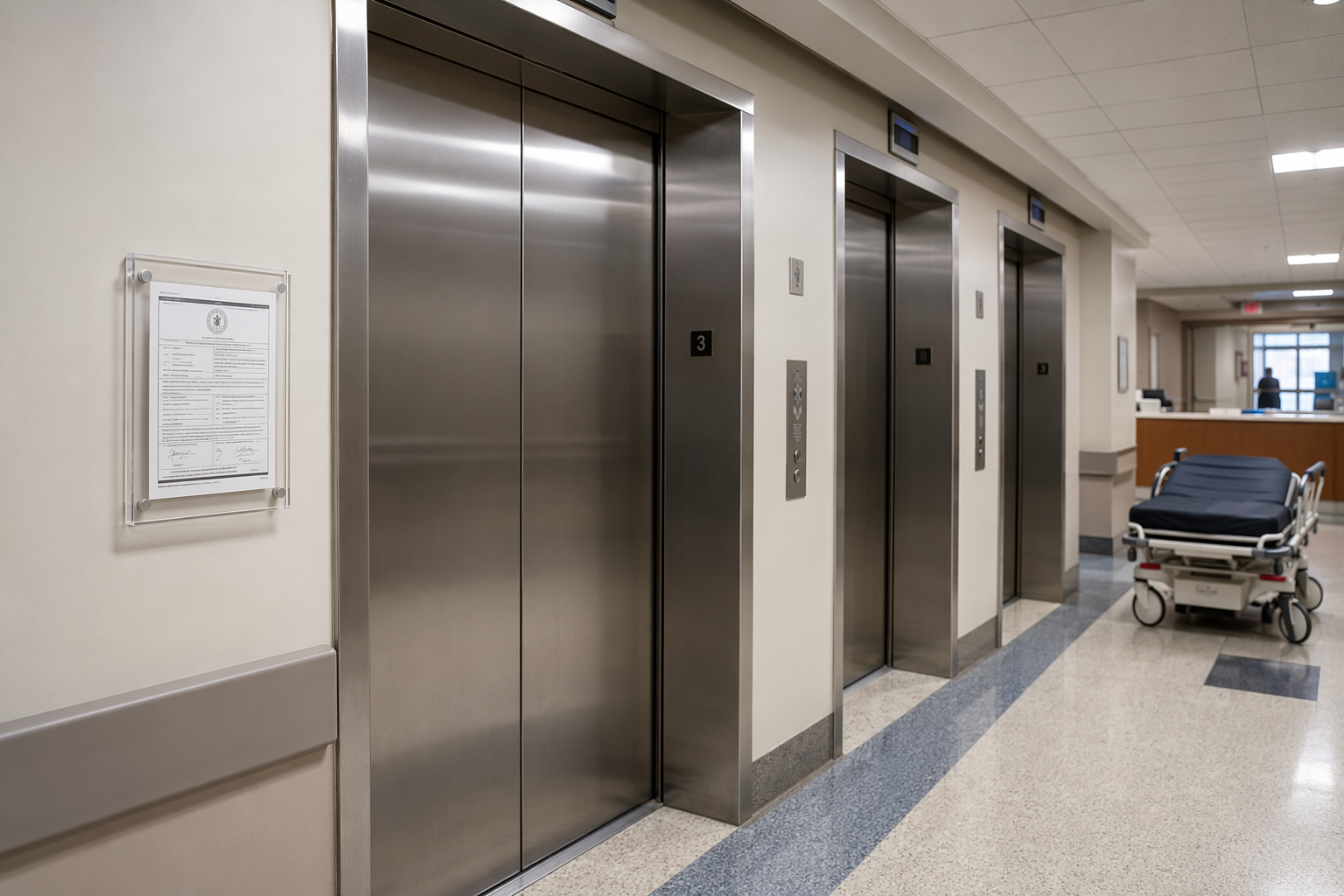
Healthcare facilities in Baltimore, Washington DC, Philadelphia, and Richmond operate under some of the most demanding elevator compliance obligations in any industry. Patients depend on reliable vertical transport for emergency care, surgical procedures, and daily mobility. A lapsed or missing elevator certificate of compliance is not merely an administrative problem — it can trigger regulatory action, interrupt patient care workflows, and expose a facility to serious liability. This guide explains what healthcare operators need to know about obtaining, maintaining, and renewing elevator certificates of compliance in 2026.
—
What Is an Elevator Certificate of Compliance in a Healthcare Setting?
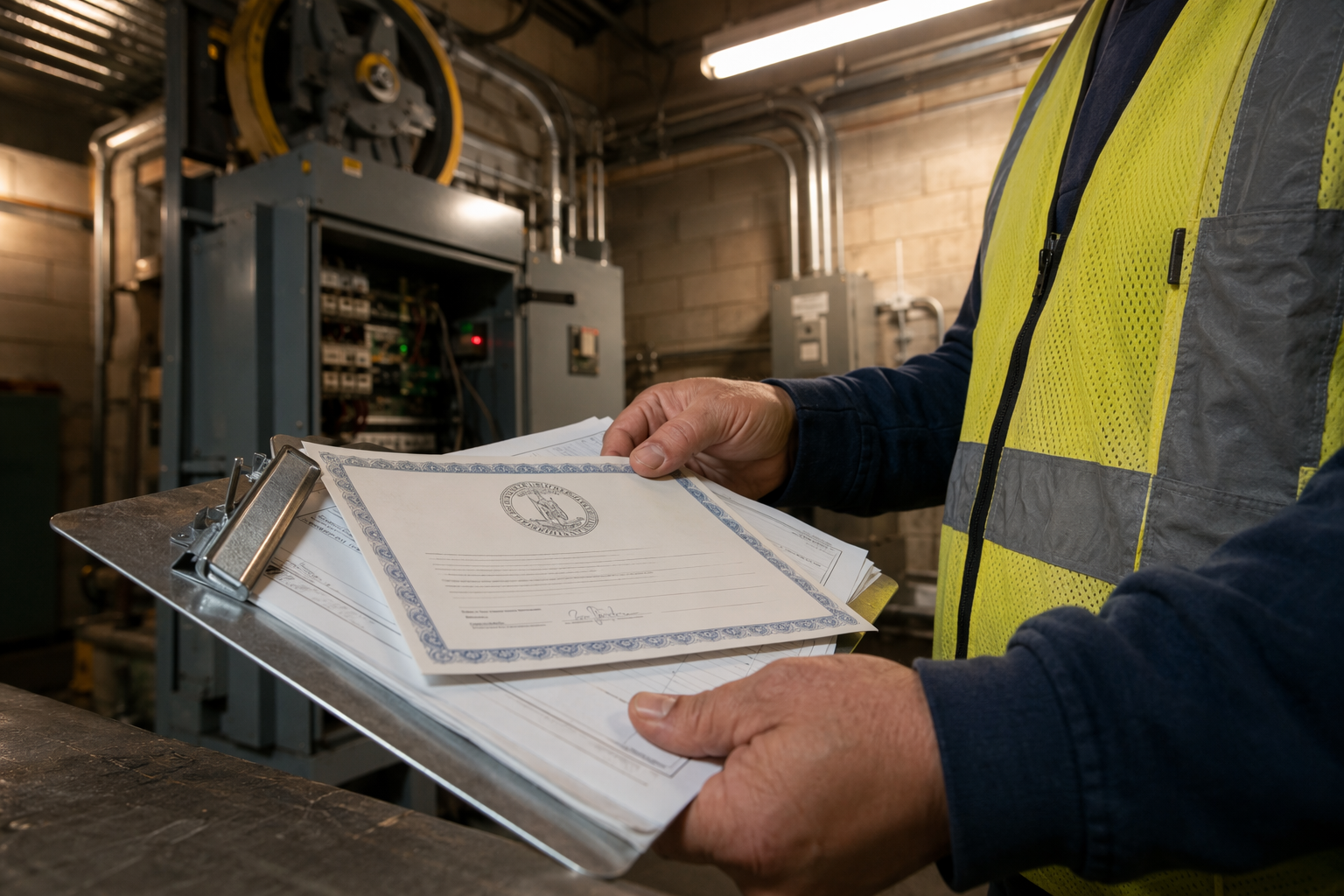
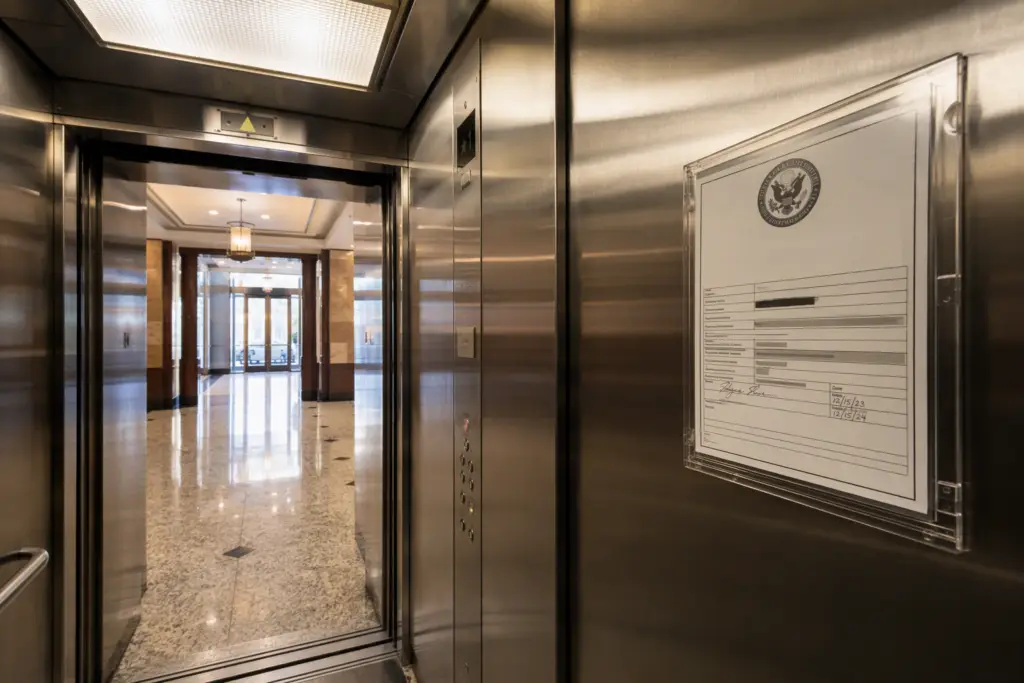
A certificate of compliance (sometimes called an elevator operating permit or inspection certificate) is a state-issued or jurisdiction-issued document that confirms an elevator has passed a formal safety inspection conducted by a licensed elevator inspector. In healthcare environments, this certificate carries additional weight because elevators must meet not only general safety standards but also specific requirements related to patient transport, infection control staging, and uninterrupted service during emergencies.
The certificate specifies the elevator’s capacity, inspection date, next required inspection date, and the governing authority that issued it. Facilities must post this certificate in or adjacent to the elevator car as required by their jurisdiction.
—
Which Codes Apply to Healthcare Elevator Compliance?

Healthcare elevator compliance is governed by a layered set of codes and standards:
- ASME A17.1 Safety Code for Elevators and Escalators: The foundational safety standard for elevator design, installation, operation, and inspection across all building types. Most state jurisdictions adopt ASME A17.1 by reference. The 2022 edition is the most recently finalized edition widely referenced in 2026 adoptions.
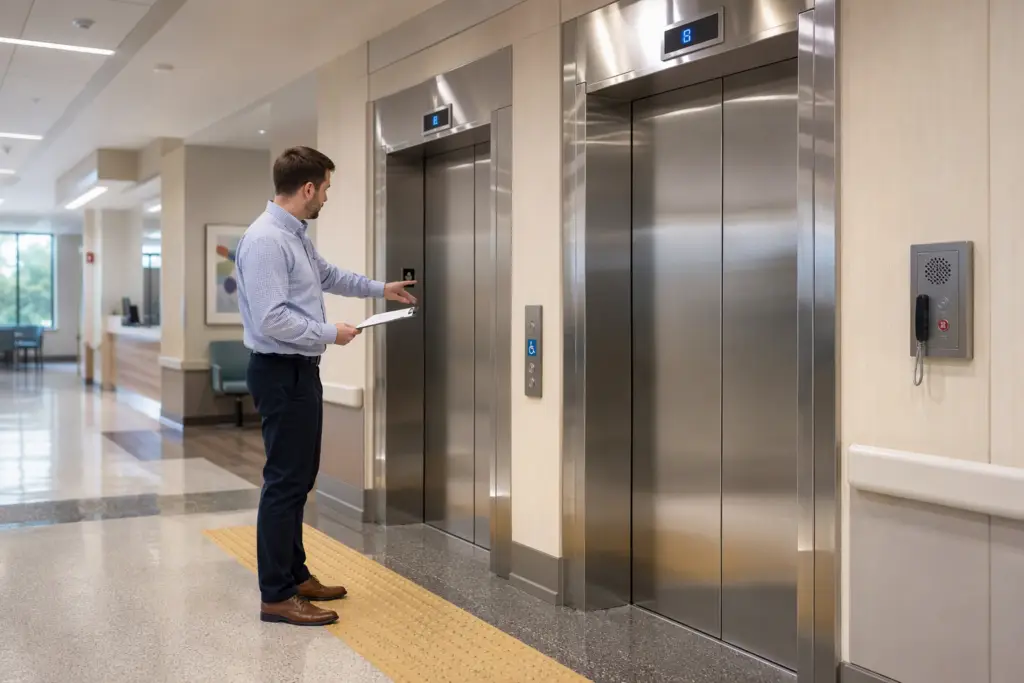
- Americans with Disabilities Act (ADA): Requires elevators in multi-story healthcare facilities to meet specific accessibility criteria including door clearance, control panel height, floor indicators, and audible signals. Non-compliance can result in federal enforcement action.
- State Elevator Safety Laws: Maryland, Virginia, Pennsylvania, and Washington DC each maintain their own elevator safety bureaus and inspection requirements. Healthcare facilities must satisfy the jurisdiction where they operate.
- The Joint Commission (TJC) Environment of Care Standards: Accredited hospitals must demonstrate that elevators are maintained, inspected, and compliant as part of the physical environment requirements under TJC’s Environment of Care chapter.
- CMS Conditions of Participation: Medicare- and Medicaid-participating facilities must maintain a safe physical environment, which includes elevator compliance, to retain federal reimbursement eligibility.
- OSHA General Duty Clause: Employers — including hospitals — must provide a workplace free of recognized hazards. Elevator deficiencies that create injury risk for staff and patients fall within OSHA’s purview.
- NFPA 101 Life Safety Code: Governs fire-rated elevator lobbies, recall operation, and firefighters’ service features critical in healthcare occupancies.
—
How Often Do Healthcare Elevators Need to Be Inspected?
Inspection frequency is established by state law, which typically references ASME A17.1 intervals. Most jurisdictions require a full periodic inspection and a separate safety test on a defined cycle — commonly annual for periodic inspections and every five years for full load and safety device testing. Healthcare facilities should confirm the exact schedule with their state elevator safety bureau or a qualified service provider. Quality Elevator Company assists healthcare clients across Baltimore, Washington DC, Philadelphia, and Richmond in tracking inspection due dates and scheduling inspections before certificate expiration.
—
What Happens If a Healthcare Facility Operates Without a Valid Certificate?
Operating an elevator without a current certificate of compliance exposes a healthcare facility to consequences that are both regulatory and operational:
- The jurisdiction’s elevator safety bureau may order the elevator immediately taken out of service.
- The facility may face civil penalties and fines under state elevator safety law.
- Joint Commission surveyors can cite the deficiency as an Environment of Care finding, potentially affecting accreditation status.
- CMS auditors may flag the non-compliance during a survey, jeopardizing Medicare/Medicaid participation.
- If a patient or staff member is injured while a certificate is lapsed, the facility faces heightened liability exposure.
- Facility directors and risk managers may be held personally accountable depending on state statute.
—
What Does the Inspection Process Look Like for a Hospital Elevator?
The inspection process for a healthcare elevator certificate of compliance typically follows these steps:
- Pre-Inspection Preparation: The facility or its elevator service contractor gathers maintenance records, previous certificates, and test documentation. Any known deficiencies should be corrected before the inspector arrives.
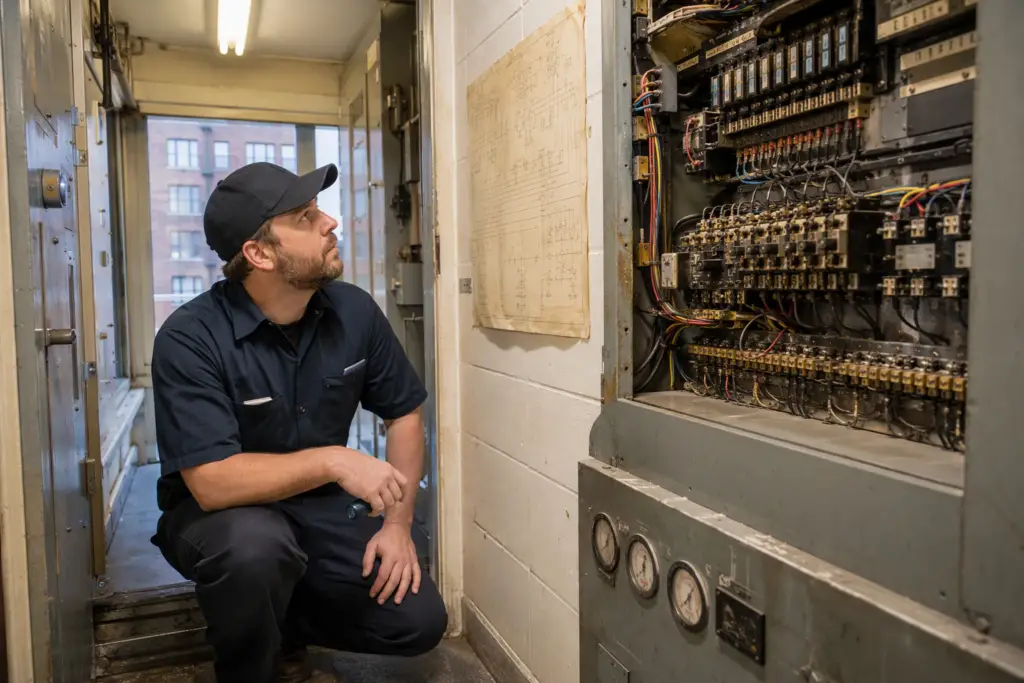
- Machine Room and Equipment Review: The inspector examines the machine room for compliance with clearance, lighting, temperature, and access requirements under ASME A17.1.
- Pit Inspection: The pit is checked for water infiltration, lighting, stop switches, and ladder compliance.
- Car and Hoistway Inspection: The inspector reviews car enclosure integrity, door operation, safety edge function, leveling accuracy, and emergency lighting.
- Safety Device Testing: Depending on the inspection cycle, the governor, safeties, and buffers may be tested under load conditions.
- ADA Compliance Check: Control panel height, door timing, audible and visual signals, and floor identification are verified against ADA standards.
- Firefighters’ Emergency Operation Test: Phase I and Phase II firefighters’ service is tested, a critical requirement in healthcare facilities.
- Documentation Review: The inspector reviews the maintenance log to confirm routine service has been performed.
- Certificate Issuance or Deficiency Notice: If the elevator passes, the jurisdiction issues or authorizes the certificate. If deficiencies are found, a correction notice is issued with a required remediation timeline.
—
Questions Your Inspector Will Ask
Healthcare facility managers should be prepared to answer — and document answers to — the following questions during an elevator inspection:
- Can you provide the maintenance log showing regularly scheduled service visits?
- Has the elevator been modified since the last inspection, and if so, do you have the alteration permit?
- When was the last full load safety test performed, and where is that documentation?
- Are the firefighters’ emergency operation Phase I and Phase II functions tested and logged?
- Has any entrapment, injury, or incident occurred since the last inspection, and was it reported to the jurisdiction?
- Is the machine room access restricted to authorized personnel only?
- Are all required signage items — including capacity placard and certificate — posted inside the cab?
- Has the governor rope been replaced or adjusted, and if so, when?
- Is the pit drainage functioning, and is the pit free of debris and standing water?
- Are door reopening devices — safety edges or light curtains — functioning on every landing?
Quality Elevator Company prepares healthcare clients for inspections by conducting pre-inspection walkthroughs and ensuring documentation is organized and complete before the inspector arrives.
—
How Do ADA Requirements Specifically Affect Healthcare Elevator Compliance?
Under the Americans with Disabilities Act, elevators in healthcare facilities must meet accessibility standards that go beyond general building requirements. Key provisions relevant to hospitals and medical facilities include: door reopening devices that remain fully open for a defined dwell time sufficient for patients using wheelchairs or mobility aids; call button height restrictions; raised and Braille floor designations; and audible floor announcements. Patient transport elevators that serve surgical suites or imaging departments must also accommodate oversized gurneys, which often necessitates larger cab dimensions reviewed during compliance assessments.
—
What Are Common Reasons Healthcare Elevators Fail Inspection?
Elevators in healthcare settings fail inspections for a predictable set of reasons, most of which are preventable with a proactive maintenance program:
- Incomplete or missing maintenance records — inspectors require documented evidence of routine service.
- Door operator malfunctions, including doors that close too quickly on patients or equipment.
- Leveling inaccuracies that create a trip hazard between the cab floor and the landing — a critical patient safety issue.
- Non-functioning or missing emergency lighting and communication devices.
- Expired safety test records for governor, safeties, or buffers.
- Machine room code violations including inadequate lighting, improper storage, or blocked access.
- Failed Phase I or Phase II firefighters’ emergency operation.
- ADA signage deficiencies, including missing or damaged Braille designations.
—
How Long Does It Take to Get a Certificate After a Failed Inspection?
The timeline depends on the nature of the deficiencies and the jurisdiction’s correction process. Minor deficiencies — such as signage issues or lighting problems — can typically be corrected within days, after which the inspector may authorize the certificate or schedule a re-inspection. Major deficiencies involving safety devices or structural components require more time for parts procurement and repair, followed by a formal re-inspection. Healthcare facilities should treat any failed inspection as an urgent operational matter because the elevator may be ordered out of service until corrections are verified.
—
How Should Healthcare Facilities Choose an Elevator Service Company?
Selecting a service provider for healthcare elevator compliance is a consequential decision. Facilities should evaluate candidates on the following criteria:
- Demonstrated experience servicing elevators in licensed healthcare facilities, including hospitals, surgery centers, and medical office buildings.
- Familiarity with Joint Commission Environment of Care documentation requirements.
- Ability to service elevators from multiple original equipment manufacturers — not limited to proprietary agreements.
- Knowledge of the specific state elevator codes for Maryland, Washington DC, Pennsylvania, and Virginia.
- A systematic approach to inspection preparation and certificate tracking.
Quality Elevator Company is a certified elevator service company serving healthcare facilities across Baltimore, Washington DC, Philadelphia, and Richmond. The company maintains compliance expertise across all major elevator systems and works directly with healthcare risk managers and facility directors to keep elevators inspection-ready year-round.
—
What Should a Healthcare Facility Do Immediately After Receiving a Deficiency Notice?
- Review the deficiency notice carefully and confirm whether the jurisdiction has placed an out-of-service order on the elevator or is permitting continued operation pending corrections.
- Notify the facility’s risk management team and document the date the notice was received.
- Contact a qualified elevator service contractor immediately to assess the deficiencies and provide a correction plan with a realistic timeline.
- Implement interim patient transport protocols if the elevator must be taken out of service — coordinate with nursing, transport, and facilities teams.
- Authorize the necessary repairs and confirm parts availability and scheduling.
- Request written documentation from the service contractor upon completion of all corrections.
- Notify the jurisdiction that corrections have been made and schedule the required re-inspection.
- File the new certificate and update the facility’s compliance tracking system upon issuance.
—
Does Quality Elevator Company Service Healthcare Facilities?
Quality Elevator Company provides full-service elevator maintenance, inspection preparation, repair, and compliance support to healthcare organizations throughout Baltimore MD, Washington DC, Philadelphia PA, and Richmond VA. The company works with hospital systems, outpatient surgical centers, long-term care facilities, and medical office buildings to ensure elevators remain compliant, safe, and operational at all times. Healthcare facilities that partner with Quality Elevator Company benefit from structured maintenance programs designed around the documentation requirements of The Joint Commission, CMS, and state elevator safety bureaus.
—
Schedule Your Healthcare Elevator Compliance Assessment
A lapsed certificate or unaddressed deficiency in a healthcare facility is a patient safety risk and a regulatory liability. Do not wait for an inspector or a surveyor to identify a problem that a proactive assessment could have resolved.
Contact Quality Elevator Company for a free elevator assessment: 301-779-9116
Quality Elevator Company serves healthcare facilities throughout Baltimore MD, Washington DC, Philadelphia PA, and Richmond VA. Reach out today to confirm your elevators are inspection-ready and fully compliant.
Need elevator service you can rely on? Quality Elevator Company is ready to help.