Elevator inspections are a legal requirement for virtually every commercial and residential building with a vertical transportation system. Whether you manage a high-rise in Washington DC, a mid-rise office building in Baltimore, a Philadelphia commercial property, or a mixed-use development in Richmond VA, understanding what inspectors look for — and how to prepare — is essential for passing on the first attempt and maintaining ongoing compliance.
What Does It Mean to Pass an Elevator Inspection?
Passing an elevator inspection means a licensed elevator inspector has verified that the unit meets all applicable safety codes, including ASME A17.1 Safety Code for Elevators and Escalators, state administrative codes, and ADA accessibility requirements, and has issued a valid certificate of operation.
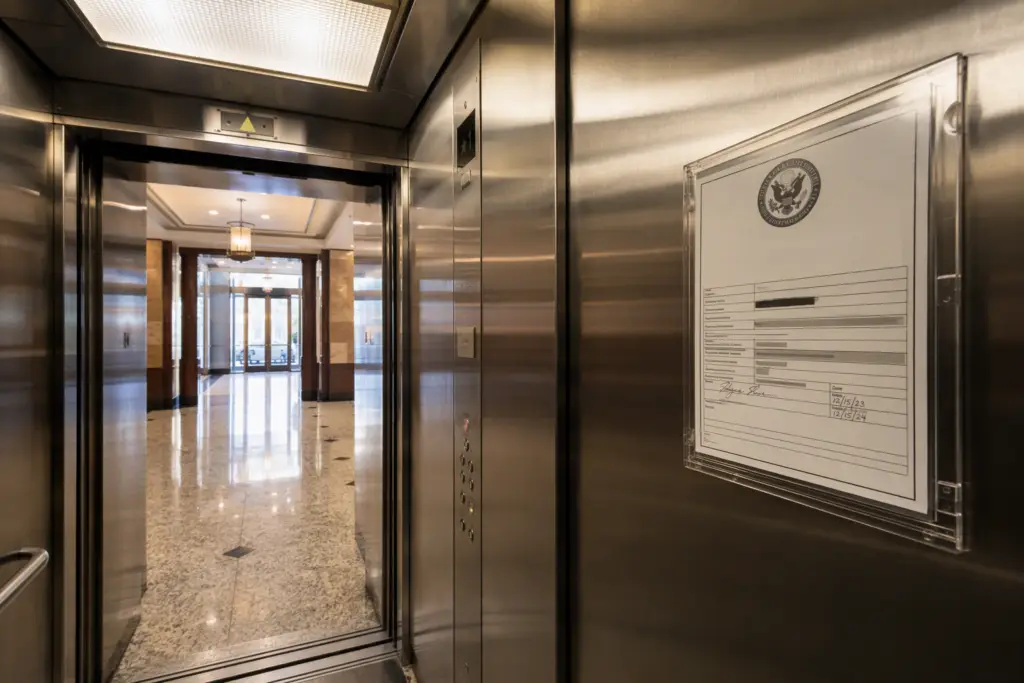
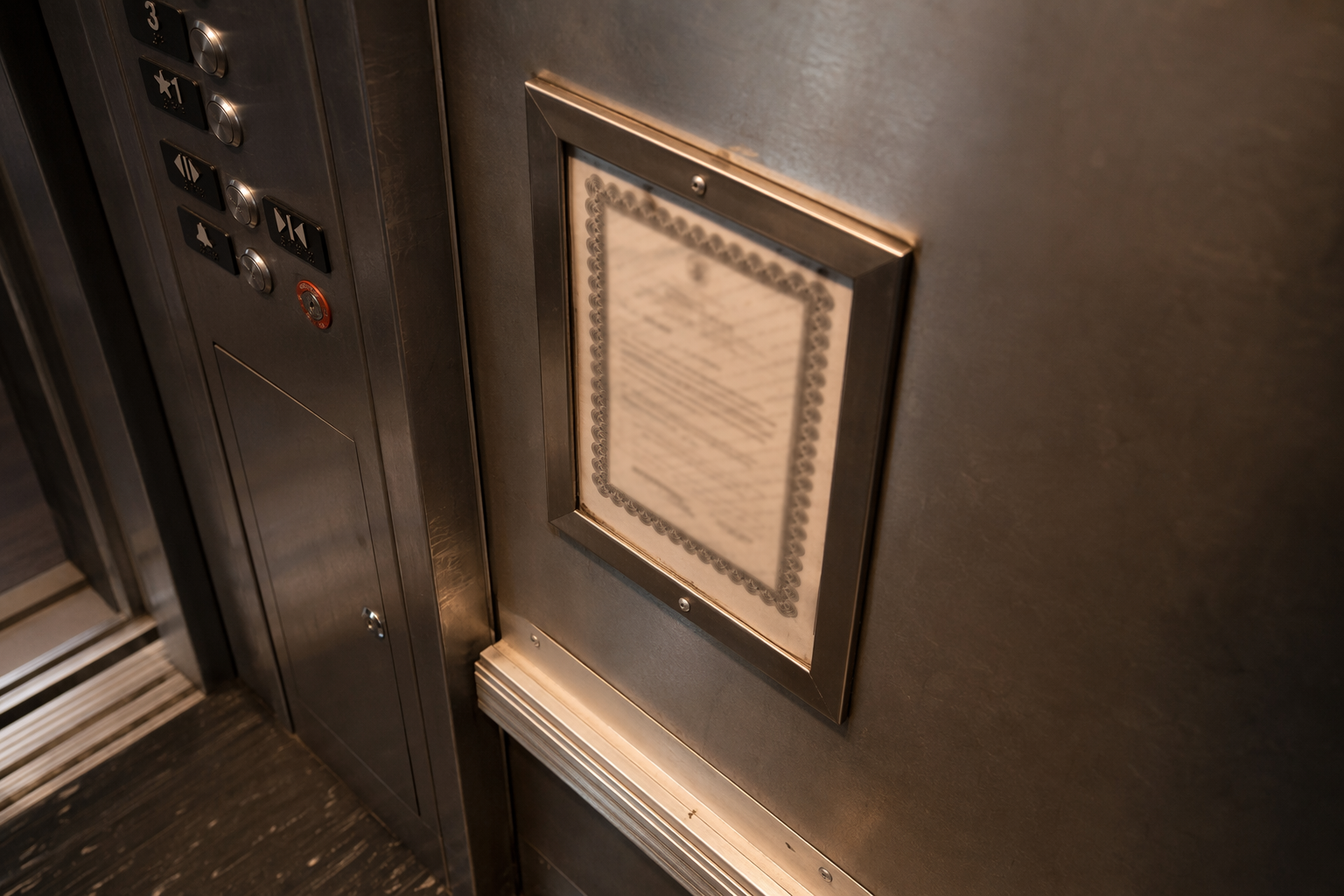
When an elevator passes inspection, the jurisdiction issues a Certificate of Operation (sometimes called a Certificate of Inspection), which must typically be posted inside the elevator car. This certificate confirms the unit is legally authorized to carry passengers. A failed inspection results in a violation notice, a required correction timeline, and in serious cases, an order to take the elevator out of service until deficiencies are remedied.
Building owners and property managers in Maryland, Washington DC, Pennsylvania, and Virginia are each subject to their respective state or district agency enforcement — meaning the specific forms, fees, and timelines vary, but the underlying technical standards largely derive from ASME A17.1.
How Often Are Elevators Required to Be Inspected?
Most jurisdictions require elevator inspections at least once per year, though the exact frequency depends on the elevator type, jurisdiction, and applicable edition of ASME A17.1.
Hydraulic elevators, traction elevators, and limited-use/limited-application (LULA) elevators may have different inspection intervals and test requirements. In addition to annual inspections, periodic tests — such as the Category 1 (annual) and Category 5 (five-year full-load safety test) tests outlined in ASME A17.1 — impose separate testing obligations independent of the routine inspection cycle.
Building owners should confirm current inspection intervals directly with their local authority having jurisdiction (AHJ), as jurisdictions in Maryland, Washington DC, Pennsylvania, and Virginia each administer their own elevator safety programs with potentially different adopted code editions.
What Are the Most Common Reasons Elevators Fail Inspection?
The most common inspection failures involve door safety systems, emergency lighting and communication, expired or missing test certificates, and deferred maintenance on mechanical and electrical components.
Inspectors consistently cite the following deficiencies across commercial and residential properties:
- Door operator and interlock failures — Doors that do not close fully, reopen inconsistently, or have worn interlocks are among the top cited violations. Door reopening devices must function reliably every cycle.
- Expired Category 1 or Category 5 test certificates — If required periodic tests have not been performed and documented, the inspector will note the deficiency regardless of the unit’s apparent condition.
- Non-functional emergency lighting — Emergency lighting inside the car must activate when main power is interrupted. Burned-out backup lamps are a frequently cited item.
- Inoperative emergency telephone or communication system — ASME A17.1 requires a means of two-way communication. If the phone or intercom system is not functioning, the elevator will not pass.
- Missing or expired Certificate of Operation — The current certificate must be posted in the car. An outdated or absent certificate is itself a violation.
- Pit conditions — Water intrusion, excessive debris, non-functioning pit lighting, or an inoperative pit stop switch are common pit-related failures.
- Governor and safety device deficiencies — Overspeed governors and safeties must be tested, adjusted, and documented on the required cycle.
- ADA non-compliance items — Including inaccessible controls, missing or incorrect Braille, or inadequate door hold-open times under ADA requirements.
What Is the Difference Between a Category 1 and Category 5 Elevator Test?
A Category 1 test is an annual no-load safety test of the elevator’s governor, safeties, and buffers, while a Category 5 test is a full-load, full-speed safety test required every five years under ASME A17.1.
Category 5 tests are significantly more involved than annual Category 1 tests. They require the elevator to be taken out of service, loaded to rated capacity, and subjected to a full safety demonstration — including a governor tripping test at full speed with the car loaded. Because Category 5 tests require advance planning, coordination with building operations, and certified personnel, they should be scheduled well in advance of the test due date to avoid lapses that trigger inspection failures.
| Test Category | Frequency | Load Condition | Key Components Tested | Documentation Required |
|---|---|---|---|---|
| Category 1 | Annual | No load (or partial, per code) | Governor, safeties, oil buffers, brake | Signed test report submitted to AHJ |
| Category 3 | As required by AHJ | Operational load test | Hydraulic pressure relief, pressure vessels | Signed test report; hydraulic elevators |
| Category 5 | Every 5 years | Rated load, contract speed | Governor, safeties, buffers, brake, full system | Signed test report submitted to AHJ |
What Should Building Owners Do to Prepare for an Elevator Inspection?
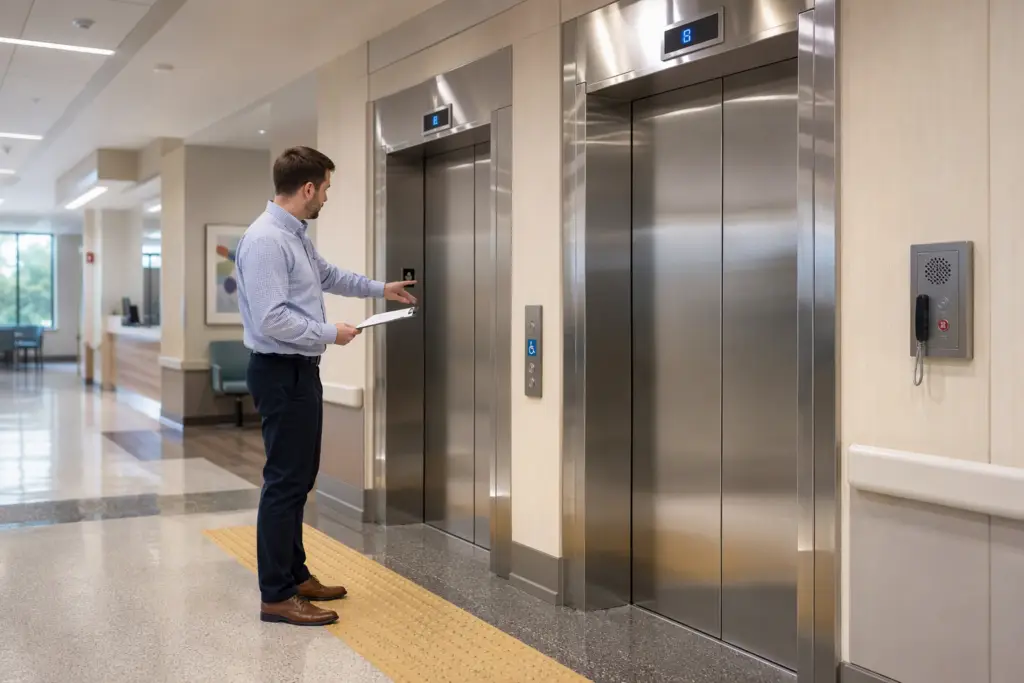
Preparation for an elevator inspection should begin at least 30 to 60 days before the scheduled date and involve a thorough pre-inspection walkthrough, documentation review, and completion of any outstanding maintenance items.
- Gather all documentation. Collect the current Certificate of Operation, previous inspection reports, Category 1 and Category 5 test records, and any outstanding violation correction notices.
- Schedule a pre-inspection maintenance visit. Have a qualified elevator service company perform a thorough maintenance check of all systems — doors, safeties, lighting, communication, pit, and machine room — before the inspector arrives.
- Verify the emergency telephone is operational. Test two-way communication from inside the car to confirm connectivity and that the correct monitoring party answers.
- Test emergency lighting. Manually interrupt power or use the test switch to confirm emergency lamps illuminate inside the car.
- Inspect the pit. Remove standing water, clear debris, verify pit lighting functions, confirm the pit stop switch operates correctly, and check that the pit ladder is secured.
- Check machine room conditions. Ensure the machine room is locked, free of unauthorized storage, properly illuminated, and that fire protection (if required) is functional.
- Confirm door operations. Ride the elevator and observe door open, close, and reopen device cycles on every floor. Address any hesitation, noise, or inconsistency.
- Review ADA compliance items. Verify control panel button heights, Braille labeling, audible signals, and door timing against ADA standards.
- Post the current Certificate of Operation. Confirm it is displayed prominently in the elevator car as required by your jurisdiction.
- Address any open violation items from the prior inspection. Inspectors will check prior violation notices first. Unresolved items from a previous cycle are automatic re-violations.
Quality Elevator Company provides pre-inspection maintenance services for building owners throughout Baltimore, Washington DC, Philadelphia, and Richmond to help identify and resolve deficiencies before the inspector arrives.
What Do Elevator Inspectors Actually Look At?
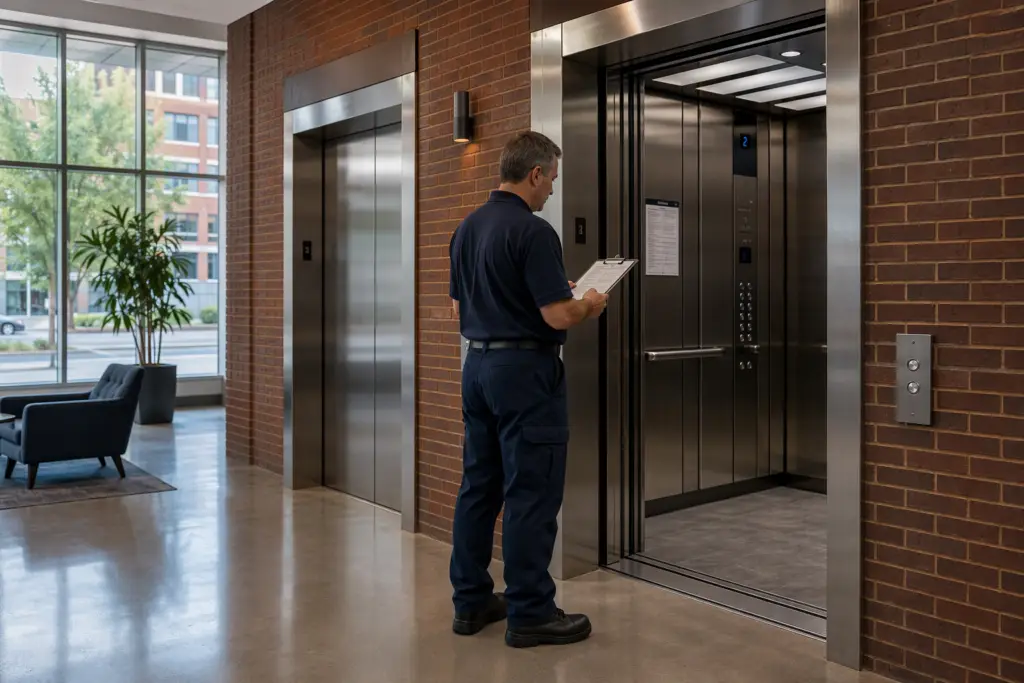
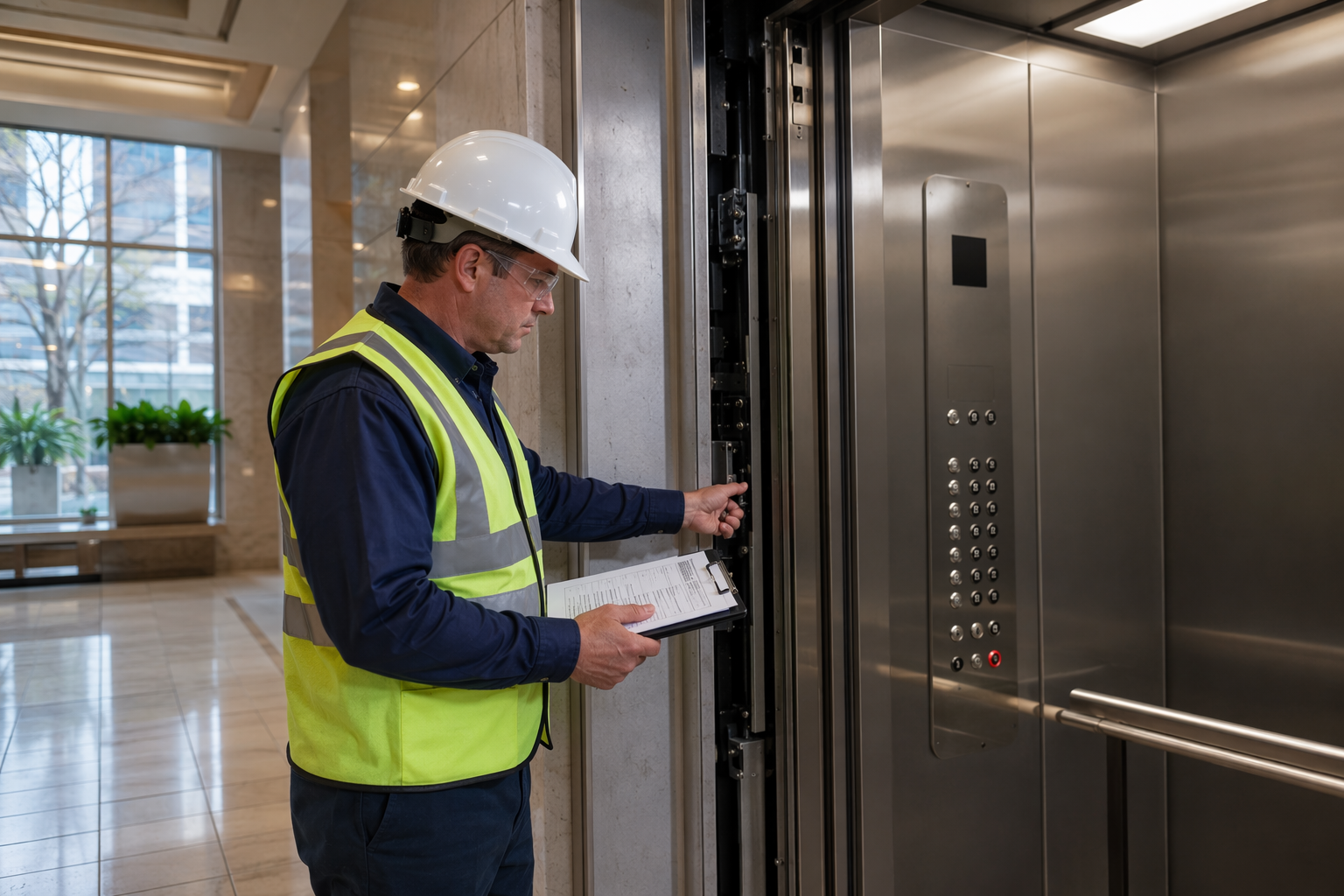
Elevator inspectors systematically examine the car interior, hoistway, machine room, pit, all safety devices, door systems, and the elevator’s operational performance against the applicable edition of ASME A17.1.
A typical inspection sequence proceeds through several zones:
- Car interior: Lighting levels, certificate posting, emergency lighting, phone/communication system, control panel labeling, capacity posting, and overall car condition.
- Door system: Door opening and closing speed, door reopening device function, interlock operation, and door contact verification at each landing.
- Hoistway: Clearances, guide rail condition, hoistway lighting, and terminal stopping device function.
- Machine room: Temperature control, lighting, housekeeping, equipment labeling, and accessibility restrictions.
- Pit: Lighting, stop switch, water intrusion, ladder condition, clearances, and buffer condition.
- Safety devices: Governor, safeties, buffers, and overspeed protection — verified against current test documentation.
- Operational test: The inspector will ride the elevator, test leveling accuracy, observe ride quality, and verify floor-to-floor performance.
What Are the Elevator Safety Codes That Govern Inspections?
The primary governing standard for elevator inspections in the United States is ASME A17.1 Safety Code for Elevators and Escalators, supplemented by state administrative codes and ADA Title III accessibility requirements for public accommodations.
Each state and jurisdiction adopts a specific edition of ASME A17.1. Maryland, Washington DC, Pennsylvania, and Virginia each administer their own elevator safety programs and may be operating under different adopted editions as of 2026. Building owners should verify which edition is currently enforced by their AHJ, as code updates can affect specific technical requirements.
Workplace elevators in buildings covered by federal standards may also implicate OSHA regulations, particularly for construction hoists and material lifts, though OSHA defers to ASME A17.1 for many passenger elevator standards in permanent installations.
How Long Does an Elevator Inspection Take?
A routine annual elevator inspection typically takes between one and three hours per unit, depending on elevator type, age, accessibility of machine room and pit, and the number of landings served.
Category 5 full-load tests take considerably longer — often a half day or more for a single unit — because they require loading the car to rated capacity, running full-speed safety tests, and documenting each test step. Building owners should plan for extended out-of-service periods when Category 5 tests coincide with scheduled inspections, and should communicate the outage to building tenants in advance.
What Happens If an Elevator Fails Inspection?
When an elevator fails inspection, the inspector issues a written violation notice specifying each deficiency, a required correction timeframe, and — if the elevator poses an immediate safety risk — an out-of-service order that legally prohibits operation until repairs are completed and re-inspected.
Minor deficiencies, such as a burned-out emergency light or an expired certificate posting, are typically given a short correction window (often 30 days). Major violations involving safety-critical systems — such as a failed governor or a non-functional door interlock — can result in immediate shutdown orders. Building owners who continue operating a condemned elevator may face significant legal liability and regulatory penalties.
After corrections are made, a re-inspection is typically required before the elevator is returned to full service. Engaging a qualified elevator service company promptly after receiving a violation notice is the most effective way to minimize downtime and legal exposure.
How Much Do Elevator Inspection Violations Cost to Fix?
The cost to correct elevator inspection violations varies widely depending on the type and severity of the deficiency — minor items like replacing an emergency light bulb or updating posted certificates involve minimal cost, while major repairs to door operators, safety devices, or control systems involve materially higher expenditures.
Because correction costs depend on the specific components involved, the age of the equipment, parts availability, and the scope of required work, building owners should obtain a detailed assessment from a qualified elevator service company after receiving a violation notice. Deferring maintenance and allowing violations to accumulate typically results in higher total costs at inspection time compared to routine ongoing maintenance that addresses wear before it becomes a code violation.
What Is the Role of the Maintenance Provider in Passing Inspection?
A qualified elevator maintenance provider plays a central role in inspection outcomes by keeping all systems in code-compliant condition, maintaining required test documentation, and identifying potential violations before the inspector arrives.
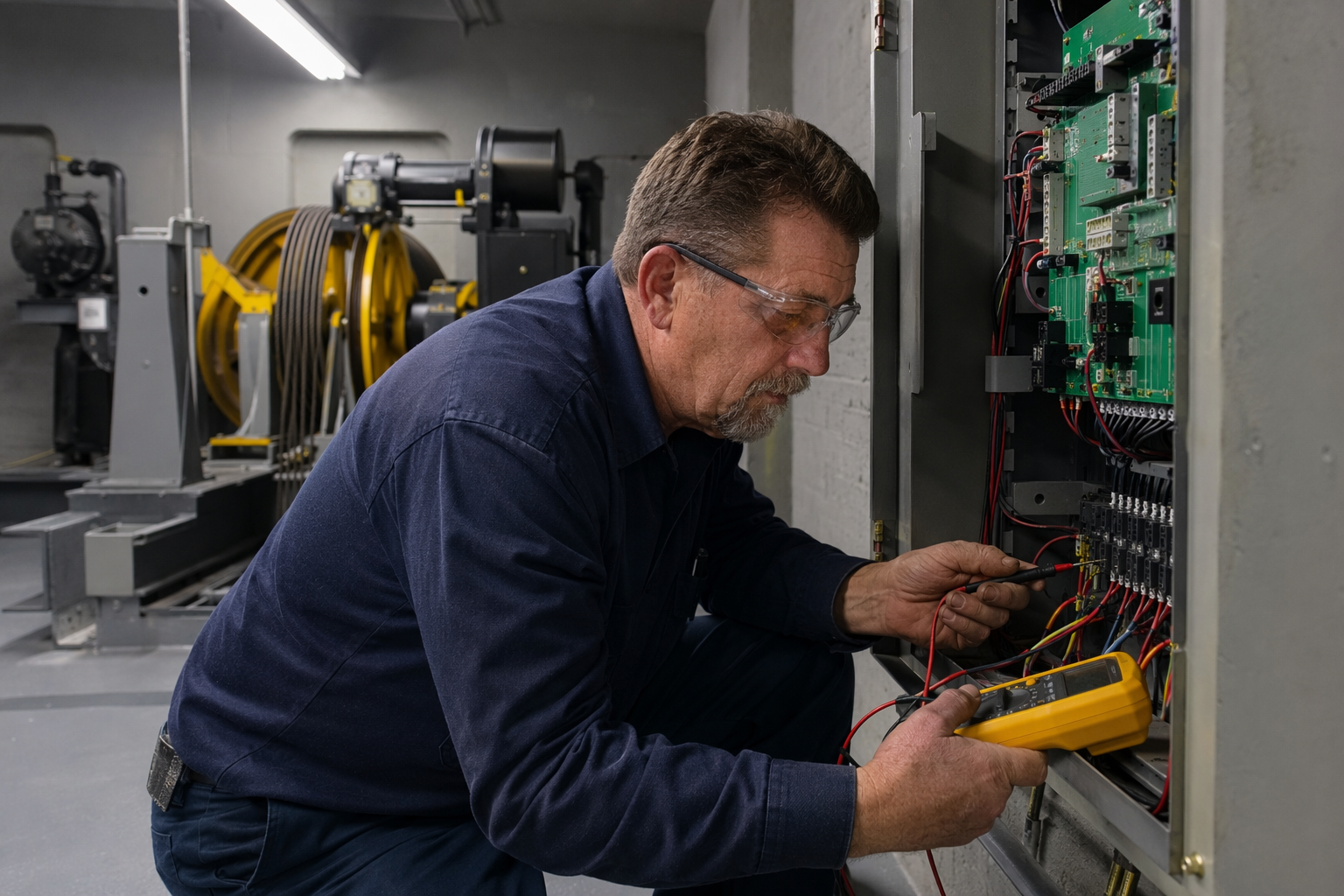
The ASME A17.1 code places affirmative maintenance obligations on elevator owners, and in practice those obligations are fulfilled through a maintenance contract with a licensed elevator company. The maintenance provider is responsible for conducting and documenting Category 1 and Category 5 tests, maintaining the maintenance control program (MCP) records required by current editions of ASME A17.1, and responding to deficiencies identified during interim service visits.
Quality Elevator Company serves building owners and property managers in Baltimore, Washington DC, Philadelphia, and Richmond with elevator maintenance programs designed to support ongoing code compliance and smooth inspection outcomes.
What Is a Maintenance Control Program (MCP) and Why Does It Matter for Inspections?
A Maintenance Control Program (MCP) is a documented system required by ASME A17.1 that specifies inspection intervals, lubrication schedules, adjustment procedures, and test records for each elevator, and inspectors may request MCP documentation as part of a compliance review.
Introduced in the 2004 edition of ASME A17.1 and retained in subsequent editions, the MCP requirement means that elevator maintenance is no longer simply a performance obligation — it is a documentation obligation. Inspectors in jurisdictions that have adopted newer code editions can cite a building owner for failing to maintain adequate MCP records even if the elevator itself is mechanically sound. Building owners should confirm with their service provider that MCP records are being maintained for each unit.
Do Accessibility Requirements Affect Elevator Inspection Outcomes?
Yes — elevators serving public accommodations must meet ADA accessibility requirements, and while ADA compliance is technically enforced separately from safety inspections, inspectors in many jurisdictions flag obvious accessibility deficiencies that can trigger separate corrective obligations.
Key ADA items relevant to elevator compliance include: control panel button heights (no higher than 54 inches for a side approach under most configurations), raised and Braille character labeling on controls and floor indicators, door hold-open times sufficient for people using mobility aids, and audible and visual floor indicators. Buildings constructed or substantially altered after ADA’s effective dates have stronger compliance obligations than those with pre-ADA vintage equipment, though barrier removal obligations apply broadly to public accommodations under Title III of the ADA.
How Do State-Specific Requirements Differ Across Quality Elevator Company’s Service Areas?
Maryland, Washington DC, Pennsylvania, and Virginia each operate independent elevator safety programs with their own licensing requirements, inspection fee schedules, adopted code editions, and administrative processes — meaning compliance in one jurisdiction does not automatically satisfy requirements in another.
Building owners with properties in multiple jurisdictions should work with a service provider familiar with the specific administrative requirements of each market. Differences can include which edition of ASME A17.1 is currently adopted, whether the AHJ employs state inspectors or uses third-party inspection agencies, the frequency and format of required test report submissions, and the process for contesting violations. Quality Elevator Company operates across Baltimore, Washington DC, Philadelphia, and Richmond and maintains familiarity with the regulatory landscape in each of these markets.
What Is a Third-Party Elevator Inspection and When Is It Used?
A third-party elevator inspection is an inspection conducted by a private, licensed inspection agency authorized by the AHJ to perform inspections in lieu of or alongside state-employed inspectors — a common arrangement in jurisdictions that have outsourced inspection functions.
In some markets within Quality Elevator Company’s service area, building owners may have flexibility to select from a list of AHJ-approved inspection agencies. Regardless of who conducts the inspection, the technical standards applied — primarily ASME A17.1 — remain the same. Third-party inspections do not relax compliance requirements; they simply change the administrative entity performing the review.
What Records Should Be Kept on File for an Elevator Inspection?
Building owners should maintain a complete elevator compliance file that includes the current and prior Certificates of Operation, all Category 1 and Category 5 test reports, the Maintenance Control Program records, any prior violation notices and correction documentation, and equipment modernization or alteration permits.
These records should be readily accessible at the time of inspection — inspectors may request to review documentation, and inability to produce required records is itself a citable deficiency. Retaining at least several years of inspection history and test reports is advisable, as some jurisdictions specify minimum records retention periods. Digital record-keeping systems maintained by the elevator service provider can simplify this obligation for building owners managing multiple units.
How Can Elevator Modernization Affect Inspection Requirements?
Modernizing an elevator — replacing the controller, drive system, door operator, or other major components — typically triggers a permit and inspection process under the alteration provisions of ASME A17.1, which may require upgraded compliance with current code editions for affected systems.
Alteration inspections are separate from routine annual inspections. Before performing any major modernization work, building owners should confirm with their elevator service company and the AHJ what permits are required, which code edition governs the altered systems, and what post-alteration inspection and test requirements apply. Failing to obtain proper alteration permits can result in stop-work orders and significant remediation costs.
What Role Does Machine Room Condition Play in Passing Inspection?
The machine room is a formally inspected area under ASME A17.1, and deficiencies including inadequate lighting, unauthorized storage, lack of fire protection where required, improper temperature conditions, or unlabeled equipment are citable violations that can contribute to an inspection failure.
A properly maintained machine room should be kept locked against unauthorized entry, free of items unrelated to elevator equipment, adequately lit, temperature-controlled to protect electronic components, and clearly labeled with equipment identification. Building facilities teams should include machine room conditions in their routine building maintenance checklists rather than treating the space as secondary storage.
What Is the Best Long-Term Strategy for Consistently Passing Elevator Inspections?
The most effective long-term strategy for consistently passing elevator inspections is a proactive, comprehensive maintenance program with a qualified elevator service company that keeps equipment in code-compliant condition year-round — rather than reactive repairs triggered only by inspection failures.
Reactive maintenance approaches typically result in higher cumulative costs, more frequent inspection failures, greater downtime, and increased liability exposure. A structured maintenance program aligned with the Maintenance Control Program requirements of ASME A17.1 ensures that safety devices are tested on schedule, wear components are replaced before they cause failures, and documentation is maintained continuously rather than reconstructed before each inspection. Building owners who view elevator maintenance as a continuous compliance obligation — rather than an annual event — consistently achieve better inspection outcomes over time.
Quality Elevator Company works with property owners and managers across Baltimore MD, Washington DC, Philadelphia PA, and Richmond VA to develop maintenance programs tailored to each building’s equipment, occupancy type, and regulatory environment.
How Do I Choose an Elevator Service Company for Inspection Preparation?
When selecting an elevator service company for inspection preparation and ongoing maintenance, building owners should prioritize a provider that is licensed in the applicable jurisdiction, demonstrates familiarity with the local AHJ’s requirements, maintains comprehensive documentation practices, and has verifiable experience with the specific type of equipment installed in the building.
Questions worth asking prospective service providers include: Are your technicians licensed by the state or jurisdiction where my building is located? Do you maintain MCP records for each unit you service? Do you provide pre-inspection walkthroughs as part of your maintenance program? Can you coordinate Category 5 tests and ensure timely submission of test reports to the AHJ? A qualified provider should be able to answer all of these questions clearly and affirmatively.
Schedule Your Free Elevator Assessment Today
Whether you are preparing for an upcoming inspection, addressing outstanding violations, or looking to establish a comprehensive maintenance program, working with an experienced elevator service company is the most effective step a building owner can take.
Contact Quality Elevator Company for a free elevator assessment. Quality Elevator Company serves building owners and property managers throughout Baltimore MD, Washington DC, Philadelphia PA, and Richmond VA with elevator maintenance, inspection preparation, Category 1 and Category 5 testing, and compliance support.
Call us today: 301-779-9116
Need elevator service you can rely on? Quality Elevator Company is ready to help.