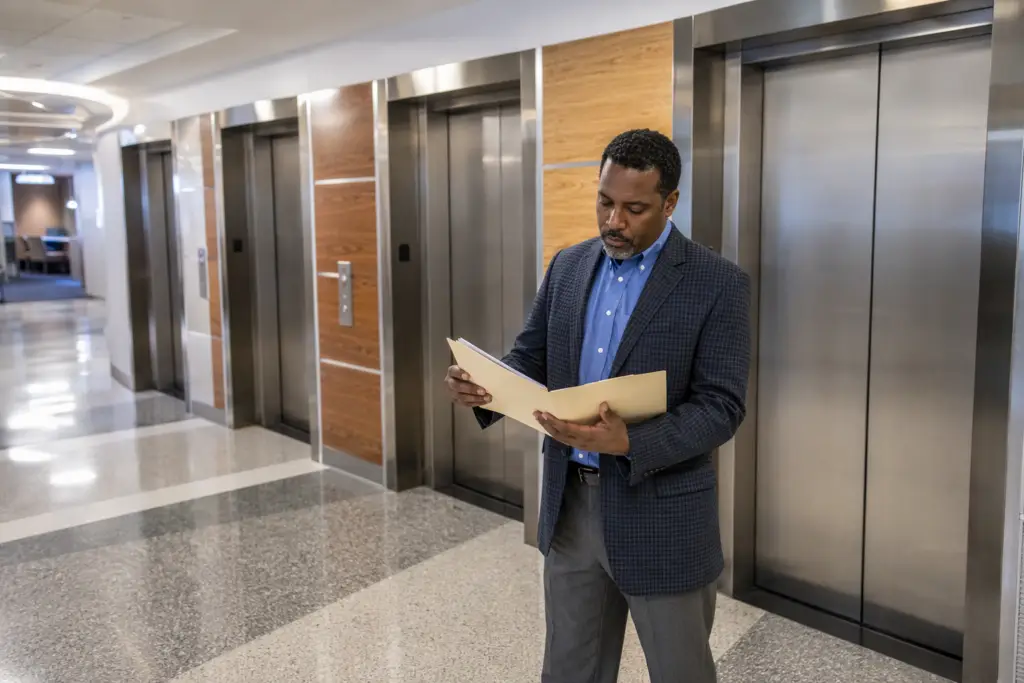
Elevator permits and certificates of inspection are not bureaucratic formalities — they are the legal authorization that allows a conveyance to carry passengers. An expired certificate can trigger mandatory shutdown, liability exposure, and regulatory fines. The following 20 questions cover every aspect of the permit and certificate process across Washington DC, Maryland, Pennsylvania, and Virginia, with the specific agencies, codes, and timelines that apply in each jurisdiction.
What is the difference between an elevator permit and a certificate of inspection?

An elevator permit authorizes the installation, alteration, or repair of an elevator; a certificate of inspection authorizes the ongoing operation of an elevator that has already passed inspection.
Permits are issued before work begins. The authority having jurisdiction (AHJ) reviews construction documents, issues the permit, and then conducts or witnesses an acceptance inspection once work is complete. Only after the elevator passes that acceptance inspection does the AHJ issue a certificate of inspection (sometimes called a certificate of operation). The certificate is what must be posted inside the elevator car and what building owners must keep current throughout the life of the equipment. Confusing the two documents is a common source of compliance gaps, particularly during modernization projects when an elevator may be under an active permit — and therefore temporarily without a standard operating certificate — while repairs are underway.
Which agency issues elevator permits and certificates in each jurisdiction?
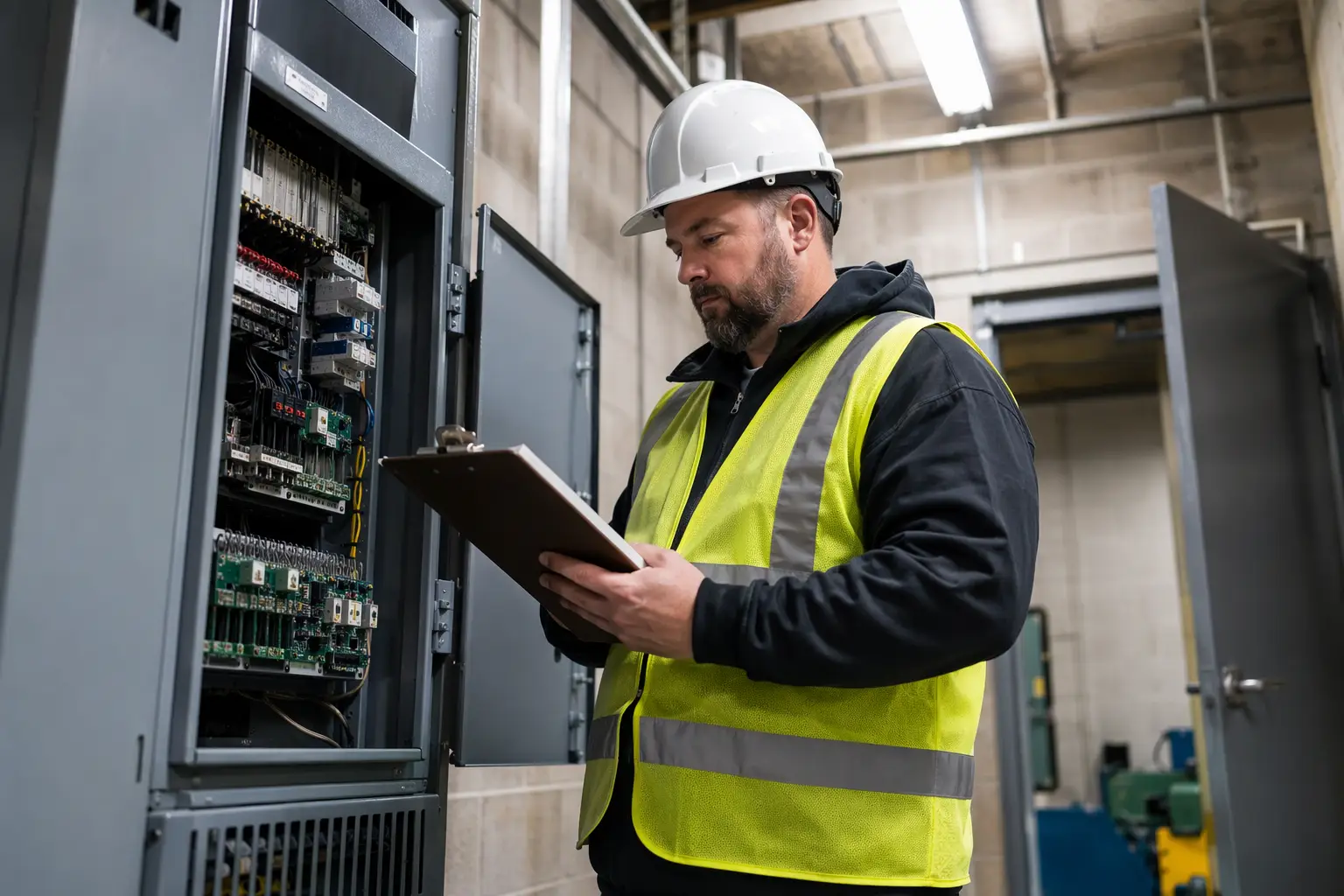
The issuing authority differs by jurisdiction: in DC it is the DC Department of Buildings (DOB); in Maryland it is the Maryland Department of Labor, Division of Labor and Industry; in Pennsylvania it is the Pennsylvania Department of Labor and Industry (L&I); and in Virginia, the local building department enforces the Virginia Uniform Statewide Building Code (USBC).
Virginia’s structure is especially important to understand: elevator inspection authority is delegated to city and county building departments, not to a state labor agency. In Richmond, for example, the City of Richmond Department of Planning and Development Review, Bureau of Permits and Inspections, runs the local elevator program, including final acceptance inspections of new or modernized elevators, annual inspections, and certificate issuance. Owners and contractors working across multiple jurisdictions must file separate permit applications with each relevant AHJ — there is no single regional permit that covers multiple states.
How do I apply for a new elevator permit in Washington DC?
DC elevator permit applications are submitted to the DC Department of Buildings through the Citizen Access Portal, and require a copy of the master electrician license and the elevator contracting license.
Under 12-A DCMR Chapter 30, DC elevator work is governed by the ASME A17.1/CSA B44, 2013 edition as referenced by the 2017 DC Building Code (effective May 29, 2020). The permit application package must include construction documents sufficient for plan review. Because DOB licenses the elevator trades through the DC Board of Industrial Trades, the contracting company named on the permit must hold a current elevator contractor license, and applicants must include documentation of that credential with the submission. After installation or alteration is complete, the owner arranges for a DOB-approved third-party inspection agency — staffed by ASME QEI-certified inspectors — to conduct the acceptance inspection. Reports from the past two years are then submitted through the Citizen Access Portal, and DOB issues the certificate of inspection.
Note: DC is planning to adopt new construction codes based on the 2024 model codes by the end of 2027. Owners planning major modernization projects should monitor DOB announcements to understand which edition will govern permit applications filed after adoption.
How do I apply for a new elevator permit in Maryland?
In Maryland, each new elevator unit must be registered with the Commissioner of Labor and Industry at least 60 days before its planned completion and before it is placed in service, and the installation contractor must be licensed by the Maryland Elevator Safety Review Board.
Maryland’s elevator law is codified in the Annotated Code of Maryland, Public Safety Article, Title 12, Subtitle 8, and implemented through COMAR 09.12.81. As of June 17, 2026, Maryland has adopted the ASME A17.1-2022/CSA B44:22 edition with Maryland changes, though the edition that governs a specific elevator depends on when the installation contract was signed — requirements in effect when an elevator was first certified remain in effect for that unit. The State conducts a final acceptance inspection after installation, modification, or alteration before the elevator is placed in service. Only after passing that inspection can a certificate be issued and the elevator lawfully operated under the Annotated Code of Maryland, Public Safety Article, § 12-801 et seq. Elevator contractors must carry at least $1,000,000 in general liability insurance and at least $500,000 in property damage insurance as a condition of licensure.
How do I apply for a new elevator permit in Pennsylvania?
In Pennsylvania, construction, alteration, replacement, or repair of an elevator requires a permit application to the Pennsylvania Department of Labor and Industry under 34 Pa. Code Chapter 405.
Pennsylvania’s elevator rules are part of the Uniform Construction Code (UCC) under the Pennsylvania Construction Code Act, 35 P.S. § 7210.101 et seq. Through December 19, 2026, permit applications must comply with ASME A17.1-2000 including the A17.1a-2002 addenda. For permit applications made on or after December 20, 2026, the updated Regulation #12-123 takes effect and ASME A17.1-2016 (with Pennsylvania modifications) applies. The Department conducts an acceptance inspection before a new, repaired, altered, or modified elevator is put into service, and an elevator may not return to service after a major repair or alteration until it passes that inspection. Third-party agencies that inspect elevators under the UCC must be certified by the Department, and any UCC-certified elevator inspector may conduct periodic inspections.
How do I apply for a new elevator permit in Virginia?
In Virginia, elevator installation, repair, improvement, or removal requires a permit from the local building department, and the contractor must hold a Virginia contractor license with the Elevator/Escalator Contracting (EEC) specialty issued by the Virginia Board for Contractors.
Virginia’s elevator program is governed by 13VAC5-63 (the Virginia Uniform Statewide Building Code), which since January 18, 2024 incorporates ASME A17.1/CSA B44-2019 for new construction under the 2021 USBC. Local building departments — not any state labor agency — accept permit applications, review plans, and witness acceptance tests. Periodic tests must be witnessed by the local code official or an approved agency authorized by that official. Elevator mechanics working on the permitted equipment must hold state certification from the Virginia Board for Contractors under the Department of Professional and Occupational Regulation (DPOR), requiring at least three years of industry experience and passage of an approved examination. No one may work as an elevator mechanic in Virginia without that certification unless working under the direct and immediate supervision of a certified mechanic.
How can I tell if my current elevator certificate or permit has expired?
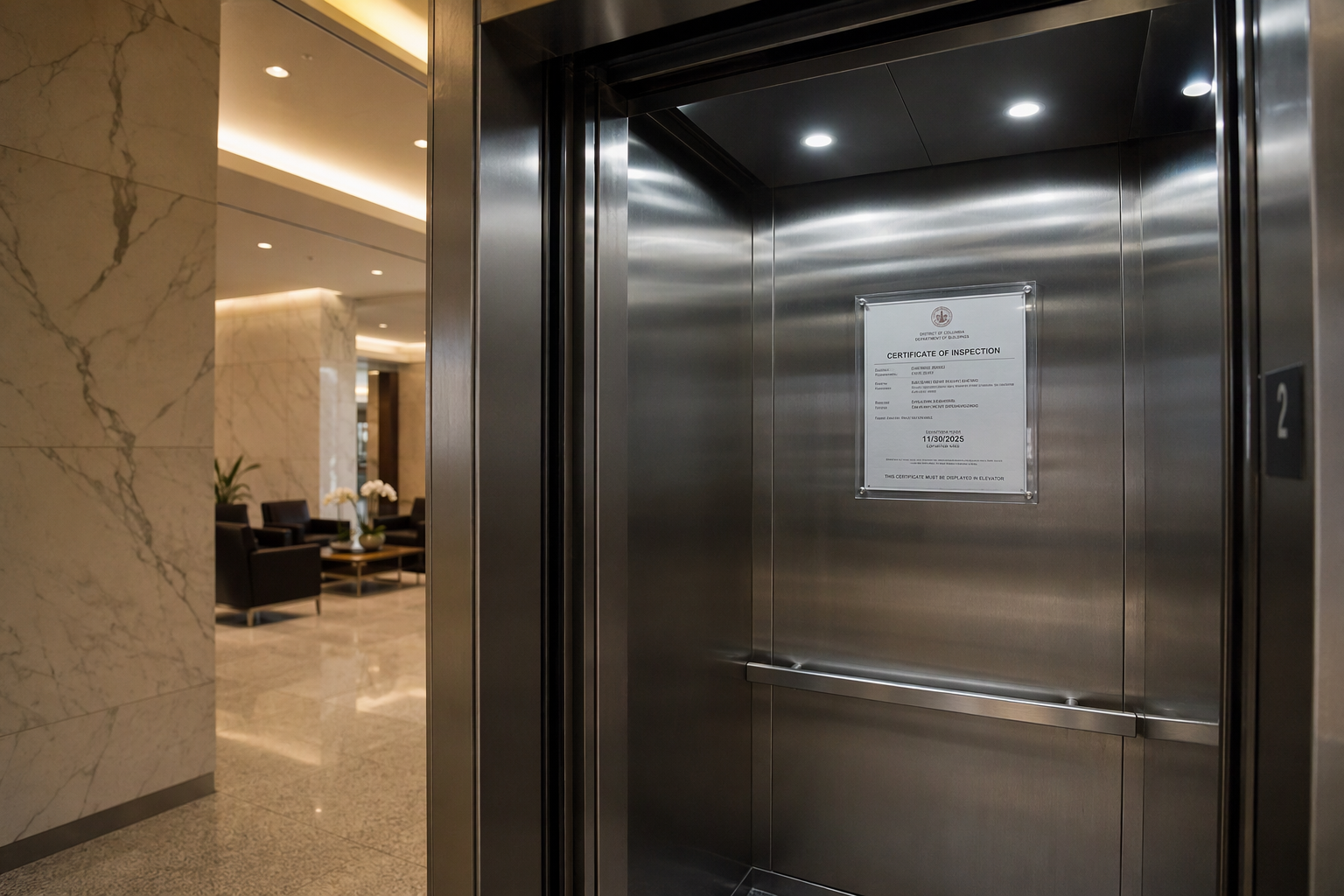
The most direct way to check is to locate the posted certificate of inspection inside the elevator car or, where permitted, in the machine room or building operator’s office, and read the expiration date printed on it.
Every jurisdiction covered here requires the current certificate to be posted conspicuously. If the date has passed, the certificate has expired and the elevator may not legally operate until a new certificate is issued. If no certificate is visible at all, that is itself a compliance violation. Building owners who cannot locate a certificate should contact their AHJ directly: in DC through the DOB Citizen Access Portal, in Maryland through the Division of Labor and Industry, in Pennsylvania through L&I, and in Virginia through the local building department. Quality Elevator Company regularly assists building owners with permit status audits as part of its compliance review services, helping clients avoid the operational and liability risks that come with an expired or missing certificate.
How long are elevator certificates and permits valid in each jurisdiction?
Certificate validity periods differ by jurisdiction and, in Pennsylvania, by inspection cycle.
The table below summarizes the key validity periods and inspection frequencies across the four markets served by Quality Elevator Company.
| Jurisdiction | Certificate Valid For | Periodic Inspection Interval | Comprehensive / 5-Year Test | Governing Authority |
|---|---|---|---|---|
| Washington DC | 2 years | Category 1: every 12 months | Category 5: every 60 months | DC Department of Buildings |
| Maryland | Renewed annually (re-registration at annual inspection) | Annual (periodic); comprehensive every 5 years for wire-rope-suspended units | 5-year comprehensive inspection required | MD Dept. of Labor, Division of Labor and Industry |
| Pennsylvania | 24 months (6-month cycle) or 48 months (12-month cycle) | No more than 6 months (electric, hydraulic, escalators); 12 months for some equipment types | Category tests per ASME A17.1 Appendix N (annual Cat 1 required from Dec 20, 2026) | PA Dept. of Labor and Industry |
| Virginia | Valid until next annual inspection (certificate tied to annual cycle) | Annual; locality may require semi-annual | Periodic tests at ASME A17.1 Appendix N intervals, witnessed by code official | Local building department (USBC) |
What happens if I operate an elevator with an expired certificate?
Operating an elevator without a valid certificate of inspection is a violation of applicable law in all four jurisdictions and can result in mandatory shutdown orders, fines, and civil liability.
In Maryland, the Annotated Code of Maryland, Public Safety Article explicitly prohibits operating an elevator unit unless the Commissioner of Labor and Industry has issued a certificate for it. In Pennsylvania, 34 Pa. Code Chapter 405 prohibits operation without a certificate of operation. In DC, 12-A DCMR Chapter 30 requires a valid certificate, and in Virginia, the USBC and local ordinances impose the same requirement. Beyond regulatory penalties, an owner who knowingly operates an elevator with an expired certificate faces heightened exposure in personal injury litigation. Building owners uncertain about certificate status are encouraged to have a qualified elevator contractor perform a compliance audit before the AHJ initiates enforcement action.
What is a Category 1 and Category 5 test, and do I need a permit for them?
Category 1 and Category 5 tests are periodic safety tests defined by the ASME A17.1 Safety Code for Elevators and Escalators, and while these tests do not typically require a construction permit, they must be performed by licensed or certified mechanics and witnessed by qualified inspectors.
Under ASME A17.1, Category 1 tests are no-load safety tests performed annually (in DC, confirmed as a 12-month requirement under 12-A DCMR). Category 5 tests are full-load pressure tests performed every 60 months (confirmed for DC). Pennsylvania’s December 20, 2026 regulatory update makes Category 1 tests a stand-alone annual requirement and aligns periodic test intervals with ASME A17.1-2016 Table N-1, with tests witnessed by a construction code official. In Maryland, tests performed for a required inspection must be performed by a licensed elevator mechanic, and when a third-party qualified elevator inspector is required to witness a test, the inspector must be physically present for the entire test. Failure to complete Category tests on schedule can delay certificate renewal and may require a variance petition before the elevator can legally resume service.
What documents do I need to submit with an elevator permit application?
Required documents vary by jurisdiction but generally include engineered construction drawings, equipment specifications, and proof of contractor licensure.
- Confirm jurisdiction: Identify whether your building falls under DC DOB, Maryland Division of Labor and Industry, Pennsylvania L&I, or your Virginia local building department.
- Prepare construction documents: Gather hoistway drawings, equipment cut sheets, load calculations, and any manufacturer specifications required by the AHJ’s plan review process.
- Verify contractor credentials: In DC, attach the elevator contracting license and master electrician license. In Maryland, confirm the contractor is licensed by the Maryland Elevator Safety Review Board and carries required insurance minimums. In Virginia, confirm the EEC specialty contractor license from DPOR.
- Register the unit (Maryland only): File the registration with the Commissioner of Labor and Industry at least 60 days before planned completion.
- Submit through the correct portal: DC uses the Citizen Access Portal; Maryland, Pennsylvania, and Virginia localities have their own submission processes — confirm the current intake method with the AHJ before submitting.
- Schedule the acceptance inspection: Do not place the elevator in service until the AHJ conducts and passes the final acceptance inspection.
Quality Elevator Company assists building owners and property managers in preparing permit packages and coordinating with the relevant AHJ to avoid delays caused by incomplete submissions.
Who is qualified to inspect an elevator and witness tests in these jurisdictions?
Inspector qualifications differ by jurisdiction, but all four jurisdictions require inspectors who meet standards established under or consistent with ASME QEI-1, the standard for the qualification of elevator inspectors.
In DC, all third-party inspections must be conducted by ASME QEI-certified inspectors using DOB-approved third-party agencies, and DC elevator inspector license applicants must meet ASME QEI-1 or an equivalent standard. In Maryland, owners must hire a third-party qualified elevator inspector to conduct periodic inspections, and that inspector must be physically present for the entire test. In Pennsylvania, any UCC-certified elevator inspector may conduct periodic inspections, and third-party agencies must be certified by the Department. In Virginia, the local code official or an approved agency performs inspections, and third-party inspection reports must include the certification number of the elevator mechanic who performed the witnessed tests.
Does an elevator need a permit to be taken out of service or placed in a dormant state?
In DC, a DOB permit is specifically required to take an elevator out of service under ASME A17.1 Section 8.11.1.4 or to place it in temporarily dormant status.
This requirement is often overlooked during building renovations or partial-occupancy situations. Without the out-of-service permit, an elevator that is physically shut down but not formally decommissioned remains subject to ongoing inspection and certificate obligations. In DC, an elevator’s certificate of inspection may be temporarily suspended while it is under permit for alteration or modernization — but only after the proper permit is obtained. Owners in Maryland, Pennsylvania, and Virginia should confirm the equivalent requirement with their AHJ before deactivating a unit, as local rules may impose similar obligations. Quality Elevator Company can coordinate the required permit paperwork and ensure that lockout/tagout and safety procedures comply with both ASME A17.1 and applicable OSHA standards found at OSHA.gov.
What are the ADA requirements related to elevator permits and accessibility?
The Americans with Disabilities Act (ADA) requires that elevators in covered buildings meet accessibility standards, and permit applications for new installations or alterations must demonstrate ADA compliance as part of plan review.
The ADA Standards for Accessible Design specify requirements for elevator cab size, door width, control panel height, hall call button placement, and two-way emergency communication systems. When a building owner applies for an elevator permit for new installation or alteration, ADA compliance is typically reviewed alongside ASME A17.1 requirements during the plan review process. Modernization projects that trigger ADA path-of-travel obligations may require upgrades beyond the elevator itself, such as accessible routes to elevator lobbies. Building owners should ensure that any permit package for alteration work addresses both the technical safety code requirements and applicable ADA accessibility standards.
What records must be kept on-site, and for how long?
All four jurisdictions require maintenance, inspection, and test records to be retained on-site and available for review by inspectors, with the specific requirements differing by jurisdiction.
In Maryland, maintenance, repair, test, and inspection records must be kept at a readily accessible central location in the building where the elevator is located. In Pennsylvania, records supporting the certificate of operation must be available for Department review. In DC, the certificate of inspection itself must be conspicuously displayed in the elevator car or, where the building operator has an office in the same building, kept available for public inspection there. In Virginia, the current certificate of inspection must be displayed in the elevator, attached to the escalator, kept in the building operator’s office, or posted in an approved conspicuous location, and third-party reports must include the certification number of the elevator mechanic who performed the tests. Property managers should maintain a centralized file for each elevator unit that includes all certificates, inspection reports, test results, and permit history — a practice that also supports due diligence during building sales and financing transactions.
What is the process after an elevator fails an inspection?
When an elevator fails a required inspection, the AHJ typically issues a written notice of violation or rejection, and the elevator may not return to service until corrective work is completed and a re-inspection is passed.
- Receive and review the inspection report: The inspector’s report will identify specific deficiencies referencing the applicable code section. Obtain a copy immediately.
- Notify your elevator contractor: Share the full report with a licensed elevator contractor who can evaluate the scope of required corrections.
- Obtain a repair permit if required: Major repairs, replacements, or alterations require a permit before work begins. Confirm with the AHJ whether the cited deficiencies trigger a permit obligation.
- Complete corrective work: All repairs must be performed by licensed or certified elevator mechanics — in Maryland by a licensee of the Maryland Elevator Safety Review Board; in Virginia by a DPOR-certified mechanic or under their direct supervision.
- Schedule re-inspection: Contact the AHJ to schedule an acceptance or re-inspection. In Pennsylvania, an elevator may not return to service after a major repair or alteration until the Department inspects and passes it.
- Post the updated certificate: Once the AHJ issues a new certificate of inspection, post it in the required location before resuming passenger service.
- File an accident report if applicable: In Pennsylvania, owners must submit an accident report to the Department when an elevator incident causes a fatality or requires professional medical care.
Can an elevator be modernized without shutting down completely, and how does that affect permits?
Partial modernization is possible in some cases, but any alteration — partial or full — requires a permit, and the scope of the permit determines which code edition applies and whether the elevator can remain partially in service during work.
In DC, an elevator’s certificate may be temporarily suspended while it is under permit for alteration or modernization, and at least one elevator must be kept in operation whenever a DC building is occupied (except in single-elevator buildings). This means that in multi-elevator buildings, phased modernization may allow unaffected units to remain in service while one is under an active alteration permit. In Pennsylvania, elevators certified before December 20, 2026, may stay in use if they are maintained under their prior permit and continue to meet inspection and testing requirements — but once an alteration permit is pulled, the governing code edition for that work is determined by the permit application date. Building owners planning phased modernization projects should discuss sequencing with their contractor and the AHJ early in the planning process to avoid inadvertent service interruptions. Quality Elevator Company works with building owners and property managers to plan modernization scopes that meet code requirements while minimizing occupant disruption.
Are there any elevators that are exempt from state permit and inspection requirements?
Yes — each jurisdiction exempts certain categories of equipment, most commonly private residential elevators, but the exemptions are narrow and should not be assumed without verifying with the AHJ.
In Maryland, the elevator inspection and certificate law generally does not apply to units in privately owned single-family homes or in buildings under federal control. In Pennsylvania, the UCC elevator rules do not apply to lifting devices used only by the occupants of a single dwelling unit. In Virginia, the local government inspects elevators and enforces the building code for them except for elevators in single-family homes, two-family homes, and townhouses. In DC, the exemptions apply to equipment specifically excluded under 12-A DCMR Chapter 30 — building owners should not assume an exemption applies without written confirmation from DOB. Even exempt equipment remains subject to the safety requirements of the ASME A17.1 code as incorporated into manufacturer guidelines and may carry liability exposure if maintained below those standards.
What should a building owner do if they purchase a building and cannot find elevator permit or certificate records?
A new building owner who cannot locate existing elevator permits or certificates of inspection should immediately contact the AHJ to request the permit history and determine whether any certificates are current, then arrange for a licensed elevator contractor to perform a full compliance review before continuing to operate the equipment.
- Contact the AHJ: Request the complete permit and inspection history for each elevator unit by address. DC’s DOB Citizen Access Portal, Maryland’s Division of Labor and Industry, Pennsylvania’s L&I, and local Virginia building departments all maintain records.
- Identify all units: Confirm the number of elevator units, including freight elevators, escalators, and platform lifts, that require certification.
- Engage a licensed elevator contractor: Have a qualified contractor perform a physical condition assessment and compare the equipment’s current state to the requirements of the governing code edition.
- Determine certificate status: Verify whether a valid certificate of inspection is in force for each unit. If not, the elevator should not be operated until the AHJ authorizes it.
- File for registration (Maryland) or request reinspection (all jurisdictions): Bring each unit into compliance through the AHJ’s reinspection or re-registration process.
- Establish a maintenance and inspection calendar: Going forward, document all inspections, tests, and certificates in a centralized building file.
Quality Elevator Company regularly supports commercial real estate transactions by performing pre-acquisition elevator assessments that identify permit gaps, deferred maintenance, and code deficiencies before closing.
How does the upcoming Pennsylvania regulatory change on December 20, 2026, affect permit applications filed today?
Permit applications filed before December 20, 2026, in Pennsylvania remain governed by ASME A17.1-2000 (with the A17.1a-2002 addenda); applications filed on or after that date must comply with ASME A17.1-2016 with Pennsylvania modifications under updated Regulation #12-123.
This transition has practical implications for owners planning elevator installations or major alterations in Pennsylvania in 2026. Projects whose permit applications are submitted before the December 20, 2026 effective date will be governed by the existing code edition, and elevators certified before that date may remain in use if maintained under their prior permit and inspection requirements. However, beginning December 20, 2026, Category 1 tests become a stand-alone annual requirement, and periodic tests must follow ASME A17.1-2016 Table N-1 intervals witnessed by a construction code official. Owners and contractors should coordinate closely with the Pennsylvania Department of Labor and Industry and their elevator contractor to understand how the transition affects projects currently in planning. Additionally, owners may appeal a code official’s decision or request a variance or extension of time by petitioning the Elevator Safety Board within 30 days of the decision.
Contact Quality Elevator Company for a free elevator assessment at 301-779-9116.
Need elevator service you can rely on? Quality Elevator Company is ready to help.