Commercial Elevator Maintenance Cost & Contract Guide: Everything Building Owners Need to Know
What Does Annual Commercial Elevator Maintenance Cost?
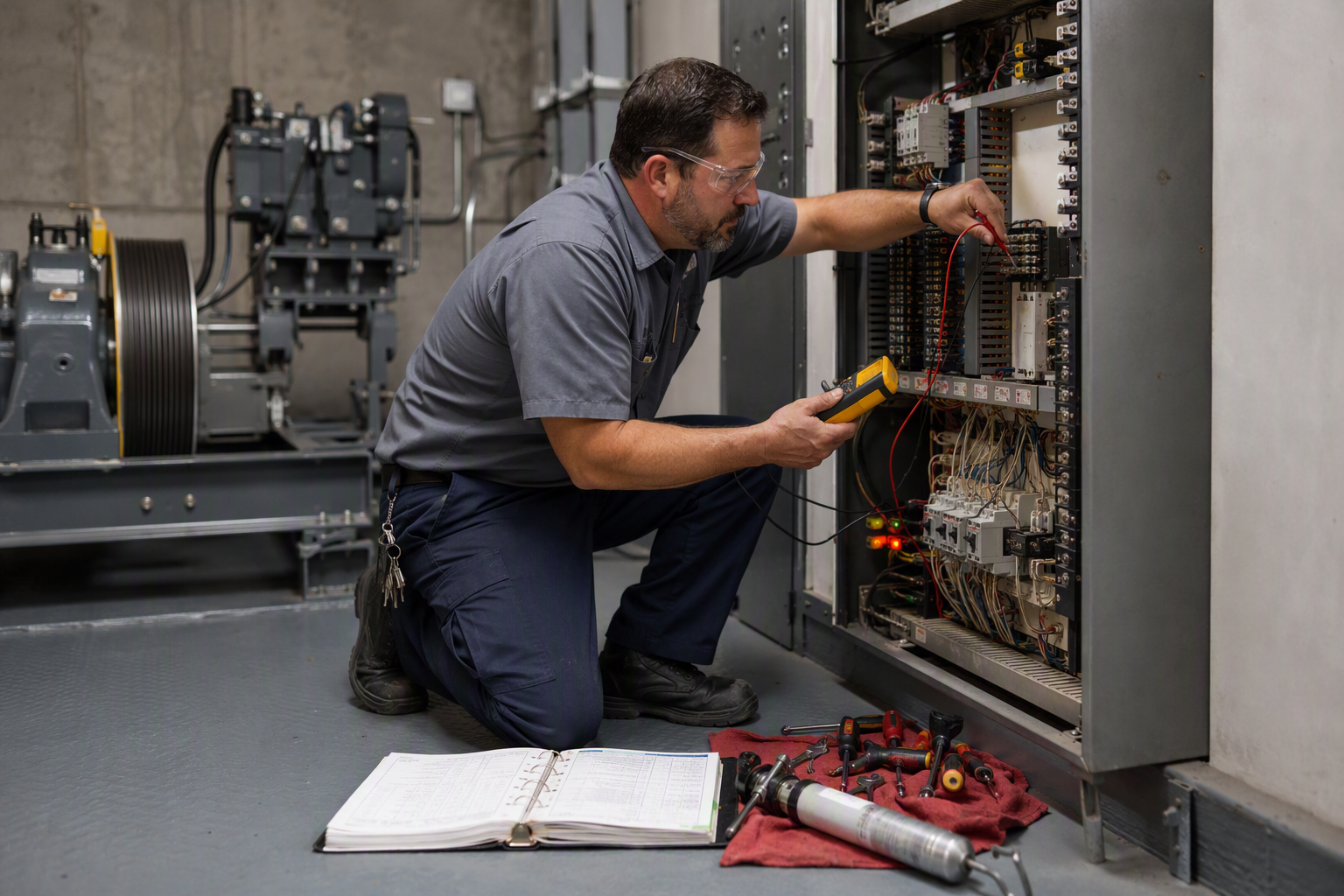
Annual commercial elevator maintenance costs vary widely based on elevator type, age, usage level, contract tier, and geographic market — there is no single universal figure, but costs scale with the complexity of the equipment and the depth of coverage selected.
Traction elevators — the kind found in mid- and high-rise office buildings — generally require more labor-intensive maintenance than hydraulic elevators because of their machine rooms, roping systems, and drive units. Machine-room-less (MRL) traction elevators introduce their own servicing demands due to component access constraints. Older elevators with proprietary controls can also drive costs higher because parts sourcing is more complex. Building owners in the Baltimore, Washington DC, Philadelphia, and Richmond markets should request itemized proposals from certified elevator contractors to understand exactly what a quoted price covers — a low headline number may exclude parts, callbacks, or after-hours response.
What Does a Standard Commercial Elevator Maintenance Contract Include?
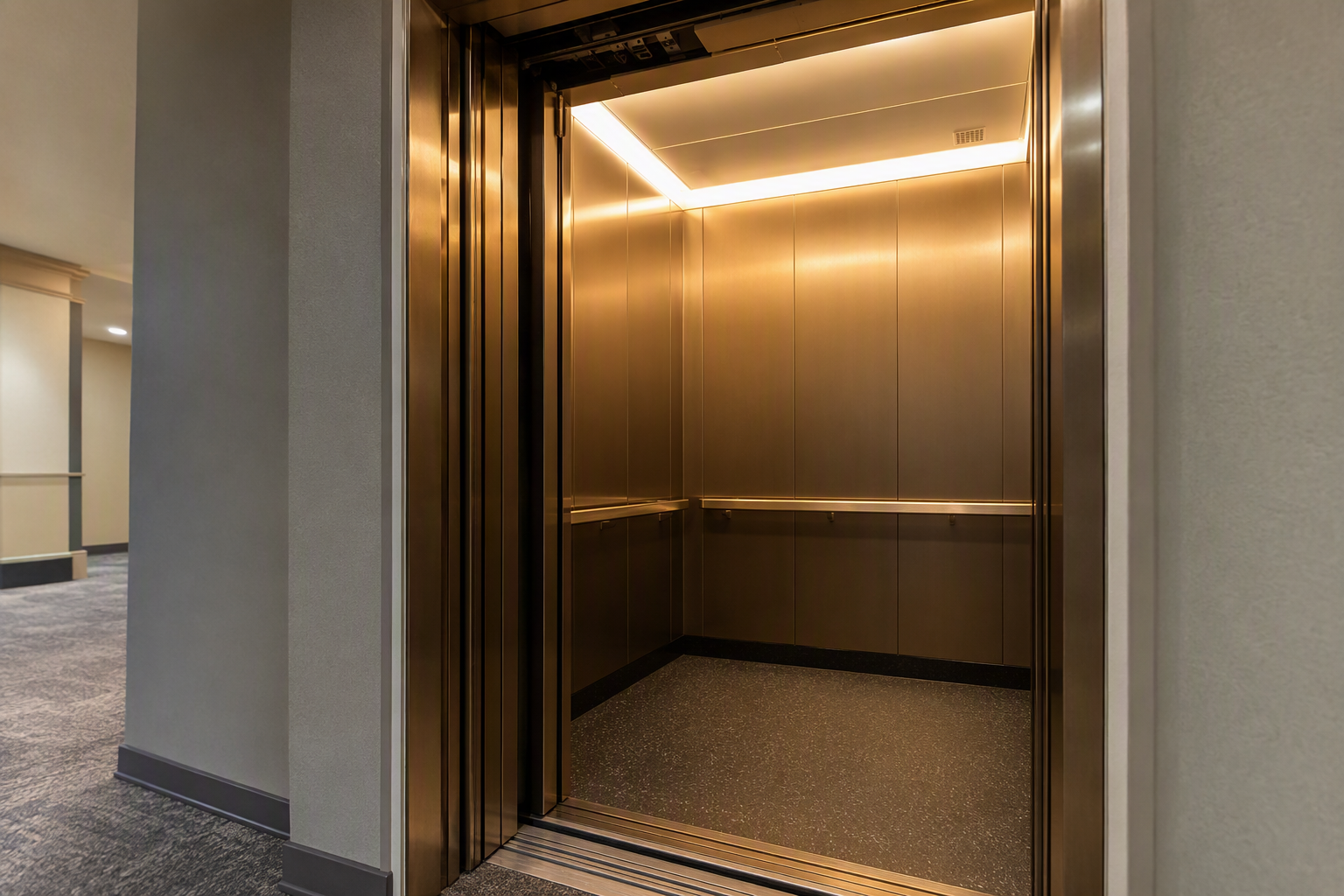
A standard commercial elevator maintenance contract includes scheduled preventive maintenance visits, lubrication of moving components, safety device testing and adjustments, minor parts replacement for normal wear, code-required annual inspections, and emergency callback service during defined hours.
Most contracts in the mid-Atlantic market are structured around monthly or quarterly on-site visits by a certified elevator mechanic. During each visit, the technician lubricates guide rails, sheaves, and bearings; adjusts door operators and safety edges; tests overspeed governors and safeties; checks hydraulic fluid levels and hoses on hydraulic units; and documents findings. Contracts that include parts coverage eliminate uncertainty around replacement costs for wear items such as rollers, buffers, or door tracks. Emergency callback provisions define how quickly a contractor will respond when an elevator goes out of service.
Quality Elevator Company structures its maintenance agreements to align with the preventive maintenance requirements outlined in ASME A17.1 Safety Code for Elevators and Escalators, ensuring that each service visit addresses the code’s maintenance and testing intervals.
What Are the Different Types of Elevator Maintenance Contracts?
Elevator maintenance contracts fall into four primary tiers — oil-and-grease, full maintenance, parts-and-labor, and comprehensive — each offering progressively deeper coverage and price points to match the risk tolerance and budget of the building owner.
| Contract Tier | Preventive Visits | Parts Covered | Callbacks Included | Major Components | Best Suited For |
|---|---|---|---|---|---|
| Oil & Grease (Basic) | Yes | No | Billed separately | No | Low-traffic, newer elevators with separate parts budget |
| Full Maintenance (Standard) | Yes | Wear items only | Yes (business hours) | No | Mid-traffic commercial buildings |
| Parts & Labor | Yes | Yes (most parts) | Yes (extended hours) | Partial | Older equipment, high-traffic buildings |
| Comprehensive (Full-Coverage) | Yes | Yes (nearly all) | Yes (24/7) | Yes | Mission-critical facilities, hospitals, Class A office |
Building owners should review exclusions carefully. Even comprehensive contracts typically exclude vandalism damage, cosmetic repairs, and upgrades required by new code editions. Contracts should specify maximum callback response windows, overtime billing policies, and whether major drive units, motors, and controllers fall inside or outside coverage.
How Often Does a Commercial Elevator Need Preventive Maintenance?
Most commercial elevators require preventive maintenance at least monthly, with high-traffic or high-rise elevators often benefiting from more frequent service intervals as defined by the equipment manufacturer and ASME A17.1 maintenance guidelines.
Frequency should reflect actual usage cycles, not just calendar time. A freight elevator running dozens of trips per day in a warehouse accumulates wear far faster than a passenger elevator in a low-rise medical office building with modest daily traffic. Maintenance contractors assess usage patterns and equipment condition to recommend appropriate visit cadences. Skipping or extending intervals between visits is one of the most common causes of preventable breakdowns and failed inspections.
What Inspections Are Required by Law for Commercial Elevators in Maryland, DC, Philadelphia, and Virginia?
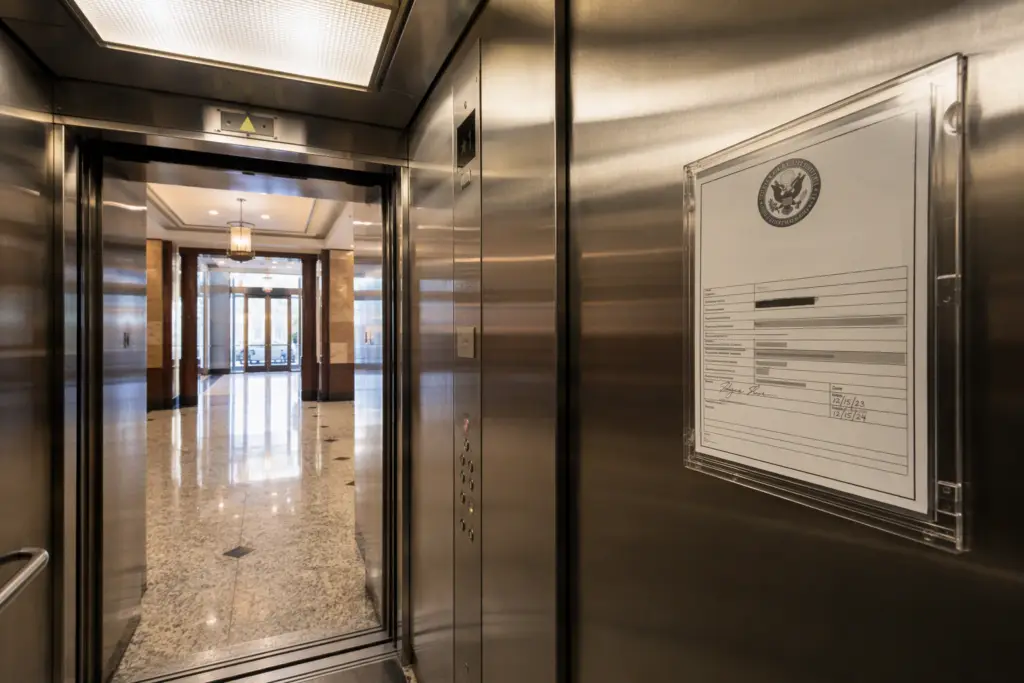
Maryland, the District of Columbia, Pennsylvania, and Virginia each mandate periodic elevator inspections by licensed inspectors — typically annual or biennial — and require that certificates of inspection be posted in or near the elevator cab before the unit may legally operate.
In Maryland, elevator inspections fall under the jurisdiction of the Maryland Department of Labor, which enforces elevator safety standards aligned with the ASME A17.1 Safety Code for Elevators and Escalators and ASME A17.3 for existing installations. The District of Columbia’s Department of Consumer and Regulatory Affairs (DCRA) administers elevator inspections for DC properties. Pennsylvania’s Department of Labor and Industry oversees elevator inspection and licensing through its Bureau of Occupational and Industrial Safety. In Virginia, the Department of Labor and Industry enforces elevator safety under the Virginia Uniform Statewide Building Code.
Across all four jurisdictions, operating an elevator without a current, valid inspection certificate exposes building owners to fines, mandatory shutdown orders, and liability exposure. A maintenance contract with a qualified contractor such as Quality Elevator Company helps ensure that required inspections are coordinated, documentation is complete, and deficiencies identified during inspection are corrected promptly.
What Does ADA Compliance Mean for Elevator Maintenance?
Under the Americans with Disabilities Act (ADA), commercial elevators that serve as a required means of access must remain functional and accessible, meaning maintenance practices must preserve ADA-compliant features such as door timing, Braille signage, audible signals, and leveling accuracy.
ADA Title III requires places of public accommodation to maintain accessible features in working condition. An elevator that repeatedly malfunctions — failing to level within the required tolerance at floor landings, displaying inoperative tactile buttons, or closing doors too quickly — can constitute an ADA violation even if the unit is otherwise operational. Preventive maintenance that addresses door timing, landing accuracy, and accessible fixtures is therefore not just a comfort measure but a legal compliance obligation. Building owners should document that their maintenance provider inspects and adjusts ADA-relevant components at each scheduled visit.
What Factors Drive the Cost of a Commercial Elevator Maintenance Contract Up or Down?
The primary cost drivers for a commercial elevator maintenance contract include elevator type and drive system, equipment age and condition, number of units in the building, annual usage volume, contract coverage tier, and the local labor market for certified elevator mechanics.
Hydraulic elevators with simple relay logic controls are generally less expensive to maintain than gearless traction elevators with proprietary microprocessor controls. Buildings with multiple elevators often negotiate per-unit discounts because a technician’s mobilization time is amortized across more equipment. Elevators that have been modernized — with updated controllers, door operators, and drives — tend to generate lower callback frequency and therefore lower overall maintenance costs over time. Conversely, aging equipment approaching or past its design lifespan typically requires more frequent parts replacement, increasing the value of a comprehensive contract. In dense urban markets such as Washington DC and Philadelphia, labor costs for licensed elevator mechanics can be higher than in smaller markets, which is reflected in contract pricing.
What Is Not Covered by a Typical Elevator Maintenance Contract?
Most elevator maintenance contracts explicitly exclude major capital components such as traction machine replacements, complete controller modernizations, structural cab repairs, vandalism damage, code-upgrade work triggered by building renovation, and repairs arising from misuse or flooding.
Building owners are sometimes surprised when a contractor presents a separate invoice for a motor replacement or a new controller board — items that felt like they should have been covered. Reviewing the exclusions section of any proposed contract before signing is essential. Questions to ask include: Are solid-state drives covered? Are door operators and their components included? What happens if the hydraulic cylinder develops a leak — is that a wear item or a capital exclusion? A reputable elevator service provider will answer these questions in plain language and document the answers in the contract itself.
How Does Elevator Age Affect Maintenance Costs?
As elevators age beyond their design lifespan — generally accepted as twenty to twenty-five years for most commercial equipment — maintenance costs increase substantially because parts availability narrows, wear rates accelerate, and code compliance gaps widen under the existing-installations provisions of ASME A17.3.
ASME A17.3, the Safety Code for Existing Elevators and Escalators, establishes requirements that authorities having jurisdiction (AHJs) may enforce on older installations. When jurisdictions adopt new code editions, older elevators may be required to retrofit safety features — two-way communication systems, door reopening devices, or emergency lighting — creating costs that fall outside a standard maintenance contract. Building owners with aging elevator fleets are advised to conduct a condition assessment to understand the likely capital expenditure horizon alongside their recurring maintenance budget. Quality Elevator Company performs elevator condition assessments to help owners in the Baltimore, DC, Philadelphia, and Richmond markets plan maintenance and modernization budgets accurately.
What Happens During a Routine Commercial Elevator Maintenance Visit?
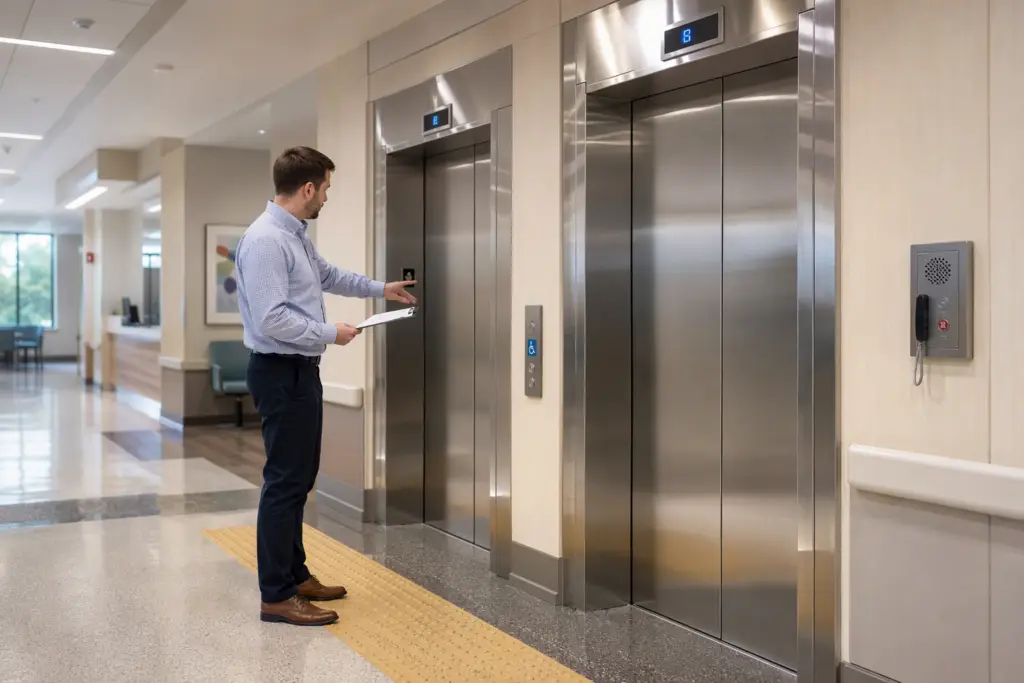
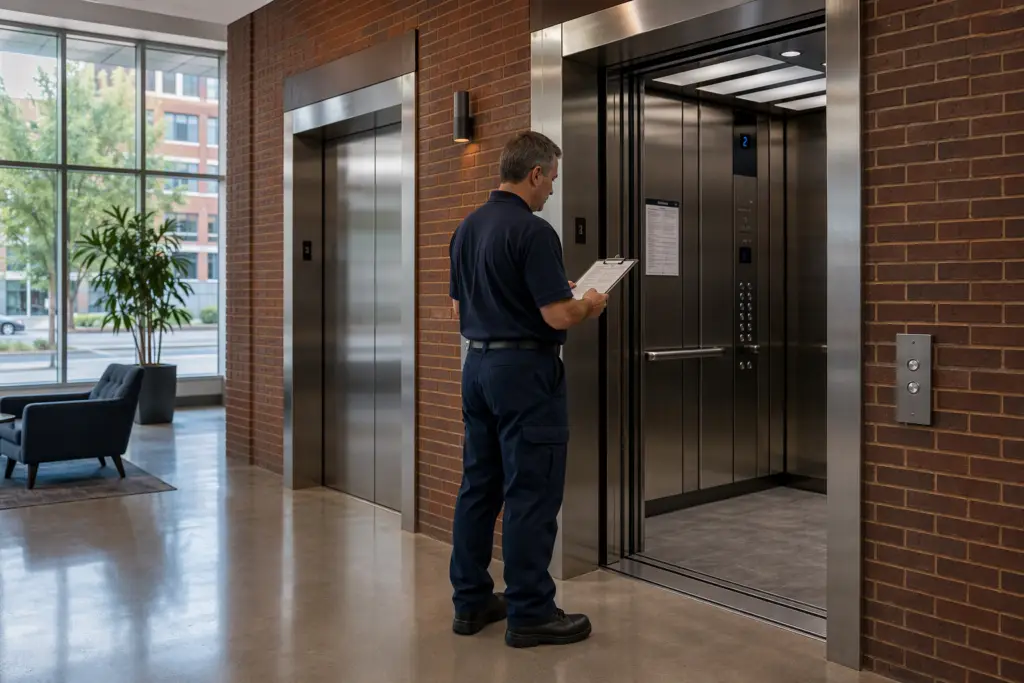
A routine preventive maintenance visit by a certified elevator mechanic follows a defined checklist that covers mechanical, electrical, hydraulic, and safety systems — the goal is to identify and correct developing problems before they cause equipment failure or a safety incident.
- Machine room or equipment space inspection: The technician inspects the motor, drive unit, controller, and machine room conditions including temperature, cleanliness, and the absence of stored materials that are prohibited by code.
- Lubrication: Guide rails, sheaves, governor ropes, and other friction points are lubricated per manufacturer specifications and ASME A17.1 maintenance guidelines.
- Door system adjustment: Door operators, cams, clutches, safety edges, light curtains, and door timings are tested and adjusted to ensure safe, ADA-compliant door operation.
- Safety device testing: Overspeed governors, safeties, buffers, and interlocks are inspected and functionally tested per the maintenance schedule.
- Hydraulic system check (hydraulic units): Fluid level, pump pressure, valve operation, and hose condition are inspected; any signs of leakage are documented and addressed.
- Leveling and ride quality assessment: The mechanic rides the elevator to verify accurate floor leveling, smooth acceleration and deceleration, and acceptable noise levels.
- Cab and hoistway inspection: Emergency lighting, communication devices, signage, and pit conditions are checked for compliance and proper function.
- Service log update: All findings, adjustments, and parts replaced are documented in the maintenance log kept with the unit, creating the paper trail needed for inspection compliance.
How Should Building Owners Compare Elevator Maintenance Proposals?
Building owners should compare elevator maintenance proposals by evaluating coverage scope, exclusions, callback provisions, technician certification requirements, contract term and exit clauses, and whether the contractor holds the appropriate licenses in the jurisdiction where the building is located — not by price alone.
A proposal with a lower monthly cost but no parts coverage and no callback guarantee can cost far more over a contract year than a higher-priced full-maintenance agreement once emergency labor and parts invoices are added. Key questions to ask every prospective contractor include: Are your mechanics licensed in this state or jurisdiction? Do you carry the required liability and workers’ compensation insurance? What is your escalation procedure when a unit is out of service? Can you provide references from comparable properties in this market? Contractors who deflect these questions during the proposal stage are unlikely to perform more transparently once under contract.
What Are the Consequences of Skipping Elevator Maintenance?
Skipping or deferring commercial elevator maintenance exposes building owners to equipment breakdowns, failed inspections, mandatory shutdown orders, ADA complaints, tenant liability claims, and accelerated capital replacement costs — all of which far exceed the cost of consistent preventive service.
Elevator safety incidents that involve passengers — entrapments, rough stops, door malfunctions — frequently trigger investigations by the state authority having jurisdiction. When an AHJ reviews the maintenance log and finds extended gaps in service or unresolved deficiencies, the building owner faces not only immediate shutdown but potential fines and liability exposure if injury occurred. From a purely economic standpoint, deferred maintenance is among the most expensive decisions a building operator can make: minor lubrication and adjustment needs become major mechanical failures if left unaddressed, and emergency repairs billed at premium labor rates can dwarf the cost of a year’s maintenance contract in a single service call.
What Is the Difference Between a Maintenance Contract and a Modernization?
A maintenance contract covers the ongoing servicing and repair of an elevator in its current configuration, while a modernization is a capital project that replaces outdated components — typically the controller, drive, door operator, and cab finishes — to extend service life, improve reliability, and bring the unit into compliance with current code.
These two investments are complementary, not interchangeable. Even a well-maintained elevator will eventually reach a point where the cost to maintain aging components exceeds the cost-benefit of replacement. Conversely, a recently modernized elevator that receives no preventive maintenance will degrade rapidly. The decision to modernize versus continue maintaining is driven by a combination of parts availability, callback frequency, inspection deficiency trends, energy consumption, and the building owner’s capital planning horizon. Qualified elevator service contractors provide condition assessments that quantify this decision in financial terms.
Does Elevator Maintenance Affect Property Insurance Premiums?
Documented, consistent elevator maintenance performed by licensed contractors can favorably influence property insurance underwriting, as insurers assess elevator maintenance records when evaluating premises liability exposure — though specific premium impacts depend on the individual insurer and policy.
Building owners should provide their insurance broker with copies of current inspection certificates, maintenance contracts, and service logs. Gaps in documentation or lapses in inspection certification are red flags for underwriters. Some insurers require proof of a current maintenance contract as a condition of coverage for elevators. Maintaining a complete, organized service history is therefore both a compliance and a risk management asset.
What OSHA Requirements Apply to Commercial Elevator Maintenance Workers?
Elevator maintenance work is subject to OSHA general industry and construction standards, including lockout/tagout (LOTO) procedures, personal protective equipment requirements, and confined space protocols when technicians access pits and overhead spaces.
Building owners have an indirect obligation here: they must ensure that the elevator contractor they hire complies with applicable OSHA standards, because incidents occurring on-premises can involve the building owner in regulatory scrutiny. Engaging a contractor who documents safety compliance, trains mechanics on LOTO procedures, and maintains proper OSHA logs is part of responsible vendor selection — not merely a preference.
How Long Should a Commercial Elevator Maintenance Contract Term Be?
Most commercial elevator maintenance contracts run one to five years, with longer terms typically offering more favorable per-unit pricing in exchange for reduced flexibility — building owners should balance cost savings against the risk of being locked into underperforming service.
Multi-year contracts make sense when the contractor has demonstrated reliable performance on an existing installation and when the equipment is stable. Short-term or annual contracts provide more flexibility to switch providers if service quality declines but may come at a higher per-visit cost. Key contract provisions to negotiate regardless of term include: performance benchmarks for callback response, annual price escalation caps, and clear termination-for-cause language that allows exit if the contractor fails to meet defined service standards. Automatic renewal clauses with short notice windows — some contracts auto-renew with only thirty days’ notice — should be tracked carefully on the property management calendar.
What Qualifications Should a Commercial Elevator Maintenance Provider Have?
A qualified commercial elevator maintenance provider should hold the elevator contractor license required by the jurisdiction where the building is located, employ mechanics who hold the applicable state-issued elevator mechanic licenses, carry adequate general liability and workers’ compensation insurance, and demonstrate familiarity with the specific elevator equipment on-site.
In Maryland, DC, Pennsylvania, and Virginia, elevator mechanics and contractors are subject to state licensing requirements administered by the respective labor or building safety agencies in each jurisdiction. Asking for license numbers and verifying them with the issuing agency is a straightforward due-diligence step that building owners and property managers should perform before executing any maintenance contract. Quality Elevator Company is a certified elevator service company operating across the Baltimore, Washington DC, Philadelphia, and Richmond markets and meets the licensing requirements applicable in each jurisdiction it serves.
Can a Building Owner Self-Perform Elevator Maintenance?
No — commercial elevator maintenance must be performed by licensed elevator mechanics under the laws of Maryland, the District of Columbia, Pennsylvania, and Virginia; self-performance by unlicensed building staff is not legally permissible and would void the equipment’s compliance status.
While building engineering staff may be responsible for monitoring elevator performance, reporting issues, and maintaining service logs, the actual mechanical maintenance and safety testing must be performed by individuals holding the appropriate elevator mechanic license in the applicable jurisdiction. This is not merely a regulatory technicality: elevator systems involve high-voltage electrical components, hydraulic pressure, and mechanical safety devices whose improper adjustment poses direct risk of serious injury or death. The licensing framework exists precisely to ensure that individuals touching this equipment have undergone verified training and examination.
How Does Elevator Maintenance Relate to Energy Efficiency?
Well-maintained elevators consume less energy than poorly maintained units because clean, properly lubricated mechanical systems operate at lower resistance, and correctly calibrated drives avoid inefficient motor operation — making preventive maintenance a contributor to a building’s overall energy performance.
In modern gearless traction elevators, regenerative drives can return energy to the building’s electrical system during deceleration — but only if the drive system is functioning correctly. A drive that is out of calibration or suffering from overheating due to inadequate maintenance cannot operate at peak efficiency. For building owners pursuing LEED certification or managing energy costs in commercial properties, elevator maintenance is a line item in the building’s sustainability program, not just its safety budget.
What Should a Building Owner Do If an Elevator Fails or Traps a Passenger?
A passenger entrapment or equipment failure is a life-safety event requiring an immediate, structured response — building staff should not attempt mechanical intervention and should contact the elevator contractor’s emergency line and emergency services as appropriate.
- Communicate with the trapped passenger: Use the elevator’s two-way communication system or intercom to establish contact, confirm the passenger’s condition, and instruct them to stay calm and remain inside the cab.
- Do not attempt manual rescue without trained personnel: Untrained extraction attempts — including manually opening hoistway doors — can result in falls into the hoistway and are prohibited except by licensed elevator mechanics or emergency responders with specific training.
- Contact your elevator maintenance contractor’s emergency line immediately: Provide the building address, elevator number, and nature of the situation. Certified contractors maintain emergency response capabilities for exactly this scenario.
- Contact 911 if the passenger reports a medical emergency: If the trapped individual indicates they are in medical distress, emergency services should be dispatched regardless of the contractor’s estimated arrival time.
- Secure the elevator lobby: Post signage and station a staff member to prevent other building occupants from attempting to use adjacent hoistway doors or otherwise compromising the scene.
- Document the incident: Record the time of the malfunction, time of contractor notification, time of resolution, and names of all individuals involved — this documentation is necessary for incident reporting to the AHJ and for insurance purposes.
- Report to the authority having jurisdiction: Depending on jurisdiction, entrapments and serious malfunctions may require formal incident reporting to the state elevator safety authority.
How Can Quality Elevator Company Help With Elevator Maintenance Planning?
Quality Elevator Company provides commercial elevator maintenance contracts, condition assessments, code compliance reviews, and modernization planning for building owners and property managers in Baltimore MD, Washington DC, Philadelphia PA, and Richmond VA.
A comprehensive maintenance relationship with a single certified elevator contractor simplifies compliance management, creates a consistent service history, and ensures that the technicians servicing a given unit develop institutional knowledge of that equipment’s specific condition and history. Quality Elevator Company’s maintenance programs are designed to meet the requirements of ASME A17.1 Safety Code for Elevators and Escalators and the applicable state and local regulations in each jurisdiction where it operates, helping building owners maintain compliant, safe, and reliable elevator service year-round.
Property managers overseeing multiple buildings across the mid-Atlantic region benefit from working with a contractor who understands the distinct inspection requirements, licensing frameworks, and authority-having-jurisdiction contacts in each of those four markets — eliminating the complexity of managing separate local vendors in Baltimore, DC, Philadelphia, and Richmond.
Ready to Protect Your Building and Budget?
Elevator maintenance is not an area where deferred decisions save money — the costs of unplanned downtime, failed inspections, and liability exposure consistently exceed the cost of a well-structured maintenance contract. Whether you are evaluating your first elevator service agreement, reviewing an existing contract, or planning a modernization budget, an expert assessment is the right starting point.
Contact Quality Elevator Company for a free elevator assessment. Serving Baltimore MD, Washington DC, Philadelphia PA, and Richmond VA — call us today at 301-779-9116 to schedule your site visit and receive a customized maintenance proposal for your property.
Need elevator service you can rely on? Quality Elevator Company is ready to help.