24 Hour Elevator Repair Service: Complete FAQ Guide for Building Owners
After 15 years working on elevators across Baltimore, Washington DC, Philadelphia, and Richmond, I’ve seen what happens when buildings don’t have reliable emergency repair coverage. Passengers get trapped, ADA obligations go unmet, and liability exposure climbs fast. This guide answers every question building owners, property managers, and facility directors ask about 24 hour elevator repair service — with real numbers, real codes, and real guidance you can act on today.
What exactly is 24 hour elevator repair service and what does it cover?
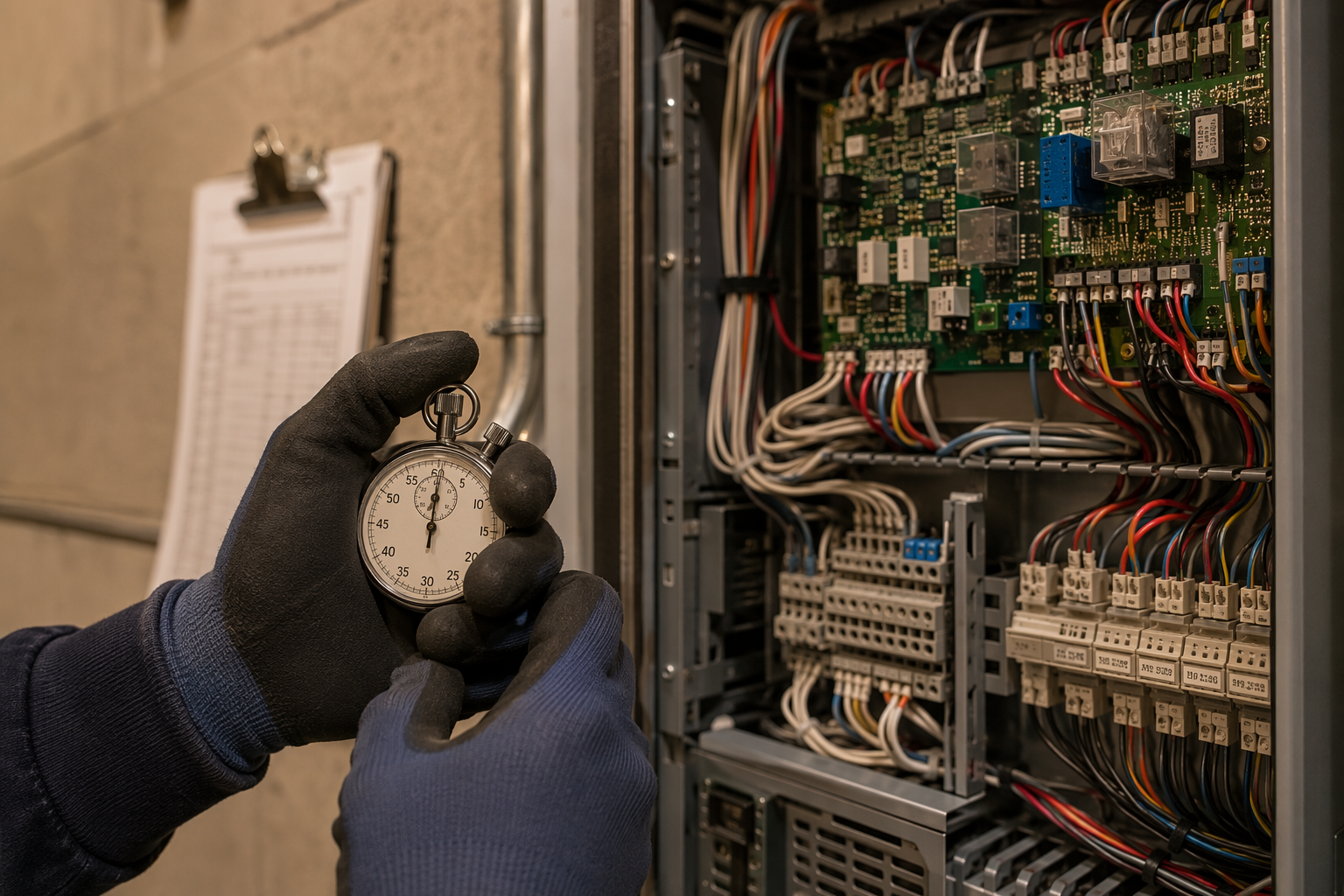
24 hour elevator repair service is emergency technical support available every hour of every day, including weekends and holidays, where certified mechanics respond to elevator breakdowns, entrapments, safety failures, and critical malfunctions regardless of when they occur.
A true 24/7 service contract covers far more than just sending someone to push buttons. It includes emergency entrapment rescue, electrical fault diagnosis, hydraulic system failure repair, door operator malfunctions, controller board troubleshooting, safety circuit resets, and temporary out-of-service lockout when a unit poses an immediate hazard. Coverage should extend to traction elevators, hydraulic elevators, MRL (machine room-less) systems, dumbwaiters, and platform lifts depending on your building’s equipment inventory.
Not every company advertising “emergency service” actually provides it. Some route after-hours calls to answering services with response times exceeding four hours. When evaluating providers, ask specifically: What is the guaranteed on-site response time? Is the responding technician IUEC-certified? Does the contract cover parts for emergency repairs or only labor?
How quickly should a certified technician arrive for an emergency elevator repair?
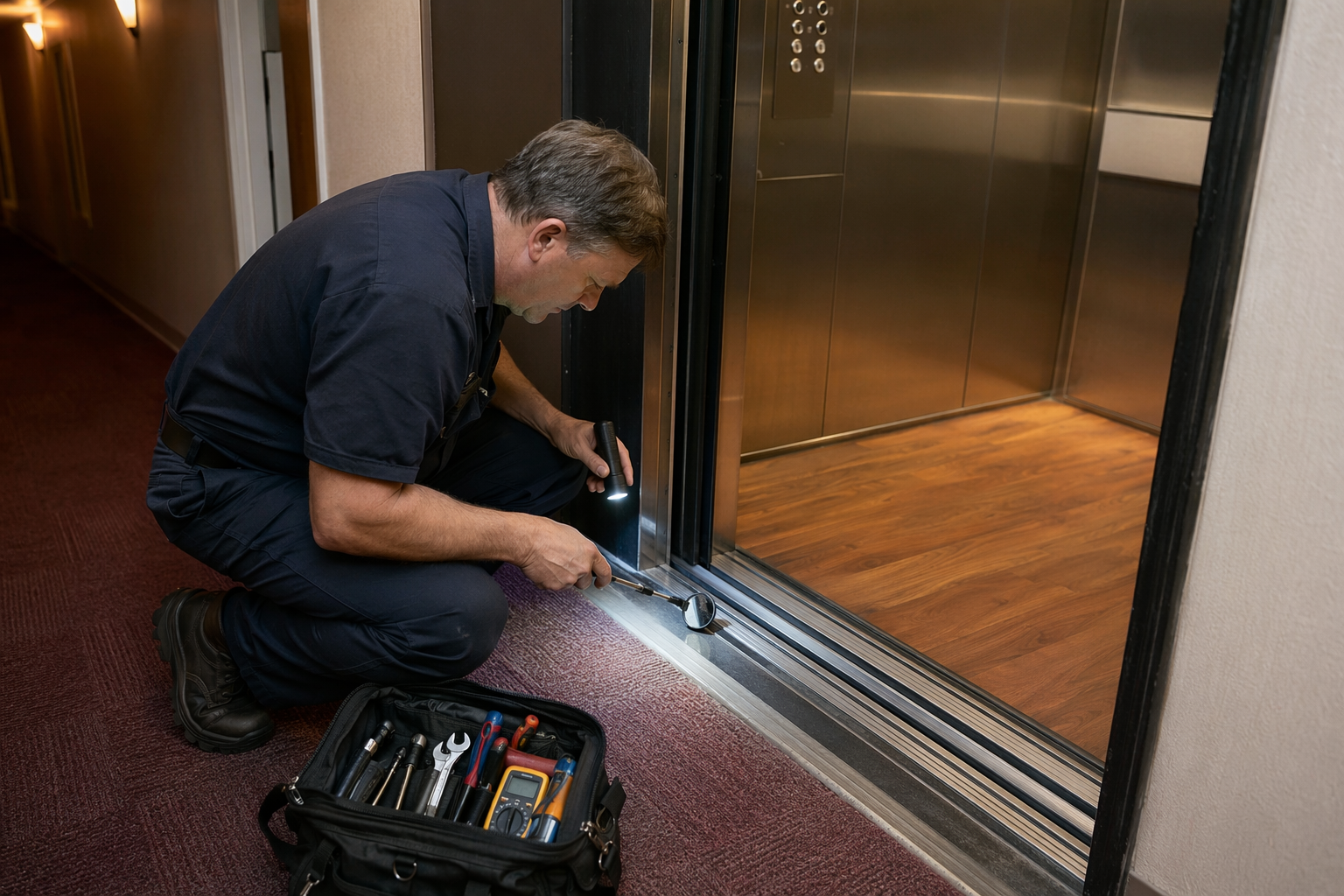
Industry best practice is a maximum 2-hour on-site response time for emergency calls, though leading service providers in urban markets like Baltimore, Washington DC, Philadelphia, and Richmond target 60–90 minute response windows.
Response time is one of the most important — and most misrepresented — metrics in elevator service contracts. I’ve reviewed dozens of service agreements where “24/7 availability” actually meant a 4-hour or even next-business-morning response window buried in fine print. That distinction matters enormously when a passenger is trapped in a cab between floors at 11 PM.
Entrapment situations carry specific urgency. While modern elevators are designed to keep trapped passengers safe, the psychological distress, ventilation limitations, and medical risk for elderly or medically vulnerable individuals make rapid rescue a genuine safety imperative. ASME A17.1-2022, the Safety Code for Elevators and Escalators, requires that means of two-way communication be maintained and that entrapments be resolved promptly. Local fire departments may respond first for entrapments, but a certified mechanic must clear the equipment before it returns to service.
Quality Elevator Company maintains certified technicians stationed across the Baltimore, DC, Philadelphia, and Richmond service areas specifically to meet sub-90-minute response targets on emergency calls.
What are the most common reasons elevators break down and require emergency repair?
The five most frequent causes of emergency elevator failures are door system malfunctions, hydraulic fluid leaks or pump failures, electrical safety circuit trips, controller and logic board faults, and worn or broken suspension components.
Door problems account for roughly 50–60% of all elevator service calls industry-wide. This includes door reopening devices failing, door operators burning out, roller guides wearing down, and safety edges becoming unresponsive. Because an elevator will not move with a door safety circuit open, even a minor door sensor fault grounds the entire unit.
Hydraulic systems on older buildings — particularly those built before 1990 — are prone to sudden pump failures, valve seat deterioration, and fluid line leaks. In many jurisdictions, a confirmed below-ground hydraulic fluid leak triggers mandatory shutdown and environmental remediation requirements before the unit can be returned to service.
Controller faults have increased in frequency as older relay-logic panels age past their design life. Replacement logic boards for legacy systems can require sourcing from specialty suppliers, which is why parts inventory management is a key differentiator when selecting a 24 hour repair provider.
What should building managers do immediately when an elevator breaks down or traps a passenger?
Follow this specific emergency response sequence to protect passenger safety, limit liability, and comply with regulatory requirements while awaiting your certified technician.
- Establish two-way communication with any trapped passenger immediately. Use the in-car phone or intercom. Confirm how many people are inside, ask about any medical conditions, and instruct them to stay calm and away from the doors.
- Call 911 if any passenger reports a medical emergency, panic attack, or if communication cannot be established. Fire department rescue teams are trained for elevator entrapment and can provide immediate assistance.
- Contact your 24 hour elevator repair service provider. Provide your building address, the elevator unit ID number (usually posted in the cab), the floor the car appears to be on, and a description of any known symptoms before failure.
- Post an out-of-service sign on all landing call buttons at every floor. Do not allow other passengers to attempt to use adjacent elevators that may share the same controller without technician clearance.
- Do NOT attempt to manually open elevator doors or operate emergency lowering valves unless you are a certified mechanic. Improper door forcing or manual lowering can cause serious injury to both rescuers and passengers.
- Document the incident. Note the time of failure, any error codes displayed on the hall call station, and the sequence of events. This documentation is required for regulatory incident reporting in Maryland, DC, Virginia, and Pennsylvania.
- Keep the area around landing doors clear until the technician arrives and clears the equipment for return to service.
How much does 24 hour emergency elevator repair service cost?
Emergency elevator repair costs range from $300–$800 for minor after-hours service calls to $2,000–$15,000+ for major component replacements, with the specific cost depending on failure type, required parts, labor hours, and time of call.
| Repair Type | Typical Cost Range (2026) | Average Repair Time | Parts Commonly Required |
|---|---|---|---|
| Door operator reset / adjustment | $300 – $600 | 1 – 2 hours | None or minor hardware |
| Safety circuit fault diagnosis & repair | $400 – $900 | 1 – 3 hours | Fuses, relays, sensors |
| Door operator replacement | $1,200 – $3,500 | 3 – 6 hours | Door operator unit |
| Hydraulic pump motor replacement | $3,000 – $8,000 | 4 – 8 hours | Pump, motor, fluid |
| Controller board replacement (legacy) | $4,000 – $12,000 | 6 – 16 hours | Logic board, wiring harness |
| Rope/cable replacement (traction) | $5,000 – $15,000+ | 8 – 24 hours | Suspension ropes, sheaves |
| Emergency entrapment response only | $250 – $500 service fee | Under 1 hour on-site | None (rescue only) |
After-hours labor rates typically carry a 50–100% premium over standard daytime rates, which is why a preventive maintenance contract that reduces emergency call frequency almost always delivers positive ROI. Buildings in Maryland, Virginia, DC, and Pennsylvania with full-coverage maintenance agreements often see emergency call rates drop by 60–70% compared to buildings on minimal inspection-only contracts.
Is 24 hour elevator repair service legally required for commercial buildings?
No federal law mandates that building owners hold a 24/7 repair contract, but ADA accessibility requirements, state elevator codes, and local jurisdictional regulations create strong de facto legal obligations to restore elevator service rapidly when it fails.
Under the Americans with Disabilities Act (ADA), buildings required to be accessible must maintain accessible routes. An out-of-service elevator in a building where the elevator is the only accessible means of reaching upper floors constitutes an ADA accessibility failure. The Department of Justice has taken enforcement action against property owners for extended elevator outages, and private lawsuits from individuals with disabilities denied access are increasingly common.
At the state level, Maryland, Virginia, Pennsylvania, and DC each maintain elevator safety programs under their respective departments of labor or licensing. These agencies require mandatory incident reporting for entrapments and injuries, and inspectors can impose civil penalties for units kept out of service beyond permissible timeframes without documented remediation efforts. A 24 hour service contract creates an auditable paper trail demonstrating that the building owner acted promptly and responsibly.
What certifications should a 24 hour elevator repair technician hold?
Technicians performing elevator repairs should hold IUEC (International Union of Elevator Constructors) certification, and in Maryland, Virginia, Pennsylvania, and DC, a valid state elevator mechanic license issued by the applicable jurisdiction’s elevator safety authority.
IUEC apprenticeship programs run four years and cover electrical systems, mechanical components, hydraulic systems, and safety code compliance under the ASME A17.1 Safety Code for Elevators and Escalators. Upon completion, mechanics may pursue QEI (Qualified Elevator Inspector) certification through NAESA International for inspection credentials.
State licensing requirements vary. Maryland requires elevator mechanics to hold a license issued by the Maryland Department of Labor. Virginia’s Department of Labor and Industry administers the elevator mechanic licensing program. Pennsylvania’s Department of Labor and Industry requires licensure under the Uniform Construction Code elevator provisions. The District of Columbia requires licensure through DCRA (Department of Consumer and Regulatory Affairs). Always verify your service provider’s current licensure status before signing a contract — licenses must be renewed and some lapse without the building owner’s knowledge.
How does 24 hour service differ between a full-maintenance contract and a time-and-materials agreement?
A full-maintenance contract bundles 24/7 emergency labor, preventive maintenance visits, and parts coverage into a fixed monthly fee, while a time-and-materials agreement bills each service call separately at prevailing after-hours labor rates plus parts markup.
For most commercial buildings, full-maintenance contracts deliver both cost predictability and faster response. Under a T&M arrangement, the service company has no guaranteed revenue from your account, which can subtly affect dispatch priority during peak demand periods. With a full-maintenance contract, you are a committed account with guaranteed monthly revenue, which creates contractual obligations around response time that are legally enforceable.
Full-maintenance contracts typically range from $200–$800 per month per elevator depending on equipment age, type, and floors served. Buildings with aging equipment (15+ years old) often benefit most from full coverage because parts failures become more frequent and individual repair costs more significant. Newer installations may find limited-coverage agreements more cost-effective for the first five to seven years of operation.
What information should I have ready when calling for emergency elevator repair?
Having seven key pieces of information ready before you call dramatically reduces dispatcher time and helps the responding technician arrive prepared with the right tools and likely parts.
- Building address and suite or floor location of the elevator machine room
- Elevator unit number or cab ID (posted inside the cab and on the controller)
- Equipment manufacturer and model number if known (Otis, KONE, Schindler, ThyssenKrupp, Dover, etc.)
- Type of elevator (hydraulic, traction, MRL, residential VPL)
- Description of the failure — what the elevator did or didn’t do, any error codes displayed
- Whether passengers are currently trapped
- Your service contract number if applicable
How do ASME A17.1 requirements affect emergency repair procedures?
ASME A17.1-2022 establishes mandatory safety testing requirements that must be completed by a certified mechanic before any elevator is returned to service following an emergency repair, regardless of how minor the failure appeared.
The ASME A17.1 Safety Code is adopted by reference in Maryland, Virginia, Pennsylvania, and DC building codes, making its provisions legally binding in all four Quality Elevator Company service markets. Following any repair affecting the safety circuit, door system, or driving machine, the technician must perform a documented operational test confirming all safety devices function correctly before passengers are permitted to use the unit.
This is not a formality. It’s a liability-critical step. Building owners who allow elevators to be returned to service without documented post-repair testing expose themselves to significant civil liability if a subsequent safety failure injures a passenger. Reputable 24 hour service providers provide written service reports documenting all tests performed after every emergency repair call.
What causes the most elevator downtime in Baltimore, Washington DC, Philadelphia, and Richmond?
In the Mid-Atlantic and Southeastern markets served by Quality Elevator Company, the leading causes of extended elevator downtime are aging equipment past its service life, deferred maintenance creating cascading failures, and parts procurement delays for obsolete components.
Buildings in Baltimore and DC tend to have a high percentage of hydraulic elevators installed in the 1970s through early 1990s that are now well past their 25–30 year design life. Philadelphia’s commercial building stock includes a significant number of older traction systems with relay-logic controllers that are no longer manufactured, meaning parts must be sourced from specialty refurbishers or fabricated to specification. Richmond’s growing commercial market includes a mix of newer construction with modern equipment and older industrial buildings with equipment that has received inconsistent maintenance.
Climate factors also matter. DC and Baltimore summers create hydraulic oil viscosity issues that stress pumping units. Philadelphia winters create door track expansion and contraction cycles that accelerate wear on door guides and sills. Local knowledge of these factors is a genuine advantage when selecting a 24/7 service provider.
Can a building be fined for keeping an elevator out of service too long?
Yes — Maryland, Virginia, Pennsylvania, and DC all have provisions allowing inspectors to issue civil penalties against building owners for unsafe elevator conditions, and extended outages without documented remediation efforts can constitute a code violation.
Maryland’s elevator safety program, administered by the Maryland Department of Labor, can issue notices of violation with daily civil penalties for units found to be operating unsafely or kept out of service beyond permissible periods without an approved remediation plan. Virginia’s Department of Labor and Industry has similar authority under the Virginia Elevator Safety Act. Pennsylvania’s UCC elevator provisions allow the Department of Labor and Industry to order immediate shutdown of unsafe equipment and to impose fines for non-compliance. DC’s DCRA can suspend elevator operating permits.
Beyond regulatory fines, ADA violation findings from DOJ investigations can result in consent decrees requiring facility modifications and ongoing compliance monitoring — costs that dwarf the investment in a comprehensive maintenance and 24/7 repair contract.
What is the difference between emergency repair and a standard service call?
An emergency repair is initiated outside normal business hours or when the equipment failure creates an immediate safety hazard or passenger entrapment, while a standard service call addresses non-urgent malfunctions during scheduled business hours at standard labor rates.
The distinction matters financially because after-hours emergency labor rates carry significant premiums. However, the more important distinction is urgency and scope. Emergency calls are triaged for immediate dispatch, while standard calls may be queued. If your building experiences a pattern of after-hours calls, that’s a diagnostic signal — it typically means the preventive maintenance program is inadequate, specific components are at end of life, or operational loads are exceeding the equipment’s design parameters.
Tracking service call frequency by category (emergency vs. standard vs. PM visit) over a 12-month period gives building managers actionable data for contract renegotiation and capital planning. Request this reporting from your service provider annually.
How do I evaluate whether my current elevator service provider is truly offering 24/7 coverage?
Test the after-hours response yourself before you need it — call the emergency line at 10 PM on a weeknight and document exactly how long it takes to reach a live certified technician, not an answering service.
This single test reveals more about a service company’s actual 24/7 capability than any contract language. Red flags include: being routed to a national call center with no local technicians available, receiving a callback time estimate exceeding two hours for a metropolitan area, speaking with a dispatcher who cannot confirm they have a licensed mechanic on call in your specific city, or being told the earliest response is the next business morning.
Also ask your current provider to document their on-call technician coverage for your specific service area. A reputable company can tell you exactly how many certified mechanics are on-call on any given night and their approximate locations relative to your building. Vague answers indicate thin after-hours staffing.
What maintenance practices reduce the need for emergency elevator repairs?
A monthly preventive maintenance program covering lubrication, adjustment, safety device testing, and early fault detection reduces emergency call frequency by 60–70% compared to inspection-only or quarterly maintenance schedules.
The most impactful monthly PM tasks include door system lubrication and adjustment (addressing the #1 cause of service calls), hoist rope tension inspection on traction units, hydraulic fluid level and condition checks, safety device operational tests per ASME A17.1 requirements, controller diagnostic review for logged fault codes, pit and machine room inspection for water intrusion or pest activity, and buffer and guide rail condition assessment.
Annual full-load safety tests, periodic retesting of governor and safety mechanisms, and five-year hydraulic pressure tests where required by local jurisdictions provide additional layers of protection. Buildings that invest in comprehensive monthly PM consistently outperform on equipment reliability, useful service life, and total cost of ownership versus buildings on minimal service agreements. Quality Elevator Company’s maintenance programs are structured around exactly this monthly-visit framework across all four service markets.
How long does a typical emergency elevator repair take to complete?
Most emergency elevator repairs are completed within 2–6 hours of technician arrival, though repairs requiring specialty parts procurement or major component replacement may require 24–72 hours with temporary service restoration where possible.
Door system repairs, safety circuit resets, minor electrical faults, and hydraulic valve adjustments are typically resolved in one to three hours on-site. These represent the majority of after-hours calls. More extensive repairs — controller board replacement, hydraulic pump motor replacement, or rope replacement — take longer and may require sourcing components that aren’t kept on every service truck.
Parts availability is where service provider quality diverges significantly. Companies that maintain regional parts warehouses with common components in stock can resolve most repairs in a single visit. Companies that must order through distributors with 48–72 hour lead times extend your downtime proportionally. Ask prospective service providers specifically about their parts inventory strategy and where their nearest regional warehouse is located.
Are there specific elevator codes I should know about for my state?
Yes — while all four states in Quality Elevator Company’s service area adopt ASME A17.1 as their base elevator safety code, each jurisdiction has state-specific amendments, inspection frequency requirements, and administrative rules that affect service obligations.
Maryland adopts ASME A17.1 with state amendments through the Maryland Department of Labor’s Division of Labor and Industry. Periodic inspections are required annually for most equipment types. Virginia’s Department of Labor and Industry administers the Virginia Elevator Safety Act, which mandates annual inspections by a QEI-certified inspector for most commercial equipment. Pennsylvania follows the Uniform Construction Code elevator provisions with inspections required at intervals based on equipment classification. The District of Columbia’s DCRA administers elevator safety under DC Code Title 10, with annual operating permit renewal tied to current inspection status.
ADA Standards for Accessible Design, specifically Sections 206 and 407, govern elevator accessibility requirements applicable to all four jurisdictions for facilities subject to ADA Title II or Title III. These standards address cab dimensions, door timing, accessible controls, and the obligation to maintain accessible features in operable condition.
What questions should I ask before signing a 24 hour elevator service contract?
Ask these ten specific questions before signing any elevator service agreement to ensure the contract delivers genuine 24/7 coverage, qualified technicians, and clear accountability.
- What is your guaranteed maximum on-site response time for emergency calls in my specific city?
- Are your on-call technicians IUEC-certified and state-licensed in this jurisdiction?
- Do you have locally stationed technicians or do you dispatch from a regional hub?
- What does the contract cover — labor only, or labor and parts?
- Are there exclusions for specific repair types or equipment age?
- How are after-hours calls dispatched — direct to a mechanic or through an answering service?
- What is your parts availability strategy and where is your nearest warehouse?
- Do you provide written service reports after every call including post-repair safety test documentation?
- What are the contract termination provisions and performance guarantees?
- Can you provide references from buildings of similar size and equipment type in my market?
How does Quality Elevator Company’s 24 hour service work across its service area?
Quality Elevator Company maintains IUEC-certified mechanics on-call around the clock in Baltimore, Washington DC, Philadelphia, and Richmond, with a target response time of 90 minutes or less for emergency calls and a fully staffed dispatch team available 24 hours a day.
The company’s geographic footprint across the Mid-Atlantic region means that technicians are stationed within the service areas — not dispatched from a distant regional hub. Each on-call mechanic carries a comprehensive inventory of common emergency parts on their service vehicle, including door operator components, safety relay packages, hydraulic valve assemblies, and control fuses for the most common equipment platforms found in each market’s building stock.
Service reports documenting all work performed, parts installed, and post-repair safety tests completed are provided after every call, creating the documentation trail that building owners need for ADA compliance records, insurance purposes, and state elevator authority reporting requirements.
When should a building owner consider full elevator modernization instead of repeated emergency repairs?
When emergency repair costs in a 12-month period exceed 30% of the estimated modernization cost, or when the equipment is more than 25 years old with recurring safety-related failures, modernization typically delivers better ROI than continued repair investment.
This is a conversation I have regularly with property managers who are caught in a cycle of escalating repair costs on aging equipment. The decision framework is straightforward: track total repair spend over 24 months, get a modernization estimate, and calculate the payback period accounting for reduced maintenance costs, improved energy efficiency (modern variable-frequency drives reduce energy consumption 30–40%), lower insurance premiums, and eliminated ADA accessibility exposure from obsolete equipment.
For buildings in Baltimore, DC, Philadelphia, and Richmond with equipment installed before 2000, the modernization conversation is almost always worth having. Partial modernization — replacing the controller and door systems while retaining the hoist machine — can often achieve 80% of the reliability benefit at 40–50% of full modernization cost, making it the right financial choice for many mid-tier commercial properties.
Get Expert 24/7 Elevator Support for Your Building
Whether you’re managing an office tower in downtown Baltimore, a residential high-rise in Washington DC, a commercial complex in Philadelphia, or a mixed-use development in Richmond, your building deserves certified 24 hour elevator repair service from technicians who know your equipment, your market, and your compliance obligations.
Contact Quality Elevator Company for a free elevator assessment. Our IUEC-certified team will evaluate your current equipment condition, review your existing service agreement, identify coverage gaps, and provide a clear proposal for comprehensive 24/7 maintenance and emergency repair coverage tailored to your specific building and budget.
Call us now: 301-779-9116 — Available 24 hours a day, 7 days a week, 365 days a year.
Serving Baltimore MD • Washington DC • Philadelphia PA • Richmond VA
Need elevator service you can rely on? Quality Elevator Company is ready to help.