Elevator Modernization vs. Replacement Cost: Complete FAQ Guide
Building owners and property managers in Baltimore, Washington DC, Philadelphia, and Richmond face a critical decision when aging elevator equipment begins causing problems: modernize what exists or replace the entire system? The answer depends on equipment condition, code compliance status, budget constraints, and long-term building plans. This comprehensive FAQ guide addresses every dimension of that decision, from initial cost estimates to compliance requirements and vendor selection.
What is the difference between elevator modernization and full replacement?
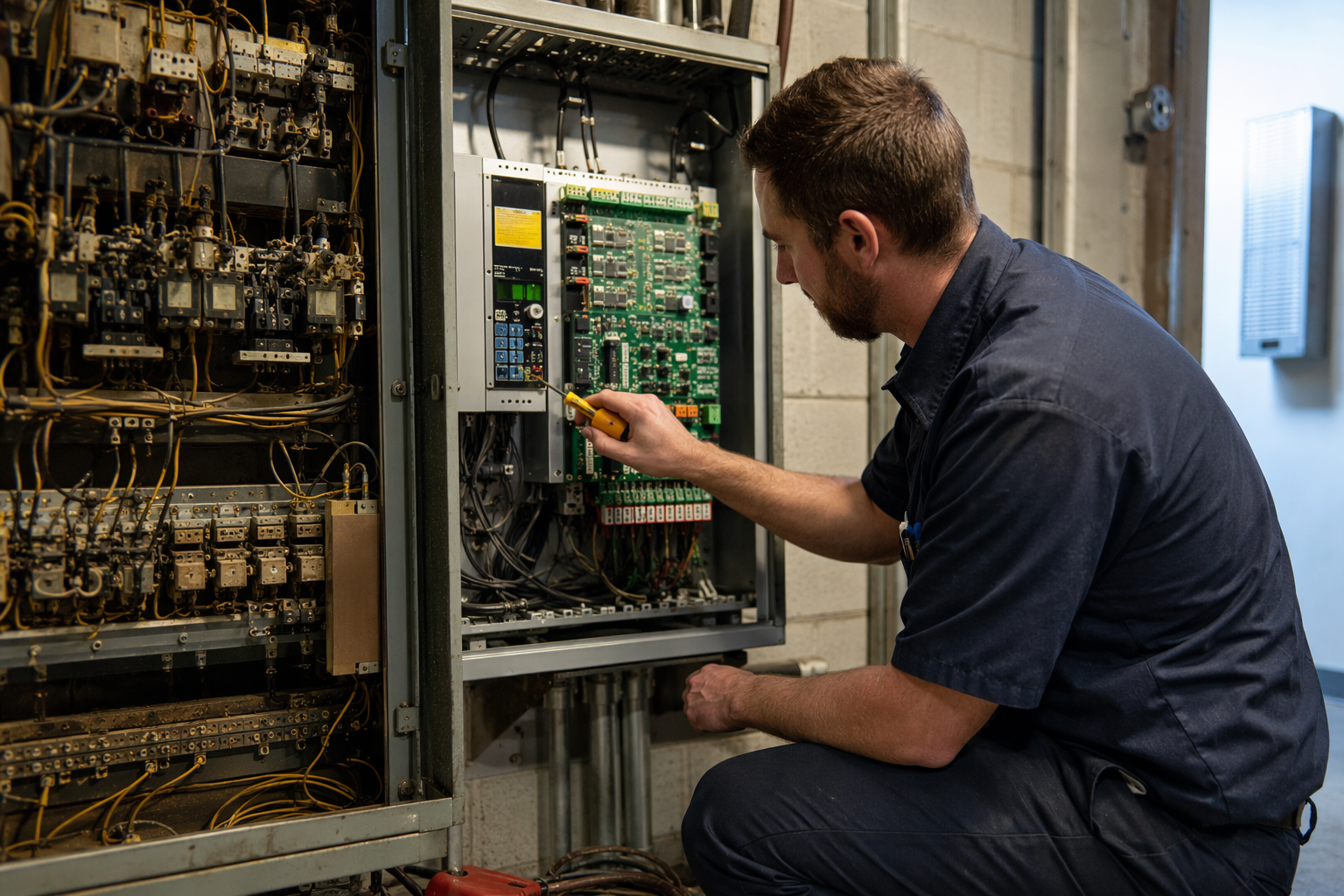
Elevator modernization updates specific components — controls, motors, drives, doors, and cab interiors — while retaining the existing hoistway structure and basic mechanical framework, whereas full replacement removes the entire system, including the hoistway equipment, and installs new machinery from the ground up.
Modernization is the industry’s preferred first response to aging equipment because it addresses the components most likely to fail — control systems, hydraulic power units, door operators — without the expense and construction disruption of removing and rebuilding an entire shaft installation. The hoistway itself (the shaft, pit, machine room, and structural elements) typically outlasts the mechanical and electronic components by decades, making targeted upgrades cost-effective.
Full replacement is warranted when the hoistway structure is compromised, when the unit type is being eliminated (such as converting a hydraulic unit in an older building that lacks compliant machine room space), or when cumulative code deficiencies make piecemeal modernization more expensive than starting fresh.
What does elevator modernization typically include?

A standard modernization scope covers the control system, drive system, door equipment, safety devices, and cab interior, with the specific components selected based on an engineering assessment of what is degraded or non-compliant.
Common modernization components include:
- Control systems: Replacing relay-logic or older microprocessor panels with current solid-state controllers that support group dispatching, remote monitoring, and energy management.
- Drive and motor packages: Upgrading DC drives to variable-voltage variable-frequency (VVVF) AC drive systems to reduce energy consumption and improve ride quality.
- Door operators and equipment: New high-speed door operators, door restrictors, and nudging features required under current editions of the ASME A17.1 Safety Code for Elevators and Escalators.
- Safety and code compliance devices: Car-top inspections stations, pit stops, governor systems, and car safeties brought to current code.
- Hydraulic system upgrades: New power units, environmentally safe fluids, and underground tank leak detection or tank replacement where required.
- Cab interior renovation: Flooring, lighting, ceiling, wall panels, handrails, and accessibility fixtures aligned with ADA requirements.
- Communication systems: Emergency lighting, two-way communication compliant with current ADA and ASME A17.1 provisions.
How do modernization and replacement costs compare?
Modernization generally represents a substantially lower capital investment than full replacement because it reuses the existing hoistway structure, which is among the most expensive elements of an elevator system to build or alter.
The table below provides a general framework for comparing scope and relative cost intensity. Note that actual project costs vary widely based on building type, local labor markets, equipment configuration, and the extent of code upgrades required. Building owners should obtain detailed assessments from a qualified elevator service company before budgeting.
| Decision Factor | Modernization | Full Replacement |
|---|---|---|
| Hoistway/structural work required | Minimal to none | Extensive; may require permits for structural modification |
| Relative capital cost | Lower | Higher (often significantly) |
| Construction disruption timeline | Weeks to a few months | Several months to over a year |
| Building permit complexity | Moderate | High; new installation permits in MD, DC, PA, VA |
| Equipment lifespan added | Typically extends useful life by many years | Full new system lifespan |
| Energy efficiency improvement | Significant with VVVF drive upgrades | Maximum with all-new equipment |
| Suitable when hoistway is | Structurally sound | Compromised or reconfigured |
| ADA compliance achievable | Yes, in most configurations | Yes, by design |
| Code compliance gaps | Addressable per state inspection authority | Full reset to current code |
| Financing and depreciation | Often qualifies as capital improvement | Full capital asset |
When does full replacement become the better investment?
Full replacement becomes the smarter long-term investment when the existing hoistway is structurally deficient, when the cumulative cost of required code upgrades approaches or exceeds replacement cost, or when the building’s use is changing in ways that require different elevator capacity or configuration.
Specific conditions that point toward replacement include severely corroded or damaged hoistway structures, machine-room-less (MRL) conversion needs in buildings without space for traditional machine rooms, underground hydraulic tank situations requiring complete excavation and remediation, and elevator systems so old that parts are no longer manufactured or available. In historic buildings across Baltimore and Philadelphia, the calculus often involves coordination with preservation authorities, which can make either path complex.
What code standards govern elevator modernization decisions in 2026?
The primary governing standard is the ASME A17.1 Safety Code for Elevators and Escalators, which is adopted by reference in Maryland, Washington DC, Pennsylvania, and Virginia, though each jurisdiction may be on a different adopted edition.
When a modernization project triggers a permit, the local authority having jurisdiction (AHJ) determines which code edition applies and which upgrades must be incorporated. In practice, this means that even a targeted drive replacement can require door restrictor upgrades, car-top inspection station additions, or pit safety device modifications if the AHJ determines those items are triggered by the scope of work. Property owners planning modernization projects should verify the current adopted edition with their state elevator inspection office before finalizing a scope of work.
ADA compliance requirements under the Americans with Disabilities Act apply independently of ASME A17.1 and must be addressed for any elevator serving a facility covered by the ADA — including commercial buildings, multifamily properties, and government facilities throughout Baltimore, Washington DC, Philadelphia, and Richmond.
How does Maryland regulate elevator modernization and inspections?
Maryland’s elevator program is administered by the Maryland Department of Labor, which requires permits for modernization work and mandates periodic inspections by state-licensed inspectors or third-party inspection agencies approved by the state.
Baltimore property owners must coordinate with both the Maryland Department of Labor’s Division of Labor and Industry and, for certain properties, Baltimore City’s own building inspection process. Modernization permits require submission of engineering drawings stamped by a licensed engineer, and the completed work must pass a full acceptance inspection before the elevator is returned to service. Working with a certified elevator service company familiar with Maryland’s permit workflow helps avoid delays.
How does Washington DC regulate elevator modernization?
Washington DC requires permits through the DC Department of Buildings (formerly DCRA) for any modernization work, and the adopted elevator code governs which components must be upgraded when a permit is pulled.
DC’s dense commercial and mixed-use building stock — including many older structures in neighborhoods like downtown, Capitol Hill, and Georgetown — frequently presents modernization complexity related to historic preservation, limited machine room access, and high-traffic operational requirements. The DC Department of Buildings conducts acceptance inspections after modernization work is complete, and elevators must hold a current operating certificate.
How does Pennsylvania regulate elevator modernization in Philadelphia?
Pennsylvania’s elevator safety program operates under the Pennsylvania Department of Labor and Industry, with Philadelphia also enforcing city-level requirements through the Department of Licenses and Inspections (L&I).
Philadelphia’s building stock includes a high concentration of older commercial towers, university buildings, and healthcare facilities, many of which operate elevators well past their original design generation. Modernization in Philadelphia often requires dual compliance review — state and city — and property managers benefit from working with elevator contractors experienced in navigating both permitting tracks simultaneously.
How does Virginia regulate elevator modernization in Richmond?
Virginia’s elevator program is administered by the Virginia Department of Labor and Industry (DOLI) under the Virginia Uniform Statewide Building Code, which adopts ASME A17.1 by reference.
Richmond’s mix of historic buildings, government facilities, and growing commercial real estate creates a varied modernization landscape. Virginia DOLI requires permits for modernization, and completed projects must be inspected and approved before returning to service. Quality Elevator Company works with property owners throughout Richmond to manage permit applications, engineering submissions, and inspection scheduling.
What factors drive up modernization costs the most?
The factors most likely to increase modernization costs beyond initial estimates include discovery of unreported prior alterations, underground hydraulic tank remediation, asbestos abatement in machine rooms of older buildings, hoistway structural repairs, and the number of code upgrades triggered by the permit scope.
Underground hydraulic tank situations deserve particular attention. Older hydraulic elevators — common in low-to-mid-rise buildings throughout Baltimore, Richmond, and Philadelphia — often have underground oil reservoirs that may require leak testing, remediation, or full replacement under environmental regulations. This work involves excavation and coordination with environmental contractors, and it can represent a meaningful share of total project cost. A thorough pre-modernization assessment identifies these conditions before contract execution.
What is the step-by-step process for planning an elevator modernization project?
A well-managed modernization follows a structured process that reduces surprises, controls costs, and ensures code compliance from permit application through final inspection.
- Commission a condition assessment: Have a qualified elevator service company inspect all mechanical, electrical, and structural components, document deficiencies, and identify code gaps relative to the current adopted standard in your jurisdiction.
- Define the modernization scope: Based on the assessment, determine which components will be replaced or upgraded. Align the scope with your budget and the projected remaining useful life of the building.
- Engage a licensed engineer: Most jurisdictions require stamped engineering drawings for permit applications. Retain a professional engineer with elevator expertise early in the process.
- Apply for permits: Submit permit applications to the state elevator inspection authority and any applicable local agency (e.g., Philadelphia L&I, Baltimore City). Allow sufficient time for review cycles.
- Procure equipment: Order modernization components early, as lead times for control systems, drive packages, and specialty items can extend project timelines.
- Schedule outage with building management: Coordinate elevator downtime with tenants, operations staff, and any occupants with mobility needs to minimize disruption.
- Execute installation: A certified elevator contractor performs the modernization per approved drawings and manufacturer specifications.
- Conduct internal quality inspection: Before calling for the state inspection, the elevator contractor performs a thorough self-inspection against code requirements.
- Schedule and pass the acceptance inspection: The AHJ inspector reviews the completed work. Address any items noted before final approval.
- Return elevator to service: Upon issuance of the updated certificate of operation, the elevator is returned to full service with updated documentation on file.
How long does an elevator modernization project take compared to full replacement?
Modernization projects typically complete in a shorter timeframe than full replacement because they do not require structural hoistway construction, though the actual duration depends on the scope of upgrades, permit review timelines, and equipment lead times.
A controls-and-drive modernization on a single elevator unit in a straightforward commercial building can take several weeks of active installation time, though total project duration from permit application to final inspection approval commonly spans multiple months when permitting and equipment procurement are included. Full replacement projects, which involve removing all existing equipment and building out new installations, typically run considerably longer and may require temporary elevator provisions for buildings with accessibility obligations. Quality Elevator Company helps property managers plan realistic project timelines during the assessment phase.
Can elevator modernization bring an older unit into full ADA compliance?
Yes, in most cases modernization can achieve full ADA compliance, including accessible cab controls, door timing and force requirements, visual and audible signals, and two-way emergency communication — though certain dimensional requirements may present constraints in very old or unusually configured hoistways.
ADA Section 4.10 (for elevators) specifies requirements for floor designation controls, door reopening devices, door timing, cab dimensions, handrails, flooring, and emergency communication. Most of these elements are addressed as standard components of a thorough modernization. Hoistway width and cab dimension requirements can present challenges in historic buildings where structural modification is restricted, but code analysis by a qualified professional typically identifies compliant solutions.
What energy savings can be expected from elevator modernization?
Upgrading from older drive systems to modern variable-voltage variable-frequency (VVVF) AC drives is among the most impactful energy improvements available through modernization, producing meaningful reductions in elevator-related electrical consumption.
The magnitude of savings depends on the original drive technology being replaced, the duty cycle of the elevator, and the building’s utility rates. Older DC motor systems and single-speed AC systems draw substantially more power than modern VVVF drives, which regulate motor speed and torque precisely to match load and speed requirements. LED cab lighting upgrades, regenerative drive options, and standby mode programming add additional efficiency gains. Building owners pursuing LEED certification or sustainability goals in Washington DC and Philadelphia — both markets with strong green building requirements — often find that elevator modernization contributes meaningfully to energy reduction targets.
How should building owners evaluate elevator service companies for modernization work?
Building owners should evaluate elevator modernization contractors on the basis of state licensing and certification, experience with the specific equipment type and building category, familiarity with local permitting processes, and the quality of their pre-project assessment process.
Key due-diligence questions include: Is the contractor licensed to perform elevator work in the specific state and municipality? Does the company employ certified elevator constructors (CECs) or comparable credentialed mechanics? Can the contractor provide references for similar modernization projects in the region? Does the contractor manage permit applications, engineering coordination, and inspection scheduling, or is that left to the building owner? Quality Elevator Company serves building owners across Baltimore, Washington DC, Philadelphia, and Richmond with modernization project management from assessment through final inspection approval.
What are the most common mistakes building owners make when planning elevator modernization?
The most costly mistakes in elevator modernization planning include underscoping the project (failing to address all triggered code requirements), selecting a contractor based on initial price without evaluating total project management capability, and failing to account for equipment lead times in project scheduling.
Underscoping is particularly common when building owners attempt to minimize upfront cost by replacing only one failed component without a full code-gap assessment. In many jurisdictions, pulling a permit for even a limited scope triggers mandatory upgrades to related safety systems — meaning the savings anticipated from a narrow scope may not materialize, and the project may need to be reopened. A comprehensive assessment at the outset prevents this scenario.
What safety standards apply specifically to modernization work under ASME A17.1?
The ASME A17.1 Safety Code for Elevators and Escalators contains specific provisions governing alterations and modernization, distinguishing between component replacements that do not trigger full code compliance review and alterations that do trigger review of related systems.
ASME A17.1 Rule 8.7 governs alterations and defines which changes require the entire elevator to be upgraded to the current standard versus which allow component-by-component replacement in kind. The adopted edition of A17.1 in each jurisdiction — Maryland, DC, Pennsylvania, and Virginia may each reference different adopted editions — determines which specific requirements apply. This is why permit pre-application meetings with the AHJ are valuable for complex modernization projects: they establish the compliance baseline before engineering work begins.
How does elevator age factor into the modernization versus replacement decision?
Elevator age is an input into the decision, but condition and parts availability are more determinative factors, since a well-maintained 30-year-old unit may be an excellent modernization candidate while a neglected 20-year-old unit may present greater complexity.
Equipment generations matter as much as calendar age. Relay-logic control systems from earlier eras often cannot be repaired because relay components are no longer manufactured. Hydraulic power units from older generations may use fluids now restricted under environmental regulations. In contrast, a 25-year-old unit with a first-generation microprocessor controller may have robust upgrade paths available from the original equipment manufacturer or through third-party control suppliers. An honest condition assessment — not calendar age alone — should drive the decision.
Are there financing or incentive programs available for elevator modernization?
Financing options for elevator modernization include traditional commercial loans, equipment financing, and in some cases energy efficiency incentive programs offered by state and local utilities, though the availability of specific programs varies by jurisdiction and changes over time.
Building owners in Washington DC and Philadelphia should investigate whether local sustainability incentive programs apply to elevator drive upgrades, as these jurisdictions have active green building and energy efficiency policy frameworks. In Maryland and Virginia, utility rebate programs for commercial energy efficiency improvements may apply to VVVF drive installations. Property owners should verify current program availability with their utility provider and tax advisor, as these programs are subject to legislative change.
How can property managers prepare a building for elevator modernization with minimum disruption?
Effective preparation involves advance communication with all building occupants, temporary accessibility planning for residents or tenants with mobility needs, coordination of freight scheduling, and a clear understanding of the daily work schedule during the outage period.
Buildings with a single elevator present the greatest disruption challenge, particularly in residential properties with elderly or mobility-impaired residents who have ADA-protected accommodation rights. Property managers should work with their elevator contractor to sequence work in ways that minimize outage duration, consider temporary lift solutions where feasible, and provide written advance notice to all affected parties well before work begins. Quality Elevator Company assists property managers throughout Baltimore, Washington DC, Philadelphia, and Richmond in developing occupant communication plans as part of pre-project coordination.
Ready to Determine Whether Modernization or Replacement Is Right for Your Building?
The decision between elevator modernization and full replacement requires a detailed, on-site assessment by qualified professionals familiar with local code requirements in Maryland, Washington DC, Pennsylvania, and Virginia. A thorough evaluation examines equipment condition, code compliance gaps, hoistway integrity, and long-term building plans to produce a recommendation grounded in engineering reality — not sales assumptions.
Contact Quality Elevator Company for a free elevator assessment. Serving building owners and property managers in Baltimore MD, Washington DC, Philadelphia PA, and Richmond VA.
Call: 301-307-5363
Need elevator service you can rely on? Quality Elevator Company is ready to help.