How Often Should Elevators Be Inspected? The Complete FAQ Guide for Building Owners
Elevator inspection schedules are one of the most consequential — and most misunderstood — compliance obligations a building owner faces. Miss an inspection cycle and the consequences range from certificate revocation to full shutdown orders, liability exposure, and, most importantly, real risk to the people who ride the equipment every day. This FAQ hub covers every angle of the question, from baseline code requirements to state-specific rules in Maryland, Washington DC, Pennsylvania, and Virginia, to what actually happens during an inspection visit.
1. How often should elevators be inspected?
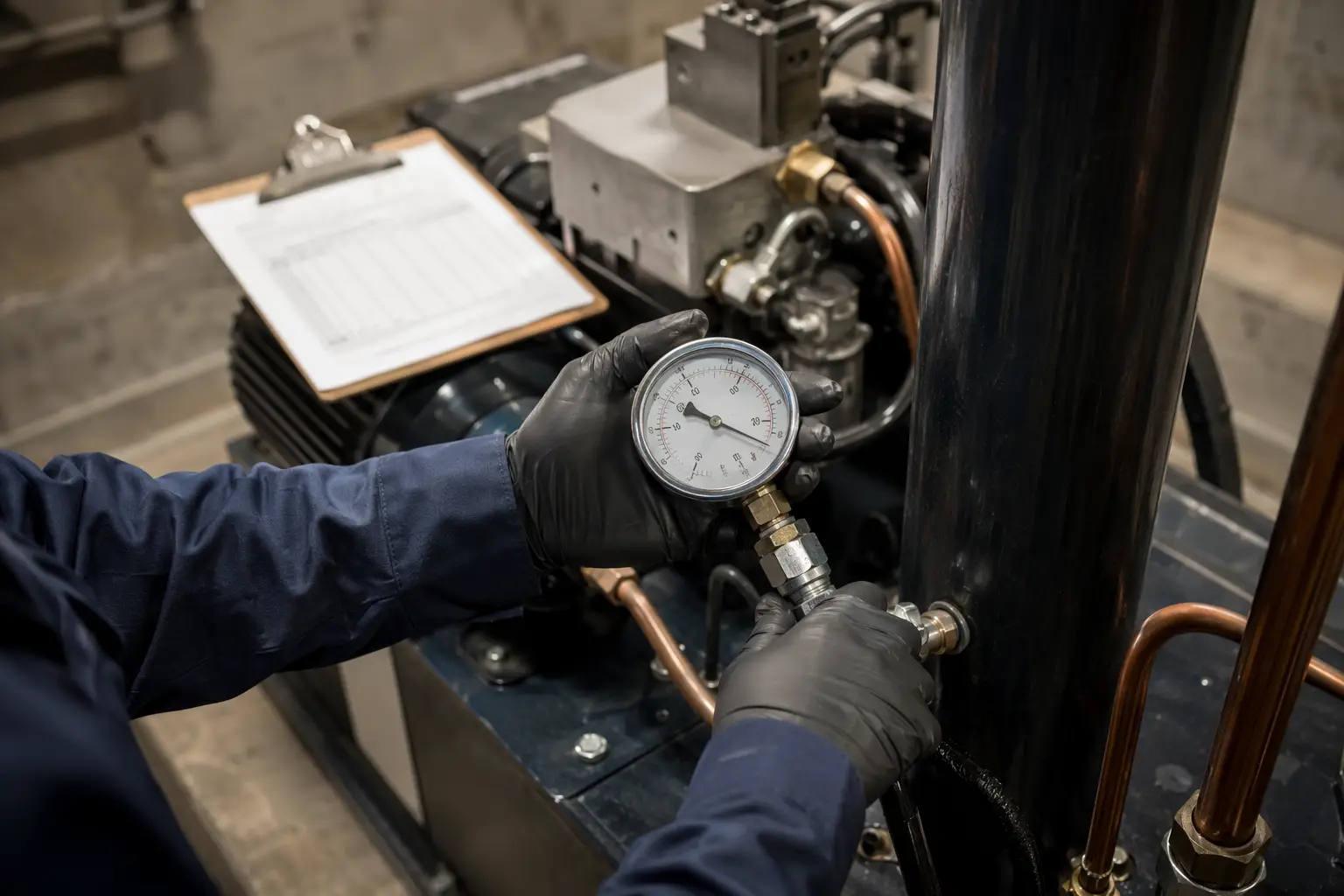
Most elevators require a state-certified safety inspection at least once every twelve months, though many jurisdictions and elevator types require more frequent periodic checks.
The baseline framework comes from ASME A17.1 Safety Code for Elevators and Escalators, the model code that nearly every U.S. state adopts in whole or in modified form. Under ASME A17.1, a routine inspection and test must be performed at defined intervals that vary by equipment category — hydraulic units, traction units, escalators, and dumbwaiters each carry their own schedules.
Beyond the annual safety inspection, ASME A17.1 requires periodic tests — such as the five-year full-load safety test for traction elevators — that go deeper than a routine annual visit. Building owners should understand that “inspection” and “test” are distinct obligations under the code, and both must appear on a current certificate of compliance to be considered fully compliant.
2. What is the difference between an elevator inspection and an elevator test?

An inspection is a visual and operational review of all safety components, while a test is a physical performance verification — such as applying full load to safety brakes — that proves the equipment meets specific performance thresholds.
Under ASME A17.1, inspections are generally annual, but certain tests are required on longer cycles. The most common periodic test for traction elevators is the Category 5 test, which requires applying full rated load and demonstrating that the safeties and buffers perform correctly. This test is typically required every five years and must be witnessed by a qualified inspector.
Hydraulic elevators carry their own test requirements, including periodic pressure relief valve tests and piston safety tests. Confusing the two obligations — or completing only one — is a common compliance gap that can result in a failed inspection report.
3. What does ASME A17.1 actually require for inspection frequency?
ASME A17.1 establishes inspection and test intervals by equipment type, with annual routine inspections as the standard baseline and periodic tests on one-year, three-year, or five-year cycles depending on the specific requirement.
The code organizes tests into categories. Category 1 tests (annual) cover safety and governor mechanisms under no-load or rated-load conditions. Category 3 tests apply to safeties on a one-year cycle for certain equipment. Category 5 tests, the most comprehensive, require full-load safety and buffer performance verification and are due every five years for most traction elevators.
Because ASME A17.1 is a model code, individual states and jurisdictions may adopt it with amendments that tighten — but rarely loosen — these intervals. Building owners in Maryland, Washington DC, Pennsylvania, and Virginia should always verify the specific local adoption to understand exactly which cycle applies to their equipment.
4. How do elevator inspection requirements differ by state in the mid-Atlantic region?
Maryland, Washington DC, Pennsylvania, and Virginia each adopt ASME A17.1 with state-specific amendments, meaning inspection intervals, licensing requirements, and enforcement agencies vary across these jurisdictions.
| Jurisdiction | Governing Body | Routine Inspection Cycle | Code Basis |
|---|---|---|---|
| Maryland | Maryland Department of Labor, Elevator Safety Unit | Annual | ASME A17.1 (state-adopted edition) |
| Washington DC | DC Department of Consumer and Regulatory Affairs (DCRA) | Annual | ASME A17.1 (DC amended edition) |
| Pennsylvania | PA Department of Labor & Industry, Elevator Safety Division | Annual | ASME A17.1 (state-adopted edition) |
| Virginia | Virginia Department of Labor and Industry (DOLI) | Annual | ASME A17.1 (state-adopted edition) |
While annual routine inspections are consistent across these four jurisdictions, each state’s enforcement agency may have distinct requirements for inspector credentials, permit renewal timelines, and the process for scheduling state-witnessed periodic tests. Quality Elevator Company maintains active relationships with the relevant authorities in all four markets and keeps current with any amendments that affect its clients’ compliance calendars.
5. Who is qualified to perform an elevator inspection?
Only state-licensed or state-certified elevator inspectors — or inspectors holding certification from a recognized body such as QEI (Qualified Elevator Inspector) under ASME — are legally authorized to issue a certificate of inspection in most jurisdictions.
Many states allow building owners to use either a state inspector or a third-party inspector who holds appropriate credentials. A QEI-certified inspector has demonstrated competency across the full scope of ASME A17.1 requirements and is recognized in Maryland, DC, Pennsylvania, and Virginia. However, building owners should confirm with the local authority having jurisdiction (AHJ) whether a third-party inspection certificate is accepted in lieu of a state-conducted inspection, as policies differ.
It is important to distinguish between a maintenance technician — who keeps the equipment running — and an inspector, who must remain independent enough to issue an objective compliance finding. Some jurisdictions prohibit the same company that performs routine maintenance from also conducting the official periodic inspection.
6. What happens if an elevator fails an inspection?
A failed inspection results in a violation notice and, if the deficiency is serious enough, an immediate out-of-service order that legally prohibits the elevator from carrying passengers until corrections are made and verified.
The severity of the response depends on the nature of the deficiency. Minor items — such as a missing certificate posting or a lighting failure — may result in a written notice with a correction deadline. Structural or safety-critical failures, such as a malfunctioning safety device or a hydraulic leak, typically trigger an immediate shutdown order.
Once corrections are completed, the building owner must schedule a re-inspection to have the violations cleared before the elevator can return to service. This process can take days to weeks depending on parts availability and the jurisdiction’s scheduling capacity, which is one of the strongest arguments for proactive preventive maintenance over reactive repairs.
7. What are the steps a building owner should take immediately after receiving a failed inspection notice?
A building owner who receives a failed inspection notice should act systematically and quickly to protect both the people in the building and the owner’s legal standing.
- Take the elevator out of service immediately if the inspector has not already done so and the violation is safety-critical. Post a clear out-of-service notice at every landing.
- Read the violation notice in full and identify whether each item is categorized as a critical deficiency (immediate shutdown required) or a non-critical deficiency (correction within a specified timeframe).
- Contact a licensed elevator service company the same business day to schedule an emergency assessment of the cited deficiencies.
- Document all existing conditions with photos before any repair work begins — this creates a baseline record in case of a dispute about the scope of work required.
- Obtain a written repair scope and timeline from the elevator company before authorizing work, so you can present the AHJ with a documented remediation plan.
- Notify your building insurer of the out-of-service status and the violation, as policy requirements vary regarding timely notification of compliance incidents.
- Schedule the re-inspection as soon as the repair company confirms completion and has provided a sign-off that the corrected items meet code.
- Retain all paperwork — the original violation notice, repair invoices, technician sign-offs, and the re-inspection certificate — in a permanent equipment file for the elevator.
8. How often should hydraulic elevators be inspected compared to traction elevators?
Both hydraulic and traction elevators require annual routine inspections, but they carry different periodic test schedules because their mechanical systems — and the failure modes that testing is designed to catch — differ substantially.
Hydraulic elevators require periodic testing of the pressure relief valve, the hydraulic cylinder integrity, and the safeties. Many jurisdictions require a pressure vessel inspection on a cycle aligned with state boiler and pressure vessel regulations in addition to the standard ASME A17.1 tests. Traction elevators, by contrast, require governor and safety mechanism tests under Category 1 annually, and the full Category 5 load test every five years.
For underground hydraulic cylinders — common in older installations — some jurisdictions require additional testing for cylinder corrosion and leak detection, particularly given the environmental liability associated with hydraulic fluid contamination of groundwater. Buildings in Baltimore, DC, Philadelphia, and Richmond with older hydraulic units should confirm with their elevator service company whether any supplementary cylinder testing applies to their specific installation.
9. Does ADA compliance affect elevator inspection requirements?
The Americans with Disabilities Act (ADA) establishes accessibility requirements for elevator features — such as door timing, cab dimensions, and control reach ranges — that are reviewed as part of a comprehensive inspection and that building owners are legally required to maintain.
ADA elevator requirements are not an optional upgrade — they are a federal civil rights obligation for any building that is subject to Title II or Title III of the Act, which covers virtually all commercial buildings open to the public. During an elevator inspection, an inspector may note ADA-related deficiencies such as a door that closes too quickly, worn Braille markings on control panels, or an auditory signal system that has failed.
While ADA compliance is enforced separately from state elevator inspection programs, a building owner who ignores ADA deficiencies flagged during an inspection faces dual liability: a potential state violation notice and exposure to a federal ADA complaint or lawsuit. Proactive maintenance of ADA features should be part of every elevator maintenance agreement.
10. How often should a building owner schedule preventive maintenance visits, separate from formal inspections?
Industry best practice and most service contracts call for monthly preventive maintenance visits on moderately to heavily used elevators, with quarterly visits sometimes appropriate for very low-use residential equipment.
Preventive maintenance is distinct from the formal inspection process. A maintenance visit by a licensed elevator technician addresses lubrication, adjustment, cleaning of the machine room and pit, and functional testing of safety devices — tasks designed to keep the equipment operating within tolerances before a deficiency develops into a failure or a violation. Monthly visits are generally considered appropriate for commercial elevators in office buildings, hospitals, hotels, and mixed-use properties.
The logic is straightforward: an elevator that receives regular professional attention is far less likely to generate a failed inspection finding, an unplanned outage, or an injury. Quality Elevator Company structures its maintenance programs around the specific duty cycle and equipment type of each unit it services across its Baltimore, Washington DC, Philadelphia, and Richmond markets.
11. What does an elevator inspection actually cover?
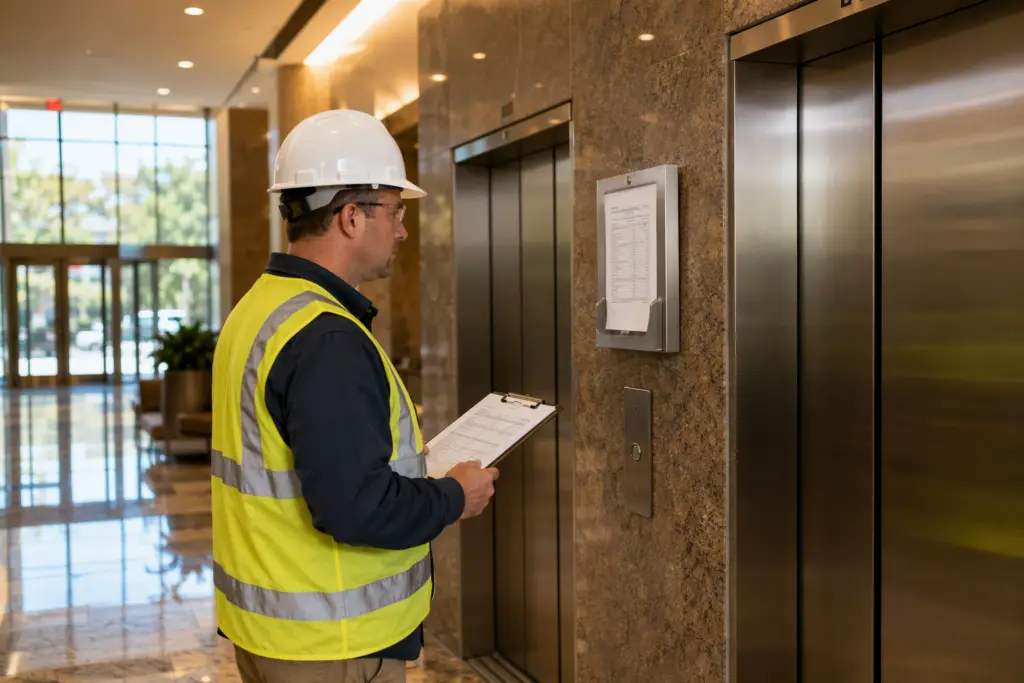
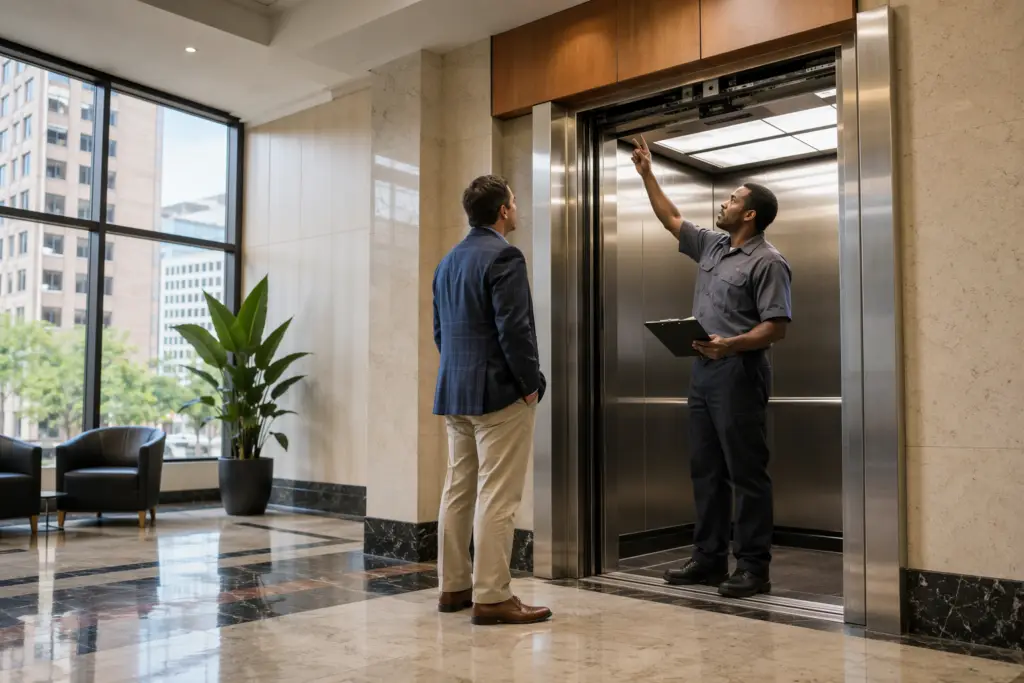
A thorough elevator inspection covers the machine room, the hoistway, the cab, all landing entrances, the pit, and every mechanical and electrical safety device required by the applicable edition of ASME A17.1.
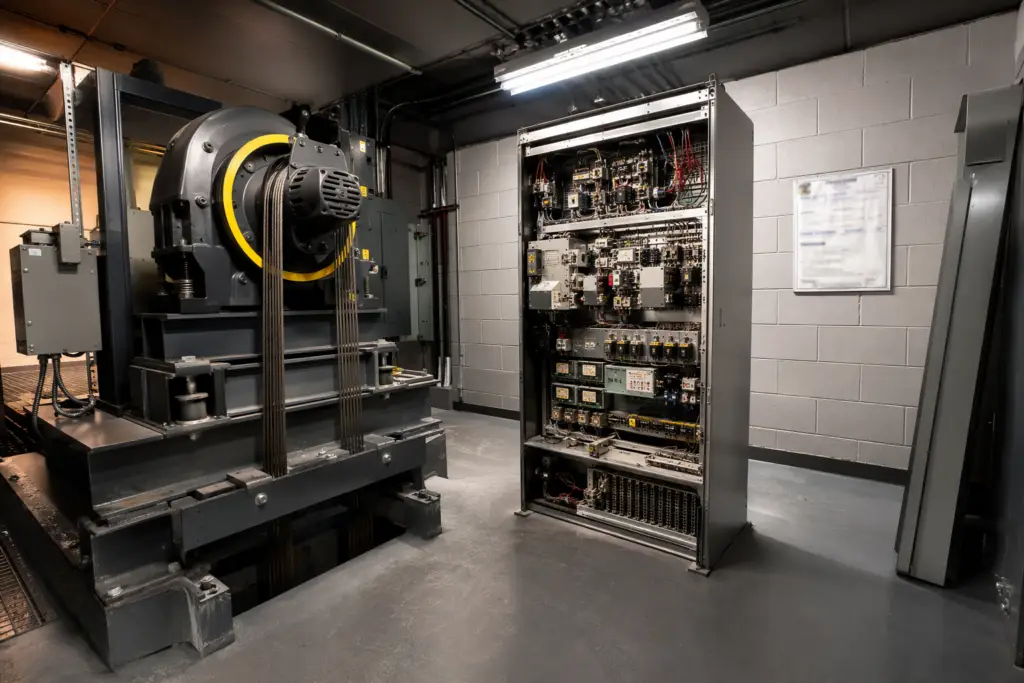
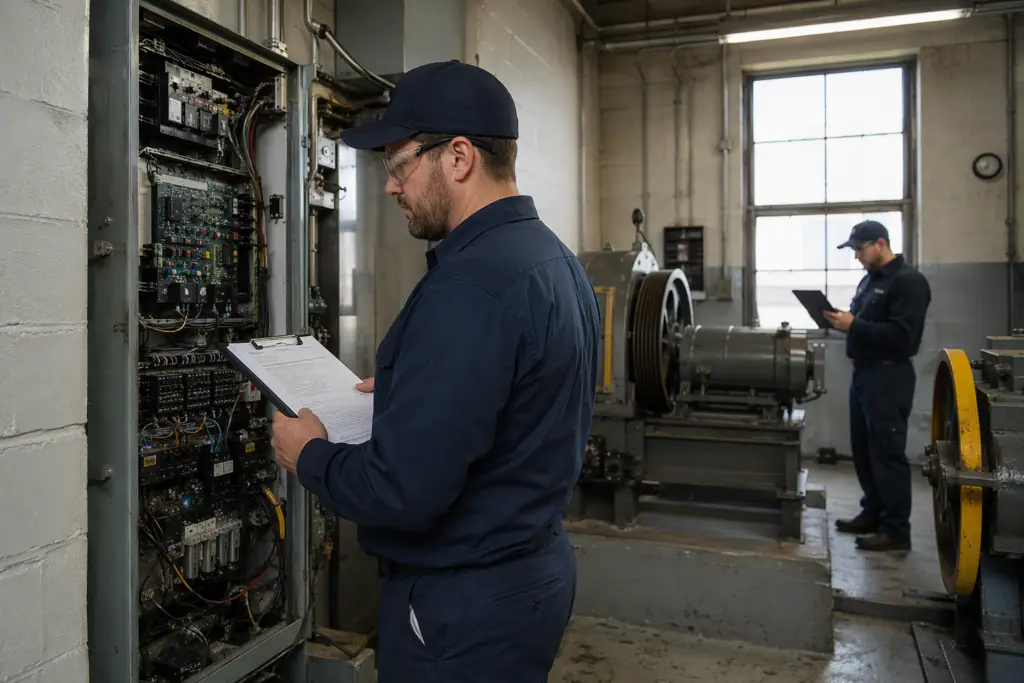
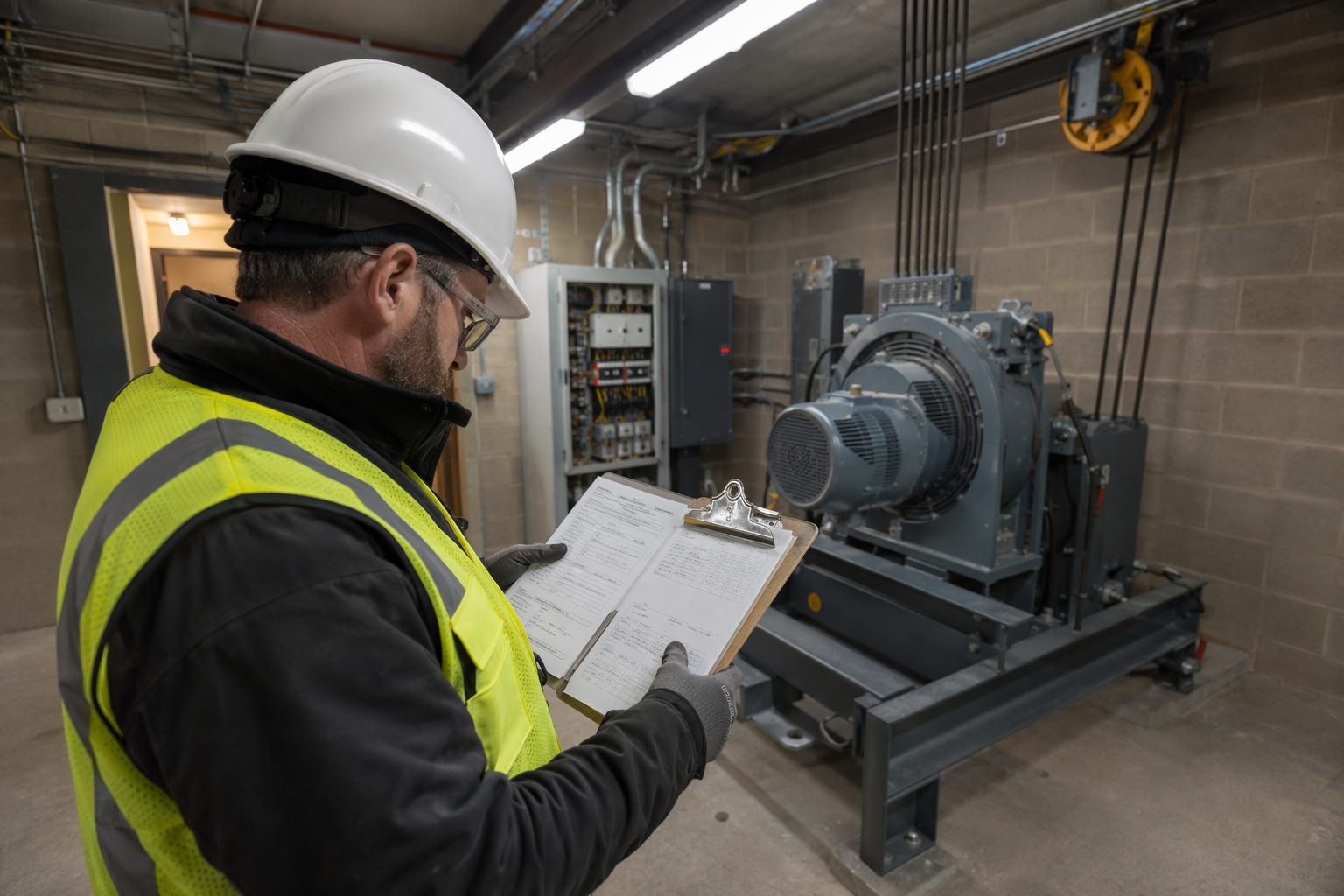
In the machine room, the inspector evaluates the drive machine, controller, governor, and machine room environment (lighting, clearances, fire protection). In the hoistway, the inspector checks guide rails, counterweights, ropes or hydraulic components, buffers, and limit switches. At each landing, door interlocks, sills, and landing signal equipment are verified. The cab itself is reviewed for lighting, emergency communication, capacity postings, and certificate display. In the pit, oil levels, pit lighting, stop switches, and buffer conditions are examined.
The complete checklist for a given unit depends on the equipment type and the specific code edition in force in that jurisdiction. A competent elevator service company will prepare equipment for inspection by conducting a pre-inspection review against the same checklist the inspector will use.
12. Are there different inspection requirements for residential elevators versus commercial elevators?
Yes — residential elevators, including those in single-family homes, are governed by ASME A17.1 Section 5.3 (private residence elevators) or by ASME A18.1 for platform lifts, which carry different — and generally less frequent — inspection requirements than commercial elevators.
Many states exempt private residence elevators from mandatory annual inspection by state authorities, placing the responsibility on the homeowner to maintain the equipment according to the manufacturer’s specifications and the applicable code. However, this exemption varies by jurisdiction. In some states, residential elevators in multi-family buildings — condominiums, co-ops, apartment complexes — are treated as commercial equipment and subject to the full annual inspection regime.
Building owners and property managers in the Baltimore, DC, Philadelphia, and Richmond markets should confirm with the local AHJ whether their specific residential application falls under mandatory state inspection jurisdiction before assuming an exemption applies.
13. What is the role of OSHA in elevator safety and inspections?
OSHA addresses elevator safety primarily in the context of worker safety during construction and maintenance operations, rather than the periodic inspection of passenger elevators in occupied buildings, which falls under state elevator safety programs.
OSHA regulations govern the safety of elevator technicians while they perform maintenance and repair — covering lockout/tagout procedures, fall protection in hoistways, and electrical safety. For construction hoists, OSHA has specific standards that differ significantly from ASME A17.1 passenger elevator requirements.
Building owners are most directly affected by state elevator inspection programs rather than OSHA, but the intersection matters: if an elevator technician is injured while working on a building’s equipment, OSHA has jurisdiction to investigate and cite the building owner if they contributed to an unsafe working environment. Ensuring that qualified, properly equipped service companies are engaged for all elevator work protects the building owner against this class of liability as well.
14. How long does an elevator inspection typically take?
A routine annual inspection of a single elevator typically takes between one and three hours, depending on the complexity of the equipment, the thoroughness of the inspector, and whether any deficiencies require additional investigation.
More complex equipment — a high-rise traction elevator with multiple entrances, a hospital elevator with specialized features, or a unit that is overdue for a periodic test — will take longer. Category 5 full-load tests, which require the presence of the inspector and a qualified elevator company with test weights and documentation, can take a full workday for a single unit.
Building operations teams should plan for the elevator to be out of normal service during the inspection window and communicate this to occupants in advance, particularly in buildings where elevator access is critical for individuals with disabilities. Having an alternative accessible route identified before inspection day is considered good facility management practice.
15. What documentation should building owners retain related to elevator inspections?
Building owners should maintain a permanent equipment file for each elevator that includes the current certificate of inspection, all historical inspection reports, periodic test records, maintenance logs, repair invoices, and any violation notices with their resolution documentation.
Most jurisdictions require that the current certificate of inspection be posted in the elevator cab in a visible location — this is a requirement under ASME A17.1 and is specifically checked during inspections. Beyond the posting requirement, retaining a full historical file serves several practical purposes: it demonstrates a pattern of compliance to regulators, supports insurance claims, assists resale due diligence, and provides a baseline for diagnosing recurring issues.
In the event of an incident — a passenger injury, an entrapment, or a mechanical failure — the inspection and maintenance record is often the first document requested by attorneys, insurers, and regulators. Gaps in the record are difficult to explain and can significantly complicate the building owner’s legal position.
16. How much does an elevator inspection cost?
Elevator inspection costs vary by jurisdiction, equipment type, and whether the inspection is conducted by a state agency or a certified third-party inspector, making it important for building owners to obtain specific quotes rather than relying on general estimates.
State-conducted inspections often involve a government fee schedule that is set by the regulatory agency, while third-party inspections are priced by the market. Periodic tests such as the Category 5 five-year test are more expensive than annual routine inspections because they require more time, specialized equipment such as test weights, and coordination between the inspector and the elevator service company.
Beyond the inspection fee itself, building owners should budget for any corrective work identified during the inspection. An elevator that has been well-maintained is likely to have minimal correction costs. One that has not received consistent professional maintenance may require significant repairs to pass. The cost of deferred maintenance almost always exceeds the cost of a proactive maintenance program over any multi-year horizon.
17. Can an elevator be shut down by authorities if it is out of inspection?
Yes — operating an elevator without a current, valid certificate of inspection is a violation of state law in Maryland, Washington DC, Pennsylvania, and Virginia, and authorities have the power to issue an immediate shutdown order and impose fines.
State elevator safety divisions conduct periodic audits of building compliance, and complaints from building occupants can trigger unannounced inspections. An elevator found to be operating past its inspection expiration date will receive a violation notice at minimum. Depending on the jurisdiction and the severity of the lapse, the AHJ may issue an immediate out-of-service order, require a re-inspection before the unit is returned to service, and assess civil penalties.
Beyond regulatory penalties, an elevator injury that occurs while the unit is operating without a valid inspection certificate creates a presumption of negligence in most courts — a significant litigation risk for building owners, property managers, and landlords.
18. How should building owners choose an elevator service company for inspections and maintenance?
Building owners should select an elevator service company that holds the appropriate state contractor licenses for their jurisdiction, employs technicians with recognized credentials, has documented experience with their specific equipment type, and can demonstrate familiarity with the local AHJ and its requirements.
Key questions to ask any prospective elevator service company include: Are you licensed to perform elevator work in this state? Do your inspection personnel hold QEI certification or equivalent credentials recognized by this jurisdiction? Can you provide references from buildings with similar equipment in this market? What is your process for managing the inspection certificate renewal cycle on behalf of clients?
Quality Elevator Company serves the Baltimore, Washington DC, Philadelphia, and Richmond markets with a focus on code-compliant maintenance and a working knowledge of each jurisdiction’s specific inspection and permit requirements. Building owners benefit from working with a company that treats compliance management as a core service, not an afterthought.
19. What are the most common reasons elevators fail inspections?
The most common elevator inspection failures involve safety device deficiencies, door operation problems, missing or expired documentation, pit and machine room violations, and deferred maintenance items that have degraded below code-required thresholds.
Door-related issues — interlocks that are worn or misaligned, closing speeds outside the required range, or door reopening devices that are not functioning correctly — are among the most frequently cited deficiency categories. Safety device failures, including governors that are past their test date or buffers that have not been tested on schedule, are also common findings on elevators that have not received consistent professional maintenance.
Administrative failures are particularly avoidable: expired certificates, missing emergency contact postings, or the absence of required documentation in the machine room can all result in a violation even when the mechanical condition of the elevator is otherwise sound. A disciplined preventive maintenance program that includes an administrative audit before each inspection is the most reliable way to avoid these findings.
20. How can building owners stay ahead of elevator inspection deadlines?
Building owners can stay ahead of inspection deadlines by maintaining a compliance calendar for each elevator unit, working with a service company that actively tracks renewal dates, and scheduling pre-inspection maintenance visits well in advance of the inspection due date.
A compliance calendar should include the annual inspection due date, the due dates for any periodic tests (Category 1, Category 5, or hydraulic-specific tests), the maintenance visit schedule, and any other recurring permit or fee deadlines required by the local AHJ. For building portfolios with multiple elevators across multiple jurisdictions — a common situation for property management companies operating across the Baltimore, DC, Philadelphia, and Richmond region — tracking these obligations manually is prone to error.
Quality Elevator Company manages inspection and compliance tracking as part of its service relationships, alerting clients to upcoming deadlines and scheduling pre-inspection maintenance visits to maximize the likelihood of a clean inspection result. Proactive management of the inspection calendar is one of the most cost-effective risk management practices available to building owners.
Ready to Confirm Your Elevator Is Fully Compliant?
Elevator inspection compliance is not a one-time event — it is an ongoing obligation that requires systematic tracking, qualified service relationships, and a proactive approach to maintenance. Whether a building has a single residential unit or a multi-elevator commercial portfolio spanning multiple jurisdictions, the stakes of non-compliance are real: regulatory penalties, liability exposure, equipment downtime, and — most importantly — risk to the people who depend on that elevator every day.
Quality Elevator Company serves building owners, property managers, and facility teams across Baltimore MD, Washington DC, Philadelphia PA, and Richmond VA. The team brings current working knowledge of each jurisdiction’s inspection requirements, a commitment to code-compliant service, and the kind of practical expertise that comes from operating at the intersection of technical elevator work and regulatory compliance every day.
Contact Quality Elevator Company for a free elevator assessment. Call 301-307-5363 to speak with a member of the team about your inspection schedule, compliance calendar, and maintenance program.
Code References: ASME A17.1 Safety Code for Elevators and Escalators | Americans with Disabilities Act (ADA) | OSHA