
Elevator Service Company vs. OEM Manufacturer: Everything Building Owners Need to Know
Choosing between an independent elevator service company and an OEM manufacturer’s service division is one of the most consequential decisions a building owner or facility manager will make. The right choice affects compliance standing, long-term maintenance costs, equipment longevity, and the safety of every passenger who steps into the cab. This comprehensive FAQ hub covers every dimension of that decision, from regulatory requirements to vendor contracts, for building owners operating in Baltimore, Washington DC, Philadelphia, and Richmond.
What is the core difference between an elevator service company and an OEM manufacturer?
An independent elevator service company is licensed to maintain, repair, and modernize elevators from any manufacturer, while an OEM manufacturer’s service division is contractually and technically focused on its own brand of equipment.
OEMs such as Otis, KONE, Schindler, and ThyssenKrupp manufacture elevator systems and also offer proprietary service contracts. Their technicians are trained specifically on their own equipment and often use diagnostic tools or software that are not accessible to outside parties. This creates a degree of vendor lock-in that can limit a building owner’s negotiating power.
Independent elevator service companies, by contrast, train their technicians across multiple equipment platforms. They carry parts inventories and diagnostic knowledge for a wide range of manufacturers, giving building owners a single point of contact regardless of how many different elevator brands are installed in a property portfolio.
Is one type of provider legally required for elevator maintenance?

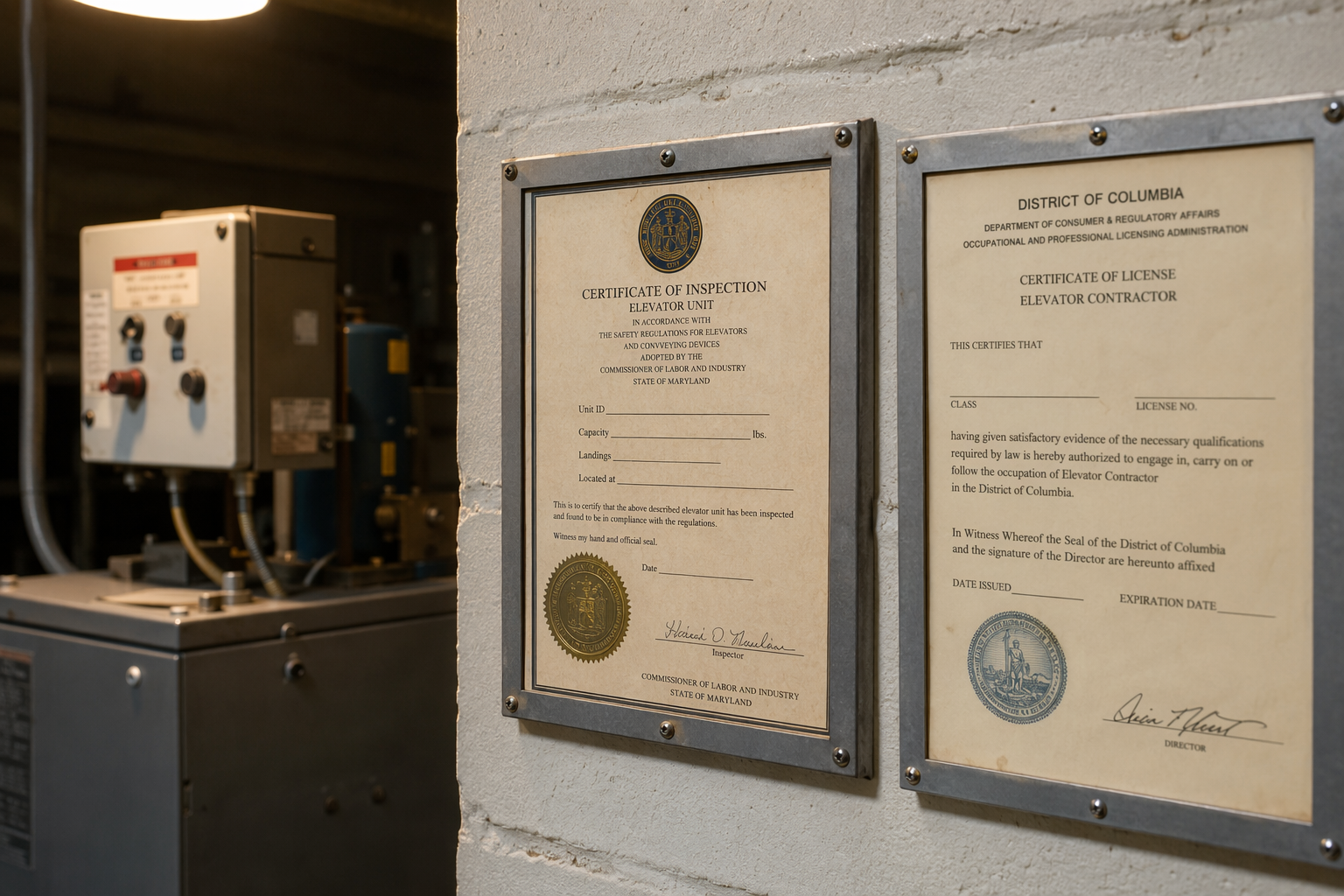
No law universally mandates the use of an OEM; building owners in Maryland, Washington DC, Pennsylvania, and Virginia are required to ensure maintenance is performed by licensed elevator mechanics or contractors, which independent service companies fully satisfy.
Each jurisdiction enforces its own licensing and permit framework. In Maryland, elevator work is regulated under the Department of Labor’s Division of Labor and Industry. Washington DC requires elevator contractor registration and adherence to the ASME A17.1 Safety Code for Elevators and Escalators. Pennsylvania’s Department of Labor and Industry issues elevator mechanic and contractor licenses. Virginia enforces its own Uniform Statewide Building Code, which also adopts ASME A17.1 as its technical standard.
In every one of these markets, a certified independent elevator service company can legally and compliantly perform all maintenance, inspection, and repair work. OEM service is not a regulatory requirement; it is a contractual option.
Does using an independent service company affect elevator warranty coverage?
It can, but the impact depends on the warranty terms, the age of the equipment, and whether the independent company uses OEM-approved parts and procedures.
New elevators typically carry a manufacturer’s warranty ranging from one to five years on major components. During this period, building owners should carefully review warranty language before switching providers, as some OEMs specify that warranty coverage is voided by non-OEM servicing. After the warranty period expires, however, the vast majority of elevator systems can be serviced by any licensed contractor without jeopardizing coverage, because there is no active warranty left to void.
Building owners with aging equipment—generally anything beyond ten years old—rarely have active OEM warranties, making the transition to an independent provider straightforward from a contractual standpoint.
How do maintenance costs compare between an OEM and an independent elevator service company?
Independent service companies frequently offer more competitive pricing than OEM service divisions because they are not constrained by proprietary parts pricing or brand-specific overhead structures.
OEMs control the supply chain for their proprietary components, which gives them pricing leverage on replacement parts. When a controller board, door operator, or drive unit is brand-specific, the OEM is the only authorized source, and pricing reflects that exclusivity. Independent service companies can source equivalent or OEM-grade parts from third-party suppliers, which introduces competition and can reduce parts costs meaningfully.
Labor rates also differ. OEM field offices carry substantial corporate overhead, including branded fleet vehicles, centralized dispatch infrastructure, and regional management layers. Independent companies like Quality Elevator Company operate with local focus, which can translate into more efficient service delivery and more transparent pricing structures for building owners in Baltimore, Washington DC, Philadelphia, and Richmond.
What types of elevators can an independent service company maintain?
A qualified independent elevator service company can maintain virtually any elevator type, including hydraulic, traction, machine-room-less (MRL), freight, limited-use/limited-application (LULA), and platform lifts, across all major OEM brands.
The range of equipment types an independent company can service depends on its technicians’ training and its parts sourcing relationships. Leading independent providers maintain working knowledge of legacy systems that OEMs may no longer prioritize supporting, which is a significant advantage for buildings with older equipment that an OEM might recommend replacing rather than repairing.
Hydraulic elevators, which are prevalent in low-rise commercial and residential buildings throughout the mid-Atlantic region, are particularly well-suited to independent service because the core hydraulic technology is not brand-proprietary in the way that digital control systems can be.
What does ASME A17.1 require for elevator maintenance, and how does it apply to both types of providers?
The ASME A17.1 Safety Code for Elevators and Escalators establishes the minimum safety requirements for elevator design, construction, installation, operation, inspection, testing, and maintenance in the United States, and it applies equally to OEM service divisions and independent service companies.
ASME A17.1 specifies routine maintenance tasks, periodic inspection intervals, and testing protocols for safety devices such as buffers, safeties, governors, and door interlocks. The code does not distinguish between who performs these tasks—it requires that they be done by qualified personnel following prescribed procedures. Both OEM and independent technicians must comply with the same code requirements to keep an elevator in legal operating condition.
The 2019 edition of ASME A17.1 (and subsequent updates adopted at the jurisdiction level) includes enhanced requirements for maintenance control programs (MCPs), which are written documentation packages specifying exactly what maintenance tasks must be performed and at what intervals. Building owners should confirm that any service provider—OEM or independent—can produce and comply with a compliant MCP for their specific equipment.
How do independent service companies handle proprietary OEM technology and software?
Independent service companies address proprietary technology through a combination of third-party diagnostic tools, reverse-engineered compatible components, and OEM-agnostic control system modernizations.
This is one of the most frequently raised concerns about switching from OEM service. Some newer elevator systems use encrypted diagnostic software that only the OEM can access. In these cases, an independent company may recommend modernizing the control system with an open-architecture controller, which simultaneously resolves the proprietary lock-in and upgrades the elevator’s performance and reliability.
For equipment where proprietary diagnostics are not a barrier, independent companies use industry-standard tools and deep mechanical knowledge to diagnose and repair problems effectively. Quality Elevator Company, which serves properties across Baltimore, Washington DC, Philadelphia, and Richmond, works with a range of equipment platforms and can advise building owners on whether proprietary technology represents a genuine service barrier for their specific equipment.
What compliance and inspection services do independent elevator service companies provide?
Independent elevator service companies provide the full spectrum of compliance support, including annual inspections, five-year periodic tests, Category 1 and Category 5 tests, witnessing of third-party inspections, and documentation for local authority having jurisdiction (AHJ) submissions.
In Maryland, Washington DC, Pennsylvania, and Virginia, elevators must pass periodic inspections by a licensed elevator inspector, who may be employed by the jurisdiction or by a third-party inspection firm. The service company’s role is to prepare the equipment for inspection, correct any deficiencies noted, and maintain records of all maintenance activities as required by the ASME A17.1 Safety Code for Elevators and Escalators.
ADA compliance is a parallel obligation under the Americans with Disabilities Act. Elevator controls, cab dimensions, door timing, and signage must meet ADA standards in public accommodations and commercial facilities. Independent service companies assess ADA compliance as part of a modernization or routine service scope and can recommend remediation steps to help building owners avoid accessibility complaints or enforcement actions.
What is an elevator maintenance control program (MCP), and does the type of provider matter?
An MCP is a written documentation package mandated by ASME A17.1 that specifies every maintenance task required for a specific elevator, and any licensed elevator service company—OEM or independent—is equally capable of developing and executing a compliant MCP.
The MCP must be kept at or near the elevator equipment room and must be available to the AHJ on request. It includes task descriptions, frequencies, and the date of last completion for each task. Building owners should request a copy of the MCP from any prospective service provider and verify that it is specific to their equipment model and installation, not a generic template.
One practical advantage of working with an experienced independent company is that the MCP is tailored without any commercial incentive to recommend unnecessary OEM-branded services or parts upgrades. The documentation reflects what the equipment actually needs, not what generates the highest parts margin for a manufacturer.
How does equipment modernization differ between OEM and independent service providers?
OEMs typically modernize equipment by replacing major components with their own branded systems, while independent service companies can source best-in-class components from multiple manufacturers and design a modernization plan around the building owner’s specific performance and budget goals.
Modernization is one of the strongest value propositions for independent elevator service companies. A comprehensive modernization typically includes controller replacement, drive upgrade, door operator replacement, cab interior renovation, and code compliance updates. An OEM will almost always specify its own components for each of these categories. An independent company can evaluate components from multiple suppliers—including industry leaders in drives, controllers, and door systems—and select the combination that delivers the best outcome for the specific installation.
This multi-vendor approach is particularly valuable for older buildings with hydraulic systems, mid-rise traction elevators, or legacy MRL installations, where the original OEM may have discontinued support for the existing equipment generation.
What should building owners look for when evaluating an independent elevator service company?
Building owners should evaluate licensing and bonding, technician training documentation, references from comparable properties, compliance track record, parts sourcing capabilities, and the quality of the proposed maintenance control program.
The following evaluation checklist covers the most critical factors:
- Confirm the company holds a valid elevator contractor license in the state or jurisdiction where the building is located (Maryland, DC, Pennsylvania, or Virginia as applicable).
- Verify that field technicians are certified elevator mechanics with documented training on the equipment types installed in the building.
- Request references from building owners with similar elevator counts, equipment types, and property classes.
- Ask to review a sample maintenance control program to evaluate its specificity and completeness relative to ASME A17.1 requirements.
- Inquire about parts sourcing: Does the company stock commonly needed parts locally, or does every repair require extended lead times?
- Review the proposed service agreement for clarity on what is included, what constitutes a billable repair, and how deficiencies identified during inspection are handled.
- Confirm the company’s familiarity with the local AHJ in Baltimore, Washington DC, Philadelphia, or Richmond, as local relationships and procedural knowledge affect how smoothly inspections and permit submissions are processed.
How do service contract terms typically differ between OEM and independent providers?
OEM service contracts tend to be longer in term, more restrictive in cancellation rights, and tied to proprietary parts clauses, while independent service company contracts are often more flexible in scope, term length, and third-party parts usage.
OEM maintenance agreements frequently include multi-year commitments with automatic renewal provisions and substantial early termination fees. These contracts may also contain clauses that require any parts replacement to use OEM-original components, which keeps the building owner dependent on OEM pricing throughout the contract period.
Independent service agreements can be structured to match a building owner’s operational needs. Shorter initial terms with renewal options are common, giving building owners the ability to evaluate performance before committing to a long-term relationship. Scope can also be customized—full-service agreements covering parts and labor, or examination-only agreements for owners who prefer to handle some work with their own facilities staff.
What are the risks of staying with an OEM service division long-term?
Long-term OEM dependency can result in escalating parts costs, reduced leverage in contract negotiations, exposure to OEM business decisions such as regional office closures, and potential service gaps when proprietary parts are discontinued.
OEMs occasionally restructure their service operations, consolidating regional offices or exiting certain geographic markets. Building owners with long-term OEM contracts who find their local service office closed or reassigned may face service disruptions or be transitioned to a new provider without meaningful input. Independent local companies, by contrast, are rooted in their service markets and are not subject to corporate-level geographic restructuring decisions.
Parts obsolescence is a related risk. When an OEM discontinues a product generation, proprietary parts may become scarce or no longer available at any price. Independent service companies are often better positioned to source compatible replacement components through aftermarket channels, keeping older equipment operational without forcing a full replacement.
How do independent elevator service companies perform in emergency and unplanned repair situations?
Independent service companies with established local operations are positioned to respond to emergency repair needs because their technicians are geographically concentrated in the markets they serve, without the dispatch routing constraints of a large national service organization.
Emergency elevator situations—including passenger entrapments, door malfunctions, or safety device activations—require immediate attention. OSHA general duty clause requirements and local jurisdiction rules impose obligations on building owners to address unsafe conditions promptly. A locally focused independent company serving a defined geographic area like Baltimore, Washington DC, Philadelphia, and Richmond can mobilize more efficiently than a national OEM with centralized dispatch routing technicians across broader territories.
Quality Elevator Company serves these four markets with a dedicated local focus, which is a meaningful operational advantage when unplanned repairs require urgent attention.
How should building owners handle the transition from OEM service to an independent service company?
A well-managed transition involves reviewing the existing contract for exit provisions, conducting a thorough equipment inspection before the handoff, obtaining all existing maintenance records, and establishing a new maintenance control program before the first service visit.
Follow these steps for a smooth service provider transition:
- Review the current OEM service agreement to identify the contract end date, renewal window, cancellation notice period, and any termination fees.
- Provide written notice of non-renewal within the specified window—typically 30 to 90 days before the contract anniversary date.
- Request a complete set of maintenance records, inspection certificates, and equipment documentation from the outgoing provider. These are the building owner’s records and should be readily available.
- Schedule a pre-takeover inspection with the prospective independent service company to assess current equipment condition, identify any open deficiencies, and document baseline performance.
- Confirm that the new provider will develop a compliant ASME A17.1 maintenance control program tailored to your specific equipment before taking over service responsibilities.
- Notify the local AHJ of the service provider change as required by jurisdiction-specific procedures.
- Arrange for the new service company to accompany the next scheduled inspection to establish their familiarity with the inspector and the equipment record.
Are there specific situations where using an OEM service division is the better choice?
OEM service is typically the better choice during the active warranty period on newly installed equipment, and may be warranted for highly proprietary or recently launched equipment generations where independent parts availability is genuinely limited.
Building owners with new elevator installations should evaluate whether their warranty terms require OEM servicing and weigh the cost of potential warranty voidance against the savings from independent service. For most buildings with equipment older than five to seven years, the warranty consideration is largely moot, and the full range of independent service advantages becomes available.
Very large, high-rise installations with deeply integrated building automation systems may also warrant OEM involvement for system integration work, though even in these cases, independent companies with relevant high-rise experience can often perform the core elevator maintenance scope effectively.
What is the comparison between OEM and independent elevator service companies on key decision criteria?
The following table summarizes the most important decision criteria for building owners evaluating OEM versus independent elevator service providers.
| Decision Criterion | OEM Manufacturer Service | Independent Elevator Service Company |
|---|---|---|
| Equipment brand coverage | Single brand only | Multi-brand, manufacturer-neutral |
| Parts sourcing | Proprietary OEM parts required | OEM and compatible aftermarket options |
| Contract flexibility | Typically long-term, restrictive | Customizable term and scope |
| Pricing leverage | Limited; OEM controls parts pricing | Competitive; multiple supplier options |
| ASME A17.1 compliance capability | Yes | Yes |
| ADA compliance support | Yes | Yes |
| Legacy equipment support | Varies; may recommend replacement | Strong; experienced with older systems |
| Modernization component choice | OEM brand components only | Best-available multi-brand selection |
| Geographic stability | Subject to corporate restructuring | Locally rooted and market-focused |
| New equipment warranty period | May be required per warranty terms | Verify warranty language before switching |
| MCP documentation | Yes | Yes; not tied to brand-specific upsells |
| Local AHJ familiarity (MD, DC, PA, VA) | Varies by OEM office | Strong local jurisdictional knowledge |
How do building owners in Baltimore, Washington DC, Philadelphia, and Richmond find a qualified independent elevator service company?
Building owners in these markets should look for independent service companies that hold active elevator contractor licenses in each applicable jurisdiction, demonstrate documented experience with their equipment types, and maintain a local physical presence in the service area.
The mid-Atlantic region—spanning Maryland, Washington DC, Pennsylvania, and Virginia—has a robust elevator service market with both large national independent companies and locally focused providers. Nationally branded independents offer broad coverage but may share some of the dispatch and overhead limitations of OEM service divisions. Regionally focused companies with deep roots in the specific jurisdictions they serve tend to offer the strongest combination of technical capability, local code knowledge, and operational responsiveness.
Quality Elevator Company is a certified elevator service company specifically serving Baltimore, Washington DC, Philadelphia, and Richmond. Building owners across these markets have access to manufacturer-neutral maintenance, inspection, repair, and modernization services delivered by licensed professionals familiar with the specific regulatory requirements of each jurisdiction.
What questions should building owners ask before signing any elevator service agreement?
Before signing an elevator service agreement with any provider—OEM or independent—building owners should ask a structured set of questions covering scope, compliance, personnel, and contract terms.
Key questions to ask every prospective elevator service provider:
- What is the contractor license number, and is the license current and in good standing in this jurisdiction?
- Which specific technicians will be assigned to this account, and what equipment platforms are they trained on?
- How is the maintenance control program developed, and will it be specific to our equipment model and configuration?
- What is included in the base service agreement, and what triggers a billable repair call?
- How are parts sourced, and are OEM-original parts available for our equipment?
- What is the contract term, the renewal process, and the cancellation notice requirement?
- How does the company coordinate with the local AHJ for inspection scheduling and deficiency resolution?
- Can you provide references from building owners with similar properties in this market?
What role does ADA compliance play in elevator service provider selection?
ADA compliance is an ongoing obligation under the Americans with Disabilities Act that applies to any elevator serving public accommodations or commercial facilities, and the service provider plays a direct role in maintaining compliance through proper door timing, control height, cab signage, and emergency communication systems.
The ADA requires that elevators in covered facilities meet accessibility standards for cab dimensions, control panel height, Braille markings, audible signals, and two-way emergency communication. These requirements are not one-time installation items; they must be maintained in working order and may require updates when the ADA standards evolve or when equipment is modernized.
An experienced independent service company conducts ADA compliance assessments as part of routine service and modernization planning. Building owners who are uncertain about their current compliance status should request an ADA audit from their service provider—a step that Quality Elevator Company incorporates into its elevator assessment process for properties across its service markets.
Ready to Evaluate Your Elevator Service Options?
Building owners in Baltimore, Washington DC, Philadelphia, and Richmond deserve manufacturer-neutral, compliance-focused elevator service from a company that understands the specific regulatory requirements and operational demands of the mid-Atlantic market. Whether the current provider is an OEM service division or another independent company, an objective third-party assessment is the best starting point for making an informed service decision.
Contact Quality Elevator Company for a free elevator assessment. A licensed professional will evaluate your equipment condition, review current compliance status, and provide straightforward recommendations—with no obligation and no brand bias.
Call Quality Elevator Company today: 301-307-5363
Need elevator service you can rely on? Quality Elevator Company is ready to help.