ADA Compliant Elevator: Complete FAQ Guide for Building Owners
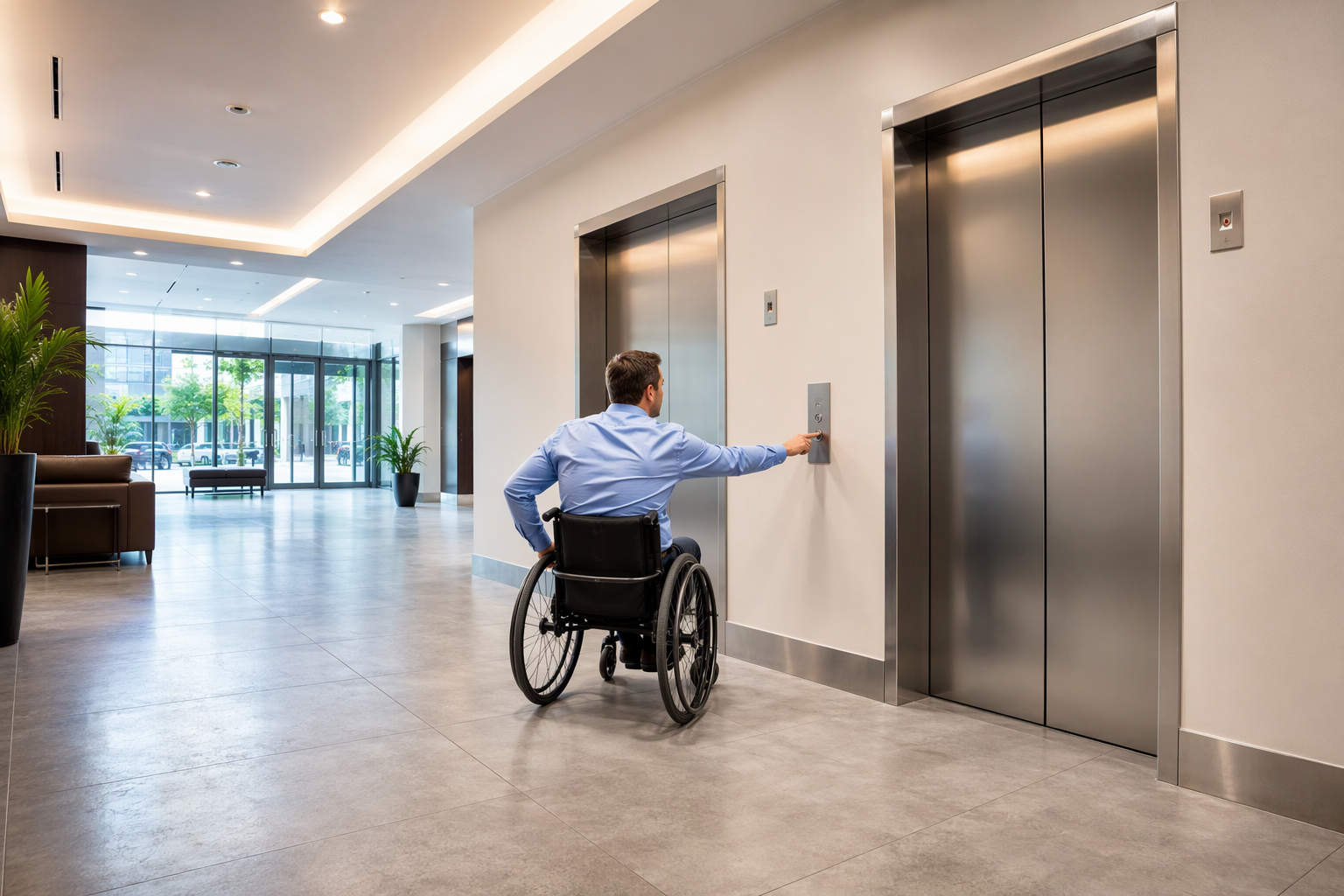
An ADA compliant elevator must satisfy the technical standards set out in the Americans with Disabilities Act and its companion accessibility guidelines, covering everything from car dimensions and door timing to control panel height and two-way communication. Building owners in Baltimore, Washington DC, Philadelphia, and Richmond who fail to meet these requirements face civil complaints, federal enforcement, and costly retrofit projects. The sections below answer every material question on the topic.
What Is an ADA Compliant Elevator?

An ADA compliant elevator is a passenger or freight elevator that conforms to the accessibility requirements of the Americans with Disabilities Act so that individuals with mobility, vision, or other disabilities can use it independently.
The ADA itself is a civil rights statute enforced by the U.S. Department of Justice. Its technical companion, the ADA Standards for Accessible Design, specifies the exact measurements and features that elevators must provide. These standards were updated in 2010 and remain the controlling federal benchmark for new construction and alterations in 2026. Buildings subject to Title II (state and local government facilities) or Title III (places of public accommodation and commercial facilities) must provide accessible routes, and an elevator is typically the required element when access to upper or lower floors is mandated.
ADA compliance for elevators overlaps with, but is legally distinct from, the mechanical safety requirements of the ASME A17.1 Safety Code for Elevators and Escalators. A building can have a mechanically safe elevator that is not ADA compliant, and vice versa. Both must be satisfied simultaneously.
Which Buildings Are Required to Have an ADA Compliant Elevator?

Most commercial buildings and government facilities with more than one floor are required to provide at least one accessible elevator, with limited exceptions for small buildings and certain private clubs.
The ADA Standards for Accessible Design require that an accessible route connect all floors in a building that is subject to the ADA. An elevator is the primary means of satisfying that requirement in multi-story buildings. Exceptions exist for buildings that are fewer than three stories or have fewer than three thousand square feet per story, unless the building is a shopping center, shopping mall, professional office of a health care provider, transit station, or airport terminal — those facility types must provide elevators regardless of size.
Buildings undergoing alterations must also bring the altered path of travel into compliance to the extent that the cost of doing so is not disproportionate (generally understood as not exceeding twenty percent of the cost of the alteration itself). Building owners contemplating renovations should conduct an accessibility audit before design begins, so that compliant elevator work can be scoped accurately.
What Are the Exact Dimensional Requirements for an ADA Compliant Elevator Car?
The ADA Standards require a minimum clear floor area inside the elevator car that allows a wheelchair user to enter, turn, and exit without assistance.
The 2010 ADA Standards for Accessible Design, Section 407, specify the following minimum elevator car dimensions:
- Inside clear width: at least 80 inches (2032 mm) for cars with a centered door, or at least 68 inches (1727 mm) wide with 51 inches (1295 mm) deep when the door is not centered
- Inside clear depth: at least 51 inches (1295 mm) from the back wall to the face of the closed doors
- A larger car configuration of at least 80 inches wide by 54 inches deep is required when a side-opening door is used
- Floor-to-ceiling height: sufficient to maintain the accessible route clearances required throughout the car
These dimensions are minimums. Many modern accessible designs exceed them to accommodate power wheelchairs, scooters, and attendants traveling alongside users. During a code-compliance assessment, Quality Elevator Company evaluates both the structural dimensions of the hoistway and the actual finished clear dimensions inside the car, since finishes, handrails, and equipment can reduce usable space below the structural opening.
What Door Requirements Must an ADA Compliant Elevator Meet?
ADA compliant elevator doors must remain open long enough for a person using a mobility device to pass through completely, and they must reopen automatically if an obstruction is detected.
Section 407.3 of the 2010 ADA Standards specifies that elevator doors must have a minimum clear width of 36 inches (915 mm). The door must remain open for at least three seconds after the last activation of a hall call or car call. If a passenger activates the door-open button, the door must remain open for at least twenty seconds. Doors must be equipped with a reopening device that will stop and reopen the door when an obstruction is detected at both the leading edge and at a point no higher than 29 inches (735 mm) above the floor, without requiring contact. Optical sensors are the most common compliant solution; mechanical safety edges alone do not meet the contactless requirement.
Door timing is a frequent failure point during ADA audits. Aging hydraulic and traction systems often develop slow door operation or shortened open-dwell times as components wear, making routine maintenance directly relevant to ADA compliance status.
What Control Panel and Signage Requirements Apply to ADA Compliant Elevators?
ADA compliant elevator control panels must be mounted within reach ranges accessible to wheelchair users and must include raised characters, Braille, and audible signals that allow use without vision or hearing.
Section 407.4 of the 2010 ADA Standards specifies the following control panel requirements:
- All floor buttons must be within the forward or side reach ranges: controls on a side wall must be no higher than 54 inches (1370 mm) from the floor, and controls on a front wall no higher than 48 inches (1220 mm)
- Floor buttons must be raised or flush and must have raised characters and Grade 2 Braille designations
- The main entry floor button must be identified by a raised star
- Emergency controls — including the emergency stop (where provided), alarm, and door-open buttons — must be grouped at the bottom of the panel, with the lowest button no lower than 35 inches (890 mm) from the floor
- A two-way communication system must be provided for use in emergencies, with both visible and audible signals
- Hall call buttons must be no higher than 42 inches (1065 mm)
Floor indicators inside the car and at landings must include both visual and audible signals, announcing each floor as the car passes or stops. Audible signals must sound once for up travel and twice for down travel, or alternatively announce the floor number and direction.
How Does ADA Compliance Differ from ASME A17.1 Elevator Safety Code Compliance?
ADA compliance governs accessibility for people with disabilities and is enforced as a civil rights matter, while ASME A17.1 governs mechanical safety and is enforced through state and local building authorities.
The ASME A17.1 Safety Code for Elevators and Escalators and its companion standard ASME A17.3 for existing installations set engineering requirements covering structural loads, speed governors, braking systems, hoistway construction, and inspection intervals. Each jurisdiction in Quality Elevator Company’s service area has adopted a specific edition of A17.1 — Maryland has adopted the 2022 edition (effective June 17, 2026), Virginia has adopted the 2019 edition (effective January 18, 2024), DC has adopted the 2013 edition as referenced by its 2017 Building Code, and Pennsylvania currently applies the 2000 edition with the A17.1a-2002 addenda (transitioning to the 2016 edition for new permit applications from December 20, 2026). None of these editions substitute for or satisfy ADA accessibility requirements.
In practice, a building owner must simultaneously satisfy the ASME safety code adopted by their jurisdiction, the state or local licensing and inspection requirements, and the ADA accessibility standards. These three layers are assessed independently during different types of inspections.
What Are the State-Specific Inspection Requirements That Affect ADA Compliant Elevators in Quality Elevator Company’s Service Area?
Each jurisdiction imposes its own inspection schedule and certificate requirements that apply to all elevators, including those being brought into or maintained in ADA compliance.
| Jurisdiction | Regulator | Periodic Inspection Interval | Five-Year / Category 5 Test | Certificate Validity | Official Resource |
|---|---|---|---|---|---|
| District of Columbia | DC Department of Buildings (DOB) | Category 1 every 12 months | Category 5 every 60 months | 2 years | ASME A17.1-2013 / 12-A DCMR Ch. 30 |
| Maryland | Maryland Department of Labor, Division of Labor and Industry | Annual periodic inspection | Comprehensive 5-year inspection | Annual re-registration required | ASME A17.1-2022 / COMAR 09.12.81 |
| Pennsylvania | PA Department of Labor and Industry | Every 6 months (electric, hydraulic, escalators) | Per ASME A17.1 test tables | 24 months (6-mo. cycle); 48 months (12-mo. cycle) | ASME A17.1-2000 / 34 Pa. Code Ch. 405 |
| Virginia | Local building department (USBC) | Annual (locality may require semi-annual) | Per ASME A17.1 Appendix N intervals | Varies by locality | ASME A17.1-2019 / 13VAC5-63 |
ADA-related modifications — such as lowering a control panel, widening a door opening, or installing a new signaling system — typically constitute an alteration under state elevator codes and require a permit before work begins. In DC, DOB issues elevator alteration permits and requires a copy of the elevator contracting license. In Maryland, the Maryland Department of Labor’s Division of Labor and Industry oversees the inspection process and requires the Maryland Elevator Safety Review Board to license all contractors performing the work. In Virginia, the local building department handles acceptance inspections, and the contractor must hold a Virginia Board for Contractors Elevator/Escalator Contracting (EEC) specialty license.
What Is the Process for Making an Existing Elevator ADA Compliant?
Bringing an existing elevator into ADA compliance follows a structured sequence of assessment, design, permitting, construction, and inspection steps that must be coordinated with the applicable state elevator authority.
- Conduct an accessibility audit. Measure all car interior dimensions, door clear widths, door timing cycles, control panel heights, Braille and raised character signage, floor indicators, and two-way communication systems against the 2010 ADA Standards.
- Identify all deficiencies. Document each item that falls below the ADA minimums, including those that may appear marginal but fail under precise measurement.
- Engage a licensed elevator contractor. Select a contractor licensed in the applicable jurisdiction — in Maryland, that means a firm licensed by the Maryland Elevator Safety Review Board; in Virginia, a firm with an EEC specialty license through the Virginia Board for Contractors.
- Apply for the required alteration permit. File permit applications with the appropriate authority before any physical work begins. In DC, this is the Department of Buildings; in Pennsylvania, it is the Department of Labor and Industry; in Virginia, it is the local building department.
- Execute the modernization or modification work. This may include hoistway widening, new car sill and threshold work, door operator replacement, control panel relocation or replacement, Braille button installation, new floor indicators, and two-way communication upgrades.
- Pass the acceptance inspection. The relevant authority conducts an acceptance inspection before the elevator returns to service. In Maryland, the state performs the final acceptance inspection. In Virginia, the local building department conducts or arranges the inspection.
- Obtain and post the updated certificate. The certificate of inspection must be posted conspicuously in the elevator car or in the designated alternative location specified by each jurisdiction.
- Document all records. In Maryland, maintenance, repair, test, and inspection records must be kept at a readily accessible central location in the building. Similar record-keeping obligations apply in the other jurisdictions.
How Long Does It Take to Bring an Elevator Into ADA Compliance?
The timeline depends on the scope of modifications required, the permitting timeline in the applicable jurisdiction, and equipment lead times, but most ADA retrofit projects range from several weeks for minor control upgrades to several months for full cab and door modernizations.
Simple upgrades — such as replacing non-compliant buttons with Braille-compliant panels or recalibrating door-open timing — can often be completed quickly once a permit is in hand. More complex work, such as widening a hoistway opening to achieve a compliant 36-inch clear door width or enlarging a cab that is below the minimum floor area, requires structural modifications that extend the timeline considerably. Permit review times vary by jurisdiction and project complexity. Building owners should factor in the possibility that the elevator will be out of service during modernization work, which carries its own operational obligations — for example, in DC, a permit is required to take an elevator out of service, and in buildings with passenger elevators, at least one elevator must remain in operation whenever the building is occupied.
What Two-Way Communication System Is Required in an ADA Compliant Elevator?
ADA compliant elevators must provide a two-way communication system in the elevator car that allows passengers to summon help in an emergency without requiring voice communication alone.
Section 407.4.9 of the 2010 ADA Standards requires a two-way communication system that includes both audible and visible signals. The system must be located in the elevator car and must connect to a monitoring point staffed by personnel able to respond. The visible component — typically a light that illuminates when the system is activated — is required so that individuals who are deaf or hard of hearing can confirm their call has been received. The system must be operable with one hand and must not require tight grasping, pinching, or twisting of the wrist. Buttons must be identified by raised characters and Braille.
Building owners should note that the ADA’s two-way communication requirement is a civil rights mandate independent of any mechanical safety code. The applicable state elevator codes in DC, Maryland, Pennsylvania, and Virginia each have their own emergency communication requirements under their adopted ASME A17.1 editions, but those requirements do not substitute for the ADA’s accessibility-specific provisions.
Are There ADA Requirements for Elevator Lobbies and Hall Signals?
Yes — ADA Standards impose specific requirements on elevator lobbies, hall call buttons, and landing indicators to ensure the entire arrival and boarding sequence is accessible.
Hall call buttons must be located on both sides of a central call button panel or on one side if a single call button is used, must have a minimum dimension of three-quarters of an inch (19 mm), and must be located no higher than 42 inches (1065 mm) above the floor. The up button must be on top. Hall lanterns — the visual and audible signals that indicate which car is responding and in which direction it will travel — must be visible from the vicinity of the hall call button and must include both a visible element (a light or illuminated arrow) and an audible signal (one chime for up, two for down, or a verbal announcement). The audible signal must be at least 20 decibels with a frequency no higher than 1500 Hz. Floor level designations in raised characters and Braille must be posted at both jambs of each elevator entrance at a height between 48 and 60 inches above the floor.
What Is the Difference Between an ADA Compliant Elevator and a Wheelchair Lift?
A wheelchair lift (platform lift) can satisfy the ADA accessible route requirement in limited circumstances, but it is not equivalent to a full elevator and is subject to specific conditions under the ADA Standards.
Section 410 of the 2010 ADA Standards permits platform lifts as part of an accessible route in specific situations, including where providing an elevator would require an addition to an existing building, where the lift serves a floor level within a dwelling unit, or where space constraints make a full hoistway impractical. However, platform lifts are not suitable for all building types or occupancies, and they carry their own ADA technical requirements covering platform size, handrails, and controls. For most commercial buildings and government facilities in Baltimore, Washington DC, Philadelphia, and Richmond, a full elevator remains the preferred and often required solution. Quality Elevator Company can assess whether a platform lift or a full elevator cab is the appropriate solution for a specific building configuration.
What Happens If a Building’s Elevator Is Not ADA Compliant?
Building owners with non-compliant elevators face civil complaints filed with the U.S. Department of Justice or private lawsuits, potential injunctive relief requiring corrective action, and in some cases monetary damages.
The ADA does not impose criminal penalties for accessibility failures, but civil enforcement is active. The Department of Justice can investigate complaints and initiate compliance reviews. Private plaintiffs under Title III can seek injunctive relief — meaning a court order requiring the building to become compliant — and attorney’s fees. Title II entities (government buildings) face similar enforcement. Beyond legal exposure, non-compliant elevators restrict access for employees, customers, tenants, and visitors with disabilities, creating reputational and operational consequences. Proactive compliance assessment is significantly less costly than reactive litigation-driven remediation.
How Are ADA Compliant Elevators Inspected and Maintained to Stay Compliant?
ADA compliance is not a one-time certification — it must be maintained through ongoing inspections and preventive maintenance that preserve door timing, signal systems, control panel integrity, and car dimensions.
Standard state-mandated elevator inspections focus on mechanical safety under the adopted ASME A17.1 edition. ADA compliance is a separate layer that is not automatically verified during those inspections. Building owners should schedule periodic accessibility audits that check door-open dwell times, sensor function, control panel button condition (Braille dots wear over time), audible signal volume and frequency, two-way communication system operation, and floor indicator function. Any maintenance work that changes door operators, control panels, or cab finishes can inadvertently introduce an ADA deficiency if the replacement components are not specified to meet the 2010 ADA Standards. Quality Elevator Company incorporates ADA-relevant checks into its maintenance service work for clients in Baltimore, Washington DC, Philadelphia, and Richmond, helping building owners identify drift before it becomes a complaint.
What Are Common Reasons Existing Elevators Fail ADA Inspections?
The most frequent ADA compliance failures in existing elevators involve door timing, control panel height, worn or missing Braille, non-compliant two-way communication systems, and inadequate floor indicators.
Common failure categories include:
- Door timing: Door-open dwell time below three seconds, or door-reopen sensors that only detect contact rather than proximity
- Control panel height: Panels installed above the ADA reach-range maximums, often in older buildings where code requirements were different at time of installation
- Braille and raised characters: Worn or missing Braille dots, incorrect Braille grade, or missing raised star on the main floor button
- Two-way communication: Voice-only systems with no visible confirmation signal, or systems that require grasping or twisting to operate
- Hall lanterns and audible signals: Missing chime signals, signals that don’t meet the decibel or frequency requirements, or lanterns that aren’t visible from the call button location
- Floor designations: Missing raised character and Braille floor designations at entrance jambs, or designations mounted at incorrect heights
- Car interior dimensions: Cab renovations that added interior finishes, reducing clear dimensions below ADA minimums
Do New Elevator Installations Need to Meet ADA Standards Automatically?
Yes — new elevator installations in buildings subject to the ADA must comply with the 2010 ADA Standards for Accessible Design as a condition of lawful operation, in addition to meeting the state-adopted ASME A17.1 edition.
When a building owner applies for a permit for a new elevator installation, the state elevator authority reviews mechanical safety compliance, but the building permit process for the overall project — handled by the local building department or applicable authority having jurisdiction — will also evaluate ADA and accessibility compliance under the International Building Code as locally adopted. In practice, an architect or designer of record specifies ADA-compliant elevator features in the permit documents, and the elevator contractor must build to those specifications. Quality Elevator Company works from ADA-compliant specifications on new installation projects across its service area, coordinating with design teams to ensure that car dimensions, door hardware, control panel layout, and signaling systems all meet the 2010 Standards before acceptance inspection.
What Is the ADA Tax Credit and Can It Help Offset the Cost of Elevator Accessibility Upgrades?
Small businesses may be eligible for a federal tax credit under Internal Revenue Code Section 44, the Disabled Access Credit, which can offset a portion of the cost of ADA accessibility improvements including elevator modifications.
The Disabled Access Credit is available to businesses with either gross receipts no greater than one million dollars in the prior tax year, or no more than thirty full-time employees in the prior tax year. The credit equals fifty percent of eligible access expenditures that exceed two hundred fifty dollars but do not exceed ten thousand two hundred fifty dollars in a tax year, for a maximum annual credit of five thousand dollars. Separately, Internal Revenue Code Section 190 allows a tax deduction of up to fifteen thousand dollars per year for expenses incurred to remove architectural barriers. Building owners should consult a qualified tax professional regarding eligibility and proper documentation. These federal provisions apply uniformly across DC, Maryland, Pennsylvania, and Virginia.
How Should Building Owners Prioritize ADA Elevator Work When Budgets Are Limited?
When full immediate compliance is not financially feasible for alterations, building owners should prioritize the accessibility deficiencies that most directly prevent independent use of the elevator and document a good-faith remediation plan.
The ADA’s readily achievable barrier removal standard for existing facilities (Title III) and the disproportionate cost limitation for alterations both contemplate that compliance may be phased. The U.S. Department of Justice has indicated that priority should be given to measures that enable individuals with disabilities to get in the door, access the services offered, and use restrooms. For elevators, this typically means prioritizing door width and timing, control panel reach range, and two-way communication before addressing ancillary signage. Owners should document the accessibility audit findings, the prioritized remediation sequence, and the timeline, retaining that documentation to demonstrate good faith in the event of a complaint. Quality Elevator Company can assist building owners in developing a phased compliance roadmap that sequences work to address the highest-impact deficiencies first while managing capital expenditure across budget cycles.
What Should Building Owners in Richmond, VA Look for in ADA Compliant Elevator Contractors?
In Virginia, elevator contractors must hold a Virginia Board for Contractors Elevator/Escalator Contracting (EEC) specialty license, and mechanics must be state-certified, with the City of Richmond’s Bureau of Permits and Inspections serving as the local authority for elevator inspections and certificates.
Virginia’s elevator inspection program is administered by local building departments under the Virginia Uniform Statewide Building Code (13VAC5-63), which incorporates ASME A17.1-2019 as of January 18, 2024. Within the City of Richmond, the Department of Planning and Development Review, Bureau of Permits and Inspections, handles final acceptance inspections of new or modernized elevators and annual elevator inspections. Building owners should verify that any contractor they engage holds the required EEC specialty license and employs certified mechanics before work begins, as uncertified work on a Virginia elevator is a violation of state law. The local building department must witness periodic tests, so coordinating scheduling with the Bureau is part of the compliance process.
How Can Building Owners Verify That Their Elevator Remains ADA Compliant Over Time?
Building owners should establish a documented accessibility maintenance checklist that is reviewed at each preventive maintenance visit and supplemented by a formal ADA audit at least once every few years or whenever modifications are made.
ADA compliance erodes gradually. Braille dots wear smooth, door sensors drift out of calibration, audible signals fail quietly, and cab renovations introduce new finishes that reduce clear dimensions. A preventive approach includes the following ongoing practices:
- Verify door-open dwell time and sensor function at each maintenance visit
- Inspect Braille and raised character integrity on all car and hall buttons annually
- Test two-way communication systems monthly and confirm the visible signal activates
- Confirm audible floor indicators are functioning at each inspection
- Measure cab interior clear dimensions whenever new flooring, paneling, or handrails are installed
- Review hall lantern visibility and chime function when any lobby work is performed
- Retain all inspection reports, maintenance records, and modification permits in the building
Partnering with a qualified elevator service company that understands both the mechanical code requirements and the ADA accessibility standards is the most reliable way to maintain continuous compliance. Quality Elevator Company provides ongoing maintenance services across Baltimore, Washington DC, Philadelphia, and Richmond, with attention to both the ASME safety code requirements adopted in each jurisdiction and the ADA accessibility features that must be preserved throughout the elevator’s operating life.
Contact Quality Elevator Company for a free elevator assessment at 301-779-9116.
Need elevator service you can rely on? Quality Elevator Company is ready to help.