How to Switch Elevator Service Companies in Healthcare Facilities Without Voiding Your Warranty or Losing Compliance Records

Hospitals, medical office buildings, long-term care facilities, and outpatient surgery centers depend on elevators as critical patient-transport infrastructure. A service transition that is poorly managed can create documentation gaps that put a facility out of compliance with state elevator safety agencies, ADA accessibility requirements, and the ASME A17.1 Safety Code for Elevators and Escalators. The guidance below covers every step healthcare facility managers in Baltimore, Washington DC, Philadelphia, and Richmond need to take before, during, and after switching elevator service companies.
Does Switching Elevator Service Companies Void a Manufacturer’s Warranty?
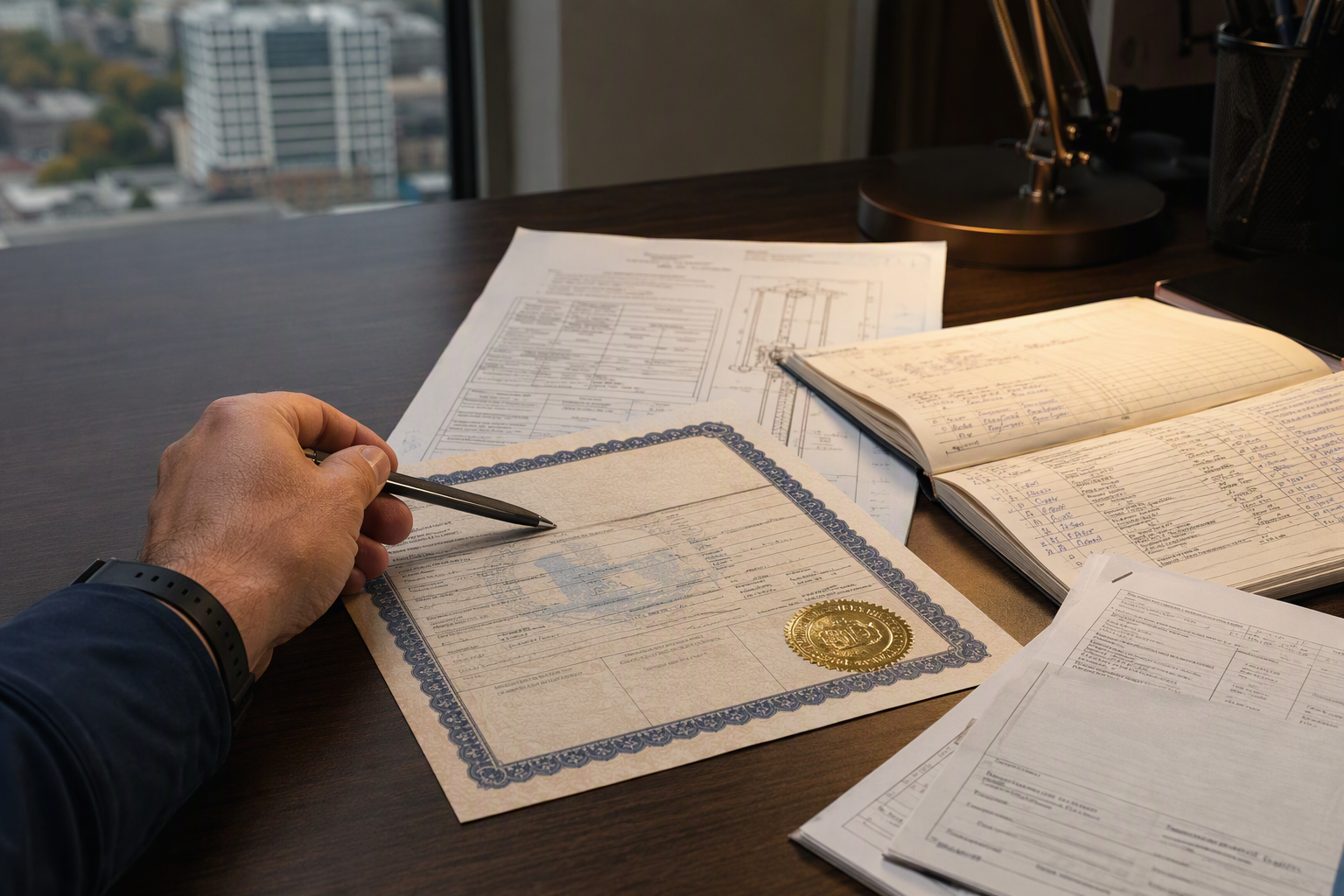
A manufacturer’s warranty on elevator equipment is tied to the equipment itself, not to any specific service company. Switching service providers does not automatically void a manufacturer’s warranty. What can affect warranty coverage is failure to maintain the equipment according to the manufacturer’s published maintenance specifications, or using non-approved replacement parts without documentation. When transitioning to a new service provider, healthcare facilities should request written confirmation from the incoming contractor that all maintenance will follow manufacturer specifications for each unit on site. Quality Elevator Company reviews manufacturer documentation during onboarding to ensure ongoing maintenance aligns with equipment specifications.
What Compliance Records Must a Healthcare Facility Request Before Switching?
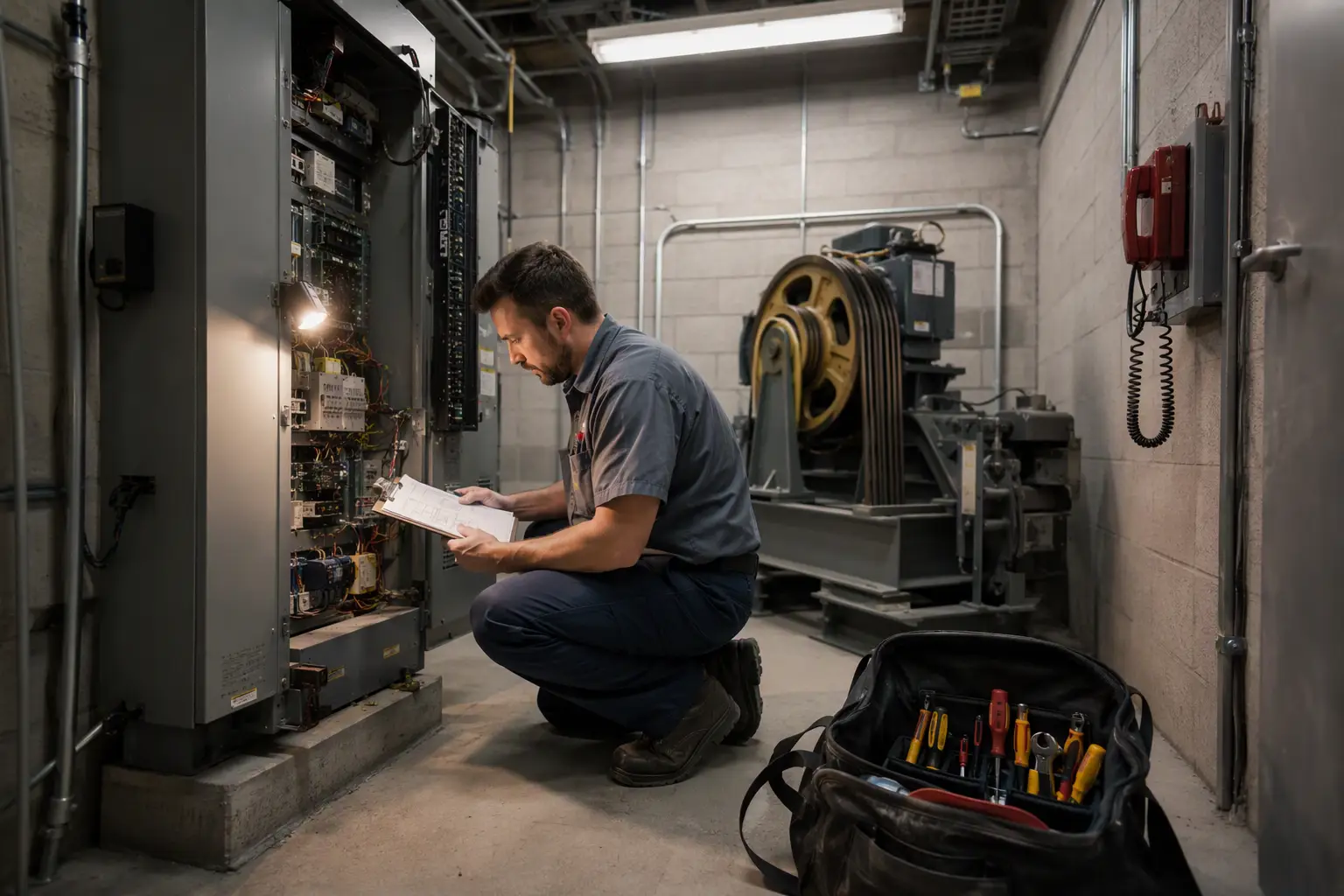
Before the outgoing contractor’s final service date, the facility manager should obtain a complete set of the following documents:
- All periodic inspection reports signed by a qualified elevator inspector, covering at minimum the prior two inspection cycles.
- Current certificates of inspection or certificates of operation issued by the applicable state elevator authority or, in DC, the Department of Buildings.
- Category 1 and Category 5 (or equivalent periodic test) reports, with dates, inspector names, and certification numbers.
- Maintenance logs, lubrication records, and repair work orders with parts documentation.
- Permits for any alterations, modernizations, or repairs completed during the outgoing contractor’s tenure.
- Callback and incident logs, including any reports filed with state agencies after accidents or malfunctions.
- Documentation of any open violations, outstanding corrective action orders, or suspended certificates.
- Copies of the maintenance control program (MCP) as required under ASME A17.1.
In Maryland, the Annotated Code of Maryland, Public Safety Article, Title 12, Subtitle 8 requires that maintenance, repair, test, and inspection records be kept at a readily accessible central location in the building. This means the records legally belong at the facility, not with the contractor, which simplifies transfer in that jurisdiction.
How Does the Switching Process Work Step by Step?
- Audit your current compliance status by reviewing all certificates of inspection and inspection reports on file at your facility.
- Send a formal written notice to the outgoing contractor specifying your transition date and requesting transfer of all maintenance and inspection records within a defined deadline.
- Verify that the incoming contractor holds the required license or certification in your jurisdiction before signing any agreement.
- Schedule a joint walkthrough — with both the incoming contractor and a member of your facilities team — to document the current condition of every elevator unit on site.
- Have the incoming contractor conduct a baseline inspection of all units and compare findings against existing records to identify any pre-existing issues.
- Confirm that open permits or outstanding violations are disclosed and assigned responsibility before the outgoing contractor demobilizes.
- Update the applicable state elevator authority records where required in your jurisdiction (for example, Maryland owners must re-register elevator units annually at the time of periodic inspection).
- Notify your healthcare accreditation body or facilities compliance officer that a service transition has occurred and update your elevator equipment inventory documentation accordingly.
What Are the Licensing Requirements for Elevator Contractors in Each Jurisdiction?
Healthcare facilities operating across the Baltimore–Washington–Philadelphia–Richmond corridor must verify contractor credentials jurisdiction by jurisdiction.
Maryland: Under the Maryland Department of Labor, Division of Labor and Industry, Elevator and Escalator Safety, a business must be licensed by the Maryland Elevator Safety Review Board as an elevator contractor before installing, altering, maintaining, repairing, or servicing elevator units. Elevator mechanics must also hold individual Maryland licenses. Contractors must carry at least $1,000,000 in general liability insurance and at least $500,000 in property damage insurance.
District of Columbia: The DC Department of Buildings (DOB) requires that elevator contractors hold a valid elevator contracting license issued by the DC Board of Industrial Trades. DOB elevator permits also require a copy of a master electrician license. Inspections must be performed by DOB-approved third-party inspection agencies using ASME QEI-certified inspectors.
Pennsylvania: The Pennsylvania Department of Labor and Industry, Bureau of Occupational and Industrial Safety, Elevator Section has statewide jurisdiction, including Philadelphia. Third-party inspection agencies must be certified by the Department. Periodic inspections for electric and hydraulic elevators are required at intervals of no more than six months.
Virginia: Under the Virginia Uniform Statewide Building Code (13VAC5-63), installing, repairing, or maintaining elevators requires a contractor license with the Elevator/Escalator Contracting (EEC) specialty issued through the Virginia Board for Contractors (DPOR). Elevator mechanics must be individually certified by the state. Enforcement is handled by local building departments; in Richmond, the Bureau of Permits and Inspections manages the local elevator program.
Which ASME and ADA Standards Apply to Healthcare Elevators?
All elevators in healthcare facilities must comply with the ASME A17.1 Safety Code for Elevators and Escalators, with the applicable edition determined by jurisdiction and the date the installation contract was executed:
- DC: ASME A17.1-2013/CSA B44-13, as adopted by the 2017 DC Building Code, effective May 29, 2020.
- Maryland: ASME A17.1-2022/CSA B44:22 (with Maryland changes), effective June 17, 2026, for contracts signed after that date. Requirements in effect when an elevator was first certified remain in effect for that unit.
- Pennsylvania: ASME A17.1-2000 with A17.1a-2002 addenda currently governs most units. For permit applications made on or after December 20, 2026, ASME A17.1-2016 (with Pennsylvania modifications) applies.
- Virginia: ASME A17.1/CSA B44-2019, incorporated by the 2021 Virginia Uniform Statewide Building Code, effective January 18, 2024.
Existing installations retain compliance with the code edition under which they were certified. When a healthcare facility undergoes alteration or modernization, the current adopted edition for that jurisdiction applies to the altered components.
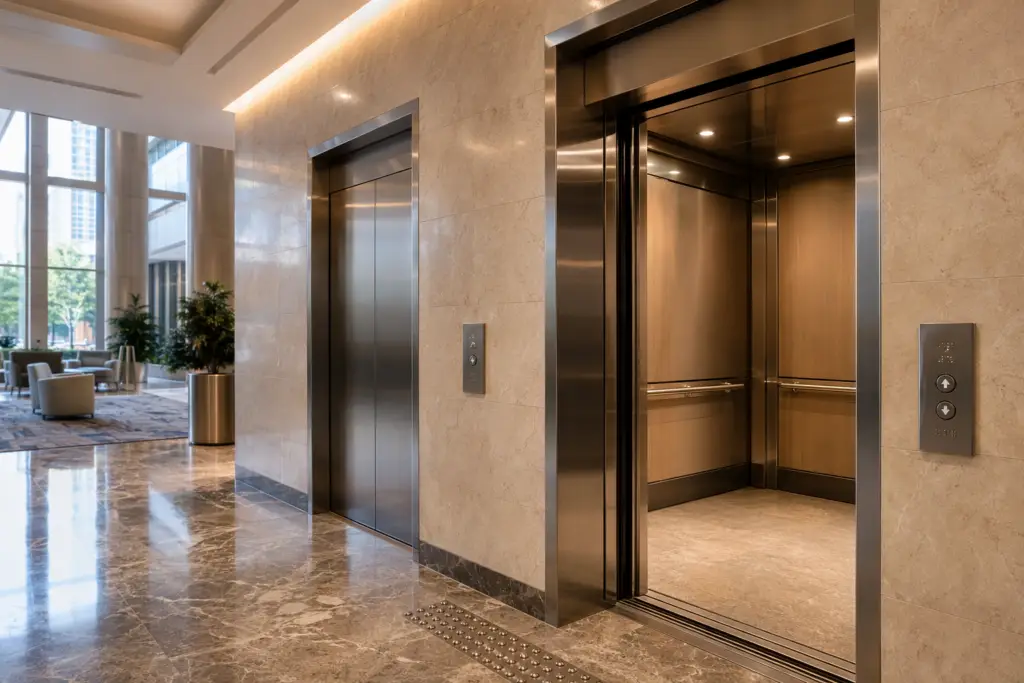
ADA accessibility requirements govern cab dimensions, door timing, control panel height, audible signals, and tactile markings in elevators accessible to patients and the public. A service transition is an appropriate time for a facility to audit ADA compliance on all units, since deferred maintenance can gradually erode accessibility features.
How Are Inspection Certificates Handled During a Service Transition?
An existing certificate of inspection or certificate of operation remains valid through its expiration date regardless of which service company holds the maintenance contract. The certificate is issued to the equipment owner, not to the contractor. Healthcare facility managers should:
- Record the expiration date of each unit’s current certificate before transition.
- Confirm that the incoming contractor is prepared to schedule inspections with the appropriate state agency or DOB-approved third-party inspection agency before each certificate expires.
- Keep a copy of all current certificates conspicuously displayed in the elevator car as required in each jurisdiction.
In DC, certificates of inspection are valid for two years and are submitted through the DOB Citizen Access Portal. In Maryland, re-registration is required every year at the time of the annual periodic inspection. In Pennsylvania, certificate validity depends on inspection cycle — 24 months for equipment on a six-month cycle. In Virginia, annual periodic inspections are required, and local authorities administer the certificate process.
What Happens to Open Permits or Violations When a Contractor Changes?
Open permits and outstanding violation orders follow the equipment, not the contractor. Before signing a new service agreement, a healthcare facility should conduct a permit search through the applicable state or local building authority to identify:
- Any active alteration or modernization permits not yet closed by the outgoing contractor.
- Any violation notices or corrective action orders requiring remediation.
- Any elevators operating under a temporarily suspended certificate due to a pending alteration permit.
The incoming contractor assumes responsibility for completing open permit work only if the new service agreement explicitly includes it. Quality Elevator Company performs a pre-contract compliance audit to identify open items so healthcare clients understand their full scope of liability before the transition date.
How Should Healthcare Facilities Handle the Transition of Their Maintenance Control Program?
The ASME A17.1 Safety Code requires that each elevator have a maintenance control program (MCP) documenting procedures, intervals, and responsible parties for all maintenance tasks. When switching service companies, the MCP must be transferred and reviewed. The incoming contractor should update the MCP to reflect their own procedures, parts sourcing, and technician qualifications before performing any maintenance. A gap in MCP documentation is one of the most common deficiencies found during state inspections of recently transitioned facilities.
What Are the Specific Risks for Hospitals and Long-Term Care Facilities?
Healthcare facilities face consequences beyond state elevator code violations when elevator compliance lapses. Facilities accredited by The Joint Commission or subject to Centers for Medicare and Medicaid Services (CMS) Conditions of Participation are expected to maintain continuous documentation of all life-safety equipment, including vertical transportation. A documentation gap created by a poorly managed contractor transition can trigger findings during accreditation surveys. For hospitals transporting patients between floors for imaging, surgery, or emergency care, an elevator taken out of service for compliance reasons creates immediate patient safety concerns.
In DC, buildings with passenger elevators must keep at least one elevator in operation whenever the building is occupied, with limited exceptions. Healthcare facilities should plan any transition so that inspection-related downtime is minimized and staggered across units where multiple elevators serve the same building.
Questions Your Inspector Will Ask
When a state elevator inspector or DOB-approved third-party inspector arrives at a healthcare facility that has recently changed service companies, the following questions are commonly raised. Facility managers should have documented answers ready:
- Can you produce the current certificate of inspection or certificate of operation for each elevator unit on the premises?
- Where are the maintenance logs, repair records, and test reports for the past inspection cycle?
- Is the current maintenance control program on site and up to date?
- Who is the licensed elevator contractor currently responsible for this equipment, and can you provide their license number?
- Are there any open permits for alterations or modernizations, and if so, what is the completion status?
- Have all required periodic tests — including Category 1 and, where applicable, five-year comprehensive tests — been completed within the required intervals?
- Has any elevator incident occurred since the last inspection that required an accident report to be filed with the state agency?
- Are certificates conspicuously displayed in each elevator car as required?
- For Maryland facilities: has the elevator unit been re-registered with the Commissioner of Labor and Industry within the past 12 months?
- For Pennsylvania facilities: is the certificate of operation posted in the elevator car or attached to the controller in the machine room?
How Long Does the Transition Process Typically Take for a Multi-Elevator Healthcare Campus?
The timeline for a service transition depends on the number of elevator units, the completeness of existing records, and the scheduling of the baseline inspection. A single-building medical office with two or three elevators can typically complete a compliant transition within two to four weeks if records are in order. A hospital campus with multiple towers and a mix of passenger elevators, freight elevators, and specialty clinical transport units requires more lead time to audit documentation, schedule baselines, and close any open permits. Quality Elevator Company recommends beginning the transition process no fewer than sixty days before the intended service start date for facilities with more than five elevator units.
What Should a Healthcare Facility Look for When Evaluating a New Elevator Service Company?
When evaluating prospective elevator service contractors, healthcare facility managers should verify:
- Active contractor license or registration in each applicable jurisdiction — Maryland Elevator Safety Review Board, DC Board of Industrial Trades, Pennsylvania Department of Labor and Industry, or Virginia Board for Contractors (DPOR).
- Technicians holding individual mechanic licenses or certifications required by state law, including ASME QEI-certified inspectors where third-party inspection is involved.
- Demonstrated familiarity with the specific adopted ASME A17.1 edition and any jurisdiction-specific amendments in effect for the facility’s location.
- A documented process for record retention and transfer that satisfies each jurisdiction’s requirements.
- Experience with healthcare-specific operational constraints, including infection control protocols for machine room access and coordination with patient transport schedules.
Quality Elevator Company serves healthcare facilities across Baltimore, Washington DC, Philadelphia, and Richmond and works within the regulatory frameworks of Maryland, the District of Columbia, Pennsylvania, and Virginia.
Contact Quality Elevator Company for a free elevator assessment at 301-779-9116.
Need elevator service you can rely on? Quality Elevator Company is ready to help.