Elevators open and close unexpectedly or stop on uncalled floors most commonly because of faulty door sensors, worn door operator components, miscalibrated leveling systems, failing control board logic, or deteriorating selector switches and position encoders that send incorrect floor-call signals to the controller.
Elevators that open and close on their own or stop at floors nobody requested are not simply quirks—they are mechanical and electrical symptoms that signal specific component failures. Door operators, safety edges, position encoders, control boards, and wiring harnesses each play a defined role in coordinating movement and access. When any one of these systems degrades or fails, the elevator’s controller receives inaccurate data and responds with erratic behavior: nuisance door cycling, phantom floor stops, or both simultaneously. Understanding the root causes helps building owners, property managers, and facility engineers make informed decisions about maintenance, repair urgency, and regulatory compliance.
What are the most common reasons an elevator stops on floors without being called?
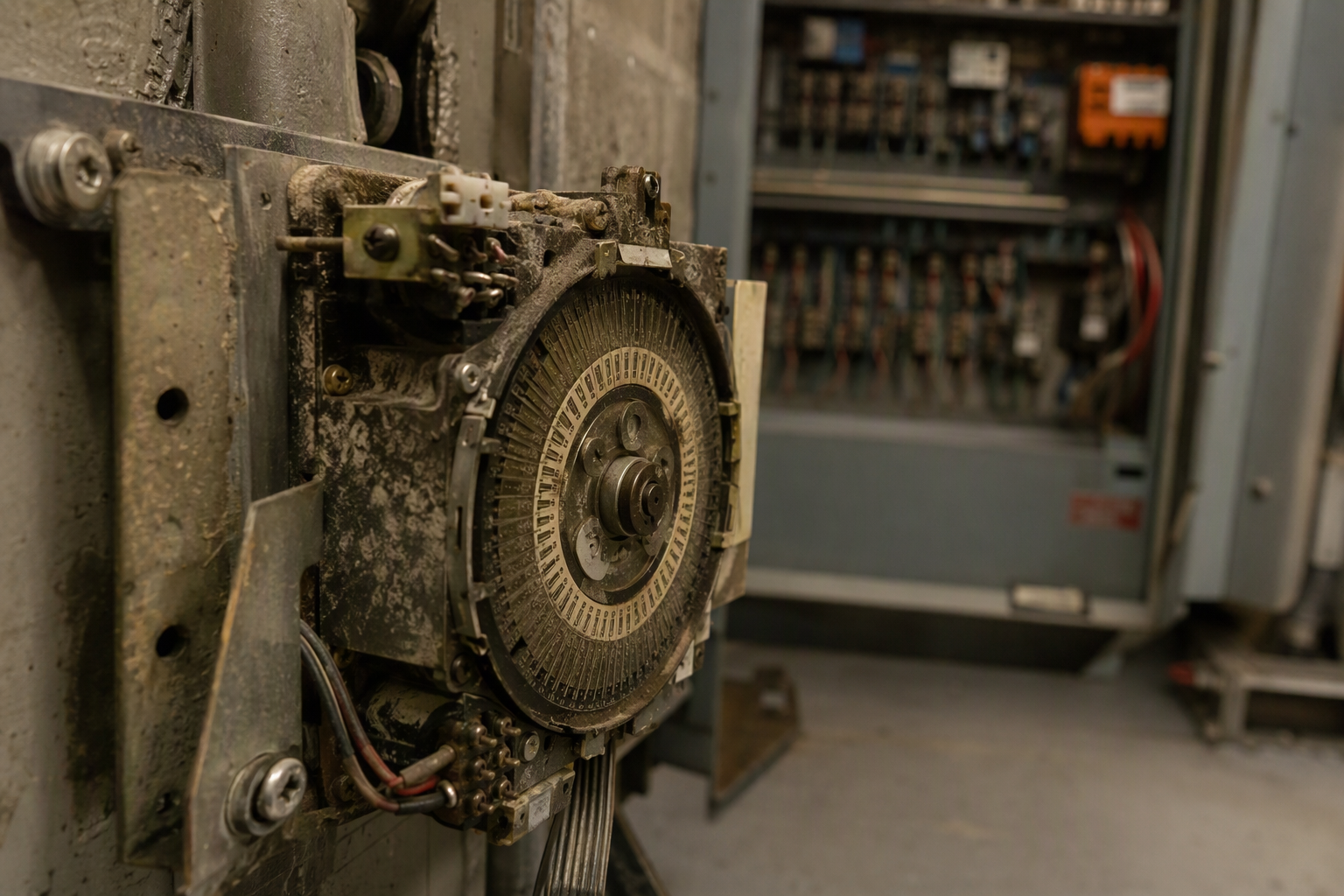
The most common causes are a malfunctioning floor selector, a failing position encoder or pulse encoder, sticking relay contacts inside the controller, and corrupted memory in the control board’s microprocessor logic.
Modern traction elevators rely on either a physical tape/disc selector or a digital encoder to tell the controller exactly where the car is in the hoistway at every moment. When that position feedback becomes unreliable—due to wear, contamination, or electrical noise—the controller may register a “call” at a floor where none exists. Older relay-logic systems are particularly vulnerable to contact welding, where a relay fuses in the closed position and continuously signals a floor call. Microprocessor-based controllers can develop firmware or memory errors after power surges, which corrupt the stored call matrix and cause phantom stops. Routine inspection under ASME A17.1 Safety Code for Elevators and Escalators includes verification of signal and selector systems precisely because these failures are predictable over time.
Why do elevator doors open and close on their own without passengers?
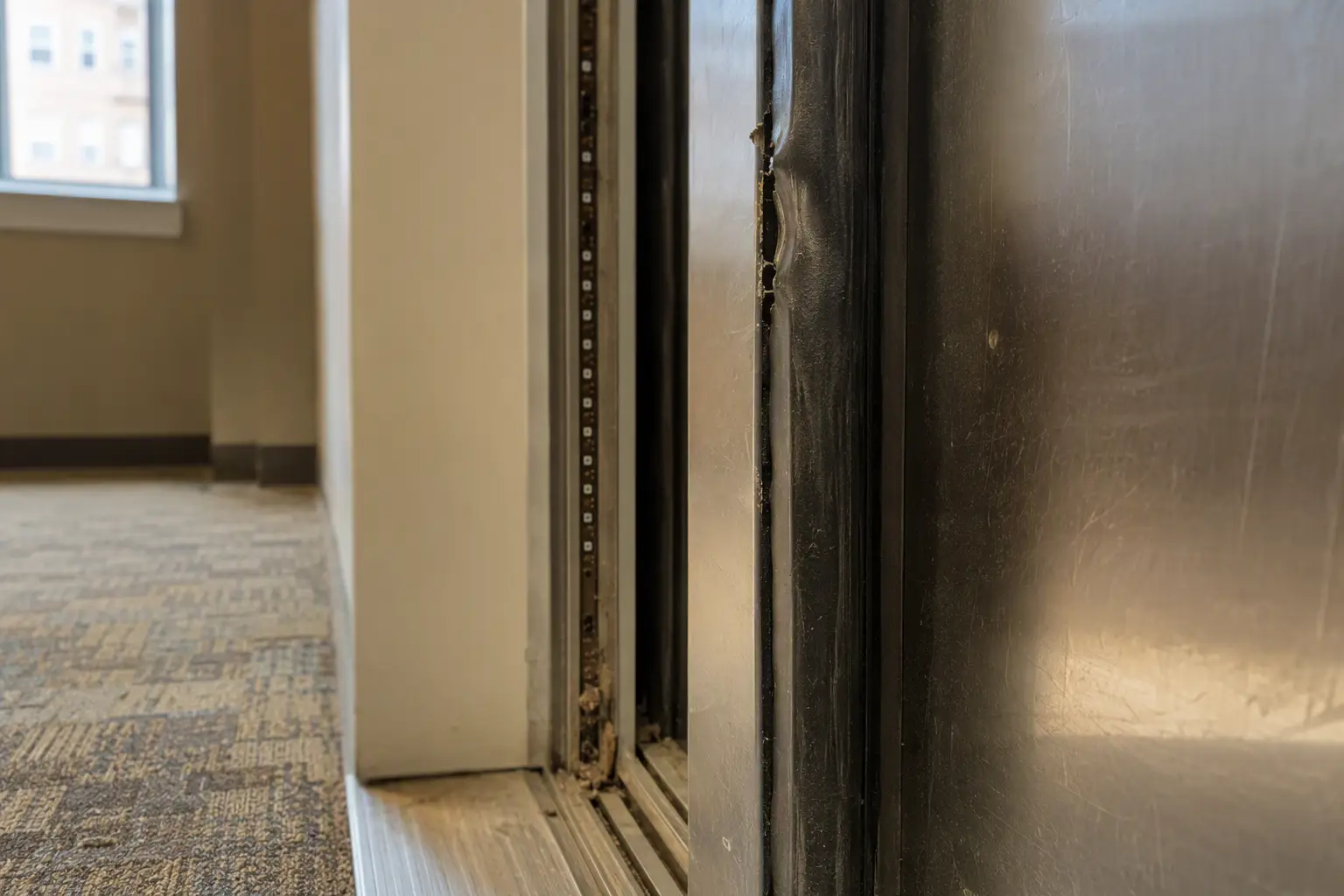
Unsolicited door cycling is almost always traced to a defective door operator motor or motor drive, a contaminated or misaligned safety reversing device, a sticky nudging relay, or a wiring fault that intermittently short-circuits the door-open circuit.
The door operator is an electromechanical assembly that receives open and close commands from the controller. When the motor drive board develops a failing capacitor or the encoder on the door motor sends erratic pulses, the controller may issue repeated open commands because it never receives a clean “door fully closed” confirmation signal. Safety edges—both mechanical contact edges and infrared light curtains—can also trigger continuous reopening if their sensing field is partially obstructed, misaligned, or electronically degraded. According to ASME A17.1, door reopening devices must prevent the doors from striking a person with more than a defined force, which means these protective devices are safety-critical and must function correctly—not just in a nuisance-free way, but in a code-compliant way.
How does a worn door operator cause erratic elevator behavior?
A worn door operator introduces mechanical slop and inconsistent torque delivery, which prevents the door from reaching its fully closed position reliably, causing the controller to keep attempting closure cycles or to time out and reopen.
Door operators depend on precise gear, belt, or chain drive mechanisms. As these components wear, the operator may stall partway through a close cycle. The door contact—a safety circuit that must be made before the elevator can move—then remains open, and the controller interprets this as a door-obstruction condition. Depending on controller programming, the car will repeatedly nudge the door closed, hold at the floor, or cycle the door open and closed in a loop. Replacement of a worn operator assembly, rather than continued adjustment, is typically the correct remedy once mechanical wear crosses a threshold.
What role do door safety edges and light curtains play in unexpected door behavior?
Door safety edges and infrared light curtains are designed to reverse or halt door closure when an obstruction is detected, but when they malfunction or become dirty, they generate false obstruction signals that make doors reopen repeatedly even when the doorway is clear.
A mechanical safety edge compresses when contacted and breaks a circuit to reverse the door. An electronic light curtain projects a grid of infrared beams across the door opening; any interruption reverses the door. Over time, the rubber or foam of a mechanical edge can harden and lose sensitivity calibration, or it can develop an internal short that permanently signals an obstruction. Light curtain emitters and receivers accumulate dust, lubricant mist, and debris in elevator lobbies, causing partial beam blockage that the control unit interprets as a passenger in the doorway. Cleaning, realignment, and sensitivity recalibration are first-line corrective actions; replacement is indicated when the device no longer meets the force and sensitivity requirements of ASME A17.1.
Can electrical wiring problems cause an elevator to behave erratically?
Yes—frayed traveling cables, loose terminal connections, and ground faults in the hoistway wiring can all inject false signals into the control circuit, causing both phantom floor stops and unsolicited door operations.
The traveling cable connects the fixed controller in the machine room to the moving elevator car and carries dozens of control, communication, and power conductors. Because the cable flexes continuously with every trip, individual conductors fatigue and crack at the insulation, eventually touching adjacent conductors or the cable’s metallic armor. A conductor that intermittently shorts to another circuit can mimic a hall call, a car call, a door-open request, or a safety-circuit fault. Ground faults behave similarly, injecting voltage onto circuits that should be at zero potential. Hoistway wiring—including the selector tape wiring, limit switch leads, and leveling vane pickups—is subject to the same degradation from vibration and moisture. A systematic wiring audit with an insulation resistance (megohm) test is the diagnostic standard for isolating these faults.
What is a leveling sensor, and how does its failure cause floor stops?
A leveling sensor—typically a magnetic vane switch or an inductive proximity sensor paired with a metal vane in the hoistway—tells the controller when the car is within the leveling zone of each floor, and a failed sensor can make the controller believe the car is perpetually within a floor’s zone, triggering repeated stops there.
Elevators use a two-stage approach system: the car slows to a leveling speed before floor level and then the leveling sensor confirms alignment within a defined tolerance (typically within a fraction of an inch of the finished floor, as required for ADA-compliant floor-level stopping under ADA Standards for Accessible Design). If a leveling vane is bent, if a sensor’s gap is incorrect, or if the sensor’s output circuit has a leakage current, the controller receives a continuous or repeated leveling signal. Depending on controller logic, this can manifest as the car stopping and opening its doors at a floor even though no one called it, or as excessive releveling attempts that cause the car to bounce at floor level before the doors open.
How do control board failures lead to phantom calls and random stops?
A failing control board—whether due to a damaged microprocessor, failing electrolytic capacitors, corrupted EPROM, or damaged relay driver circuits—can generate false floor-call registrations entirely within the electronic logic, independent of any physical input from buttons or sensors.
Modern elevator controllers use programmable logic controllers (PLCs) or proprietary microprocessor boards to manage all dispatch, door, and safety functions. Electrolytic capacitors on these boards have a finite service life and, when they fail, they allow voltage ripple to corrupt data lines. EPROM and flash memory chips that store the operational program can develop bit errors after thousands of power cycles or after a power surge. When the stored call register becomes corrupted, the board may continuously write a “call active” flag to one or more floors. Component-level board repair or full board replacement is the only reliable remedy, and it requires technicians with the manufacturer’s diagnostic software and wiring schematics. Quality Elevator Company carries diagnostic tooling for a range of controller platforms to identify board-level faults accurately.
What does ASME A17.1 require regarding door operation and floor stopping accuracy?
ASME A17.1 requires that power-operated doors include a reopening device to prevent contact with passengers, that door-open and door-close forces not exceed specified limits, and that cars stop within a defined tolerance of the landing floor level.
The ASME A17.1 Safety Code for Elevators and Escalators is the foundational design and maintenance standard adopted, in various editions, by all four jurisdictions served by Quality Elevator Company. It specifies that door reopening devices must function throughout the door’s closing cycle up to a nudging threshold, that kinetic energy limits govern door closing speed, and that leveling accuracy must be maintained within the tolerance required for accessible entry. Any elevator exhibiting unsolicited door operations or phantom floor stops is, in practical terms, operating in a condition that risks non-compliance with these requirements, making prompt diagnosis and repair a regulatory matter, not merely a convenience issue.
What are the inspection and compliance requirements in Maryland for elevators showing these symptoms?
In Maryland, every elevator must receive a periodic annual inspection by a qualified elevator inspector, and any elevator exhibiting unsafe behavior must be corrected before the certificate of operation remains valid.
Under the Annotated Code of Maryland, Public Safety Article, Title 12, Subtitle 8, and the regulations at COMAR 09.12.81, elevator owners must ensure annual inspections are conducted and that the certificate issued by the Maryland Department of Labor, Division of Labor and Industry, Elevator and Escalator Safety is conspicuously posted. Elevators suspended by wire ropes must also receive a comprehensive five-year inspection. Erratic door or floor behavior noted during an annual inspection can result in a failed inspection finding, requiring correction before re-certification. Maintenance, repair, test, and inspection records must be kept at an accessible central location in the building. All repair work must be performed by a mechanic licensed by the Maryland Elevator Safety Review Board.
What are the inspection requirements in Washington DC for elevators with these problems?
In the District of Columbia, all elevators must be inspected and certified by a DOB-approved third-party agency using ASME QEI-certified inspectors, with a Category 1 inspection every 12 months and a Category 5 inspection every 60 months.
Under D.C. Official Code § 6-1409 and 12-A DCMR Chapter 30, the DC Department of Buildings (DOB) oversees elevator certification. Owners must use a DOB-approved third-party inspection agency. The DC elevator code references ASME A17.1-2013/CSA B44-13 as adopted in the 2017 DC Building Code. A certificate of inspection is valid for two years, and the certificate must be conspicuously displayed in the elevator car. An elevator that exhibits phantom stops or erratic door cycling is operating with active safety system anomalies that a QEI-certified inspector would document. At least one elevator must be kept in operation whenever a multi-elevator building is occupied, which means an out-of-control elevator in a single-elevator building creates an immediate compliance and liability concern.
What are the inspection requirements in Pennsylvania for elevators exhibiting erratic behavior?
In Pennsylvania, electric and hydraulic elevators must be inspected at intervals of no more than six months by a UCC-certified elevator inspector, and an elevator may not remain in service without a valid certificate of operation from the Department of Labor and Industry.
Under 34 Pa. Code Chapter 405 and the Pennsylvania Construction Code Act, the Pennsylvania Department of Labor and Industry, Bureau of Occupational and Industrial Safety, Elevator Section certifies elevator operation statewide, including in Philadelphia. A certificate of operation is valid for 24 months for equipment on a six-month inspection cycle. Pennsylvania’s updated elevator regulation takes effect December 20, 2026, at which point new permit applications fall under ASME A17.1-2016 with Pennsylvania modifications. Owners must submit an accident report to the Department when an elevator accident causes a fatality or requires professional medical care—erratic door operation that injures a passenger would qualify. After a major repair, the elevator may not return to service until the Department inspects and passes it.
What are the inspection requirements in Virginia for elevators with phantom stops or door issues?
In Virginia, local building departments enforce annual periodic elevator inspections under the Virginia Uniform Statewide Building Code, and the current certificate of inspection must be displayed in the elevator car or kept in the building operator’s office.
Under Code of Virginia § 36-97 et seq. and 13VAC5-63, local government building departments are responsible for elevator inspections. The 2021 Virginia Uniform Statewide Building Code, effective January 18, 2024, incorporates ASME A17.1/CSA B44-2019. Virginia also allows localities to require six-month periodic inspections. Periodic tests must be witnessed by the code official. In Richmond specifically, the City of Richmond Department of Planning and Development Review, Bureau of Permits and Inspections, manages elevator annuals and certification. No one may work as an elevator mechanic in Virginia without state certification from the Virginia Board for Contractors (DPOR), which also licenses elevator contractors with the Elevator/Escalator Contracting specialty.
What should a building owner or property manager do immediately when an elevator starts behaving erratically?
When an elevator begins opening, closing, or stopping unexpectedly, the immediate priority is passenger safety, followed by documented notification to a licensed elevator service company and regulatory compliance steps.
- Remove the elevator from service if the erratic behavior poses an immediate risk of passenger entrapment, injury, or door-strike incidents.
- Post clear out-of-service signage at every landing and secure the car at a floor with doors open so no one is trapped.
- Contact a licensed elevator service company to dispatch a qualified technician for diagnosis—do not attempt to reset or reprogram the controller without professional assessment.
- Notify your elevator maintenance contractor of the specific symptoms observed: which floor the car stops on, how frequently doors cycle, whether the behavior is intermittent or continuous, and when it first occurred.
- Document the incident in writing with timestamps, including any passenger complaints or near-miss incidents, and retain this record with your maintenance and inspection logs.
- Determine whether the jurisdiction requires notification to the elevator regulatory authority—in Maryland, Pennsylvania, and DC, incidents causing injury require formal reporting.
- Do not return the elevator to service until the technician confirms the fault has been identified and corrected, and where required by state or local authority, do not return it to service until re-inspected and cleared.
How are phantom floor stops and erratic door behavior diagnosed by a technician?
Diagnosis follows a structured process of controller log review, live signal monitoring, mechanical inspection, and component-level electrical testing to isolate whether the fault originates in the input device, the wiring, or the controller itself.
A technician typically begins by downloading or reviewing the controller’s fault log, which in microprocessor-based systems records every registered call, door fault, and safety chain interruption with a timestamp. This log often pinpoints the triggering input. Next, the technician uses a digital multimeter and, where applicable, the manufacturer’s laptop diagnostic tool to monitor signal states in real time while observing the erratic behavior. Door operator circuits, selector encoder outputs, leveling sensor outputs, and hall-call wiring are checked in sequence. Insulation resistance testing of the traveling cable isolates intermittent wiring faults. Quality Elevator Company’s service process includes systematic use of these diagnostic methods to avoid the common mistake of replacing parts by trial and error, which prolongs downtime and increases cost.
What is the difference between a nuisance stop and a safety-related stop?
A nuisance stop inconveniences passengers without creating a direct physical hazard, while a safety-related stop involves the elevator’s protective circuits responding to a real or perceived unsafe condition—and distinguishing between them determines the urgency and scope of required repair.
A nuisance stop caused by a phantom floor call from a sticking relay is operationally disruptive but does not necessarily mean the elevator is unsafe to ride in the short term. By contrast, a stop caused by a leveling sensor fault may mean the car is not accurately positioning at floor level, creating a tripping hazard—a genuine safety issue with ADA implications under the ADA Standards for Accessible Design and a ASME A17.1 leveling tolerance concern. Similarly, doors that reopen due to a light curtain fault are nuisance behavior; doors that fail to fully close but allow the car to move represent a safety circuit bypass condition requiring immediate shutdown. The distinction must be made by a qualified technician, not assumed.
How does deferred maintenance contribute to erratic elevator behavior?
Deferred maintenance allows wear, contamination, and component degradation to compound over time, turning individually manageable issues—a slightly worn door operator, a dirty light curtain, a marginal contact—into the simultaneous multi-system failures that produce erratic and unpredictable elevator behavior.
Most of the component failures described throughout this page develop gradually. Door operator brushes wear, belt tension loosens, relay contacts develop carbon buildup, and traveling cable insulation ages. Under a robust preventive maintenance program, a technician identifies and addresses each of these at an early stage during scheduled visits. When maintenance is deferred or abbreviated, multiple components reach failure threshold at roughly the same time, and the interactive effects make diagnosis far more complex. A worn door operator may work adequately with a healthy door contact but fail unpredictably when the contact also develops resistance. Regulatory requirements for annual and periodic inspections exist partly for this reason—they create mandatory checkpoints that surface deferred-maintenance conditions.
What is the typical repair timeline for fixing phantom stops and erratic door issues?
Repair timelines vary significantly depending on whether the fault is a field-adjustable condition, a stocked replacement part, or a proprietary component that requires ordering from the original equipment manufacturer.
A misaligned leveling vane or a dirty light curtain can be corrected during a single service visit of a few hours. A failed door operator motor drive board may require one to three days if the part is in local inventory or up to several weeks if it must be sourced from an OEM for an older controller. A full traveling cable replacement is typically a planned one-to-two-day shutdown. Control board replacements for proprietary systems can be among the longest lead-time repairs, particularly for legacy controllers that have been discontinued. Building owners should ask their service provider to assess lead times for critical spare parts before a failure occurs, especially in buildings where the elevator is the only vertical transportation. Quality Elevator Company advises clients across Baltimore, Washington DC, Philadelphia, and Richmond to maintain an inventory review as part of annual maintenance planning.
What benchmark data compares elevator component service life and failure risk?
| Component | Typical Service Life | Common Failure Mode Causing Erratic Behavior | ASME A17.1 Inspection Category | Recommended Action Interval |
|---|---|---|---|---|
| Door operator motor/drive | 10–20 years depending on duty cycle | Motor drive board failure; encoder fault | Periodic inspection (annual or semi-annual) | Inspect drive board components at each PM visit |
| Mechanical safety edge | 5–10 years | Hardened rubber; internal short circuit | Periodic inspection | Test sensitivity and contact continuity at each PM visit |
| Infrared light curtain | 7–15 years | Contaminated lenses; emitter LED degradation | Periodic inspection | Clean and align lenses at each PM visit; test beam integrity |
| Traveling cable | 15–25 years | Insulation fatigue; conductor-to-conductor shorts | Periodic inspection; Category 5 (every 5 years in DC, MD) | Megohm test at 5-year intervals; visual at each PM visit |
| Position encoder / selector | 10–20 years | Optical or magnetic wear; contamination | Periodic inspection | Verify signal accuracy at each PM visit |
| Control board (microprocessor) | 15–25 years | Capacitor failure; EPROM bit error; relay driver damage | Periodic inspection | Capacitor visual inspection; voltage ripple test at major PM intervals |
| Hall call buttons / wiring | 10–20 years | Stuck button contacts; wiring insulation breakdown | Periodic inspection | Test each button for contact resistance at annual PM |
| Leveling sensors (vane switches) | 10–20 years | Bent vane; sensor gap drift; leakage current | Periodic inspection | Verify floor-level stopping accuracy at each PM visit |
Note: Service life ranges reflect general industry component characteristics. Actual service life depends on usage intensity, environment, and maintenance quality. These figures are provided for general planning reference only and are not sourced from a single standard; specific replacement decisions require on-site technician assessment.
Can a building owner be held liable if an elevator with known erratic behavior injures a passenger?
Yes—building owners and property managers have a duty of care to maintain elevators in a safe condition, and continuing to operate an elevator with documented erratic behavior after receiving notice of the problem can constitute negligence under general tort principles and may also violate state elevator safety statutes.
In Maryland, the Public Safety Article requires that elevators be maintained in accordance with the safety code as a condition of certification. In Pennsylvania, operating an elevator without a valid certificate of operation is a statutory violation. In the District of Columbia, the Department of Buildings can order an elevator out of service for safety deficiencies. In Virginia, local building departments have enforcement authority under the Virginia Uniform Statewide Building Code. Beyond regulatory liability, documented complaints from passengers or maintenance records showing a known defect that was not repaired are significant factors in personal injury litigation. Maintaining complete, current maintenance and repair records—as required in Maryland—is therefore not only a regulatory obligation but also a risk management practice.
When should erratic elevator behavior trigger a full modernization rather than a component repair?
Modernization becomes the cost-effective and code-appropriate choice when multiple interdependent systems are simultaneously degraded, when replacement parts for a legacy controller or operator are no longer manufactured, or when the cumulative cost of incremental repairs over a short horizon approaches the cost of modernization.
A component-by-component repair approach is appropriate when the elevator’s core systems—controller, machine, and structural components—remain sound and when parts are available. However, when an elevator exhibits phantom floor stops and erratic door behavior simultaneously, it often signals that the controller, traveling cable, door operator, and selector system have all aged together. Replacing one component at a time in this scenario typically produces short intervals between subsequent failures. Modernization replaces the controller, door operator, selector system, and often the traveling cable as an integrated scope, resetting the reliability clock and bringing the elevator into compliance with current code editions. Quality Elevator Company evaluates modernization scope and phasing for building owners across Baltimore, Washington DC, Philadelphia, and Richmond as part of long-term asset planning.
How can building owners in the DC, Maryland, Pennsylvania, and Virginia region prevent phantom stops and erratic door behavior through proactive maintenance?
Prevention relies on structured preventive maintenance visits that include cleaning, lubrication, component testing, signal verification, and early identification of wear before it reaches failure threshold—combined with compliance with the annual and periodic inspection requirements of each jurisdiction.
A comprehensive preventive maintenance program for an elevator in this region should include cleaning of door tracks, gibs, and sill grooves at every visit to prevent door operator overload; testing of safety edge or light curtain sensitivity; measurement of door-open and door-close forces against ASME A17.1 limits; verification of leveling accuracy to within ADA tolerances; inspection of traveling cable condition and terminal connections; review of controller fault logs for early-warning patterns; and lubrication of all manufacturer-specified points. Compliance with annual inspections required by the Maryland Department of Labor, DC Department of Buildings, Pennsylvania Department of Labor and Industry, and local Virginia building departments provides a mandatory external check on maintenance quality. Quality Elevator Company structures its maintenance agreements to align with the specific inspection cycle and code edition requirements of each jurisdiction, ensuring that clients in all four markets receive code-appropriate service.
Contact Quality Elevator Company for a free elevator assessment at 301-779-9116.
Need elevator service you can rely on? Quality Elevator Company is ready to help.