Getting a quote for wheelchair lift troubleshooting and service starts with one step: calling a licensed elevator contractor and scheduling an on-site assessment. A technician will inspect the lift, identify the fault, and provide a written estimate covering parts, labor, and any compliance work required by your jurisdiction. The sections below walk through every aspect of that process in detail.
What information should I have ready before calling for a wheelchair lift service quote?
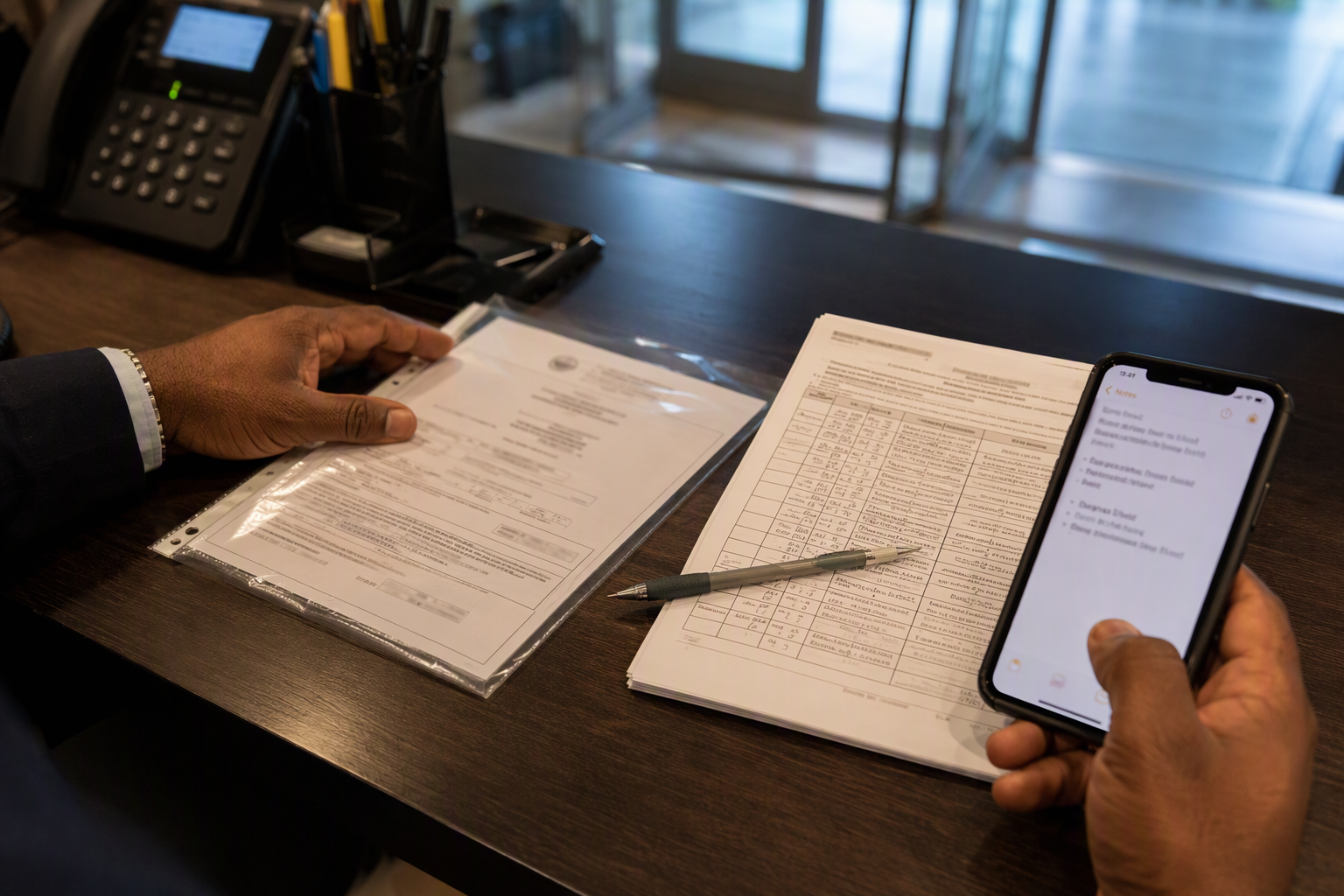
Before calling a service provider, gather the lift’s make, model, serial number, installation date, a description of the malfunction, and the building address — this allows the technician to arrive prepared and shortens the quoting process.
The make and model are typically printed on a nameplate affixed to the drive unit or the platform. The serial number is critical because it determines parts availability and the applicable code edition under which the lift was originally permitted. If the lift is in a commercial building, also locate the current certificate of inspection, which is required to be posted in or near the unit in Maryland, Pennsylvania, Virginia, and the District of Columbia. Note the certificate’s expiration date; an expired certificate may need to be resolved before the lift can legally return to service after repair.
Describe the symptoms as precisely as possible: Does the platform fail to move at all? Does it stop mid-travel? Is there an error code displayed on the control panel? Does a door or gate interlock fail to release? These details help the technician bring the correct diagnostic tools and likely replacement components on the first visit, avoiding a costly second trip charge.
What types of wheelchair lifts are typically serviced by elevator contractors?
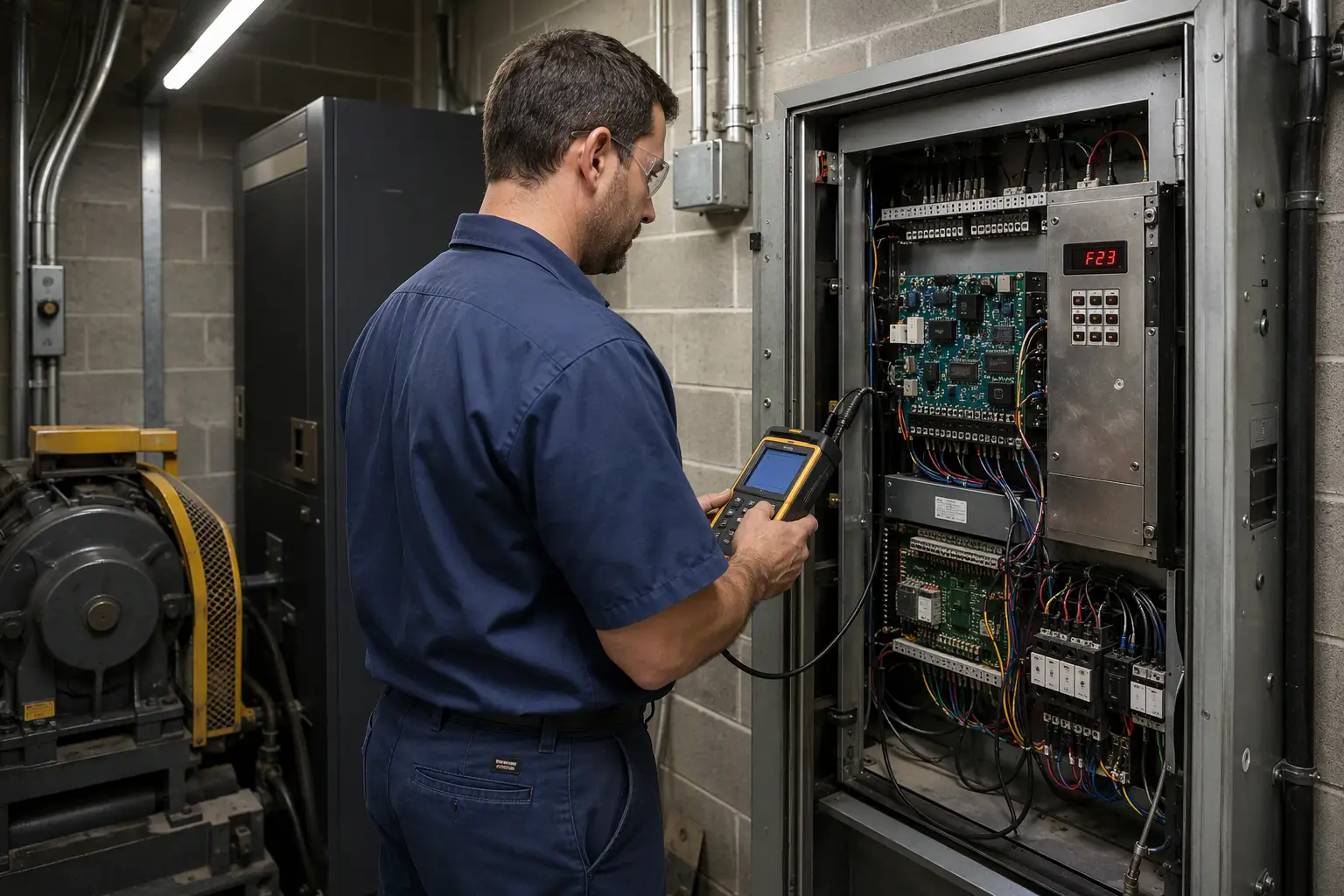
Elevator contractors licensed for vertical conveyances typically service inclined platform lifts, vertical platform lifts (VPLs), stair lifts with platform carriages, and limited-use/limited-application (LU/LA) elevators — each governed by specific sections of the applicable safety code.
Vertical platform lifts that travel more than 14 inches are regulated under ASME A17.1 Safety Code for Elevators and Escalators and must be permitted, inspected, and certified just like a conventional elevator in Maryland, Pennsylvania, Virginia, and the District of Columbia. Inclined platform lifts and stair lifts with a seated or platform carriage are addressed under ASME A18.1 Safety Standard for Platform Lifts and Stairway Chairlifts; Maryland’s elevator regulations under COMAR 09.12.81 specifically include chairlifts within the regulated equipment scope.
LU/LA elevators — enclosed cab units limited in travel speed and rise — are governed by ASME A17.1 and carry full inspection and certification requirements in all four jurisdictions. Knowing which category your equipment falls into is important because it determines which licensed contractor type is required to perform the work and which inspection authority must be notified after a repair.
How does an on-site assessment differ from a phone estimate for wheelchair lift service?
A phone estimate is a rough ballpark based on symptom descriptions, while an on-site assessment is a physical diagnosis that identifies the root cause and produces a firm, itemized written quote — the only type that should be used for budgeting or compliance planning.
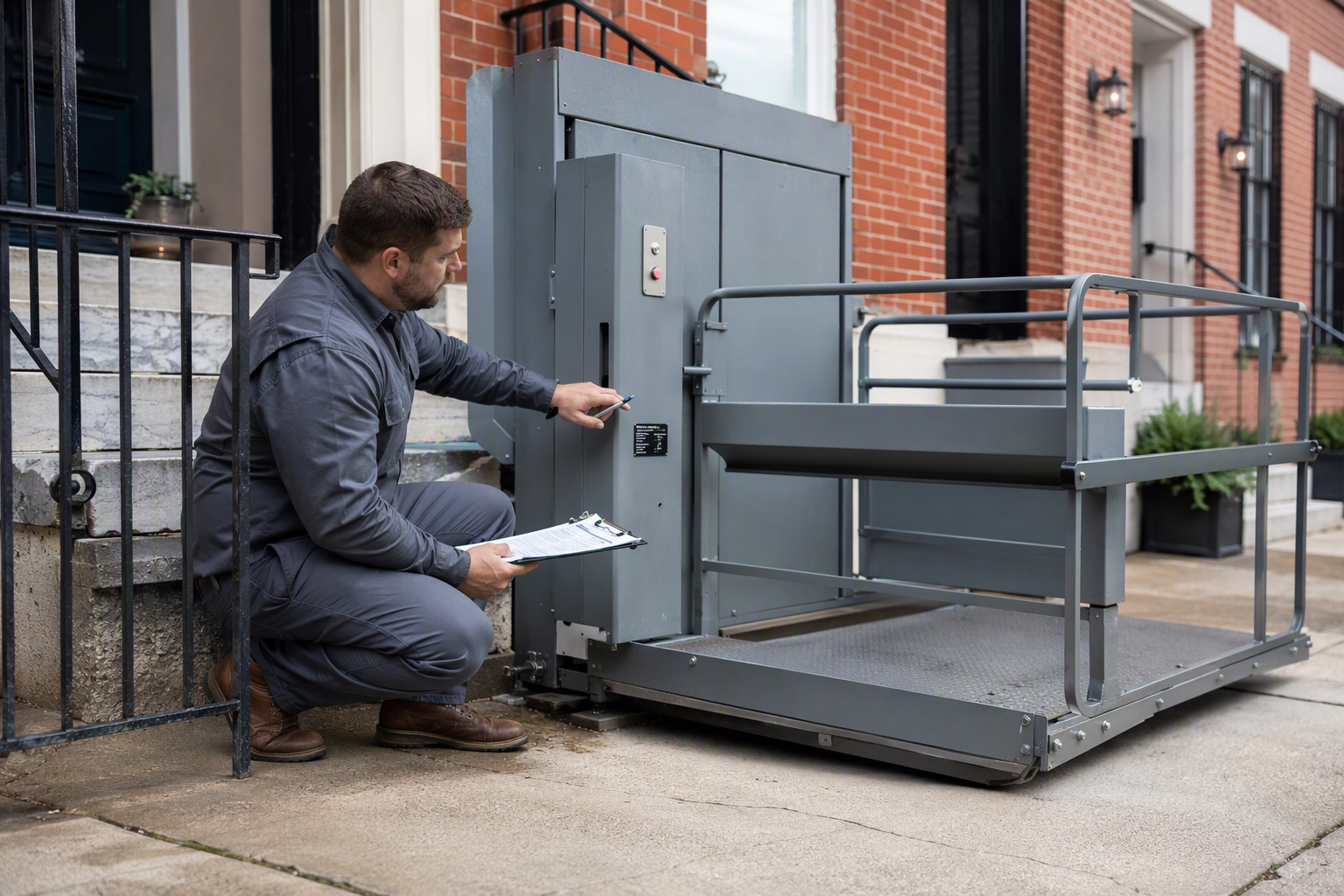
During an on-site assessment, a technician will cycle the lift through its full range of travel, test all safety devices (including the platform gate interlock, upper and lower limit switches, and the emergency lowering system), inspect the drive mechanism, check electrical connections and the control board for fault codes, and evaluate the structural condition of the platform, guide rails, and mounting hardware. The technician will also verify whether the existing installation meets current code requirements, because a repair that triggers a major alteration classification may require a new permit and acceptance inspection before the lift returns to service.
Quality Elevator Company performs on-site assessments in Baltimore, Washington DC, Philadelphia, and Richmond so that every written quote reflects actual field conditions rather than assumptions.
What factors influence the cost of wheelchair lift troubleshooting and repair?
Cost is driven by the type of fault (electrical vs. mechanical vs. structural), parts availability for the specific make and model, whether the repair triggers a code-required permit, and any compliance upgrades that must accompany the work under the applicable state or local regulations.
Common fault categories and their relative complexity are summarized in the table below. Note that these are qualitative descriptions, not published price benchmarks — actual costs vary by market, equipment age, and parts availability.
| Fault Category | Common Examples | Relative Complexity | Permit Typically Required? | Inspection After Repair? |
|---|---|---|---|---|
| Electrical / Control Board | Blown fuse, faulty control board, wiring fault | Low to Moderate | Generally no (maintenance level) | No, unless classified as alteration |
| Safety Device Failure | Gate interlock, limit switch, overspeed governor | Moderate | Depends on jurisdiction and scope | May be required |
| Drive Mechanism | Hydraulic pump, screw drive, chain or belt | Moderate to High | Often yes for major component replacement | Yes, for major replacement |
| Structural / Rail | Rail alignment, platform damage, mounting hardware | High | Yes | Yes — acceptance inspection required |
| Modernization / Code Upgrade | Controller replacement, new safety devices | High | Yes | Yes — full acceptance inspection |
Parts for older or discontinued models can significantly increase cost and lead time. A technician conducting the on-site assessment will identify whether proprietary parts must be sourced from the original manufacturer or whether compatible alternatives are available.
What are the ADA requirements that affect wheelchair lift service and repair decisions?
The Americans with Disabilities Act (ADA) requires that accessible routes in public accommodations and commercial facilities remain accessible, meaning a non-functional wheelchair lift serving as the only accessible path of travel creates an immediate ADA compliance obligation that must be addressed promptly.
Under ADA Title III, public accommodations must remove barriers to access when readily achievable and must maintain accessible features in operable condition. A wheelchair lift that is out of service for an extended period without an equivalent alternative accessible route may expose the building owner to a complaint or civil action. This compliance dimension often makes repair urgency a legal matter, not just a facilities management question.
When requesting a service quote, ask the contractor whether the proposed repair scope will restore the lift to full ADA-compliant operation, including platform dimensions, handrail configuration, and call control heights. If the lift predates current ADA Standards for Accessible Design (effective March 15, 2012), the repair may present an opportunity to bring those elements into conformance.
What are the inspection and certification requirements for wheelchair lifts in Maryland?
In Maryland, wheelchair lifts and chairlifts regulated under Maryland Department of Labor, Division of Labor and Industry, Elevator and Escalator Safety must have an annual periodic inspection, and any repair work must be performed by a contractor licensed by the Maryland Elevator Safety Review Board.
Under the Annotated Code of Maryland, Public Safety Article, Title 12, Subtitle 8, no elevator unit — including regulated platform lifts — may be operated without a certificate issued by the Commissioner of Labor and Industry. That certificate must be posted conspicuously in or on the unit. After a major repair, modification, or alteration, the State conducts a final acceptance inspection before the lift is returned to service. Tests required for inspection must be performed by a licensed elevator mechanic. Elevator contractors operating in Maryland must carry at least $1,000,000 in general liability insurance and at least $500,000 in property damage insurance under COMAR 09.12.81.
As of June 17, 2026, Maryland adopted the ASME A17.1/CSA B44, 2022 edition as the applicable safety code, with Maryland-specific changes. The edition that applies to any given lift depends on when its installation contract was signed. Maintenance, repair, test, and inspection records must be kept at a readily accessible central location in the building where the lift is located.
What are the inspection requirements for wheelchair lifts in the District of Columbia?
In the District of Columbia, regulated conveyances must be inspected by a DOB-approved third-party agency using an DC Department of Buildings (DOB)-sanctioned process, with a Category 1 inspection every 12 months and a Category 5 inspection every 60 months, each performed by an ASME QEI-certified inspector.
DC’s adopted code is ASME A17.1/CSA B44, 2013 edition, as referenced by the 2017 DC Building Code with District amendments, effective May 29, 2020. A DC certificate of inspection is valid for two years, and the current certificate must be conspicuously displayed in or on the conveyance. Elevator permits in DC require a copy of the master electrician license and the elevator contracting license. The DC Board of Industrial Trades, within the Department of Licensing and Consumer Protection (DLCP), licenses elevator contractors, mechanics, and inspectors. Applicants for a DC elevator inspector license must meet ASME QEI-1 or an equivalent standard. If a lift is placed under permit for alteration or modernization, its certificate may be temporarily suspended during that work.
What are the inspection requirements for wheelchair lifts in Pennsylvania?
In Pennsylvania, the Pennsylvania Department of Labor and Industry (L&I), Bureau of Occupational and Industrial Safety, Elevator Section has statewide jurisdiction, including Philadelphia, and requires periodic inspections at intervals no greater than six months for regulated lifting equipment.
Under 34 Pa. Code Chapter 405, no elevator or regulated lifting device may be operated without a certificate of operation issued by the Department. Until December 20, 2026, Pennsylvania elevator construction, repair, replacement, and alteration must comply with ASME A17.1-2000, including the A17.1a-2002 addenda. For permit applications made on or after December 20, 2026, ASME A17.1-2016 with Pennsylvania modifications will apply. After a major repair, replacement, or alteration, an elevator may not return to service until the Department inspects and passes it. Owners must also submit an accident report to the Department when an elevator incident causes a fatality or requires professional medical care.
What are the inspection requirements for wheelchair lifts in Virginia?
In Virginia, the local building department enforces the Virginia Uniform Statewide Building Code (13VAC5-63) and inspects elevators and platform lifts annually, with some localities requiring six-month inspections.
Virginia adopted ASME A17.1/CSA B44, 2019 edition, incorporated by the 2021 USBC, effective January 18, 2024. No one may work as an elevator mechanic in Virginia without state certification from the Virginia Board for Contractors (DPOR), unless working under the direct and immediate supervision of a certified mechanic. Installing, repairing, or removing lifts in Virginia requires a contractor license with the Elevator/Escalator Contracting (EEC) specialty. In Richmond specifically, the City of Richmond Department of Planning and Development Review, Bureau of Permits and Inspections, runs the local elevator program including final acceptance inspections of new or modernized equipment and annual elevator inspections with test. Periodic tests must be witnessed by the code official, and third-party inspection reports must include the name and certification number of the elevator mechanic who performed the witnessed tests.
What steps should I take immediately when a wheelchair lift stops working?
When a wheelchair lift fails, follow these steps in order to protect building occupants, preserve ADA compliance, and set up an efficient service call.
- Take the lift out of service immediately and post a clear “Out of Service” notice on both the upper and lower landings to prevent unauthorized use.
- Check whether any building occupant was on or near the lift at the time of failure and confirm no one is trapped or injured. If anyone requires assistance, call emergency services first.
- Do not attempt to reset or manually operate the lift unless you are a trained technician — improper reset attempts can damage control boards or override safety devices, increasing repair costs.
- Identify and document an alternative accessible route within the building. Notify affected users immediately to satisfy ADA maintenance obligations.
- Locate the lift’s nameplate information: make, model, serial number, and installation date.
- Locate the current certificate of inspection to confirm the unit’s certification status and expiration date.
- Contact a licensed elevator contractor to schedule an emergency or priority on-site assessment. Provide the nameplate details and a clear description of what occurred immediately before the failure.
- Document the malfunction with photos and notes, including any error codes displayed on the control panel, for the technician’s reference and for any required incident reports.
How long does a wheelchair lift service and repair typically take?
Repair timelines depend on fault complexity, parts availability, and whether a code-required permit and acceptance inspection are needed — straightforward electrical faults may be resolved in a single visit, while structural repairs or modernizations requiring permits and state inspections can take several weeks.
Parts availability is often the most significant variable. Older or discontinued models may require custom fabrication or sourcing from specialized parts suppliers. A contractor with established vendor relationships can often accelerate this timeline. When a major repair triggers a permit requirement in Maryland, Pennsylvania, or Virginia, the contractor must submit permit documentation to the relevant authority before beginning work, and the lift cannot return to service until the authority conducts an acceptance inspection. Building owners should account for these regulatory timelines when planning maintenance budgets and communicating with ADA-impacted users.
Does a wheelchair lift repair require a permit, and who is responsible for obtaining it?
Whether a permit is required depends on the scope of work: routine maintenance and minor adjustments generally do not require a permit, but replacement of major components — drive systems, control panels, safety devices, or structural elements — typically triggers a permit obligation in all four jurisdictions served by Quality Elevator Company.
In all cases, the licensed elevator contractor is responsible for determining permit applicability and filing the required permit application with the appropriate authority: the Maryland Department of Labor for Maryland work, DC Department of Buildings for DC work, Pennsylvania Department of Labor and Industry for Pennsylvania work (including Philadelphia), and the local building department for Virginia work. Building owners should confirm with their contractor at the quoting stage whether a permit will be required, what the estimated permit timeline is, and whether a post-repair acceptance inspection will be needed before the lift can return to service.
What is included in a comprehensive wheelchair lift service quote?
A thorough service quote should itemize the diagnostic findings, all parts to be replaced with part numbers, labor hours, permit fees if applicable, the estimated inspection coordination timeline, and any recommended code compliance upgrades identified during the assessment.
Transparency in the quote protects both the building owner and the contractor. A quote that bundles all costs into a single line makes it difficult to verify whether the scope is appropriate or to compare proposals from multiple vendors. Owners should ask for a breakdown that separates parts costs from labor, identifies which components carry a warranty, and specifies whether the quoted price is fixed or subject to adjustment if additional faults are discovered during disassembly. Quality Elevator Company provides itemized assessments in Baltimore, Washington DC, Philadelphia, and Richmond so building owners can make fully informed decisions.
How should I compare quotes from multiple wheelchair lift service contractors?
Compare quotes on scope accuracy, parts quality, contractor licensing, insurance coverage, and familiarity with local inspection authorities — not on price alone, because the lowest quote may exclude permit fees, required safety device replacements, or post-repair inspection coordination.
Verify that each bidding contractor holds the appropriate license for your jurisdiction: in Maryland, a license from the Maryland Elevator Safety Review Board; in DC, an elevator contracting license from the DC Board of Industrial Trades; in Virginia, an EEC specialty contractor license from the Virginia Board for Contractors (DPOR). In Pennsylvania, confirm the contractor is certified to work under the UCC elevator rules administered by the Department of Labor and Industry. Request proof of insurance: Maryland, for instance, mandates at least $1,000,000 in general liability and $500,000 in property damage coverage for elevator contractors. Contractors who do not disclose licensing or insurance credentials during the quoting process are a red flag in a regulated industry.
Can a wheelchair lift be repaired in place, or is replacement sometimes the better option?
Repair is cost-effective when the structural frame and drive system are sound and parts are available; replacement becomes the better option when the unit is obsolete, repair costs approach or exceed replacement cost, or the existing installation cannot economically be brought into compliance with current code requirements.
A licensed technician can help frame this decision during the on-site assessment. Key questions to ask include: Is this model still supported by the manufacturer for parts? Can the existing installation meet current ASME A17.1 Safety Code for Elevators and Escalators requirements after repair? Will a new installation permit trigger a full code-compliance review of the surrounding accessible route under ADA? A reputable contractor will present both repair and replacement options with honest cost and timeline projections for each.
What preventive maintenance practices reduce wheelchair lift repair frequency?
A documented preventive maintenance program that includes lubrication of moving components, safety device testing, drive system inspection, and control system checks at regular intervals significantly reduces the frequency of unplanned failures and extends equipment service life.
Maryland requires that maintenance, repair, test, and inspection records be kept at a readily accessible central location in the building. Virginia requires that periodic tests be witnessed by the local code official at intervals specified in ASME A17.1 Appendix N. Regardless of jurisdiction, maintaining a service log that records every technician visit, part replaced, and test result creates a documented history that supports faster diagnosis during future service calls and demonstrates due diligence to inspectors and ADA compliance reviewers.
A full-service maintenance contract with a licensed elevator contractor typically covers scheduled lubrication, safety device testing, code-required Category 1 and Category 5 testing coordination, and priority response for unplanned outages. Building owners should request a detailed scope of services when evaluating maintenance contracts to confirm what is and is not included.
How does the quoting process differ for a wheelchair lift in a historic or multi-tenant building?
Historic and multi-tenant buildings introduce additional variables — structural constraints, lease agreements governing access to mechanical spaces, and potential historic preservation requirements — that must be evaluated during the on-site assessment and reflected in the service quote.
In a multi-tenant property, the elevator contractor may need to coordinate access with multiple parties, which can affect scheduling and labor costs. Historic buildings in Baltimore, Washington DC, Philadelphia, and Richmond may have architectural restrictions that limit how structural modifications can be made to accommodate code-required equipment updates. The on-site assessment should specifically evaluate whether the proposed repair or replacement can be completed within the existing structural envelope or whether additional engineering review is needed. Quality Elevator Company technicians conducting assessments in these markets are familiar with the coordination requirements common in older urban building stock.
What should I ask a wheelchair lift service contractor before signing a service agreement?
Before signing any service agreement, a building owner should ask for proof of contractor licensing in the applicable jurisdiction, a written scope of work distinguishing maintenance from repair tasks, confirmation of whether permit fees are included, details on parts warranty coverage, and clarity on how code-required testing and inspection coordination is handled.
Additional questions that protect the owner’s interests include: What is the escalation process if additional faults are discovered during repair? How are emergency calls handled when the lift fails outside standard business hours? Does the agreement specify response priority for ADA-critical equipment? Is the contractor familiar with the specific inspection authority for this building — for example, the DC Department of Buildings, the Maryland Department of Labor, the Pennsylvania Department of Labor and Industry, or the local Virginia building department? Answers to these questions distinguish contractors with genuine regulatory fluency from those who may not fully understand the compliance obligations their work creates.
How do I verify that a wheelchair lift service contractor is properly licensed in my jurisdiction?
Licensing can be verified directly through the regulating authority for each jurisdiction: the Maryland Elevator Safety Review Board within the Maryland Department of Labor, the DC Board of Industrial Trades within the Department of Licensing and Consumer Protection, the Virginia Board for Contractors (DPOR) for Virginia EEC-licensed contractors, and the Pennsylvania Department of Labor and Industry for Pennsylvania-certified inspection agencies.
In Maryland, the statutory requirement is clear: a business must be licensed by the Board as an elevator contractor before engaging in installing, altering, maintaining, repairing, or servicing elevator units. In DC, elevator contracting licenses are required before performing permitted work, and permits require a copy of the elevator contracting license. In Virginia, the EEC specialty license must appear on any contract for elevator or escalator work. Building owners who skip this verification step risk engaging unlicensed contractors whose work may not pass acceptance inspection, voiding equipment warranties, and creating liability exposure if an incident occurs on a lift serviced without proper licensure.
Why should Quality Elevator Company be my first call for a wheelchair lift service quote?
Quality Elevator Company is a certified elevator service company operating in Baltimore MD, Washington DC, Philadelphia PA, and Richmond VA, with direct familiarity with the regulatory frameworks, inspection authorities, and licensed technician requirements in each market.
Wheelchair lift service involves regulatory obligations that vary significantly across jurisdictions — from Maryland’s licensed contractor and insurance requirements under COMAR 09.12.81, to DC’s DOB-approved third-party inspection process, to Pennsylvania’s Department of Labor and Industry acceptance inspection requirement, to Virginia’s local building department enforcement model. A contractor operating across all four of these markets understands how to coordinate permit applications, schedule code-required testing, and communicate with the appropriate inspection authority on the building owner’s behalf. That coordination competency is part of the service Quality Elevator Company delivers alongside the technical repair work itself.
Contact Quality Elevator Company for a free elevator assessment at 301-779-9116.
Need elevator service you can rely on? Quality Elevator Company is ready to help.